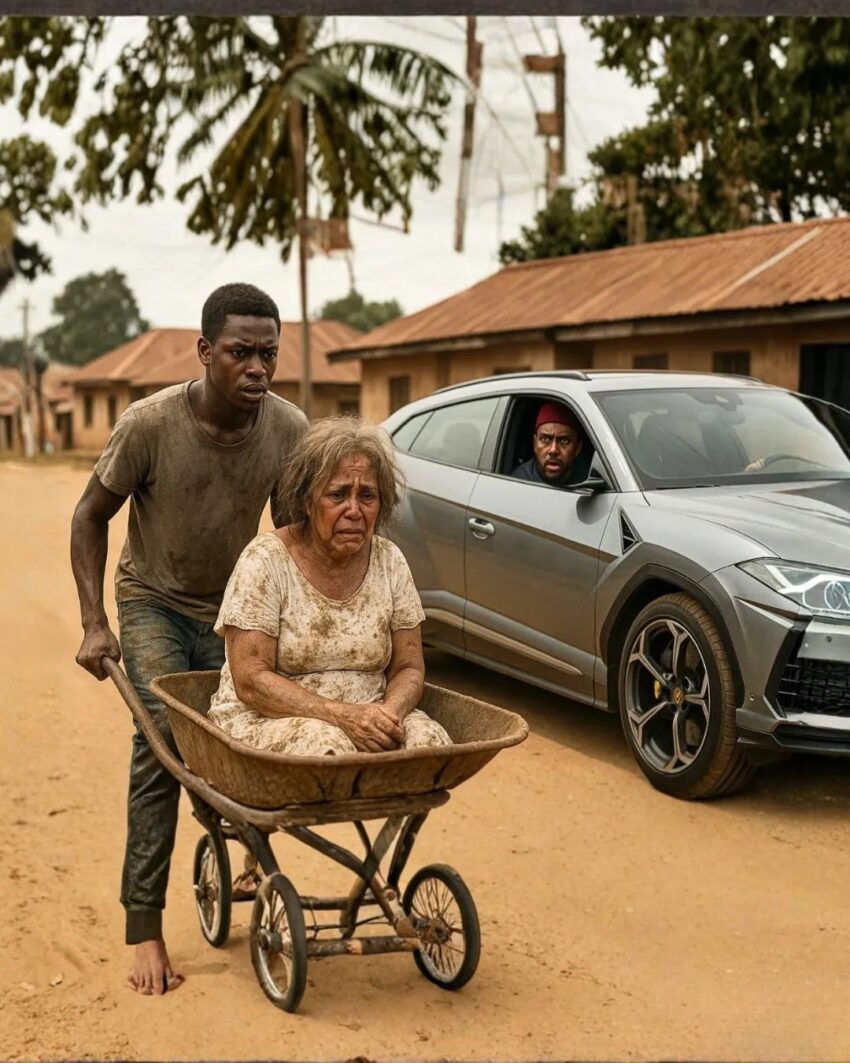
The billionaire had almost given up hope after two empty years that felt like a lifetime, days dissolving into nights, nights into regret, every unanswered phone call sharpening a quiet, permanent fear inside him.

His mother had vanished slowly, like a candle guttering in wind, her memory unraveling, her sense of direction dissolving, last seen wandering streets she once navigated proudly, now reduced to a maze of strangers.
He hired investigators with polished shoes and confident smiles, paid officers overtime, chased rumors whispered by shopkeepers and bus drivers, but every lead faded, leaving only silence and guilt.
The city kept moving, indifferent and loud, while his grief stayed still, anchored to a single image of her smile, half confused, half apologetic, the last time she forgot his name.
That afternoon, traffic crawled beneath gray skies, his chauffeur murmuring updates he barely heard, his mind somewhere else, until something outside the window pulled his attention sharply forward.
From the back seat, through tinted glass, he saw an old woman on a cracked curb, shoulders hunched, coat threadbare, posture achingly familiar, a posture burned into childhood memories.
His heart stuttered as recognition struck without logic, without certainty, just a son’s instinct screaming louder than reason, louder than fear, louder than the years of disappointment.
She was not alone, and that was the detail that froze him completely, because beside her knelt a boy, thin as a shadow, shoes torn, hair uncombed, movements careful and gentle.
The boy held a small plastic cup of soup, steam barely rising, lifting a spoon with reverence, as if feeding royalty rather than a woman forgotten by a city rushing past.
Slowly, Grandma, the boy murmured, his voice soft but steady, guiding the spoon with patience learned too early, reminding her to swallow, to breathe, to take her time.
The billionaire’s breath caught painfully, memories colliding with the present, as the woman blinked in confusion, then smiled at the boy, trusting him completely, unquestioningly.
The child wiped her hands with his sleeve, not caring about stains, then shrugged off his jacket, draping it around her shoulders, shielding her from cold like it was instinct.
This was not charity performed for attention, not kindness calculated for reward, but something raw and untrained, kindness born from loneliness recognizing itself in another human being.
Security noticed his sudden stillness, eyes tracking the scene, hands shifting nervously, ready to step out, to intervene, to separate danger from wealth as trained.

Wait, the billionaire whispered, the word cracking, barely audible, but enough to halt movement, enough to buy one more second of watching something fragile and sacred.
He opened the door himself, ignoring protocol, shoes touching pavement that felt unfamiliar, grounding, as if stepping out of his insulated life into a forgotten truth.
The boy looked up first, startled but not afraid, eyes sharp from survival, assessing quickly whether this stranger was threat or merely another passerby who would disappear.
The billionaire spoke gently, voice trembling despite decades of boardrooms and power, asking the simplest question he could find, a question heavy with meaning.
Why are you helping her, he asked, gesturing softly, afraid that a wrong tone might shatter the moment, afraid of the answer he might hear.
The boy blinked, confused by the question, as if kindness itself needed no explanation, as if asking why one breathed or slept or cried when hurt.
Because she gets scared when she’s hungry, the boy said simply, adjusting the jacket again, making sure it covered her thin arms properly.
And no one should be alone like that, he added, shrugging, eyes already returning to the woman, priority clear, world narrowed to her comfort.
The billionaire turned away, shoulders shaking, tears blurring a city he thought he understood, realizing no report or file could teach what this child embodied effortlessly.
In that moment, wealth felt weightless, powerless, stripped of meaning, while the boy’s empty pockets carried something priceless, something that had saved his mother when he failed.
He remembered every missed call, every postponed visit, every assumption that money could fix absence, and shame burned deeper than grief ever had.
The woman looked up at him then, eyes searching, recognition flickering like a match struggling against wind, her gaze resting on his face uncertainly.
She smiled politely, as she did with strangers now, thanking him without knowing why, her voice soft, distant, familiar and heartbreakingly foreign all at once.
He knelt beside her, ignoring the cold pavement, the watching crowd, the murmurs forming around them, and took her hand gently, afraid to frighten her.
It is me, Mom, he whispered, not demanding recognition, not forcing memory, simply offering presence, something he realized mattered far more than names.
She studied him, brow furrowing, then relaxed, squeezing his hand lightly, as if deciding he was safe, even if she could not place him.
That small gesture broke him open completely, tears falling freely now, unnoticed by a city suddenly watching something it rarely paused to see.
The boy observed quietly, spoon lowered, sensing importance without understanding fully, protective instinct still alive, ready to intervene if distress appeared.
Thank you, the billionaire said to the boy, voice hoarse, words inadequate, eyes searching the child’s face, seeing resilience carved by hardship.
The boy nodded once, not expecting praise, only asking if the woman would eat the rest of her soup, concern overriding curiosity.
They finished together, the billionaire holding the cup, the boy guiding the spoon, strangers bound by one fragile life needing care.
Phones emerged from pockets nearby, whispers spreading, a circle forming, people suddenly attentive, moved by a scene that felt almost unreal.
Security returned cautiously, softer now, expressions changed, witnessing something beyond their job description, something that rearranged their understanding of protection.
The billionaire stood slowly, helping his mother up, wrapping her securely, promising warmth, safety, a place to rest, though words meant little now.
He turned to the boy again, asking his name, learning it hesitantly, hearing a story of shelters, of nights counted by hunger and cold.
The boy spoke plainly, without bitterness, as if hardship were weather, something endured rather than resented, something that simply was.
The billionaire listened, really listened, for the first time in years without checking time, without calculating outcomes, absorbing every word like penance.
He made a decision then, quiet but absolute, not driven by cameras or guilt alone, but by a truth revealed on cracked concrete.
The boy was invited into the car, eyes widening at warmth and leather seats, hesitant, glancing back at the woman to ensure she was safe.
She patted his hand, smiling reassuringly, as if roles had reversed, as if she were comforting him now, the caregiver remembered briefly.
At the hospital, doctors moved quickly, surprised by her condition, stabilized by kindness more than medicine, nourished by consistent care at last.
The boy waited patiently, clutching a cup of juice, overwhelmed but composed, watching doors open and close like scenes in a dream.
The billionaire returned with news, gratitude overflowing, explaining she would be safe now, explaining nothing would take her back to the streets again.
The boy nodded, relief softening his sharp edges, though uncertainty lingered, a lifetime of impermanence making trust difficult.
What happens to him, a nurse asked quietly, glancing at the child who had done more than anyone else.
The billionaire answered without hesitation, without consulting lawyers or advisors, speaking from a place untouched by contracts or caution.
He comes with us, he said simply, surprising even himself with how right it felt.

Days later, the story spread, headlines softened by humanity, footage replayed, viewers stunned by a child’s compassion reshaping three lives.
But inside the quiet home that followed, cameras gone, something deeper unfolded, routines built slowly, trust layered day by day.
The boy received a room, new clothes, schooling, but most importantly, consistency, something no donation had ever provided him before.
The mother improved, anchored by familiar faces, guided by patient hands, her fear lessened by love steady enough to hold her confusion.
The billionaire changed too, canceling meetings, rediscovering meals together, learning that presence, not power, healed the deepest wounds.
Years later, when asked what saved his family, he never mentioned money or influence, only a hungry boy and a plastic spoon.