For twelve years, my father-in-law Bill had no pension, no savings I could see, and no one else willing to take responsibility.
My husband worked far away for long stretches, so it was mostly me, our son, and Bill inside the same small orbit of duty and love.
In the beginning, I told myself I was doing what family does, because that’s the story we’re raised on when we want to believe we’re decent people.
But decency gets tested in ordinary, grinding ways, like medication schedules, bathroom trips at 2 a.m., and the loneliness of being the only adult who shows
Neighbors watched everything the way neighbors always do in tight communities.
They judged my choices with casual cruelty, whispering, “She’s wasting her youth on someone who isn’t even her father.”
Their words didn’t change the work, but they changed the air around it.
I learned to smile politely while carrying groceries, and then cry quietly when my son was asleep, because bitterness is loud when you’re tired.
Bill, however, never treated me like hired help or a substitute.

He treated me like a person, and in a house where I often felt invisible, that mattered more than people realize.
He was the kind of old man who said “thank you” for water, for soup, for a clean shirt, for the simple dignity of being cared for.
And that gratitude made me more determined, because it’s easier to sacrifice for someone who doesn’t pretend you owe them.
Still, there were nights when my patience cracked.
Not because I didn’t love him, but because love doesn’t erase exhaustion, and nobody prepares you for the way caregiving can swallow your identity.
One night, after my son finally slept, I sat at the kitchen table and stared at the sink like it was an enemy.
Bill shuffled in, saw my face, and didn’t ask shallow questions like “Are you okay,” because he already knew.
He sat across from me, and his hands looked older than they should have, knuckles swollen, skin thin like paper.
I confessed what I had been hiding, that I was tired to my bones, that I felt like I was disappearing, that I didn’t know how much more I had.
Bill reached for my hand and held it gently, as if he was afraid to break me too.
He said, “That’s why I’m thankful,” and his voice shook, “Without you, I wouldn’t still be here.”
After that, I tried harder to stop resenting what the world called “wasted time.”
I started seeing the years as something else, not a loss, but a long, quiet proof of who I was when nobody clapped.
Bill never spoke about money, and I never asked, because it felt rude and pointless at the same time.
He had no pension, no property, no mysterious investments, just a small room, a worn recliner, and habits from a life that didn’t reward him.

My husband called when he could, tired and guilty, always promising things would change.
Promises are easy from far away, and I learned not to lean on them the way I leaned on my own routine.
As Bill’s health worsened, the house grew quieter.
The pauses between his breaths became longer, and I started counting them without meaning to, like my body was preparing for grief before my mind allowed it.
On his last morning, the sun came in soft through the curtains, and the light made his face look both peaceful and startlingly fragile.
He asked me to sit beside him, and his eyes held a seriousness that made my throat tighten before he even spoke.
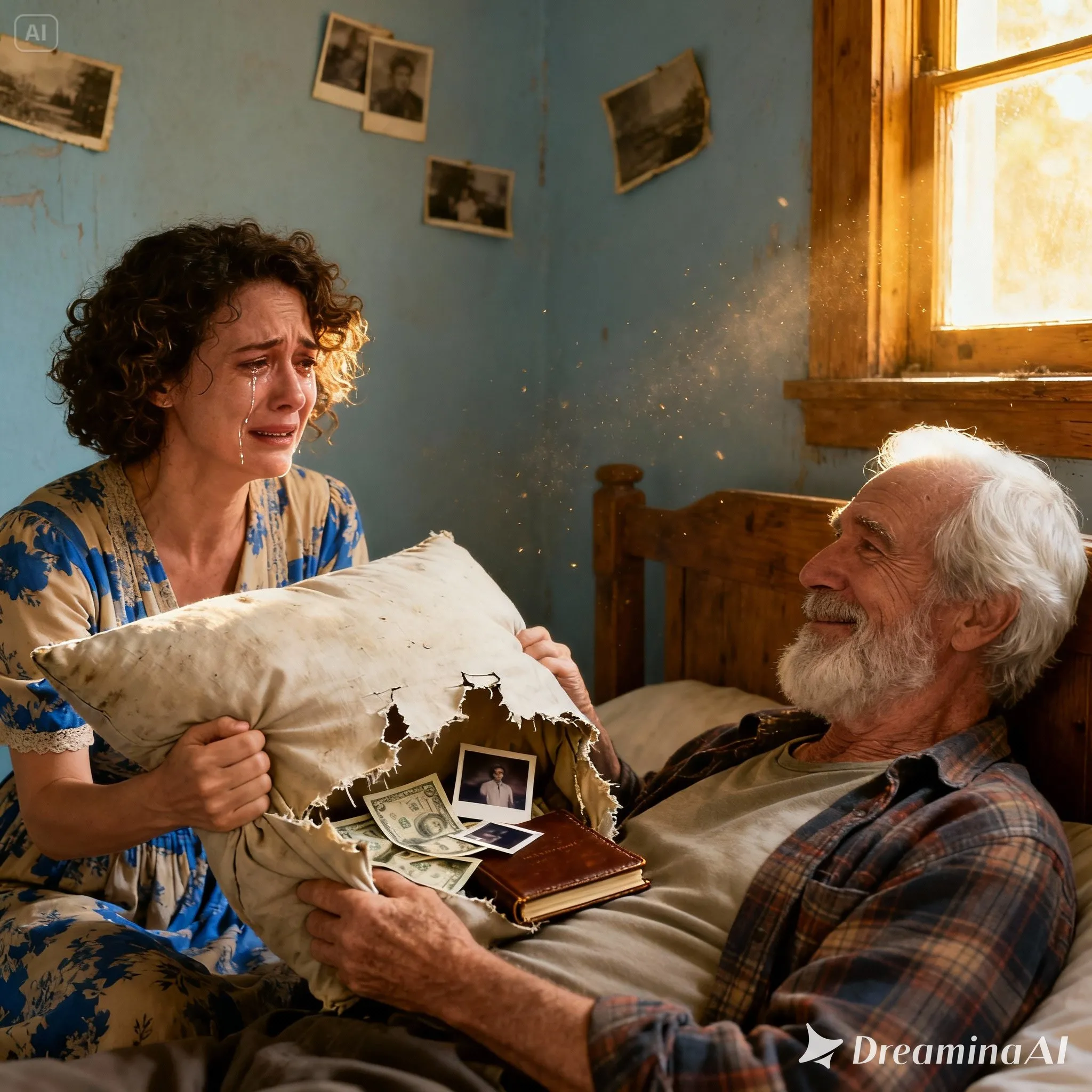
He motioned toward the bedside table and told me to bring him the pillow.
It was an old pillow, torn at the seam, one that should have been thrown out years ago, and I didn’t understand why it mattered now.
Bill’s hands trembled as he pulled it into his lap.
He looked at it like it was heavy, like it contained more than stuffing, like it contained his last chance to say something the right way.
Then he pressed it into my arms.
His voice was thin, barely there, and he said, “For… Althea,” speaking my name like a final promise he needed to complete.
I tried to tell him not to talk, to rest, to save his strength.
But he shook his head once, tiny and stubborn, and I realized he had been saving this moment, not his breath.
Moments later, he was gone.
No dramatic speech, no cinematic goodbye, just the sudden stillness that makes you understand how final silence can be.
I sat there holding the torn pillow and felt ridiculous for even noticing it.
Grief does that, it makes you cling to objects because your hands need something to hold when your heart can’t hold reality.
My son stood in the doorway, blinking, confused, and I forced myself to stand up and be the adult again.

I made calls, spoke to doctors, arranged what needed arranging, and moved through the day like a machine that had learned to function while breaking.
That night, after my son fell asleep, I returned to Bill’s room alone.
I sat on the edge of his bed and stared at the pillow in my lap until the silence became unbearable.
It wasn’t curiosity that made me open it.
It was the way he said my name, the way he pressed it to me with intent, like he was giving me something he’d protected from everyone else.
I found the torn seam and ran my fingers along it.
The stitching was crude, hand-done, and suddenly I understood the pillow hadn’t torn on accident, it had been opened before and resealed.
My hands started shaking as I pulled the fabric apart.
Inside, wrapped in plastic and tucked beneath the stuffing, was a bundle of envelopes, flattened and carefully stacked.
At first, I thought it was letters.
Then I saw the corners of bills, the faint shine of old certificates, and my mouth went dry like my body had forgotten how to breathe.
There was cash.
Not a fortune, not some absurd movie twist, but enough to make my knees weaken when I counted the bundles.
There were also receipts, each one folded neatly, labeled with small handwriting.