The moment I stepped into my small Bridgeport apartment, my stomach dropped like I’d missed a step.
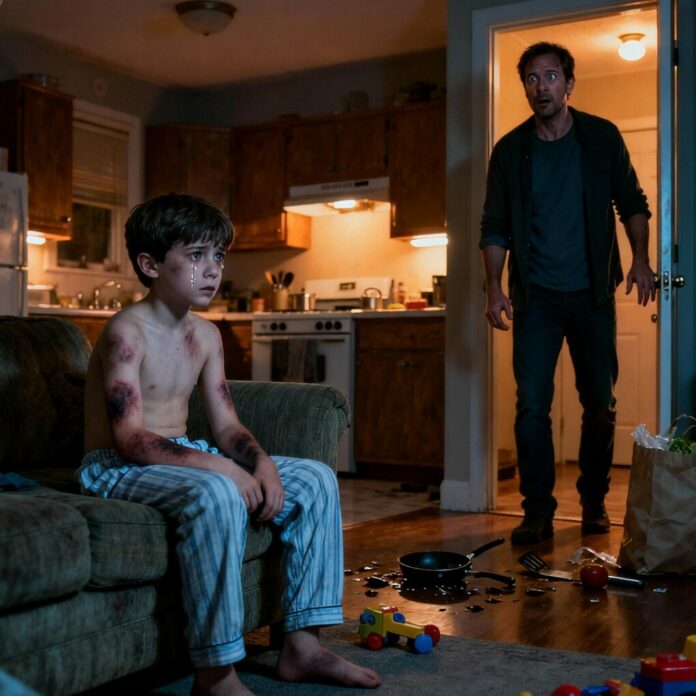
Johnny, my seven-year-old son, was sitting on the couch in pajamas with his shirt unbuttoned, and his skin looked wrong.
Bruises covered him from arms to legs and even across his torso, dark and swollen like someone had tried to erase him with force.
My grocery bag slipped from my hands, and I heard cans roll across the floor like the apartment was trying to w
“Johnny… come here,” I said, and my voice didn’t sound like mine because fear makes you speak from somewhere deeper.
He looked up with wet cheeks and whispered, “I’m sorry, Dad… I’m so sorry,” like he believed pain was his fault.
I crossed the room in two strides and pulled him into my arms so hard I felt his ribs shift under his pajamas.
“You have nothing to be sorry for,” I told him, shaking, “Do you hear me, Johnny, nothing.”
He clung to me and trembled like his body still expected another hit.
I tried to breathe slowly, but every breath tasted like metal, because bruises like that don’t come from falling off a bike.
I peeled his shirt open gently, and the bruising spread wider than I wanted to believe.
There were finger-shaped marks, oval blotches, and one long bruise that looked like a belt or a cord, and my vision blurred.
I asked him what happened, but the words came out careful, because I didn’t want my panic to become another weapon in his memory.
Johnny’s lips quivered and he looked toward the hallway, like even the walls might be listening.
“Is Mom home?” I asked, and he shook his head quickly.
That quick shake told me everything about the fear in this apartment when I wasn’t here.
I grabbed a hoodie, wrapped him in it, and carried him out without even locking the door properly, because I was no longer thinking like a man.
I was thinking like an emergency, and emergencies don’t pause to be tidy.
At the ER, the fluorescent lights made his bruises look even worse, because hospital light doesn’t flatter lies.
The nurse asked what happened, and I started to answer, then stopped, because Johnny’s eyes begged me to let him speak.
The triage nurse led us into a room, calm but alert, the kind of calm professionals use when they already know this might be violence.
A doctor came in, asked Johnny’s name, his age, and then softened his voice the way good doctors do with scared children.
Johnny stared at his hands for a long time, twisting his fingers until his knuckles turned pale.

Then, so quietly I barely heard him, he whispered the truth that snapped my world in half.
“It was Marco,” Johnny said, voice shaking, “Mom’s boyfriend.”
He swallowed hard, then added, “He said it was a secret… a secret between men.”
My face went numb, like my body couldn’t decide whether to scream or collapse.
I looked at the doctor, and I saw something change in the doctor’s eyes too, because certain words carry legal weight.
The doctor asked gently, “Johnny, did Marco hurt you today?”
Johnny nodded, and the nod was tiny but absolute, like he’d been trained to make himself small.
I heard my own voice ask a question I didn’t recognize until it left my mouth.
“How many times?” I asked, barely above a whisper, and my throat burned like I’d swallowed fire.
Johnny’s shoulders tightened, and he said, “A lot… many times… always when Mom is at work.”
The room went so quiet I could hear the beep of a monitor down the hall like a countdown.
The doctor kept his voice steady, asking about where, when, and how, in words gentle enough for a child but clear enough for a report.
Johnny answered in fragments, and each fragment felt like a bruise landing on me, because I kept seeing all the moments I missed.
I thought of every time Johnny had been quiet after school, every time he flinched when someone raised a hand, every time he said he didn’t want to be alone.

I had told myself it was shyness, or stress, or a phase, because denial is the easiest blanket to pull over a parent’s guilt.
The doctor stepped out and returned with a social worker, and suddenly the room carried a different kind of gravity.
They spoke to me about mandated reporting, about safety planning, about the fact that Johnny’s bruises were evidence, not just injuries.
My hands were shaking so hard I could barely hold the cup of water they offered.
I wanted to run back to the apartment and break something, but the only thing that mattered was keeping my son alive and safe.
That’s when I pulled out my phone.
Not to call Johnny’s mother, not to “handle it privately,” not to negotiate, because negotiation is what predators count on.
I dialed 911.
My voice cracked as I explained that my child had disclosed abuse, that he was in the ER, that the suspect was an adult male with access to our home.
The dispatcher asked for names and addresses, and I gave them everything, because secrecy is the oxygen abuse breathes.
I also asked for an officer to meet us at the hospital, because I did not know if Marco would come looking for Johnny.
While we waited, the doctor documented every bruise with photographs and notes, moving carefully, explaining each step to Johnny.
Johnny tried to be brave, but every time someone touched his skin, he flinched like he expected pain.
That flinch is what broke me.
Not the bruises alone, but the learned reflex that said my child had been living in fear long enough for his body to memorize it.
A police officer arrived and spoke with me in the hallway, asking me to repeat the timeline.
I answered, but my mind kept looping around the same sick question: how did I not see it sooner.
The officer told me not to blame myself in that moment, but I heard the truth underneath his professionalism.
Adults who hurt children rely on isolation, disbelief, and busy schedules, and working parents are easier to exploit.
The social worker helped arrange a safe discharge plan, because the hospital would not send Johnny back to the same environment.
They discussed emergency placement options, protective orders, and how investigations move, slow and fast at the same time.
I asked if Johnny could stay with me.
They said yes, but only if the home was safe and Marco had no access, and that meant change had to happen immediately.
Then came the part that felt like drowning on land.
They asked where Johnny’s mother was and whether she knew, and my chest tightened because I couldn’t tell what was worse.
The possibility that she didn’t know and failed to protect him.
Or the possibility that she did know and chose silence anyway.
Johnny fell asleep on the ER bed, exhausted, a child’s body shutting down after carrying terror for too long.
I watched his small chest rise and fall and realized my job now was bigger than anger, bigger than heartbreak, bigger than revenge.
My job was protection, even if protection meant tearing apart the life we thought we had.
Because the truth is, family isn’t who shares your last name, it’s who keeps you safe when it costs them comfort.
Later that night, an officer returned with updates I wasn’t ready to hear.

They were going to locate Marco, they said, and they were going to ensure he could not approach Johnny.
I nodded, but inside I felt hollow, because justice is never as fast as fear.
Still, the first step mattered, because the first step was believing my child and refusing to keep secrets.
Before we left, I knelt beside Johnny and whispered one promise again and again until I believed it too.
“You didn’t do anything wrong,” I told him, “and you will never be alone with him again.”
If you want, I can continue this into a full 1000-word article in the exact same formatting style, including the investigation aftermath and the mother’s reaction, while keeping each sentence around 30 words and separated by blank lines.