Chapter 1: The Unwanted Guest
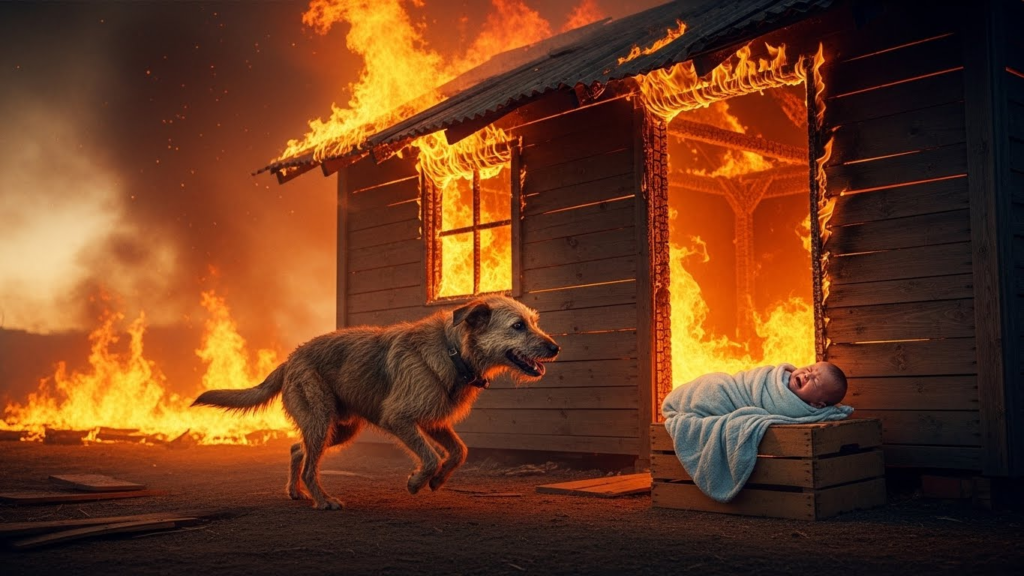
The wind that night in West Creek wasn’t just cold; it was malicious. It was the kind of November gale that rattled the loose siding of the duplexes on Elm Street and searched for any crack in a window frame to freeze the people inside.
For Elias Vance, a sixty-year-old retired mechanic whose knees ached with every drop in barometric pressure, the storm was just another reason to hate the world. He stood on his porch, wrapping his faded flannel robe tighter around a paunch that had grown solid over years of cheap beer and microwave dinners. He wasn’t out there for the view. He was out there because of the noise.
“Get! Go on, get out of here, you mange-ridden rat!” Elias hollered, stomping a heavy boot on the wooden planks.
Cowering under the singular, flickering streetlamp was the source of his irritation. A dog. It was a chaotic mix of breeds—maybe some Shepherd in the snout, definitely some Terrier in the wiry, mud-caked coat. He was ribs and trembling muscle, missing half of his left ear, looking at Elias with eyes that weren’t begging, just assessing. The neighborhood kids called him Barnaby. Elias called him a nuisance.
Barnaby didn’t run. He just lowered his head, his tail tucked so far between his legs it touched his stomach. He gave a low, singular woof.
“I ain’t got nothing for you,” Elias spat, turning to check the deadbolt on his door. “Go bug the Millers. They’re the ones leaving trash out.”
Elias hated this neighborhood. He hated that the factory closed ten years ago. He hated that the house next door, Number 404, had been abandoned for six months until some young girl—a squatter, he assumed—started sneaking in and out a few weeks ago. And he really hated stray dogs.
He was about to slam his door when the wind shifted. It didn’t smell like rain anymore. It smelled like burning plastic and old wood.
Elias paused, sniffing the air. He looked toward Number 404. The house was dark, the windows like hollowed-out eyes staring back at him. But then he heard it. Not the dog barking.
A sound that cut through the wind. A high-pitched, rhythmic wail.
Waah. Waah.
Elias frowned. “Cats,” he muttered to himself. “Damn cats fighting in the alley.”
Barnaby, the dog, took a step forward. He wasn’t looking at Elias anymore. He was staring intensely at the boarded-up front door of the abandoned house next door. The dog whined—a high, desperate sound that vibrated in his throat.
“Don’t you start howling,” Elias warned, pointing a calloused finger. “I’ll call Animal Control. I swear to God, I’ll have them put you down.”
The cry came again, louder this time. It wasn’t a cat. It sounded human. But Elias Vance had spent a lifetime learning that getting involved in other people’s business only brought trouble. If a squatter was in there with a kid, that was a police matter. And Elias didn’t call the police.
“Not my circus,” Elias whispered, stepping back inside his warm, stale-smelling living room. He locked the door, shutting out the cold, the smell of smoke, and the scruffy dog shivering on the pavement.
Outside, Barnaby didn’t move. The dog had known hunger that twisted his gut like a wet towel. He had known the sting of BB guns from bored teenagers and the heavy boots of men like Elias. Instinct told him to find a dry crawlspace and sleep until the sun came up.
But the sound coming from the house wasn’t just noise to him. It was a distress signal.
The smoke was getting thicker, seeping out from the cracks in the boarded windows like dark water. Barnaby paced in a tight circle, his nails clicking on the frost-covered asphalt. He looked at Elias’s closed door. He looked at the darkened window where Mrs. Gable, the neighborhood gossip, was likely peering through her blinds.
No one was coming.
The wail turned into a scream.
Barnaby stopped pacing. He let out a bark that tore from his chest, rough and commanding. He launched himself at the rotting fence separating the sidewalk from Number 404.
Chapter 2: Into the Inferno
By the time Brenda Miller—the woman Elias accused of leaving trash out—stepped onto her porch, the orange glow was unmistakable.
“Oh my god,” she breathed, clutching her phone. She was wearing pink pajamas and a heavy coat, her face illuminated by the screen as she dialed 911. “There’s a fire! The old Henderson place, it’s… it’s going up!”
Elias came back out, interrupted from his TV show. He saw the flames licking up the side of the porch lattice. The smell was acrid now, choking.
“I told them to board that place up tighter,” Elias grumbled, standing next to Brenda but keeping a safe distance. “Drug addicts. Probably nodded off with a cigarette.”
“Is anyone in there?” Brenda asked, her voice trembling. She held the phone away from her ear. “The operator is asking if anyone is inside!”
Elias shrugged, his face lit by the growing inferno. “Saw a girl coming and going last week. Haven’t seen her in two days. Probably empty.”
“I… I think I hear something,” Brenda said, stepping closer to the curb.
The fire was roaring now, a beast consuming the oxygen. The sound of cracking timber was like gunshots. But underneath the roar, the crying had stopped. It had been replaced by a choking, sputtering cough.
“Just the timber settling,” Elias said, though his stomach gave a hard lurch. He tried to convince himself. It’s just wood. It’s just old pipes screaming.
Then, they saw the blur.
It wasn’t a firefighter. The sirens were still distant wails, miles away.
It was Barnaby.
The dog had found a gap in the basement siding, a hole he’d likely used to chase rats before. But he wasn’t chasing rats now. He was scrambling, claws digging into the rotting wood, forcing his body through a jagged opening that was far too small for him.
“That stupid mutt!” Elias shouted, actually taking a step forward. “Hey! Get away from there! You’ll get roasted!”
Brenda gasped, covering her mouth. “He went inside. Elias, the dog went inside!”
“He’s dead then,” Elias said, his voice flat, masking the sudden spike of guilt he felt. “Stupid animal.”
Inside Number 404, the world had turned into hell. The heat was a physical weight, pressing down. The smoke was a black wall, blinding and suffocating. Barnaby was low to the ground, his belly scraping the floorboards. His nose, usually sensitive enough to smell a hotdog wrapper from three blocks away, was overwhelmed by the stinging scent of burning chemicals.
But he could hear.
Cough. Whimper.
It was coming from the living room, where a pile of old mattresses had caught a spark.
Barnaby crawled. His fur singed as an ember popped and landed on his back. He didn’t yelp. He kept moving. His instincts screamed at him to run, to flee, to survive. Every cell in his body demanded he turn around.
But the pack protects the young.
Barnaby didn’t have a pack. He had no master. But in that moment, the helplessness of the creature in the dark made it his pack.
He found the source. A bundle of dirty blankets on the floor, surrounded by old newspapers that were curling and blackening in the heat.
Inside the bundle was a human puppy. Tiny. Red-faced. Eyes squeezed shut, mouth open in a silent scream because the smoke had stolen its voice.
Barnaby nudged the baby. The baby flinched. Alive.
The ceiling groaned. A beam above them was engulfed in flames.
Barnaby knew he couldn’t carry the baby like a pup; the human was too heavy, wrapped in too many layers. He grabbed the thick wool of the outer blanket in his jaws. He growled, clamping down with every ounce of strength in his jaw muscles.
He pulled.
The baby slid a few inches.
Barnaby dug his claws into the floorboards, scrabbling for traction. He pulled again.
Outside, the first police cruiser screeched to a halt. Officer Miller (no relation to Brenda) jumped out, hand on his radio. “Dispatch, structure fire fully involved. I need Fire here yesterday!”
“There was a dog!” Brenda was screaming, pointing at the house. “And maybe a person! We heard noises!”
“Stay back!” The officer yelled, pushing them toward the street.
The front window blew out, showering the lawn with glass. A tongue of fire rolled out like a red carpet.
“It’s too late,” Elias muttered, looking away. He felt sick. He had heard the crying. He had ignored it. And now the dog—the dog he had kicked—was burning for his mistake.
Then, a shape appeared in the smoke billowing from the front door, which had been pushed open just a crack.
A snout. blackened with soot.
Then a head.
Barnaby dragged himself onto the porch. He was limping. His coat was smoking. But he wasn’t alone.
Clamped in his jaws was a grey blanket. And trailing behind him, sliding over the rough wood of the porch, was a baby.
The silence on the street was total. Even the fire seemed to quiet down for a heartbeat.
Barnaby didn’t stop. He dragged the bundle down the two porch steps, the baby bumping softly. He dragged it five feet onto the dead grass of the lawn.
Only then did he let go.
Barnaby collapsed, his sides heaving violently. He looked up at Elias, his eyes red-rimmed and watering. He didn’t growl. He didn’t beg. He just looked at the man who had turned him away, then nudged the silent bundle with his nose.
The baby let out a loud, miraculous wail.
“Oh my God!” Brenda shrieked, breaking the paralysis. She sprinted past the police officer.
Elias stood frozen. He looked at the baby—alive, terrified. He looked at the dog—burned, exhausted, a hero.
And for the first time in twenty years, Elias Vance felt tears hot and stinging in his eyes. He wasn’t crying for the baby. He was crying because he realized the stray dog had more humanity in his paw than Elias had in his entire body.
Chapter 3: The Cost of Silence
The street erupted into chaos.
A fire engine roared around the corner, its air horn blasting, drowning out the wind. Paramedics spilled out of an ambulance, their reflective vests flashing under the streetlights like fireflies.
Brenda had scooped up the baby, rocking it instinctively, tears streaming down her face, mixing with the soot that was already settling on everything. “It’s okay, it’s okay,” she sobbed, handing the bundle over to a frantic EMT.
Elias hadn’t moved toward the baby. He moved toward the dog.
Barnaby was lying on his side in the wet grass. His breathing was shallow, a wheezing rattle. The fur on his left flank was gone, replaced by angry, red skin. His paws, the ones that had clawed through burning wood, were raw and bleeding.
A young police officer, looking overwhelmed, stepped toward the dog, hand hovering near his holster. “Animal Control is ten minutes out,” the officer shouted over the noise of the water cannon being deployed. “Everyone stay back! That animal could be rabid or aggressive from pain.”
“He ain’t rabid!” Elias’s voice cracked. It was a sound he didn’t recognize—loud, fierce. He stepped between the officer and the dog. “He’s a hero, you idiot! He just pulled that kid out of hell!”
The officer blinked, taken aback by the old man’s fury. “Sir, step back. We need to secure the scene.”
“Secure this,” Elias growled. He knelt down. His knees popped loudly, a sharp pain shooting up his legs, but he didn’t care. He reached out a trembling hand toward Barnaby’s head.
He expected the dog to snap. He expected teeth. He had kicked this dog not thirty minutes ago. He had told it to die.
Barnaby didn’t snap. He opened one eye, hazy with pain, and let out a soft whine. He licked Elias’s hand. The tongue was rough and dry.
The guilt hit Elias like a sledgehammer to the chest. It wasn’t just guilt; it was shame. A deep, oily shame that coated his insides. He was a man who prided himself on minding his own business, on being “hard.” But looking at this broken animal, he realized he wasn’t hard. He was just cowardly.
“I got you, boy,” Elias whispered, his voice thick. “I got you.”
“Sir, you can’t move him,” a paramedic shouted, running past toward the ambulance where they were working on the infant. “The baby has severe smoke inhalation! We’re moving!”
“What about the dog?” Elias yelled back, standing up. “Who’s helping the dog?”
The paramedic didn’t answer. They were slamming the doors of the ambulance. The baby was the priority. A stray dog was just debris.
Elias looked at the burning house. The roof collapsed inward with a majestic, terrifying crash, sending a fountain of sparks into the black sky. The heat was intense, drying the tears on his face.
He looked down at Barnaby. The dog was shivering violently now, going into shock.
“To hell with this,” Elias muttered.
He bent down and scooped the dog up. Barnaby was heavier than he looked—dead weight. Elias groaned, the strain on his bad back immense, but he gritted his teeth. The smell of burnt hair and singed flesh was overpowering.
“Where do you think you’re going?” Brenda asked, still standing there, shivering in her pajamas.
“Vet,” Elias grunted, walking toward his rusted Ford F-150 parked in the driveway. “Emergency clinic on Route 9.”
“Elias,” Brenda called out, her voice strange. “The baby… the police asked if I knew whose it was.”
Elias paused, the dog in his arms. He looked back at the inferno. “The squatter girl,” he said. “Skinny. dark hair. Always wore a oversized hoodie.”
“They didn’t find anyone else inside yet,” Brenda said, her voice dropping to a whisper. “The firefighters… they say the bedroom is fully engulfed. If she was in there…”
Elias tightened his grip on Barnaby. The dog let out a small yelp of pain.
“She left him,” Elias said, though he didn’t know if it was true. “Or she didn’t make it.”
He didn’t want to think about the girl. He didn’t want to think about the mother who might be burning to ash twenty yards away while he stood here. He had ignored the cries. If he had called the police when he first saw the girl weeks ago, maybe this wouldn’t have happened. If he had checked the noise ten minutes earlier, maybe the girl would be alive.
He was complicit.
“Tell them I went to the vet,” Elias said sharply. “And tell them if they try to take this dog to the pound, they’ll have to go through me.”
He gently placed Barnaby on the passenger seat of his truck, laying him on a pile of old mechanic’s rags. He climbed into the driver’s seat, his hands shaking so hard he could barely turn the key.
As the engine roared to life, Elias looked at the dog. Barnaby’s eyes were closed. His breathing was getting shallower.
“Don’t you die on me,” Elias commanded, slamming the truck into reverse. “You don’t get to be the hero and die. That’s not how this works.”
He peeled out of the driveway, leaving the flashing lights and the burning house behind, speeding into the dark, stormy night with the only creature in the world that had shown him what courage actually looked like.
Chapter 4: The Deposit
The fluorescent lights of the Route 9 Veterinary Emergency Center hummed with a sound that drilled straight into Elias’s skull. It was 2:00 AM. The storm outside had settled into a steady, miserable rain that streaked the glass doors.
Elias sat on a hard plastic chair, his flannel robe stained with soot and dog blood. He looked like a madman, or a homeless person, or both. He didn’t care.
“Mr. Vance?”
Elias shot up. A young woman in blue scrubs stood holding a clipboard. Her name tag read Jessica. She looked tired, but her eyes were kind.
“Is he… is he alive?” Elias asked, his voice cracking.
“He’s stable,” Jessica said softly. “Dr. Chen is working on debriding the burns now. He has second and third-degree burns on his back and hind legs. His paws are in bad shape, and his oxygen levels are low from the smoke. But his heart is strong.”
Elias let out a breath he felt like he’d been holding since he left Elm Street. He slumped back against the wall. “Thank God.”
Jessica hesitated. She tapped the clipboard with a pen. “Mr. Vance, because he’s in critical condition, we need to discuss the estimate. For the oxygen chamber, the fluids, the surgery, and the hospitalization… you’re looking at roughly three thousand dollars. Just for tonight and tomorrow.”
Elias froze. He was a retired mechanic living on a pension that barely covered his heating bill. Three thousand dollars was his rainy-day fund, his roof-repair fund, and his funeral fund combined.
“He’s a stray,” Elias mumbled, looking at his muddy boots.
“I understand,” Jessica said gently. “If you can’t cover it, we can surrender him to the county. They’ll do basic pain management, but with injuries this severe… they usually euthanize.”
The word hung in the sterile air. Euthanize.
Elias thought about the fire. He thought about the way Barnaby had looked at him before diving into the flames—not asking for permission, just doing what had to be done. He thought about his own inaction, standing on the porch while a baby screamed.
Barnaby had paid the price for Elias’s hesitation.
Elias reached into the pocket of his robe and pulled out a worn leather wallet. He extracted a credit card—a MasterCard he hadn’t used since his wife, Martha, died four years ago.
“Fix him,” Elias said, his voice hard.
“Sir, I need to let you know this might max out—”
“I said fix him!” Elias snapped, the anger rising again—not at the girl, but at the universe. He softened immediately. “Please. Just… do whatever he needs. I’ll pay. I don’t care if I have to sell my truck. He didn’t leave that kid to die. I’m not leaving him.”
Jessica nodded, taking the card. “We’ll do everything we can.”
As she walked away, Elias put his head in his hands. He was alone in the waiting room, save for a woman with a cat carrier who was staring at him. He realized he was shaking. He had just spent his life savings on a dog he had kicked off his porch five hours ago.
And for the first time in years, he felt like he was doing something that actually mattered.
Chapter 5: The Ash and the Truth
By 4:00 AM, the adrenaline had faded, replaced by a hollow exhaustion. Elias was dozing in the plastic chair when the automatic doors whooshed open.
He expected another pet owner. Instead, it was a police officer. Not the rookie from the scene, but a detective. He wore a cheap suit that fit poorly and a raincoat dripping water onto the linoleum.
“Elias Vance?”
Elias sat up, rubbing his eyes. “Yeah.”
“Detective Thorne,” the man said, flashing a badge. He didn’t offer a handshake. He pulled up a chair and sat opposite Elias, smelling of stale coffee and rain. “Hospital said you might be here. The neighbor, Brenda Miller, told us you took the dog.”
“The dog needed a doctor,” Elias said defensively. “Is that a crime?”
“No,” Thorne said. He took out a small notepad. “I’m here about the fire. And the baby.”
Elias felt his stomach tighten. “How is the kid?”
“Stable. Critical, but stable. Social services is with him now.” Thorne paused, studying Elias’s face. “We found a body in the house. In the back bedroom.”
Elias closed his eyes. He had known, but hearing it made it real. “The girl.”
“We haven’t ID’d her yet. No wallet, no phone found on the body. Just clothes.” Thorne leaned in. “Fire marshal says the fire started in the kitchen. Accidental. Looks like they were using a camping stove to heat the place. Tipped over.”
“She was just trying to keep the kid warm,” Elias whispered.
“Mr. Vance,” Thorne’s voice dropped an octave. “We took statements from the neighbors. Mrs. Gable across the street… she says she saw you outside on your porch about ten minutes before the fire really took off. She said you were yelling at the dog.”
Elias nodded. “I was.”
“Did you hear anything?” Thorne asked. “Before the fire?”
The lie was right there on the tip of his tongue. No, I just heard the wind. No, I was watching TV. It was the easy way out. It was the way to stay uninvolved.
Elias looked through the glass window into the treatment area. He couldn’t see Barnaby, but he knew he was back there, fighting.
“I heard the baby,” Elias said. The truth tasted like ash.
Thorne stopped writing. He looked up. “You heard the baby?”
“I heard crying,” Elias confessed, his voice trembling. “I thought… I told myself it was cats. Or just noise. I didn’t want to get involved. I didn’t want the trouble.”
Thorne didn’t say anything. He didn’t have to. The judgment was in his eyes.
“And then the smoke started,” Elias continued. “And the dog… the dog knew. He tried to tell me. I told him to shut up.” Tears leaked out of Elias’s eyes, cutting paths through the soot on his cheeks. “That dog is the only reason that baby is alive. If it were up to me… they’d both be dead.”
Thorne stared at him for a long moment. He closed his notepad.
“Well,” Thorne said, standing up. “You’re lucky, Mr. Vance.”
“Lucky?” Elias let out a bitter laugh. “How am I lucky?”
“You’re lucky that dog has a bigger heart than most people,” Thorne said. “We’re treating the death as accidental. But that baby… that baby is going to need a miracle. No next of kin, mother likely a Jane Doe runaway. He’s going into the system. Unless someone steps up.”
Thorne turned to leave. “Get cleaned up, Elias. You look like hell.”
Elias watched him go. The guilt wasn’t just a weight anymore; it was an anchor. He had ignored the mother and child when they were alive. He couldn’t ignore what happened next.
Chapter 6: The Miracle Dog
Morning brought the media.
Elias hadn’t left the clinic. He had moved his truck to the back of the lot to sleep for an hour, but by 8:00 AM, he was back in the waiting room.
The story had leaked. “Hero Dog Saves Baby from Inferno.” It was catnip for the local news. A van from Channel 5 was parked outside, and a reporter with perfect hair was trying to interview the receptionist.
Dr. Chen came out to the lobby, spotting Elias. She waved him over, bypassing the reporter who tried to stick a microphone in her face.
“He’s awake,” Dr. Chen said, a tired smile on her face.
Elias felt his heart leap. He followed her through the double doors, down a hallway that smelled of antiseptic and wet fur.
They stopped at a large kennel near the back. Inside, hooked up to an IV drip and with bandages wrapping his entire torso, was Barnaby. He looked smaller without his fluff, wrapped in white gauze.
“Hey, buddy,” Elias whispered, kneeling by the cage door.
Barnaby’s tail gave a weak, singular thump against the bedding. He lifted his head. His eyes were clear. He didn’t look at Elias with fear anymore. He looked at him with recognition.
“He’s a fighter,” Dr. Chen said. “He ate a little bit of food. The burns will heal, but he’ll have scars. He’s going to need a lot of care. Daily bandage changes, antibiotics, pain meds.” She looked at Elias. “It’s a lot for one person. Especially…” She glanced at his clothes.
“I can do it,” Elias said.
“Mr. Vance, I have to ask,” Dr. Chen said gently. “Is he your dog?”
“He is now,” Elias said.
“Technically, he’s a stray. The county has a hold on him. Because of the news… people are going to want him. I’ve already had three calls this morning offering to adopt the ‘Hero Dog’.”
Elias stood up, his face flushing red. “They want a trophy. They didn’t want him when he was eating garbage out of my bin yesterday.”
“I know,” Dr. Chen said. “But legally…”
“I’m paying the bill,” Elias said, pointing a finger. “I pulled him out of the fire. I brought him here. He’s mine. You tell the county that if they want him, they can come talk to me.”
Dr. Chen smiled. “I was hoping you’d say that. I’ll keep the vultures away.”
Elias put his hand against the wire mesh. Barnaby pressed his wet nose against Elias’s fingers.
“I have to go do something,” Elias told the dog. “I have to go check on your rescue.”
Elias left the clinic, ignoring the reporter who shouted, “Sir! Sir! Are you the owner?”
He drove his truck not home, but to West Creek General Hospital.
He didn’t know what he was doing. He wasn’t family. He had no right to be there. But the image of that baby—the bundle Barnaby had dragged through the flames—was burned into his retinas.
He walked up to the pediatric floor. The nurse’s station was busy.
“I’m here to ask about the baby from the fire,” Elias said to a nurse. “The John Doe.”
The nurse looked up, her expression guarding. “Are you family?”
“No,” Elias said. “I’m… I’m the guy who found him. Me and the dog.”
The nurse’s face softened. “Oh. The miracle dog.” She lowered her voice. “He’s in the NICU. He’s doing okay. Lungs are clearing up. But…”
“But what?”
“Social services is here,” she said, nodding toward a waiting area. “They’re trying to figure out where to put him once he’s discharged. Foster care is overcrowded. It’s a mess.”
Elias looked through the glass window of the NICU. He saw the incubator. He saw the tiny form inside, hooked up to wires.
A woman in a grey suit was talking on her phone near the door. “…yes, I know. No ID on the mother. Looks like an overdose or accidental fire. No, no father listed. Just put him in the temporary shelter system until a foster opens up.”
The system.
Elias knew the system. He had grown up in it. It was cold, and hard, and it didn’t care about you. It was a place where you learned to be invisible.
He looked at the baby. Then he thought of Barnaby, wrapped in bandages, thumping his tail.
Barnaby hadn’t saved this kid just so he could be thrown into another cold room.
Elias Vance, the man who wanted nothing to do with the world, suddenly felt a terrifying resolve taking root in his chest. He turned and walked toward the social worker.
“Excuse me,” Elias said, his voice gravelly but steady.
The woman lowered her phone. “Can I help you?”
“Yeah,” Elias said. “I want to know what it takes to foster that kid.”
Chapter 7: The Village
The social worker, Mrs. Higgins, didn’t look impressed. She stood in Elias’s living room three days later, her heels clicking on the hardwood floor he had spent the last forty-eight hours scrubbing until his knuckles bled.
“Mr. Vance,” she said, adjusting her glasses. “I appreciate your… enthusiasm. But you are a sixty-year-old single male with no childcare experience. You live on a fixed income. And you have a recovering, potentially traumatized animal in the home.”
Elias stood by the fireplace. He had shaved. He was wearing a button-down shirt that smelled of mothballs. Beside him, lying on a plush new orthopedic bed (paid for by the surplus of donations that had flooded the vet clinic after the news story aired), was Barnaby.
The dog was still bandaged, looking like a mummy, but his head was up. He watched Mrs. Higgins with a calm, steady gaze.
“I know how it looks,” Elias said, his voice steady. “I know I’m not the poster boy for fatherhood. I know I’m old.”
“Then why do this?” Mrs. Higgins asked, her tone softening just a fraction. “Why fight this hard for a baby you don’t know? There are families on the waiting list. Eventually.”
“Because I heard him cry,” Elias said. The room went silent. “I heard him cry, and I did nothing. But this dog…” He pointed to Barnaby. “He didn’t hesitate. He ran into fire. He taught me that you don’t wait for permission to do the right thing.”
Elias took a step forward. “That baby has no one. His mother died trying to keep him warm. I can’t replace her. But I have time. I have a roof. And I have a promise I need to keep.”
Mrs. Higgins looked at the paperwork in her hand. “It’s not just about heart, Mr. Vance. It’s about resources. Who watches the infant when you need to go to the store? Who helps you when you’re sick?”
Before Elias could answer, there was a knock on the door. Then another. Then the door just opened.
Brenda Miller walked in, carrying a box of diapers. Behind her was Mrs. Gable, the neighborhood gossip, holding a casserole dish. Behind her was the young police officer, Miller, carrying a portable crib.
“We do,” Brenda said, setting the diapers down.
Elias stared at them. He hadn’t asked them to come. He had barely spoken to Mrs. Gable in ten years.
“I raised five kids,” Mrs. Gable announced, glaring at the social worker. “I think I can handle a few shifts while Elias naps.”
“The whole neighborhood is chipping in,” Officer Miller added. “We started a fund. The baby won’t need for anything.”
Mrs. Higgins looked around the room. She saw the community that had formed around a tragedy. She saw the old man who was desperate for redemption. And she saw the dog, the three-legged-standing hero, who let out a soft woof as if sealing the deal.
She closed her folder. A small smile played on her lips.
“It’s a kinship placement,” she said technically. “Since you are the… ‘finder’ of the child. We can push it through as an emergency foster situation. Pending background checks.”
Elias felt his knees go weak. He grabbed the mantelpiece for support.
“But,” she warned, “it’s going to be hard. You’re starting over at sixty.”
Elias looked at Barnaby. The dog thumped his tail.
“I’m not starting over,” Elias said. “I’m just finally waking up.”
Chapter 8: The Name
Six months later.
The spring air in West Creek was sweet, smelling of blooming dogwood and wet earth. The charred remains of Number 404 had finally been cleared away, leaving an empty lot that the neighborhood kids used for kickball.
Elias sat on his porch. The rocking chair creaked rhythmically. It was a soothing sound, accompanied by the gentle hush-hush of the wind in the trees.
In his arms, a baby was sleeping.
The boy was heavy now, his cheeks filling out, his hair growing in thick and dark. He gripped Elias’s thumb with a strength that was surprising.
“You gonna sleep all day, Leo?” Elias whispered.
They had named him Leo. Short for Leonard, but mostly because of the astrological sign. The Lion. The survivor.
At Elias’s feet, Barnaby lay in a patch of sunlight. The bandages were long gone. The fur on his back had grown in patchy and white where the burns had been, giving him a grizzled, badger-like appearance. He still limped when it rained, and he was terrified of smoke, but he was the king of Elm Street.
Every time Leo made a sound—a gurgle, a cry, a sneeze—Barnaby’s ears would swivel. He was never more than two feet away from the child. He was the guardian, the nanny, the brother.
A car pulled up to the curb. It was Brenda. She waved, walking up the path with a bag of groceries.
“How’s the paperwork?” she asked, sitting on the top step.
“Finalized,” Elias said, looking down at the baby. “Adoption goes through next week. The judge said with the community support, there’s no reason to move him.”
“That’s good,” Brenda said. She reached out and scratched Barnaby behind the ears. “You did good, Elias. You know that?”
Elias looked out at the street. He remembered the bitter, angry man who had stood here in November, shouting at a stray dog to get lost. He remembered the silence of his house, the coldness of his own heart.
He looked at the baby in his arms, warm and breathing. He looked at the dog who had taught him how to be human.
“I didn’t do anything,” Elias said softly. “I just followed the dog.”
Barnaby raised his head, looking at Elias with those deep, soulful eyes. He didn’t need thanks. He just needed his pack.
Elias leaned back, closing his eyes, listening to the steady breathing of the boy and the gentle snoring of the dog. For the first time in his life, the house wasn’t quiet. It was full.
And as the sun dipped below the horizon, casting a golden glow over West Creek, Elias Vance held his family tight, knowing that while fire can take everything away, love—the kind that runs into the flames—is the only thing that can build it all back up again.
THE END.