Everyone Feared the Mountain Man in the Cage—Until the Widow Asked to Buy Him with Her Wedding Ring
Selma hadn’t meant to stop in Fallow Ridge. She was just passing through, riding the same wagon she’d bought with her late husband’s pension, and whatever silver hadn’t been pried from her trunk by his brothers. But when the wheel snapped outside the saloon, and the townsmen offered laughter instead of help, she saw the cage.
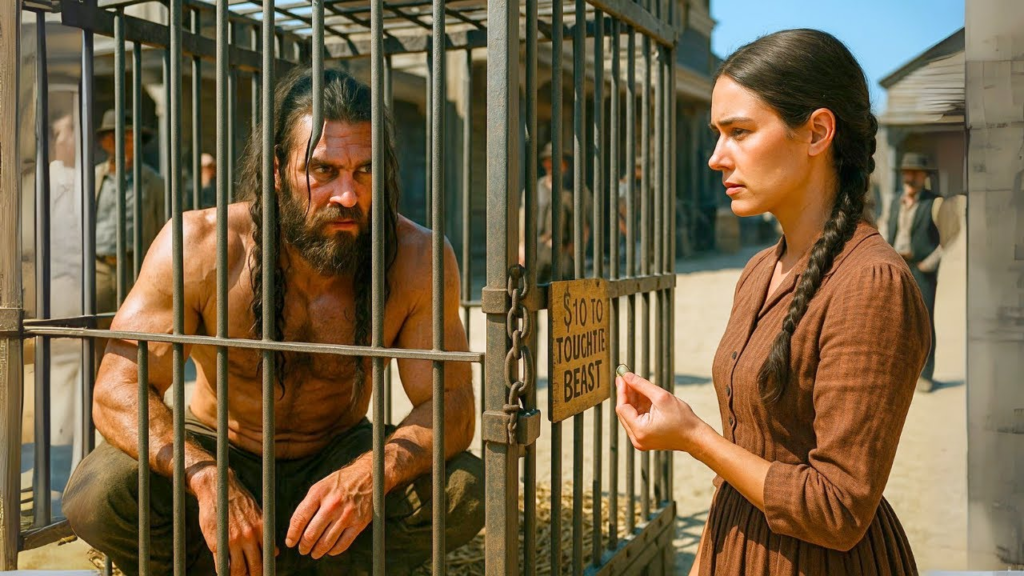
It sat in the middle of the square like a spectacle. Iron bars rusted at the base, straw scattered on the floor, and inside a man slumped against the wall with his head bowed low. He didn’t speak, didn’t move. He was barefoot, shirt torn, wrists wrapped in makeshift cuffs.
Someone had scrolled $10 to touch the beast on a board nailed to the side.
A boy threw a rock at the cage. It hit the bars and bounced back. The man didn’t flinch. Selma climbed down from her wagon slowly. Her hands were raw from gripping the rains for days, but she moved toward the commotion like she’d been summoned.
A cluster of locals hooted and jeered as the sheriff leaned against the post, whittling something.
“What’s he done?” Selma asked quietly. The sheriff barely glanced at her. “Nothing we can prove, but he won’t talk. came out the hills carrying another man’s saddle bag and bleeding like a stuck hog. Couldn’t explain himself, so he let the folks make use of him.
“Is he dangerous?” she asked. “To who?” The sheriff smirked.
“A woman like you.” That was when the man in the cage lifted his head. “Not fully, just enough that Selma saw his eyes. Not wild, not begging, just watching like someone long past hoping, but not yet broken. She stepped forward until her boots met the edge of the cage. The town grew quiet behind her. “Does he have a name?” she asked.
“None we can get out of him. Calls himself nothing.” The man kept staring. She didn’t look away. Her fingers twitched at her side. She thought of the ring. It still sat in her coin pouch. The one thing she hadn’t pawned. Her wedding ring. Thin gold smoothed from years of wear.
A relic of a man who never came back from the war.
She told herself she’d trade it for nothing. Until now. She reached into her satchel, felt the cool metal between her fingers, and pulled it free. The crowd leaned in. Selma stepped to the sheriff, held the ring up.
“Will this buy what he is?” she asked. The man behind the bars didn’t blink. But in that moment, Selma knew.
She wasn’t buying a man. She was setting something free in both of them. The sheriff took the ring with a smirk and held it to the sunlight like he was weighing a horse, not a man. Ain’t worth $10, he said. but it’ll make for a fine tail.”
The crowd chuckled, not knowing whether to jeer or applaud. Selma didn’t flinch.
She watched as the sheriff unlocked the cage with a rusted iron key and let it fall open with a screech that made dogs bark in the distance. The man inside didn’t move. “He’s yours now,” the sheriff said. “
Hope you’ve got rope and regrets.” Selma stepped forward, pausing just outside the cage.
“You can come or stay,” she said. “Either way, you’re not anyone’s anymore.” Still, the man didn’t rise. Then, slowly, he pushed himself up, hands braced against his knees, legs stiff like they hadn’t moved in weeks. He stood tall, taller than she expected.
Sunlight hit his face full now. Dark hair matted, beard thick, eyes shadowed and unreadable.
Not young, not old, not a monster, just worn. He stepped out without a word. The crowd parted as he passed. Selma beside him, her back straight though her heart pounded in her chest like hooves. She climbed onto the wagon. He climbed in back.
No one stopped them. No one spoke. The wheels creaked as they pulled away. Selma didn’t look back.
The road east of Ridge wound through sparse pine and dusty fields. She kept her eyes ahead, hands steady on the rains. The man didn’t ask where they were going. Didn’t ask for food or water.
Didn’t ask anything at all. When the sun dipped low, she stopped at a hollow where a stream cut through the rocks and let the horse drink.
The man jumped down before she could speak, untied the pack without prompting, and began gathering wood. By the time she’d unhitched the horse and unpacked the blankets, he had a fire going, small, tight, efficient. Selma watched him crouch beside it, quiet as the trees around them.
“Do you have a name?” she asked.
He looked at her, then shook his head once. “Can you speak?” he nodded. “But you don’t.” A pause, then a shrug. She sighed, settling on a nearby stone. “I’m not looking for a husband or a worker or a story to pity.” He looked up, brow raised. She met his gaze, firm, but tired.
I bought you because you didn’t deserve that cage, not because I need anything from you.
He didn’t reply, but he reached into the fire light, tore a piece of his own bread in two, and offered her half. No words, just the gesture. And somehow that was the loudest thing either of them had said all day.
They traveled for 3 days without incident, camping near rivers and beneath low trees where crows circled but nevercalled.
Selma kept the wagon on old trader trails, the kind her husband had once marked on maps in pencil and prayer.
The mountain man, still unnamed, never strayed far from camp. He slept near the fire, but never too close, cooked without being told, gathered wood before she noticed the pile had shrunk. And each morning, without asking, he made sure the wheels were sound.
It was an unspoken rhythm, like a dance without music. Selma didn’t ask for more.
But one evening, as dusk turned the sky to bruised lilac, she watched him carve something into a piece of dry cedar with a rusted knife. He sat cross-legged by the fire, bare forearms wrapped in linen from her sewing kit. She hadn’t offered it.
He’d taken only what he needed. That fact oddly comforted her.
“What are you making?” she asked softly. He didn’t answer at first, then turned the carving toward her. A simple wolf, long legs, sharp snout, tail arched. “You?” she asked. He shook his head, then pointed to her. She laughed, not cruy.
“You think I’m a wolf?” he nodded once with certainty. You know, wolves get shot out here, she said. Most folks call them thieves. He tapped the figure again, then pointed to the sky. Selma followed his gesture. Stars cold and silver, and a half moon rising.
You think I came from there? He shrugged, but his eyes said yes. A creature too stubborn to die, too silent to beg.
She stared at the carving a long moment, then reached into her satchel and pulled out the empty ring pouch, the one that used to hold her wedding band. She tied it shut with a piece of string and placed it on the fire’s edge.
“Seems like we’re both unclaimed now,” she murmured. He watched the pouch smolder, never interrupting.
When she looked back at him, he wasn’t staring at the fire. He was watching her, not with hunger, not with pity, with something steadier, like the ground itself had eyes. “Did you ever belong to anyone?” she asked.
He pressed a hand to his chest, then slowly shook his head. She nodded. “Maybe that’s for the best.
” The fire crackled soft and low. The wolf figure sat between them now, unburned, unfinished. And in that moment, the quiet wasn’t empty. It was sacred. Something passed between them that didn’t need to be spoken, just held.
They reached the edge of the canyon on the fifth day, where the cliffs broke open, and the wind stopped pretending to be kind.
Selma pulled the wagon beneath an overhang, and stared at the narrow trail ahead. Barely wide enough for the horse, much less a wagon and two lives, trying not to fall.
The mountain man stood beside her, arms folded, hair tied back with the same bit of leather he’d used to strap down their supplies. He didn’t look nervous. He looked ready.

“You’ve done this before,” she said. He gave a small nod. “You want to lead?” Another nod. She smiled faintly. “You’re not much of a talker, but you sure know when to say yes.” She handed him the reinss without flinching. Trust, she realized, didn’t always come in full. Sometimes it slipped in quiet, one breath at a time.
He took the horse’s lead and walked with a careful gate, every step measured. Selma followed on foot beside the wagon, hand steady on the frame. The cliff dropped off into nothing, and her throat tightened at every gust of wind, but the man never faltered. At a bend in the trail, a rattling spooked the horse.
The beast reared, kicking, and Selma nearly lost her grip. The wagon groaned. Then his hand on the bridal, calm, grounded. The horse stilled. Just like that, he said nothing. Just looked back once to make sure she was still upright. Her heart thutdded in her ribs.
Not from the near fall, but from the way he looked at her, like she wasn’t something fragile, like she was already standing.
That night, they camped near a small spring tucked behind cedar trees. He made stew with salted meat and boiled herbs she didn’t recognize. As they ate, she studied him, the way he always faced outward, eyes on the dark, watching for trouble, even if it never came.
You don’t sleep much, she said. He shrugged.
Is it fear? He looked at her for a long moment, then shook his head. She tried again. Guilt? Still? No. Then he did something unexpected. He reached for the knife at his hip and dragged its hilt slowly across the ground. Two lines, then another across.
A shape. A cage, she whispered. He nodded, then scratched a single line through it. Gone.
She stared at the lines at him, at the fire between them. Then maybe it’s not fear keeping you up, she said softly. Maybe it’s just habit. He didn’t reply, but when she stood and turned to bed, she felt the braid of her hair shift over her shoulder, and the cord that tied it had been replaced with twine.
braided, silent, his. She found the mirror by accident, cracked and half wrapped in linen at the bottom of her pack. She hadn’t touched it since before the war took her husband, since before her hair turned darker with ash, and her face learned stillness as a shield.
But now, seated on a flat rock beside the stream, she held it in one hand and stared at the braid falling down her back.
It was tight, precise, bound at the base with twine, the ends frayed like something salvaged but sacred. She hadn’t felt him do it, hadn’t asked, but it was there. Proof of care in a world where men usually only reached for what they could keep.
The mountain man, no name still, was crouched at the water’s edge, washing out the stew pot.
His movements were quiet, practiced, the kind that made a woman watch longer than she meant to. Selma turned the mirror toward the braid again. Her fingers brushed the twine, and for a moment, something cracked under her ribs.
Not pain, not desire, just a question she’d buried deep. What does it mean to be seen when you’re not performing sorrow? That night, as the stars lit one by one, she sat across from him and didn’t speak for a long time.
When she finally did, her voice was low. I think people are wrong about cages. He looked up. She gestured toward the fire. They think they’re made of bars, iron, keys, but most cages don’t lock from the outside. He tilted his head.
She held his gaze. I’ve been walking with one for years. a pause. Then slowly he reached into his pouch and pulled out something wrapped in oil skin. He unfolded it carefully.
Inside was a single bead, not glass or metal, but carved from bone, smooth, polished. He offered it across the fire. Selma took it with two hands as if it were something fragile. For the braid? She asked. He nodded.
Then with deliberate fingers, he reached across and tied the bead into the end of her hair just under the twine.
His hands brushed hers only once, but it was enough. Later, in the dark, she lay beside the fire and held that braid against her chest like a ribbon of truth. No one had kissed her. No one had claimed her. But somehow she’d been named. Not with a word, not with a vow, but with a braid she didn’t ask for.
Tied by a man who had every reason to fear touch, yet gave it gently. And first they passed through the ghost town of Marluff just after dawn. Burned rafters still leaning toward each other like they were praying.
Selma said nothing. Neither did the mountain man. But she saw how his eyes swept the ash, how his shoulders tensed as they passed an old church door left halfhinged, its cross charred to a stump.
He’d seen places like this, or maybe caused them. She didn’t ask. Not yet. That night, as they camped in the hollow of a dry riverbed, she watched him carve again. His hands were steady, even in the cold, shaping cedar-like memory.
She sat nearby, her braid wrapped around one shoulder, the bone bead cool against her collarbone. “You remember things through your hands?” she said softly.
He paused, looked up, then nodded. “Tell me something.” He hesitated, then set the carving in her lap. A woman seated, long braid down her back, not elegant but unmistakable. Her. Selma blinked. That’s me.
He nodded, then reached for another piece of wood, a shape already halfformed, larger, shoulders hunched, hands open. That one’s you? She asked.
He didn’t answer, just kept carving. She leaned closer. What happened to your voice? he stilled, his jaw clenched. She waited. Finally, he picked up a stick and began to draw in the dirt again. Simple lines. A cabin, a flame, a body outside. Selma’s breath caught. You were in a fire.
He nodded, then added another mark. A small figure crouched beside the body, watching a child. Her throat tightened. Was it your family? His hands trembled, then dropped the stick. He didn’t finish the story.
Didn’t need to. She reached out and touched the back of his hand, lightly, not asking for more, just holding what little he could give.
That night, when she lay beside the fire, she found her braid had been retied again. This time the twine was darker, sturdier, and at the end beneath the bone bead hung a second one smooth and carved with a single etched line, a flame. It wasn’t decoration.
It was memory, an offering, a confession. And somehow she knew it wasn’t meant to scare her.
It was trust, the kind no tongue could give. She held the braid as she slept. And when morning came, he was already cooking, still silent. But something had shifted. She no longer felt like she was traveling with a stranger.
She was moving with a man who had chosen not to run. Even from the parts of himself, still smoldering inside.
The next town was larger than the rest. Clay buildings pressed tight. Storefronts with real glass, children running barefoot down hardpacked streets. Selma thought about passing through without stopping, but the horse needed oats and they needed coffee, and she was tired of eating cold beans by streamlight.
As they rode in, she kept her braid tucked behind her shawl.
Let them see a widow with a quiet man in tow. Let them guess. The town didn’t stare the way Ridge had. They whispered instead, curious, hesitant. But no one threw rocks. No one spit.
The general storehad a bell over the door and the kind of shelves that reminded her of easier years when her husband stood behind her with his hand on her back and called her darling in a voice that made other women envious.
She hadn’t thought of him in weeks. Not until that bell rang. She picked out flour, coffee, a little honey. The clerk eyed the man beside her, but said nothing. When Selma reached for her pouch to pay, her fingers brushed the hollow where her wedding ring used to sit. Gone, traded, a man for a memory.
And yet, she didn’t regret it. Not for a breath.
Back outside, Creel, that was the name she’d started using in her head, secured the goods without being told. As he tied them to the wagon, an old woman in a sun hat approached. “He yours?” she asked softly. Selma turned. “No,” she said, then paused. “But I’m his.” The woman smiled, eyes kind. “That’s rarer.
” Selma nodded as they rode out of town. She kept her eyes on the road. “They’re wondering why you don’t speak,” she said over her shoulder. He didn’t reply. She turned halfway, braid swinging. “I tell them it’s because you’re listening.” A small smile touched his lips. Barely there, but real.
They think I gave up too much, she said. A man for a ring. But the ring never washed dishes, never built a fire, never carved me from memory. That night, he tied her braid again. She didn’t feel him do it, but she found it freshly wound, tighter than before at the base.
Another bead, small brass, shaped like a ring, not the one she gave up. Not a replacement, just a reminder.
She touched it gently, turned to look at him across the fire light. “Why do you keep doing this?” she asked. He met her eyes, reached toward the braid, tapped each bead, bone, flame, ring, then tapped her chest. home.
Pain choice. She understood and didn’t ask again. The road turned rugged after they left the high plains.
Roots clawed through the trail, and cliffs leaned close on either side, like the land itself wanted to listen in. Selma held the rains steady, though her shoulders achd and her throat had grown raw from the dust.
Creel walked ahead, always a few paces in front, eyes scanning like a sentry who’d never been relieved. She trusted that, trusted him.
Not because of the fire he built, or the silence he kept, but because her hair never tangled anymore. That evening they stopped near a grove of trembling aspens. She set up camp while he returned with a satchel of dry roots and a pouch of flint.
When the fire was lit and the pot hung to boil, she sat across from him and finally asked, “What would your name be if you got to choose it?” He didn’t look up, just slowly reached for a flat stone and began carving with the tip of his blade.
The scraping sound filled the air like soft wind. After several minutes, he turned it toward her. One word cleanly etched. Solen, her brow furrowed. What does it mean? He hesitated, then pressed a hand to the ground, then pointed to the sky.
Earth light. Then tapped his own chest. Selman nodded slowly. Soulen.
He looked at her, then really looked. Not past her, not around her. At her. She let the name settle between them like coals under a fresh flame. You don’t have to stay with me,” she said. After a while, the ring was never meant to bind you.
He picked up the carving from earlier, the wooden figure of her with the braid, and passed it to her gently.
Then, with the same quiet certainty, he held up a second carving himself, seated beside her, both facing the same direction. She blinked. “This is what you want?” He nodded, then reached behind her, fingers finding her braid. He didn’t tie a new bead this time.
He just unraveled it gently and began again, slowly, carefully, like it was his own story he was reweaving.
When he finished, he tied the braid off with twine, then looped a sliver of bark through it, carved with one word, solen. His name now part of her, not claimed, not owned, shared. She touched it, fingers trembling. Then I won’t leave either, she whispered.
The wind passed between them. No vows, no promises, just a braid.
And in that braid, the truth that neither one of them was alone anymore, not in name and not in silence. They reached the canyon’s edge by late morning, where wild flowers grew between stone cracks, and the air smelled like water before it could be seen.
Selma pulled the wagon to a stop and climbed down without a word. Sen, she called him that now, even if no one else ever would, stood beside her, one hand on the res, the other resting on the carved handle of his knife.
This is it, she said softly, pointing to the ridge. Past that bend is where I was meant to go. He looked at her calm and unreadable. A widow’s homestead. My husband claimed it with the land deed before he left for war. I just never got around to finishing the trip.
She didn’t say why. She didn’t need to. The silence was enough, but then she turned to him, eyes steady.
There’s one thing I haven’t asked. He tilted his head slightly.Why didn’t you run when the cage opened? Sen looked away toward the edge of the canyon where Hawks circled lazily. Then he crouched low, picked up a stick, and drew in the dust. A circle, a smaller one inside it.
Then a figure sitting. You were already caged inside, she guessed. He nodded.
Then he reached into his satchel and pulled out something small. A tarnished ring. Not hers, not gold, simple, dented. “What is that?” she asked. He held it up, then pointed to his heart, then to the fire, then back to her.
“Someone gave it to you?” He nodded once. “They died?” Another nod, her throat tightened. “And you couldn’t speak after this time.
” He looked her straight in the eyes, held her gaze, then placed the ring into her hand. “You want me to carry it?” He nodded slowly. She closed her fingers around it. “Then I will, and I’ll carry you with it.” That night they reached the homestead.
The cabin was barely standing, two walls intact, the rest held together by vines and ghosts.
But the land was still fertile, the creek still flowing. She stood in the doorway, wind pressing against her dress, and turned to him. This was supposed to be my husband’s home. Now I think it’s ours.”
Solen didn’t move, but his hand found the end of her braid again, smoothed the bark bead with his thumb, the one that bore his name. He added nothing.
Didn’t need to. Sometimes what’s sacred isn’t what’s spoken, but what stays. And he had stayed long after he was free to leave. A man bought with a ring now tied to something deeper than any vow, a quiet thing, a permanent thing.
Spring bloomed like breath on the ridge. Wild iris pushed up through the broken floorboards of the old cabin, and the creek sang a little louder each morning.
Selma rose early now, not because she had to, but because she wanted to. The air was easier to breathe with someone stirring beside her, even if he didn’t snore, didn’t speak, didn’t take more than space and silence. Solen had built the porch from salvaged timber, sanded smooth by hand.
Each evening they sat there together, her rocking slow, his knife busy shaping pieces of the past into something small enough to hold. He had carved animals, feathers, her face, her braid, but tonight he was carving her hand. Just the fingers open, empty.
She asked once, “Why?” He looked at her, then reached forward, turning her wrist palm up, and with the gentlest pressure, placed the wooden hand in it, a mirror, not perfect, but hers, like she’d been seen from the inside.
She didn’t cry, but she did lean into his shoulder, and he didn’t move away. That night, as she undressed, she caught sight of herself in the warped mirror above the wash basin. Her braid was longer now, thicker.
At the base hung five beads, bone, the beginning, flame, his memory ring, what she traded, bark with his name, what they chose, smooth riverstone, the one he’d slipped in yesterday, without telling her she hadn’t asked what that last one meant.
But when she brought it up, he just smiled barely and pressed a hand to her shoulder. Steady, present, ongoing. In the morning, she found a note, the first he’d ever written. Not elegant, just a scrap of paper nailed to the door. Gone to hunt back before dusk. Don’t wait to live. She read it twice, then laughed.
She stepped out barefoot, hair down, wind tugging at it wildly. She didn’t braid it that morning. She didn’t need to. The beads clinkedked softly like chimes of a story still being told.
As she walked the edge of the creek, she remembered the cage, the ring, the man no one wanted, and the choice that had unmade her grief.
He had never promised to stay. But every day he chose to, not because she asked, not because she needed, but because he had something worth staying for. And in that braid, threaded with pain, memory, and quiet gifts, she carried the truth.
She had bought nothing. She had simply traded a ring for a man who knew how to braid her spirit back into place, one strand at a time.
Please like, share, and subscribe to support more souldeep stories here on Echoes of the West. If you’d seen him in that cage, would you have given up your ring, too? Tell us in the comments.
Una maestra acusó de mentiroso a un niño afrodescendiente… hasta que apareció su padre, un general condecorado de cuatro estrellas, cambiando todo en un instante….-kimthuy
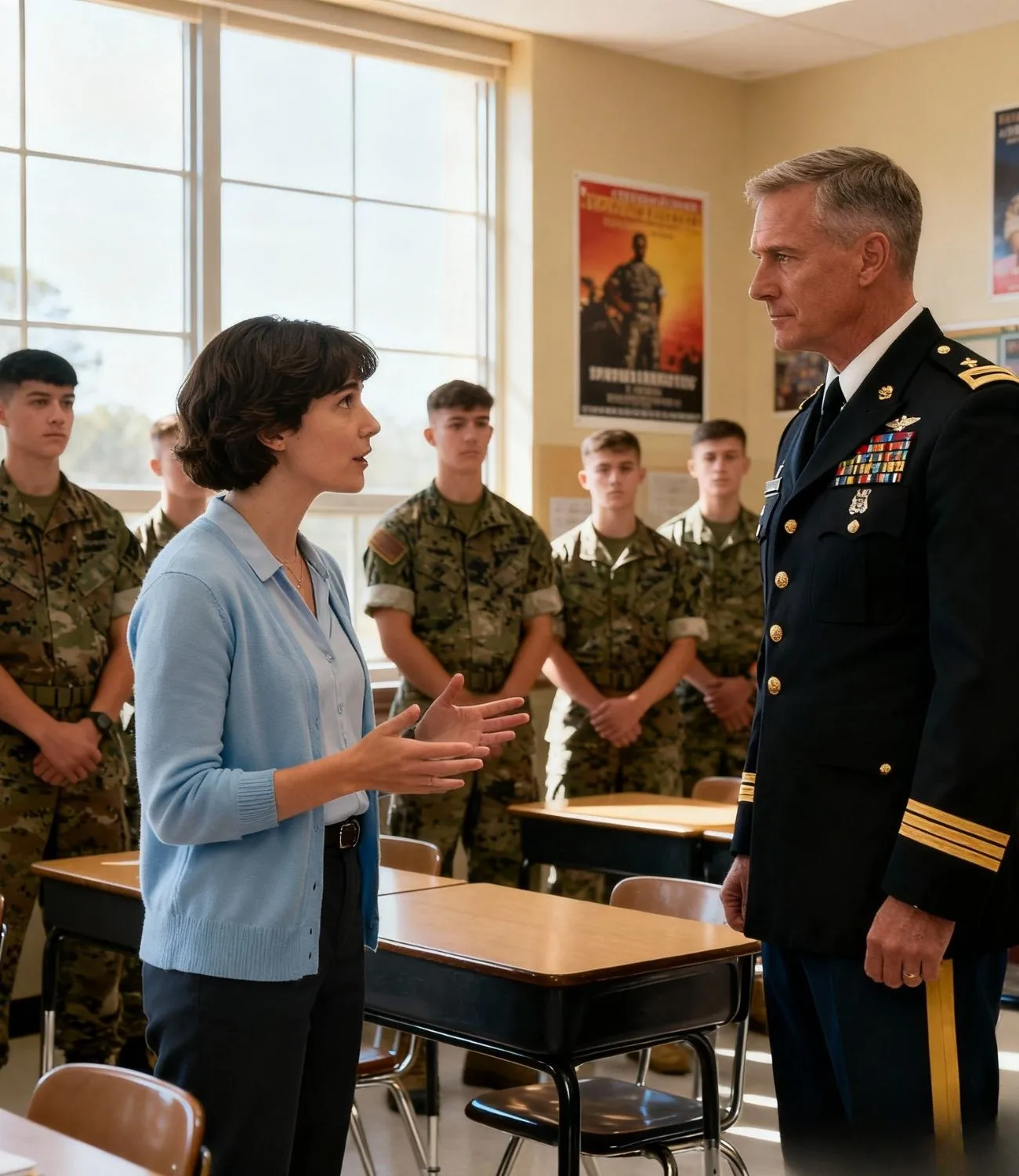
En la tranquila escuela de San Miguel, los niños jugaban y aprendían. Sin embargo, aquel día, una maestra impaciente señaló a un niño y lo llamó mentiroso frente a todos.
El pequeño, llamado Javier, sintió que su corazón se hundía. Sus ojos brillaban con lágrimas, mientras sus compañeros observaban con miedo y confusión, sin saber cómo intervenir ante la injusticia.
La maestra, la señora Torres, estaba convencida de su propia autoridad. Pensaba que corregir a Javier públicamente sería un ejemplo de disciplina para toda la clase, sin considerar las consecuencias emocionales.
Javier bajó la cabeza, sosteniendo su cuaderno con fuerza. Sabía la verdad sobre lo que había pasado, pero nadie le creería. Sus palabras quedarían atrapadas en el silencio de la humillación.
Mientras la maestra continuaba con su lección, un murmullo recorrió la puerta de la escuela. Algunos estudiantes miraron hacia la entrada, preguntándose quién podría irrumpir en aquel momento tenso y embarazoso.
De repente, la puerta se abrió con firmeza. Un hombre de uniforme impecable, con insignias brillantes en su pecho, entró. Su porte transmitía respeto y autoridad, y todos los niños lo miraron asombrados.

El corazón de Javier latía con fuerza. Reconoció a su padre al instante: el general de cuatro estrellas que había servido a su país durante décadas, conocido por su disciplina, pero también por su honor y justicia.
La maestra Torres giró lentamente, sorprendida. La confianza con la que el general avanzaba hacia el aula hizo que su arrogancia inicial se desmoronara frente a la presencia de un hombre tan imponente.
El general se detuvo frente a su hijo, observando los ojos llenos de miedo y tristeza de Javier. Sin decir una palabra, su mirada transmitía apoyo, amor y una firme determinación de defenderlo.
“¿Qué está pasando aquí?”, preguntó con voz profunda. Cada palabra resonaba con autoridad, haciendo que el aula entera contuviera la respiración y mirara con asombro la escena que se desarrollaba.
La maestra, temblando, intentó explicar la situación. Sus palabras sonaban vacías y poco convincentes frente a la presencia del general, cuya experiencia le permitía percibir la verdad con facilidad.
Javier miró a su padre con esperanza. Sabía que finalmente alguien escucharía su versión, alguien que no juzgaría por el color de su piel ni por malentendidos, alguien que pondría justicia por encima de todo.
El general asintió lentamente, escuchando la historia de su hijo. Cada detalle revelaba no solo la inocencia de Javier, sino también la injusticia que la maestra había cometido, subestimando la fortaleza de su propio alumno.

El aula permaneció en silencio absoluto. Incluso los estudiantes más traviesos comprendieron que algo importante estaba ocurriendo, algo que cambiaría la percepción de todos sobre la autoridad y el respeto.
El general se volvió hacia la maestra y habló con calma pero firmeza. Sus palabras no buscaban humillarla, sino corregir el error y enseñar que la justicia y la verdad siempre deben prevalecer.
“Señora Torres, acusar a un niño sin pruebas es inaceptable. Su deber es educar, no herir. Javier merece respeto y comprensión, no humillación pública frente a sus compañeros”, dijo con claridad.
La maestra bajó la mirada, sin saber qué responder. Nunca había enfrentado una autoridad como aquella, alguien que combinaba poder, ética y humanidad, mostrando cómo debía actuar un verdadero líder.
Javier se limpió las lágrimas discretamente. Sintió un alivio inmenso al ver que su padre lo defendía, demostrando que la verdad y el valor personal siempre pueden imponerse ante la injusticia.

El general continuó, dirigiéndose también a la clase: “Aprendan que todos merecen respeto. La verdad no tiene color ni estatus. Lo que importa es la integridad y la honestidad que mostramos en nuestras acciones”.
Los estudiantes escucharon atentos, comprendiendo la magnitud del momento. Nunca olvidarían aquel día, cuando vieron que incluso la figura más poderosa de la escuela podía ser confrontada por la justicia y la verdad.
La maestra Torres asintió lentamente, reconociendo su error. Su orgullo inicial se transformó en humildad, y por primera vez comprendió que la verdadera enseñanza va más allá de los libros y las reglas estrictas.
Javier sonrió tímidamente a su padre. El apoyo que sentía era inmenso, y supo que, con él a su lado, ninguna injusticia podría derrumbarlo jamás, ni en la escuela ni en la vida.
El general se inclinó y susurró a su hijo: “Recuerda siempre, Javier, tu valor no depende de lo que digan los demás. Mantén tu honestidad y tu corazón fuerte, siempre”.
La maestra Torres respiró hondo, decidida a cambiar su actitud. Sabía que había sido testigo de una lección más grande que cualquier programa educativo: la lección del respeto y la equidad.
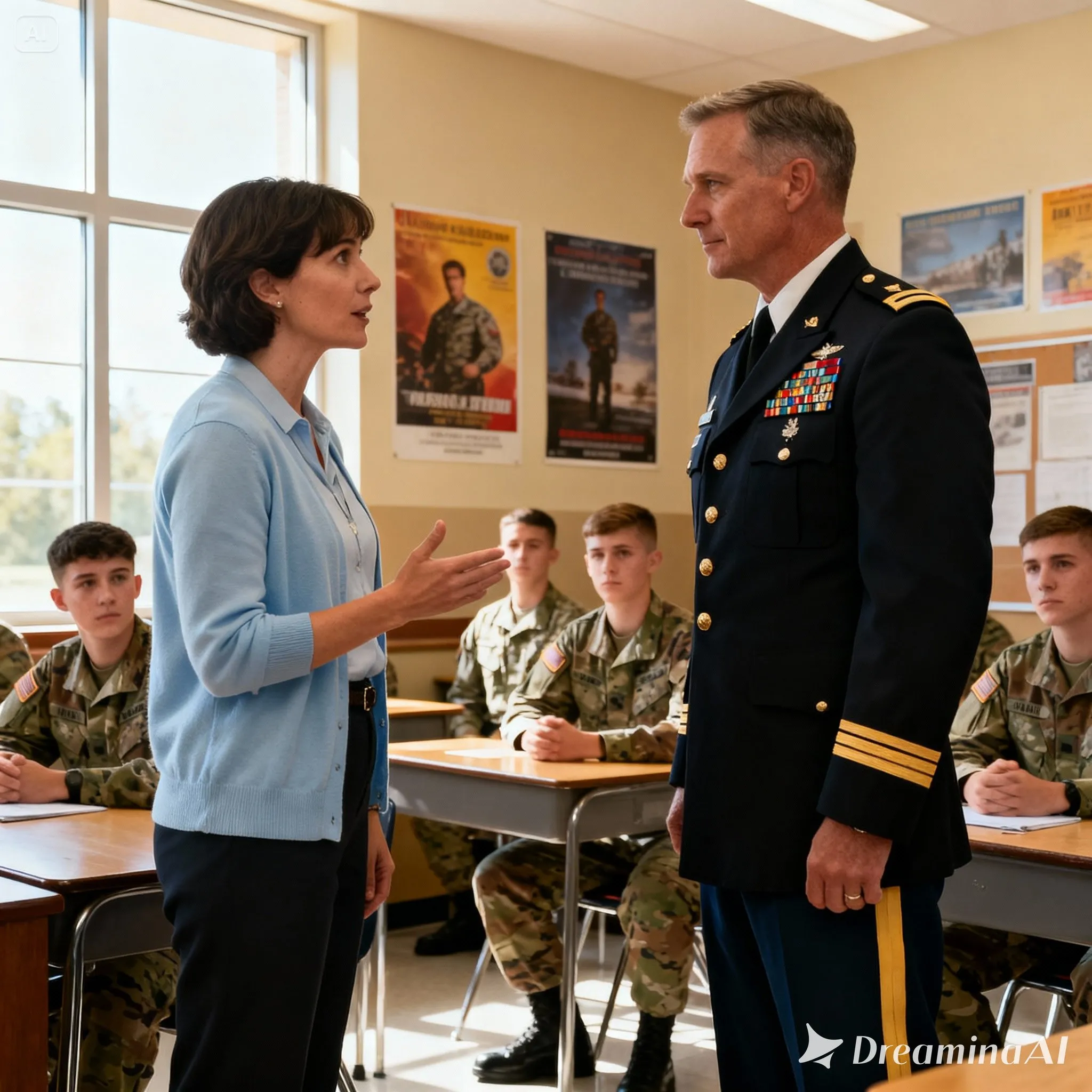
Los alumnos aplaudieron discretamente, sorprendidos por la intensidad del momento. Javier se sintió más seguro que nunca, comprendiendo que la justicia puede llegar incluso en los lugares más inesperados.
El general se despidió de la clase, dejando claro que su presencia no era para intimidar, sino para enseñar que la autoridad debe ir siempre acompañada de ética, respeto y justicia.
Javier regresó a su asiento con la cabeza erguida. Sentía una nueva confianza, un orgullo silencioso y la certeza de que su padre siempre estaría allí para protegerlo y guiarlo en la vida.
La maestra Torres comenzó la lección nuevamente, pero esta vez con un enfoque diferente. Cada palabra que pronunciaba estaba impregnada de consideración y atención hacia cada estudiante, especialmente hacia Javier.
Con el tiempo, la historia del incidente se difundió entre el personal y los padres. Todos aprendieron que un error puede transformarse en enseñanza si se reconoce y se corrige con humildad y justicia.
Javier creció recordando aquel día como un hito en su vida. Aprendió que la valentía y la integridad no siempre se muestran con armas o rangos, sino con acciones que defienden lo correcto.
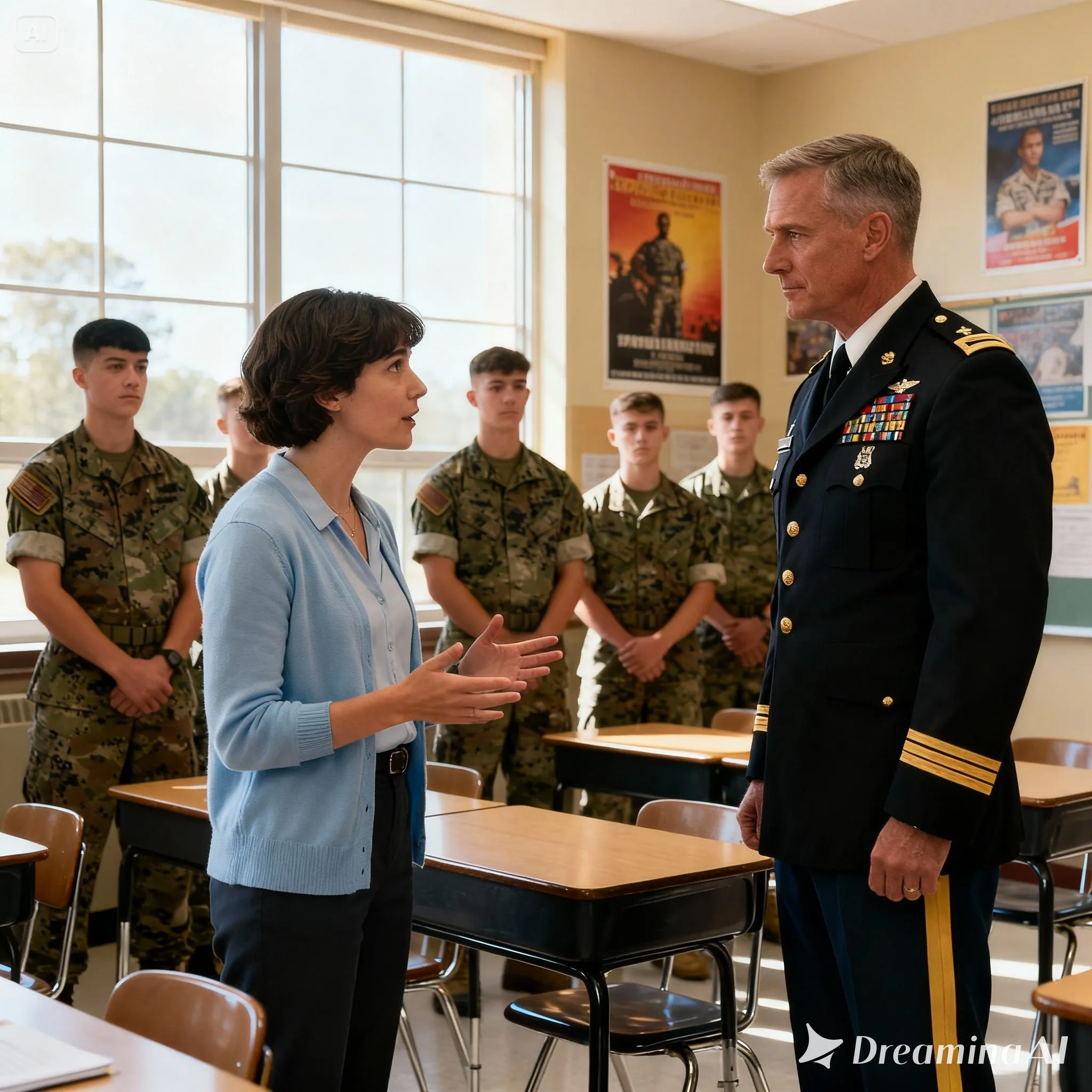
El respeto mutuo se convirtió en un valor fundamental dentro de la escuela. Profesores y alumnos comprendieron que cada persona merece ser escuchada y tratada con dignidad, sin importar su origen.
Años después, Javier se convirtió en un defensor de la educación y la justicia social. Aquella experiencia con su padre lo inspiró a luchar por los derechos de todos los niños y jóvenes a su alrededor.
La maestra Torres cambió su forma de enseñar para siempre. Reconoció que la empatía y la paciencia eran herramientas esenciales, más valiosas que cualquier autoridad impuesta sin comprensión.
El general de cuatro estrellas siguió siendo un modelo de integridad y liderazgo. Su intervención demostró que incluso en situaciones delicadas, la verdad y el respeto siempre prevalecen sobre el miedo o la arrogancia.
Javier jamás olvidó aquel momento en que la injusticia fue confrontada con valentía. Comprendió que el apoyo de alguien justo puede transformar no solo su vida, sino la de todos los que lo rodean.
El pequeño incidente se convirtió en leyenda local. Padres y maestros contaban la historia como ejemplo de cómo la ética y la honestidad deben guiar todas nuestras acciones, en la escuela y fuera de ella.
Cada vez que Javier visitaba la escuela, recordaba la mirada de su padre, llena de orgullo y amor, y entendía que su valor y dignidad nunca debían depender de la opinión de otros.
Años más tarde, como adulto, Javier se convirtió en un líder comunitario, trabajando para garantizar que cada niño fuera escuchado y respetado, promoviendo un ambiente de equidad y justicia.
La historia del niño y el general de cuatro estrellas continuó inspirando generaciones. Demostró que el respeto, la verdad y la valentía pueden superar cualquier prejuicio o injusticia, incluso en los lugares más inesperados.