“ONE SONG… FOR ONE MEAL?” That’s what a starving 12-year-old girl asked in the middle of a black-tie charity gala—right before she shattered the ego of every millionaire in the room. 1 The ballroom looked like a movie set: crystal chandeliers, velvet carpets, watches worth more than my yearly rent. I was working the event, circulating trays and trying to angle my body so no one noticed the tear in my shoe. In the corner sat a grand piano—polished, perfect, untouchable. Then she appeared. She was small, thin, and painfully quiet… but her eyes weren’t on the diamonds or the cameras. They tracked the food. Every passing plate. She walked straight to the piano. A man in an expensive tux stepped in front of her and smirked. “Hey—this isn’t a playground.” She didn’t flinch. She looked him dead in the face and said, softly: “If I play… will you give me a plate of food?” The room froze. A few people laughed—nervous, uncomfortable. Others suddenly couldn’t meet her eyes. She sat down anyway. Her feet didn’t even reach the floor. And then her hands hit the keys. It wasn’t just music. It was pressure. Hunger. A storm wrapped in a melody so raw the room changed in seconds—smiles collapsing, throats tightening, eyes watering. I remember thinking: Who is this child… and why does it feel like she’s playing for her life? But what happened right after the final note—what it exposed about the people in that room—still makes my stomach turn. The last note didn’t end.
It hovered in the air like smoke—thin, aching, impossible to ignore.
For three seconds, nobody moved.
Then the room exploded into applause.
Not the warm kind. Not the human kind. The kind rich people do when they’ve just witnessed something powerful… and they’re already trying to decide how to own it.
A man near the front dabbed at his eyes with a linen napkin. Another leaned toward his wife and whispered something that made her laugh—quick, sharp, guilty.
The tuxedo guy who’d tried to block her earlier was clapping too, grinning like he’d just discovered a new party trick.
And the girl?
She didn’t bow. She didn’t smile.
She just sat there, small and still, hands hovering above the keys like she was waiting for the world to keep its promise—If I play… will you give me a plate of food?
1
The host—silver hair, perfect teeth, microphone in hand—glided onto the stage with the smooth confidence of someone who’d never once been told “no.”
“Ladies and gentlemen,” he said, voice like honey, “this is why we’re here tonight.”
He placed a gentle hand on the piano lid, careful not to touch the girl.
“Talent. Hope. Inspiration. Even in the darkest circumstances, the human spirit can—”
The girl turned her head and looked up at him.
Not angry.
Just… empty.
“Food,” she said, soft enough that only the people closest heard it.
The host blinked, still smiling, still performing.
“Of course, sweetheart,” he said into the microphone, and the audience laughed—because they thought it was cute. “Of course. We’ll make sure you’re taken care of.”
He turned back to the crowd. “Now—shall we begin the live auction?”
My stomach dropped.
Because that was the trick.
They were going to use her.
They were going to squeeze the last drop of emotion out of what she’d just done, pass it around the room like champagne, and then move on—full bellies, clean hands, generous reputations.
And I knew it, because I’d seen it before.
Not with a child at a piano. But with people who knew how to make pain look pretty.
The host raised his hand. “Tonight, we raise funds for the St. Marlowe Youth Initiative—a program that gives disadvantaged children the resources they need to thrive.”
Disadvantaged children.
I looked at the girl again—her thin wrists, the way her shoulders held tension like she’d learned to be braced for impact, the way her eyes kept flicking to passing trays like she was trying to memorize them.
If this is what their “initiative” looks like… what does their neglect look like?
The tuxedo guy leaned forward in his seat, calling out, “Let her play again!”
Someone else joined in. “Yes! Another piece!”
The host chuckled. “Well, if you insist…”
He bent slightly toward the girl, lowering his voice so it wouldn’t carry.
“Play something uplifting,” he murmured, still smiling. “Something that says thank you.”
The girl stared straight ahead.
“No,” she said.
The host’s smile twitched.
“What was that?”
“I played,” she said. “You said food.”
A ripple of discomfort slid across the front tables—little shuffles in expensive chairs, a few fake coughs, eyes darting away like they’d just been caught watching something they weren’t supposed to see.
The host’s gaze hardened. He leaned closer, the mic angled away.
“Don’t embarrass me,” he hissed, so quietly it almost sounded like kindness.
The girl’s voice didn’t rise. It didn’t shake.
“You already did,” she said.
The tuxedo guy laughed too loud. “Oh, come on. Somebody get the kid a sandwich. We’ve got an auction to run.”
And that’s when I saw two security guards moving toward the piano.
Big men. Black suits. Earpieces. Hands already positioned like they were trained to grab.
My tray was in my hands before my brain caught up.
I cut across the ballroom, heart punching at my ribs, weaving through gowns and laughter and crystal glasses that cost more than my rent.
One of the guards reached the stage first and whispered something to the host.
The host nodded without looking away from the girl.
The guard stepped toward her.
“Sweetheart,” he said, voice low, “we need you to come with us.”
The girl flinched.
Not because he was loud.
Because he was familiar.
Her fingers curled into fists on her lap.
“No,” she said again, smaller this time.
The guard reached for her elbow.
That’s when I spoke—too loud, too sharp, the kind of voice you only use when something inside you snaps.
“Hey.”
Every head turned.
The guard paused, annoyed. “Staff aren’t supposed to be up here.”
I lifted the tray slightly. “She asked for food.”
The tuxedo guy scoffed. “Jesus, it’s not your job.”
I stepped closer, ignoring him. My hands were shaking, but I steadied the tray like it was the only normal thing left in the room.
On it: a small plate of roasted chicken, potatoes, and bread.
The girl’s eyes locked on it so hard it felt like the air tightened.
I held it out to her.
“Here,” I said. “Eat.”
The host smiled again, now the way people smile when they’re trying to control a narrative.
“How sweet,” he said into the microphone. “A round of applause for our staff’s generosity.”
The audience clapped—because clapping is easier than thinking.
The guard’s jaw tightened. “She can eat offstage.”
“She can eat here,” I said, and I didn’t know where the boldness came from—only that I couldn’t stop it. “She earned it.”
The host’s eyes flicked to mine, cold now.
Then he gave a tiny nod.
The guard stepped back, but not far. Like a dog told to wait.
The girl reached for the plate, but her hands hesitated—hovering like she was afraid it might vanish if she touched it wrong.
“Take it,” I whispered.
Her fingers closed around the edge, and for a second I saw her try to be polite.
Try to be a “good” child.
But hunger doesn’t care about manners.
She tore a piece of bread in half and shoved it into her mouth, chewing fast, swallowing like she didn’t trust it to stay.
Her throat worked hard.
Her shoulders trembled.
The room watched like it was entertainment.
And that was the part that made me sick.
Because as she ate, I saw something else.
A bruise on the inside of her upper arm—yellowed at the edges. Older.
Another faint mark near her wrist, like someone had gripped her too tightly.
Her sleeve had ridden up slightly, revealing skin that looked too fragile, too exposed.
I lowered my voice. “What’s your name?”
She swallowed. Her eyes stayed on the food.
“…Lina,” she said.
“Where are your parents?”
Her chewing slowed.
Her eyes flicked up, just once.
And in them, there was a warning.
“Don’t,” she whispered.
The guard took a step forward. “That’s enough. She needs to go.”
Lina stiffened. The bread froze in her fingers.
I felt her body shift, subtle and practiced—like she’d learned the exact posture of obedience that kept things from getting worse.
“No,” I said.
The guard’s eyes narrowed. “Excuse me?”
“She’s eating,” I said. “You can wait.”
The tuxedo guy stood up now, irritated. “Are we really doing this? It’s a kid. Someone will feed her. Let the event continue.”
“That’s the problem,” I said before I could stop myself. “You all keep saying someone will do it.”
Silence.
The host’s smile hardened into something dangerous.
He raised the microphone again. “Thank you, everyone, for your compassion. Our young performer will be escorted to a safe place—”
“No,” Lina said suddenly.
Her voice cut through the host’s sentence like a blade.
She looked at me, eyes wide.
Then she whispered, barely moving her lips:
“Don’t let them take me back.”
My blood went cold.
The guard reached again.
I moved first.
I didn’t grab the guard. I didn’t make a scene. I just stepped between them like I belonged there—like this was normal.
“Kitchen needs this tray,” I said quickly, snatching it back with my free hand, leaving Lina with the plate.
The guard frowned. “She’s coming.”
I leaned closer, lowering my voice so only he heard.
“If you drag her off that stage,” I said, “half this room will film it. You want that?”
His eyes flicked around—phones already rising, people hungry for drama now that the music was over.
The guard hesitated.
The host’s jaw tightened.
“Fine,” the host said smoothly, into the mic. “A short intermission while we prepare the next segment.”
He turned away, still smiling for the crowd.
But when he passed me, his shoulder brushed mine, and he murmured through clenched teeth:
“Get her out of my sight.”
I nodded like a good employee.
Then I looked down at Lina.
“Can you walk?” I asked softly.
Her fingers tightened around the plate.
“Yes,” she said. “But… they’ll follow.”
“Let them,” I whispered. “Just stay close.”
I guided her off the stage—not by pulling her, but by walking as if she was staff too, as if she belonged in the back hallways.
As if she wasn’t a child everyone had just used as a conscience cleanser.
The moment we reached the service corridor, the noise of the ballroom dulled.
The air changed—less perfume, more metal and steam and disinfectant.
Lina’s steps sped up like she’d been waiting for this moment.
Behind us, I heard the guard’s footsteps.
Not running.
Following.
I turned into the kitchen.
Cooks shouted orders. Plates clattered. A dishwasher sprayed a rack like he was trying to erase the world.
Nobody looked twice at me.
But Lina drew eyes.
Because she was out of place.
A kid in an oversized dress, clutching a plate like it was a life raft.
I steered her toward the staff break room—a small door marked “EMPLOYEES ONLY.”
Inside: fluorescent lights, chipped tables, a vending machine that never worked right.
Lina sat down the second she crossed the threshold and started eating again, faster now, shoulders relaxing just enough to show how tightly she’d been holding herself.
I closed the door behind us.
And then I realized my mistake.
There was no lock.
The door handle jiggled almost immediately.
A woman’s voice, sharp and controlled, slid through the crack.
“Lina?”
Lina froze mid-bite.
Her face drained.
I hadn’t seen the woman in the ballroom.
But I recognized the tone.
Not a mother. Not a caretaker.
A handler.
“Lina,” the voice said again, sweeter now. “Come on, honey. Don’t make this difficult.”
Lina’s whole body trembled.
I stepped forward and planted my hand on the door.
“Who are you?” I called.
A pause.
Then: “She’s with us.”
“With who?”
Another pause—like the woman was deciding which lie would work fastest.
“With the initiative,” she said. “She’s a participant.”
I looked down at Lina.
Her eyes were locked on me, pleading.
She shook her head, small.
No.
My grip tightened on the door.
“She’s eating,” I said. “Give her five minutes.”
The woman laughed once, quietly—like I was adorable.
“You don’t understand,” she said. “Lina is scheduled.”
Scheduled.
Like a performer.
Like a product.
Lina whispered, mouth barely moving: “If I’m late… they punish me.”
My skin prickled.
I swallowed hard. “Who is ‘they’?”
Lina’s eyes flicked away.
And I knew—whatever she was about to tell me, she had learned the cost of telling.
The handle on the door turned again, harder this time.
“Open the door,” the woman said, her sweetness cracking. “Now.”
I leaned down, voice urgent. “Lina. Listen to me.”
She looked up, cheeks hollow, lips still smeared with bread crumbs.
“I can help you,” I said. “But I need to know what’s happening.”
Her throat moved. She swallowed.
Then she said something so quiet I almost didn’t hear it.
“This isn’t charity,” she whispered. “It’s a showroom.”
The word hit me wrong—like a puzzle piece clicking into place in a picture I didn’t want to see.
“A showroom for what?” I asked.
Lina’s hands began to shake again.
“For kids,” she whispered.
The door handle jerked violently.
A second voice joined outside—male, impatient.
“Enough. Break it.”
My heart slammed.
I looked around the break room for anything—anything I could use.
A chair.
A broom.
A lock that didn’t exist.
Lina stared at me, panic rising like a wave.
“You shouldn’t have fed me,” she whispered, almost apologetic. “Now you’re in it.”
I stepped closer, lowering my voice.
“Maybe I already was,” I said.
And I meant it in a way I didn’t have time to explain—because in that moment, a memory flashed through me so sharp it hurt:
A different hallway.
A different night.
A different child.
Small hands, slipping from mine.
A voice on the phone saying, We can’t locate her.
A file stamped CLOSED.
The door slammed once—an impact from the outside.
Lina flinched so hard her plate tipped, food spilling onto the floor.
She didn’t even look at it. She just whispered, broken:
“Please.”
I made a decision so fast it felt like falling.
“There’s a walk-in freezer,” I said, grabbing her wrist gently. “In the kitchen. We can hide you.”
Lina’s eyes widened. “They’ll find me.”
“Not if we move now.”
Another slam. The doorframe rattled.
I yanked it open suddenly, stepping into the hallway with my shoulders squared.
The woman outside was exactly what I feared: clipboard, earpiece, designer coat pretending to be practical.
Beside her stood one of the security guards, hand already half-raised like he was about to grab.
The woman’s eyes flicked past me to Lina.
“There you are,” she said, smile snapping back into place. “Come on, sweetheart.”
I smiled too.
But it wasn’t friendly.
“She’s with me,” I said.
The woman blinked. “Excuse me?”
I leaned closer, lowering my voice like we were sharing a joke.
“You want to keep this quiet?” I murmured. “Then you’ll walk away.”
The guard frowned. “Who the hell are you?”
I held his gaze and said something I hadn’t planned to say—but once it left my mouth, it felt like the truest thing in the building.
“I’m the reason this ends tonight.”
The woman’s smile finally vanished.
Her eyes sharpened, calculating.
“Do you have any idea what you’re interfering with?” she said softly.
I glanced back at Lina.
She was standing now, barefoot—somehow her shoes were gone—hands trembling, face pale, but her eyes locked on mine like I was the last door left in a burning building.
I looked back at the woman.
“No,” I said. “But I’m about to.”
And just as the guard’s hand shot forward—
The ballroom lights dimmed again in the distance, and the host’s voice boomed through the speakers:
“Ladies and gentlemen, thank you for your patience. Our special guest will now be presented—”
Lina let out a sound—half gasp, half sob.
“That’s me,” she whispered.
And before I could stop her, she bolted.
Straight toward the kitchen.
Straight toward the noise.
Straight toward the room full of people who had clapped for her hunger… and were about to bid on her pain like it was art.
I chased her.
The guard chased me.
And the woman’s voice followed like poison:
“Bring her back.”
As we hit the kitchen doors, Lina turned her head just once—eyes wild, terrified, determined.
And she screamed, loud enough for the entire gala to hear:
“I’M NOT A DONATION!”
Every conversation died.
Every fork froze.
Every camera lifted.
And for the first time all night, the room didn’t clap.
It went silent.
Because Lina hadn’t played another song.
She’d finally played the truth.
And the people in that ballroom—every millionaire, every sponsor, every smiling donor—
They had nowhere left to look but straight at themselves.
(If you want, I can continue with Part 3: what the “initiative” really is, who Lina is running from, and why the narrator is willing to burn the whole room down to get her out.)
来源 继续 已思考 25s ONE SONG… FOR ONE MEAL? (Part 3)
Silence is a funny thing.
In a room full of money, it’s rare. People pay to avoid it. They fill it with music, laughter, glasses clinking—anything to keep the truth from echoing.
But Lina’s scream didn’t just stop the auction.
It punched a hole in the room.
“I’M NOT A DONATION!”
Every head turned like a synchronized machine. Faces froze mid-expression—smiles half-worn, brows halfway lifted, mouths still open from whatever joke they’d been about to make.
And then the host did what men like him always do when they’re cornered:
He tried to turn panic into a script.
He chuckled into the microphone like it was all part of the show.
“Ah—children,” he said warmly. “Raw emotion. Beautiful. What you just witnessed is… the honest voice of—”
“No,” Lina shouted, louder now.
Her hands were shaking, but her chin was up. She wasn’t performing anymore. She wasn’t playing. She was surviving.
“They said if I played, I’d get food,” she said, voice cracking. “They said I’d be safe. They lied.”
The word lied landed like a dropped plate.
A woman near table six stiffened. A man with a watch the size of a small planet looked around, suddenly interested in his own hands.
Phones rose higher.
A few people didn’t record because they cared. They recorded because scandal is a souvenir.
Security moved in a clean line—black suits, identical steps, eyes scanning for the fastest way to shut this down.
I pushed through the edge of the crowd, heart slamming, trying to get to Lina before they could.
But the woman with the clipboard was faster.
She slipped in from the side of the stage like she owned the air.
“Lina, sweetheart,” she said, voice dripping sugar. “You’re overwhelmed. Let’s take a breath, okay?”
Lina took a step back like the woman was fire.
“No,” Lina whispered.
The woman’s smile twitched—but she kept it, because she knew the room was watching.
“This is a charity event,” she said gently, into the open space. “Our participants sometimes—”
“I’m not a participant,” Lina snapped. “I’m a thing to you.”
The host’s eyes flicked to security.
A signal.
Two guards stepped up.
And that’s when I got there.
I didn’t shove anyone. I didn’t swing. I just stepped between Lina and the guards like a wall that decided to become real.
“She stays,” I said.
One guard leaned in. “Move.”
I looked past him, straight at the host, and raised my voice enough for the nearest tables to hear.
“You said you were feeding kids,” I said. “So why does your ‘initiative’ need security to drag one away?”
The host’s smile went tight.
“This man is not authorized—”
“Are you?” I cut in. “Authorized to promise food to a starving child like it’s a reward?”
A ripple ran through the crowd—soft, uneasy.
Not outrage.
Not yet.
Just that first crack of discomfort when people realize the story they bought might be rotten.
Lina grabbed my sleeve.
Her fingers were cold.
“They’ll take me,” she whispered. “Please.”
I nodded once—small, firm.
Not a promise.
A decision.
And then I did the only thing I could think of.
I reached for the microphone.
The host jerked it away.
I didn’t stop.
I leaned close enough that my voice carried anyway.
“You want to know why she screamed?” I said, sweeping my gaze over the tables—over the diamonds, the silk, the plates that could’ve fed Lina for a week.
“Because this isn’t charity. It’s selection.”
The clipboard woman’s eyes sharpened. She stepped forward like a knife.
“Security,” she warned.
But it was too late.
Somebody in the back—maybe a donor with a conscience, maybe a server who’d seen enough—shouted:
“Is that true?”
And another voice, louder:
“What do you mean, selection?”
Lina’s breath hitched.
Her eyes darted around the room like she was trying to choose between danger and hope.
I lowered my head toward her.
“Tell them,” I whispered. “Just one thing. One detail.”
Her lips trembled.
And then she said it—quiet, but the microphones overhead caught it anyway, feeding it into the speakers like confession:
“They make us practice,” she said. “They make us smile. They tell us which tables to look at. They say if someone ‘likes’ you… you get a better room.”
A better room.
That phrase was a trapdoor.
Because everyone understood what it meant the moment it opened.
Not all the way.
Not the full horror.
But enough.
A woman in a red dress covered her mouth.
A man stood up abruptly, knocking his chair back.
The host’s face went pale underneath the tan.
The clipboard woman moved like she’d been waiting for permission to become cruel.
She grabbed Lina’s arm.
Lina screamed.
And something in me broke so cleanly it felt like relief.
I grabbed the woman’s wrist.
Hard.
Not enough to hurt—enough to stop.
“Don’t touch her,” I said, voice low.
The woman’s eyes met mine.
And for the first time, her expression wasn’t polished.
It was recognition.
Like she’d seen me before.
Like I wasn’t just staff to her.
Like I was a problem she’d been hoping wouldn’t show up.
“You,” she breathed.
My stomach dropped.
Because I knew her too.
Not from the gala.
From the worst day of my life.
A memory flashed—grainy security footage, a hallway camera, a woman’s profile passing a doorway.
A clipboard.
A badge.
A logo stitched into a coat pocket.
I’d stared at that footage until my eyes ached, pausing on every frame like I could force the truth out of pixels.
I hadn’t known her name.
But I knew the shape of her.
And I knew the way she smiled when she thought nobody was watching.
The guard grabbed my shoulder.
I turned, and the room blurred with adrenaline.
“Let go,” the guard growled.
I didn’t.
I looked at Lina.
She was shaking so hard she could barely stand.
And behind her fear, I saw something else.
A flicker.
A question.
Are you real? Or are you another trap?
I leaned down to her ear.
“Run when I say run,” I whispered.
Her eyes widened.
I squeezed her hand once.
Then I turned back to the host and said the words I’d been carrying for two years, buried under paperwork and dead ends and police shrugs and polite condolences:
“My daughter disappeared,” I said.
The crowd murmured—confused, annoyed, curious.
“I’ve been looking for her since the night she didn’t come home,” I continued. “And I’m telling you right now—your ‘initiative’ matches the pattern. The same donors. The same private events. The same children who vanish into paperwork.”
The clipboard woman’s voice snapped like a whip.
“Remove him.”
The guard’s grip tightened.
I let the adrenaline sharpen my focus into a single point.
I raised my voice.
“If you drag me out,” I said, “you’re going to do it in front of fifty phones. And if even one person here has the guts to call the police—this whole organization goes up in flames.”
Someone near the back did.
I heard it—the unmistakable sound of a phone dialing.
A woman’s voice: “Yes, hello—there’s a child—she says—”
The host’s eyes widened.
He shifted instantly.
“Ladies and gentlemen,” he said smoothly, turning back into a performer, “there appears to be a misunderstanding. Our staff member is—”
Lina yanked her arm free.
She stood on the edge of the stage, trembling.
And she did something I will never forget.
She lifted her sleeve higher.
Exposed the bruises.
A collective inhale swept the room.
The host’s script died in his mouth.
The woman with the clipboard lunged again.
I pushed Lina behind me.
“Now,” I whispered.
Lina ran.
Not toward the kitchen this time.
Toward the side doors—toward the service corridor I’d shown her.
I turned and slammed my elbow into the guard’s chest—not to injure him, just to stagger him long enough to buy her seconds.
Seconds are everything.
The crowd erupted—not into applause, but into shouting.
Questions. Gasps. A chair scraping. A glass shattering.
The host shouted into the mic, “Please remain seated!”
Nobody listened.
Because once people smell truth, even the ones who hate it start moving.
I sprinted after Lina.
The clipboard woman was already following.
I heard her heels like gunshots behind us.
We hit the corridor.
The noise of the ballroom muffled into a distant roar.
Lina was fast—too fast for a kid who looked like she hadn’t eaten properly in months.
Fear will do that.
I caught up to her at a junction and grabbed her hand.
“This way,” I said, pulling her toward the loading dock.
“But the guards—” she gasped.
“Let them come,” I said.
We burst into the kitchen again.
Cooks froze, eyes wide.
A dishwasher dropped a rack with a crash.
Lina didn’t stop.
We tore past the walk-in freezer.
Past the pantry.
Toward the back exit where the air smelled like cold concrete and exhaust.
But the moment we reached the loading dock door—
It slammed shut from the other side.
A bolt clicked.
Someone had locked it.
My heart sank.
The clipboard woman’s voice floated in behind us, calm now, pleased.
“Smart choice,” she said. “Back here, there are no donors to impress.”
I turned.
She wasn’t alone.
Two guards behind her.
No microphones.
No audience.
Just the truth, finally free to be ugly.
Lina’s grip on my hand tightened until it hurt.
The woman tilted her head, studying me like a broken appliance someone didn’t want to replace.
“You should’ve stayed gone,” she said.
I swallowed hard.
“I tried,” I said.
That was true, in a way.
I’d tried to bury myself under ordinary life after my daughter vanished—tried to believe she was just… gone.
But then the calls came.
Anonymous tips. Whispers in forums. A name that kept repeating like a curse: St. Marlowe.
So I took a job with the caterers.
I learned the routes.
I learned the doors.
I learned where they kept the kids.
I just hadn’t expected Lina to be the match that lit everything.
The woman stepped closer.
“You think you’re saving her,” she said softly. “You’re not. You’re stealing property.”
Lina flinched at the word property like it was a slap.
I forced my voice steady.
“She’s a child.”
The woman smiled thinly.
“Everything is a product,” she said. “Even innocence. Especially innocence.”
The guards advanced.
I looked around.
Metal shelves. Stacks of trays. A rolling cart. A heavy flashlight hanging by the breaker box.
And then I saw it:
A door marked OFFICE.
Small. Unassuming. But the kind of door that meant paper.
Paper meant records.
Records meant proof.
My pulse kicked.
I glanced at Lina.
“Can you hide?” I whispered.
Her eyes darted, terrified.
“Where?”
I pointed toward the walk-in freezer.
She shook her head violently. “No. No cold. They used to—”
She stopped herself, lips clamping shut, as if even the memory could get her punished.
My stomach turned.
“Behind the shelves,” I whispered instead. “Stay low. Don’t make a sound.”
Lina hesitated.
Then she nodded and slipped behind a stack of crates like a shadow.
The woman’s gaze flicked, tracking her movement.
“Don’t,” she warned.
I stepped toward her, deliberately, trying to pull her attention away.
“You know what’s funny?” I said. “You’re scared.”
She laughed. “I’m not scared of you.”
“Not of me,” I said. “Of that room. Of those phones. Of the wrong person calling the wrong cop.”
Her eyes hardened.
“One scandal doesn’t kill an institution,” she said.
“No,” I agreed. “But evidence does.”
I lunged—not at her.
At the OFFICE door.
I yanked it open and slammed it behind me.
A guard slammed into the door instantly, rattling the frame.
The office was small, sterile, lit by a single buzzing fluorescent tube.
On the desk: files.
Stacks of them.
Folders with names.
Numbers.
Photos paperclipped to the top.
My hands shook as I grabbed the nearest pile and flipped it open.
CHILD PROFILE. PLACEMENT HISTORY. PATRON INTEREST: HIGH.
It wasn’t adoption paperwork.
It wasn’t sponsorship.
It was inventory.
My throat tightened.
I flipped another folder.
A photo of a boy with dark eyes and a forced smile.
Notes in the margin: “Compliant.” “Trains well.” “Good at performing gratitude.”
I wanted to vomit.
The door banged again—harder.
Wood splintered near the lock.
I grabbed a folder at random and shoved it under my shirt like I could hide truth with cloth.
Then I saw a file at the bottom of the stack.
Not random.
Not just any profile.
Because the photo on top made the world tilt.
A little girl.
Two braids.
A gap between her front teeth.
Her eyes bright in the way only children’s eyes are before the world teaches them to dim.
My lungs stopped working.
I knew that face.
I’d kissed that forehead.
I’d held those hands.
I’d promised that child I would always come back.
The name on the folder swam, blurred by tears I didn’t remember making.
And then it sharpened.
MAYA HART. Age at intake: 8.
My daughter.
The lock on the door finally gave.
The door burst inward.
The guard filled the frame, breathing hard.
Behind him, the clipboard woman strolled in like she was entering her own home.
Her eyes flicked to the open folder in my hands.
And she smiled.
Not polished.
Not pretty.
Real.
“Oh,” she said softly. “So that’s why you’re here.”
I clutched the file so hard the paper crumpled.
My voice came out broken.
“Where is she?”
The woman’s smile widened.
“You’re going to have to be more specific,” she said. “We have a lot of girls.”
Rage hit me so hot it made my vision blur.
I stepped forward.
The guard grabbed me.
The file slipped from my hands and fluttered to the floor like a dying bird.
The woman bent, picked it up, and tapped the photo with one manicured nail.
“Your problem,” she said, “is you still think this is about love.”
She leaned in, eyes gleaming.
“This is about ownership.”
Then she straightened, nodded once to the guard, and said the words that turned my blood to ice:
“Bring Lina out.”
From behind the shelves outside, a small gasp.
A soft, terrified sound.
And I realized with a sick clarity—
They hadn’t locked the loading dock door to stop Lina from leaving.
They’d locked it so she could never make it out alive.
Because Lina wasn’t just a witness.
She was a message.
And they were about to use her to teach me what happens to fathers who don’t stop digging.
I fought the guard’s grip, but he was too strong.
The woman stepped toward the doorway and called out, sweet as syrup:
“Lina, honey. Come on. Don’t make this worse.”
Silence.
Then—slow footsteps.
Small ones.
Lina emerged from the shadows, shaking, eyes wet, shoulders curled inward like she was trying to disappear into her own body.
The woman smiled at her.
“There you are,” she said. “Good girl.”
Lina’s eyes flicked to me.
And in them was the same question as before—only now it was sharper.
Are you still real… now that it costs something?
I forced my voice through the guard’s hold.
“Lina,” I said. “Don’t listen to her.”
The woman didn’t even look at me.
She reached out and brushed Lina’s hair back with fake tenderness.
“Sweetheart,” she murmured, “remember what we said about gratitude?”
Lina’s hands trembled.
I felt my body thrash against the guard—useless.
And then Lina did something unexpected.
She lifted her chin.
Looked at the woman.
And quietly said:
“No.”
The woman’s smile vanished.
In one smooth movement, she slapped Lina—fast, controlled, almost casual.
Lina fell sideways, hitting the floor.
My heart stopped.
The guard tightened his grip, bracing for me to explode.
And I did.
Not with fists.
With a sound—raw, animal, the kind of noise that comes from a person who has been forced to watch the same nightmare twice.
“TOUCH HER AGAIN,” I snarled, “AND I SWEAR—”
The woman turned to me, eyes cold.
“You swear what?” she asked. “You’re unarmed. You’re alone. And even if you make noise—who’s going to believe you?”
She gestured toward the ceiling, toward the distant ballroom like it was another planet.
“They’ll be told it was a misunderstanding,” she said. “They’ll be thanked for their generosity. They’ll go home and sleep just fine.”
She crouched beside Lina, speaking softly into her ear.
“And you,” she whispered, “will go back to being invisible.”
Lina’s cheek was red. Her eyes were wide.
But she didn’t cry.
She looked at me again.
And I saw it:
She’d made a choice.
Not to survive quietly.
To burn the lie down with her if she had to.
She opened her mouth—
And screamed again.
Not a plea this time.
A word.
One single word, shouted with everything she had:
“HELP!”
It echoed through the kitchen corridors like a siren.
On the other side of the office wall, someone shouted.
A cook. A server. Someone.
“What’s going on back there?”
Footsteps—running.
The woman stood abruptly, furious now, exposed.
“Stop her,” she snapped at the guard.
But it was already happening:
The back door to the kitchen slammed open.
Voices. More footsteps. A crowd of staff flooding the corridor—people who weren’t paid enough to ignore a child’s scream.
And beyond them, in the distance, faint but real—
Sirens.
Somebody had actually called. Somebody had stayed on the line.
The woman’s eyes narrowed, calculating again.
Then she leaned close to me, so only I could hear.
“This isn’t over,” she whispered. “If you want your daughter alive… you’ll come quietly.”
My stomach clenched around the file she still held—around the photo of Maya.
I stared at her, shaking with rage, with hope, with terror.
And I realized the truth that made my vision go dark at the edges:
They weren’t just afraid of being caught.
They had leverage.
They had my daughter.
And they were offering a trade.
My freedom.
For her life.
Behind the woman, Lina crawled backward, trying to stand, eyes locked on mine like she was begging me not to surrender.
The footsteps grew louder.
The corridor filled with people.
The woman tucked Maya’s file under her arm and smiled—small, confident.
Because she thought she’d already won.
And maybe she had.
Because the second the first police officer stepped into the kitchen—
The woman lifted her hands, calm as a saint, and said:
“Thank God you’re here.”
She turned, pointed at me, and her voice was smooth as silk:
“That man tried to kidnap one of our children.”
The officer’s eyes snapped to mine.
A hand moved toward a holster.
And the room—suddenly—felt just like the night my daughter disappeared:
Everyone watching.
Everyone guessing.
Everyone ready to believe the neat version.
I looked at Lina.
I looked at the file under the woman’s arm.
And I knew—
If I didn’t play this perfectly, I’d lose both girls.
And the people who did this would walk away clean.
Again.
Silence is a funny thing.
In a room full of money, it’s rare. People pay to avoid it. They fill it with music, laughter, glasses clinking—anything to keep the truth from echoing.
But Lina’s scream didn’t just stop the auction.
It punched a hole in the room.
“I’M NOT A DONATION!”
Every head turned like a synchronized machine. Faces froze mid-expression—smiles half-worn, brows halfway lifted, mouths still open from whatever joke they’d been about to make.
And then the host did what men like him always do when they’re cornered:
He tried to turn panic into a script.
He chuckled into the microphone like it was all part of the show.
“Ah—children,” he said warmly. “Raw emotion. Beautiful. What you just witnessed is… the honest voice of—”
“No,” Lina shouted, louder now.
Her hands were shaking, but her chin was up. She wasn’t performing anymore. She wasn’t playing. She was surviving.
“They said if I played, I’d get food,” she said, voice cracking. “They said I’d be safe. They lied.”
The word lied landed like a dropped plate.
A woman near table six stiffened. A man with a watch the size of a small planet looked around, suddenly interested in his own hands.
Phones rose higher.
A few people didn’t record because they cared. They recorded because scandal is a souvenir.
Security moved in a clean line—black suits, identical steps, eyes scanning for the fastest way to shut this down.
I pushed through the edge of the crowd, heart slamming, trying to get to Lina before they could.
But the woman with the clipboard was faster.
She slipped in from the side of the stage like she owned the air.
“Lina, sweetheart,” she said, voice dripping sugar. “You’re overwhelmed. Let’s take a breath, okay?”
Lina took a step back like the woman was fire.
“No,” Lina whispered.
The woman’s smile twitched—but she kept it, because she knew the room was watching.
“This is a charity event,” she said gently, into the open space. “Our participants sometimes—”
“I’m not a participant,” Lina snapped. “I’m a thing to you.”
The host’s eyes flicked to security.
A signal.
Two guards stepped up.
And that’s when I got there.
I didn’t shove anyone. I didn’t swing. I just stepped between Lina and the guards like a wall that decided to become real.
“She stays,” I said.
One guard leaned in. “Move.”
I looked past him, straight at the host, and raised my voice enough for the nearest tables to hear.
“You said you were feeding kids,” I said. “So why does your ‘initiative’ need security to drag one away?”
The host’s smile went tight.
“This man is not authorized—”
“Are you?” I cut in. “Authorized to promise food to a starving child like it’s a reward?”
A ripple ran through the crowd—soft, uneasy.
Not outrage.
Not yet.
Just that first crack of discomfort when people realize the story they bought might be rotten.
Lina grabbed my sleeve.
Her fingers were cold.
“They’ll take me,” she whispered. “Please.”
I nodded once—small, firm.
Not a promise.
A decision.
And then I did the only thing I could think of.
I reached for the microphone.
The host jerked it away.
I didn’t stop.
I leaned close enough that my voice carried anyway.
“You want to know why she screamed?” I said, sweeping my gaze over the tables—over the diamonds, the silk, the plates that could’ve fed Lina for a week.
“Because this isn’t charity. It’s selection.”
The clipboard woman’s eyes sharpened. She stepped forward like a knife.
“Security,” she warned.
But it was too late.
Somebody in the back—maybe a donor with a conscience, maybe a server who’d seen enough—shouted:
“Is that true?”
And another voice, louder:
“What do you mean, selection?”
Lina’s breath hitched.
Her eyes darted around the room like she was trying to choose between danger and hope.
I lowered my head toward her.
“Tell them,” I whispered. “Just one thing. One detail.”
Her lips trembled.
And then she said it—quiet, but the microphones overhead caught it anyway, feeding it into the speakers like confession:
“They make us practice,” she said. “They make us smile. They tell us which tables to look at. They say if someone ‘likes’ you… you get a better room.”
A better room.
That phrase was a trapdoor.
Because everyone understood what it meant the moment it opened.
Not all the way.
Not the full horror.
But enough.
A woman in a red dress covered her mouth.
A man stood up abruptly, knocking his chair back.
The host’s face went pale underneath the tan.
The clipboard woman moved like she’d been waiting for permission to become cruel.
She grabbed Lina’s arm.
Lina screamed.
And something in me broke so cleanly it felt like relief.
I grabbed the woman’s wrist.
Hard.
Not enough to hurt—enough to stop.
“Don’t touch her,” I said, voice low.
The woman’s eyes met mine.
And for the first time, her expression wasn’t polished.
It was recognition.
Like she’d seen me before.
Like I wasn’t just staff to her.
Like I was a problem she’d been hoping wouldn’t show up.
“You,” she breathed.
My stomach dropped.
Because I knew her too.
Not from the gala.
From the worst day of my life.
A memory flashed—grainy security footage, a hallway camera, a woman’s profile passing a doorway.
A clipboard.
A badge.
A logo stitched into a coat pocket.
I’d stared at that footage until my eyes ached, pausing on every frame like I could force the truth out of pixels.
I hadn’t known her name.
But I knew the shape of her.
And I knew the way she smiled when she thought nobody was watching.
The guard grabbed my shoulder.
I turned, and the room blurred with adrenaline.
“Let go,” the guard growled.
I didn’t.
I looked at Lina.
She was shaking so hard she could barely stand.
And behind her fear, I saw something else.
A flicker.
A question.
Are you real? Or are you another trap?
I leaned down to her ear.
“Run when I say run,” I whispered.
Her eyes widened.
I squeezed her hand once.
Then I turned back to the host and said the words I’d been carrying for two years, buried under paperwork and dead ends and police shrugs and polite condolences:
“My daughter disappeared,” I said.
The crowd murmured—confused, annoyed, curious.
“I’ve been looking for her since the night she didn’t come home,” I continued. “And I’m telling you right now—your ‘initiative’ matches the pattern. The same donors. The same private events. The same children who vanish into paperwork.”
The clipboard woman’s voice snapped like a whip.
“Remove him.”
The guard’s grip tightened.
I let the adrenaline sharpen my focus into a single point.
I raised my voice.
“If you drag me out,” I said, “you’re going to do it in front of fifty phones. And if even one person here has the guts to call the police—this whole organization goes up in flames.”
Someone near the back did.
I heard it—the unmistakable sound of a phone dialing.
A woman’s voice: “Yes, hello—there’s a child—she says—”
The host’s eyes widened.
He shifted instantly.
“Ladies and gentlemen,” he said smoothly, turning back into a performer, “there appears to be a misunderstanding. Our staff member is—”
Lina yanked her arm free.
She stood on the edge of the stage, trembling.
And she did something I will never forget.
She lifted her sleeve higher.
Exposed the bruises.
A collective inhale swept the room.
The host’s script died in his mouth.
The woman with the clipboard lunged again.
I pushed Lina behind me.
“Now,” I whispered.
Lina ran.
Not toward the kitchen this time.
Toward the side doors—toward the service corridor I’d shown her.
I turned and slammed my elbow into the guard’s chest—not to injure him, just to stagger him long enough to buy her seconds.
Seconds are everything.
The crowd erupted—not into applause, but into shouting.
Questions. Gasps. A chair scraping. A glass shattering.
The host shouted into the mic, “Please remain seated!”
Nobody listened.
Because once people smell truth, even the ones who hate it start moving.
I sprinted after Lina.
The clipboard woman was already following.
I heard her heels like gunshots behind us.
We hit the corridor.
The noise of the ballroom muffled into a distant roar.
Lina was fast—too fast for a kid who looked like she hadn’t eaten properly in months.
Fear will do that.
I caught up to her at a junction and grabbed her hand.
“This way,” I said, pulling her toward the loading dock.
“But the guards—” she gasped.
“Let them come,” I said.
We burst into the kitchen again.
Cooks froze, eyes wide.
A dishwasher dropped a rack with a crash.
Lina didn’t stop.
We tore past the walk-in freezer.
Past the pantry.
Toward the back exit where the air smelled like cold concrete and exhaust.
But the moment we reached the loading dock door—
It slammed shut from the other side.
A bolt clicked.
Someone had locked it.
My heart sank.
The clipboard woman’s voice floated in behind us, calm now, pleased.
“Smart choice,” she said. “Back here, there are no donors to impress.”
I turned.
She wasn’t alone.
Two guards behind her.
No microphones.
No audience.
Just the truth, finally free to be ugly.
Lina’s grip on my hand tightened until it hurt.
The woman tilted her head, studying me like a broken appliance someone didn’t want to replace.
“You should’ve stayed gone,” she said.
I swallowed hard.
“I tried,” I said.
That was true, in a way.
I’d tried to bury myself under ordinary life after my daughter vanished—tried to believe she was just… gone.
But then the calls came.
Anonymous tips. Whispers in forums. A name that kept repeating like a curse: St. Marlowe.
So I took a job with the caterers.
I learned the routes.
I learned the doors.
I learned where they kept the kids.
I just hadn’t expected Lina to be the match that lit everything.
The woman stepped closer.
“You think you’re saving her,” she said softly. “You’re not. You’re stealing property.”
Lina flinched at the word property like it was a slap.
I forced my voice steady.
“She’s a child.”
The woman smiled thinly.
“Everything is a product,” she said. “Even innocence. Especially innocence.”
The guards advanced.
I looked around.
Metal shelves. Stacks of trays. A rolling cart. A heavy flashlight hanging by the breaker box.
And then I saw it:
A door marked OFFICE.
Small. Unassuming. But the kind of door that meant paper.
Paper meant records.
Records meant proof.
My pulse kicked.
I glanced at Lina.
“Can you hide?” I whispered.
Her eyes darted, terrified.
“Where?”
I pointed toward the walk-in freezer.
She shook her head violently. “No. No cold. They used to—”
She stopped herself, lips clamping shut, as if even the memory could get her punished.
My stomach turned.
“Behind the shelves,” I whispered instead. “Stay low. Don’t make a sound.”
Lina hesitated.
Then she nodded and slipped behind a stack of crates like a shadow.
The woman’s gaze flicked, tracking her movement.
“Don’t,” she warned.
I stepped toward her, deliberately, trying to pull her attention away.
“You know what’s funny?” I said. “You’re scared.”
She laughed. “I’m not scared of you.”
“Not of me,” I said. “Of that room. Of those phones. Of the wrong person calling the wrong cop.”
Her eyes hardened.
“One scandal doesn’t kill an institution,” she said.
“No,” I agreed. “But evidence does.”
I lunged—not at her.
At the OFFICE door.
I yanked it open and slammed it behind me.
A guard slammed into the door instantly, rattling the frame.
The office was small, sterile, lit by a single buzzing fluorescent tube.
On the desk: files.
Stacks of them.
Folders with names.
Numbers.
Photos paperclipped to the top.
My hands shook as I grabbed the nearest pile and flipped it open.
CHILD PROFILE. PLACEMENT HISTORY. PATRON INTEREST: HIGH.
It wasn’t adoption paperwork.
It wasn’t sponsorship.
It was inventory.
My throat tightened.
I flipped another folder.
A photo of a boy with dark eyes and a forced smile.
Notes in the margin: “Compliant.” “Trains well.” “Good at performing gratitude.”
I wanted to vomit.
The door banged again—harder.
Wood splintered near the lock.
I grabbed a folder at random and shoved it under my shirt like I could hide truth with cloth.
Then I saw a file at the bottom of the stack.
Not random.
Not just any profile.
Because the photo on top made the world tilt.
A little girl.
Two braids.
A gap between her front teeth.
Her eyes bright in the way only children’s eyes are before the world teaches them to dim.
My lungs stopped working.
I knew that face.
I’d kissed that forehead.
I’d held those hands.
I’d promised that child I would always come back.
The name on the folder swam, blurred by tears I didn’t remember making.
And then it sharpened.
MAYA HART. Age at intake: 8.
My daughter.
The lock on the door finally gave.
The door burst inward.
The guard filled the frame, breathing hard.
Behind him, the clipboard woman strolled in like she was entering her own home.
Her eyes flicked to the open folder in my hands.
And she smiled.
Not polished.
Not pretty.
Real.
“Oh,” she said softly. “So that’s why you’re here.”
I clutched the file so hard the paper crumpled.
My voice came out broken.
“Where is she?”
The woman’s smile widened.
“You’re going to have to be more specific,” she said. “We have a lot of girls.”
Rage hit me so hot it made my vision blur.
I stepped forward.
The guard grabbed me.
The file slipped from my hands and fluttered to the floor like a dying bird.
The woman bent, picked it up, and tapped the photo with one manicured nail.
“Your problem,” she said, “is you still think this is about love.”
She leaned in, eyes gleaming.
“This is about ownership.”
Then she straightened, nodded once to the guard, and said the words that turned my blood to ice:
“Bring Lina out.”
From behind the shelves outside, a small gasp.
A soft, terrified sound.
And I realized with a sick clarity—
They hadn’t locked the loading dock door to stop Lina from leaving.
They’d locked it so she could never make it out alive.
Because Lina wasn’t just a witness.
She was a message.
And they were about to use her to teach me what happens to fathers who don’t stop digging.
I fought the guard’s grip, but he was too strong.
The woman stepped toward the doorway and called out, sweet as syrup:
“Lina, honey. Come on. Don’t make this worse.”
Silence.
Then—slow footsteps.
Small ones.
Lina emerged from the shadows, shaking, eyes wet, shoulders curled inward like she was trying to disappear into her own body.
The woman smiled at her.
“There you are,” she said. “Good girl.”
Lina’s eyes flicked to me.
And in them was the same question as before—only now it was sharper.
Are you still real… now that it costs something?
I forced my voice through the guard’s hold.
“Lina,” I said. “Don’t listen to her.”
The woman didn’t even look at me.
She reached out and brushed Lina’s hair back with fake tenderness.
“Sweetheart,” she murmured, “remember what we said about gratitude?”
Lina’s hands trembled.
I felt my body thrash against the guard—useless.
And then Lina did something unexpected.
She lifted her chin.
Looked at the woman.
And quietly said:
“No.”
The woman’s smile vanished.
In one smooth movement, she slapped Lina—fast, controlled, almost casual.
Lina fell sideways, hitting the floor.
My heart stopped.
The guard tightened his grip, bracing for me to explode.
And I did.
Not with fists.
With a sound—raw, animal, the kind of noise that comes from a person who has been forced to watch the same nightmare twice.
“TOUCH HER AGAIN,” I snarled, “AND I SWEAR—”
The woman turned to me, eyes cold.
“You swear what?” she asked. “You’re unarmed. You’re alone. And even if you make noise—who’s going to believe you?”
She gestured toward the ceiling, toward the distant ballroom like it was another planet.
“They’ll be told it was a misunderstanding,” she said. “They’ll be thanked for their generosity. They’ll go home and sleep just fine.”
She crouched beside Lina, speaking softly into her ear.
“And you,” she whispered, “will go back to being invisible.”
Lina’s cheek was red. Her eyes were wide.
But she didn’t cry.
She looked at me again.
And I saw it:
She’d made a choice.
Not to survive quietly.
To burn the lie down with her if she had to.
She opened her mouth—
And screamed again.
Not a plea this time.
A word.
One single word, shouted with everything she had:
“HELP!”
It echoed through the kitchen corridors like a siren.
On the other side of the office wall, someone shouted.
A cook. A server. Someone.
“What’s going on back there?”
Footsteps—running.
The woman stood abruptly, furious now, exposed.
“Stop her,” she snapped at the guard.
But it was already happening:
The back door to the kitchen slammed open.
Voices. More footsteps. A crowd of staff flooding the corridor—people who weren’t paid enough to ignore a child’s scream.
And beyond them, in the distance, faint but real—
Sirens.
Somebody had actually called. Somebody had stayed on the line.
The woman’s eyes narrowed, calculating again.
Then she leaned close to me, so only I could hear.
“This isn’t over,” she whispered. “If you want your daughter alive… you’ll come quietly.”
My stomach clenched around the file she still held—around the photo of Maya.
I stared at her, shaking with rage, with hope, with terror.
And I realized the truth that made my vision go dark at the edges:
They weren’t just afraid of being caught.
They had leverage.
They had my daughter.
And they were offering a trade.
My freedom.
For her life.
Behind the woman, Lina crawled backward, trying to stand, eyes locked on mine like she was begging me not to surrender.
The footsteps grew louder.
The corridor filled with people.
The woman tucked Maya’s file under her arm and smiled—small, confident.
Because she thought she’d already won.
And maybe she had.
Because the second the first police officer stepped into the kitchen—
The woman lifted her hands, calm as a saint, and said:
“Thank God you’re here.”
She turned, pointed at me, and her voice was smooth as silk:
“That man tried to kidnap one of our children.”
The officer’s eyes snapped to mine.
A hand moved toward a holster.
And the room—suddenly—felt just like the night my daughter disappeared:
Everyone watching.
Everyone guessing.
Everyone ready to believe the neat version.
I looked at Lina.
I looked at the file under the woman’s arm.
And I knew—
If I didn’t play this perfectly, I’d lose both girls.
And the people who did this would walk away clean.
Again.
(If you want, I can continue with Part 4: how the father flips the accusation, what’s in the “showroom” records, and the first real clue to where Maya is being kept.)
收尾 已思考 11s ONE SONG… FOR ONE MEAL? (Finale)
The officer’s eyes stayed on me.
On my shaking hands. On the guard’s grip on my shoulder. On Lina’s swollen cheek.
The clipboard woman didn’t blink. She stood there like virtue in a designer coat, arms raised, voice calm.
“That man tried to kidnap one of our children,” she repeated, louder this time—so the room would memorize her version first.
The officer took a step closer. “Sir—hands where I can see them.”
I did it. Slow. Careful. Because a single wrong move would turn me into a headline instead of a father.
Then I said the only thing that mattered—clear enough to cut through the noise:
“My daughter is missing.”
The officer hesitated.
The clipboard woman smiled slightly, like I was following a script she’d already read.
“Officer,” she sighed, “he’s unstable. We handle troubled families all the time—”
“No,” I said, louder. “Not troubled. Taken.”
I turned my head toward the kitchen staff spilling into the corridor—servers with aprons, cooks with knives still in their hands, people whose faces finally showed what money had been paying them to swallow.
“You heard her scream,” I said. “You saw them try to take her. Tell him.”
For a second nobody moved.
Then the dishwasher—hands still wet, eyes furious—stepped forward.
“I heard that kid yell ‘Help,’” he said. “Not once. Twice.”
A line cook pointed at Lina. “And I saw that woman hit her.”
The clipboard woman’s smile vanished.
“Don’t be ridiculous,” she snapped, forgetting the cameras, forgetting the donors, forgetting the mask.
And that—more than anything—did it.
Because the officer’s body-cam was still rolling.
He looked from Lina’s face to the woman’s clenched jaw.
“Ma’am,” he said, “step back.”
Her eyes darted. She tried to pivot—back to sweetness, back to control—but the room had shifted. Once a lie cracks, it never looks smooth again.
I swallowed hard and pointed toward the office door behind them.
“There are files,” I said. “Child profiles. Photos. Notes. Donor lists.”
The clipboard woman went still.
A guard moved—fast—to block the hallway.
The officer noticed.
His tone sharpened. “Sir—move.”
The guard hesitated.
Because this wasn’t a ballroom anymore. It wasn’t their stage anymore.
Two more officers pushed in from the service entrance—radio chatter, hands ready. The first officer spoke into his mic without taking his eyes off the clipboard woman.
“Possible child endangerment. Need a supervisor. Secure exits.”
The clipboard woman’s face tightened into something cold and naked.
Then she did the one thing people like her do when they can’t win:
She tried to disappear.
She stepped back, turning as if she was simply going to “check on something.”
I saw it. The officers saw it.
“Stop,” the first officer ordered.
She didn’t.
The guard shifted to cover her—
—and Lina, still shaking on the floor, suddenly stood up.
She lifted her sleeve again.
Showed the bruises.
Then, with a voice that didn’t belong to a “good girl” anymore, Lina said:
“They keep papers. In the office. They write down who looks at us.”
The hallway went quiet.
One officer knelt beside Lina immediately, his voice softer.
“Hey. You’re okay. What’s your name?”
“Lina,” she whispered.
The officer glanced up at his partner. A nod passed between them—silent, grim.
The clipboard woman’s eyes flicked toward me one last time.
And in them, I saw a promise.
If you keep pushing, you’ll lose her.
I held her gaze and said, barely moving my lips:
“Where is Maya?”
Her mouth curved—not a smile, not quite.
Then she whispered back, so softly no one else heard:
“Not here.”
And before she could say more, an officer caught her arm and spun her around.
“Ma’am,” he said, “you’re being detained.”
That word—detained—made her snap.
“This is outrageous!” she barked. “Do you know who funds this place?”
And then a door opened behind me.
A supervisor stepped into the corridor—older, tired eyes, the kind of face that had seen too many neat stories fall apart.
He took one look at Lina’s face, the staff’s expressions, the officers’ posture…
…and said quietly:
“Search the office.”
The clipboard woman froze.
They pushed past her. Opened drawers. Pulled folders. Photocopied pages.
And when the first photo of a child with a clipped-on name hit the counter—when the notes and codes and “patron interest” lines began stacking like bodies—
Even the donors who’d wandered back to see what the commotion was started backing away.
Some left quickly. Some pretended they’d never been there. Some tried to bribe their way out with smiles.
It didn’t matter.
Because paper doesn’t care how much you paid for your suit.
An officer looked up from a folder, eyes hard.
“This is trafficking,” he said.
The word landed like a gunshot.
The clipboard woman’s shoulders stiffened.
The guards finally moved—too late, too obvious—and in a blink the corridor filled with commands and cuffs and shouting.
But I barely heard it.
Because a file slid across the counter.
A photo stared back up at me from the page.
Two braids. A gap in her teeth.
Maya.
My knees threatened to buckle.
I reached out like the paper could burn me and heal me at the same time.
The supervisor spoke, careful now.
“Sir… is this your child?”
My voice came out wrong.
“Yes,” I managed. “That’s my daughter.”
The supervisor nodded to an officer.
“Run her name. Missing persons.”
The radio crackled.
Seconds passed like hours.
Then the officer’s face changed—eyes widening, jaw tightening.
“It’s a match,” he said. “Report filed two years ago.”
My chest caved inward.
The clipboard woman’s head turned sharply—like an animal hearing a trap snap shut.
“No,” she hissed, and for the first time all night, she sounded afraid.
The supervisor’s voice went cold.
“Lock this building down.”
The clipboard woman fought. Screamed. Threatened.
It didn’t matter anymore.
Because now it was official.
Now it was real.
And the lie didn’t have enough room to breathe.
Epilogue
They didn’t find Maya that night.
Not in the gala. Not in the kitchen. Not behind any elegant door.
But they found what mattered next:
Routes. Names. Schedules. Locations coded into donation ledgers. A network hiding behind the oldest trick in the world—good optics.
Lina stayed with an officer under a blanket that didn’t smell like perfume or fear. She ate slowly, like she was learning what “enough” felt like.
Before they took the clipboard woman away, she looked at me once more—face pale now, makeup cracked by sweat.
And she said, almost gently:
“You’ll never get her back the way you want.”
Maybe she was right.
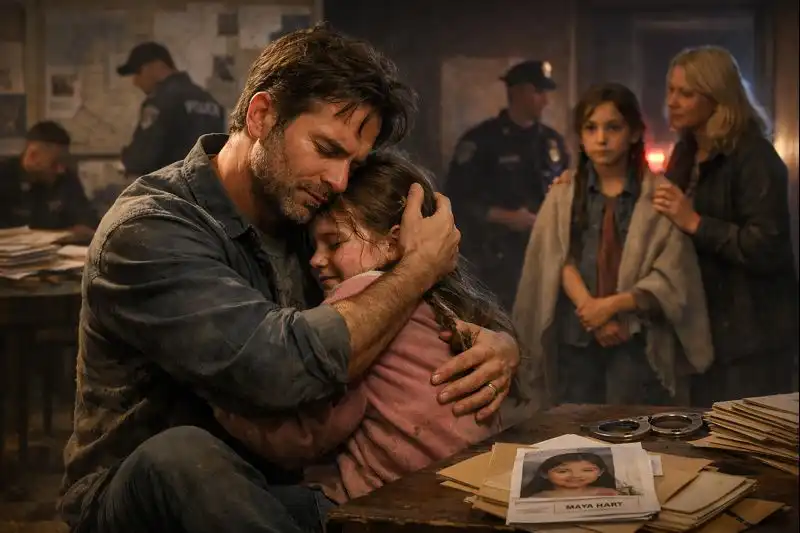
Because when they finally found Maya—three days later, in a house with quiet halls and locked rooms—my daughter didn’t run into my arms like a movie.
She stared.
Like she had to verify I was real.
Like she had learned not to trust miracles.
I knelt on the floor so I wouldn’t tower over her.
My hands shook.
“Maya,” I whispered. “It’s Dad. I’m here.”
Her eyes flickered over my face—searching for proof.
Then her voice came out thin and careful.
“You… came back?”
And in that moment, the world narrowed to one promise.
“Yes,” I said, swallowing the grief that had lived in my throat for two years. “And I’m not leaving again.”
She didn’t cry at first. Neither did I.
She just took one step forward.
Then another.
And when she finally touched my sleeve—just a light grip, like she was afraid I’d vanish—
I felt something inside me unclench for the first time in years.
Behind us, Lina stood in the doorway with a social worker, watching quietly.
Not smiling.
Not yet.
But she was standing.
Free.
The gala became an investigation. The “initiative” became evidence. And the people who’d clapped for hunger had to explain why they stayed seated while a child begged for food.
Some would deny it forever.
But denial isn’t the same as innocence.
As for me?
I thought the fight would end when I found my daughter.
It didn’t.
Because rescue is only the beginning.
But when Maya finally fell asleep on my shoulder that first night—breathing steady, warm, alive—
I understood the real ending wasn’t vengeance.
It was this:
The truth doesn’t just expose monsters. It brings the lost back into the light.
And if the world wants to hide behind pretty stories, let it.
I’m done hiding.
Not ever again.