“No man is strong enough for me,” the giant Apache woman said as three men lay groaning in the dust, and a fourth stood motionless, paralyzed by the realization that she had defeated them without weapons or any effort.
Nahimana stood taller than any of them, broad-shouldered, her body forged by necessity, not vanity, and her post-battle stillness was even more intimidating than the violence itself.
From the canyon ridge, Royce Barrett watched silently, holding his horse still, fascinated not only by the woman’s strength but by the precision of her every movement.
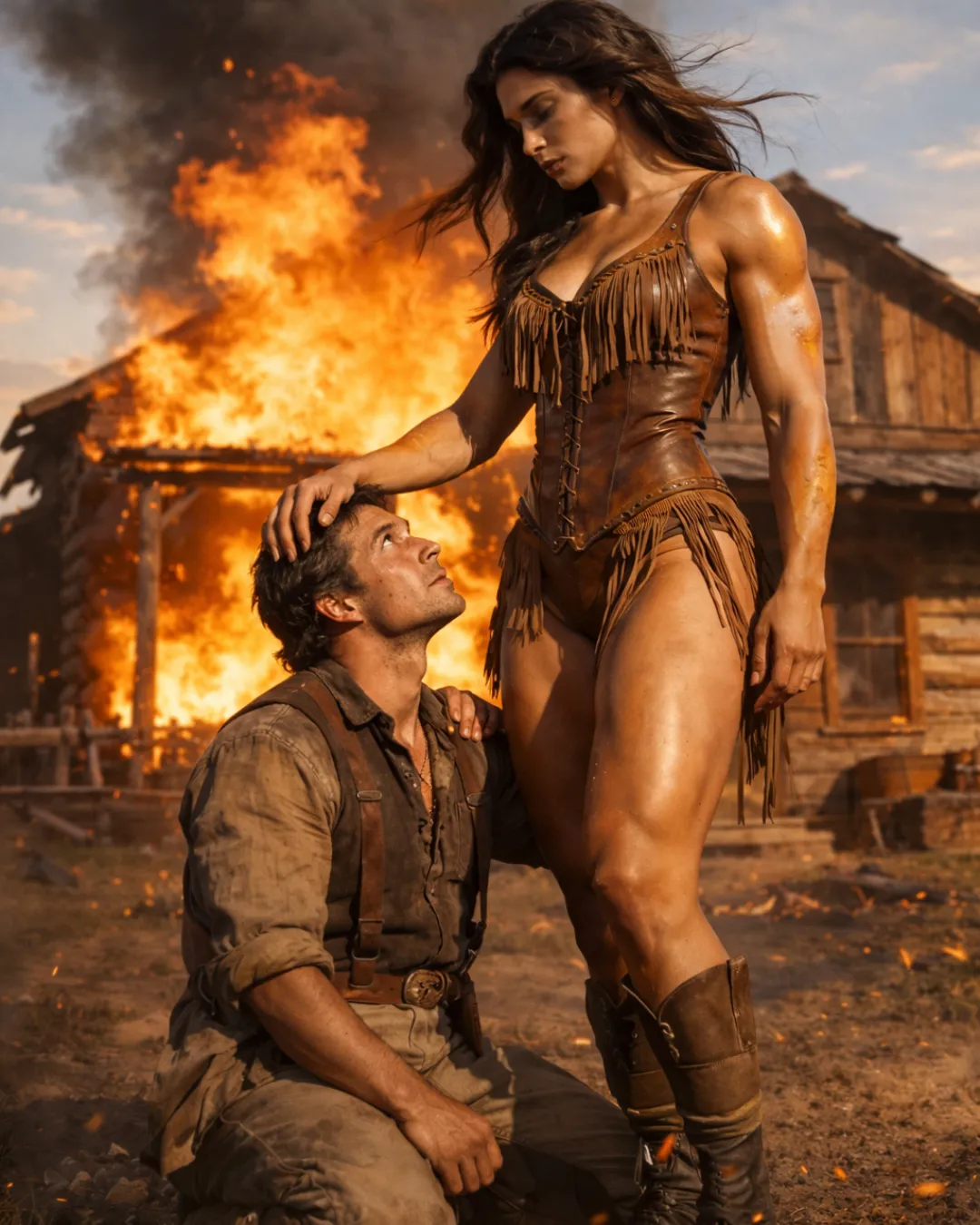
She fought not out of fury or pride, but like someone facing an unavoidable problem, weighing the consequences, letting them live when fear was enough to teach the right lesson.
The men fled, leaving their supplies behind, and Nahimana did not pursue them, for she knew that terror travels farther than violence and that these men would warn others about the canyon pass.
For years, she had turned her body and her reputation into a living wall, a stark warning to those who thought Apache land was just another territory they could seize.
When Nahimana looked up and her eyes met Royce’s in the distance, the air seemed to tighten, and the smile he offered her wasn’t friendly, but a silent challenge.
Royce descended slowly, his hands visible, remembering his mother’s teachings about respect without submission, aware that any wrong move could turn this encounter into a fatal mistake.
She ordered him to turn around, and he replied that he couldn’t, that he was carrying medicine for sick children beyond the canyon—words that struck a chord Nahimana didn’t want to hear.
Royce spoke without pleading or arrogance, asking for mercy to cross sacred land, and Nahimana studied him closely, reading his posture, his breathing, the way he didn’t touch his weapon.
“You’re not like the others,” she finally said, her words sharp, because that difference could make him more dangerous than any man who came to test her strength.
She turned her back on him as proof, awaiting the physical challenge that always seemed to come, but Royce refused to fight, asserting that there was more than one kind of strength.
That refusal disarmed Nahimana more than any blow, because she couldn’t overcome words that didn’t seek to impose themselves, only to exist with calm and conviction.

As they searched through the abandoned supplies, Royce offered her water before drinking himself, and that simple gesture stirred something uneasy inside Nahimana’s chest.
He spoke of his mother, an Apache healer who had saved her during a fever, and Nahimana touched the amulet around her neck, understanding that their stories had intersected without their knowledge.
That night, a landslide trapped members of their tribe, and without unnecessary words, Nahimana and Royce acted together, lifting rocks and stabilizing wounds with a coordination born of urgency.
She lifted a block that would have crushed anyone, while Royce carefully extracted the injured woman, and in that instant, they both understood that strength could also heal.
At dawn, the elder demanded that Royce leave, but Nahimana decided to accompany him, not out of defiance, but to ensure that the medicine arrived and that the promise was kept.
During the journey, they traversed hidden paths, shared long silences and brief confessions, discovering that both had been shaped by loss and the obligation to be strong.
Royce spoke of his sister who had died of a fever, of his mother, and Nahimana understood that his determination was not ambition, but a wound transformed into purpose.
When the mountain exhausted the horses, they shared a saddle, bodies forced to trust, learning that closeness didn’t always mean weakness.
She confessed that she had spent her life proving that no man was enough, because being strong alone was safer than letting someone stay behind.
Royce replied that strength wasn’t lost by sharing, that sometimes it multiplied when someone else helped bear the weight.

They arrived at the settlement and found children burning with fever, desperate parents, and fear disguised as mistrust, but necessity broke down barriers faster than any argument.
Nahimana worked alongside Royce all night, holding small bodies, singing in Apache, demonstrating that her hands could protect without destroying.
At dawn, the children were breathing easier, and the settlement understood that strength had no single face or clear boundaries.
Back in the canyon, Nahimana faced the decision she had avoided her entire life: to continue being just a wall or to allow herself to be something more.
Royce offered to stay nearby, help the settlements, respect the land, share the burden without trying to dominate it, and Nahimana felt something like…
The old man was breaking inside her.
She understood that she had never needed a man stronger than her, but someone strong enough not to compete with her power.
When they returned to the tribe, the old man saw something new in Nahimana, not weakness, but balance, and he accepted the choice she had made.
Nahimana had said for years that no man was strong enough for her, and she wasn’t wrong, just incomplete.
She needed someone who understood that true strength isn’t about winning, but about staying, healing, and building when running away would be easier.
In the days that followed, the canyon changed its rhythm, as if the land itself were adjusting to a new truth it had not known how to name before.
Nahimana no longer stood alone at the pass like a warning carved from stone, though her presence remained just as formidable.
Royce built no home there, asked for no claim, and that restraint earned him more trust than any oath could have secured.

Together they became something unfamiliar to both tribes and settlers alike: a point of balance rather than a boundary of fear.
Travelers learned that the canyon was no longer ruled by violence, but neither was it open to disrespect or greed.
Those who came with arrogance were turned away without a fight, unsettled by the quiet certainty in Nahimana’s gaze.
Those who came with need were questioned, measured, and sometimes allowed through, under the watch of both her judgment and Royce’s calm presence.
At night, they spoke little, but the silences between them were no longer defensive; they were shared.
Nahimana found herself sleeping without armor close at hand, a change so subtle it frightened her more than any enemy ever had.
Royce learned the names of stars in Apache, and she listened as he spoke of distant towns without longing, only memory.
Neither promised permanence, because both understood that strength built on obligation eventually collapses.
Instead, they chose consistency, showing up each day, lifting burdens that did not belong to one alone anymore.
When disputes arose, Nahimana listened before deciding, discovering that authority could exist without intimidation.
Royce watched her evolve without trying to guide her, knowing that real respect meant witnessing change, not directing it.
Over time, the children of the settlement laughed when they saw her coming, no longer afraid of the giant woman of canyon stories.
They knew her hands as steady, her voice as firm but kind, her presence as safety rather than threat.
Nahimana understood then that strength was not diminished by being seen differently; it was expanded.
She had not stepped down from her power; she had stepped into its full shape.
And when people whispered her old words, that no man was strong enough for her, she no longer corrected them.
The truth had simply grown larger than the sentence could hold.