
The mess hall at Fort Halcyon always sounded the same at noon—metal trays sliding over scratched counters, the soda machine coughing ice, and soldiers murmuring like they weren’t counting minutes.
Fluorescent panels hummed overhead, bleaching the room into a tired gray it had worn for years, like paint that gave up long ago.
Master Sergeant Eli Rowan had eaten in places like this most of his adult life, and twenty-two years in uniform taught him patterns.
He knew when laughter was real, when it was nervous, and when it was about to stop, and today the rhythm felt wrong.
Too quiet, too careful, like the entire room was holding its breath and waiting for permission to inhale again.
“Major’s in one of his moods,” Specialist Park muttered across the table, stabbing chicken with unnecessary force, eyes flicking toward the line.
Rowan didn’t look up immediately, because he didn’t need to, and everyone on Delta’s side sensed Major Lucas Hale the way you sense weather.
Conversations thinned, chairs scraped back early, and people suddenly remembered appointments they didn’t have, all to avoid being noticed.
“Lower your voice,” Rowan said automatically, though his own gaze slid over the rim of his coffee mug toward the serving line.
Hale stood there—uniform crisp, boots mirror-bright, sleeves rolled with calculated precision, wearing his body like a weapon that wanted applause.
His jaw was tight, eyes scanning like they were hunting, because Hale didn’t just like to be seen.
He liked to be felt, like gravity, like a warning, like a hand on the back of your neck.
He’d arrived less than a year ago with glowing evaluations and a reputation for “results,” the kind leadership loves from a distance.
It didn’t take long for whispers to shift, because tough became volatile and fair became selective, and excuses floated like smoke.
Stress, command pressure, expectations—those were the words people used after hours to make fear sound professional.
Three months ago Rowan watched Hale grab a young private by the collar over unshined boots, leaning close, voice low and violent.
The private shook so hard she dropped her tray, and the sound of it hitting tile haunted Rowan longer than it should.
“Are you filing that?” another NCO asked later, cautious, as if the question itself could earn punishment.
Rowan stared at the command office door and remembered a different base, a different superior, a vanished investigation, and chose caution.
“I’ll handle it,” he’d said, promising himself he would, as if promises were enough to stop patterns once they started.
He did talk to command, and the battalion commander sighed, nodded, muttered about discipline and pressure, and promised to “have a word.”
No report, no record, no change, and the pattern continued because silence has a way of becoming policy.
Now Hale stood near the coffee station, and someone else stood there too, someone Rowan didn’t recognize, which made his stomach tighten.
Rowan knew every soldier in Delta by face, if not name, and this woman was not one of them.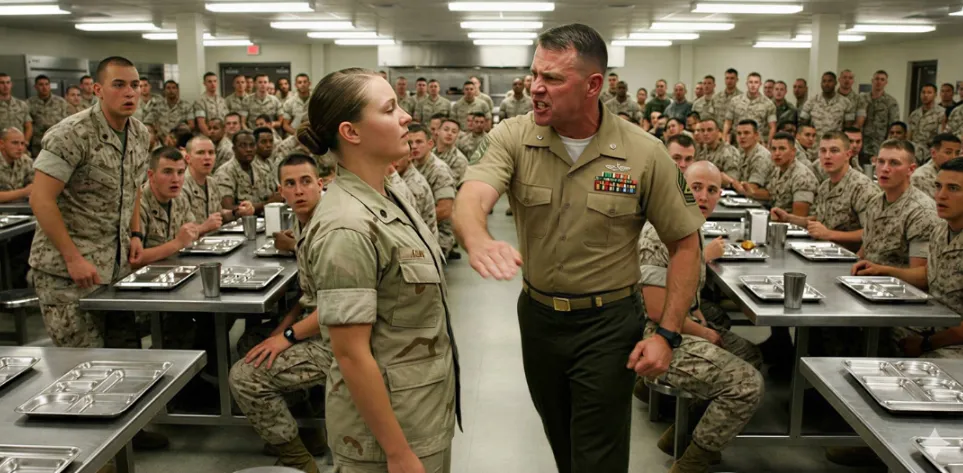
She was short, maybe five-five, dark hair in a severe regulation bun, uniform spotless, sleeves down, boots practical instead of showy.
What caught Rowan wasn’t her posture.
It was what was missing: no visible rank, and no name tape he could read from this distance.
“That’s weird,” Park murmured, “who shows up without—” and Rowan cut him off before curiosity became trouble.
“She’s not ours,” Rowan said quietly. “Eyes front,” because the safest questions are the ones you don’t ask aloud.
The woman held a chipped mug, waiting for the coffee pot’s last sputtering pour, not slouched, not stiff, just still.
Alert, controlled, like someone who learned that stillness could be a weapon and also a shield.
Rowan felt a prickle between his shoulders, the sense of an approaching snap, and he watched Hale start moving with purpose.
Hale didn’t raise his voice at first, because he preferred control to volume, and control to him was a kind of pleasure.
“You,” he said, stopping a step too close. “What unit are you with?” like the mess hall belonged to him personally.
She turned slowly and met his gaze without haste. “Excuse me, sir?” and the room fell silent in a way that felt practiced.
Rowan’s grip tightened around his mug, because Hale hated being questioned, even politely, especially when other people could see it.
“I asked you a question,” Hale snapped. “You don’t wander into my mess hall without proper identification,” voice sharp with entitlement.
“Yes, sir,” the woman replied evenly, calm without being submissive. “I’m authorized to be here,” like she’d rehearsed steadiness.
Hale laughed, short and humorless. “Funny how authorization usually comes with rank insignia,” and soldiers shifted like they wanted to disappear.
Rowan watched Hale’s hand, because he recognized the flex of fingers and the shoulder roll, a warning sign he’d seen before.
“Sir,” the woman said, still calm, “if there’s an issue, I’m happy to—” and Hale struck her before the sentence could land.
It wasn’t a punch, and somehow that made it worse, an open-handed slap that cracked off the walls like a gunshot.
The mug shattered on the floor, coffee splashing across her boots, her head snapping to the side, a red mark blooming instantly.
For half a second no one moved, and Rowan was already standing, chair scraping back loud enough to feel like confession.
Around him other chairs scraped too, but bodies stayed rooted, held in place by rank and fear and years of conditioning.
“What the hell—” Park whispered, voice thin, and Rowan didn’t answer because there wasn’t a safe answer.
The woman straightened slowly without touching her cheek, without shouting, without acting like a victim the way bullies expect.
She simply looked back at Hale, and the silence stretched, thick and suffocating, like the room itself was waiting for consequences.
“You do not speak to a superior like that,” Hale growled. “You will learn—” and she cut through him with calm.
“Sir,” she said steadily, “you’ve made a serious mistake,” and something in her tone made Rowan’s pulse spike again.
Hale scoffed. “You’re a private with no name tape. You don’t get to tell me anything,” and his confidence sounded rehearsed.
She reached into her pocket without drama, and hands around the room shifted instinctively toward holsters, because movement is contagious.
She pulled out a phone, tapped once, then again, and spoke like procedure, not emotion, was her real weapon.
“I’m placing a call,” she said calmly. “You might want to stand down,” and Hale barked laughter like noise could erase risk.
“Put that away before I add insubordination to your list,” Hale snapped, and she lifted her gaze past him toward the exit.
“I wouldn’t,” she said. “They’re already on their way,” and Rowan felt the ground under Fort Halcyon crack.
The doors at the end of the mess hall swung open, and the room froze as if someone had turned off the air.
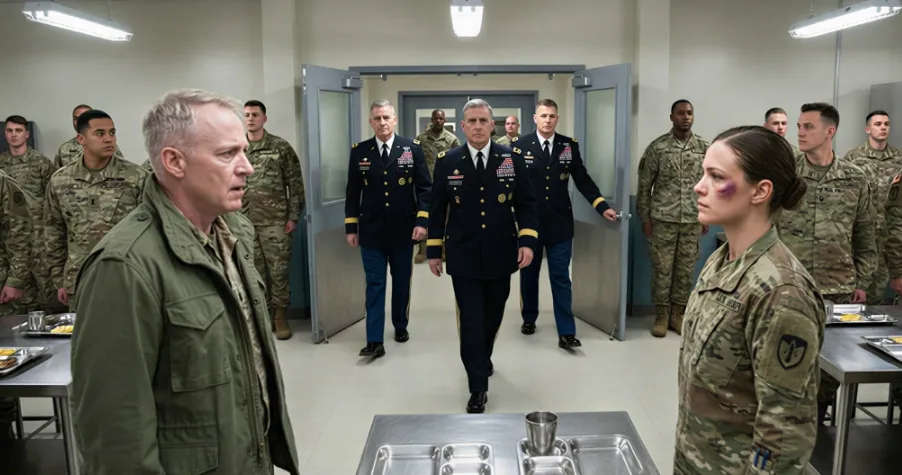
The double doors opened with a hydraulic hiss, and three officers stepped inside with the kind of quiet weight that doesn’t need sound.
They didn’t hurry and they didn’t shout, because authority like theirs moves like gravity and people react before thinking.
Every soldier recognized the insignia before their minds finished processing it, and attention snapped into place in staggered waves.
Lieutenant General Arthur Kline led, silver stars stark, and beside him walked Major General Denise Alvarez, posture rigid, expression stone.
On Kline’s left was Brigadier General Samuel Rourke, gaze sweeping the room with surgical precision that made Rowan’s skin prickle.
No aides, no ceremony, no warning, and the absence of performance made their arrival feel even more terrifyingly deliberate.
Hale turned, and the color drained from his face so quickly it looked almost unreal, like someone erased him with one stroke.
“Sirs—” Hale began, snapping to attention with terror more than training. “I wasn’t informed—” and Kline raised one hand.
Hale stopped instantly, and Kline’s gaze moved past him to the woman near the coffee station with the mark on her cheek.
“Ms. Mercer,” Kline said quietly, and the room exhaled disbelief because “Ms.” landed like a blade through assumption.
Mercer nodded once. “Sir,” and Rowan felt the word “civilian” forming in the room before anyone dared to say it.
“You injured?” Alvarez asked, clipped and professional, the voice of someone who counts damage without flinching.
“No, ma’am,” Mercer replied. “But the assault was witnessed by approximately seventy-two personnel,” and the word “assault” changed everything.
Hale’s mouth opened and closed, hands trembling at his sides, because the room was no longer his stage.
“Major Hale,” Rourke said, finally turning full attention to him, “step away from the investigator,” voice controlled and deadly calm.
“She’s not a soldier,” Hale blurted. “No rank, no tape—” and Rourke’s eyes hardened like a door locking.
“Major, you will stop speaking,” Rourke said, and Hale obeyed because fear finally outranked his ego.
Kline examined Mercer’s face without touching her. “You were told to remain low-profile,” he said, voice quiet and disappointed.
“I did,” Mercer replied. “I removed insignia and name tape as instructed,” and the room understood the trap they’d been living in.
“And you were still struck,” Kline said, and Mercer answered, “Yes, sir,” like confirmation mattered more than drama.
Kline turned to Alvarez. “Initiate lockdown,” he said, and Alvarez lifted her radio without hesitation, already moving the machine.
“Implement full base lockdown immediately,” Alvarez ordered. “No departures, no off-base communications, secure all command offices,” and acknowledgments crackled back.
A low murmur rippled through the mess hall, because lockdowns weren’t drills, they were statements that something rotten was being cut out.
“What is this?” Hale demanded, panic cracking his voice. “Sir, with respect, this is my command,” and Kline turned slightly.
That small movement silenced Hale, and the room learned how fast power can reverse when oversight stops being theoretical.
“Major Hale,” Kline said, “you are relieved of command effective immediately,” and the words landed like artillery in human language.
Hale’s knees wobbled. “This is a misunderstanding. I was enforcing discipline,” and Alvarez’s voice cut through him like ice.
“You struck a civilian oversight investigator,” she said coldly, and the mess hall erupted into stunned whispers that no one could swallow.
Rourke stepped closer. “Ms. Mercer is attached to the Office of Command Integrity. She reports directly to us,” and Hale’s breathing went thin.
“That office doesn’t—” Hale started, and Rourke cut him off. “Doesn’t exist? That’s the point,” and Rowan felt chills.
Mercer spoke calmly. “Your conduct has been under review for six months: physical aggression, intimidation, misuse of authority, retaliation, suppression.”
She met Hale’s eyes. “Today’s incident was the final confirmation,” and Hale’s composure cracked into anger and denial.
“This is a setup,” he snapped. “You provoked me,” and Mercer replied, flat and precise, “I walked in for coffee. You escalated.”
Kline addressed the room. “All personnel remain in place until further notice. Witnesses will be interviewed. Retaliation will be punished.”
Rowan felt something loosen inside his chest, something he hadn’t realized had been clenched for years in the shape of helplessness.
Two MPs entered from the side door, faces blank, movements efficient, and their presence felt like the first honest thing in months.
“Major Hale,” Rourke said, “surrender your sidearm and follow the MPs,” and Hale looked around for allies and found none.
No one moved, no one met his eyes, and Rowan didn’t look away, because refusing to flinch was its own small rebellion.
Hale’s shoulders sagged. He unclipped his weapon with shaking hands and handed it over like he was giving away his last illusion.
As the MPs escorted him out, Hale twisted toward Mercer, fury and desperation wrestling on his face like drowning men.
“This isn’t over,” he hissed. “You think this ends my career?” and Mercer didn’t blink when she answered.
“Yes,” she said, and the simplicity made it final in a way threats never are.
The doors closed behind him, and the room stayed silent for seconds that felt longer than months of swallowed stories.
Kline turned to Mercer. “We’ll need your full report,” and she replied, “It’s already submitted,” voice calm as paperwork.
“Including video, audio, and sworn statements,” Mercer added, “from personnel who believed no one was listening,” and Rowan swallowed hard.
Alvarez scanned the room. “You’ll have the opportunity to speak freely, without consequence,” she said, firm but not unkind.
Rourke added, “This base remains under oversight. Command restructuring begins today,” and the word “today” sounded like salvation.
Kline’s gaze lingered on Rowan for a fraction of a second, recognition passing like a signal that didn’t need explanation.
“Ms. Mercer,” Kline said, “you’re done here,” and Mercer nodded, retrieving her phone with steady hands.
As she passed Rowan’s table, their eyes met, and for the first time her expression softened, almost imperceptibly.
“Thank you for watching,” she said quietly. “Even when you couldn’t act,” and Rowan’s throat tightened with regret.
“I should’ve done more,” Rowan admitted, and Mercer shook her head once, like she’d expected that exact confession.
“You’re about to,” she said, and then she walked out, leaving the room with the sound of accountability behind her.
The lockdown alarms began—low, steady, unmistakable—and Fort Halcyon felt like it had been sealed for surgery, not punishment.
The lockdown lasted twelve hours, and twelve hours on a base can feel like a lifetime when truth is finally given room.
Rowan spent most of it in a windowless interview room smelling of disinfectant and old coffee, across from a captain he didn’t recognize.
No unit patch, no familiar face, just a recorder, a neutral voice, and questions that refused to let fear hide behind convenience.
“Describe Major Hale’s behavior over the past six months,” she said, and Rowan answered carefully at first, then steadily, then fully.
Names, dates, incidents he’d buried under routine and rationalization, and each time he hesitated she waited without rescuing him.
When he finished, she nodded. “Your statement corroborates others,” and that single word—others—settled like relief inside his ribs.
By the time he was released, the base felt different: quieter, but breathable, like pressure had moved on and left clean air.
Soldiers clustered openly. MPs stood at command entrances not as threats, but guarantees, and Rowan watched people talk without flinching.
At 0600 the next morning, a formation was called, and everyone knew why even before boots aligned in straight rows.
Kline stepped onto the platform with no band and no flourish, just facts delivered like steel.
“Major Lucas Hale is charged with assault, abuse of authority, obstruction of reporting, and conduct unbecoming,” Kline announced, voice flat.
“He is pending court-martial,” and a ripple moved through the formation, controlled, contained, but impossible to hide.
“Several senior personnel failed to intervene,” Kline continued. “Administrative actions are underway,” and Rowan felt grim balance, not joy.
“This base exists to train, protect, and lead,” Kline said, “not to shelter misconduct,” and the words sounded like a door opening.
Then Kline looked directly at the enlisted ranks, not over them, not past them, and spoke like he meant it.
“Silence protects the wrong people,” he said. “That ends here,” and Rowan felt something in the culture crack for good.
Within days the changes became visible: an interim commander arrived, Colonel Naomi Fletcher, sharp-eyed and unafraid of eye contact.
An open-door policy that wasn’t theater, anonymous reporting channels that worked, mandatory reviews going back two years, and reopened statements.
Soldiers who had transferred under “performance issues” got calls, patterns were mapped, and fear stopped being the unofficial supervisor.
Rowan watched with relief and shame, because he hadn’t been blind, he’d just been careful, and careful had cost people.
Nearly two weeks later Rowan was called to headquarters again, and this time the office had windows and real light.
Ms. Mercer sat at a table in plain clothes, a blazer and slacks, the mark on her cheek gone but faint bruise lingering.
She looked up. “Master Sergeant Rowan,” she said, and Rowan hesitated over titles like he didn’t know what language fit anymore.
“Either’s fine,” Mercer said with a faint smile, and Colonel Fletcher stepped out, leaving the room to honest quiet.
“I wanted to thank you,” Mercer said. “Your testimony mattered,” and Rowan nodded, the guilt still sitting heavy in his chest.
“I should’ve spoken sooner,” he said, and Mercer answered, “You weren’t why the system failed. You’re why it finally worked.”
Rowan exhaled slowly, like he’d been holding that breath since the first time he watched Hale cross the line.
“What happens now?” Rowan asked, and Mercer folded her hands like she was closing a file, not a life.
“Hale will be prosecuted. Others will face consequences. The Office of Command Integrity moves on,” she said, voice steady.
“And you?” Rowan asked, and Mercer held his gaze without flinching from what the question really meant.
“I go where I’m needed,” she said. “Usually where people think oversight doesn’t exist,” and Rowan felt the truth in his bones.
“You knew he’d hit you,” Rowan said quietly, and Mercer didn’t deny it, because denial would be childish here.
“I knew he might,” she replied, and Rowan shook his head, unsettled by the cost of proving what everyone suspected.
“That’s a hell of a risk,” Rowan said, and Mercer answered, “Yes,” then added, “Not as risky as letting it continue.”
Mercer reached into her bag and placed a small card on the table—no seal, no logo, just a phone number.
“If you ever see something again and you’re not sure who’s listening, call,” she said, and the paper felt heavy with promise.
Rowan picked it up like it was a duty he’d been avoiding. “I will,” he said, and Mercer nodded once.
Three months later Fort Halcyon barely resembled what it had been, not because standards dropped, but because fear stopped running them.
Morale rose, retention stabilized, training improved, and people spoke up without expecting the floor to open under them.
Hale’s court-martial was swift, guilty on all counts, and his career ended with a record that couldn’t be massaged away.
One afternoon Rowan stood in the mess hall watching recruits laugh too loudly over bad food, and the fluorescent lights still buzzed.
The chicken was still overcooked, the counters still scratched, but the rhythm was right again, like breathing had returned.
As Rowan turned to leave, his phone buzzed with a message from an unknown number, short and clean like a final signature.
“Oversight complete. Fort Halcyon cleared,” it read, and Rowan slipped the phone away, feeling something like peace.
Somewhere else another mess hall hummed, another command breathed too easily, and somewhere nearby someone unseen was already watching.
Mi mamá lleva tres días dormida; una niña de 7 años arrastró carretilla y salvó a sus hermanos…_yennhi
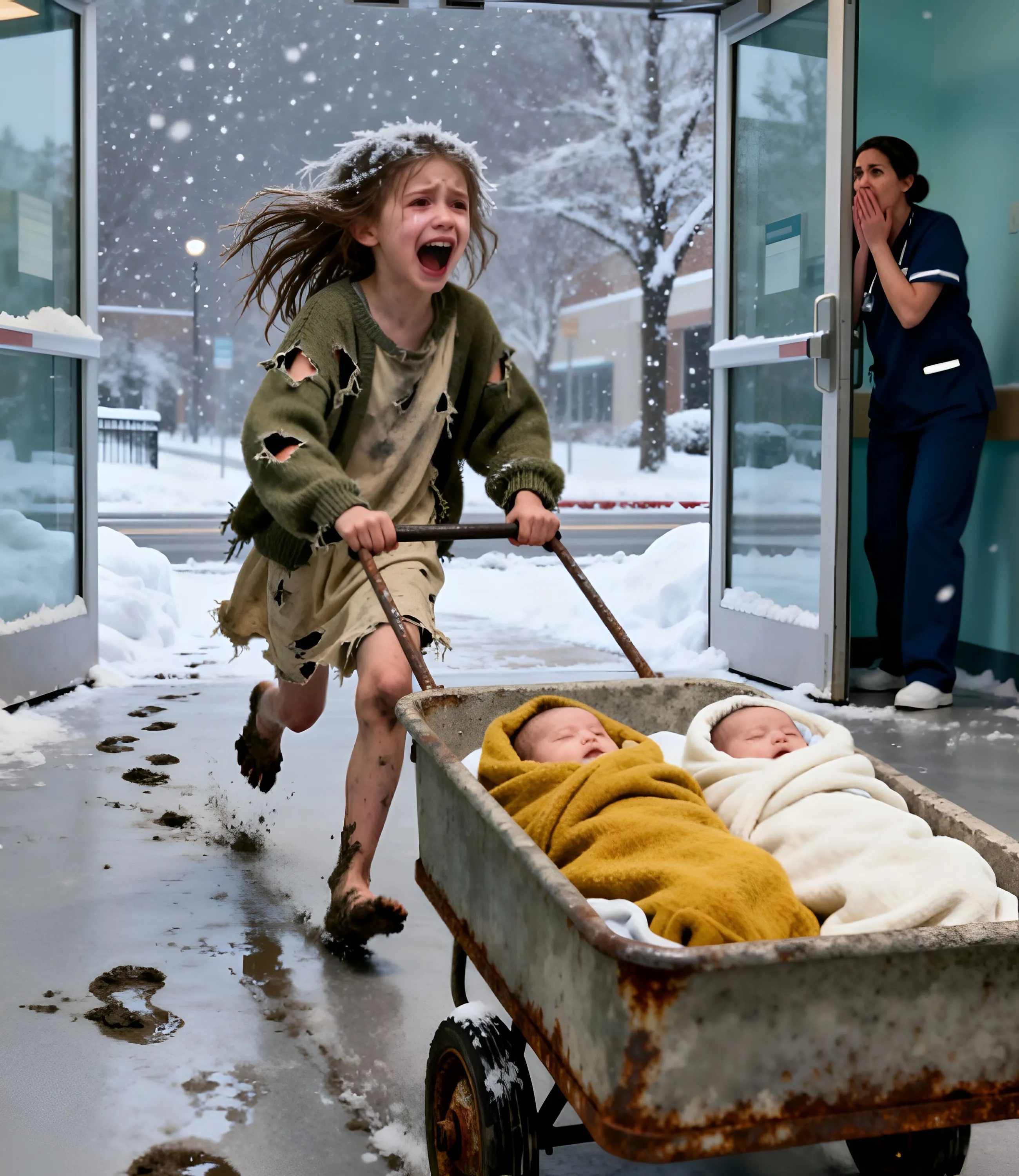
“Mi mamá ha estado dormida tres días.” Una niña de siete años empujó una carretilla kilómetros para salvar a sus hermanos recién nacidos. Lo que pasó después dejó al hospital sin palabras.
Cuando la recepcionista la vio entrar tambaleándose, pensó que era una broma. Una niña pequeña. Descalza. Con pies agrietados y sangrantes, empujando una carretilla oxidada y chirriante con manos temblorosas.