He unlocked the front door slowly, avoiding the click of the latch. The house smelled like antiseptic and quiet. One step. Silence. Another.
Then he heard it.
Not crying.
Not television noise.
Laughter.
Wild, uncontrollable, explosive laughter.
It came from the kitchen.
Michael’s jaw tightened. Laughing? With my son?
Rage flooded him. He imagined Rebecca on speakerphone, joking with friends while Ollie sat strapped in his chair. His shoes struck the marble hallway sharply as he strode toward the sound.
He reached the kitchen doorway.
“What is going on in—”
The words evaporated.
His briefcase slipped from his hand.
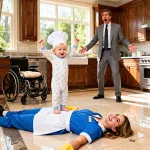
The kitchen was drenched in sunlight. And in the center of it lay Rebecca — flat on her back on the tile floor, wearing her pale green uniform and absurd yellow kitchen gloves. Her dark curls fanned around her head, and she was laughing so hard tears streaked her cheeks.
But she wasn’t what stole Michael’s breath.
Oliver was not in his wheelchair.
The sleek, imported chair — the one Michael had spent a fortune on — stood empty by the refrigerator.
Oliver was standing.
Standing on Rebecca’s stomach, wobbling but upright. His striped pajamas bunched at the ankles, a tiny plastic crown perched crookedly on his head. His arms were raised triumphantly, his face lit with joy so pure it almost hurt to see.
He was laughing.
Rebecca held his ankles gently, steady but not restraining, chanting softly, “Up you go, superhero. Show the world.”
Michael’s mind screamed impossible. The neurologist’s voice echoed in memory.
Weak lower-limb response. Do not force mobility. The wheelchair is necessary. Accept reality.
Accept reality.
Michael had built a life around that sentence. Protective. Controlled. Safe. He forbade crawling to prevent “false hope.” Structured therapy. No risks.
And here was this woman undoing it all on a kitchen floor.
Fear detonated into fury.
“Rebecca!”
The engine cut off two blocks before the estate. Michael Harrington didn’t want the rumble of his car announcing his return. He had rehearsed this moment all week, carefully, obsessively — like a surgeon preparing to cut something rotten out.
He straightened his navy tie, fingers trembling slightly. Three days, he muttered to his reflection in the rearview mirror. His eyes were rimmed red from sleepless nights. He had told everyone he’d be out of the country at a medical conference. The house would be unsupervised. If Rebecca showed her true colors, today he would see it.
A month earlier, he had hired her through a small agency after every certified nurse had quit. No one wanted to tolerate his temper — or the heavy sorrow that seemed embedded in the walls of that mansion.
Rebecca Lane had stood out immediately. Too bright. Too optimistic. Too alive for a house that felt like a mausoleum.
The doubt hadn’t started with him. It came from the neighbor, Mrs. Eleanor Pike, who lived permanently behind lace curtains.
“That girl is odd,” she’d warned him in a hushed voice. “Yesterday I heard shouting. And music. Loud music — with a sick baby inside? Be careful. People who smile that much are hiding something.”
Those words had burrowed deep.
His son, Oliver — little Ollie — was one year old and already labeled by specialists as permanently limited. Partial paralysis in both legs. Minimal nerve response. Adjust your expectations, they had told him.
Michael kept the diagnosis locked in his office safe like a verdict. Ollie was fragile. Breakable. His wife had died during childbirth; the thought of losing the only piece of her left had twisted Michael into someone he barely recognized.
If Rebecca was careless — if she was playing games while he was gone — he would destroy her professionally.
He unlocked the front door slowly, avoiding the click of the latch. The house smelled like antiseptic and quiet. One step. Silence. Another.
Then he heard it.
Not crying.
Not television noise.
Laughter.
Wild, uncontrollable, explosive laughter.
It came from the kitchen.
Michael’s jaw tightened. Laughing? With my son?
Rage flooded him. He imagined Rebecca on speakerphone, joking with friends while Ollie sat strapped in his chair. His shoes struck the marble hallway sharply as he strode toward the sound.
He reached the kitchen doorway.
“What is going on in—”
The words evaporated.
His briefcase slipped from his hand.
The kitchen was drenched in sunlight. And in the center of it lay Rebecca — flat on her back on the tile floor, wearing her pale green uniform and absurd yellow kitchen gloves. Her dark curls fanned around her head, and she was laughing so hard tears streaked her cheeks.
But she wasn’t what stole Michael’s breath.
Oliver was not in his wheelchair.
The sleek, imported chair — the one Michael had spent a fortune on — stood empty by the refrigerator.
Oliver was standing.
Standing on Rebecca’s stomach, wobbling but upright. His striped pajamas bunched at the ankles, a tiny plastic crown perched crookedly on his head. His arms were raised triumphantly, his face lit with joy so pure it almost hurt to see.
He was laughing.
Rebecca held his ankles gently, steady but not restraining, chanting softly, “Up you go, superhero. Show the world.”
Michael’s mind screamed impossible. The neurologist’s voice echoed in memory.
Weak lower-limb response. Do not force mobility. The wheelchair is necessary. Accept reality.
Accept reality.
Michael had built a life around that sentence. Protective. Controlled. Safe. He forbade crawling to prevent “false hope.” Structured therapy. No risks.
And here was this woman undoing it all on a kitchen floor.
Fear detonated into fury.
“Rebecca!”
She turned instantly but did not release Oliver. Her grip tightened to steady him.
Oliver startled, wobbling.
Michael rushed forward. “Let him go! Are you insane? He could fall — he’s disabled!”
He scooped Oliver into his arms. The baby began to cry — not from injury, but from being pulled away from something he clearly loved.
“You’re fired,” Michael snapped. “Pack your things. This is reckless endangerment.”

Rebecca sat up slowly, rubbing her elbow where he’d shoved her. Her expression wasn’t submissive. It was steady.
“He’s not crying because he’s hurt,” she said calmly. “He’s crying because you stopped him.”
Michael strapped Oliver back into the wheelchair. The buckle snapped shut like a lock.
“You think this is progress?”
“I think that chair is a tool,” she replied. “Not a prophecy.”
“Enough,” he barked. “He’s disabled.”
Oliver covered his ears at the volume of his father’s voice.
Rebecca stood.
“That’s where we differ,” she said quietly. “You love the son you’re afraid of losing. I love the son who’s right in front of us.”
The words struck deeper than he expected.
She walked to the counter and handed him a notebook.
Daily logs. Exercises. Muscle responses. Small gains.
The last entry read: 9:15 a.m. — Stood independently for six seconds.
Michael shook his head. “This is fantasy.”
“Then watch,” she said.
She placed Oliver on the floor.
Slowly, she let go.
Oliver trembled. His knees quivered.
But he stayed upright.
One second.
Two.
Then he took a step.
Then another.
“Daddy!” he squealed.
Michael’s knees nearly gave out. The world he had clung to cracked open.
His son was not broken.
He had been protected into stillness.
Shame flooded him. Followed by something softer. Terrifying.
Hope.
Rebecca explained the homemade strengthening games. The music Mrs. Pike had heard was rhythm exercises. The shouting was effort, not pain.
“You can’t wrap courage in bubble wrap,” she said gently.
Michael removed his tie. His jacket. His defenses.
He got down on the floor.
And when Oliver wobbled toward him, giggling, Michael let himself laugh too.
Months later, the neurologist stared in disbelief as Oliver toddled across the clinic floor.
“This is… unexpected,” the doctor murmured.
Michael closed the tablet holding the old prognosis.
“My son isn’t a file,” he said. “He’s a fighter.”
At the park, Michael once offered Rebecca money — a bonus, a way out if she wanted it.
She smiled and shook her head.
“I didn’t stay for a paycheck,” she said. “I stayed because I believed.”
She remained part of their lives.
Years passed. Oliver ran. Fell. Scored goals. Climbed trees his father once would have banned.
One afternoon, another anxious father approached Michael on a park bench.
“They say my daughter may never walk,” the man whispered.
Michael looked at Oliver racing across the field.
“Doctors understand medicine,” he said quietly. “They don’t decide futures.”
At sunset, laughter spilled from the once-silent house. It was messy. Loud. Alive.
The mansion was no longer a monument to fear.
It was a home.
And the man who once believed his son was made of glass had finally learned—
He was made of courage.
And sometimes, so was the woman brave enough to challenge him.