Part 1
The sun hadn’t cleared the Pacific yet, but Coronado was already awake.
At 5:15 a.m., the air tasted like salt and old sweat, the kind that lived in concrete walls and never fully washed out. Lieutenant Roxan “Roxy” Jet finished her three-hundredth burpee without drama. No flourish. No pause to let anyone see what it cost.
Down. Up. Jump.
Down. Up. Jump.
Around her, twenty-eight SEALs matched the cadence, a synchronized grind that sounded like boots and breath and stubbornness. The instructors didn’t need to shout. The work spoke for itself. This place didn’t care about speeches. It cared about repetitions.
Roxy rose on the last one like a machine, then stood still with her hands on her thighs, eyes forward, refusing to fold in half the way her lungs begged her to. She knew the feeling well—burning chest, buzzing arms, legs so tight they felt bolted to bone. She’d lived in that edge since she was a teenager, back when the idea of a woman in the Teams was still something people said with a laugh.
Now she was here, one year, eight months, and nine days into wearing a trident on her chest.
And every morning she made sure nobody forgot what it had taken to earn it.
“Recovery stretch, move,” Commander James Torres called, voice crisp in the dawn.
Torres wasn’t the kind of leader who performed. He didn’t need to. He’d been in the Teams longer than Roxy had been alive, and the lines around his eyes looked like they’d been carved by wind and bad sleep. When he said move, people moved—not because he was loud, but because he was right.
Roxy dropped into a stretch, smooth and controlled. No tremor. No wince. She’d learned that if you showed pain, some people treated it like an invitation. Doubt was contagious out here. Disrespect was worse.
This was her family now—men who’d watched her crawl through Hell Week, who’d seen her shake and puke and keep going anyway. It hadn’t made everyone love her. It had made them accept a simple fact: she belonged.
The gate at the edge of the training ground rattled. Engines rolled in low and heavy.
Three matte-green Humvees rolled through the morning like they owned it, each door stamped with UNITED STATES MARINE CORPS. The rumble cut through the quiet in a way that made heads lift and shoulders tighten.
SEALs and Marines had a relationship that shifted with context. Sometimes it was pure respect, the kind you only give another person who’s lived in the same hard places. Sometimes it was rivalry wrapped in jokes that carried teeth. Both sides thought they were the sharper blade.
The Humvees stopped. Doors opened.
Eight Marines stepped out, all male, all built like they’d been assembled from spare parts labeled aggression and confidence. Their posture had that Force Recon swagger—loose, but ready. Like the world was a door and they’d been born to kick it in.
Roxy recognized the type instantly. She’d grown up around it.
Her brother had been one, too, before he’d joined the Navy and disappeared into the quiet, dangerous world that didn’t make recruiting posters.
The lead Marine moved first. Tall—six-three, maybe more—with shoulders like a linebacker and a jaw that looked chiseled from frustration. Staff Sergeant chevrons rode his sleeve. The name tape read HAYES.
Torres stepped forward, hand out. “Commander James Torres. Welcome to Coronado.”
Hayes shook with a firm, deliberate grip, eyes sweeping the assembled SEALs like he was counting them. His gaze landed on Roxy and stayed there just a touch too long.
Three seconds.
His mouth twitched like he’d smelled something sour.
Torres didn’t miss it. Neither did Roxy.
“This is a joint training detachment,” Torres said, voice even. “Two weeks. Advanced close-quarters, hostage rescue, extraction, the whole package. We do this clean. We do it professional.”
“Crystal, Commander,” Hayes said.
The words were respectful. The tone carried something else. Like he was agreeing out loud while disagreeing in his head.
Introductions began. One by one, SEALs stepped up, shook hands, exchanged the usual warrior language—short, blunt, polite.
When Torres brought Hayes to Roxy, she stepped forward and extended her hand.
“Lieutenant Roxan Jet,” she said. “Good to have you here, Staff Sergeant.”
Hayes stared at her hand like it was a test. Then he took it, grip tightening just enough to send a message.
“Staff Sergeant Gunner Hayes,” he said. Then he added, “Ma’am.”
He said ma’am like it was a dare.
Behind him, a shorter Marine with ice-blue eyes and a buzzcut leaned in just slightly, smirk already loaded.
His name tape read FROST.
“Didn’t know SEALs were recruiting for diversity posters now,” Frost said, just loud enough for everyone to hear.
The Marines chuckled—small, controlled, like they were marking territory. The SEALs went still. A few eyes slid toward Roxy, watching for reaction.
Roxy’s expression didn’t change.
Funny thing about being underestimated: you get used to the sound of it.
She tilted her head a fraction. “Didn’t know Marines were still recruiting for Neanderthal reenactments.”
The chuckles stopped.
Frost’s smirk blinked out of existence. Hayes’s jaw tightened.
Torres stepped between them with the smoothness of a man who’d broken up worse fights in worse places. “That’s enough. Lieutenant Jet earned her trident the same way every operator here did. Blood, sweat, and refusing to quit. You’ll show her the same respect you show anyone in this formation.”
Hayes didn’t argue. He didn’t need to.
“Understood,” he said.
But his eyes stayed on Roxy as if the idea of her in this space offended something deep and old.
Training began.
The first days were the normal kind of brutal—room entries until everyone’s knees ached, dry runs until movements felt like instinct, drills that punished hesitation. They moved in mixed stacks—SEALs and Marines shoulder to shoulder—learning each other’s rhythms, figuring out who spoke with their hands, who spoke with their silence.
Roxy performed the way she always did: clean, fast, efficient. She didn’t try to impress. She tried to be undeniable.
It didn’t matter.
By the third day, the mockery moved from subtle to casual, as if the Marines had decided it was okay to be loud about what they thought.
In the chow hall, Frost leaned across a table and said, “Hey, Princess, pass the salt.”
The word landed like a slap dressed up as a joke.
Princess.
Roxy didn’t look up. She slid the salt across the table without comment.
The Marines laughed softly. The SEALs didn’t.
Roxy swallowed her anger the way she’d swallowed it her whole life—quietly, deliberately, like medicine that tasted bad but kept you alive.
By day five, she opened her locker in the team room and found the word carved into the metal, deep and crude.
PRINCESS.
For a second, something cold settled in her chest. Not rage—rage was loud and sloppy. This felt sharper. Cleaner.
Behind her, she could feel eyes. Some of the SEALs looked uncomfortable. Some looked away. None of them said a word.
Roxy closed the locker slowly, the metal clanging like a bell.
Then she picked up her gear and walked out.
She found Torres in his office twenty minutes later. He looked up from a stack of paperwork and read her face like it was a map.
“Let me guess,” he said, tired. “Hayes and his choir boys.”
“It’s fine, sir,” Roxy said.
Torres leaned back in his chair, studying her. “Jet.”
She didn’t flinch, but her eyes flicked once, just once, toward the defaced locker in her mind.
Torres sighed and stood, moving to the window that overlooked the training grounds. The surf sounded distant, steady, like a heartbeat.
“You know what your brother used to say?” Torres asked quietly.
Roxy’s spine stiffened. The name of her brother didn’t get spoken often out loud. Not here.
“Sir,” she warned, voice tight.
Torres didn’t push past her boundaries. He just spoke like a man acknowledging a truth.
“He said the best operators aren’t the ones who never get hit. They’re the ones who get hit and keep moving forward.”
Roxy’s throat tightened, and she hated that it did.
Torres looked out at the grounds, then back at her. “They’re laughing now, Jet. But you make them regret the echo.”
Roxy wanted to ask what he meant. Wanted to ask if he was telling her to fight, or to endure, or to let it go.
Instead, Torres nodded toward the door, dismissing her with the same calm authority he used on everyone.
Roxy left without another word.
That evening, she stood alone on the beach behind the base, boots in the sand, waves rolling in with that relentless patience the ocean had. The sky burned gold and red as the sun sank, and for a moment the Pacific looked like it was on fire.
She thought about her brother—Captain Leon “Ghost” Jet—the man who’d taught her how to throw a punch before he taught her how to drive. The man who’d died in Mogadishu carrying two wounded Marines out of an ambush, because that’s what he’d believed honor meant.
Somewhere behind her, laughter drifted.
Hayes and his unit, heading back from the range.
“Princess!” Frost called. “You coming to dinner or you need a permission slip?”
More laughter.
Roxy didn’t turn around.
She stared at the horizon and let the storm inside her chest gather itself into something patient.
Let them mock the storm, she thought.
They’ll learn to fear the thunder.
Part 2
The next morning started the same way all mornings started at Coronado: pain, salt, and routine.
Roxy didn’t sleep much. She never had, not since she’d been a kid listening for her brother sneaking in late from whatever trouble he’d found. Sleep made her mind wander. Wandering was dangerous.
So she ran early, when the sky was still dark and the only witnesses were gulls and the occasional instructor whose life had been built on waking up before anyone else. She pushed herself into that familiar place where breath became a metronome and thoughts turned into simple instructions: left, right, inhale, exhale, don’t slow down.
By the time most people hit the chow hall, she’d already done what she needed to do: remind her body who was in charge.
The Marines didn’t stop.
If anything, the nickname spread faster, like a joke everyone wanted to be part of. They said it in passing, in hallways, in the training bay when Torres wasn’t within earshot. They said it with grins, with fake sweetness, with that casual cruelty men sometimes used when they wanted to remind someone they didn’t belong.
“Princess, you wanna take point?”
“Hey, Princess, you sure you can carry that kit?”
“Careful, boys, she’s royalty.”
Roxy ignored it. She gave no reaction, because reactions fed people like Frost.
But ignoring didn’t mean it didn’t land.
There was a specific kind of loneliness that came with being the only one. Not just the only woman—the only one under a microscope. Every mistake became evidence. Every success became suspicious. If she did well, it was because she got special treatment. If she struggled, it was because she never should’ve been there.
Some nights she lay in her rack staring at the ceiling, listening to the base settle into quiet, and wondered if the constant proving would ever end.
Then she remembered her brother.
Leon had written her letters during deployments. Short, blunt things that sounded like him. No poetry. No apologies.
Stop waiting to be comfortable, kid.
Comfort is a trap.
Be sharper than their doubts.
Those letters had gotten her through college. Through the selection boards. Through the years of hearing no before she heard yes. Through BUD/S, where the ocean became both enemy and teacher.
Hell Week had been the worst of it. Not because of the cold, though the cold was like teeth chewing through her bones. Not because of the sleep deprivation, though she’d hallucinated at one point that the surf was whispering her name. The worst part had been the constant scrutiny—the sense that some people wanted her to fail not because she wasn’t capable, but because her success threatened their idea of the world.
She’d finished anyway.
She’d finished because quitting would’ve meant agreeing with them.
Now she was here, and quitting wasn’t even on the table.
On day seven, the joint unit moved into hand-to-hand drills in the combatives hangar. The place smelled like sweat and rubber mats, with a faint chemical bite from disinfectant that never quite erased the history soaked into the floor.
Torres stood at the edge, arms crossed, scanning like he could see future injuries before they happened.
“Controlled intensity,” he reminded them. “Egos stay out of it. Tap early. Live to train.”
SEALs and Marines rotated through partners in the sand-floored ring, practicing grips, takedown defenses, transitions. It was supposed to be technical—skill sharpening skill.
For the first hour, it was.
Roxy ran through three partners. One Marine corporal tried to muscle her down and ended up hyperextending his elbow when she trapped him mid-transition. A SEAL teammate took her seriously and made her work for every inch. Another Marine tried to slam through a double-leg and got redirected into the sand so cleanly it looked almost gentle.
Roxy didn’t celebrate. She reset and moved on.
She could feel the Marines watching. Assessing. The room had that crackling tension that came when pride started turning into something more volatile.
Then Frost stepped into the center and raised his voice.
“Lieutenant Princess,” he called, loud enough to cut through the drills. “How about you stop dancing with junior varsity and step up to someone who can actually fight?”
The hangar quieted in a way that felt immediate, almost physical. Fifty operators froze mid-motion. Someone coughed. Someone’s knuckles popped. Torres’s gaze sharpened.
Roxy stood in the sand, breathing steady, and looked at Frost like he was just another problem to solve.
Torres opened his mouth, probably to shut it down.
Roxy moved before he could.
She stepped into the center ring, hands loose at her sides. “Let’s go, Corporal.”
Frost’s grin widened. He outweighed her by at least seventy pounds. He had reach. He had the kind of confidence that came from never being embarrassed in front of your friends.
They circled.
The ring of spectators formed without anyone saying a word. Marines on one side, SEALs on the other, the line between them drawn by habit and history.
Frost feinted left and shot in hard for a double-leg, textbook aggression. He drove like he meant to plant her into the sand and make a point.
Roxy didn’t retreat.
She pivoted, redirecting his momentum like she’d been taught by waves. One hand found the back of his neck, the other controlled his shoulder line. It wasn’t strength. It was timing.
Frost went airborne.
For a split second, his body actually lifted, rotating midair, arms flailing for balance he didn’t have. Then he hit the sand with a thud that made a few people suck air through their teeth.
Silence.
Roxy stood over him, not even breathing hard.
“Good effort,” she said, calm. “Corporal.”
Frost groaned, clutching his ribs, eyes wide with shock and something uglier—fear, maybe. Humiliation.
Hayes stepped forward.
He hadn’t laughed. He hadn’t moved until now. But pride wounded in a man like Hayes was a dangerous thing. His face was stone, but his eyes burned.
“Cute trick, Princess,” Hayes said, voice carrying across the hangar. “You want to impress the boys? Prove you belong.”
He gestured to his seven Marines. They straightened like they’d been waiting for permission.
“Beat my whole squad,” Hayes said. “All eight of them. Back to back.”
The Marines laughed, because it sounded impossible. Because it was supposed to be a joke.
Roxy met Hayes’s stare and didn’t blink.
“Deal,” she said.
The laughter died. Even the air seemed to pause.
Hayes’s brows lifted, surprise flickering through the control. “You serious?”
Roxy’s mouth twitched, not friendly. “Do I look like I’m joking?”
Hayes stepped closer, voice dropping to something colder. “Full contact. No time limits between rounds. You tap, you lose. You quit, you lose.”
“Fine.”
“And when you lose,” Hayes continued, “you admit you don’t belong here. In front of everyone.”
Roxy held his gaze. “And when I win?”
Hayes actually laughed then, a sharp bark. “If you somehow beat all eight, I’ll resign my stripes. Put in my papers. Leave the Corps.”
The room went dead.
Torres stepped forward, warning in his eyes. “Hayes—”
But Hayes had already extended his hand.
Roxy took it. His grip was iron. Hers matched it.
“One week,” Hayes said. “Gives you time to prepare. Gives us time to promote the show.”
That night, the bet spread through Coronado faster than gossip ever should have. Betting pools formed. Marines treated it like Christmas. SEALs were split between quiet confidence and worried skepticism.
Roxy ignored all of it.
In her quarters, she pulled a weathered leather notebook from the bottom of her foot locker. It had belonged to Leon. Worn edges, pages yellowed, the smell of old paper and sweat. She’d kept it locked away since his death, like touching it would make the grief fresh again.
Now she opened it.
On the first page, Leon’s handwriting cut clean and sharp:
Valkyries don’t wait for rescue. They are the rescue.
Below it, sketches—angles, leverage points, movement sequences. Notes about using force like water. Notes about turning size into weakness. Notes written by a man who had learned the hard way what mattered when the world got violent.
Roxy traced the ink with her fingertip and felt something steady settle into her bones.
Eight Marines. One week. Everything to prove.
She looked up at the dark window where the ocean waited beyond the base, patient as ever.
“Okay,” she whispered into the quiet. “Let’s resurrect the Valkyrie Protocol.”
Part 3
The ocean did not care who you were.
At 4:30 a.m., Roxy stood waist-deep in the Pacific, the water cold enough to numb, the waves heavy enough to bully. They slammed into her torso with the slow, unstoppable force of something ancient.
She didn’t fight them.
She let them hit, absorbed the energy, shifted her stance by millimeters, and stayed rooted.
On the beach, Commander Torres watched with a stopwatch in his hand. He didn’t say much. He didn’t need to. He’d seen people crack in this surf, seen strong men lose their minds because they couldn’t tolerate cold and helplessness at the same time.
“Balance isn’t resistance,” he called. “It’s adaptation.”
Roxy swallowed a breath as another wave struck, spraying salt across her face. “Copy,” she said, voice even.
Torres’s eyes stayed on her. “The ocean doesn’t care how strong you are. Only how smart.”
Leon’s notebook had said the same thing.
Force flows like water. Meet it head-on and you drown. Redirect it and you ride the current.
After an hour in the surf, Roxy ran five miles of soft sand until her calves felt like they were filled with wet cement. Then she hit pull-ups until her hands tore open, blood smearing the bar. Then core work until her stomach muscles screamed and her vision shimmered.
She wasn’t trying to get stronger. She was strong enough.
She was trying to become inevitable.
By 7:00 a.m., she sat in the video analysis room with Torres and a hard drive full of security footage. Torres had pulled every combatives exchange from the last week—Marine habits, tells, patterns.
Roxy watched the Marines like she was studying a language.
Frost: overcommits on takedowns, drops his right hand when he feints.
Ree: technical grappler, telegraphs transitions with a shoulder dip.
Sergeant Torres (the Marine, not the Commander): powerhouse striker, shifts weight before throwing the cross.
Gwyn: defensive tactician, waits too long to capitalize.
Walker: wrestler’s patience, likes to pressure and grind.
Briggs: brawler, believes pain is optional.
Ortiz: speed, high-volume combinations with a predictable finish.
Roxy cataloged strengths and weaknesses with the detached focus of someone building a plan. She wasn’t angry anymore. Anger was heat. Heat made mistakes.
This was something colder.
She studied Hayes longest.
Hayes didn’t move like the others. He wasn’t loud. He didn’t posture. When he sparred, his footwork was economical, his hands tight, his body language calm.
He was disciplined.
That made him dangerous.
Everyone had weaknesses, though. Everyone.
Torres rewound a clip from a base event months earlier: Marines playing volleyball against a SEAL platoon during a morale day. Hayes spiked the ball, rotated, and for a split second—so brief you’d miss it if you weren’t hunting—his face tightened. His right shoulder dipped, protective.
Roxy paused the video. Zoomed in. Watched it again.
There.
A favoring. A compensation.
She made a note in the margin of Leon’s notebook.
Old shoulder injury. Hidden. Protected.
That night, she trained alone in the combatives facility long after everyone else had left. The fluorescents hummed overhead like insects. Shadows pooled in corners. The place felt like a church built for violence.
Roxy moved through sequences from Leon’s notebook, slow at first, then faster, until the motions became fluid. Defensive movements that turned into attacks. Redirections that made strength irrelevant. Traps designed not for sport but for survival.
She shadow-boxed against invisible opponents and felt her brother’s presence in the rhythm. Not as a ghost haunting her, but as a steady hand on her shoulder, guiding.
Fast beats strong.
Smart beats fast.
Fast and smart is unstoppable.
She drilled until her knuckles split and her wrists ached. She drilled until her breath came in controlled bursts and her body forgot the difference between thought and action.
Meanwhile, across the base, Hayes and his Marines trained too.
They ran together, shouting cadence, laughing like the week ahead was a comedy show they’d already seen. They sparred in groups, trash-talking, building each other up on confidence.
“Princess probably quit already,” Frost said during cool-down stretches, loud enough for passing SEALs to hear.
Hayes snorted. “Nah. She’s too stubborn. She’ll show up, get embarrassed, and then we never have to hear about women in special operations again.”
His Marines laughed. They believed him.
Why wouldn’t they?
Eight trained Force Recon Marines against one woman. No matter how hard she’d trained, it felt like math.
What they didn’t know was that Roxy sometimes watched them from the rafters of the gym, perched in the dark like a quiet predator. She’d sit with Leon’s notebook open, writing observations in the margins, her handwriting mixing with her brother’s.
Two warriors separated by death, united by purpose.
On the sixth night, Roxy stood alone in the locker room under harsh lights. She stared at the locker door where PRINCESS was carved deep into the metal.
She’d asked the maintenance crew not to replace it.
She wanted the reminder.
The woman staring back at her in the reflection wasn’t the same one who’d opened that locker a week ago.
That woman had been furious and raw, full of sharp edges.
This one was refined by pressure, heat, and relentless preparation. Her eyes looked calmer. Colder. Like she’d turned the insult into fuel and burned it clean.
Roxy tightened the tape around her hands and rolled her shoulders.
Tomorrow the entire base would watch.
Tomorrow, Hayes would get what he’d asked for.
“Eight Marines,” she whispered to her reflection.
“One Valkyrie.”
She smiled, small and lethal. “Let’s dance.”
Part 4
The combatives hangar was standing-room only.
SEALs packed one side, quiet and watchful. Marines packed the other, louder, more restless, money changing hands in quick motions as last bets locked in. The overhead lights created a perfect rectangle of brightness over the sand-floored ring, like a stage.
Roxy stood in the corner with her hands wrapped, wearing a plain black tank top and training shorts. No theatrics. No music. No trash talk. Just controlled breathing and eyes that tracked movement with the calm of someone who’d made peace with what was coming.
Across from her, Hayes stood with his seven Marines.
They looked like what they were—elite, confident, dangerous.
Torres stepped into the center like a referee who’d rather be anywhere else. “Rules are simple. Full contact. Tap or knockout ends a round. Five minutes rest between fights. Medical checks after each round. Clear?”
“Clear,” Hayes said.
“Clear,” Roxy answered.
Hayes nodded once, then tipped his head toward Frost. “Show her what Marines are made of.”
Frost stepped forward, rolling his neck, smirk back in place like he couldn’t help himself. He bounced on the balls of his feet, eyes glittering with the expectation of entertainment.
“Try not to cry, Princess,” Frost said.
The Marines laughed.
Roxy didn’t react. She just raised her hands.
Torres lifted his arm. Dropped it.
“Fight.”
Frost charged immediately. Aggressive. Confident. The same double-leg he’d tried before, the same textbook drive that had probably put plenty of men into the sand.
Roxy pivoted and redirected him like he was a wave.
Frost went airborne again.
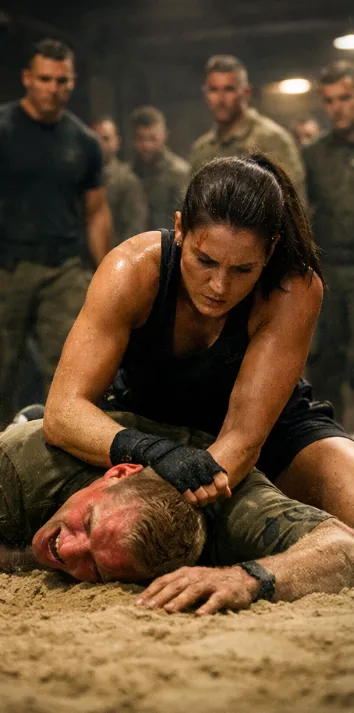
This time the impact sounded worse. His body hit hard enough to knock the air out of his lungs in an audible whoosh. Roxy followed him down, knee on chest, forearm across his throat, pressure precise.
Frost’s eyes went wide. His hand slapped the sand in frantic taps.
Torres called it. “Tap.”
Fifteen seconds.
The hangar went silent, like the air had been sucked out. Then the SEALs made small, controlled noises—murmurs, nods, the quiet approval of men who respected clean work.
Frost stumbled back to his corner, dazed, ribs screaming, smirk gone.
Roxy stood in the center, barely breathing hard. She extended a hand anyway. Frost hesitated, then took it, and she pulled him up.
“Good effort,” she said.
Torres pointed to the next Marine. “Ree. You’re up.”
Corporal Ree stepped into the ring without swagger. Technical grappler. Patient. He’d watched Frost get tossed like luggage. He didn’t want to be next on the highlight reel.
They circled.
Ree feinted, tested distance, then shot in low for an ankle pick, trying to be clever. Roxy sprawled, countered, and the fight turned into a fast, brutal chess match—hands fighting for grips, hips shifting for position, pressure and balance and timing.
Ree was good. Better than Frost.
But Roxy had studied him like an exam.
When he transitioned for an arm triangle, she felt it: the shoulder dip, the half-second tell. She counter-rolled, trapped his arm, and extended into a straight armbar with just enough force to make the point.
Ree yelped and tapped fast.
Roxy released immediately.
Ree rolled away clutching his elbow, grimacing. When he looked up, the arrogance was gone. What remained was reluctant respect.
Two down.
The Marines weren’t laughing anymore.
Sergeant Torres (the Marine) stepped up next—six-four and built like a refrigerator, hands heavy, eyes serious. He didn’t talk. He didn’t smirk.
He came forward like a freight train.
Roxy moved like water.
Every punch he threw, she wasn’t there. Every takedown attempt met empty space. She made him chase her, made his size a liability, made him burn energy while she conserved hers.
Three minutes in, his breathing turned ragged. Frustration flared. He loaded up an overhand right, a massive swing meant to end it.
Roxy read the shift—his weight settling back before the cross. She slipped inside, drove an uppercut into his solar plexus, and swept his leg at the same time.
He crashed down hard.
Roxy mounted and delivered controlled strikes, enough to force the tap without turning it into cruelty.
Three down.
Roxy stood, chest rising and falling, sweat running down her spine. She looked across the ring at Hayes.
His expression had changed.
The smugness was gone. In its place was calculation, like he was rewriting the math in his head.
Five minutes rest.
The medic checked Roxy, ran light over her eyes, listened to her breathing. “You good?”
“I’m good,” she said.
A small cut near her eyebrow had started to seep blood. She didn’t wipe it. Let it run. Let them see she could bleed.
Torres leaned in, voice low so only she could hear. “Keep it technical. Don’t get pulled into brawling.”
Roxy nodded once. “Yes, sir.”
Hayes sent the next Marine in.
Lance Corporal Gwyn stepped forward with a different energy—defensive, cautious, smart. He’d watched three men fall and wasn’t eager to be four.
They circled for nearly a minute, neither committing. Gwyn waited for a mistake, hunting for an opening the way a careful hunter waits for prey to step wrong.
So Roxy gave him one.
She dropped her left hand a fraction, like fatigue or carelessness had finally cracked her discipline. She showed him a target.
Gwyn’s eyes sharpened. He couldn’t resist. He shot in.
The “opening” was bait.
Roxy sprawled, trapped his head, and drove him face-first into the sand with a clean redirect. She took his back in one fluid movement and sank in a choke.
Gwyn tapped, frantic, slapping her arm like he’d found religion.
Four down.
The hangar’s mood shifted from mockery to something electric. Marines leaned forward now, not laughing, eyes wide with disbelief. SEALs watched like they were witnessing history.
Roxy stood alone in the center of the ring, blood at her brow, tape dark with sweat, breathing controlled.
Hayes stared back.
He’d wanted a show.
He’d gotten a reckoning.
“Four down,” Roxy called, loud enough for everyone to hear. Her voice was steady, not triumphant. “Four to go.”
The medic stepped in again. “You should stop,” he murmured, checking the cut. “You proved your point.”
Roxy pushed the gauze aside. “I’m not done.”
Corporal Walker stepped into the ring.
Middleweight wrestler. Quick hands. Quicker feet. He’d watched the first four fights and learned. He didn’t rush. He probed for weaknesses like he was testing a fence for loose boards.
Roxy could feel fatigue beginning to tug at her limbs. Four fights took a toll, no matter how prepared you were.
Walker shot in.
Roxy sprawled, but slower this time. Walker adjusted, changed levels, and drove through her defense. They hit the sand with Walker on top, pressure heavy and grinding.
Something in Roxy’s left side gave with a sharp, wrong pop.
Pain flared so bright it nearly stole her breath.
Cracked rib.
She didn’t scream. She didn’t freeze.
Walker tried to pass into mount.
Roxy bridged, rolled, fought through the white-hot stab that came with every movement. She trapped Walker’s arm during a transition and muscled into a triangle choke.
Walker struggled, tried to slam his way out, but Roxy squeezed with everything she had left.
Walker tapped.
Five down.
Roxy released him and sucked in air through gritted teeth. Breathing hurt. Moving hurt. Everything hurt.
The medic was there instantly, hands probing her ribs. “You’re cracked.”
“I know,” she said.
“Lieutenant—”
“Wrap it.”
He wrapped her torso tight enough to support without locking her lungs. When he finished, he met her eyes.
“You’re going to do permanent damage,” he said.
Roxy’s mouth tightened. “Then it’ll be permanent proof I was here.”
Hayes sent in the next Marine.
Sergeant Briggs stepped forward—brawler mentality, heavy hitter, the kind of fighter who believed pain was a suggestion. He didn’t try to be clever. He tried to break her.
And for the first time, the fight got ugly.
Briggs hammered a body shot into her left side. Pain detonated, and Roxy tasted copper. Blood in her mouth. Tongue bitten or lip split—she didn’t care.
Briggs pressed, sensing weakness, throwing a combination meant to end it.
Roxy slipped the cross, ducked the hook, and drove her knee into his midsection twice—clean, brutal, efficient.
Briggs folded.
Roxy caught his neck in a guillotine as he doubled over, dropped back, wrapped her legs, and squeezed until his body went limp.
Briggs didn’t tap. He just went out.
Six down.
The hangar was on its feet now. Not cheering like a game. More like a storm building—people unable to sit still while something impossible unfolded.
Torres watched Roxy sway slightly as she stood. His face stayed hard, but his eyes carried something like pride.
He called out, voice sharp through the noise. “Your brother would’ve broken before you do, Valkyrie.”
The words struck Roxy like a spark.
Legacy.
Purpose.
Leon’s ghost wasn’t a weight on her back. It was a hand in the center of her chest, pushing her upright.
Roxy wiped blood from her mouth with the back of her wrapped hand.
Lance Corporal Ortiz stepped forward.
Speed demon. Kickboxer. Fresh legs against someone who’d been through six fights.
They touched gloves.
Ortiz came at her like a storm—kicks, punches, constant movement, trying to overwhelm her with volume and speed. Roxy’s body lagged. Her ribs screamed with every twist.
But her mind stayed locked.
She’d studied Ortiz.
Three-strike combinations always ended with a low kick. Always.
She waited. Absorbed punishment. Let Ortiz think he was winning.
Then the pattern came.
Jab. Cross. Low kick.
Roxy checked the kick and threw everything she had left into one straight right that landed clean on Ortiz’s chin.
Ortiz’s eyes went glassy.
Roxy swept his legs, mounted, and delivered hammering strikes until his body went slack.
Seven down.
The hangar erupted, and the chant started somewhere in the SEAL section, then spread like fire.
“Valkyrie! Valkyrie! Valkyrie!”
Roxy stood in the center of the ring, tape soaked, blood and sweat mixed, breathing shallow through cracked ribs.
Across the sand, Hayes stepped forward.
His smirk was gone.
What was left in his eyes wasn’t mockery anymore.
It was respect.
And maybe fear.
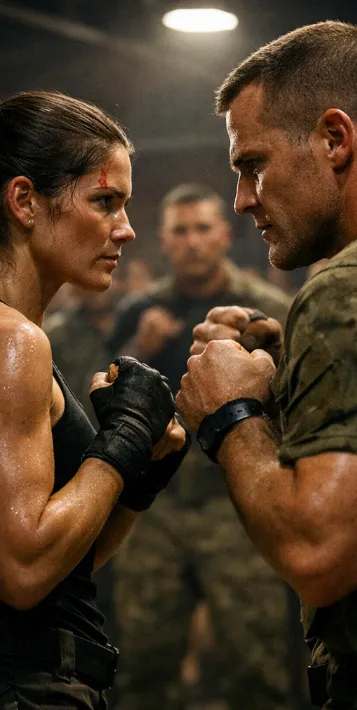
“It’s my lucky number,” Hayes said quietly, stepping into the light.
Roxy stared back, breathless but unbroken. “Then this is where your luck dies.”
Part 5
The hangar had never been quieter.
Two hundred warriors—SEALs, Marines, instructors, medics—held their breath as Hayes stepped fully into the ring. He rolled his shoulders once, deliberate, and Roxy saw it: the right side moved a fraction differently. The old injury hidden under discipline.
Torres looked between them, voice steady. “Last round. You both sure?”
“Yes, sir,” Hayes said.
“Yes, sir,” Roxy answered.
Torres raised his hand and dropped it.
“Fight.”
Hayes didn’t charge. He didn’t showboat. He circled left, hands high, stance perfect, measuring her like a professional. He respected her now in a way he hadn’t when he’d first said Princess like it was a weapon.
Roxy mirrored him, every breath grinding against her ribs. The world narrowed to footwork, distance, timing. Her body felt heavy, like gravity had doubled, but her eyes stayed sharp.
Hayes jabbed—testing.
Roxy slipped it.
He jabbed again, followed with a low kick that she barely checked, pain flashing up her leg.
Methodical. Patient. Smart.
They traded for thirty seconds. Hayes landed a body shot that made Roxy’s world go white. For a split second, she saw nothing but pain and ocean and the carved word on her locker.
She absorbed it.
She answered with a hook that caught him on the ear.
Hayes blinked, surprised—not that she’d hit him, but that she’d hit him with that much intent while running on fumes.
This was different from the other rounds.
This was a fight between two real operators.
Hayes shot in for a takedown—clean, technical, perfectly timed. Roxy sprawled, but her legs were jelly now. Hayes drove through and got her down.
The crowd gasped.
For the first time all night, Roxy was in trouble.
Hayes settled into side control with heavy pressure, controlling her hips, pinning her movement. Roxy’s vision blurred. Pain radiated through her ribs like broken glass.
She could tap.
No shame in losing to Hayes after beating seven Marines. The logical part of her mind offered the exit like a gift. She’d already proved everything.
But logic wasn’t what had carried Leon through Mogadishu.
Leon hadn’t quit. He hadn’t dropped the Marines he was carrying just because the math said he should.
Valkyries don’t wait for rescue.
They are the rescue.
Hayes transitioned, hunting for an Americana. He posted his right hand to adjust position, weight shifting to stabilize—weight pressing into that old shoulder without him even realizing it.
There.
The weakness she’d cataloged. The one chance.
Roxy bridged explosively, ignoring the screaming protest of her ribs. Hayes shifted to compensate.
In that half-second, she trapped his right wrist, rolled her hips, and swung a leg over his head. It looked like an armbar setup, and Hayes reacted like it was one—tightening, preparing to defend.
But Roxy didn’t go for the arm.
She adjusted her grip and angle and used a manipulation Leon had drawn in his notebook—something designed for real fights, not gym taps. Leverage and rotation, targeted specifically at old injuries.
Torque.
A sharp, sickening crack echoed in the hangar.
Hayes screamed.
His shoulder dislocated, and the sound of it was so clear it made several people flinch. Hayes’s left hand slapped the sand—tap, tap, tap—frantic, desperate.
Torres lunged forward. “Stop! Tap!”
Roxy released immediately and rolled away, trying to stand. Her legs buckled, and she dropped to one knee.
Silence.
Two hundred people froze, like their bodies didn’t know what to do with what they’d just seen.
Hayes lay on his back clutching his right shoulder, face twisted with agony, breath coming in sharp gasps. But his eyes were locked on Roxy with something that wasn’t hate.
It was awe.
Roxy crawled over and sat beside him in the sand, both of them broken and bleeding in different ways.
Hayes swallowed hard, voice cracking. “You’re no princess.”
Roxy’s chest rose and fell carefully. She didn’t have spare air for words.
Hayes grimaced, then managed, “You’re a damn Valkyrie.”
Roxy nodded once, slow.
Hayes tried to sit up, failed, and hissed. “Deal’s a deal,” he said, forcing it out. “I resign.”
The Marines murmured, stunned. SEALs stayed quiet, watching Roxy. Waiting.
Roxy shook her head. “No.”
Hayes blinked through pain. “What?”
“You’re a good Marine,” Roxy said, voice rough but steady. “Too good to lose your career over pride.”
Hayes stared at her, processing.
“But,” Roxy continued, and her eyes sharpened, “you spread that nickname. You let it become normal. You let disrespect be a team sport. So here’s your new deal.”
The hangar leaned in without moving.
“You don’t resign,” Roxy said. “You fix the culture that made this necessary.”
Hayes’s breathing slowed as the words sank in. Pain didn’t make him weak. It made him honest.
Slowly, he extended his left hand, since his right was useless.
“Deal,” Hayes said.
Roxy took his hand.
“And,” she added, the corner of her mouth lifting, “you finally learned how to kneel.”
Hayes laughed—pained, genuine. “Guess I did.”
Medics rushed in, taking over Hayes, checking Roxy’s vitals. Torres pushed through the crowd, face unreadable.
Then he did something Roxy had never seen him do for anyone in that ring.
He rendered a sharp salute to her, still kneeling in the sand, still bleeding.
“Lieutenant Jet,” Torres said formally. “Call sign Valkyrie.”
The hangar erupted.
Not just SEALs. Marines too. The chant thundered through the building, shaking the air.
“Valkyrie! Valkyrie! Valkyrie!”
Hayes, being loaded onto a stretcher, managed to lift his left hand and join the chant with a grim smile.
One voice among two hundred.
That night, after the adrenaline faded, the pain came in like a tide. Roxy lay in her quarters with her ribs wrapped, eyebrow stitched, knuckles bruised. She stared at the ceiling and listened to distant laughter outside—different laughter now, warmer, less sharp.
She reached for Leon’s notebook and opened it to a blank page.
Her hand shook as she wrote:
You were right. They don’t fear the storm until it breaks over them.
Then she paused, swallowed, and added a second line:
I carried your words into the ring. I didn’t quit.
Outside, the Pacific kept rolling in, patient as ever.
And somewhere in that steady rhythm, Roxy felt something she hadn’t felt since Mogadishu took her brother away.
Not peace.
Not yet.
But direction.
Part 6
In the weeks after the fight, Coronado didn’t go back to normal. Not exactly.
Pain has a way of rewriting memory. So does humiliation. But so does respect—real respect, the kind earned when there’s nowhere to hide.
Roxy healed the way operators healed: quickly on paper, stubbornly in reality. Her ribs took longer than she wanted. Breathing deep hurt for days. Laughing hurt longer, which felt like its own kind of irony.
The cut above her eyebrow faded into a thin scar that caught sunlight at certain angles. The bruise along her left side turned from purple to sickly yellow, then disappeared, leaving only a quiet ache that reminded her to stay honest about her body’s limits.
Hayes’ shoulder surgery was clean. He spent days in physical therapy, jaw clenched, learning patience the hard way.
The first time he saw Roxy after the fight, it wasn’t in a ring.
It was in the chow hall.
Roxy stood in line with a tray, hair still damp from training. She wore her fatigue like she wore everything else—quietly. Hayes approached with his arm in a sling, face set like he expected a fight even here.
Marines behind him slowed, watching.
Hayes stopped in front of her, squared his shoulders as much as he could with one arm immobilized.
“Lieutenant Jet,” he said.
Roxy nodded once. “Staff Sergeant.”
Hayes hesitated, then said the words like swallowing glass. “I owe you an apology.”
The chow hall went quieter around them. Even the clatter of trays seemed to soften.
Roxy didn’t smile. She didn’t gloat. She just watched him with the calm patience of someone who’d already won.
Hayes took a breath. “Princess was disrespect. It wasn’t funny. It wasn’t harmless. And I let it go because it was easy.”
Roxy’s eyes stayed steady. “Why?”
Hayes’s jaw worked. “Because I didn’t want to admit I was wrong,” he said. “About you. About… what I thought this place was supposed to look like.”
Roxy let that hang for a moment.
Then she said, “What now?”
Hayes nodded toward the Marines behind him. “Now I fix it. Like I said I would.”
That same afternoon, Hayes gathered his unit in a classroom. Torres allowed it—not because he cared about feelings, but because he cared about teams that worked under pressure. A team with poison in its bloodstream failed in the field.
Roxy didn’t sit in the room. She didn’t need to. She heard about it later from a SEAL teammate who’d walked past the open door and caught pieces of Hayes’ voice.
“I let disrespect become tradition,” Hayes told them. “That ends now.”
Frost, ribs still tender, had stared at the floor.
“You can be tough without being cruel,” Hayes continued. “You can be elite without being arrogant. If you want to call yourself a professional, act like one.”
It wasn’t a magic fix. Culture didn’t turn on a dime. But it was a start, and in a world built on repetition, starts mattered.
The joint training exercise ended on schedule, but Torres didn’t send Hayes’ unit back immediately. Instead, he requested an extended integration. The higher-ups loved the phrase synergy, and Torres knew how to sell it.
What he didn’t put on paper was the real reason.
He’d watched rivalry almost turn into rot. Then he’d watched it burn away into something stronger.
He wanted more of that.
Two weeks became four. Training evolved into mixed teams instead of two groups sharing space. They ran drills that forced reliance: buddy carries, blind entries, extraction simulations where one unit couldn’t succeed without the other.
Roxy became a quiet center point in that shift, not because she demanded it, but because people looked at her now and saw proof.
Proof that the old assumptions were weak.
One afternoon, Torres pulled her aside after a mixed-team CQB run.
“You did something bigger than a fight,” he said, tone casual like he was talking about weather.
Roxy wiped sweat off her forehead. “I just didn’t quit.”
Torres’s eyes narrowed slightly. “That’s what they all think it was. A spectacle. A bet.”
He stepped closer, lowering his voice. “But what you actually did was force everyone to choose what they were willing to tolerate.”
Roxy’s chest tightened, not with pain this time, but with something more complicated. “They should’ve chosen sooner.”
“They should have,” Torres agreed. “They didn’t. Now they know what it costs.”
Roxy looked toward the training ground where Marines and SEALs were laughing together, the sound less sharp now. Frost stood with two SEALs, expression awkward but not hostile. Walker was explaining a wrestling grip to a SEAL who listened like he cared.
Roxy had never needed everyone to like her. She still didn’t.
But she needed them to be real.
Two days later, Torres called Hayes and Roxy into his office.
On the wall behind him was a framed photo of an old SEAL platoon. Men with younger faces and tired eyes. A trident patch stitched onto sleeves that looked worn from ocean and war.
Torres tossed a folder onto the desk. “You both want to build something? Here’s your chance.”
Roxy flipped the folder open.
Proposal: Joint Maritime Direct Action Task Unit. Pilot program. Mixed elements. Shared training pipeline. Rapid deployment capability.
Hayes raised his eyebrows, pain flickering through his expression even now. “This gets approved?”
Torres leaned back. “It will if I’m loud enough.”
Roxy looked up. “Why us?”
Torres’s gaze pinned her. “Because you already proved you can take eight Marines. And because Hayes already proved he can swallow pride and make himself useful again.”
Hayes’s jaw tightened, but he didn’t argue. The truth didn’t need defending.
Torres tapped the folder. “This isn’t about publicity. It’s about readiness. I don’t care what people say at bars. I care what happens when bullets start flying and someone can’t walk.”
Roxy felt Leon’s name like a pulse under her skin. Mogadishu. Two Marines on her brother’s shoulders. A mission completed at the cost of his life.
Torres’s voice softened, just slightly. “You built respect in a ring. Now you’re going to build trust in the field.”
Hayes nodded once. “Understood.”
Roxy closed the folder slowly. The weight of it wasn’t paper. It was responsibility.
That night, she sat alone on the beach again, Leon’s notebook open on her lap. The sky was clear, stars sharp above the ocean. The waves rolled in, steady as breathing.
Roxy flipped to the page where Leon had written Valkyries don’t wait for rescue.
She stared at it for a long time.
Then she turned to the next blank page and wrote:
If I’m going to be the rescue, I can’t do it alone.
She paused, then added:
So I’m building a team that doesn’t waste time hating its own.
Behind her, footsteps approached.
Hayes stopped a few feet away, careful not to intrude. He didn’t sit. He just stood with the ocean wind pushing against his hair.
“Lieutenant,” he said.
Roxy didn’t look up. “Staff Sergeant.”
Hayes cleared his throat. “Frost asked me if he should apologize.”
Roxy’s mouth twitched. “And what did you tell him?”
“I told him yes,” Hayes said. “And I told him it shouldn’t be about saving face. It should be about doing better.”
Roxy finally looked at him. In the starlight, Hayes looked older than he had in the ring. Less like an unbreakable wall, more like a man who’d been forced to admit he had cracks.
“That’s a start,” Roxy said.
Hayes nodded once. Then, after a moment, he added quietly, “Your brother… he really carried two Marines out?”
Roxy’s chest tightened.
“Yes,” she said. “He did.”
Hayes swallowed, eyes on the dark ocean. “Then I’m glad you didn’t leave me in that riverbed someday.”
Roxy held his gaze, and for the first time since Hayes arrived, she saw not a rival, not an enemy, but a teammate trying to become worthy.
“You won’t be left,” she said. “Not if I’m still breathing.”
Hayes nodded like he believed her.
The ocean kept rolling in, patient and relentless.
And in that steady sound, Roxy felt the story shifting—away from insult and toward something harder, better.
A future built on earned respect, not borrowed assumptions.
Part 7
Six weeks after the fight, the world smelled different.
Not like salt and gym sweat. Not like rubber mats and disinfectant.
It smelled like dust, cold stone, and burned-out cooking fires.
At 3:00 a.m. in the mountains of northern Syria, Lieutenant Roxan “Valkyrie” Jet pressed her back against a mud-brick wall and scanned a courtyard through night-vision goggles. Green shadows sharpened into shapes: a low building, a rusted truck, a tangle of wires that might have been nothing or might have been death.
Behind her were twelve operators—six SEALs from Team 7 and six Force Recon Marines. They moved like one unit now. No rivalry. No jokes. No need to prove anything. Just quiet competence.
Hayes stood to her right, shoulder still taped from surgery, weapon steady. He was here because Torres had insisted. Hayes had fought to come back early, driven by something that looked a lot like penance.
The mission had started as a clean high-value extraction: slip in, grab the informant, exfil before dawn.
Intel had been wrong about the security detail. What should have been a skeleton crew had turned into a hardened force. But wrong intel was common. Good teams adapted.
Valkyrie touched her comms. “Overwatch, this is Valkyrie. Confirm exfil window.”
A voice crackled back. “Valkyrie, Overwatch. Two minutes before company arrives. Recommend expedited exfil.”
Roxy’s voice stayed calm. “Copy. We’re moving.”
She signaled with two fingers. The team flowed forward in pairs, covering sectors, crossing open spaces like smoke. The informant—thin, shaking, eyes wide—stayed between two Marines who guided him without dragging.
They reached the exfil point: a dried riverbed half a click from the compound. The helicopter rotors were distant thunder, growing louder.
Almost home.
Then the night exploded.
An RPG streaked through the darkness and detonated left of the riverbed, throwing dirt and rock like shrapnel. The shockwave punched the air out of lungs. Someone screamed.
“Contact rear!” a Marine shouted.
Roxy spun, weapon up, firing controlled bursts toward muzzle flashes in the treeline. Her team answered with disciplined fire, laying suppression while moving toward cover.
“Peel back!” Hayes barked, voice sharp but steady. “Peel back to the LZ!”
They moved in textbook bounds—one pair firing while another moved, then switching, building a rolling shield of bullets and movement. The helicopter’s rotors grew louder, the sound of escape and time pressure.
Another burst of gunfire cracked.
Hayes grunted and stumbled.
“Hayes is hit!” someone called.
Roxy was there before Hayes hit the ground. She grabbed his vest and yanked him behind a rock outcropping. Blood soaked through his left thigh, dark even under night vision.
Arterial.
Hayes’s face tightened, but he tried to push up. “I’m good,” he gasped. “I can move.”
“You’re staying down,” Roxy snapped.
She applied a tourniquet with fast, practiced motions. Her team’s fire intensified, buying seconds. The helicopter touched down fifty meters away, door guns hammering the treeline.
Hayes tried to stand again and collapsed.
“Leave me,” he said, breathing hard. “Get your people out.”
Roxy stared at him.
This man who had called her Princess. This man who had tried to embarrass her into silence. This man who had learned, slowly and painfully, what respect cost.
She thought of Leon.
Mogadishu. Two wounded Marines. Her brother’s shoulders. His refusal to drop them even as bullets cut the air around him.
Valkyries don’t wait for rescue.
They are the rescue.
Roxy didn’t hesitate.
She hooked her arms under Hayes, hauled him up in a fireman’s carry, and ran.
Hayes weighed over two hundred pounds with gear. The weight burned through her legs. The distance to the helicopter felt like an eternity. Bullets snapped past. Tracers lit the darkness like angry fireflies.
Roxy’s ribs, long healed, still remembered pain. Her lungs wanted to collapse. Her mind stayed locked on one truth: moving forward.
Her team laid down covering fire, shifting positions to shield her. SEALs and Marines moved as one, not because of orders, but because the unit’s heartbeat demanded it.
Roxy hit the helicopter ramp and handed Hayes up to waiting hands. She climbed in behind him as the aircraft lifted, door gun still pounding.
Inside the cabin, the medic pressed gauze and worked fast, voice clipped. Hayes lay on the deck, face pale, sweat shining.
His eyes found Roxy.
“You carried me,” Hayes said, voice barely audible over the rotors.
Roxy crouched near him, breath still tight. “That’s what teammates do.”
Hayes’s mouth twitched, something like a smile and something like regret. “Leon would’ve approved.”
The name hit her like a quiet punch.
Roxy looked out the open door at the shrinking darkness below. “He would’ve expected it,” she said.
Back at Coronado weeks later, the parade ground felt unreal compared to Syria. The sun was too bright. The grass was too green. The air smelled like salt again, like the world had never held gunfire.
SEALs and Marines stood in formation together. The pilot program had become reality. Torres stood at the front, hands clasped behind his back.
Hayes stood near the front too, thigh still healing, but upright. His Marines stood behind him—all eight of the original unit.
Torres gestured Hayes forward. “Staff Sergeant, you have something to say.”
Hayes stepped out, came to attention, and rendered the sharpest salute Roxy had ever seen.
“Lieutenant Jet,” he said, voice carrying. “Call sign Valkyrie.”
Roxy returned the salute, face controlled, eyes steady.
Hayes lowered his hand and spoke like a man owning his past.
“You didn’t just beat eight Marines that night,” he said. “You changed eight men.”
His voice tightened, but he didn’t let it break.
“You showed us strength isn’t size or gender or pride. It’s heart. It’s refusing to quit. It’s carrying your people home when they can’t walk.”
He looked at his unit. Frost’s eyes were down, jaw clenched. Ree’s arm was fully healed, but the memory hadn’t faded. Walker’s face stayed hard, but respectful.
Hayes looked back at Roxy. “It’s an honor to serve with you.”
For a second, Roxy couldn’t speak.
So she did the only thing she’d learned to do when emotion threatened control.
She nodded once.
“Likewise,” she said.
The formation erupted in applause.
SEALs. Marines. Together.
That evening, Roxy returned to the beach. The Pacific rolled in, patient, relentless. The sunset painted the water gold and blood.
Behind her, voices rose—her team, her family now, calling her back toward laughter and cold beer and the kind of normal that only existed between people who’d nearly died together.
“Valkyrie!” someone shouted. “Beer run, you coming?”
Roxy smiled, turned away from the ocean, and walked toward them.
They had told her to toughen up.
They had told her not to cry.
But Roxy didn’t need tears to prove anything.
She just needed the world to understand what Leon had always known:
Valkyries don’t fall.
They rise.
Part 8
The beer tasted like salt and relief.
Roxy sat on an upside-down cooler on the beach, boots off, feet buried in cool sand. Someone had dragged a small speaker out, low volume, just enough to turn the dark into something less sharp. The team clustered in loose knots—SEALs and Marines mixed without thinking about it, laughing the way people laughed when they’d earned the right to.
Hayes sat a little apart, leg stretched out, a brace hidden under civilian pants. His shoulder still moved like it remembered pain. He didn’t drink much. He watched.
Frost was talking too loud, like he had something to prove to the night. He kept catching himself, lowering his voice, then forgetting again. Old habits didn’t vanish. They got replaced, slowly, with better ones.
Roxy listened more than she spoke. She felt the warmth of the beer, the sting of it, the simple fact that her ribs didn’t hurt anymore. She felt the Pacific breathing in and out beside them, patient as ever.
A SEAL named Kline raised his bottle. “To the stupidest bet in Coronado history.”
“Second stupidest,” someone corrected. “I’ve seen a man bet his truck on a push-up contest.”
“Yeah,” Kline said. “But did the truck survive?”
Laughter rolled through the group.
Hayes lifted his bottle slightly toward Roxy. “To culture shocks.”
Roxy’s mouth twitched. “To people learning the hard way.”
That got another wave of laughter, and for a second she let herself relax into it. Not because she needed their approval, but because she could finally feel what Leon had always described in his letters: the quiet bond that formed when you went through ugly things and came out still willing to sit beside each other.
Later, when the beer ran low and the jokes slowed, Torres appeared out of the dark like he’d been there the whole time. He didn’t sit. He never sat when he could stand.
He looked at Roxy. “Jet. My office. Oh-seven-hundred.”
Roxy didn’t ask why. She just nodded. “Yes, sir.”
Torres’s gaze flicked to Hayes. “You too.”
Hayes’s brows rose. “Yes, Commander.”
Torres walked away without another word. The night swallowed him.
The beach got quieter after that, like everyone felt the shift. No one asked questions. They didn’t need to. Whenever Torres summoned you, it was either something important or something painful. Sometimes both.
At 0700, Roxy stood in Torres’s office with her hands behind her back, posture clean. Hayes stood to her right, slightly stiff. Torres didn’t offer seats.
On the desk was a folder stamped with more acronyms than words.
Torres tapped it once. “Naval Criminal Investigative Service is sniffing.”
Roxy’s expression didn’t change, but something tightened behind her ribs anyway. “About the Syria op?”
Torres shook his head. “About the fight.”
Hayes’s jaw clenched. “It was on base. Training environment.”
“It was a spectacle,” Torres corrected, voice flat. “And if you think nobody recorded it, you’re living in a fantasy. There’s video. That means there’s attention. That means there are people who will make this about everything except what it actually was.”
Roxy stared at the folder. The word PRINCESS flashed in her memory like a carved wound.
Torres leaned forward. “You did what you did inside the rules I gave you. Full contact. Tap ends the round. Medical checks. All documented.” He pointed at Hayes. “You agreed to it.”
Hayes didn’t flinch. “I did.”
Torres pointed at Roxy. “You agreed.”
Roxy nodded once. “I did.”
Torres’s eyes narrowed, not angry, just precise. “Then you both own it. Because an investigator is going to come in here and try to turn it into a headline. Hazing. Misconduct. Command failure. They will want someone to blame, because blame is tidy.”
Roxy held his gaze. “And what do you want?”
Torres didn’t hesitate. “I want the truth. Clean. Simple. No drama.”
Hayes cleared his throat. “The truth is I started it.”
Roxy glanced at him. Hayes kept his eyes forward, like he’d decided shame wasn’t useful anymore.
Torres nodded once, approving. “Good. Then when they ask why you challenged a SEAL officer to fight eight Marines, you tell them the truth. You tell them you were wrong. You tell them you were arrogant. You tell them you let disrespect spread like rot.”
Hayes swallowed. “Yes, sir.”
Torres looked at Roxy. “And you tell them the truth too. That you accepted because you refused to let your competence be negotiable.”
Roxy’s voice stayed even. “Yes, sir.”
Torres leaned back slightly. “And if they ask why I allowed it—” his mouth tightened “—I’ll tell them the truth. That I’d rather deal with paperwork than deal with a unit that can’t trust itself.”
The NCIS interview happened two days later in a gray building with fluorescent lights that made everyone look slightly sick. The investigator was polite, which meant dangerous. He asked questions the way a fisherman cast nets—wide, patient, waiting for something to snag.
Roxy answered without emotion. Hayes answered without excuses. Torres answered like a man who’d been in too many rooms like this to be rattled.
At one point, the investigator leaned toward Roxy and said, “Do you feel you were pressured into participating?”
Roxy met his eyes. “No.”
“Do you feel you were targeted because you’re a woman?”
Roxy didn’t blink. “I was targeted because some people needed an excuse to be small.”
The investigator paused, pen hovering. “That’s not a typical answer.”
“It’s an honest one,” Roxy said.
The report took a week. The conclusions were bureaucratic and predictable: the bout was deemed unsafe, outside the spirit of training standards, and formally discouraged. Torres received a stern letter. Hayes received a formal counseling statement. Roxy received a reminder about officer conduct and risk.
But there was also a second page most people didn’t read out loud.
The second page acknowledged improved unit cohesion, noted the measurable effectiveness of the integrated detachment during real-world deployment, and recommended expansion of the program under stricter oversight.
Torres folded that page carefully and slid it into a different folder.
When he handed Roxy the final results, he watched her face closely.
“Regret it?” he asked.
Roxy thought about Frost’s smirk, the carved locker, the cracked rib, the moment Hayes said Valkyrie with awe instead of spite. She thought about Syria, about Hayes bleeding in the dirt, about Leon’s hands in her memory, lifting, carrying.
“No,” she said.
Torres nodded like he’d expected that. “Good. Because we’re not done.”
He slid another folder across the desk.
This one was cleaner. Official.
Joint Maritime Direct Action Task Unit: Approved Pilot Expansion. New selection cycle. New standards. Dedicated leadership.
Torres tapped the signature line. “They want a commanding officer for the detachment.”
Roxy’s throat tightened, not with fear, but with the weight of it. “Sir—”
Torres cut her off. “Don’t do that humble thing. You’ve earned it. You’re getting it.”
Hayes looked at her, expression unreadable.
Torres added, “And they want a Marine senior enlisted advisor who knows exactly what happens when culture goes bad.”
Hayes’s eyes widened slightly. “Commander—”
Torres’s stare was iron. “That’s you, Staff Sergeant. You asked for a deal. Here it is.”
Hayes exhaled slowly, then nodded. “Understood.”
Roxy stared at the folder, feeling Leon’s notebook like a phantom weight in her locker.
A detachment built on trust, not tolerance.
A team where nobody got carved into a joke.
Torres’s voice softened, just a little. “This is bigger than you, Jet. Bigger than Hayes. If you do it right, ten years from now nobody will remember why it was weird that you were here.”
Roxy looked up. “And if we do it wrong?”
Torres’s expression hardened again. “Then it becomes a cautionary tale they use to shut doors.”
Roxy didn’t hesitate. “Then we do it right.”
Torres nodded once. “Good. Valkyrie doesn’t get to be a nickname. It gets to be a standard.”
When Roxy walked out of the office, the morning felt different. Same sun, same salt air, same Coronado routine.
But the future had edges now. Sharp ones.
And she planned to hold them.
Part 9
The first thing Roxy did was erase the idea that this was a club.
She didn’t say it in a speech. She built it into the process.
The new selection cycle for the detachment started quietly, without fanfare. Torres refused media. He refused visitors. He refused anyone who treated it like a headline. The only people invited were the ones who wanted to earn a place.
Roxy and Hayes stood at the front of a small classroom while candidates—SEALs, Marines, a few Navy divers, a couple corpsmen—sat with backs straight and eyes forward. Most of them had combat experience. All of them had confidence.
Confidence was cheap.
Roxy watched them the way she’d watched the ocean: not for strength, but for adaptation.
Hayes’s presence beside her changed the room. The candidates knew his reputation. They’d heard about the fight. Some looked at him like he was a warning. Others looked at him like he was redemption.
Hayes didn’t perform. He didn’t need to.
Roxy held up a simple sheet of paper.
“This is the standard,” she said. “Not the rumor. Not the story you heard. Not the video you watched.”
She slid the paper onto the projector.
Valkyrie Standard:
Adapt fast.
Protect your team.
Leave ego behind.
Earn trust daily.
Carry what needs carrying.
Roxy let the room sit with it.
A Marine candidate in the second row raised a hand cautiously. “Ma’am, what does ‘carry what needs carrying’ mean?”
Roxy’s gaze stayed level. “It means sometimes you carry weight you didn’t choose. Sometimes it’s gear. Sometimes it’s a teammate. Sometimes it’s responsibility. Sometimes it’s a mistake you made that you have to fix.”
Her eyes flicked, briefly, to Hayes.
Hayes didn’t look away.
Roxy continued, “If you’re here because you want a patch, you’re in the wrong room.”
No one moved.
“Good,” she said. “Then we start.”
Selection wasn’t designed to break people for entertainment. Roxy hated that kind of culture. It was lazy. Real selection revealed who someone was when the world got tight.
Day one was physical assessments—runs, swims, carries, obstacle work—but Roxy watched behavior more than times. Who encouraged someone struggling. Who blamed someone else when they failed. Who tried to cheat a standard by cutting corners.
Hayes watched too, his Marine eyes tuned to different tells than hers.
A SEAL candidate named Dyer finished a ruck carry and immediately dropped his pack, ignoring a Marine candidate who’d stumbled and couldn’t get his straps loose.
Roxy didn’t correct Dyer on the spot. She wrote his name down.
Later, during a scenario drill, Dyer made a sharp call that saved time but left a corpsman exposed. The corpsman got “hit” in the simulation.
Dyer shrugged. “Collateral risk.”
Roxy stared at him for a long beat. “Say that again.”
Dyer hesitated. “It was the fastest route.”
Roxy’s voice stayed calm. “Fast and smart is unstoppable. Fast and careless is just a different way to quit.”
Dyer opened his mouth to argue.
Hayes stepped forward, tone flat. “You want a unit where you can step on people to look good, go back to wherever you came from.”
The room got very quiet.
Dyer didn’t make it past day three.
It wasn’t because he was weak. It was because he thought ego was the same thing as leadership.
By the end of the first week, the candidates looked stripped down to essentials: tired, hungry, sore, and honest. That was when the real selection began.
Roxy introduced the thing Torres had taught her in the surf: adaptation.
They ran drills with deliberately changing conditions. Unpredictable friction points. A plan that worked once would fail the next time because the environment changed, or the rules shifted, or a teammate had to step into a new role unexpectedly.
Roxy watched who panicked.
She watched who got rigid.
And she watched who breathed once, adjusted, and moved forward.
Frost returned halfway through the cycle—not as a candidate, but as a support instructor. He’d requested it himself. He walked into the training bay with an awkward stiffness, as if he wasn’t sure he was allowed to exist in this new version of the world.
Roxy didn’t make a speech about forgiveness.
She handed him a clipboard and said, “You’re running safety checks. You’re watching for ego. You’re calling out disrespect, even when it’s subtle.”
Frost blinked. “Me?”
Roxy’s eyes were steady. “Yes. Because you know exactly what it looks like when it starts.”
Frost’s throat bobbed. “Yes, ma’am.”
Hayes watched Frost like he was watching a fuse. But he didn’t undermine him. He let Frost earn his way back through work.
One afternoon, a young Marine candidate muttered under his breath after a failed drill, “This is stupid. We’re babysitting.”
Frost heard it.
Old Frost would’ve laughed. Old Frost would’ve smirked and looked for a way to bond over arrogance.
New Frost walked over, face serious. “Say that again.”
The candidate stiffened. “I didn’t—”
Frost cut him off. “You think protecting people is babysitting? You think humility is weakness? That attitude is how units rot. That’s how you get someone killed and call it ‘mission success’.”
The candidate stared, surprised by the heat.
Frost leaned closer. “You want to be here? Then you learn to shut up and carry your weight.”
The candidate nodded quickly.
Frost walked away, shoulders tight, like it had cost him something.
Hayes approached him afterward. “Good correction,” he said.
Frost blinked like he didn’t expect praise. “It felt weird.”
Hayes’s expression softened slightly. “It should. That’s how you know it’s real.”
Roxy watched that exchange from across the bay and felt something settle in her chest.
This was the work.
Not fights in rings. Not chants in hangars.
This.
By the end of selection, only twelve candidates remained. Roxy stood in front of them with sand on her boots and salt dried on her sleeves.
“You’re not here because you’re special,” she told them. “You’re here because you were adaptable and reliable when the world got tight. Now the real test starts. Now you live the standard every day.”
A Navy corpsman raised a hand. “Ma’am, what happens if we fail later?”
Roxy didn’t sugarcoat it. “Then we fix it or we remove you. There’s no shame in being wrong. There’s shame in refusing to learn.”
She paused, then added, “And if you ever think about carving a teammate into a joke, you come find me first. Because I’ll save you the trouble.”
A few nervous laughs flickered. Roxy didn’t smile.
She meant it.
That night, alone in her quarters, she pulled Leon’s notebook from her locker and opened it to a page she’d reread a hundred times.
Valkyries don’t wait for rescue. They are the rescue.
Roxy flipped to a blank page beneath it and started writing her own notes—standards, lessons, small observations about people and pressure.
She wrote until her hand cramped.
Then she closed the notebook and stared at the carved word on her locker door.
PRINCESS.
She didn’t erase it.
Instead, she took a marker and wrote one word beneath it in neat, steady letters:
REMEMBER.
Part 10
The detachment’s first major operation under the expanded program didn’t come wrapped in heroism.
It came wrapped in weather.
A tropical storm had churned across a chain of islands, tearing roofs off villages and turning roads into rivers. The official mission was humanitarian: deliver supplies, assist local authorities, evacuate civilians from cut-off zones.
But the world rarely offered one problem at a time.
A criminal group took advantage of the chaos and grabbed a small team of aid workers moving between villages. They weren’t soldiers. They weren’t trained for danger. They were people carrying medicine and food who got unlucky.
The call came in the early morning. Torres briefed the detachment in a room that smelled like coffee and wet gear. Satellite images showed flooded roads, collapsed bridges, a coastline battered into jagged shapes.
“Primary is recovery,” Torres said, voice tight. “No headlines. No cowboy moves. Bring them home.”
Roxy listened, then asked the question she always asked. “What’s the local support situation?”
“Complicated,” Torres said. “Authorities are stretched thin. Weather is still shifting. Comms are inconsistent.”
Hayes leaned forward. “So we plan for isolation.”
Torres nodded. “Exactly.”
They moved out under gray skies and hard wind. The sea was choppy, the kind of water that punished arrogance. Roxy remembered standing in the surf at Coronado, learning to adapt. Now she watched her team do it in real time—quiet adjustments, steady hands, no complaint.
On the ground, the storm’s aftermath looked like a world half-erased. Trees snapped. Streets swallowed by mud. Families gathered on higher ground with whatever they’d managed to save.
Roxy hated how the misery made some people feel powerful. She’d seen it before in other countries, in other disasters. She’d also seen the opposite: people who stepped into chaos and simply helped, without needing credit.
The detachment moved with that second energy.
They delivered supplies first. They helped lift debris. They got children onto evacuation boats. They let local leaders speak for their own communities instead of turning everything into an American show.
Then they shifted toward the secondary problem.
The aid workers had last been seen moving near a flooded roadway close to an abandoned processing facility. The facility sat on higher ground—dry, isolated, a perfect hiding place.
Roxy didn’t romanticize what they were about to do. She didn’t frame it as vengeance or justice.
It was retrieval.
Bring them home.
As the detachment approached the area, Hayes moved beside her, quiet. “You good?” he asked.
Roxy didn’t look at him. “I’m always good until I’m not.”
Hayes’s mouth twitched. “Fair.”
They reached a vantage point and observed from cover. Movement inside. A few armed figures. No uniforms. No clear discipline. That made it more dangerous in some ways—unpredictable, jumpy, trying to prove something.
Roxy watched the building for a long moment.
Then she turned to her team. Her voice stayed low, controlled. She assigned roles without drama, emphasizing patience and protection. The goal wasn’t to win a fight. The goal was to get civilians out alive.
When it started, it started fast.
A door opened. A figure moved. Someone yelled in a language Roxy didn’t understand, and then everything snapped into motion.
The detachment flowed forward with a calm that came from training that wasn’t based on ego. They moved like people who’d learned the hardest lesson already: your teammate’s life mattered more than your pride.
Inside, the air smelled damp and metallic. The building was cluttered with old equipment and storm debris. Voices echoed. Fear did what fear always did—it made people either freeze or flail.
Roxy spotted the aid workers in a corner room, bound, faces pale, eyes huge.
One of them started crying the moment he saw her, silent tears cutting lines through grime on his cheeks.
Roxy didn’t tell him to toughen up.
She didn’t tell him not to cry.
She crouched, kept her voice steady, and said, “You’re okay. We’ve got you.”
Behind her, Hayes and Frost controlled the corridor, posture tight, ready.
A criminal with a weapon lurched into view, yelling, hands shaking. His eyes were wide, wild, like the storm had torn his sense apart. He wasn’t trained. He was scared and desperate, which meant he could do something stupid.
Frost’s voice cut through the panic, sharp and commanding. The man hesitated.
Roxy watched the man’s hands, not his face. Hands told the truth.
In a heartbeat, the situation tipped—one wrong movement, one burst of fear. Roxy moved with the same surf-learned redirection she’d used in the ring, but here it wasn’t about proving anything. It was about ending danger without turning it into slaughter.
The man dropped his weapon.
Hayes secured him fast, efficient, and the room exhaled.
They got the aid workers out into the storm air, moving them carefully, wrapping them in blankets, guiding them into waiting transport.
Outside, rain started again, light at first, then heavier. The storm didn’t care that they’d succeeded.
Roxy watched one of the aid workers—young woman, soaked hair plastered to her face—clutch a medic’s hand like it was an anchor. Her shoulders shook with quiet sobs.
Frost glanced at Roxy as they loaded people up. “You ever hear what you used to get called?”
Roxy’s gaze flicked to him. “Yes.”
Frost swallowed. “I’m sorry.”
Roxy held his eyes for a long beat, then nodded once. “Keep being better. That’s the apology.”
Frost exhaled, relief and shame mixed. “Yes, ma’am.”
Hayes watched the exchange, then leaned closer to Roxy. “You know,” he murmured, “somewhere out there, someone’s going to try to turn this into a story about you.”
Roxy stared out at the rain. “Let them.”
Hayes’s brow furrowed. “You don’t care?”
Roxy’s voice stayed calm. “I care about the right things.”
She glanced back at the aid workers, safe now, alive, trembling but breathing.
“Try not to cry, Princess,” Roxy said quietly, not as an insult, not as a mockery, but as a private reclaiming.
Then she added, softer, “Cry if you need to. Just keep moving forward.”
The transport doors closed. The detachment moved out into the storm again, carrying what needed carrying.
And for the first time, the nickname that had once been a blade felt like something else entirely.
A reminder of how far she’d come.
And how far she still intended to take them.
THE END!