“LOCK THE DOOR SO NO ONE HEARS IT!” They Dragged Her Into The Bathroom — 2s Later, Only One Navy SEAL Walked Out!
Part 1
“Lock it.”
The command ricochets off tile walls, sharp enough to feel like it can cut. A deadbolt slides home with a metallic click that sounds like a lid sealing shut.
Four men. One woman.
Eleven minutes from now, only one person will walk out of this bathroom alive enough to matter.
But that’s eleven minutes away.
Three weeks earlier, the air in the room tastes like ozone and old secrets. Fluorescent lights hum at a frequency you don’t notice until it’s all you can think about. The room doesn’t officially exist, inside a building the Pentagon pretends isn’t there, inside a corridor that never appears on a map.
Commander Katherine Sullivan sits in a steel chair bolted into concrete. She’s thirty-three, auburn hair pulled back tight, posture straight like her spine is a rod. Her green eyes are steady in a way that makes men who rely on intimidation feel suddenly uncertain.
Across from her sits Admiral Lawrence Donnelly, sixty-two, shoulders still squared like he’s standing at attention even while sitting. His hands rest on a manila folder with a red stripe that means people have killed to keep what’s inside buried. His wedding ring is worn thin. His knuckles are scarred.
“Fort Davidson,” he says.
Two words, flat and heavy, like he’s naming a disease.
Kate doesn’t blink. Donnelly opens the folder. The first page is a satellite image: Nevada desert, tan buildings, firing ranges, obstacle courses, and mountains wavering in heat mirage.
“Seventeen assault reports in two years,” Donnelly says. “Zero prosecutions. Zero convictions. Zero consequences.”
He turns a page.
The photograph on it doesn’t belong in a classified folder. It belongs on a fridge. A young woman in Navy blues, twenty-four, blonde hair regulation length, blue eyes bright with the kind of optimism that comes from believing the uniform means something.
Jessica Sullivan.
Kate’s baby sister.
The girl who used to steal Kate’s combat boots when she was five and parade through the backyard like she owned the world. The teenager who cried when Kate shipped out. The young woman who followed her into the Navy because she wanted to be just like her.
Dead.
April 3rd, 2021.
Donnelly slides the official report across the table. The words are clean and lifeless.
Training accident. Fatal fall from fourth-floor administrative building. Catastrophic injuries consistent with impact. No witnesses. Case closed.
Kate’s jaw tightens, just a fraction. Donnelly notices. He’s a man who has spent a lifetime learning what grief looks like in people trained not to show
“That’s the official version,” he says quietly.
He turns another page.
Medical examiner’s preliminary report, before someone higher decided it didn’t need to exist.
Bruising inconsistent with a simple fall. Defensive wounds. Torn clothing. Evidence of a struggle.
Kate’s breathing doesn’t change, but something behind her eyes goes very still.
“Unofficial version,” Donnelly says, “is that Jessica tried to report an assault. She went through proper channels. Filed paperwork. Requested an investigation.”
He turns another page. A witness statement that never made it into the final report. A female corporal saw multiple men leaving the building shortly before Jessica was found.
“Transferred to Okinawa before follow-up,” Donnelly adds. “Statement disappeared. She was threatened with court-martial for making false accusations if she kept talking.”
Kate’s hands rest flat on her thighs, still as stone.
“How many others?” she asks.
Donnelly closes the folder like he’s shutting a coffin. “Forty-seven we know of,” he says. “Women who reported assaults at various installations. Transferred to places flagged for systemic misconduct. Labeled disciplinary problems. Isolated. Discredited. Or—”
He doesn’t finish. He doesn’t need to.
Kate reaches into her jacket pocket and pulls out an old photograph. Two little girls in a backyard. The younger one wearing a Marine dress cover three sizes too big. The older one at attention beside her. Both grinning like they own the world.
Their father, Colonel Patrick Sullivan, was killed in Mogadishu. Kate was eight. Jessica was five. The photograph was taken two weeks before notification officers showed up at their door.
Kate tucks it away again, right over her heart.
“Tell me about Corsair,” she says.
Donnelly leans back. A second folder appears from a locked briefcase, thicker, stamped with a classification level that makes the red stripe look casual.
“Black program,” Donnelly says. “Doesn’t exist on paper. Never will.”
Kate’s gaze doesn’t flicker.
“We send female Tier One operators into installations flagged for systemic misconduct,” he continues. “Strip identity. Remove rank. Make them look like the perfect victim.”
Kate’s mouth tightens. “Bait.”
“Catalyst,” Donnelly corrects. “Predators don’t expose themselves to strength. They hunt perceived weakness. We create vulnerability. When they attack, we get evidence so clean even Pentagon lawyers can’t bury it.”
He turns pages, showing operational summaries, most stamped mission failure in block letters.
“Twelve operators before you,” he says. “Three killed. Four permanently injured. Five couldn’t trigger an attack or gather enough evidence to break the protection ring.”
Kate’s eyes scan the casualty list. She reads each name like she’s engraving it into memory.
“Success rate?” she asks.
“Zero,” Donnelly says.
The silence in the room thickens, heavy as water filling a compartment.
“You’d be number thirteen,” Donnelly adds.
Kate looks down at Jessica’s photograph in the other folder. That trusting smile. That bright, stupid hope.
“When do I leave?” she asks.
Donnelly doesn’t congratulate her. Doesn’t call her brave. He just nods like a judge pronouncing sentence.
“Seventy-two hours,” he says. “New identity. Private Jane Miller. E-1. Disciplinary transfer. Insubordination. Failure to adapt. The paper trail will make you look disposable.”
He opens a small case. Inside is a capsule smaller than a grain of rice.
“Swallow it,” he says. “Biocompatible nano-recorder. Activates when your heart rate crosses one-forty. Records forty-eight hours of audio. Transmits when you hit open air.”
Kate holds the capsule up to the light. So small. So heavy.
“If I die,” she says, “what happens?”
Donnelly’s face doesn’t change. “Training accident,” he says. “Full honors. Folded flag. Letter of regret. Your name on a wall nobody visits.”
Kate sets the capsule on the table and asks the question that matters.
“Do you think I can do this?”
Donnelly meets her eyes with the kind of respect that isn’t given, only earned.
“You graduated BUD/S,” he says. “You deployed. You’re the most qualified person we’ve ever sent.”
He pauses.
“But qualification doesn’t mean survival.”
Kate nods once, small.
“My sister tried to do it the right way,” Kate says quietly. “The system failed her.”
“The system protected predators,” Donnelly says. “So the system needs exposure.”
Kate picks up the capsule, closes her fist around it.
“When I walk out of that base,” she says, voice steady, “it won’t be in a body bag.”
Donnelly extends his hand. Kate shakes it.
The agreement is sealed with something stronger than ink.
Three weeks later, in a Nevada bathroom, the deadbolt clicks.
And Kate Sullivan is exactly where she planned to be.
Part 2
Seventy-two hours is enough time to erase a person, if the people erasing you have the right access and the right indifference.
Commander Katherine Sullivan becomes a ghost with paperwork.
Her service record disappears behind sealed files. Her medals go into a lockbox. Her rank becomes a rumor no one is allowed to repeat. Her name becomes something she must not respond to, even inside her own head.
Private Jane Miller steps off a transport truck at Fort Davidson’s main gate with a duffel over her shoulder and a face that is meant to be forgettable.
The desert heat hits like a hand. The base squats in sand and sun—tan buildings, bleached concrete, distant mountains shimmering like they’re not real.
Two soldiers at the checkpoint glance at her ID like it’s a grocery list.
“Transfer?” one asks, eyes sliding over her without respect.
“Yes,” Kate says, one word, neutral.
He runs a finger down a clipboard. “Miller. Jane. E-1.” He says it like it doesn’t matter. “Female barracks. Building Seven.”
The other guard snorts, like there’s an inside joke she hasn’t heard yet. “Good luck with that.”
Kate takes the base ID card. The photo is intentionally bad, slightly blurred, like she’s already being treated as disposable.
Building Seven sits at the edge of the base, a converted storage facility pretending to be living quarters. Windows don’t shut properly. The lock on the main door looks solid but the scratches around the keyhole tell a different story. No cameras in the hallway.
Kate notices that immediately.
Every modern installation has surveillance everywhere—except, apparently, where the women sleep.
Inside, the building smells like dust and neglect. On a bulletin board by the entrance, a crooked note is pinned in neat handwriting:
Keep your head down. Keep your mouth shut. Try to last longer than the last one.
Kate memorizes the script. The slight right slant. The steady loops. Whoever wrote it meant it as a warning, not drama.
Her assigned room has six bunks. Four are occupied, but everyone is at duty stations. Personal items suggest women in their late teens to late twenties. Kate sets her duffel on the bottom bunk and doesn’t unpack.
First rule of deep cover: know your exits.
She counts. Window—painted shut. Door to hallway—no internal lock. Vent—too small.
One way in. One way out.
Tactically terrible.
Exactly what you’d design if you wanted people to feel trapped.
She leaves her gear and walks the base like she belongs there. She watches without staring. She listens without looking like she’s listening. She maps camera angles, dead zones, routes patrols take and routes they don’t.
The mess hall at lunch is a sociology lesson written in seating charts. Men take the best tables near windows and doors. Loud. Relaxed. Secure in the kind of confidence that comes from never being questioned.
Women sit in the corner, backs to the wall, eyes tracking foot traffic with peripheral awareness that speaks to hypervigilance.
Kate sits alone at a table where she can see most of the room. She needs to be noticed by the wrong people before the right people will trust her.
It doesn’t take long.
A corporal bumps her shoulder as he walks past, just hard enough to be intentional, not hard enough to claim.
“Didn’t know we let trouble transfers in here,” he mutters, loud enough for his friends to laugh.
Kate doesn’t react. She keeps eating tasteless food. She keeps her posture small, her gaze down, her body language apologetic.
Her heart rate stays low. The nano-recorder in her stomach remains dormant.
By day three, she’s identified the pack.
Staff Sergeant Marcus Hayes.
Thirty-eight, tall, shaved head, scar through his left eyebrow that gives him a permanent look of contempt. He moves like a man comfortable in violence. He’s never alone. He’s always flanked by others—men who laugh when he laughs, stop when he stops, watch what he watches.
He doesn’t leer openly. He hunts with patience.
Kate watches him in formation. The way his eyes track women like they’re resources. The way his smile appears when someone looks away.
Predator.
Then the moment comes that isn’t in the plan.
Utility corridor between laundry and storage. Late morning. The hallway narrows. The air is cooler here, shadowed by concrete.
Kate hears voices before she sees them. She slows but doesn’t stop. Casual approach.
Around the corner: four men, one woman.
The woman is backed against the wall, boxed in without being grabbed yet, the way pack predators test boundaries before crossing them. Her name patch reads McKenzie. Red hair pulled tight. Freckles across pale skin. Her eyes flick to Kate for half a second, and the message is clear.
Run.
Hayes stands closest. His hand rests on McKenzie’s shoulder like a fake comfort that is really control.
“Just need you to take that jacket off,” Hayes says in a reasonable voice, as if it’s policy. “Quick check.”
“I don’t—” McKenzie starts, and Reeves—broad, thick-necked, the kind of man who mistakes aggression for personality—grins.
“There is now,” he says.
Kate makes a decision that is not part of the plan.
If she walks away, she stays invisible.
If she intervenes, she becomes a target.
She steps into view.
“Step back,” she says.
Four words. Flat tone. No anger. No pleading. A statement of fact.
All five of them turn.
Hayes assesses her in one second—blank name tag, low rank, smaller frame, a body that looks tired instead of trained.
“Chain of command business,” he says dismissively. “Walk away, Private.”
Kate doesn’t move closer. She holds position. Calm.
“She didn’t consent,” Kate says. “Step back and let her go.”
The corridor goes silent. Even the air feels like it’s waiting.
Hayes steps toward Kate until he’s invading space, using height and mass as a weapon. “You’re new,” he says quietly. “So maybe you don’t understand how things work here.”
Kate lifts her eyes and meets his. “Neither do you,” she replies.
His smile twitches. The lie he’s standing on shifts under him.
He considers escalation. Kate can see it. But it’s daytime. Foot traffic passes nearby. Cameras might not cover this exact corner, but they cover approaches.
Hayes steps back, slow, controlled. His smile doesn’t reach his eyes.
“Your call,” he says. “Friendly advice? Learn when to mind your own business.”
He turns. The others follow. Pack behavior. Unified front.
McKenzie stays frozen against the wall, breathing too fast.
Kate doesn’t touch her. Touch can trigger panic. She just positions herself where McKenzie can see her without turning her head.
“They’re gone,” Kate says quietly. “You’re safe.”
McKenzie zips her jacket with shaking hands.
“You just painted a target on yourself,” she whispers.
“I know.”
“You can’t fix this place,” McKenzie says, voice cracking with exhaustion.
Kate’s gaze stays steady. “I’m not here to fix it,” she says. “I’m here to burn it down.”
McKenzie stares at her, searching for sanity.
Then she reaches into her pocket and hands Kate a folded piece of paper.
“Locker forty-seven,” she whispers. “Combination one-seven-three-zero-two-eight.”
Then she walks away without looking back.
Smart. Association gets you killed here.
Kate unfolds the paper once the corridor is empty.
It isn’t a map.
It’s a list of names. Female. Ages. Bunk assignments. A few phone numbers.
At the bottom, in the same neat handwriting as the warning note in the barracks:
We’ve been waiting for someone like you.
Kate refolds the paper and slips it into her pocket.
Her heart rate still hasn’t crossed one-forty.
But something else is beating now.
Something dangerously close to hope.
Part 3
Locker forty-seven sits in the equipment building where the air smells like metal, oil, and dust baked into concrete. Kate moves like she belongs, like she’s not counting steps and sightlines.
She spins the dial: 17… 30… 28.
The locker opens.
Inside: a burner phone, cheap and plain, the kind that can disappear without leaving much behind. It has one contact saved. No name, just a number.
Kate memorizes it, powers the phone off, locks it back, and walks away as if she just grabbed gloves.
That night, she returns to Building Seven and pretends to sleep.
She’s already learned the rhythms of the room. Who snores. Who wakes easily. Who takes sleeping pills. Who lies awake pretending not to.
At 2:03 a.m., she slips out of bed, silent.
Down the hallway. Past the dead camera. Into a supply closet that smells like bleach and old mop heads.
They’re waiting.
Eight women, ages nineteen to twenty-seven, faces set in different kinds of exhaustion. Reed McKenzie stands in the center, red hair down for the first time Kate has seen it, making her look younger and more vulnerable than her rank suggests.
And one man: Lieutenant Blake Morrison, JAG. Late twenties. Clean-cut. His posture says he wants to believe the uniform still means something, even after watching it fail.
No one speaks at first. They assess Kate like she might be a plant.
Reed breaks the silence. “You stopped Hayes,” she says. “Either you’re stupid, suicidal, or you actually give a damn.”
“Option three,” Kate says quietly.
A woman with faint scars on her forearms snorts. “Hayes doesn’t forget.”
“I know,” Kate says.
“You don’t understand what that means,” another woman whispers, barely nineteen, eyes too wide.
“It means I’m next,” Kate replies. She lets that hang, then adds, “And I’m still here.”
Reed’s eyes narrow. “Why?”
Kate could tell them everything—Corsair protocol, Donnelly, the nano-recorder sleeping in her stomach.
But deep cover runs on controlled truth.
“My sister tried to report an assault,” Kate says instead. “She followed the rules. Then she died. They called it an accident.”
Silence falls like weight. These women understand that kind of silence.
Reed reaches into her pocket and produces a USB drive. “Six months,” she says. “Photos. Logs. Audio. Incident reports that disappeared. Names. Patterns.”
She hands it to Kate like it’s both a weapon and a prayer.
Lieutenant Morrison speaks, voice tight with shame. “I filed reports,” he says. “Every time. They vanished. My commanding officer told me if I filed another, I’d be court-martialed for making false accusations.”
“So we stopped reporting,” Reed says, “and started documenting.”
Kate turns the USB drive in her fingers. “You need something undeniable,” she says.
Reed nods. “Video evidence of an actual attack. Something so clear the base command can’t bury it.”
Kate’s stomach tightens, not with fear but with recognition. “You need someone willing to be attacked.”
The nineteen-year-old flinches. “The last woman who tried… she didn’t make it out.”
Reed’s jaw clenches. “They pick victims who look weak. Who won’t fight. Who can be isolated.”
Kate looks around at these women—bruises hidden under sleeves, eyes trained to watch corners, bodies carrying tension like armor.
“How many?” Kate asks.
“Eighteen in the last three years,” Reed says. “Here.”
Eighteen. The number tastes like poison.
“And they’re protected,” Morrison adds. “Captain Wade controls security. He controls cameras. Creates blind spots.”
“Why?” Kate asks.
Morrison pulls out a tablet, showing financial records that shouldn’t exist outside secure systems. “Colonel Kramer receives payments,” he says. “Defense contractors. Nearly half a million over three years. In exchange, he keeps the base ‘disciplined.’ Zero assault prosecutions equals clean metrics.”
Kate stares at the numbers, the cold math of corruption.
Reed watches her face. “We think it goes higher,” she says. “We just can’t prove it.”
Kate’s mind runs through options. The plan forms like a map snapping into place.
“Tuesday night,” Kate says. “2100. Auxiliary bathroom.”
Reed’s eyes widen. “No.”
“That’s where I shower,” Kate says. “Every night. Same time. Same route. They’ve noticed.”
“They’ll kill you,” the nineteen-year-old whispers.
Kate meets her eyes, steady. “They’ll try.”
Reed’s hands shake, anger turning into action. “What do we do?”
Kate lays it out without sounding like she’s issuing orders. She doesn’t give tactics that can be copied. She gives structure.
“You position yourselves at exits,” she says. “Phones ready. Record what happens outside. Who stands watch. Who blocks access. Who controls the corridor.”
Morrison leans forward. “I can get NCIS on standby,” he says. “If we have clear evidence, federal jurisdiction overrides base command.”
“Not before,” Kate says. “If Hayes suspects federal involvement, he won’t commit. He’ll vanish into the system. We need him to choose to attack.”
Reed swallows hard. “And you?”
Kate’s voice stays calm. “I go in. They follow. The recorder activates. Their words become evidence.”
The women stare at her like she’s either a hero or a disaster.
Reed steps closer, lowering her voice. “Why are you really doing this?”
Kate looks at the faces in the closet, the makeshift resistance network built out of survival and rage.
“Because someone has to,” she says. “And I’m tired of watching good people die while bad people get promoted.”
It isn’t the full truth. But it’s true.
They disperse with a carefulness learned from living under predators. No loud goodbyes. No hugs. No obvious alliance.
Back in her bunk, Kate lies awake staring at the dark ceiling.
The nano-recorder in her stomach remains dormant, waiting for her pulse to betray her calm.
Outside, Fort Davidson sleeps.
And somewhere on the base, Marcus Hayes is making his own plan, confident because the system has rewarded him for years.
Kate can feel the countdown starting in her bones.
Part 4
Tuesday arrives with a sky so clear it looks fake.
Kate wakes before dawn and runs a mental checklist while her face stays neutral. Eat. Hydrate. Move like everything is normal. Don’t change the pattern.
At breakfast, she sits alone. She forces down food she barely tastes.
Across the mess hall, Hayes watches from his table, surrounded by his pack. Reeves laughs too loud. Crane—older, wiry, a medic patch on his shoulder—watches with clinical detachment. Captain Wade joins them, security chief, confidence that comes from control.
They aren’t hiding their association. Why would they?
Nobody ever made them.
Kate meets Hayes’s eyes for one second, then looks away like she’s intimidated.
It’s a mask. A performance. The kind predators love.
All day, she does the tasks they give her to break her down. Latrine cleaning. Inventory. The humiliations designed to make someone feel small.
Kate performs them without complaint.
By late afternoon, she feels the shape of the base shifting. A tightening. A quiet coordination.
At 7:58 p.m., she retrieves the burner phone from locker forty-seven, powers it on, and sends one text to the saved number.
Active. 2100. Positions.
The reply comes quickly.
Ready.
She deletes the message. Powers the phone off. Returns it to the locker.
At 8:30, she changes into a gray tank and black sweatpants. Hair pulled back. No jewelry. Nothing to grab.
She touches the photograph in her duffel, the one of her and Jessica as kids, and then she leaves it behind. She can’t risk it being lost in what’s coming.
At 8:45, she steps into the night.
The route is familiar. Cameras that don’t work. Corridors people avoid after dark. The auxiliary bathroom in Building Twelve with the “out of order” sign that’s been there long enough to yellow.
As she walks, she catches brief glimpses of Reed’s network in the shadows—women pressed into alcoves, phones angled around door frames, the faint glow of a screen quickly hidden.
They are doing what they promised: witnessing.
At 8:55, Kate reaches the bathroom door.
It’s unlocked.
She pushes it open and steps into fluorescent hum. Tile. Three shower stalls. Two sinks. A small frosted window painted shut.
One door. One exit.
She sets her towel on a bench. Puts her soap bag beside it. Turns on the sink water and splashes her face like she’s tired, like she’s normal, like she’s unprepared.
In the mirror, she sees what she’s supposed to look like: vulnerable. A little scared. Alone.
At 8:58, the door opens behind her.
She doesn’t turn. She keeps her hands in the water for two seconds longer than necessary.
Footsteps. Multiple. Boots on tile.
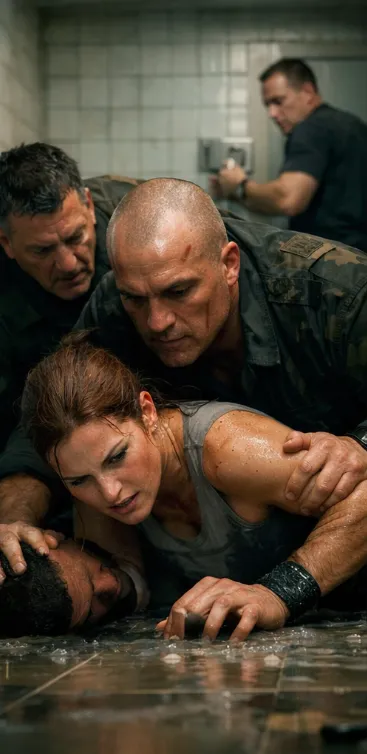
Then a hand clamps over her mouth.
Her training screams at her to react. Her body wants to explode into motion.
She forces herself to freeze for two seconds.
Long enough for them to commit. Long enough for the nano-recorder to catch their intent.
Arms pin her. Weight drives her down. Tile slams into her shoulder, her head bouncing hard enough to blur her vision.
It isn’t fake pain. Physics doesn’t care about plans.
Hayes’s face appears above her, close, smug.
“You picked the wrong base to play hero,” he murmurs.
Reeves laughs, breath thick with satisfaction.
Wade’s voice comes from near the door, detached and professional, like he’s giving instructions during a drill.
“Lock it.”
The deadbolt slides into place.
The click feels like a sentence.
Kate’s heart rate jumps.
Her pulse climbs past one-forty, adrenaline flooding through her.
The recorder activates.
She feels it not as a sensation but as a fact: the evidence is now being made.
Hayes says something low and threatening. Reeves adds something cruder. Crane mutters about keeping it quiet, about no interruptions, like they’ve rehearsed this.
Kate keeps her eyes wide. Breathing fast. Fear on her face.
Inside her mind, the calm voice runs calculations she’s trained to trust.
Time. Distance. Space. Who is closest. Who is blocking the door. Who thinks they’re in control.
She lets them believe she’s breaking.
She lets them lean in.
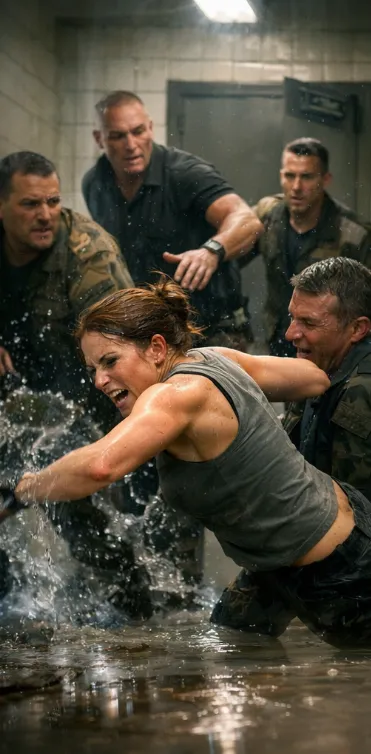
And when Reeves shifts his weight on wet tile and Hayes’s balance turns just slightly wrong, Kate stops acting.
She explodes into motion.
Part 5
The bathroom becomes a storm in a space too small to hold it.
Kate’s movements are fast, brutal, and controlled, the kind you only get from years of training that was designed to keep you alive when everything wants you dead. She doesn’t fight like someone trying to prove something. She fights like someone finishing a mission.
Hayes jerks back with a sharp gasp as pain hits him, surprise cracking his confidence. Reeves stumbles as his footing fails, his laughter cutting off into shock. Crane reaches forward instinctively, but his timing is wrong; his body hesitates half a beat too late, like his brain is trying to understand a reality he never planned for.
Wade goes for his weapon.
Kate doesn’t let him complete the motion.
The struggle is loud—boots scraping tile, breath tearing, bodies hitting hard surfaces. The fluorescent lights buzz overhead, indifferent. Water from the sink splashes across the floor, turning the tile slick and making arrogance expensive.
One by one, the men who walked in confident start moving like men who realize they can lose.
Hayes tries to rally them, voice snapping commands, but he can’t keep the pack together when fear enters the room. Wade’s control of the door doesn’t matter if the person inside isn’t trapped.
In the chaos, Kate hears words—threats, admissions, the casual language of men who’ve done this before and never feared consequence. The recorder catches it all.
That is the point.
Not vengeance. Not cruelty.
Evidence.
In under a minute, the room shifts from their trap to hers.
Wade is the last one standing long enough to understand what’s happening. His eyes are wide. His breathing is wrong. He backs up toward the locked door like it can protect him from what he started.
Kate’s voice is low and steady, the same tone she used in the corridor with Reed McKenzie.
“Don’t move.”
He freezes.
Behind him, Hayes struggles to rise, rage dragging him up through pain. He reaches for something—an attempt at control, at danger.
Kate stops him without theatrics, the way you stop someone who is no longer the priority.
The men end up on the tile, breathing hard or not breathing right, their confidence broken into something smaller. Kate stands in the center of the room with a torn shirt and bruises blooming fast, her throat aching where a hand tried to silence her.
Her pulse is still high. The recorder is still running.
She picks up Wade’s phone from the floor, sees that it’s recording. She looks into the camera. Blood streaks her lip, not glamorous, not cinematic—just real.
“My name is Commander Katherine Sullivan,” she says, voice steady. “Naval Special Warfare.”
She states her service number. The location. The time. The details that make this evidence and not a story.
Then she adds what matters most.
“This was an attempted assault,” she says. “These individuals acted with intent. Their words, their actions, and their coordination demonstrate a pattern of systematic abuse and cover-up.”
She stops recording and pockets the phone.
The deadbolt is still locked from inside.
Kate drives her boot into the doorframe.
Wood splinters. The bolt tears loose. The door bursts open into the hallway like a wall finally giving up.
Outside, Reed McKenzie stands in the center of a formation of people who have decided they are done being prey.
Women with phones raised, recording. A few men too—witnesses who finally chose a side. Lieutenant Morrison stands farther back, body cam active, face pale and determined.
Two civilians step forward, badges visible.
NCIS.
They weren’t late.
They were waiting for the moment they could legally take the base out of its own hands.
Reed’s eyes lock on Kate’s face, and relief hits her like a wave.
“Commander,” Reed says, voice shaking. “Evidence secured.”
Kate’s knees wobble as the adrenaline begins to drain. Reed catches her before she falls, hands steady.
“We did it,” Reed whispers, tears running.
Kate’s voice is rough. “We did it,” she corrects.
Behind them, NCIS agents move past with efficient speed. Radios crackle. The base that thrived on silence fills with the sound of authority that doesn’t belong to Fort Davidson’s chain of command.
The hallway feels like a line in history being crossed.
Kate’s vision blurs. Not from defeat. From exhaustion. From three weeks of being bait. From surviving the locked door.
As she slips into darkness, the last thing she sees is Reed McKenzie’s face, alive.
For the first time in years, the part of Kate that is only a sister—not an operator, not a weapon—feels something that isn’t rage.
It feels like the universe finally inhaled.
Part 6
Kate wakes to antiseptic and white ceiling tiles.
Medical bay. Fort Davidson. The same fluorescent hum. The same institutional beige. A reminder that even hospitals on military bases can feel like holding cells with IV poles.
Her throat burns like she swallowed glass. Her ribs ache with every breath. Her head pounds in a steady rhythm.
She turns her head and finds Admiral Donnelly sitting beside her bed, uniform wrinkled, eyes tired in a way that suggests he hasn’t slept since she stepped onto the base.
“Commander,” he says quietly.
Kate’s voice comes out rough. “Where are they?”
“Federal custody,” Donnelly replies. “Hayes. Reeves. Crane. Wade. And Colonel Kramer.”
Kate tries to sit up. Pain flares. She does it anyway.
“What about the evidence?” she asks.
Donnelly slides a tablet onto the bed. “Wade’s phone,” he says. “Clear footage of the attempted assault. Your nano-recorder audio. Every threat. Every admission. Their coordination. Their language.”
He swipes. Files appear—encrypted server dumps, recovered footage, timestamps that match years of disappeared reports.
Kate’s stomach twists when she sees a filename with Sullivan in it.
Donnelly’s voice softens without becoming sentimental. “You don’t have to watch it now.”
Kate’s jaw tightens. “I will,” she says.
He swipes again. A map appears: multiple bases flagged, a network of transfers, retaliations, “disciplinary actions” that look like patterns when you stop pretending they’re isolated.
“It goes higher than Kramer,” Donnelly says. “Major General Stakes. We have communications tying him to the transfer network. And Caldwell—Under Secretary level—approved the reporting metrics that made ‘zero prosecutions’ look like ‘excellent discipline.’”
Kate stares at the map. Fourteen bases. Years of rot.
“How many?” she asks.
Donnelly’s silence is answer enough.
“Forty-seven confirmed deaths,” he finally says. “Matching patterns. Accidents. Suicides. Falls. Training incidents. Some might be misclassified. Some might never be found.”
Kate closes her eyes. She thinks of Jessica’s smile in that photo. She thinks of the women in the supply closet. Reed’s trembling hands. The nineteen-year-old whispering they’ll kill you.
“And now?” Kate asks.
“Now it’s public,” Donnelly says. “NCIS seized every server. Inspector General took jurisdiction. The Pentagon can’t bury it because too many people have copies.”
Kate exhales carefully, throat stinging. “Tribunal,” she says.
“In three weeks,” Donnelly confirms. “Federal military court. Media. Oversight. You wanted sunlight. You’re getting it.”
Kate opens her eyes and looks at him. “They’ll try to destroy me on the stand.”
“They will,” Donnelly agrees. “They’ll claim entrapment. They’ll claim you engineered the assault. They’ll try to turn your survival into proof you weren’t harmed.”
Kate’s mouth twists. “Let them try.”
Donnelly pauses. “Corsair protocol authorization is signed,” he says. “Legal counsel. Federal judge. The evidence stands.”
A knock interrupts. Reed McKenzie steps in, civilian clothes, hair down, face raw with emotion.
She stops like she doesn’t know whether to salute or hug or collapse.
“Kate,” she says, voice breaking.
Kate lifts a hand slightly. “Don’t thank me,” she says.
Reed swallows hard. “My little sister wants to enlist,” Reed whispers. “She’s seventeen. I’ve been terrified she’d end up somewhere like this.”
Kate’s throat tightens. “It will be different here,” she says. “And it will be harder to hide elsewhere. But I can’t promise it’ll be safe everywhere.”
Reed nods, wiping her face. “I know,” she says. “But now we have proof. Now we have a story so loud they can’t pretend it’s nothing.”
After Reed leaves, Donnelly stands. “Rest,” he says. “Get sharp. Tribunal is war without bullets.”
Kate nods.
When he’s gone, she opens the tablet again and scrolls until she finds the file with her sister’s name.
She presses play.
She watches enough to understand.
Jessica wasn’t an accident.
Jessica fought.
Jessica died because she believed rules would protect her.
Kate closes the file, stares at the ceiling, and doesn’t cry. Not yet.
Grief can wait.
Justice has a schedule.
Part 7
The tribunal convenes at Quantico in a courtroom packed so tight it feels like pressure.
Cameras. Reporters. Families with hands clenched around tissues. Service members in uniform, some stiff with anger, some stiff with shame.
Kate sits in dress uniform, SEAL insignia visible, medals earned the hard way. Reed McKenzie sits beside her, now promoted, spine straight like she refuses to bend again. Lieutenant Morrison sits behind them in civilian clothes—he resigned before he could be forced out, choosing honesty over career.
Across the aisle, the defendants sit in orange jumpsuits.
Hayes’s face is harder, but something in him looks smaller. Reeves has a limp. Crane’s eyes dart too much. Wade stares at the floor like it can swallow him.
Colonel Kramer sits with his shoulders still squared, still trying to look like a man who deserves respect.
The prosecution is methodical. They build the case like a wall: testimony, footage, records, transfers, threats, patterns.
Women testify one by one. Some composed. Some shaking. Some angry enough to vibrate.
Dr. Holloway, the base psychiatrist, takes the stand and admits she was pressured to misdiagnose victims, to label them unstable, to discredit them. She produces files. Dozens. Patterns too clear to argue away.
Then Kate is called.
She walks to the stand and swears in. Her hands don’t shake.
“Commander Sullivan,” the prosecutor says, “why did you volunteer for Corsair protocol?”
Kate takes a breath and pulls the photograph from her pocket.
“My sister,” she says. “Private Jessica Sullivan. She reported an assault. She tried to do it right. Then she died. They called it an accident.”
The prosecutor displays the photograph to the court. A young woman’s smile fills screens.
Kate keeps her voice steady. “I volunteered because my sister died believing the system would protect her. And it didn’t.”
They play a short clip of the recorded attempt in the bathroom. Not sensationalized. Just enough. The sound of the lock. The words spoken by men who thought they were untouchable.
Defense cross-examination comes hard.
Hayes’s attorney stands with the confidence of someone paid to twist language.
“Commander,” he says, “you intended to be attacked, didn’t you?”
“I created an opportunity,” Kate answers. “They chose to attack.”
“You engineered it.”
“They engineered it,” Kate replies. “They planned it. They coordinated it. They locked the door.”
“You’re a trained SEAL. Were you ever in real danger?”
Kate leans forward slightly. Her throat tightens, but her voice stays controlled. “I was alone in a locked room with four men who intended to hurt me. If you’re suggesting my training makes that not danger, you’re wrong. If you’re suggesting I could have stopped them earlier, you’re right. But then I would not have evidence to protect the women who can’t fight back.”
The courtroom stills.
The defense tries another angle. “Corsair protocol is illegal.”
The prosecutor produces signed authorization, approvals, oversight. The defense loses that ground.
Then the case expands beyond Fort Davidson.
A surprise witness is called: Robert Caldwell, Under Secretary of Defense.
The courtroom breathes like a single organism. A man who has lived behind layers of protection sits under oath.
The prosecutor reads an email. Metrics. “Base discipline.” “Zero prosecutions.” “Contract favorability.”
The language is clean and chilling.
Caldwell’s face tightens. He tries to hide behind bureaucracy.
The prosecutor asks, “How much is a life worth?”
Objection. Sustained. The question lands anyway.
When Caldwell steps down, federal marshals approach—not to escort, but to arrest. Corruption doesn’t look powerful in handcuffs.
Verdicts come two weeks later.
Guilty. Guilty. Guilty.
Sentences are long. Benefits revoked. Pensions gone. Rank stripped. Careers erased.
Colonel Kramer’s polished shoes don’t matter in federal prison.
Major General Stakes goes down hard. Caldwell goes down hard.
And the story becomes too loud for the military to swallow without changing.
Congress moves fast when the public is watching.
The Sullivan-McKenzie Act passes with bipartisan force, named for Jessica Sullivan and Reed McKenzie—because Kate insists on both names.
External oversight for assault reports. Civilian investigators. Whistleblower protection. Automatic felony for retaliation. Public reporting of prosecution data. Command relief during investigations. Funding for special victims units.
It isn’t perfection.
But it’s a wall built where there used to be a hole.
Part 8
Fort Davidson is decommissioned within months.
The base that lived on silence becomes a headline and then a warning. The auxiliary bathroom is demolished. The corridor where women learned to walk faster gets ripped out and rebuilt.
On the land where the building stood, they put a garden.
White roses. In a Nevada desert that never cared about softness.
They build the Jessica Sullivan Trauma Recovery Center on the remaining grounds. Counseling. Legal support. Medical care. Job placement. A place for survivors that doesn’t require them to beg for credibility.
The dedication ceremony is large, but the moment that matters is small.
Kate stands before a wall of black granite engraved with names.
Forty-seven.
Confirmed.
More may come later, because truth expands when you stop burying it.
Kate finds Jessica’s name and touches it with two fingers. Cold stone. Unmoving. Real.
Behind her, Admiral Donnelly speaks to families who have waited years for someone to say the words out loud.
“These women didn’t die in combat,” he says. “They died because we failed them.”
Mothers cry. Fathers stare at the wall like they want to tear it down and build a different world.
One gray-haired woman approaches Kate after the ceremony, hands shaking.
“My daughter tried to tell me,” the woman whispers. “And I said… be strong. Don’t make waves. If I’d listened—”
Kate takes her hand gently. “The system failed her,” Kate says. “Not you.”
The woman squeezes Kate’s hand like she’s holding onto the only solid thing left.
Reed stands nearby in uniform, now part of a new unit with real authority. Not a secret network, but an official one, built with oversight that doesn’t belong to base commanders.
Lieutenant Morrison works at the center now as a civilian legal advocate. He resigned his commission and chose service over rank, turning shame into something useful.
After the crowd leaves, Kate stays.
Just her and the wall.
“I got them,” she whispers to Jessica’s name. “Every one we could reach. They’ll never touch anyone again.”
Wind moves through roses. The scent is faint in desert air, but it’s there.
Kate closes her eyes and lets grief hit like it’s been waiting for permission.
It comes quiet at first—pressure behind the eyes, tightness in the throat. Then it comes harder, a wave that makes her grip the edge of the granite to stay upright.
She doesn’t cry like a movie.
She cries like a sister who couldn’t save her sister.
When the wave passes, Kate exhales and stands up straighter.
“I can’t bring you back,” she whispers. “But I can make what happened to you mean something.”
Then she salutes the name, not because Jessica is a soldier on paper anymore—records were altered, reports erased—but because Kate refuses to let the system take even that.
She turns away and walks toward Reed and Morrison.
Forward is the only direction that matters.
Part 9
The first time Kate returns to the field after Fort Davidson, she isn’t alone.
That’s the biggest change the reforms create immediately.
Corsair protocol evolves. No more single-operator isolation. Teams. Real-time support. Extraction within minutes. Multiple channels of evidence. Predators can still exist, but they have to fear that the floor beneath them has cameras now.
A new folder lands on Kate’s table in a coffee shop in Georgetown. Donnelly sits across from her, older and more tired, but with something in his eyes that wasn’t there before Fort Davidson.
Hope, but hardened into purpose.
“Camp Lejeune,” Donnelly says. “North Carolina. Nineteen red flags. Missing woman.”
Kate flips the folder open and sees a photograph.
Corporal Julia Brennan. Twenty-three. Blonde. Smiling with the same trusting brightness Jessica once had.
“Reported an assault three weeks ago,” Donnelly says. “Transferred as a disciplinary problem. No contact since.”
Reed sits beside Kate now, officially assigned. Morrison sits near the window, civilian consultant with a legal mind built for tearing holes in lies.
“How fast can we move?” Kate asks.
“Forty-eight hours,” Donnelly replies. “Cover story: readiness evaluation. Access to personnel files, incident reports, and facilities.”
Kate reads the folder, not with surprise but with grim familiarity. Patterns repeat until someone breaks them. Names change. Tactics change. The hunger stays the same.
When they arrive, the base feels different than Fort Davidson, but the undercurrent is familiar: the way women move with their shoulders slightly raised, the way certain men take up space like they own it.
The team moves quietly. Reed speaks to women who have learned to whisper. Morrison gathers paper trails that used to vanish. Kate watches eyes, posture, habits—the human tells predators can’t hide.
They find Julia on day three.
Not dead. Not hidden in a dramatic basement. Alive in a reality that is quieter and worse: isolated, labeled unstable, threatened with charges if she keeps “making trouble.”
They bring her out with paperwork, cameras, and authority that doesn’t belong to the base.
Julia’s hands shake when she sees Kate.
“I thought nobody would come,” she whispers.
Kate keeps her voice soft. “We came,” she says. “You’re not alone.”
The predators don’t get a bathroom trap this time.
They don’t get a locked door.
They get subpoenas and federal agents and evidence stacked too high to kick over.
NCIS arrests two NCOs and one civilian contractor tied to retaliation and coercion. A commander is relieved pending investigation. The base goes into external review.
It’s not cinematic.
It’s effective.
On the flight home, Julia sleeps between Reed and Kate like someone whose nervous system finally stopped screaming.
Reed watches her and wipes her eyes quickly, like she’s embarrassed to show emotion in front of someone as hard as Kate.
Kate looks out the window at clouds and thinks about the difference between revenge and justice.
Fort Davidson needed a reckoning loud enough to change laws.
Camp Lejeune needed intervention fast enough to save a life without needing another locked door.
The work will never be finished.
But it can be different.
And that difference is everything.
Part 10
Five years after Fort Davidson, Kate stands in a gym that smells like rubber mats and sweat and determination.
A group of young women face her in a half-circle. Some are SEAL candidates. Some Rangers. Some military police, some intelligence. All volunteers. All with eyes that have that same question underneath the confidence.
Will the system protect me?
Kate doesn’t lie.
“No system protects you,” she says. “People protect you. Evidence protects you. Oversight protects you. And you protect yourself.”
She trains them without teaching violence like a hobby. She teaches them survival like a responsibility. Awareness. Communication. Boundaries. How to document. How to trust the right channels and how to recognize when a channel is trying to become a trap.
Reed runs the special victims unit now. Her hair is shorter. Her shoulders are steadier. Her sister enlisted last year and serves on a base that has cameras where Building Seven used to have none.
Morrison directs legal advocacy at the recovery center. He’s older too, quieter, grounded in a life built around repair instead of regret.
Donnelly retired, but he still shows up. He watches the young operators train and looks like a man who finally believes he didn’t spend decades feeding a machine that only hurt the right people.
Kate’s body carries scars that don’t show in dress uniform. Sometimes she wakes up hearing a deadbolt click. Sometimes she tastes copper in her mouth and has to remind herself she’s in her own bed.
Trauma doesn’t vanish because you won in court.
It just changes shape.
On the anniversary of Jessica’s death, Kate drives to the recovery center in Nevada. The desert is still indifferent. Wind still moves sand like it’s trying to erase footprints. But the roses in the garden still bloom.
Kate stands at the wall and touches Jessica’s name.
“I saved some,” she whispers. “Not enough. Never enough. But some.”
She doesn’t ask for forgiveness from the universe. She doesn’t bargain with grief. She just stands there long enough for memory to feel like love instead of a knife.
Before she leaves, she walks to the garden where the auxiliary bathroom used to be.
It’s quiet.
No fluorescent hum. No tile echo.
Just white roses and sun.
Kate sits on a bench and closes her eyes.
In her mind, she hears Jessica’s laugh from when they were kids, running around the backyard in their father’s oversized dress cover, pretending the world was simple.
Kate opens her eyes and looks at what they built instead.
A center that didn’t exist. Laws that didn’t exist. A unit that can arrive before another locked door becomes a coffin.
It won’t fix everything. Kate knows that better than anyone.
But it changed the balance.
Predators used to move like they owned the system.
Now they move like they might be watched.
And victims used to feel alone.
Now they have proof that someone will come.
Kate stands, salutes the wall one more time, then turns and walks away without looking back.
Not because she’s done grieving.
Because she’s done living in the place where grief is the only thing that survives.
Forward is still the only direction that matters.
And as long as there are locked doors built for silence, there will be someone trained to break them open.
Part 11
The backlash didn’t come from men like Hayes.
Men like Hayes were easy in a certain way. They were loud. They were physical. They were obvious once you looked at them long enough.
The backlash came from the people who wore clean suits and spoke in careful sentences. The ones who didn’t threaten you in hallways, but who could ruin your life with a document you’d never see.
It started as a story.
A senator went on television and called the Sullivan-McKenzie Act “a political overcorrection.” He said it weakened the chain of command. He said it “handcuffed good leaders.” He said the military was becoming “too afraid to be military.”
Then an editorial appeared arguing Corsair protocol was entrapment dressed up as justice. The author never mentioned Jessica Sullivan’s name. Never mentioned the forty-seven dead. Just spoke about “legal overreach” and “agent provocation” like those were the only words that mattered.
Kate watched it all the way you watch weather on radar—calm, alert, preparing.
Donnelly, older now, called her from a number she didn’t have saved.
“They’re pushing,” he said.
“Who is ‘they’?” Kate asked.
Donnelly didn’t bother pretending. “Defense contractors. Lobbyists. Old networks. People who lost money when the data started being published quarterly.”
Kate didn’t answer. She didn’t need to. Money always moves like a living thing; when you cut off its favorite food source, it tries to grow teeth.
A week later, an envelope arrived at the recovery center addressed to Kate, no return address.
Inside was a printed photo.
Kate, in the Fort Davidson bathroom, blood on her lip, eyes clear. The image was from Wade’s phone.
Under it, a single line in block letters:
YOU THINK YOU WON.
Kate stared at it until the paper felt thin in her hands.
Reed found her in her office, holding it. Reed’s expression tightened.
“Do we have a threat assessment?” Reed asked.
Kate exhaled once. “We do now.”
They treated it like an operational problem, not a melodrama. Morrison contacted federal marshals. Reed tightened security around the center. Donnelly made calls that didn’t appear on any logs.
And Kate did what she always did when someone tried to reframe her life into a narrative they could control.
She went to the source.
Two months later, Kate sat in a hearing room in D.C., behind a placard that read:
CMDR. KATHERINE SULLIVAN (RET.)
She wasn’t active duty anymore. That had been a decision she made after year three, when she realized the work would swallow every part of her if she didn’t carve out a boundary. Reed still deployed. Teams still ran operations. Kate now did what she’d once despised: meetings, oversight, policy.
But policy is where predators hide when the bathrooms get cameras.
The committee room smelled like old wood and cologne. Senators shuffled papers. Cameras lined the wall. Reporters whispered.
A senator with a confident smile leaned toward the microphone.
“Commander Sullivan,” he said, “or should I say former Commander. You led an operation that resulted in multiple convictions. But some argue Corsair protocol constitutes entrapment. That it creates crimes that wouldn’t otherwise happen.”
Kate looked at him, face steady. “Senator,” she said, “predators don’t need to be created. They only need opportunity and confidence.”
He smiled as if she’d given him something. “So you admit you provided opportunity.”
“I provided a situation in which men could choose to follow the law,” Kate replied. “They chose to commit assault. They chose to lock a door. They chose to speak, on record, about the other women they’d hurt.”
The senator’s smile faltered.
He tried again. “You’re a trained SEAL. In the Fort Davidson incident, were you ever truly at risk?”
Kate didn’t flinch, but she felt something in her chest tighten with an old memory: the deadbolt click.
“I was in a locked room with four men who intended to rape and kill me,” she said. “If you need me to be helpless to consider me harmed, then your definition of harm is designed to protect perpetrators.”
A murmur ran through the room.
Another senator—older, quieter—leaned forward. “Commander,” she said, voice controlled, “what do you say to the argument that these reforms damage morale?”
Kate turned toward her. “Morale is damaged when women believe they can be assaulted without consequences,” she said. “Morale is damaged when good men watch predators get promoted. Morale is damaged when families bury daughters and are told it was an accident.”
She paused, then added, “If your morale depends on silence, then it deserves to be damaged.”
The hearing went on for hours. Questions about oversight. Costs. Data. Statistics.
Kate answered with facts and calm.
And then the senator with the confident smile made his final move.
He held up a folder.
“Commander,” he said, “are you aware that elements of your Fort Davidson operation remain classified? That your testimony today may be exposing protected methods?”
Kate stared at him. She could almost see the trap being sprung.
She waited two seconds, then said, “Senator, nothing I have stated today is classified. Your own committee cleared my prepared remarks. If you are suggesting someone leaked classified material to undermine this act, then you should be asking who leaked it and why.”
Silence.
The senator blinked, caught.
Because the truth was, he wasn’t protecting methods.
He was threatening her with the shadow of classification—the same shadow that buried Jessica’s death for years.
Kate leaned slightly forward. “If you have evidence of a leak,” she said, voice even, “I recommend you refer it to the Inspector General immediately. Because leaks are crimes. And using them as intimidation in a hearing is obstruction in a nicer suit.”
The cameras zoomed in.
The senator’s cheeks reddened.
The chairperson cleared their throat and moved on.
Afterward, in the hallway, a reporter shouted, “Commander, do you feel safe?”
Kate stopped, turned, and looked directly into the lens.
“No,” she said honestly. “But safety was never the point. Accountability is.”
That night, back at her hotel, Kate stood at the window looking out over D.C., lights scattered like spilled coins.
She wasn’t shaking.
She wasn’t afraid.
She was tired in a way that felt familiar—like the end of a mission.
Her phone buzzed.
A text from Reed:
Heard you lit them up. Proud of you. Also, marshals traced the photo envelope. It came from a private mailbox tied to an Apex subcontractor.
Kate stared at the message.
Then she typed:
Good. Follow the chain.
Because this wasn’t over.
It was just changing arenas.
Part 12
The Apex subcontractor didn’t lead to a smoky backroom with villains laughing.
It led to spreadsheets, shell companies, and “consulting fees” labeled so blandly they could’ve been office supplies.
Morrison built the case like he built everything: quietly, obsessively, with legal precision that turned vague suspicion into something a judge could sign.
Reed ran point with the Inspector General’s office and federal marshals. Donnelly—retired but still connected—made sure doors opened when they were supposed to.
Kate did what she did best now.
She watched patterns.
Money didn’t just move to protect predators. It moved to protect the system that made predators profitable—bases with “excellent discipline,” commanders with clean metrics, contractors with steady contracts.
The problem was never one base.
It was incentives.
So they dismantled incentives.
They didn’t do it in a single raid. They did it over two years: audits, subpoenas, data exposure, prosecutions that weren’t headline-worthy but were devastating in effect.
Apex didn’t disappear, but it bled. Contracts canceled. Executives resigning. Investigations widening until even the people who claimed ignorance realized ignorance wasn’t a shield anymore.
In the middle of all that, Reed called Kate at 2 a.m. from an unfamiliar number.
“We’ve got a situation,” Reed said.
Kate sat up immediately. “Where?”
“Joint base in Alaska,” Reed replied. “Not in the original fourteen. New flag cluster. Three women transferred there in six months. One missing. Local command is… stalling.”
Kate’s pulse ticked up. “Corsair team?”
Reed hesitated. “They requested you.”
Kate closed her eyes. The request wasn’t flattering. It was fear. When people had been burned, they reached for the match they trusted.
“I’m not the only match anymore,” Kate said.
“I know,” Reed replied. “But they want your presence because the command is acting like the old days. Like they think they can wait it out.”
Kate exhaled slowly. “I’ll come. But we do this the new way.”
They moved within forty-eight hours.
No lone operator. No bathroom. No deadbolt.
A team.
Two NCIS agents embedded under a readiness inspection cover. Reed as team lead. Morrison remote, legal coordination ready. Kate as oversight, witness, and, if needed, the person who could force higher authorization with a phone call that carried weight.
The base was colder than anything Nevada ever imagined. Snow on concrete. Wind like knives. The kind of place where isolation did half the predators’ work for them.
Kate walked the base with Reed and watched the small tells: women who moved too carefully, men who watched too comfortably, doors that didn’t lock right, cameras angled wrong.
They found the missing woman on day two.
Alive.
Locked in a medical holding room under the label “psychological instability,” sedated enough to keep her quiet. A paper trail existed, but it was suspiciously clean, as if someone had learned from Fort Davidson and tried to build a better lie.
They got her out with paperwork and cameras and a federal badge that didn’t ask permission.
The woman—Specialist Mariah Torres—clutched Reed’s sleeve like she was afraid the world would vanish if she let go.
“They said nobody would believe me,” Mariah whispered.
Reed’s voice was steady. “They were wrong.”
The predators didn’t get a fight. They didn’t get to drag anyone into a bathroom. They didn’t get to lock a door.
Instead, they got a conference room with federal agents and a sealed warrant.
They got phones seized, hard drives cloned, emails recovered.
They got the thing predators fear most: daylight.
One of the accused NCOs tried to posture in the interrogation room. “This is overblown,” he said. “We didn’t do anything. She’s unstable.”
Kate didn’t speak to him. She didn’t need to.
Mariah sat behind one-way glass with Morrison on video, Reed beside her. Mariah’s hands were shaking, but her voice didn’t break.
“Here is what happened,” she said.
And because the system had changed enough to hold her up instead of crush her, she didn’t have to scream to be heard.
They arrested two men. Relieved a commander for obstruction. Opened a broader investigation into “medical holds” being used as retaliation across multiple cold-weather installations.
On the flight back, Reed looked at Kate over the aisle.
“You okay?” Reed asked.
Kate stared out the window at endless white. “I’m relieved,” she said quietly.
Reed blinked. “Relieved?”
Kate nodded. “Because it worked without me being bait.”
Reed’s face softened. “That’s the whole point,” she said.
Kate swallowed. “I know. But part of me… part of me kept thinking the only way to make them show themselves was to let them put hands on someone.”
Reed shook her head gently. “They show themselves in other ways. In retaliation. In cover-ups. In paperwork. In threats. We don’t need another locked bathroom to prove it.”
Kate let that settle.
It was the real evolution of the mission: moving from survival through violence to protection through structure.
Because the goal was never to create a legend.
The goal was to make sure fewer women needed legends to survive.
Part 13
The day Kate decided to stop deploying wasn’t dramatic.
It was a Tuesday morning.
She was at the recovery center in Nevada, walking past the garden where the auxiliary bathroom used to be, white roses stubborn against desert heat. She watched a young woman in civilian clothes sit on the bench with a therapist, hands wrapped around a paper cup like warmth could fix what happened.
The young woman looked up as Kate passed.
Recognition flickered. Not celebrity recognition. Something deeper.
That look said: You’re the reason I’m alive.
Kate felt a tightness in her chest that wasn’t pride.
It was weight.
Because being someone’s reason can become a burden if you don’t set it down sometimes.
That afternoon, she met Reed and Morrison in a small office with a view of the memorial wall.
“I’m stepping back,” Kate said.
Reed’s jaw tightened. “From what.”
“Field oversight,” Kate clarified. “Deployments. I’ll stay on policy, training, and hearings. But I’m not going into bases anymore.”
Morrison studied her face. “Burnout?”
Kate shook her head. “Not exactly. I’m… at peace with what we built. And I don’t want to turn my life into a perpetual chase for the next locked door.”
Reed was quiet for a long moment. Then she nodded once, slow.
“You gave us a blueprint,” Reed said. “We can run it.”
Kate exhaled, relieved. “I know you can.”
Two weeks later, Kate stood at the memorial wall with her mother.
It was the first time her mother had come to the center.
Her mother’s hair had gone more gray. Her posture looked smaller. Time had done what apologies couldn’t: it had made denial exhausting.
They stood together in silence for a long time, staring at names carved into black granite.
Jessica Sullivan.
Kate’s mother reached out with trembling fingers and touched the letters like she was afraid they’d disappear.
“I believed them,” her mother whispered.
Kate didn’t answer immediately. Anger rose, old and familiar, but it didn’t own her the way it once did.
“I know,” Kate said finally.
Her mother’s eyes filled. “I should have fought harder,” she said. “I should have screamed until someone listened.”
Kate swallowed. “We both should have had to do none of this,” she replied.
Her mother turned toward her, face breaking. “I’m sorry,” she whispered. “Not the kind of sorry that fixes anything. Just… sorry.”
Kate stared at her mother for a long moment. The girl who’d lost her father at eight and her sister at twenty-four lived somewhere behind Kate’s eyes, watching, measuring whether this sorrow was real or just late.
It was real.
It was late.
Both things can be true.
“I don’t forgive what happened,” Kate said quietly. “But I forgive you for not knowing how to fight the machine. Because the machine was built to crush you too.”
Her mother let out a sob like she’d been holding it for years.
They left a bundle of white roses under Jessica’s name and walked into the desert sun together, not healed, but no longer standing on opposite sides of silence.
That winter, Kate taught her last training cycle for new SVU operators.
Twelve women. Four men. The unit wasn’t women-only anymore; it was anyone willing to defend truth under pressure. The best protection isn’t separation. It’s culture that refuses to tolerate predators.
At the end of the cycle, a young operator lingered behind.
She was twenty-six. California accent. Blonde hair pulled back. Her hands were steady but her eyes were nervous.
“Commander Sullivan,” she said.
“Kate,” Kate corrected gently.
The young woman swallowed. “My name is Julia Brennan,” she said. “Not the one from Camp Lejeune. Different Julia. Same name.”
Kate felt something twist in her chest at the coincidence.
Julia continued, “My older sister was assaulted at a base in 2022. She didn’t die, but… she left the service. She never recovered. When Fort Davidson went public, she started sleeping again. She said, ‘Finally. Someone proved it.’”
Kate listened without interrupting.
Julia held out a small item in her palm: a white rose pin, simple and clean.
“I made these,” Julia said. “For the unit. Not official. Just… a reminder.”
Kate took the pin carefully.
“You don’t owe me anything,” Kate said.
Julia’s eyes filled. “I know,” she whispered. “But I wanted you to have one anyway.”
Kate nodded once, because sometimes accepting a symbol is a way of letting someone close a loop.
That spring, Kate moved into a small house outside Denver, closer to mountains, quieter air. She planted roses in her backyard—white ones—because she’d learned symbols can be reclaimed.
She still testified when needed. She still advised. She still took midnight calls when Reed asked, “What do we do?” But she also cooked dinner. Hiked. Slept without a deadbolt click in her dreams, most nights.
On the anniversary of Fort Davidson, Reed called her.
“Another base just got flagged,” Reed said. “You want to see the folder?”
Kate stood on her porch, looking at her garden.
“No,” she said softly. “You’ve got it.”
Reed was quiet, then said, “We’ll burn it down.”
Kate smiled, small. “Good,” she replied. “Just make sure you don’t burn yourselves with it.”
After the call, Kate walked into her backyard and knelt by the roses. The petals were open, bright against green leaves, stubborn against everything the world had tried to make them.
Kate touched one gently, then looked up at the sky.
Her sister was still gone. Nothing fixed that.
But the locked doors were fewer now. The cameras were more honest. The chain of command had limits. The silence had consequences.
And somewhere, on some base, a young woman reporting an assault would be believed faster than Jessica was.
Kate couldn’t bring her sister back.
But she made sure her sister’s death stopped being only a tragedy.
It became a turning point.
That was the ending Kate could live with.
So she stood, wiped her hands on her jeans, and went back inside, leaving the roses to bloom without needing her to guard them.