The nightmare always began with the same color.
Bone-white desert. A sky burned flat by heat. The Humvee ahead of her blossomed into orange fire, metal spinning like shrapnel confetti—beautiful for half a second, then brutally real.
And the screaming.
Always the screaming.
Captain Harrison shouting orders no one would live long enough to follow. The gritty stench of diesel and blood. Hands—rough hands—hooking under her arms and dragging her backward into a darkness that tasted like rust.
Russian voices lived in that darkness.
Kira Blackwood snapped awake on her rack at Forward Operating Base Wolverine, breath sawing in and out of her chest like a saw blade. Her hand went to where her sidearm should’ve been.
Nothing.
Just air and the faint red emergency glow painting the world the color of old wounds.
Another dream. Another memory clawing its way out of the grave.
She sat up slowly, feet on the cold floor, forcing her mind to do the math it always did after the nightmares.
Afghanistan, not Iraq.
2011, not 1991.
Thirty-eight years old, not eighteen.
Alive.
That was supposed to mean something.
She dragged a hand through her dark hair, the silver streak catching the red light like a warning flare. Doctors had called it stress, trauma made visible in pigment. Kira called it what it was.
A scar you couldn’t bandage.
She dressed with the mechanical precision of someone who’d done it ten thousand times and still didn’t feel safe. The uniform hung loose on her frame. She’d always been small—small enough to be sent where others couldn’t go, small enough to be underestimated until the moment it became fatal.
Outside, the FOB was mostly asleep. A handful of Marines wandered like ghosts to the head or the perimeter. No one looked at her twice.
That was how she survived.
Not by being invisible.
By being forgettable.
She hit the gym—an old storage container turned iron box that smelled of sweat, rust, and stubbornness. Her routine wasn’t about passing standards. It was about keeping the part of her body that remembered violence sharp enough to respond before her mind had time to hesitate.
Because hesitation had a body count.
By 0700, she was clean, dressed, and nursing coffee that tasted like regret, reading an advanced ballistics manual she didn’t need.
Then the PA system crackled.
“All Alpha Company personnel—medical bay, 0800. Routine readiness physicals. No exceptions.”
Kira closed the manual.
Medical bay.
She hated medical bays. Too many hands lifting fabric. Too many voices asking questions that started gentle and ended sharp.
But the safest way to avoid attention was to follow the script.
So she followed it.
At 0755, she sat on the edge of a diagnostic bed, back straight, hands calm on her knees. The room was crowded with Marines shifting, joking, complaining about interrupted mornings.
A young corporal beside her bounced his knee like it could outrun his nerves.
“First deployment?” Kira asked quietly.
He flinched, then nodded.
“Yes, Staff Sergeant. Little bit.”
She gave him a thin, almost-soft smile.
“You’ll be fine. Listen to your team leader. Do what you’re told. Don’t try to be a hero.”
He swallowed. “Heard you transferred from embassy duty in Rome. Must be… different.”
“It is.”
She didn’t give him more. She didn’t give anyone more.
Across the bay, Major Evelyn Strand—hard eyes, controlled posture—scrolled reports on a tablet like she was trying to read the war before it happened.
The corpsman moved down the line with brisk efficiency, telling Marines to remove their tops and step through the bioscanner arch.
Standard.
Simple.
Nothing to fear.
Except Kira’s body didn’t believe in simple.
The bay doors hissed open.
The room changed in a single heartbeat.
Jokes died mid-sentence. Spines straightened. That cold tension—rank in the doorway—flooded in like ice water.
Rear Admiral Garrett Drummond strode inside.
Not a desk admiral. Not a ceremonial presence. This was a man who wore authority like a blade—sharp, heavy, unavoidable. His uniform was immaculate, his face carved by decades of command and the kind of war that didn’t come with press releases.
Two officers trailed him, but they were just shadows.
The senior medical officer rushed forward, nervous and eager.
“Admiral Drummond, sir— we weren’t expecting—”
“That’s the point,” Drummond cut in, voice gravel over steel. “Are my people medically ready or are they not?”
“Yes, sir. Readiness is—”
“I’ll decide.”
He moved through the bay, eyes sweeping the Marines like he could measure their worth by how they held their shoulders. He picked up a tablet, flicked through the roster with dismissive speed.
Then his thumb stopped.
His gaze sharpened.
“Blackwood. Kira. Staff Sergeant.”
Kira felt the weight of it like a hand closing around her throat.
He looked up, found her, and held the gaze.
“Transfer from Rome,” he said, like embassy duty left a stain.
“Yes, sir.”
“Stand up when I address you.”
She rose to attention—five-six, lean, unremarkable. The silver streak was the only thing that made her stand out, and she wished it didn’t.
Drummond walked closer, studying her like he was searching for the flaw that would justify his contempt.
“Embassy security,” he said. “That’s where we send people to stand still and pretend it matters.”
Silence thickened.
“We’re at war,” he continued, voice rising just enough for the room to hear. “And I’m given someone who’s spent years checking IDs and smiling for diplomats.”
Kira didn’t blink.
Men like him didn’t want answers. They wanted validation for the judgment they’d already made.
“What’s your specialty?” he asked. “Polite conversation?”
“Small arms maintenance, sir. Advanced marksmanship. Combat lifesaving.”
He snorted—dismissal sharpened into insult.
“Let me guess. Expert on a range where the targets don’t shoot back.”
“Yes, sir.”
Agreement was armor.
Drummond turned, addressing the room like a lesson.
“Continue the physicals.”
He didn’t leave.
That was the problem.
He stood there, arms folded, a living threat, while the corpsman gestured toward the scanner.
“Staff Sergeant—your blouse, please.”
Kira could feel eyes turning. Curiosity. Boredom. The casual attention of people who didn’t know they were seconds away from learning something they couldn’t unsee.
Her fingers found the collar. Fabric rustled.
She pulled the blouse up and off.
Folded it with automatic precision.
Then she faced the scanner and stepped forward.
The bay held its breath.
A sharp inhale cut through the quiet. A muttered curse. Then the kind of silence that wasn’t calm—it was shock.
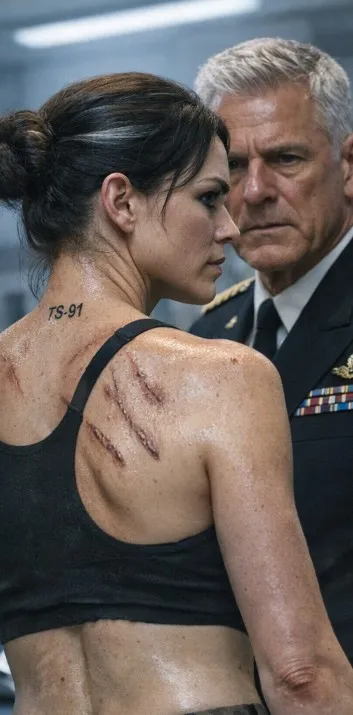
Kira’s back was a map of survival.
Not clean surgical lines. Not training injuries.
Violence, healed into flesh.
Shrapnel burns bloomed over her shoulder blade—melted, puckered starbursts that spoke of explosions close enough to cook skin.
Three gouges ran diagonal across her spine, raised and discolored, like something had been dragged across her slowly—deliberately.
Cigarette burns dotted her lower back in a pattern too neat to be accidental.
Pale rings circled her wrists.
And a long, puckered line cut her ribs where a bullet had kissed bone instead of ending her.
Drummond’s earlier contempt vanished so fast it looked like fear.
But it wasn’t the scars that froze his blood.
It was the ink.
Small. Black. Half-hidden under the healed chaos at the base of her neck, where a collar would cover it.
91. TS.
Task Force Sandstorm.
Drummond’s face changed—not disbelief, not confusion—recognition.
Like he’d just seen a ghost step into the light.
His voice, when it came, was stripped raw.
“Where did you get those markings?”
Kira stared straight ahead. She didn’t turn. She didn’t flinch.
“Iraq,” she said. “Long time ago.”
“How long?”
“Desert Storm. 1991.”
The room didn’t understand.
But Drummond did.
Because Task Force Sandstorm wasn’t supposed to exist. And if it had existed, it wasn’t supposed to have survivors.
His hand went to the tablet. Fingers moved too fast, too desperate for dignity.
He pulled a file—deep access, clearance stacked on clearance—then stopped.
His face went gray.
He held the tablet like it weighed a hundred pounds.
And his whisper hit the room like a gunshot.
“You’re listed as KIA.”
Kira finally turned.
Her eyes met his.
Not defiant. Not pleading.
Something colder. Older.
“Yes, sir.”
“You’ve been dead for twenty years.”
“Yes, sir.”
His jaw worked, struggling between authority and the impossible.
“Forgery of classified insignia is a crime.”
Kira’s mouth barely moved.
“I understand perfectly, Admiral.”
She stepped half a pace closer, just enough to make him feel it.
“Do you?”
Before he could answer, the base answered for him.
A low vibration came up through the floor—subsonic, wrong, familiar.
Every veteran’s body recognized it before the mind could name it.
Then sirens.
Incoming.
Incoming.
Find cover.
Now.
The RPG hit the southern wall of the medical bay like a sledgehammer made of fire.
Light. Sound. Pressure. Heat.
The wall became shrapnel.
The room became screams.
Kira moved before thought arrived. Instinct took the wheel, the past climbing into the driver’s seat like it never left.
She hit the deck in a controlled roll, came up on one knee.
The scanner collapsed, metal shrieking, missing the young corporal’s head by inches. He slammed into a cabinet—blood, unconsciousness, fragile life.
Major Strand flew hard into equipment, went still.
Drummond—closest to the blast—hit the far wall like a thrown stone. His left arm hung wrong. His head snapped, then sagged.
The corpsman tried to stand, eyes wide, hands slick with blood.
Kira didn’t panic.
She triaged.
Pulse on the corporal—strong.
Bandage, tight.
Strand—pupils uneven, breathing shallow, pain masked by shock.
“Stay down,” Kira ordered, voice edged with command that didn’t care about rank.
Then Drummond—gray, grimacing, trying to rise with a dislocated shoulder and a concussion he hadn’t admitted yet.
Kira stepped in, set her stance, grabbed his arm—
No warning.
No gentleness.
She yanked.
The shoulder popped back into place with a crack like a pistol shot.
Drummond’s scream cut off as his eyes sharpened from pain into focus.
“Functional,” Kira said flatly. “You can shoot?”
He stared at her like she’d just rewritten the laws of reality.
“I can shoot.”
“Good,” she said.
Then she angled her head toward the shattered opening.
Bootsteps.
Multiple.
Not frantic.
Professional.
And under it—voices.
Russian.
Kira’s blood turned to ice.
This wasn’t a random attack. This was a retrieval.
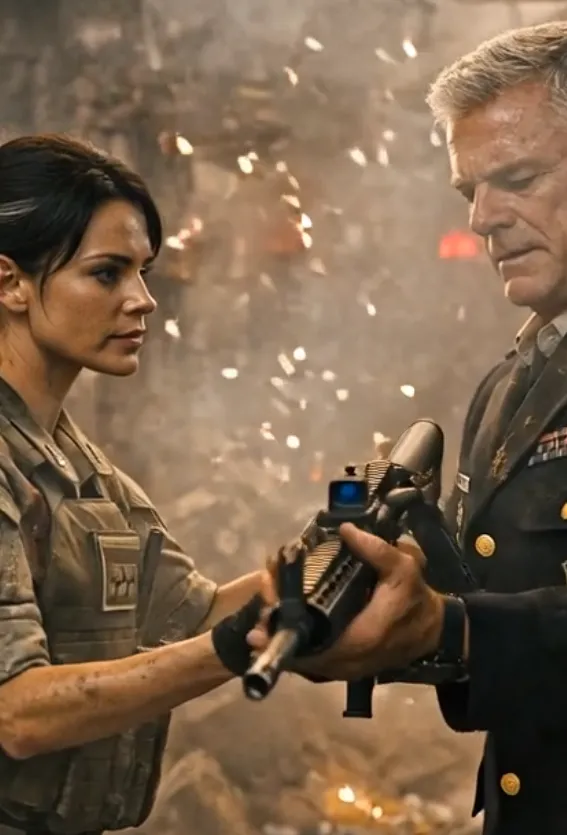
She grabbed an M4 from a dead Marine, checked the mag, charged it like she’d done it in a different life.
She shoved it into Drummond’s good hand.
“Anything that isn’t us,” she said. “Center mass. Keep firing until they stop moving.”
“Who the hell are you?” he rasped.
Kira didn’t blink.
“Later.”
She scanned the wreckage—overturned carts, oxygen tanks, exposed wiring, ruptured coolant hissing.
Her mind built a solution out of desperation and physics.
She tore IV bags free—anesthetic, flammable.
Oxygen tank—portable.
Tape. Tubing.
A spark source.
Drummond watched, confusion hardening into alarm.
“What are you doing?”
“Building a welcome.”
The bootsteps got closer.
A breaching crack split the air and the opening widened.
The first mercenary came through, weapon up.
Drummond fired—three rounds—wild, loud, wrong, exactly as Kira told him.
Two more poured in, moving past bodies, past smoke, past the crude device hidden like a secret.
Kira waited.
Waited until they committed.
Waited until retreat was impossible.
Then she triggered it.
Oxygen ruptured.
Anesthetic aerosolized.
Coolant mixed.
A spark kissed it—
And the air caught fire.
Not a normal explosion.
A fuel-air detonation that turned the room into a weapon.
White-hot light. Pressure wave. Bodies erased into smoke and heat.
Kira slammed behind cover, lungs crushed, ears ringing, vision bleaching white.
Then silence fell—thick, choking, smelling of burned chemicals and things that shouldn’t burn.
Kira pushed up, shaking it off, scanning the corridor beyond the cratered breach.
More movement.
More Russian.
And then a voice—English with an accent she could hear in her nightmares.
“Reaper,” it called softly.
Kira’s grip whitened on the rifle.
Drummond looked at her like he’d found the answer to a question he hadn’t dared ask.
“That was my call sign,” Kira said, voice dangerously calm. “Task Force Sandstorm. Desert Storm. Eight of us went in. Seven died. He’s the one who made sure of it.”
Drummond’s expression tightened.
“Who is he?”
Kira swallowed the taste of old blood.
“Colonel Victor Ashenko.”
Ashenko’s voice slid through the smoke, almost amused.
“Twenty years. And you still breathe. Come out, little ghost.”
Kira stepped toward the breach.
Drummond grabbed her arm.
“We need a plan. Reinforcements—”
“We need to survive the next five minutes,” Kira said, pulling free. “Everything else is paperwork.”
She moved into the corridor like the smoke was home.
Drummond followed, because he’d already seen enough to understand the truth.
Kira wasn’t just a Marine with scars. She was a weapon someone had buried and the war had dug back up.
They moved through ruined hallways and overturned storage like predators, not soldiers. Kira signaled with her hand—stop, listen, cover left—and Drummond obeyed like his rank didn’t matter in a place where survival wrote the rules.
Kira dropped one mercenary without firing a shot—rifle butt into the base of the skull, clean, silent, efficient.
She took his suppressed AK like an old habit.
Then they heard it.
A young voice, terrified, coughing through pain.
The corporal from the medical bay.
Ashenko’s voice, sharper now, commanding.
“Bring the medic. I want them to see what happens when they resist.”
Kira’s body went cold.
They found the motor pool through an access grate.
Below: fourteen Marines, zip-tied, kneeling.
Twelve mercenaries with black gear and calm eyes.
And Ashenko—older, grayer, but the same gaze that had turned pain into language.
He held the young corporal by the collar like property.
A pistol pressed to the kid’s temple.
Ashenko spoke to the hostages like a teacher explaining consequences.
“Your lives mean nothing to me. You are leverage.”
He smiled.
“Perhaps you live. Perhaps you die. Depends on how quickly your commanders understand what I have taken.”
Kira’s lungs forgot how to breathe.
Ashenko lifted the pistol slightly.
“But first… I send a message.”
Kira didn’t think.
She dropped through the opening—fifteen feet—hit the ground in a crouch, rifle up.
Mercenaries snapped toward her.
But she was already firing—soft, suppressed coughs of death.
Throat gap. Down.
Armpit gap. Down.
A flanker—knee, stock, collapse.
Drummond dropped behind her, clumsier, but steady enough to lay down bursts that forced the left side into cover.
The hostages flattened, trained bodies recognizing a miracle and trying not to waste it.
Momentum shifted.
The mercenaries stopped acting and started reacting.
Then Ashenko made the move Kira knew he’d make.
He hauled the corporal up as a shield and jammed the pistol tight.
“Reaper!” he shouted. “Enough, or the boy dies.”
Kira froze.
Her rifle tracked micro-adjustments, hunting angles that didn’t exist.
Ashenko smiled, pleased with himself.
“Twenty years,” he said. “I have waited. You ruined my career. You humiliated me. You made me rebuild my life in the shadows.”
He leaned closer to the hostage’s head like it was a microphone.
“And now you come to me, like you always do. Because you cannot resist the fight.”
Kira’s voice came out low, razor-flat.
“I remember my team. I remember their names. And I remember you.”
Ashenko’s eyes glittered.
Then he revealed the real blade.
He nodded to a laptop.
A mercenary turned the screen toward Kira.
Security feeds.
A hidden facility.
Lab Section Seven.
Scientists on their knees.
Sealed containment units being loaded for transport.
Ashenko’s grin widened.
“This isn’t revenge,” he said softly. “It’s profit.”
Kira felt the floor tilt under her.
He’d used her.
Used her history.
Used her predictability.
He spoke like a man savoring victory.
“Biological samples. Genetic material. Your government’s secrets. Worth fortunes to the right buyers.”
He glanced at her like she was a detail, not the center.
“My extraction arrives in eight minutes. I leave with the samples. And I leave with your death.”
Kira’s mind raced—math, timing, angles, consequences.
She leaned slightly toward Drummond without taking her eyes off Ashenko.
“How much demo do you have?”
“Two flashbangs. One breaching charge.”
Kira nodded once.
“Good.”
Drummond stared. “What are you thinking?”
Kira’s voice didn’t shake.
“I’m thinking we trap him.”
Drummond’s jaw tightened. “That traps us too.”
Kira’s eyes stayed locked on Ashenko.
“Exactly.”
She breathed once—steady, controlled—and spoke like she was ordering a range drill.
“When I move, you blow the eastern supports. Drop the ceiling. Seal this room. No extraction. No exit. He has to negotiate.”
Drummond’s face said insane.
Kira’s face said necessary.
Three seconds passed.
Then Drummond’s voice came rough.
“Make it count.”
Kira shifted, preparing her distraction.
Ashenko tilted his head, amused.
“You still think you can outplay me.”
Kira’s lips barely moved.
“The bunker,” she said softly. “Do you remember what I did before I left?”
Ashenko sneered. “You ran—”
Kira moved.
Not toward him—toward the nearest mercenary.
Two steps. Her forehead smashed his nose. Blood sprayed.
She ripped a flashbang from his vest, yanked the pin, threw it into the cluster of mercenaries on the far side.
White flash.
Crack.
Screams.
Gunfire wild and blind.
Ashenko’s attention snapped sideways for a heartbeat—
And Kira fired once.
Into the corporal’s thigh.
A clean shot—meat, not bone—chosen with brutal precision.
The corporal screamed and dropped straight down, slipping out of Ashenko’s grip like a released weight.
Ashenko’s eyes went wide.
His shield was gone.
Kira hit him like a truck—shoulder into his chest—slamming him into the makeshift command post.
His pistol flew.
They hit the floor, hands on throats, twenty years collapsing into one violent breath.
And across the room, Drummond slapped the breaching charge onto the eastern support and ran.
The blast punched the column into failure.
Concrete groaned.
Rebar snapped.
Then the ceiling came down.
A roar of collapsing weight.
Mercenaries disappeared beneath rubble.
Dust swallowed screams.
The eastern wall became a sealed tomb.
No one was coming in. No one was getting out.
Kira barely registered it.
She was locked onto Ashenko—older, but still trained, still dangerous.
He rolled, hands clamping her throat.
Her vision narrowed.
She broke the grip with leverage, not strength, kicked him back, rose.
They circled—two predators with history written in blood.
Ashenko smiled through split lips.
“You never broke.”
Kira’s voice was quiet, shaking with something deeper than anger.
“I broke.”
She stepped forward.
“I just didn’t give you the satisfaction of seeing it.”
They crashed together—fists, elbows, knees, the ugly truth of violence when technique burns off and only willpower remains.
A rib cracked.
A temple split.
A knee found nerve.
Ashenko stumbled—
And Kira took him down.
Hands around his throat.
Tightening.
Watching his eyes bulge.
Watching the life begin to leak away.
“Blackwood!”
Drummond’s voice cut through the red haze.
“Blackwood—stop.”
Kira didn’t.
Twenty years of ghosts pressed their weight into her hands.
“Staff Sergeant,” Drummond barked, voice turning into the kind of command that couldn’t be ignored, “that is an order.”
Something inside her—old training, old obedience, the Marine that still existed under the legend—answered.
Her hands loosened.
Ashenko coughed, gasping, eyes full of hate.
“Kill me,” he rasped. “Finish it.”
Kira stared at him, chest heaving, tears and dust streaking her face.
Then her voice came steady.
“No.”
She pulled zip ties, snapped his hands behind his back with vicious efficiency.
“You don’t get the easy way out.”
Around them, the motor pool quieted—mercenaries dead, surrendered, buried, or broken. Marines rose shakily, helping each other, bleeding and alive.
The young corporal was being treated, white-faced, but breathing.
Drummond approached, rifle lowered, expression torn between awe and something like fear.
“You shot your own Marine,” he said.
Kira didn’t flinch.
“I shot him where he’d live.”
She looked him dead in the eye.
“Sometimes you hurt someone to save them.”
Drummond exhaled like the day had aged him ten years.
“And you’ve been making those choices for a long time.”
Kira nodded once.
“Yes, sir.”
Then—slowly—Drummond came to attention and saluted her.
Not as an admiral to a staff sergeant.
As a warrior to a warrior.
One by one, Marines who could stand followed, saluting through blood and shaking hands.
Kira held still, returning it, her arm trembling, her throat tight with the weight of a recognition she never expected to receive while alive.
Later, when the dust settled and the base finally caught its breath, Kira sat on a crate, hands wrapped, ribs taped, face bruised into a new map.
Ashenko sat zip-tied and silent, eyes calculating even in defeat.
Drummond sat beside her, shoulder immobilized, uniform torn, voice low.
“Pentagon’s sending a team,” he said. “People with acronyms no one says out loud.”
Kira stared ahead.
“I know.”
“They’re declassifying your record. Task Force Sandstorm. All of it.”
Kira’s jaw tightened.
“My team deserved that twenty years ago.”
Drummond didn’t argue.
He just said, “Truth still matters. Even late.”
A JAG captain approached, nervous.
“Staff Sergeant… Ashenko is requesting to speak with you privately. He claims he has information about your team.”
Kira’s stomach dropped.
Things she didn’t know.
Details.
Hours after she escaped.
Suffering she hadn’t witnessed.
Questions she’d carried like stones for two decades.
Kira stood.
“I’ll talk.”
She glanced at Drummond.
“But not alone.”
They sat across from Ashenko behind portable barriers that pretended to be privacy.
Ashenko’s face was bruised. His eyes were still sharp.
“Twenty years,” he said softly. “Long time to wonder what you missed.”
Kira’s voice came cold.
“Talk.”
Ashenko leaned forward as far as restraints allowed.
“Your Captain Harrison. Strong man. He resisted well.”
Kira’s knuckles whitened.
“And?”
“He knew your secret,” Ashenko said, almost savoring it. “He knew you were eighteen. He knew you lied to get on the team.”
Kira’s breath caught—pain blooming behind her ribs.
Ashenko watched it land.
“He was proud,” he added. “Even dying, he was proud.”
Kira stared, not trusting her voice.
Ashenko continued, quieter now.
“His last words were about you.”
Kira’s throat tightened.
“What words?”
Ashenko smiled without humor.
“He said, ‘She will kill you someday.’ He smiled when he said it.”
Kira blinked hard, fast, angry at the tears anyway.
“Bennett,” she forced out. “Briggs.”
Ashenko’s expression shifted, almost respectful.
“Bennett was terrified. He cried. He never broke.”
Kira swallowed.
“And Briggs?”
Ashenko exhaled like remembering hurt him.
“He laughed during interrogation,” he said. “He attacked guards with broken hands. I shot him seven times before he stopped.”
Kira’s eyes burned.
“He taught me to survive,” she whispered. “Everything I used to get out… I learned from him.”
Ashenko held her gaze.
“You won today,” he said finally. “Your captain was right.”
Kira stared at the man who had haunted her, and found no satisfaction waiting for her.
Only emptiness.
Because revenge didn’t resurrect the dead.
Drummond put a hand on her shoulder as MPs hauled Ashenko away.
“You did the right thing,” he said. “Letting him live.”
Kira’s voice was raw.
“I don’t know what strength looks like anymore.”
Drummond didn’t hesitate.
“It looks like you.”
Weeks later, after paperwork and debriefs and quiet rooms full of men who spoke in redactions, Kira stood at Quantico as Chief Instructor for Scout Sniper School.
Virginia air. A clean range. Young Marines lined up, eyes hungry and afraid in the way only the untested can be.
Drummond—retired now, but still circling the Corps like gravity—stood beside her.
“You’ve got a visitor,” he said.
An elderly woman stepped out of a car, moving carefully but with a spine that hadn’t bent for grief.
Mrs. Harrison.
Kira walked toward her, suddenly nervous in a way combat never made her.
“Ma’am,” Kira said. “It’s an honor.”
Mrs. Harrison smiled—soft, tired, unbreakable.
“He wrote about you,” she said. “Called you Reaper. Said you were the toughest Marine he ever trained.”
She opened a small case.
Inside were dog tags.
And a letter.
Kira’s hands shook as she unfolded paper written by a man dead for twenty years.
Reaper—
Mission first.
Live for us.
Make it mean something.
Train them better than I trained you.
Bring them home.
That’s an order.
Kira stood very still in the Virginia morning, orders from a ghost settling into her bones like something finally clicking into place.
Not closure.
Not healing.
But purpose.
Mrs. Harrison squeezed her hand.
“Welcome home,” she whispered. “Welcome home.”
Kira returned to the line of students, dog tags warm against her chest, the letter’s weight heavier than any medal.
She faced the young Marines.
Their faces watched her like she had answers.
Maybe she did.
Maybe she only had experience paid for in blood.
She let her voice carry across the range.
“You’re here because you think you want to be snipers,” she said. “You think it’s about the shot.”
She paused, scanning them one by one.
“It’s not.”
A few shifted, listening harder.
“It’s about patience. Discipline. The ability to make a decision you’ll carry for the rest of your life… and make it anyway because someone’s life depends on you being steady.”
She touched the dog tags at her neck.
“I had a team,” she said. “Eight of us. Seven died. I lived because my captain ordered me to live.”
Their eyes widened.
And Kira felt the familiar pressure of the legend trying to rise.
The name people whispered.
The ghost story.
The Reaper.
She didn’t deny it.
But she didn’t worship it either.
She let the truth land where it belonged.
“I’m not here to teach you how to become a myth.”
Her voice hardened, honest enough to sting.
“I’m here to teach you how to bring each other home.”
Silence held.
Then one Marine—older now, limping just slightly—raised his hand.
Corporal Sutton.
“Gunny,” he said, voice steady, “is it true what they say?”
Kira looked at him—at the scar the war left, at the will it didn’t take.
She nodded once.
“Yes,” she said. “It’s true.”
Then she breathed out, slow.
“And it doesn’t matter.”
Sutton blinked.
Kira’s gaze swept the group.
“What matters is this: when it’s dark and loud and you’re scared and your hands shake and someone is counting on you…”
She tapped the dog tags once, a quiet metal click.
“You don’t quit.”
She stepped back.
“Tomorrow, 0500. Live-fire.”
A few swallowed hard.
Good.
Fear meant they understood the stakes.
Kira turned toward the range, the wind shifting, carrying the clean scent of powder and possibility.
For the first time in twenty years, the weight on her chest felt… different.
Still heavy.
Still there.
But aimed somewhere now.
Forward.
Always forward.
Mission first.
Always mission first.
Forever faithful.