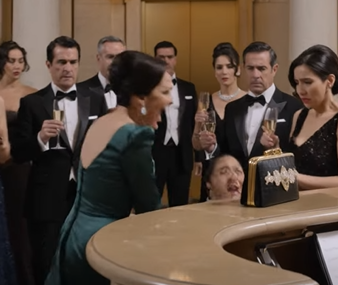
The chandeliers still glowed over the marble columns. Soft music still lingered unfinished in the air. Guests stood frozen with champagne in hand, their phones no longer raised with the same appetite for scandal. What had looked, only moments earlier, like another vicious high-society accusation had shifted into something far heavier. The brooch no longer mattered. The spilled service bag no longer mattered. Even the woman in emerald, who had just shoved a poor maid against the reception desk and called her a liar in front of strangers, no longer held the center of the room. That center had moved to the trembling girl on the floor — and to the older woman who was staring at her like the dead had just returned under chandelier light.
The maid slowly pushed herself upright, though one hand remained braced against the polished marble because her knees no longer trusted themselves. Tears still streaked her face, but the fear inside them had changed shape. Before, she had been the victim of a public humiliation she could not stop. Now she looked like someone standing at the edge of a truth she had spent her whole life being warned away from. The older woman stepped closer, not with the sharpness of accusation, but with the terrible hesitation of someone who is afraid hope itself may be another cruelty.
She asked the maid to turn her face toward the light.
The socialite in emerald finally found her voice.
“This is absurd,” she said too quickly. “She is a maid. She stole from me.”
But no one in the room turned back to her.
The older woman barely seemed to hear her. She was looking at the small crescent-shaped birthmark near the maid’s temple, half-hidden by loose hair and tears. She said her daughter had the same mark in the same place — a mark she kissed the night fever nearly took the child when she was three. She said she had last seen that mark on a child wrapped in white, burning with fever, before men from her late husband’s staff told her there had been a terrible accident on the coast road and both the child and the nurse had died before dawn. No body was shown to her. No funeral she was allowed to arrange herself. Only papers, silence, and a marriage already cracked by things no wealthy family wanted printed in newspapers.
A murmur spread through the guests.
The maid stared at her, shaking harder now.
“My mother told me never to come here,” she said softly. “She said if anyone ever recognized me, I should leave before they asked my name.”
That sentence changed the room all over again.
The older woman closed her eyes as if pain had reached her through time. Then she asked the maid what her mother’s name had been. When the maid answered, the older woman pressed a hand to her mouth. It was the name of the nurse — not dead, then. The nurse who had vanished the same week as the child. The nurse everyone in the household had whispered about afterward, first with pity, then with suspicion, then never again. The older woman said she had begged to find her. Her husband had forbidden it. He called the entire matter finished. He said grief was making her unstable. He moved her abroad for almost a year. By the time she returned to Paris, the story had calcified into family fact: tragic accident, no survivors, no questions.
Now the maid understood why her mother had feared this hotel like a living thing.
The socialite took one step backward.
The older woman finally turned toward her, and when she did, her face was no longer soft with shock. It was sharpened by something much older and much more dangerous — memory. She asked, very quietly, whether the socialite knew which suite the brooch had supposedly been stolen from. The woman answered after too long a pause: the old VIP suite at the end of the gold corridor. At that, the older woman’s expression hardened further. That suite, she said, had once been part of the private residence level reserved for her husband’s inner circle. The nurse had been summoned there on the final night. The child had been with her. After that, both were declared dead.
Now the spilled contents of the maid’s service bag no longer looked like the remains of a poor girl’s embarrassment.
They looked like evidence someone else had been waiting twenty years not to see.
The older woman bent and picked up the photograph that had fallen from the bag. In it was the maid as a little girl beside an older woman, standing in front of a gray building far from luxury. The child in the picture had the same eyes, the same mouth, and the same small mark near the temple. On the back, written in faded ink, was a date. The older woman read it, and her hand began to shake. The photo had been taken six months after the date her daughter had supposedly died.
A sound passed through the lobby — not quite a gasp, not quite disbelief, but something rawer.
The socialite in emerald opened her mouth to speak, then stopped.
Because now even she could see what the room could see: this was no random resemblance, no dramatic misunderstanding, no servant trying to invent nobility out of scandal. This was a buried family story stepping back into the light, and it was doing so at the worst possible moment — just after a rich woman had publicly brutalized the very girl who might prove it.
The maid looked from the photograph to the older woman.
“Who are you?” she whispered.
The older woman’s eyes filled at last.
“I’m the woman they told had no daughter left to come back for.”
The silence after that felt enormous.
Then, slowly, carefully, as if one wrong word might shatter the whole truth before it fully formed, the older woman said what she had understood the moment she saw the birthmark and heard the warning about never returning to the hotel: the nurse had not kidnapped the child, as the household later implied in private. She had saved her. Saved her from something inside that suite, inside that family, inside that night — something powerful enough that a little girl could be erased with documents and money and still have half the city obey the lie for decades.
Every eye in the lobby turned back to the socialite.
Because she was no longer just a guest accusing a maid of theft.
She was part of the house that had benefited from the disappearance.
The maid, still tear-streaked, still shaking, slowly straightened her posture. The humiliation had not vanished. Her belongings were still scattered across marble. Her face still burned with shame. But something else stood beside it now: dignity, yes — and blood. Not status, not wealth, not luxury. Something older and harder to deny. The older woman said there was one final thing everyone deserved to hear. The brooch from the VIP suite had not belonged to the socialite at all. It had once belonged to the missing child’s grandmother and had been kept in the same sealed suite for years, untouched, because opening that room too often meant reopening the lie.
The socialite’s face emptied.
The maid looked at her and understood at last.
This accusation had never been random.
Maybe the socialite recognized the face.
Maybe only the mark.
Maybe only the surname on the maid’s staff file.
But somewhere, somehow, fear had already begun before the screaming started.
The older woman stepped toward the maid and, for the first time in the whole terrible scene, someone touched her gently. Just her sleeve. Barely. Enough to say: you are not alone in this room anymore.
One by one, phones lowered.
Not because the drama had ended.
Because everyone suddenly understood they had not been watching a theft scandal.
They had been watching a woman try to crush the return of a ghost.
The maid looked at the socialite — the woman who had shoved her, dumped her bag, and called her a liar in front of the whole gala — and when she finally spoke, her voice was soft enough to make the entire lobby listen.
“You didn’t think I stole your brooch,” she said.
Her fingers closed around the photograph.
“You were afraid someone would recognize who I was before I did.”