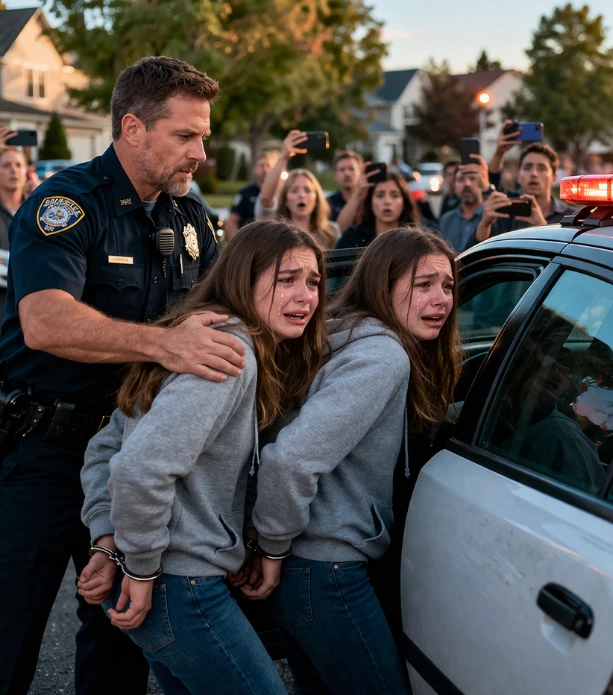
They Put the Wrong Girls in Handcuffs. They Had No Idea Who Had Just Stepped Out of the Black SUV.
The click of the handcuffs was the kind of sound people never forgot.
It split the quiet suburban afternoon in half.
One second, Maple Glen Drive had been all trimmed hedges, bicycles tossed on lawns, sprinklers ticking over bright strips of grass. The next, it was sirens, shouting, and two terrified teenage girls being shoved into the back of a patrol car while half the neighborhood lifted their phones and started recording.
“We didn’t do anything!” one of the girls cried, twisting hard enough that her dark braid slapped across her shoulder. “You’ve got the wrong people!”
“Hands behind your back means hands behind your back,” Sergeant Mark Halvorsen snapped.
He was a broad man with a square face and a reputation that moved through the department like folklore. No hesitation. No softness. No second-guessing. Officers under him said he could smell a lie before a suspect opened their mouth. Civilians said something else: that once Halvorsen decided you were guilty, the only thing left was paperwork.
The twins looked about sixteen. One wore a gray school hoodie, the other a denim jacket with a torn cuff. Their faces were so alike it was unsettling—same high cheekbones, same green eyes, same panic burning through both of them.
“Please,” the girl in the denim jacket said, voice breaking. “We just came from rehearsal. Call our mom. Please call our mom.”
Halvorsen ignored her and slammed the cruiser door.
The sound echoed down the street.
A woman across the road whispered, “Oh my God.”
A teenager on a skateboard muttered, “Dude, this is messed up.”
But nobody moved closer. Nobody intervened. They watched the way people always watched power in motion—fascinated, frightened, grateful it wasn’t aimed at them.
Halvorsen touched the radio clipped to his shoulder. “Two female suspects detained at scene. Awaiting confirmation.”
Inside the patrol car, the twins pressed toward each other, shoulders caving inward, breathing up fog on the glass. One was crying openly now. The other kept trying not to.
Then Officer Daniel Ruiz came running.
Not walking. Running.
He was young, maybe twenty-seven, still carrying that dangerous trace of conscience that policing had not yet sanded out of him. He skidded to a stop beside Halvorsen, chest heaving, one hand clamped around his phone.
“Sarge.”
Halvorsen didn’t turn. “What?”
Ruiz swallowed. “Dispatch updated the description.”
A pause.
“What about it?”
Ruiz’s face had gone pale. “The suspects are two adult males. Mid-thirties. No females involved.”
The street fell into a silence so sudden it felt staged. Even the breeze seemed to stop.
Halvorsen turned slowly. “That’s not what was called in.”
“I know.”
“You sure?”
Ruiz held up his phone with trembling fingers, as if he wished the screen could lie for him. “It just came through.”
Inside the cruiser, one of the twins stared out through the glass with wide, wet eyes. She couldn’t hear the words, but she saw the faces. She saw the shift. And hope—small, fragile, almost painful—flashed through her expression.
Halvorsen’s jaw locked. “Then dispatch screwed it up.”
Ruiz hesitated.
“That’s not all,” he said.
Something in his tone finally got Halvorsen’s full attention.
Ruiz lowered his voice. “They’re saying the original call may not be legitimate.”
Halvorsen’s brow knotted. “What does that mean?”
“It means they can’t trace the source properly. The report hit the system, but now CAD shows routing anomalies. IT says it looks like the call was… inserted.”
“Inserted?” Halvorsen repeated.
Ruiz gave a helpless nod. “Like it didn’t come in normally.”
The bystanders weren’t close enough to hear every word, but they didn’t need to. They could read body language. Authority had cracked. Something was wrong, and now everyone could feel it.
That was when the black SUV rolled onto the street.
It moved slowly, not like a vehicle arriving late to chaos, but like something that had known exactly where chaos would be waiting. A sleek black Range Rover with smoked windows and government plates. The engine purred once, then cut.
The driver’s-side rear door opened.
A woman stepped out.
She was tall, elegant, and dressed in a fitted black suit that made the bright neighborhood look toy-like around her. No jewelry except a watch. No visible badge. No wasted movement. Her face was striking, but it was the control in it that made people step back.
Not fear.
Not confusion.
Control sharpened into purpose.
She looked at no one but the cruiser.
Inside, the twins saw her at once.
“Mom,” whispered the one in the hoodie.
Not loud. Barely sound at all.
But the woman heard it.
And now every eye on Maple Glen Drive turned toward Sergeant Halvorsen, because suddenly the situation looked very different. Not like a clean arrest. Not like professional command. Like a public mistake with witnesses.
The woman stopped three feet from him.
“Sergeant Halvorsen,” she said.
She knew his name.
That disturbed him more than he let show.
“Ma’am—”
“Why are my daughters in your car?”
Her voice was calm enough to be chilling.
Halvorsen straightened. “They matched the description of suspects in an active theft report.”
“Did they?”
He opened his mouth, but she lifted one hand very slightly, and for some reason he stopped.
“I’m going to ask you one time,” she said. “Did either of my daughters resist? Threaten you? Run? Possess stolen property? Match the final description? Or did you simply decide that two Black girls walking home in the wrong zip code were sufficient?”
The words landed like hammer blows.
A murmur rippled through the crowd.
Halvorsen’s face darkened. “Watch your accusations.”
She didn’t blink. “Watch my daughters.”
Ruiz looked between them, increasingly sick.
“Ma’am,” he said carefully, “we may have detained them based on incorrect information. We’re working to sort that out.”
Her gaze shifted to him. It softened—not warmly, but enough to show she understood exactly who in this cluster could still think. “Then sort it out faster.”
Halvorsen bristled. “You don’t command this scene.”
The woman turned back to him, and now there was something in her eyes that made even the nearest bystanders lower their phones a fraction.
“No,” she said. “But I understand it better than you do.”
His radio crackled.
“—Sergeant Halvorsen, you need to—”
Static cut the message into nothing.
Everyone froze.
Halvorsen hit the side of the radio. “Dispatch, repeat.”
Nothing.
Only hiss.
The woman’s gaze sharpened. Not confusion. Recognition.
She stepped past Halvorsen and laid two fingers against the back passenger door.
“Unlock it.”
He put a hand out. “Not until we clear—”
She turned her head just enough to look at him.
And in that instant, something changed in his expression. Because now he saw it clearly: the earpiece tucked just behind her hairline. The nearly invisible scar along her jaw. And clipped inside her jacket, just for a second as the fabric shifted—a federal credential with a seal he recognized too late.
His hand dropped.
“Unlock,” she said again.
Ruiz moved before Halvorsen did. He opened the cruiser door, and both girls half-fell into their mother’s arms.
The crowd expected anger then. Fury. Tears.
What they got instead was stranger.
The woman held both daughters, checked their wrists with swift, practiced hands, and looked into each face as if assessing damage under battlefield conditions.
“Maeve. Tessa. Look at me.”
The twins obeyed instantly.
“Were you hurt?”
Maeve shook her head through tears. Tessa whispered, “No.”
“Did anyone touch you beyond cuffing and placement?”
“No.”
The woman exhaled once. It was the first sign that she, too, had a pulse.
Then she straightened.
“My name,” she said to Halvorsen, “is Elena Voss.”
Ruiz’s eyes widened.
Because he knew the name.
Almost anyone in federal law enforcement knew the name.
Deputy Director Elena Voss, Department of Justice liaison to a classified interagency task force so sensitive that most departments only heard rumors of it. Cyber infiltration. corruption exposure. ghost networks inside public institutions. The kind of investigations that destroyed careers and, occasionally, governments.
Halvorsen stared at her, the color draining from his face. “You’re—”
“Yes.”
The crowd rustled in confusion. The title meant little to them. The effect on the officers meant everything.
But Elena Voss wasn’t finished.
“And this,” she said, glancing once at the silent radio on his shoulder, “was not a mistaken arrest. It was a trigger event.”
Ruiz frowned. “A what?”
Elena turned toward him. “Someone needed my daughters detained in public. Not harmed. Not disappeared. Seen. Recorded. Time-stamped. They wanted me here.”
Halvorsen scoffed, but the sound lacked force. “That’s absurd.”
“No,” Elena said softly. “It’s efficient.”
She looked toward the far end of the street.
At first, nobody understood why.
Then an elderly man near the mailbox on the corner suddenly dropped.
Not collapsed. Dropped—like his strings had been cut.
A scream tore out of a woman nearby.
Ruiz ran first. Halvorsen after him. Several bystanders stumbled backward as the old man hit the pavement hard, his grocery bag splitting open, oranges rolling across the asphalt like bright little flares.
When Ruiz reached him, he stopped dead.
“There’s no blood,” he said.
The old man’s eyes were open. Empty.
Something thin and metallic protruded from beneath his collar.
Elena was already moving.
“Don’t touch him!” she shouted.
Too late.
Halvorsen had already crouched and grabbed the man’s shoulder.
The corpse’s chest emitted a sharp electronic chirp.
Then every phone on the street went black.
Simultaneously.
Screens died. Cameras cut. Even the live-streaming teenager cursed and slapped at his device.
“What the hell—”
Ruiz stepped back. “EMP?”
“Localized pulse,” Elena said.
Her expression had gone from cold to lethal.
“He wasn’t a civilian.”
The “old man” on the pavement had a prosthetic ear, the flesh tone peeling back just enough now to show composite polymer underneath. A disguise.
Ruiz stared. “Who is that?”
Elena didn’t answer.
Instead, she crouched, slid two fingers beneath the dead man’s jaw, and pulled free a thin capsule no larger than a pen cap. Black. Unmarked.
Her face changed when she saw it.
Not fear.
Something worse.
Memory.
Maeve, still clutching her sister, whispered, “Mom?”
Elena closed her fist around the capsule.
“We’re leaving,” she said.
But then Halvorsen stood and blocked her path.
“No,” he said, recovering the arrogance that had protected him his entire life. “You don’t get to walk into my scene, play secrets, and leave with evidence.”
Ruiz stared at him in disbelief. “Sarge—”
Halvorsen ignored him. “You say this was targeted? Fine. Then it stays local until my chief is briefed.”
Elena looked at him for a very long moment.
When she spoke, her voice was almost gentle.
“Sergeant, you are the local compromise.”
He went rigid.
Ruiz whispered, “What?”
Elena turned the capsule in her palm. “Three months ago, my task force began tracking a covert laundering pipeline moving through municipal asset forfeiture accounts in six states. Cash seizures. phantom charities. shell vendors. It led us to police departments, private security firms… and one buried operational name.”
She looked directly at Halvorsen.
“Mosaic.”
He flinched.
Just slightly.
But Elena saw it. Ruiz saw it. And the whole terrible shape of things began to emerge.
“You’ve been skimming evidence seizures,” Elena said. “Then funneling the money through front organizations tied to a private intelligence contractor. We were building the case.”
Halvorsen laughed once, sharp and ugly. “That’s insane.”
Elena held up the capsule. “This contains a dead-drop key. Someone from Mosaic came to retrieve or destroy it. When my daughters were publicly detained, I was meant to arrive, identify the threat, and expose myself. They weren’t after the girls.” Her eyes hardened. “They were after me.”
Ruiz stepped back from Halvorsen as if the man had burst into flames.
“No,” Halvorsen said too quickly. “No, this is— this is crazy. You can’t pin some ghost op on me because dispatch glitched.”
Elena’s gaze stayed on him. “Dispatch didn’t glitch. You had someone inject the false call. You expected any patrol response but yours would create variables. So you put yourself on scene.”
The silence that followed was unbearable.
Because now every neighbor’s memory rewound: the speed of the arrest, the certainty, the refusal to listen, the way Halvorsen hadn’t seemed surprised by anything except the correction.
Ruiz’s voice was barely audible. “Sarge… tell me that’s not true.”
For the first time, Halvorsen looked something other than angry.
Cornered.
Then his hand moved toward his weapon.
Ruiz reacted instantly. “Don’t!”
The street exploded.
A woman screamed. People dropped behind cars and hedges. Maeve and Tessa clung to Elena as she shoved them behind the SUV. Ruiz lunged for Halvorsen’s arm just as the sergeant drew.
The gun fired.
The shot shattered a mailbox.
Ruiz slammed into Halvorsen, and both men crashed onto the pavement.
Another shot.
Then another.
Then stillness.
When the ringing in everyone’s ears subsided, Halvorsen was on his back, staring upward with blank astonishment. Blood spread beneath him in a dark, fast-moving halo.
But Ruiz wasn’t holding a smoking gun.
Halvorsen’s own sidearm lay three feet away.
And the fatal shot had come from somewhere else.
Elena looked up sharply.
Rooftop.
Across the street.
A figure in matte gray was already withdrawing behind a chimney line.
“Sniper!” Ruiz shouted.
Too late. The shooter vanished.
Halvorsen coughed wetly, trying to speak. Elena knelt beside him despite everything. His eyes locked on hers, frantic now, stripped of command, stripped of ego.
“He—” Blood bubbled at his lips. “He wasn’t… supposed to…”
His hand clawed weakly at her sleeve.
“Elena…”
It was the first time he had used her first name.
And that was what made her freeze.
Not the familiarity.
The voice.
There was something wrong with it.
Not just pain. Not just weakness.
A cadence.
A ghost of one.
She looked harder at his face—the shape of the mouth, the fold beside the eye, the old scar at the brow he’d claimed came from a bar fight.
And suddenly the world tilted under her.
“No,” she whispered.
Halvorsen’s gaze flickered with something like apology. Or triumph. Or both.
Ruiz stared between them. “What is it?”
Elena’s hand shook as she touched the edge of Halvorsen’s hairline—and the skin there shifted.
Latex.
A prosthetic seam.
Ruiz recoiled. “Jesus Christ—”
Elena ripped upward.
The face of Sergeant Mark Halvorsen peeled back.
Beneath it was an older man, gaunter, with steel-gray eyes Elena had seen only in photographs and nightmares.
Maeve gasped. Tessa made a choking sound.
Because even they recognized him from the file room Elena kept locked in her home office.
Elena went white.
“David.”
Ruiz looked lost. “Who the hell is David?”
The dying man smiled through blood.
Not Halvorsen.
Never Halvorsen.
David Voss.
Elena’s husband.
Officially dead for fifteen years.
The father of her daughters.
The man whose body had never been found after an undercover operation collapsed in Prague.
Maeve took a stumbling step forward. “Dad?”
The word hit the street like an aftershock.
Elena couldn’t breathe.
David’s eyes found the twins, and for one unbearable moment all the machinery of espionage, corruption, betrayal, and violence fell away. He wasn’t a ghost network operative. He wasn’t Mosaic.
He was a father looking at his children.
“I tried,” he whispered.
Elena’s voice broke for the first time. “You were dead.”
He gave a tiny shake of his head. “I was taken. Turned. Rebuilt.” His eyes slid shut, then forced themselves open again. “Mosaic… doesn’t recruit. It hollows.”
Tears spilled down Maeve’s face. Tessa stood perfectly still, as if movement might make reality final.
Ruiz said, stunned, “The real Halvorsen?”
David’s mouth twitched. “Dead… two years.”
The crowd had gone utterly silent. No one was filming now. No one was whispering. They were witnessing the collapse of something too large to name.
Elena bent closer. “Why arrest the girls? Why do this?”
His expression twisted in agony.
“Because they gave me one choice. Prove loyalty… or they’d take them for real.” His eyes searched hers. “I made it public so you’d come fast. So witnesses would be here. So Mosaic couldn’t disappear them quietly.”
Elena shut her eyes as the meaning hit her.
He had done the unforgivable.
And also, perhaps, the only thing left to save them.
David coughed again, weaker now. “The capsule… not a key.”
“What is it?”
His gaze shifted to the black device clenched in her hand.
“A list,” he whispered. “Names. Judges. chiefs. federal contacts. Everyone.”
Elena’s fingers tightened.
Ruiz stared at the capsule like it might be radioactive.
David looked at his daughters again, and now the tears finally escaped Elena too, because in their faces—terrified, confused, shattered—she saw the impossible truth: they had inherited his eyes.
“I watched you,” he murmured to the girls. “Every birthday. Every recital. I was there.” A ragged breath. “I’m sorry I could only be shadows.”
Maeve dropped to her knees. “Don’t go.”
Tessa, who had not cried until then, broke.
The sound that came out of her was not a sob. It was the sound of a child losing a parent twice.
David looked back at Elena.
One final secret remained in his face.
“Not both,” he whispered.
Her brow furrowed. “What?”
His lips barely moved.
“Not both are yours.”
Elena went still.
The words did not make sense. Could not make sense.
But David was already fading, his pulse fluttering away beneath her fingers.
She grabbed his collar. “David. David, what does that mean?”
His eyes moved weakly toward the twins.
Then to Elena.
Then closed.
Gone.
For several seconds, no one moved.
The wind rose again, stirring leaves across the blood-streaked pavement. Somewhere far off, sirens began to wail—real ones this time, multiplying in the distance.
Ruiz finally found his voice. “What did he mean?”
Elena looked up at her daughters.
At Maeve, trembling openly.
At Tessa, standing strangely still now, her face drained not just of grief, but of something else.
Calculation.
Elena’s stomach dropped.
Because Tessa was not looking at David’s body.
She was looking at the capsule.
And in that instant, Tessa’s tears stopped too quickly.
Way too quickly.
Elena rose slowly.
“Tessa,” she said.
Her daughter met her gaze.
Then smiled.
It was small. Almost loving.
And absolutely terrifying.
“I’m sorry, Mom,” Tessa said softly.
Before anyone could move, she lifted her cuffed hands—hands Elena had assumed were still bound only because of shock—and the cuffs fell neatly apart onto the pavement.
Unlocked long ago.
Engineered release.
Ruiz reached for his weapon.
Too slow.
Tessa stepped backward once and a motorcycle roared from behind the hedge line, bursting out of nowhere like a summoned beast. A rider in gray leaned low over the handlebars. Tessa leapt onto the back with impossible precision.
Maeve screamed, “Tessa!”
But the girl already turning away looked over her shoulder with those familiar green eyes and said the words that ripped the world open one final time.
“I’m not Tessa.”
Then the motorcycle shot down Maple Glen Drive and vanished into the dying afternoon, carrying with it the child Elena had raised for sixteen years—and the knowledge that somewhere, sometime, somehow, the real Tessa Voss had been replaced.
Elena stood frozen in the middle of the shattered street, one dead husband at her feet, one daughter sobbing in her arms, and one impossible truth roaring away into the distance.
In her hand, the capsule felt suddenly heavier than bone.
Because this had never been an arrest.
Never been a mistake.
It had been a message, a reunion, a confession, and the opening move of a war so much larger than she had imagined.
And as the first wave of federal sirens screamed toward the neighborhood, Elena Voss understood the most horrifying thing of all: