I knew exactly what it meant when a small body started to feel like it was already slipping away…
Mara didn’t look away from me after asking. Her eyes searched my face like she was trying to decide if I was someone she could trust—or someone who already knew how this would end. My fingers tightened unconsciously around the zipper of my jacket, still warm where her daughter had been pressed against me just moments ago.
A nurse rushed past us, not even glancing in our direction, pushing a cart that rattled louder than it should have. Mara flinched at the sound, her breath catching halfway in her chest, like she couldn’t finish it.
“Is she going to—” Mara started, then stopped, her voice breaking before the words could land.
I shook my head, but it wasn’t an answer. It was something else. Something stuck between memory and fear.
Because the silence behind that door felt too familiar.
The same kind of silence that comes right before someone walks out and everything changes.
A monitor beeped somewhere inside the room. Steady. Then faster.
Then—just for a second—it stopped.
Mara grabbed my sleeve, her nails digging into the leather.
“What does that mean?” she whispered.
I didn’t answer.
Because I had heard that sound before… and the last time, it didn’t come back.
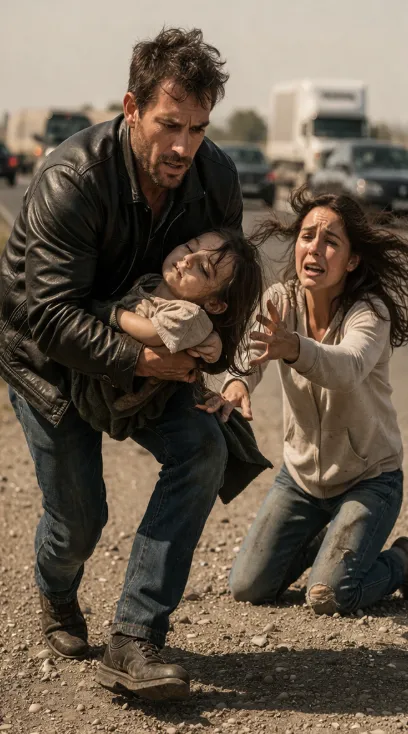
Traffic roared past like it always does when it isn’t your problem. Engines growled, horns snapped, and the world kept moving as if a child wasn’t slipping through someone’s arms right there on the roadside.
My hands tightened on the handlebars before I even knew I was reacting. The back tire skidded when I slammed the brakes, gravel spraying out beneath me, the bike jerking sideways as a van blasted past, its exhaust hitting my face like a slap. I tasted metal and heat.
And then I saw her clearly.
The girl couldn’t have been more than five. Her lips had gone a dull gray, her skin slick with sweat that caught the sunlight in a way that didn’t look like life anymore. The woman holding her—Mara, though I didn’t know her name yet—clutched her like she was trying to hold water in her hands.
“Nobody’s stopping,” she rasped, her voice shredded thin with panic. “Please—please—”
Something inside my chest twisted hard enough to hurt.
I cut the engine. The sudden silence rang like a bell, loud and disorienting after the chaos. For a second, everything felt suspended—like the world was waiting to see what I’d do next.
Then the heat hit me.
Not the kind from the road or the engine. The kind that crawls under your skin before you even touch it, the kind your body recognizes before your mind catches up.
“Name?” I asked, my voice coming out rough, like it had to fight its way through something lodged in my throat.
“Mara,” she said quickly, almost choking on the word. “She’s Nia.”
I nodded, even though my hands had already moved.
When I slid my arms under the girl, she weighed almost nothing—light in the way that should have been comforting, but wasn’t. Her head rolled against my forearm, and for a second I thought she wasn’t breathing at all.
Then I felt it.
A faint flutter against my wrist.
Barely there. But there.
I didn’t think. Thinking would’ve slowed me down.
I pulled her against my chest, pressed her into the worn leather of my jacket, and zipped it up around her like she belonged there—like she was mine to carry, mine to protect.
Her heat soaked through instantly.
Behind me, cars kept passing. Windows up. Eyes forward. Lives uninterrupted.
So I ran.
My boots hit gravel hard enough to jar my knees. My breath came in sharp bursts, but I didn’t slow. The bike loomed ahead, black and waiting, and Mara was right behind me, her footsteps uneven, her breath breaking apart with every step.
“Hospital?” she asked, her voice trembling so badly it almost didn’t form words.
“The county ER,” I said, already swinging onto the seat. “Now.”
She climbed on behind me, pressing herself against my back, one arm wrapped tight around my waist, the other cradling Nia between us. I could feel both their heartbeats through the leather—fast, frantic, overlapping like they were trying to keep each other alive.
And then we were moving.
The road opened up in front of us like it had been waiting. Lights blurred into streaks. The wind tore at my face, drying tears I hadn’t realized were there. Every second stretched and snapped at the same time, too fast and not fast enough.
I checked her constantly.
Two fingers to her cheek. Still burning.
My hand hovering over her chest. Still rising—barely.
Back to the throttle. Faster.
Back to her cheek again.
A rhythm. A prayer.
Almost there.
Not fast enough.
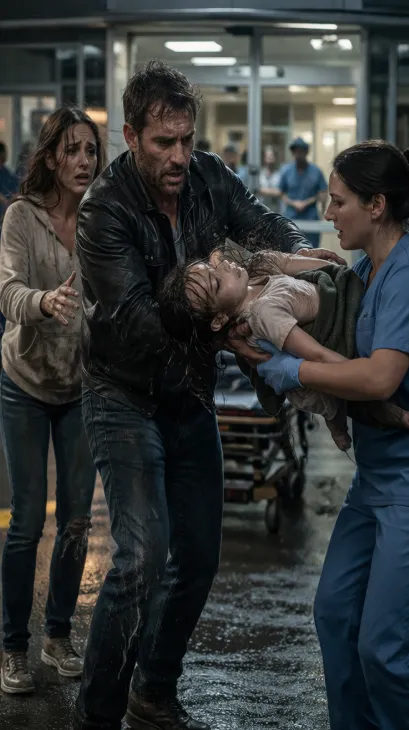
We hit the ambulance bay crooked, tires screeching as I cut across the entrance. I had the kickstand down before the bike fully stopped, already pulling the zipper open, already lifting her out.
Doors burst open. White light spilled out, harsh and unforgiving. The smell of antiseptic hit me—bleach and something older, something heavier.
“Fever,” I said, my voice gravel-thick. “Lethargic. Not responding.”
Words I hadn’t spoken in twelve years.
A nurse rushed forward and took her from my arms, and the second Nia left my grip, Mara’s hands hung in the air—empty, shaking, like they didn’t know where to go.
That sight hit harder than anything else.
And then the doors closed.
The hallway swallowed us whole.
It was too bright, too cold, and yet somehow it still felt like standing inside a furnace. My hands wouldn’t stop shaking. Somewhere, a monitor beeped steadily behind a wall we couldn’t see, each sound punching through the silence.
Mara looked at me, her eyes wide, searching, desperate.
“Why did you stop?” she asked.
The question landed heavy.
I looked down at the floor tiles, at my boots still dusted with road grit, still damp where her daughter’s heat had soaked through. Then I looked at the door they had taken Nia through.
And I felt it again.
That memory I never outran.
Because I knew this heat. I knew this weight. I knew the exact shape a small body makes when it’s trying to leave.
Twelve years ago, it had been a different hallway. Different lights. Different voices.
But the silence had felt the same.
I leaned closer to Mara, lowering my voice so it wouldn’t break.
“You don’t breathe for yourself right now,” I told her quietly. “You borrow someone else’s breath until yours remembers how.”
Her fingers dug into my jacket, gripping the leather like it was the only solid thing left in the world. She nodded, but her eyes stayed locked on that door, like she could force it open just by looking.
We stood there like that, stealing minutes from time that didn’t want to move.
Because some roads let you pass right through.
And some stop you cold, turn you around, and make you stay until something changes.
Time didn’t pass in that hallway.
It thickened. Curled in on itself. Every squeak of rubber soles made Mara flinch. Every time the automatic doors hissed open somewhere down the corridor, my chest tightened like I was bracing for impact.
I kept touching the zipper of my jacket.
Phantom heat.
Ten minutes.
Twenty.
An hour.
I should’ve left. I wasn’t family. I wasn’t anything. Just a guy on a bike who happened to stop.
But my feet wouldn’t move.
Then the double doors swung open.
A doctor stepped out, pulling his mask down. His face looked tired in that way that only comes from standing too close to life and death for too long.
Mara made a small sound—a broken, strangled noise—and froze.
She couldn’t ask.
So I did.
“Is she…?”
The doctor looked at me, then at her.
And then, slowly, he smiled.
“She’s back with us,” he said gently. “Febrile seizure. Her temperature spiked too fast, and her body shut down to protect itself. We got the fever down. She’s awake. She’s asking for her mom.”
For a second, nothing moved.
Then Mara collapsed.
I caught her before she hit the ground, her body shaking as the tension finally broke. She clung to me, sobbing hard, her breath coming in heavy, uneven bursts that soaked through my shoulder.
“Thank you,” she cried. “Oh God, thank you.”
I didn’t know what to say.
The doctor glanced at me again, eyes lingering on my worn jacket, the dust, the road still clinging to me.
“You got her here fast,” he said. “Another ten minutes like that… it could’ve been very different.”
I swallowed, but my throat felt like glass.
“You saved her brain,” he added quietly. “Maybe her life.”
They let Mara go in first.
She turned back once, reaching for me, trying to pull me along, but I shook my head and stayed where I was—just inside the doorway.
From there, I could see her.
Nia sat up in the hospital bed, small and pale, an IV taped to her arm. Her hair stuck to her forehead, her cheeks still flushed, but her eyes were open.
Alive.
She held a small cup of apple juice in both hands, sipping carefully, like it was the most normal thing in the world.
And something inside my chest shifted.
The knot that had been there for twelve years—the one that tightened every time I passed a playground, every time I saw a toy left behind on a sidewalk—loosened.
Not gone.
But looser.
My boy hadn’t made it out of that hallway.
But she had.
Mara turned back to me, her daughter’s hand wrapped in hers.
“What’s your name?” she asked softly. “I don’t even know your name.”
I shook my head.
“It doesn’t matter,” I said, my voice rough. “Just… keep her warm.”
I turned before she could see my face, before she could see what was breaking through.
Outside, the air had cooled. The sky stretched wide, bruised purple and orange as the sun dipped lower, like the day itself had been through something and was still trying to recover.
I swung my leg over the bike.
It felt lighter.
I felt lighter.
I zipped up my jacket. The leather was still damp where she had pressed against me, the warmth lingering like a ghost that didn’t want to leave.
The engine roared to life beneath me, steady and strong—a heartbeat made of steel.
As I pulled away from the ambulance bay, I glanced up toward the building, toward the fourth-floor windows glowing faintly in the fading light.
I didn’t believe in much anymore.
Not after twelve years of carrying something that never let go.
But as the wind rushed past me, I felt it.
A small, familiar weight.
A hand—light, warm—against my shoulder.
And for the first time in a long time, it didn’t hurt.
“We did good, kid,” I whispered into the wind. “We did good.”
The road stretched out ahead, dark and endless.
I didn’t turn toward home.
I twisted the throttle and let the bike carry me forward, into the night, into something that didn’t feel like running anymore.
For the first time in years—
I was just riding.