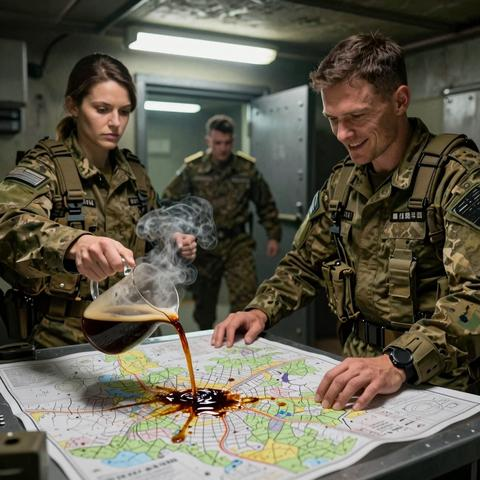
The heavy steel door of the Tactical Operations Center clicked shut behind me, sealing me inside the chilled, fluorescent-lit bunker. It was 0430 hours. The air smelled of ozone, burnt electrical wiring, and the stale, bitter scent of day-old coffee. I preferred the quiet of the early morning. It was the only time Fort Bragg didn’t feel like a pressure cooker waiting to explode. I walked over to the main briefing table, my boots making dull, measured thuds against the reinforced concrete floor.
I stopped at my station and adjusted the velcro strap on my tactical vest, pulling it tight. Exactly flush with the seam. Not a millimeter over. It was a nervous habit, one of the few I allowed myself. Then, my right hand drifted to my cargo pocket, my fingers brushing against the cold, smooth edges of my late father’s silver challenge coin. Three taps against the metal. One for focus. One for endurance. One for survival. It was a ritual that grounded me, a silent promise to the man who had taught me that a soldier’s greatest weapon wasn’t their rifle, but their mind.
I smoothed out the massive topographical map across the metal surface of the briefing table. It wasn’t just a map. It was seventy-two hours of my life, meticulously overlaid with transparent acetate, marked with ultra-fine point sharpies detailing every single elevation shift, hostile choke point, and extraction route for the upcoming Joint Task Force evaluation. The blue and red lines intersected with mathematical precision. This map was my ticket out of the mud. It was my golden ticket to Officer Candidate School. If I nailed this briefing, I was no longer just Sergeant Sarah Hayes, the token female infantryman in a squad of hardened cynics. I would be on my way to wearing brass.
I leaned over the table, checking the grid coordinates for the third time. Everything had to be perfect. In my world, perfection wasn’t an ambition; it was body armor. The moment you showed a crack, they tore you apart.
I was so absorbed in the contour lines of Sector 4 that I didn’t hear the door open. But I smelled him before I saw him. A nauseating blend of cheap wintergreen chewing tobacco and aerosol deodorant. Staff Sergeant Miller.
“Working hard, Hayes? Or just coloring inside the lines?” Miller’s voice dragged across the quiet room like a rusted blade.
I didn’t look up. I kept my eyes locked on the acetate overlay, my face a mask of absolute neutrality. “Reviewing the extraction protocols for Bravo team, Staff Sergeant. Making sure we don’t end up boxed in at the ravine.”
Miller sauntered over, his heavy frame casting a dark shadow over the table. He was a man who wore his authority like a blunt instrument. He didn’t lead; he bullied. And for the past eight months, I had been his favorite target. He hated my precision. He hated my PT scores. But most of all, he hated that no matter how much dirt he threw at me, I never broke rank. I never gave him the reaction he craved.
He leaned against the edge of the metal table, invading my personal space. He was holding a large, steaming styrofoam cup of black coffee. The heat radiating from it was palpable in the chilly TOC.
“You know what your problem is, Hayes?” he murmured, taking a slow, deliberate sip. “You think you’re smarter than the dirt you walk on. You think these little blue lines are going to save your life when the bullets start flying. You’re a clipboard soldier. You don’t belong in the mud with my boys.”
I felt the familiar, dangerous tightening in my chest. The invisible grip of panic. It was the same feeling that haunted me since the convoy ambush in Syria two years ago. The IED blast that had shattered my vehicle and left me with a permanent, imperceptible tremor in my left hand. A tremor I spent every waking hour hiding. I had falsified my medical clearance to stay in the infantry. If anyone found out about my PTSD, my career was over. Miller didn’t know the truth, but he possessed a predator’s instinct. He knew I was guarding a vulnerability, and he was determined to expose it.
I clenched my left hand into a tight fist, driving my fingernails into my palm to suppress the shake. “With all due respect, Staff Sergeant, the route is mathematically sound. It minimizes exposure.”
Miller smirked, his eyes dropping to my meticulously drawn map. “Mathematical precision,” he mocked softly. “Let me show you what the enemy thinks of your math.”
He didn’t stumble. He didn’t trip. With a casual, deliberate flick of his wrist, he tilted the styrofoam cup.
A waterfall of scalding, pitch-black coffee cascaded directly onto the center of the map.
I flinched as drops of boiling liquid splattered against my forearm, burning my skin, but I didn’t make a sound. I stood frozen as the dark liquid pooled over the acetate, seeping under the edges, smearing the painstakingly drawn red and blue ink into a muddy, chaotic blur. Seventy-two hours of work. My OCS ticket. Dissolving into a brown puddle.
Miller let out a low, satisfied chuckle. He set the half-empty cup down right in the middle of the ruined map. “Oops. Guess you’ll have to redraw it, Hayes. Better work fast. Briefing is in three hours. Welcome to the real world.”
He watched my face eagerly, waiting for the dam to break. He wanted the tears. He wanted the screaming match. He wanted me to throw a punch so he could write me up for insubordination and end my career before lunch.
I stared at the ruined map. The smell of the coffee was overpowering. My left hand was shaking so hard inside my pocket that my knuckles ached. The ghost of the Syrian desert roared in my ears. The sound of twisted metal. The smell of burning diesel. I was suffocating under the weight of the injustice. I wanted to destroy him.
But I forced my breathing to slow. In through the nose, out through the mouth. I looked up slowly, meeting his cruel, expectant gaze. My voice was eerily calm, stripped of all emotion.
“I will have a new map ready by 0700, Staff Sergeant. Is there anything else?”
Miller’s smile faltered for a fraction of a second. Disappointment flashed in his eyes. He hadn’t broken me. He opened his mouth to deliver another insult, ready to push the knife deeper, when the heavy steel door of the TOC blew open with the force of a localized hurricane.
The booming voice that followed froze the air in the room.
“Ten-hut!”
Miller snapped to attention so fast he nearly knocked over his own cup. I locked my knees, my eyes snapping forward, arms pinned to my sides.
Captain Vance, the Base Commander, strode into the room. He wasn’t just a commanding officer; he was a legend in the Special Operations community. A man who rarely left the executive wing, let alone stepped foot in the junior enlisted briefing room at 0445 in the morning. His face was a mask of chiseled granite, his eyes sweeping the room with terrifying intensity.
He didn’t look at Miller. He didn’t look at the ruined map dripping brown liquid onto the concrete floor. His eyes locked entirely on me.
“Sergeant Hayes,” Captain Vance’s voice was dangerously quiet, carrying a weight that made the hairs on my arms stand up.
“Yes, sir!” I barked, my heart hammering against my ribs.
Miller stood rigid beside me, but I could see his chest rising and falling rapidly from my peripheral vision. The arrogant swagger was entirely gone, replaced by the distinct, unmistakable stench of fear.
Captain Vance stepped closer, his boots crunching against the floor. He stopped mere inches from the table, glancing down at the puddle of coffee, then back up to me.
“Grab your gear, Hayes,” Vance ordered, his tone leaving absolutely zero room for interpretation. “My office. Right now.”
I didn’t hesitate. I grabbed my tactical helmet and my rifle. As I stepped away from the table, I caught a fleeting glimpse of Miller’s face. He was pale, his jaw slack, staring at the commander in sheer, unadulterated panic. The squad leader chuckled as he poured hot coffee onto the female soldier’s tactical map, but the smile vanished when her superior called her for a private meeting.
CHAPTER II
The click of the deadbolt echoed through Captain Vance’s office like the hammer of a rifle falling on an empty chamber. It was a heavy, mechanical sound that seemed to suck the oxygen right out of the room. I stood at a rigid attention, my eyes burned into a spot on the wall precisely six inches above Vance’s head, but my peripheral vision was screaming. The office didn’t look like a standard Army workspace; it was too clean, too quiet, and smelled faintly of expensive cedar and floor wax.
“At ease, Sergeant Hayes,” Vance said. His voice was like a low-frequency hum, the kind that vibrates in your teeth.
I didn’t move. Not really. I shifted my weight just enough to comply with the order, but my spine remained a steel rod. My right hand, the one that had almost betrayed me in the briefing room, was currently tucked into a tight fist at my side, buried against the seam of my ACU trousers. I could feel the phantom heat of Miller’s coffee still radiating from my thigh, a damp reminder of the humiliation I’d just endured.
Vance didn’t sit down. He walked over to a monitor mounted on the side wall. He tapped a key, and the screen flickered to life. It was a high-angle, grainy security feed of the briefing room we’d just left. There was Miller, leaning over, his face twisted in that smug, petty grin. There was the flash of white as the coffee spilled. And there was I—standing like a statue, refusing to give him the satisfaction of a flinch.
“I’ve been watching the feeds for weeks, Hayes,” Vance said, his back still to me. “Most NCOs would have laid Miller out. Some would have gone to JAG. You? You just stood there and took it. Why?”
“Discipline, sir,” I replied, my voice clipping each syllable. “Personal grievances are secondary to the mission.”
Vance turned around, and for the first time, I saw the look in his eyes. It wasn’t praise. It was a cold, calculating hunger. He walked to his mahogany desk and picked up a manila folder with a bright red ‘CLASSIFIED’ stripe running diagonally across the cover. He didn’t hand it to me; he tossed it. It skittered across the polished wood and stopped right at the edge.
“Forget OCS for a second, Hayes. OCS is for people who want to manage bureaucracies. I need someone who can manage ghosts.”
I looked down at the file. The header read: *TASK FORCE OBSIDIAN.*
“You’re being laterally promoted to Master Sergeant, effective immediately,” Vance continued, his words hitting me like physical blows. “You’ll be the lead NCO for a specialized kinetic-response squad. You’ll be Miller’s new commanding officer. You’ll be the one deciding if he gets to breathe the same air as the rest of the professional Army.”
The thought of it—having Miller under my thumb, being able to bury his career with a single stroke of a pen—was a hit of pure adrenaline. It was everything I’d worked for. It was the ultimate vindication.
But then came the hook.
“However,” Vance said, leaning forward, his shadow stretching across the desk. “Obsidian operates under Title 50 authority. The medical requirements are… stringent. Because of the immediate nature of the deployment, I can’t wait for your scheduled physical next month. I’ve already cleared a slot at the MTF. You’re going over there now. Full-spectrum screening. Neuro, psych, and physical.”
The floor felt like it had tilted forty-five degrees. My heart, which had been a steady drumbeat, suddenly skipped, then hammered against my ribs. A full-spectrum neuro screening? They’d put me in the chair. They’d check my motor responses. They’d see the microscopic tremors that I’d been masking with sheer willpower and a cocktail of over-the-counter suppressants that shouldn’t be in my system.
“Sir, with all due respect,” I started, my voice wavering just a fraction—a fraction I hoped he didn’t hear. “I have the evaluation for the JTF today. My map was ruined. I need to—”
“The map is garbage, Hayes. I don’t care about the map,” Vance snapped. He stepped closer, entering my personal space. I could smell the peppermint on his breath. “I care about the asset. You are the asset. You’ve been hiding something. I see it in the way you hold your breath when you think no one is looking. I see it in the way you avoid using your right hand for fine motor tasks when you’re tired.”
My blood ran cold. He knew. Or he suspected.
“This isn’t a request, Sergeant. It’s a direct order. You will proceed to the Medical Training Facility, Building 402. You will report to Colonel Aris. You will undergo the Obsidian Tier-1 screening. If you pass, you’re the most powerful NCO on this base. If you fail… well, we’ll cross that bridge when we see the results.”
He signaled to the door. It unlocked with another heavy thud.
I had no choice. To refuse a direct order from the Base Commander would be the end of my career right then and there. To go meant exposure. I saluted—using my left hand to steady my right elbow as I brought it up, a move I’d practiced in the mirror a thousand times to make it look natural.
I walked out of the office. The hallway felt miles long. As I passed the briefing room, I saw Miller through the glass. He was cleaning up the coffee, looking agitated, looking like a man who knew the sky was falling but didn’t know where the impact would be. He saw me, and for a second, our eyes locked. I didn’t give him a look of triumph. I couldn’t. I was a dead woman walking.
I stepped out into the humid North Carolina air. Fort Liberty was buzzing. Humvees roared in the distance, and the sound of cadence from a passing platoon echoed off the barracks. To anyone else, I looked like a high-speed Sergeant on her way to a promotion. Inside, I was calculating the half-life of the beta-blockers I’d taken that morning. They were wearing off.
By the time I reached Building 402, my right hand was humming. It wasn’t a visible shake yet, just a low-voltage vibration beneath the skin, the ghost of a mortar blast in Aleppo that had never truly left my nervous system.
I pushed through the double doors of the clinic. The smell of antiseptic hit me like a wall. This was the temple of the one god I couldn’t lie to: Science.
“Sergeant Hayes reporting as ordered for Tier-1 screening,” I told the specialist at the front desk. My voice was flat, robotic.
The specialist looked at his screen, then looked up at me with a mix of awe and pity. “Yes, Sergeant. The Colonel is expecting you. Room 4. Please strip to your PT shorts and wait.”
I walked into the small, windowless exam room. The fluorescent lights flickered at a frequency that seemed to sync with the twitch in my hand. I stripped off my uniform, folding it with agonizing slowness. I watched my right hand. It stayed still for five seconds, then gave a sharp, violent jerk.
“Stop it,” I whispered to my own limb. “Just hold it together for one hour.”
I sat on the edge of the exam table, the crinkly paper beneath me sounding like a forest fire in the silence. I tried the grounding techniques the VA pamphlets always talked about. Five things you can see. Four things you can touch.
I saw the blood pressure cuff. The jars of tongue depressors. The scale. The sharp-container. The door.
I touched the cold metal of the table. The rough fabric of my shorts. My own damp palm.
It didn’t work. The anxiety was a physical weight, pressing down on my chest until I could only take shallow, ragged breaths. If they found the PTSD, I wasn’t just losing the promotion. I was losing the Army. I was losing the only identity I’d had since I was eighteen. I’d be ‘broken.’ Medically discharged. Discarded.
The door opened. Colonel Aris didn’t look like a soldier; she looked like a scientist who happened to be wearing O-6 eagles. She had a tablet in her hand and a pair of thin, wire-rimmed glasses perched on her nose.
“Sergeant Hayes. Captain Vance says you’re the best he’s ever seen,” she said, not looking up from her screen. “Let’s see if your nervous system agrees.”
She moved with a terrifying efficiency. She checked my vitals—my heart rate was 110, high enough to be suspicious, but I blamed it on the ‘excitement’ of the promotion. She checked my eyes, my reflexes. Then she reached for the sensory-motor kit.
“Extend your arms, Sergeant. Palms down. Fingers spread.”
This was it. The moment of truth.
I lifted my arms. My left hand was a rock. My right hand… I squeezed my shoulder blades together, trying to lock the tension in my back, trying to use every muscle in my forearm to stabilize the fingers. For three seconds, I held it.
Then, the tremor started. A fine, rhythmic oscillation.
Aris paused. She didn’t say anything. She reached out and placed a single sheet of paper on the back of my right hand. The paper began to flutter, a white flag of surrender in the sterile room.
“How long has this been happening, Sarah?” she asked. Her voice wasn’t unkind, which made it worse.
“It’s just caffeine, ma’am. I haven’t slept. The evaluation—”
“Don’t,” she interrupted. “I’m looking at your baseline from three years ago. You’re a different person on paper than you are sitting in front of me. You’ve been falsifying your self-reports, haven’t you?”
I looked at her, and the facade finally cracked. The stoic Sergeant Hayes, the woman who took coffee to the chest without blinking, felt a tear prick the corner of her eye. I blinked it away fiercely.
“I can do the job, Colonel. You saw the footage. I didn’t break. I don’t break.”
“Your mind didn’t break, but your body is screaming,” Aris said. She turned the tablet around. It showed a red-line graph of my motor stability. It was a disaster. “If I clear you for Obsidian, and you have a motor lapse during a high-stakes extraction, people die. If I don’t clear you, I have to report this to the Board.”
Before I could respond, the intercom on the wall buzzed.
“Colonel, Captain Vance is on the line. He wants a status update. He says the transport for the Obsidian transition is leaving in twenty minutes.”
The air in the room felt pressurized. Aris looked at the intercom, then back at me. I could see the conflict in her eyes—the doctor versus the officer.
“Tell the Captain…” Aris started, her finger hovering over the button.
I stood up, stepping off the table, standing as close to her as I dared. “Please,” I whispered. “Give me one chance. Put me in the simulator. If I fail there, I’ll sign the discharge papers myself. Just don’t end it like this. Not in an exam room.”
She hesitated. Then, she pressed the button. “Tell the Captain we’re running a final stress-induction test. We’ll have a decision in fifteen.”
She turned to me. “The simulator is in the basement. It’s a live-fire neuro-feedback loop. It’s designed to break healthy people. If you want to prove you’re not a liability, you’re going to have to do it under the most extreme conditions possible. And Sarah? If you have a seizure or a total motor collapse in there, I can’t hide it. Everyone in the observation deck will see. Including Vance. Including your squad.”
“Let’s go,” I said, my voice finally steadying, even as my hand continued its treacherous dance.
As we walked toward the elevator, we passed the waiting area. Miller was there. He must have been sent to deliver my gear or sign for the transfer. He saw me walking with the Colonel toward the high-security labs. He saw the look on my face—the look of someone headed toward a firing squad.
A slow, nasty realization spread across his face. He didn’t know exactly what was wrong, but he knew I was being tested. He knew I was vulnerable. He pulled out his phone, his thumbs flying across the screen.
I knew what he was doing. He was spreading the word. By the time I got to that simulator, the entire command structure would be watching the feed, waiting to see the ‘perfect’ Sergeant Hayes fall apart.
I stepped into the elevator, the doors sliding shut on Miller’s grinning face. I was trapped between a Captain who wanted to use me, a Colonel who wanted to study me, and a rival who wanted to destroy me.
My right hand spasmed again, harder this time. I shoved it into my pocket and gripped my thigh until it bruised. This was no longer about a promotion. This was a fight for survival in a system that had no room for the broken.
The elevator hit the basement level with a soft chime. The doors opened to a room filled with black-clad soldiers and high-tech displays. In the center sat the simulator—a spherical cage of wires, sensors, and screens.
It looked like an executioner’s chair.
“You have ten minutes,” Aris said, her voice echoing in the cold, industrial space. “Make them count.”
I walked toward the chair, every eye in the room—and dozens more through the remote feeds—fixed on my every movement. I could feel the secret burning inside me, a ticking time bomb of trauma and adrenaline, ready to explode in front of the very world I was trying so hard to lead.
CHAPTER III
The air inside the Simulation Suite at Fort Liberty didn’t smell like North Carolina. It smelled like ionized dust and the sterile, metallic tang of high-end electronics. It was a cold, windowless box designed to break people, and as I stood in the center of the room, the weight of the haptic vest felt like a lead shroud. Colonel Aris sat behind a reinforced glass observation window, his face a mask of clinical indifference. Beside him, Captain Vance stood like a gargoyle, his hands clasped behind his back, his eyes tracking my every breath.
This was the end of the line. There was no OCS application to fall back on, no quiet exit from the service with my pride intact. If I failed this ‘Live-Fire Neuro-Feedback’ test, Aris would sign the medical discharge papers before I even unbuckled my helmet. I would be out—stripped of my career, my identity, and my purpose. The tremor in my left hand was a rhythmic drumming against my thigh, a silent traitor reminding me that my nervous system was a frayed wire.
I looked at the black pod of the simulator. It looked like a coffin.
“Sergeant Hayes,” Aris’s voice crackled over the intercom, sounding hollow and distant. “The parameters are set. This is a level-five immersive reconstruction. We are monitoring your heart rate, cortisol levels, and neural stability. If your hand tremors exceed the threshold, the simulation will terminate. You know what that means.”
I nodded, the movement stiff. I reached into my pocket, my fingers brushing against a small, unmarked plastic vial. I had taken it from a private stash I’d kept since my second tour in the Levant—an experimental nerve-blocker, something the guys in the shadows used to keep their aim true when the world was exploding around them. It was unauthorized, highly addictive, and carried a side effect profile that included permanent sensory degradation. But it was my only weapon.
I palmed the pill and swallowed it dry, the bitter chemical coating my throat. I didn’t care about the side effects. I didn’t care about the long-term cost. I just needed twenty minutes of stillness. I needed to be the soldier everyone thought I was, even if I had to burn my brain to do it.
“Initiate,” I said, my voice cracking.
The world vanished.
The transition was violent. One moment I was in a sterile room; the next, the scorching sun of Syria was beating down on my neck. The smell of burning diesel and rotting garbage filled my nostrils. The sound of a distant, rhythmic chanting and the low rumble of a Humvee engine vibrated through my boots. This wasn’t just a video game; it was a ghost. This was the Latakia outskirts, August 2021. The day my life broke.
“Hayes, stay on the SAW!” a voice barked in my ear. It was Specialist Moreno. My heart lurched. Moreno had been dead for three years. In the sim, he was sitting right next to me, his face covered in a layer of fine tan dust, a half-eaten MRE cracker in his hand.
I grabbed the handles of the M249 Squad Automatic Weapon. My hand felt… solid. The nerve-blocker was kicking in, a cold wave of numbness spreading from my stomach to my extremities. The tremor was gone, buried under a layer of chemical ice. I felt like a god. I felt like a machine.
“Contact left!” the simulation screamed.
An IED detonated fifty yards ahead, a plume of black smoke and orange fire erupting from the road. The haptic vest slammed against my chest, mimicking the pressure wave of the blast. My ears rang with a high-pitched whine. This was the moment. The ambush.
I opened fire. The SAW chattered in my hands, a steady, rhythmic thumping that should have been shaking my arm to pieces. But I was steady. I tracked the digital shadows moving behind the mud-brick walls with a precision that felt predatory. One target down. Two. Three. I was a surgeon with a machine gun.
But then, the sensory overload began.
The nerve-blocker wasn’t just stopping the tremor; it was heightening everything else. The colors of the desert became impossibly bright, searing my retinas. The sound of the gunfire wasn’t just noise; it was a physical weight crushing my skull. I saw the blood on the virtual pavement—redder than real blood, a neon smear that pulsed like a heartbeat.
“Sarah, help me!”
I turned. It was Moreno. Or the digital ghost of him. He was slumped against the door of the Humvee, the same way he had been in the real world. Only this time, the simulation was pushing me to do more. It was testing my stability under the weight of my greatest failure. I had to choose: keep firing to protect the convoy or stop to save a man I knew was already gone.
My vision started to fray at the edges. Geometric patterns—digital artifacts of the simulation—started bleeding into the Syrian sky. My heart was a frantic bird trapped in a cage of ribs. The chemical in my system was fighting the PTSD spike, and the battlefield in my mind was becoming a kaleidoscope of horror.
“Keep your eyes on the sector, Sergeant!” Vance’s voice cut through the sim, cold and demanding. He wasn’t part of the simulation, but he was in my head.
I screamed, a raw, guttural sound, and leaned into the trigger. I didn’t stop until the barrels were white-hot. I didn’t stop until the entire village was a smoking ruin in the VR goggles. I didn’t stop until the simulation faded to a dull, throbbing grey and the word ‘SUCCESS’ flickered in my vision.
I ripped the helmet off. I was drenched in sweat, my breath coming in ragged gasps. I vomited into a trash can by the simulator pod, the chemical bitterness of the pill coming back up.
I looked at my left hand. It was as still as a stone. I had won.
Colonel Aris was staring at the monitors, his brow furrowed. “The neural readings… they’re anomalous. Your brain activity spiked into the red, Sergeant. I’ve never seen anyone maintain that level of focus under that much stress. It’s almost… inhuman.”
“She passed, Colonel,” Vance said, stepping out from the shadows of the observation deck. He was smiling, but it wasn’t a smile of congratulations. It was the smile of a man who had just seen a trap spring shut. “The data doesn’t lie. She’s the most stable operator we have.”
Aris sighed, looking like he wanted to argue, but he stamped the digital file. “Fine. You’re cleared for duty, Hayes. God help you.”
Aris left the room, his footsteps echoing with a finality that made my skin crawl. I was alone with Vance. I tried to stand up, but my legs were like jelly. I gripped the edge of the simulator pod.
“I did it,” I whispered. “I’m the new Master Sergeant.”
“Yes, you are,” Vance said. He walked over to me, leaning in close. The smell of his expensive cologne was suffocating. “And we both know how you did it, Sarah.”
I froze. “What?”
“The nerve-blockers. The neural-suppression techniques. I’ve been watching you for months, Hayes. I knew you had a tremor. I knew you’d fail a standard physical. That’s why I pushed for the simulator. I needed to see how far you’d go to stay in the game.”
He reached out and tapped the rank on my shoulder—the rank I hadn’t even officially put on yet.
“I don’t want a perfect soldier, Sarah,” Vance hissed. “Perfect soldiers have ethics. They have options. They can leave whenever they want. I want someone who is broken. I want someone who has a secret so dark it would ruin them if it ever came out. I want someone who belongs to me.”
He straightened up, his eyes cold and triumphant. “Task Force Obsidian isn’t just a unit. It’s a black site for the disposable. You’re my new Master Sergeant because you have nowhere else to go. You just traded your soul for a promotion, and now, you’re going to do exactly what I tell you to do.”
He turned and walked toward the door. “Report to the TOC at 0600. Your first task is to bring SSG Miller into line. He’s been talking too much. Since you’re his commanding officer now, I expect you to handle him… permanently.”
He left the room, the heavy door clicking shut behind him.
I stood in the silence of the Sim Suite, the ‘SUCCESS’ screen still glowing on the monitor. I felt the first twitch in my left hand. It was back, and it was worse than before—a violent, jagged spasm that moved all the way up to my shoulder.
I had the rank. I had the power. And I was more of a prisoner than I had ever been.
Outside, in the hallway, I saw a shadow move. I knew it was Miller. He had been waiting for the results. He didn’t know about Vance’s blackmail, but he knew I had cheated. I could see it in the way he stood, the way he watched me through the narrow window of the door. He was a cornered animal, and he was ready to bite back.
I looked at my trembling hand and clenched it into a fist until my nails drew blood. The game wasn’t over. It was just getting deadly.
CHAPTER IV
The weight of the new rank sat heavy on my shoulders, the points of the Master Sergeant insignia digging into my skin. Vance’s smile, the congratulations… it all felt like a brand. I was his now. My first official act as Master Sergeant was to attend a tactical exercise out in the training grounds. The sun beat down, and the air shimmered with heat. I tried to focus, but the world kept tilting. The nerve-blocker from the sim… it wasn’t entirely gone. Flickers of shadow danced at the periphery of my vision. Sounds warped and amplified, then faded to nothing.
I gripped my rifle, knuckles white. I had to appear in control. Miller was watching. I could feel his gaze, sharp and predatory, like a viper waiting to strike. He moved with a smirk that said he knew exactly what was going on. The other members of Task Force Obsidian moved with a strange level of deference. It was unsettling how quickly the team dynamic had changed. The exercise was a simple convoy drill, moving supplies from one point to another while reacting to simulated ambushes. Nothing I hadn’t done a hundred times before. But today, every detail felt amplified, dangerous.
The convoy started, the trucks kicking up dust. I rode in the lead vehicle, trying to maintain a professional facade. But my hands… they wouldn’t stop trembling. I clenched them into fists, stuffed them between my knees, but the tremor persisted, a frantic vibration that threatened to shatter my composure. We rounded a bend, and suddenly, explosions erupted all around us. Simulated IEDs. The trucks swerved, tires screaming. My team reacted instantly, leaping out, taking cover, laying down suppressive fire.
This was it. The moment Miller had been waiting for. I knew it. But something was wrong. The explosions were too close, too real. The smell of burning metal filled the air. This wasn’t the simulation protocol. As my ears rang, I looked toward the ridge where the ‘enemy’ was supposed to be firing blanks. I saw Miller, not firing, but grinning. He gave a subtle hand signal. I knew then, this was no accident. He had sabotaged the exercise. He had escalated it into something dangerous, something that would expose me, destroy me.
One of the vehicles began to burn. A soldier screamed, trapped inside. I knew I had to act, but my body refused to obey. The tremor intensified, my vision blurred, and the shadows closed in. I saw flashes of Syria. The burning truck was the burning car. The screaming soldier was Omar. Everything swirled together in a chaotic vortex of guilt and fear. “Hayes! Move!” I heard someone yell, but the voice seemed distant, muffled. I stumbled forward, rifle slipping from my grasp. I was falling apart. The general and a host of officers were here to observe, standing a safe distance away. And they were all watching me.
I tried to plant my feet, to focus, to regain control. But it was no use. The tremor was out of control now, shaking my entire body. I could feel the eyes of everyone on me, the disgust, the disappointment, the confirmation of their suspicions. Then, Miller started shouting, his voice echoing across the training ground, “Look at her! Look at the Master Sergeant! She’s a fraud! A faker! She can’t even hold her weapon steady!”
His words were like a physical blow. The world seemed to tilt on its axis. I closed my eyes, trying to block out the noise, the heat, the shame. But it was no use. The truth was out. I was exposed. Everything I had worked for, everything I had sacrificed, was crumbling around me.
Then, I heard another voice, a voice that cut through the chaos like a knife. “Miller! Stand down!” It was Vance. He was striding toward us, his face a mask of fury. He pushed through the crowd, his eyes fixed on me. “Hayes, are you alright?” He reached out a hand, but I flinched away from his touch. “Get away from me,” I spat, my voice trembling. “You knew. You knew all along.”
Vance’s expression flickered. He opened his mouth to speak, but I didn’t let him. “You set me up,” I said, my voice rising. “The test… it was all a trap.” He swallowed, his gaze darting around nervously. The General was approaching. “What is the meaning of this, Captain Vance?” the General asked with a level of controlled rage I hadn’t heard before.
That was my chance. “He knew about my condition,” I said, pointing at Vance. “He knew I wasn’t fit for duty. He used me. He blackmailed me.” Vance’s face turned ashen. “She’s lying!” he shouted. “She’s unstable! She’s having a breakdown!” But no one was listening to him anymore. All eyes were on me. “Tell them Vance,” I demanded, “Tell them about the Syria mission. Tell them about what really happened.” I saw a bead of sweat drip down the Captain’s head.
I knew I was going down. I knew I was ruining my career. But I didn’t care anymore. The truth had to come out. “The Syria mission,” I continued, my voice gaining strength. “It wasn’t what they said it was. It was a setup. Vance ordered us into that ambush.” A gasp rippled through the crowd. The General’s face was a thundercloud. I locked eyes with him, “He authorized the mission, and he knew the risks. He sacrificed us to cover up his own mistakes.” A wave of nausea washed over me, and I leaned heavily on my rifle.
I had nothing left to lose. I had already lost everything. As if a dam had burst, the memories, the guilt, the pain, all came flooding back. The faces of my dead comrades, the screams of the wounded, the stench of burning flesh… they were all there, vivid and real. I could see it all as clear as day. My head was pounding. My throat was on fire.
Then, something happened that I hadn’t anticipated. Miller stepped forward. He looked at me, his expression unreadable. “She’s telling the truth,” he said, his voice surprisingly calm. “About the mission. About Vance.” A collective murmur ran through the crowd. Miller had been my enemy, my tormentor. But in this moment, he was my unlikely ally. “Vance falsified the reports,” Miller continued. “He covered up the truth to protect himself.”
Vance stood there, speechless, his face a mask of disbelief. The General turned to him, his eyes burning with fury. “Captain Vance,” he said, his voice low and dangerous. “You’re relieved of your command. You will be placed under arrest pending a full investigation.” Two MPs stepped forward and took Vance into custody. He didn’t resist. He just stared at me, his eyes filled with a mixture of hatred and fear.
The crowd dispersed, leaving me standing alone in the dust. My career was over. My reputation was ruined. I was a pariah. But as I looked up at the sky, I felt a strange sense of peace. The truth was out. And that was all that mattered.
I could see everything shattering. All around me, the future I dreamed of. The future I had killed for, was now nothing more than a mirage in a desert of my own making. I saw my team walking away, whispering. I heard their judgement. I knew they were right. I was no hero. No patriot. Just a broken person who should have been put out to pasture years ago.
Colonel Aris stepped forward from the crowd. He didn’t say anything. He simply shook his head. His face was a mask of utter disappointment. The shame of his gaze was worse than any prison sentence. He had believed in me. I had let him down.
But the worst part was knowing I had let myself down. I had compromised my values. I had chased a dream that wasn’t mine. I had become the very thing I despised. And now, it was over. All of it.
The sun beat down on me, unforgiving. The heat was intense, blurring the edges of my vision. As my head started to pound, I realized the side effects weren’t going away. My vision warped again. I felt the world spinning, but this time, I didn’t fight it. I let myself fall. I sank to my knees in the dirt, everything around me fading away until there was only darkness and the silence that followed.
As I began to weep, I thought of my parents. I thought of my brother. I thought of all the people I loved. People who had died for their country, and I was the one who lived? What a joke.
No more secrets. No more lies. Just the cold, hard truth. And the bitter taste of defeat.
I wasn’t a hero. I wasn’t a leader. I was just a survivor. And sometimes, survival wasn’t enough.
CHAPTER V
The silence was the worst. Not the silence of the training grounds, the brief pause before the storm of commands and simulated gunfire. This was the silence of a tomb. My tomb. The walls of my small, off-post apartment seemed to press in, suffocating me with the weight of what I had lost, what I had done.
The initial fury had subsided, leaving behind a residue of ash and bitter regret. Vance was gone, relieved of command, facing a court-martial. Miller…Miller had been surprisingly quiet. He’d offered a curt nod as I was escorted away after my outburst, a strange mixture of pity and something akin to respect in his eyes. The General’s face, etched with disappointment, haunted me. And Aris… I couldn’t even begin to think about Aris.
My phone lay on the coffee table, a black mirror reflecting my own ravaged features. It hadn’t stopped ringing for the first few hours after the incident. Calls from fellow NCOs, junior officers, even a couple of well-meaning but ultimately clueless soldiers from my old unit. I ignored them all. What could I possibly say? How could I explain the tangled mess I had made of my life?
Then the calls stopped. The silence descended. The kind of silence that tells you you’ve been erased.
Days blurred into weeks. I barely ate, barely slept. The tremor, once a manageable annoyance, had become a constant, violent shaking. My hands were useless, my focus shattered. The nerve-blocker was long gone from my system, leaving me raw and exposed.
One afternoon, a knock echoed through the apartment. I hesitated, peering through the peephole. Miller. I almost didn’t open the door.
“Hayes,” he said, his voice flat, devoid of its usual sardonic edge. “Can I come in?”
I stepped back, letting him enter. He looked uncomfortable, out of place in my disheveled living room. He didn’t sit, just stood there, his eyes scanning the space, avoiding mine.
“Look,” he began, “what happened… it was messed up. Vance… he was playing us all. I knew he was dirty, but I didn’t realize how deep it went.”
I stared at him, numb. “You helped him, Miller. You set me up.”
He flinched. “I did. I thought… I thought you were losing it. That you were a liability. I was wrong. Vance… he pushed too far. He used you. He used Omar’s death. That ain’t right.”
“So, this is your apology?” I asked, my voice hollow.
“No,” he said. “It’s not. I can’t take back what I did. But I can tell you… I put in a statement. I told them everything I knew about Vance, about the mission, about the nerve-blocker. It won’t fix anything for you, but… it’s the truth.”
He turned to leave. “Hayes,” he said at the door, “you were a damn good soldier. Don’t let this break you.”
He left, and the silence returned, but it was different this time. There was a faint echo of something… not hope, exactly, but a flicker of understanding. Miller’s admission didn’t absolve him, or me, but it confirmed what I already knew: Vance was the architect of this disaster, and we were all just pawns in his game.
Days turned into weeks. I started going to therapy, mandated by the Army, but surprisingly helpful. I spoke of Omar, of the mission, of the constant fear that gnawed at me. The therapist listened, offering no easy answers, just a space to unravel the tangled threads of my trauma.
I knew I couldn’t stay in the Army. The trust was broken, the damage irreparable. I began the process of applying for a medical discharge. The paperwork was a constant reminder of my failure, each form a fresh wound.
One evening, I received a call. It was Aris.
“Sarah,” he said, his voice weary, “I heard you were trying to reach me. I wasn’t sure if I should answer.”
“I understand,” I said. “I just… I wanted to apologize. For everything.”
“There’s nothing to apologize for,” he said, though I could hear the lie in his voice. “You were under immense pressure. Vance… he manipulated you.”
“That doesn’t excuse what I did,” I said. “I betrayed your trust. I let you down.”
There was a long silence. “I’m disappointed, Sarah. I believed in you. I saw potential in you. But… what’s done is done. I wish you the best.”
His voice cracked slightly at the end. I knew that was his way of saying goodbye. Our friendship, our professional bond, was over. Severed by my actions.
I packed my belongings, the few things that still held meaning. My uniform, neatly folded, a ghost of the soldier I once was. My awards, tarnished by the shadow of my disgrace. And the Master Sergeant insignia, the symbol of everything I had strived for, now a cruel reminder of my failure.
I found myself drawn to the small box where I kept Omar’s letters. His words, once a source of comfort, now felt like a burden. I reread them, searching for some kind of guidance, some hint of redemption.
His last letter spoke of hope, of a future where we could both find peace. A future that would never come to pass.
The day I left Fort Liberty, I drove past the training grounds one last time. The sounds of simulated gunfire echoed in the distance, a constant reminder of the war I could never escape.
I stopped at a small diner just outside the gate, a place I used to frequent with my unit. The waitress, a friendly woman with tired eyes, recognized me.
“Sarah!” she exclaimed. “Haven’t seen you in a while. What can I get you?”
“Just coffee,” I said. “Black.”
She brought me the coffee, her eyes filled with a mixture of pity and curiosity.
“Heard about what happened,” she said softly. “Rough break.”
I nodded, unable to speak.
“You’ll get through it,” she said, her voice filled with a simple, unwavering faith. “You’re a strong woman.”
I looked at her, at her worn hands and her kind eyes. Maybe she was right. Maybe I would get through it. But I would never be the same.
As I drove away, I glanced at the Master Sergeant insignia lying on the passenger seat. It glinted in the sunlight, a cold, hard reminder of my ambition, my betrayal, my fall from grace.
I picked it up, feeling the weight of it in my hand. The metal was cold, lifeless. I stared at it, seeing not a symbol of achievement, but a symbol of loss. Loss of trust, loss of friendship, loss of self.
I pulled over to the side of the road, near a cluster of wildflowers. I got out of the car and walked towards the field. Kneeling down, I placed the insignia amidst the colorful petals. It didn’t belong to me anymore.
I looked back at the car, at the road ahead. The future was uncertain, unknown. But one thing was clear: the past was over. I had faced the truth, and it had shattered me. But in the shards, I could see a glimmer of something new, something different. A chance to rebuild, to heal, to find a different kind of strength.
The last image I had was of those wildflowers, blooming brightly even as the tarnished insignia rested among them. A testament to life’s enduring power, and its ability to blossom even in the face of devastation.
The truth may set you free, but sometimes freedom comes at a devastating price.
END.