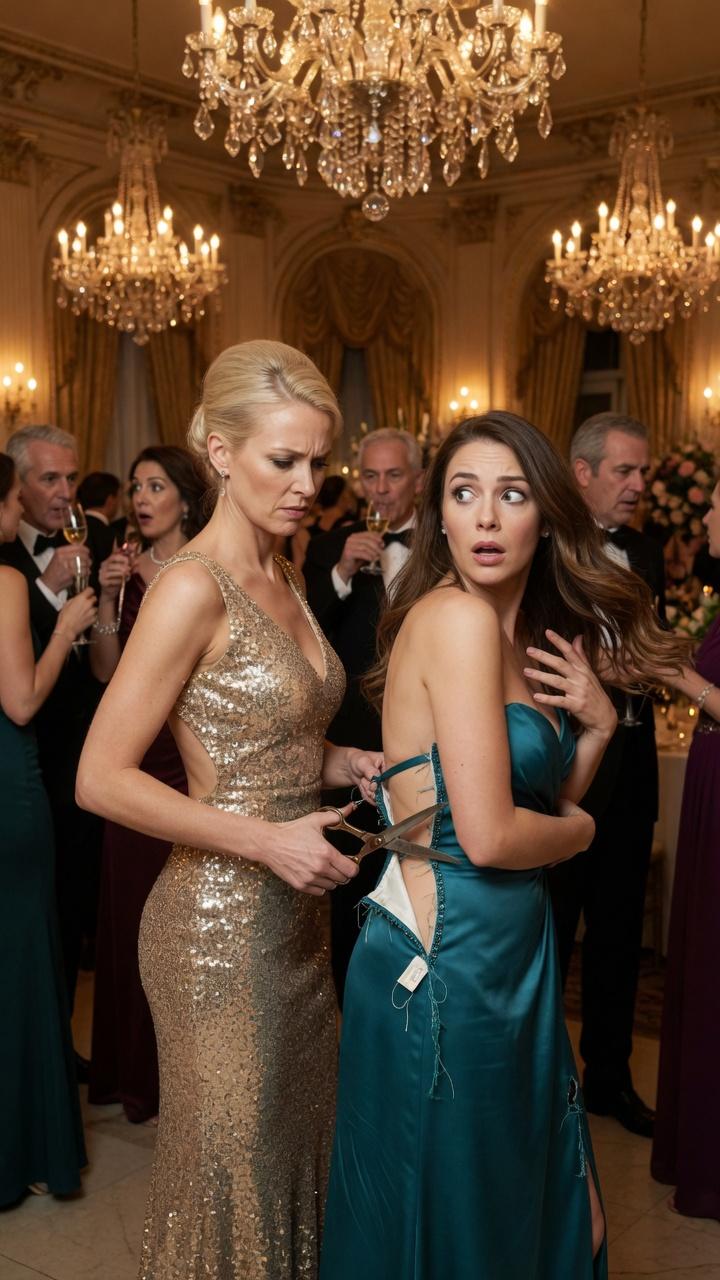
She cut my skirt to humiliate me in front of the elite — then one sapphire necklace made her whole “socialite image” look cheap. The city’s meanest socialite sliced open my gown at a glittering gala, exposed my underskirt in front of the whole room, and smiled like my humiliation was part of the entertainment. Not in the restroom. Not behind the curtain. In the middle of the reception floor, under chandeliers, with donors, heirs, cameras, and half the city’s old-money families standing close enough to hear the fabric tear. I was the shy poetry girl, the quiet one, the girl who spoke softly, dressed simply, and never fought to be seen in rooms full of people who treated wealth like a religion. That drove Catherine Blake crazy. She was the polished “it girl,” perfect hair, perfect laugh, perfect little army of girls who mistook cruelty for social rank. She took one look at my long gown and decided I was easy. “Sweetheart,” she said, circling me with a champagne smile, “if you can’t dress for the room, at least don’t waste the lighting.” I didn’t answer, and that made her meaner, because girls like Catherine need your discomfort to feed their performance. She stepped behind me, I heard the tiny metallic click, then cold air hit my legs. She had taken scissors to the hem and sliced the back seam high enough to split the skirt and expose the plain ivory slip underneath. The room gasped, someone dropped a glass, a woman near the orchestra covered her mouth, and Catherine laughed, “There. Now she finally matches her own budget.” People stared, no one moved fast enough, no one wanted to be the first to challenge the girl who lived off invitations, alliances, and other people’s fear. That was when she made the worst mistake of her life. She looked right at me and said, “You don’t belong around real jewels anyway.” If only she knew, because the one man in that ballroom who owned the word “real” in the jewelry world was my grandfather, Edward Virelli, and he had just stepped out of the private salon with a blue velvet case in his hand. The orchestra stopped, heads turned, even the donors went quiet, then my grandfather crossed the room, saw the cut in my gown, saw the slip showing, and looked at Catherine with the kind of disappointment that makes rich people forget how to breathe. He opened the case, a blue fire lit the room, and in that exact second Catherine’s entire social life started dying in public. The sapphire didn’t just shine—it commanded. Light bent around it, deep ocean-blue fire rippling through the ballroom like something alive, conversations dying mid-breath, chandeliers seeming dimmer in its presence. My grandfather didn’t rush, he never did. He stepped fully into the center, the velvet case open, his gaze moving from me to the torn fabric to Catherine, then stopping in front of her. “Do you know what real jewels are made of?” he asked calmly. Catherine tried to recover, lifting her chin, forcing a smile, “Oh, I’m sure you’re about to tell us,” but no one laughed, no one backed her, because everything had shifted. He tilted the case slightly, letting the sapphire catch the light. “They are not made for attention. They withstand it. They are cut under pressure, tested under heat, and they do not shatter just because someone unworthy tries to scratch them.” The words landed hard. Catherine’s smile faltered. He turned to me, bowed his head slightly, and said, “My dear, I believe this belongs to you.” The air broke, murmurs spread, because everyone knew that necklace—the Azure Heart of Virelli, one of the rarest sapphires in private circulation—and he was offering it to the girl whose dress had just been cut open. My hands trembled as I stepped forward, not from fear anymore, but from something rising. I met Catherine’s eyes, and for the first time she looked unsure. “Are you sure?” I asked. “More sure than I have ever been,” he replied, and placed the necklace around my neck. The sapphire settled against my skin like it had always belonged there, and suddenly everything changed. The torn gown didn’t matter, the exposed slip didn’t matter, because now the most important piece in that ballroom was mine. Gasps turned into whispers, whispers into realization. “That’s Virelli’s granddaughter… she’s his heir…” Donors who hadn’t looked at me twice were now watching closely, recalculating, because power doesn’t appear—it reveals itself. Catherine stepped back, just one step, instinct, survival. “This is ridiculous,” she said weakly. “It’s just a necklace—” “No,” my grandfather cut in, “it is not.” Silence fell. He faced her fully. “You built your image on proximity—borrowed shine—but you never learned the difference between wearing elegance and being it.” The room felt it. A gala organizer stepped forward. “Miss Blake, it would be best if you leave.” Not loud, not dramatic, but public—and worse. Catherine looked around for support. No one moved. No one spoke. Her smile disappeared completely. She turned and walked out alone. The doors closed, and just like that the “it girl” of the city was no longer invited. The room exhaled. My grandfather turned back to me. “You were never the small one in this room.” I looked at the sapphire. “I know.” And for the first time, I meant it. The orchestra resumed, conversations returned quieter, more careful, because everyone had just witnessed something rare—not revenge, not chaos, but correction. Cruelty exposed. Power revealed. True elegance erasing everything fake. And standing there, no longer invisible, I understood something simple: she didn’t destroy me when she cut my dress—she revealed herself. And that was the most expensive mistake she would ever make.