I tightened my grip on the knife, the metal cold against my palm, while his breath came out in wet, uneven gasps beneath me. The diner had gone dead quiet except for the sound of him drowning from the inside, every second stretching thinner as his life slipped through my hands.
One of the bikers leaned in too close, his shadow falling over us, his eyes flicking between my face and the blood pooling across the table. His voice dropped, low and dangerous.
“Don’t mess this up… you don’t know who he is.”
I didn’t answer, but something about the way he said it made my stomach twist—not fear, not exactly, but something sharper, like a warning I didn’t fully understand yet.
The man on the table suddenly grabbed my wrist.
His grip was weak… but intentional.
His eyes cracked open just enough to find mine, unfocused but searching, like he was trying to say something before it was too late. His lips parted, blood at the corner of his mouth.
“You…” he rasped, voice breaking, “…shouldn’t—”
He choked before he could finish.
And for the first time, my hands hesitated.
Because something in his eyes didn’t look like a threat.
It looked like recognition.
This is only the beginning of the story… The most unexpected part is in the continuation. Tap to continue
It was the engines. That same relentless, rhythmic growl I had tried to forget—the sound that had taken my husband away from me and left nothing but silence in its wake.
I forced myself to breathe, counting each inhale like I used to in another life, gripping the counter as if it could anchor me to the present. The smell of bacon grease and burnt syrup wrapped around me like a shield, the familiar clutter of the Maple Leaf Diner my only defense against the storm gathering outside. This place had been my refuge, my disguise, my escape from everything I used to be.
Then the door burst open, and that illusion shattered in an instant.
They entered not like customers, but like a force of nature—six men, broad-shouldered and soaked in road dust, their presence swallowing the small diner whole. The heavy stomp of their boots echoed across the linoleum like a verdict being delivered, final and unavoidable. But it wasn’t just their size or their noise that made my stomach twist—it was the leather. The creak of those worn vests, stitched with symbols that spoke of violence and brotherhood, of rules written in blood.
My chest tightened. I knew exactly what they were.
The man at the front was the worst of them. He carried himself like a war machine barely holding together, a jagged scar cutting across his face and disappearing into a graying beard. His eyes scanned the room with a kind of hollow intensity that told me he hadn’t slept—or maybe hadn’t rested—longer than any man should survive.
He took two steps forward.
“We need…” he rasped, his voice breaking apart before the sentence could form.
Then his body gave out.
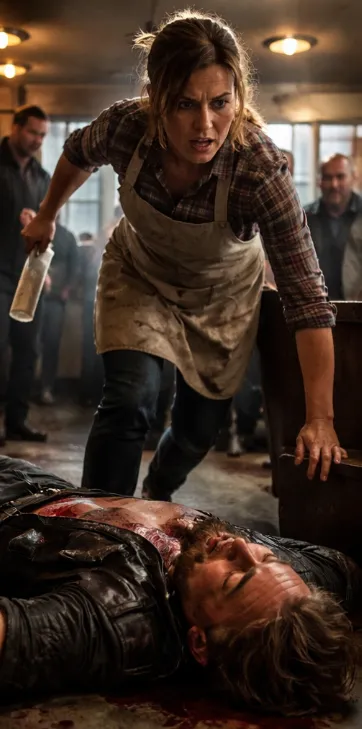
He collapsed hard against the floor, the impact echoing through the diner like a gunshot. For a split second, everything stood still—then chaos exploded.
Chairs scraped violently as customers scrambled back. One of the bikers shouted, another pulled a knife, swinging it wildly to keep everyone frozen in place. Panic flooded the room, thick and suffocating, as his companions dropped to their knees around their fallen leader.
“Don’t move!” one of them roared. “Somebody help him! Help him now or I swear I’ll burn this place down!”
I stood behind the counter, rooted in place, my hands cold despite the heat rising around me. The memory hit me like a punch to the ribs—Mark’s car crushed against the guardrail, the police officer avoiding my eyes, the quiet way they told me he’d been run off the road for sport.
They had left him to bleed out in a ditch.
My vision narrowed as I stared at the man on the floor.
Let him die, a voice whispered inside me, cold and sharp. Let this be justice.
The biker convulsed, a wet, choking sound tearing from his throat as something pink bubbled at his lips.
Pink.
My mind snapped into focus so suddenly it felt like a switch had been flipped. The diner faded. The fear faded. Even the hatred faded—replaced by something older, sharper, and far more dangerous.
Pink froth. Labored breathing. One side of the chest barely moving.
He’s drowning in his own blood. Tension pneumothorax. Minutes at most.
I wasn’t Sarah the waitress anymore.
I was Sergeant Sarah Miller.
“Clear the table!” I shouted.
The command tore through the chaos like a blade. My voice didn’t sound like mine—it was louder, harder, edged with something that demanded obedience. The bikers froze, startled more by the authority in my tone than the words themselves.
“I said clear the damn table! Get him up—now!”
For a moment, they hesitated, staring at me like they couldn’t reconcile the woman in a stained apron with the voice that had just ordered them around.
Then I moved.
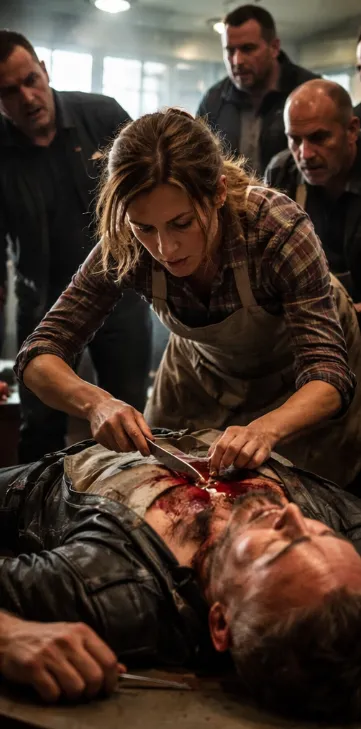
I vaulted over the counter, grabbing a steak knife and a roll of plastic wrap without breaking stride. My hands were already steady, my thoughts aligning into precise, practiced steps as I dropped to my knees beside the man.
“Do you want him to live?” I snapped, locking eyes with the one still holding the knife.
He blinked, thrown off balance.
“Then move!”
They obeyed.
They lifted their leader onto the booth, his body limp and heavy, blood soaking through his shirt in dark, spreading patches. I tore his vest open, ignoring the symbols stitched into the leather, focusing only on the wound beneath.
One bullet hole. No exit.
“He was shot down the road,” one of them stammered. “We thought—”
“He didn’t miss,” I cut him off.
I pressed my ear to his chest, blocking out the noise around me. No breath sounds on the right side. The trachea was shifting. Pressure building.
Crushing his heart.
“Hold him down,” I ordered.
“What are you doing with that knife?” another demanded, stepping closer.
I didn’t look up.
“I’m the only thing standing between him and death. Step back—or watch him die.”
Silence fell, heavy and uncertain.
I grabbed a bottle of vodka from the counter and poured it over the blade, then over his chest. My hands didn’t hesitate.
Then I cut.
The resistance of skin gave way beneath the blade, followed by the sickening softness of tissue. For a split second, everything held its breath—then a sharp hiss burst from the wound, air escaping like a valve finally released.
His chest jerked.
A ragged, desperate inhale tore through him as his body fought its way back from the edge.
I slapped plastic over the wound, sealing three sides, leaving one edge loose—a makeshift valve. My fingers moved quickly, taping it down, pressing against his chest to stabilize him.
“Breathe,” I whispered, my voice low now, steady but urgent. “Come on… you’re not dying here.”
His eyelids fluttered, then opened.
And the first thing he saw was me.
Not his men. Not the chaos.
Just me—kneeling over him, my hands covered in his blood, my expression locked somewhere between fury and something far more complicated.
I was saving a man I hated with everything I had.
The sirens came ten minutes later, distant at first, then growing louder as they closed in. The tension in the room shifted again, the bikers exchanging glances that carried the promise of violence if things went wrong.
But their leader was awake now, barely, his breathing steadier beneath my hands.
He reached out weakly, grabbing the arm of the man beside him.
“Go,” he rasped. “Take them… out the back.”
“Boss—”
“Go!”
Reluctantly, they obeyed, disappearing through the rear exit one by one, leaving only their leader behind as the sound of sirens filled the air.
Paramedics burst through the door moments later, followed by the police, their presence cutting through the last remnants of chaos. They moved quickly, taking over, securing him onto a stretcher.
As they lifted him, his hand closed around my wrist.
“You’re a medic,” he said, his voice thin but certain.
“Used to be,” I replied, pulling a dish towel from my apron and wiping the blood from my hands.
He studied me for a moment, then spoke again, his words slower now, deliberate.
“My boys… three years ago… a man run off the road. Blue sedan.”
My heart stopped.
“That was my husband.”
For a moment, something flickered across his face—pain, but not the kind caused by the bullet.
“I know,” he said quietly. “It wasn’t my crew. It was the Reapers. We’ve been hunting them ever since.”
The world tilted.
“That’s why you were shot?” I asked, my voice barely above a whisper.
He nodded weakly.
“I took a bullet trying to put down the men who killed your husband.”
Silence swallowed everything.
The man I had wanted dead… had been fighting the war I thought I faced alone.
“Why?” I asked, unable to stop the question from slipping out.
He coughed, wincing as the movement pulled at his wound.
“Because there are rules,” he said. “And they broke them.”
His grip loosened slightly, but his eyes stayed locked on mine.
“You saved me today, Medic,” he added. “Debt’s paid.”
Then they carried him away.
I stood there long after the sirens faded, the diner slowly returning to its quiet rhythm, as if nothing had happened at all.
But everything had changed.
A week later, a package arrived.
No return address. No note.
Inside was an envelope thick with cash—more money than I had seen in years—and a single black leather patch resting on top.
It didn’t carry a gang symbol.
Just one word.
PROTECTED.
I stared at it for a long time, the weight of everything pressing down on me in ways I couldn’t quite explain. Then I walked to the front door, peeled off the backing, and pressed the patch against the glass.
When Old Man Miller came in that morning, he paused, squinting at it.
“New decoration?” he asked.
I poured his coffee, my hands steady in a way they hadn’t been since before Mark died.
“No,” I said softly, a faint smile touching my lips.
“Insurance.”
And for the first time in three years, I realized I wasn’t hiding anymore.