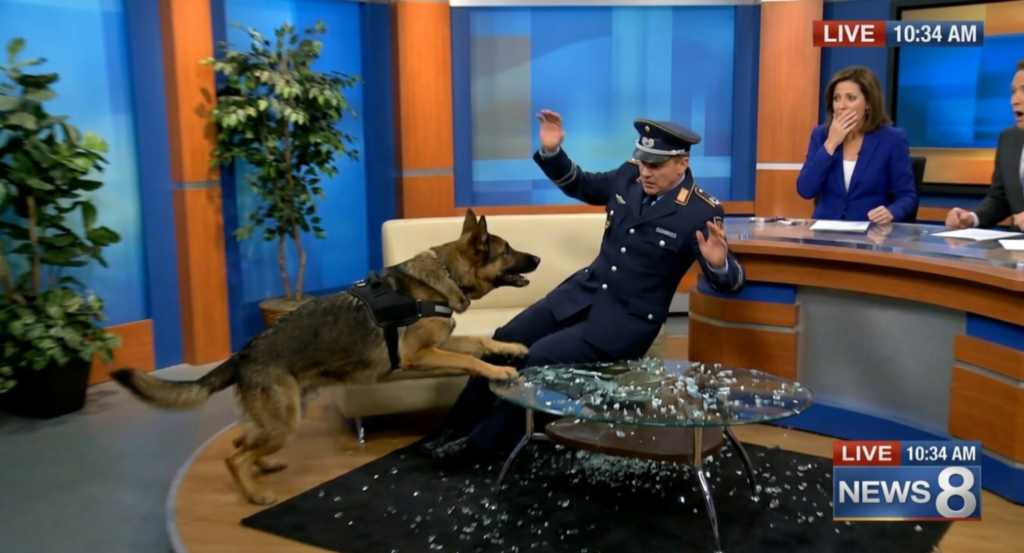
I’ve spent twelve years producing live television in the heart of Seattle, and I thought I’d seen it all—wardrobe malfunctions, unscripted political rants, even a fire in the rafters. But nothing, absolutely nothing, prepared me for the morning we invited Sergeant First Class Elias Thorne and his retired K9, Max, onto our “Morning Heroes” segment.
It was supposed to be the feel-good story of the year. A local boy returns from three tours, saves his platoon, and comes home to a hero’s welcome with the dog that sniffed out the IEDs that would have killed them all. The set was perfect: the Space Needle looming in the background through the glass, the soft morning light, and a veteran who looked like he’d walked straight off a recruiting poster.
But Max, the German Shepherd, knew something we didn’t.
From the moment they stepped onto the soundstage, Max wasn’t acting like a retired service dog. He wasn’t the calm, disciplined animal we’d seen in the pre-interview photos. His fur was standing up along his spine, and his eyes—fixed on Thorne—were filled with a primal, terrifying distrust.
My lead anchor, Sarah, was halfway through a question about Thorne’s final mission in the Korengal Valley. She was leaning in, her face twisted into that practiced expression of televised empathy.
“Sergeant,” she said, her voice soft. “Can you tell us what was going through your mind when the radio went dead and you realized you were alone?”
Thorne began to answer. His voice was steady, a deep, resonant baritone that commanded the room. “In that moment,” he began, “you don’t think about yourself. You think about the brothers to your left and right…”
That was when it happened.
Max didn’t just bark. He let out a roar that sounded like it came from the bowels of hell and launched himself across the coffee table. He didn’t go for Thorne’s arm. He didn’t go for his leg. He went straight for the throat—or so we thought.
Sarah screamed. The cameraman jolted, the frame swinging wildly toward the ceiling. I was in the control booth, screaming at my director to cut to a commercial, but my hand froze over the switch.
Because on the monitor, the impossible was happening.
Thorne was on the floor, pinned by eighty pounds of snarling muscle. The dog’s jaws were clamped tight, but not on flesh. Max was tearing into the lapel microphone clipped to Thorne’s uniform, his teeth grinding against the plastic and wire.
And the voice… God, the voice.
Thorne’s mouth was clamped shut. His face was a mask of cold, robotic indifference. Yet, through the studio monitors and into the homes of three hundred thousand viewers, the voice of the “hero” continued to speak.
“…we knew the cost of freedom,” the voice said, perfectly calm, perfectly clear, without a single hitch of breath or a hint of the struggle happening on the floor.
The audio wasn’t coming from him. It was coming from somewhere else. And as the dog ripped the microphone clear from the uniform, the voice didn’t stop. It just kept talking to an empty room.
CHAPTER 2: THE SEVEN-SECOND GHOST
The “On Air” light didn’t just turn off; it flickered and died like a heart stopping on a monitor.
In the control booth, the silence was louder than the screaming had been seconds before. We were sitting in a tomb of high-definition glass and expensive hardware. My director, Dave, sat with his hands hovering over the switcher, his fingers trembling so violently they tapped against the plastic.
“Did we… did we just broadcast that?” Sarah’s voice crackled through my headset, coming from the floor. She was still huddled near the anchor desk, her makeup smeared, looking at the spot where the coffee table had exploded into a thousand glittering shards.
I didn’t answer her. I couldn’t. My eyes were locked on the master monitor—the one that showed the raw, unbuffered feed from Camera 2.
On the floor of the studio, the man we called Sergeant First Class Elias Thorne was standing up.
It was the most unnatural thing I’ve ever seen. A man who had just been tackled by an eighty-pound predator, a man who had fallen through a glass table, should have been checking for blood. He should have been shaking. He should have been swearing or gasping for air.
Instead, Thorne stood up with the fluid, mechanical grace of a hydraulic lift. He brushed a stray shard of glass from his shoulder as if it were a piece of lint. His face remained a perfect, unmoving mask of stoicism. No sweat. No dilated pupils. Nothing.
And then there was Max.
The dog had stopped attacking the moment the microphone was shredded. He wasn’t lunging anymore. He was standing five feet away, his body low to the ground, his teeth still bared, but he wasn’t looking at Thorne’s face. He was staring at Thorne’s chest—specifically, the area where the lapel mic had been clipped. Max was growling at the air, a deep, rhythmic sound that felt like a Geiger counter hitting a radioactive source.
“Jim,” Dave whispered, pointing at the audio board. “Look at the waveform on the backup master.”
I looked. My stomach did a slow, sickening roll.
The live microphones on the floor—the ones Max had destroyed—were flatlines. Nothing but static. But on the secondary auxiliary channel, the “Thorne” audio was still coming through.
“…and we must never forget that the price of our sleep is the wakefulness of those in the shadows,” the voice said.
It was Thorne’s voice. It was continuing the speech. But Thorne was standing right there on the monitor, his lips pressed together, watching the security guards rush onto the set. He wasn’t talking. He wasn’t even breathing in time with the words.
“Where is that coming from?” I hissed, grabbing the faders. I pushed the Aux 4 slider down to zero.
The voice didn’t stop. It stayed at the same volume in my headset.
“I’ve bypassed the board!” Dave yelled, panic finally breaking through his professional shell. “I’ve cut the master out-feed! Why is he still talking?”
I grabbed my tablet and pulled up the station’s live webstream—the one the public was seeing. Because of the 7-second delay we use for profanity and accidents, the “attack” hadn’t happened yet on the internet.
I watched the screen. On the webstream, Thorne was still sitting on the couch, calmly discussing the Korengal Valley.
7 seconds.
I looked at the live monitor on the wall—the real-time feed. Thorne was standing up, being surrounded by guards.
6 seconds.
On the webstream, Sarah was asking the question about the “absolute silence” of the mission.
5 seconds.
I realized then that the audio wasn’t just “delayed.” It was independent. The voice on the stream was answering Sarah’s question before the “man” on the set had even heard it.
“Dave, kill the digital encoder! Pull the fiber cables! Now!”
Dave lunged for the rack behind us, ripping the glowing blue cables from their sockets. The webstream died, replaced by a “Technical Difficulties” graphic.
The silence that followed was heavy. I stood up, my legs feeling like lead, and walked to the glass window overlooking the studio floor.
Down below, four security guards were trying to lead Thorne off the set. He didn’t resist, but he didn’t help either. He moved where they pushed him, his arms hanging stiffly at his sides. Max was being wrangled by our floor manager, who had a catch-pole. The dog was frantic, snapping at the air, his eyes never leaving Thorne.
“Something’s wrong with him,” Sarah whispered, her voice echoing in the studio. She was looking at Thorne. “He’s not… he didn’t even blink when the glass broke.”
I looked closer. Thorne’s uniform was torn. Through a rip in the expensive fabric of his tunic, I expected to see skin. Maybe a bruise. Maybe the red marks of a dog’s teeth.
Instead, I saw a flash of something matte-black. Something that didn’t look like flesh.
Before I could get a better look, a group of men in dark, nondescript suits—not our station security—burst through the side exit. They moved with a military precision that made our guards look like mall cops. They didn’t go to Sarah. They didn’t go to the dog.
They swarmed Thorne.
They threw a heavy black coat over him, shielding him from our cameras, and hustled him toward the service elevator. One of them stayed behind, staring up at the control booth. He didn’t say a word, but the way he adjusted his jacket—revealing the holster beneath—was a message loud and clear.
I ducked back into the shadows of the booth.
“What the hell was that?” Dave asked, his face pale. “Who are those guys?”
“I don’t know,” I said, my heart hammering against my ribs. “But they aren’t here for the hero.”
I sat back down at my workstation. My hands were shaking, but the producer in me—the part of me that had spent a decade chasing the truth behind the lens—was screaming. I opened the recording software. I needed to see that 7-second gap again.
I pulled the file for the last ten minutes of the broadcast. I isolated the audio tracks.
When I looked at the raw data, I saw it. The audio for Thorne wasn’t coming from the wireless pack we’d clipped to his waist. That channel was dead—it had been dead since he walked onto the set.
The audio was being injected directly into our primary server via an external IP address. Someone was “streaming” the veteran’s voice into our broadcast, perfectly synced to a script that the man on the floor was supposed to be miming.
But then I saw the anomaly.
In the seconds before Max attacked, there was a spike in the sub-frequency of the audio—a sound too low for human ears to hear, but the software caught it. It was a high-intensity burst of data.
A trigger.
Max didn’t snap because he was “jittery.” Max snapped because he heard something. He heard the “voice” before we did.
I leaned into the monitor, scrolling through the frame-by-frame of the attack. I zoomed in on Thorne’s ear. It was hidden by his hair, but for one split second, as the dog tackled him and his head jerked back, I saw it.
It wasn’t an earpiece. It was a silver port, embedded directly into the bone behind his ear.
My breath hitched. I felt a cold sweat break out across my forehead. I went to the station’s archives and pulled up the “Hero’s Background” folder the PR firm had sent us. I scrolled past the photos of Thorne in the desert, past the scanned medals and the commendation letters.
I found his medical discharge papers.
Sergeant First Class Elias Thorne. Status: Deceased. Date of death: May 14, 2024. Location: Korengal Valley.
The man who had been sitting on our couch, the man the world was calling a hero, had been dead for two years.
I looked back at the studio floor. It was empty now, save for the shattered glass and a single, blood-stained dog toy Max had left behind.
“Dave,” I said, my voice barely a whisper. “We need to get out of here. Right now.”
“What? Why? We have to prep the noon news.”
“There isn’t going to be a noon news,” I said, grabbing my jacket. “Because the man we just interviewed isn’t a man. And the people who brought him here just realized we saw the glitch.”
I looked at the monitor one last time. On the frozen frame, Max was mid-air, his teeth inches from the microphone.
The dog wasn’t trying to hurt the veteran.
The dog was trying to unplug him.
CHAPTER 3: THE ECHO IN THE BONE
The elevator ride down to the parking garage felt like an eternity. Every floor we passed, every soft ding of the bell, felt like a countdown to a confrontation I wasn’t prepared for. Dave was leaning against the back wall, his face the color of old parchment. He hadn’t stopped shaking since he’d pulled those fiber cables.
“Jim, we can’t just leave,” he whispered, his voice cracking. “The footage… the raw files. If they find out I didn’t wipe the cache, they’re going to come for us.”
“They’re already coming, Dave,” I said, watching the floor numbers flicker. 4… 3… 2… “Those weren’t station security. Those were Cleaners. You saw the way they moved. You saw the hardware they were carrying. They don’t give statements, and they don’t file reports. We need to move.”
The doors slid open to the dim, concrete expanse of the basement level. The air was cold and smelled of damp earth and exhaust. I scanned the shadows, looking for the black SUVs I knew would be there. But the garage was strangely empty. Too empty.
We sprinted to my truck. My fingers fumbled with the keys, the metal cold against my sweaty palms. Once we were inside, I didn’t turn on the lights. I just backed out and drove, hitting the exit ramp and merging into the grey, rain-slicked streets of Seattle.
I didn’t head home. That was the first place they’d look. Instead, I drove toward a small, 24-hour diner in Industrial District—a place where the coffee was battery acid and nobody asked questions about why two guys in TV production gear looked like they’d just seen a ghost.
We took a booth in the back, far from the windows. Dave opened his laptop immediately, his fingers flying across the keys. He was tethered to a burner phone I’d kept in my glovebox for years.
“I managed to mirror the internal server before I pulled the plug,” Dave muttered, his eyes reflected in the blue light of the screen. “I have the biometric metadata from the ‘Thorne’ unit. Jim… this is worse than we thought. It’s not just a recording.”
“Then what is it?”
Dave turned the laptop toward me. On the screen was a complex series of frequency graphs. “Look at the vocal patterns. When a human speaks, there’s variance—breathing, micro-stutters, the wet sound of the mouth. This ‘Thorne’ voice has none of that. But it’s not AI-generated either. It’s a perfect loop of his actual neural pathways. They didn’t just record his voice; they mapped his brain before he died. They’re running his consciousness through a processor and ‘performing’ it through that body.”
“The port,” I whispered, remembering the silver circle behind the man’s ear. “It’s a receiver.”
“Exactly,” Dave said. “The body is just a puppet. A high-end, biological prosthetic. The real ‘Thorne’ is a server rack in a basement somewhere in D.C. But here’s the kicker… look at the frequency spike right before Max attacked.”
He pointed to a sharp, jagged needle on the graph.
“That’s a feedback loop,” Dave explained. “The ‘Echo’—that’s what the file headers call the program—was glitching. It was trying to process a memory that wasn’t in the script. The dog didn’t just hear a signal. The dog heard a scream. A digital scream that we couldn’t perceive, but to a K9 with military-grade hearing, it must have sounded like a siren.”
Before I could respond, the bell over the diner door chimed. I tensed, my hand dropping to the heavy maglite I’d brought from the truck.
It wasn’t the men in suits. It was a woman. She was drenched, her blonde hair plastered to her forehead, wearing a rugged tactical jacket that had seen better days. She looked around the diner with the eyes of a hunted animal until they landed on us.
She walked straight to our booth and slid in next to Dave.
“You’re the producer,” she said. It wasn’t a question. “And you’re the tech who tried to kill the feed.”
“Who are you?” I asked, my heart hammering.
“My name is Elena,” she said, her voice low and raspy. “I was Max’s handler in the 75th Rangers. And I was the one who was supposed to be in that studio today to make sure the dog didn’t realize his master was a corpse.”
She reached into her pocket and pulled out a battered dog tag. It didn’t say Thorne. It said Project Echo – Asset 01.
“The military doesn’t like losing heroes,” Elena said, staring into her empty hands. “Elias Thorne was the perfect soldier. He was brave, he was handsome, and he was the face of the recruitment drive. When he died in that tunnel, the PR nightmare was too much for them to handle. They had the technology—a way to ‘preserve’ the neural architecture of fallen assets. They thought they could just put the ghost back into a shell and keep the parade going.”
“But Max knew,” I said.
Elena nodded, a single tear tracking through the dirt on her cheek. “A dog’s nose doesn’t lie, and neither do its ears. Max knew the moment he got within ten feet of that… thing… that it wasn’t Elias. He could smell the chemicals they use to preserve the tissue. He could hear the hum of the cooling fans in the chest cavity. He’s been grieving for two years, and today, he finally had enough. He tried to kill the machine that was wearing his friend’s face.”
“Why are you telling us this?” I asked. “You’re part of it.”
“I was part of it,” she snapped, her eyes flashing with a sudden, sharp anger. “Until they told me what they’re planning to do with Max. They’re calling him ‘compromised.’ They think he’s a threat to the integrity of the program. They’re going to put him down, Jim. Tonight.”
She leaned in closer, the smell of rain and gun oil coming off her in waves.
“I can’t get to the facility alone. But you… you have the press credentials. You have the access codes to the secure transport lane at the station where they took him. If we don’t move in the next hour, Max is dead, and that mechanical puppet will be on the evening news in another city, telling the same lies to a different crowd.”
I looked at Dave. He looked at his laptop, then back at me. We were just two guys from local news. We weren’t soldiers. We weren’t whistleblowers. We were the people who made sure the weather report ran on time.
But I thought about Max. I thought about the way he’d looked at the “man” on the floor—not with aggression, but with a desperate, heartbreaking sorrow. He was the only one in that room who was telling the truth.
“Where is he?” I asked.
“The old Naval Reserve building on the waterfront,” Elena said. “They’ve turned the basement into a ‘maintenance’ bay for the Echo units. Max is being held in the kennel block.”
“Dave,” I said, standing up. “Can you scramble the GPS on the truck?”
“I can try,” he said, already typing. “But Jim… if we do this, there’s no going back. We aren’t just reporting the story anymore. We’re the story.”
“I’ve spent ten years broadcasting garbage,” I said, pulling my jacket on. “For once, I’d like to do something that’s actually real.”
We walked out into the rain. The city of Seattle felt different now—colder, more mechanical. Every security camera felt like an eye; every hum of a transformer felt like a voice.
As we pulled out of the parking lot, I saw a black SUV turn the corner two blocks away, its headlights off.
They were close. But for the first time in my life, I wasn’t looking at the monitor. I was looking through the windshield.
“Elena,” I said, checking the rearview mirror. “Does that ‘Echo’ unit have a shut-off switch?”
She looked at me, a grim smile touching her lips. “It does. But you have to get close enough to pull the plug. And the ‘Thorne’ unit is programmed for self-defense.”
“Good,” I said, flooring the accelerator. “Because I have a feeling Max wants to finish what he started.”
The waterfront was a graveyard of rusted cranes and shipping containers. Somewhere in the dark, a dog was waiting for us. And somewhere in the dark, a dead man was waiting to speak again.
I didn’t know if we’d make it through the night. But as the lights of the Naval building appeared through the fog, I knew one thing for sure.
The 7-second delay was over. The truth was finally going live.
CHAPTER 4: THE KILL SWITCH
The old Naval Reserve building sat on the edge of the Puget Sound like a rotted tooth in a dark mouth. The rain was coming down in sheets now, blurring the lights of the shipping containers that lined the pier. Elena parked the truck behind a rusted crane, the engine ticking as it cooled.
“Check your gear,” she whispered. She didn’t have a rifle—that would be too loud, too conspicuous. She had a specialized frequency jammer and a heavy-duty tranquilizer pistol designed for large animals. “Jim, stay behind me. Dave, if you lose the uplink, we’re dead in there. You’re our eyes.”
Dave opened his laptop, the glow illuminating his sweat-streaked face. “I’m into the building’s local subnet. It’s old architecture, but the internal security is high-spec. I’ve looped the cameras in the loading bay, but I can only hold it for twelve minutes before the system does a handshake with the main server in D.C. After that, they’ll know the loop is a fake.”
“Twelve minutes,” I said, my heart drumming a frantic rhythm against my ribs. “That’s not enough time to find a dog and a server rack.”
“It has to be,” Elena said. She climbed out into the rain, and we followed.
We moved like shadows through the side entrance. Elena used a magnetic bypass on the door—military tech I’d only ever seen in movies. Inside, the building was a tomb. The air was pressurized and filtered, smelling of ozone and medical-grade disinfectant.
“This way,” Elena hissed, leading us down a narrow corridor lined with reinforced concrete.
We passed a glass window that looked into a lab. I stopped, my breath catching in my throat. Inside were three more “units.” They weren’t Thorne, but they were familiar. One was a female pilot who had died in a crash two years ago. Another was a young Marine who had been the poster boy for the “Stronger Together” campaign. They were suspended in gel-filled tanks, their eyes closed, wires snaking into the ports behind their ears.
“It’s a factory,” I whispered. “They’re not just replacing Thorne. They’re replacing the entire history of the war.”
“Keep moving,” Elena urged. “The kennel block is at the end of this hall.”
We found Max in a small, sterile room. He wasn’t in a cage; he was strapped to a metal table, his breathing heavy and ragged. A technician in a white lab coat was standing over him, preparing a syringe.
Elena didn’t hesitate. She stepped into the room and fired the tranquilizer. The technician slumped over before he could even turn around.
“Max!” Elena ran to the table, her hands flying over the restraints.
The dog’s eyes fluttered open. He let out a low, weak whine when he saw her, his tail giving a single, pathetic thump against the metal. He smelled the air, his nose twitching, and then his ears pinned back. He began to growl—not at us, but at the door.
“He’s here,” Elena said, her voice turning cold.
A heavy, rhythmic thud echoed from the hallway. Step. Step. Step. It was too steady, too precise.
SFC Elias Thorne—or the thing wearing his face—walked into the room. He wasn’t wearing his dress uniform anymore. He was in tactical blacks, and the matte-black plating I’d seen through the rip in his tunic was now visible across his torso. His eyes were wide, unblinking, and glowing with a faint, artificial amber light.
“Asset 01 has detected a security breach,” a voice said. It was Thorne’s voice, but it wasn’t coming from his mouth. It was coming from the wall speakers, echoing through the facility. “Handlers Elena Miller and James Brennan are marked for termination. Authorization: Echo Protocol.”
“Dave!” I yelled into my comms. “Now!”
“I’m trying!” Dave’s voice was frantic in my ear. “The firewall is too thick! I can’t find the kill switch!”
Thorne moved with a speed that defied physics. He lunged at Elena, his arm swinging like a piston. She rolled under the strike, the metal table behind her crumpling like paper under the force of the blow.
I grabbed a heavy fire extinguisher from the wall and swung it with everything I had. It hit Thorne’s shoulder with a sickening clang. He didn’t even flinch. He turned his head 180 degrees—a movement no human neck could perform—and looked at me.
“The broadcast was a success, James,” the voice said from the speakers. “The public believes in the hero. The hero cannot be allowed to fail.”
He grabbed me by the throat. His grip was like a hydraulic vice. I felt the air leave my lungs, the world turning grey at the edges.
Then, a roar filled the room.
Max, fueled by sheer adrenaline and the bond with his true handler, had broken the final strap on the table. He didn’t go for the throat this time. He went for the silver port behind Thorne’s ear.
The dog’s jaws clamped down on the metal interface, his teeth grinding against the circuitry. Thorne’s body began to spasm. The amber light in his eyes flickered and died.
“I’ve got it!” Dave screamed in my ear. “I found the primary node! I’m dumping the entire server cache to every news outlet in the country! 3… 2… 1… UPLOAD!”
Thorne froze. His hand released my throat, and I slumped to the floor, gasping for air.
The voice on the speakers began to glitch. “Honor… honor… hon-on-on…” It devolved into a high-pitched digital shriek that made my ears bleed.
The “Thorne” unit collapsed. It didn’t fall like a man; it fell like a machine that had lost power, its limbs locking in place. The skin on its face began to sag, the underlying cooling systems failing, the heat from the internal processors beginning to cook the biological tissue from the inside out.
Elena grabbed Max, pulling him away from the smoking remains. “We have to go! The upload triggered a self-destruct on the servers! This whole place is going to burn!”
We ran. We sprinted through the corridors as the lights began to strobe and alarms blared. We burst out into the rain just as the basement levels of the building erupted in a series of muffled explosions.
We didn’t stop until we were back in the truck, miles away from the waterfront.
I sat in the passenger seat, my neck bruised, watching the sunrise break through the Seattle clouds. On my phone, the notifications were exploding. Every major news site, every social media platform, was flooded with the raw footage Dave had uploaded: the tanks, the “Echo” units, the medical records of dead soldiers being used as puppets.
The “7-second delay” was gone. The world was finally seeing the reality behind the broadcast.
Elena was in the back of the truck, her head resting against Max’s fur. The dog was exhausted, but he was breathing deeply, his eyes closed. For the first time in two years, he was at peace.
“What happens now?” Dave asked from the driver’s seat.
“Now,” I said, looking at the city I had spent my life televising. “We stop telling stories. We start living the truth.”
I looked at the “Hero’s” voice on my phone screen, a clip of the interview from the morning.
“…and we must never forget that the price of our sleep is the wakefulness of those in the shadows.”
I hit the delete button.
The shadows were gone. And for the first time, I wasn’t afraid of the silence.