The river swallowed me whole—and for a second, I thought that was the end.
But the box didn’t sink the way he expected. It slammed against something hard, tilting just enough for freezing water to start leaking in through a cracked seam. My lungs burned as I fought to stay conscious, fingers numb, vision blurring, until I felt something still hidden inside my cast.
A blade.
I cut myself free blindly, hands shaking, heart pounding louder than the water rushing in. The lid wouldn’t open. Not at first. Not until I forced it—until the pressure shifted and the river came crashing in like it wanted me gone for good.
I barely made it out.
Mud. Air. Pain.
And then—headlights.
For one terrifying second, I thought it was him coming back.
But it wasn’t.
A figure ran toward me, then stopped just short, eyes locked on the shattered box behind me… and something in her expression changed.
She grabbed her radio, hesitated, then looked back at me.
“You shouldn’t have survived this…”
This is only the beginning of the story… The most unexpected part is
“They Thought I’d Drown in Silence—Instead, I Came Back and Destroyed Their Careers”…
My name is Cadet Elena Ward, and for most of my life I have been careful about one thing: I never wanted my parents’ rank to do my work for me.
My father is Lieutenant General Marcus Ward, and my mother is Major General Diane Ward. In some families, names like that open doors before you ever knock. In ours, they came with a warning. My father used to tell me that borrowed authority is the weakest kind, because the day you lose the name, you discover whether you ever had a spine of your own. So when I entered Redstone Army Officer Academy, I listed both my parents as federal employees and let everyone assume whatever they wanted.
I wanted to earn my place.
At first, that worked.
I ranked high in tactics, field navigation, and endurance. I kept my head down, helped weaker cadets when I could, and learned quickly which instructors cared about discipline and which ones cared more about being feared. Captain Brandon Hale belonged to the second group. He ran the discipline wing like a private kingdom, the kind of officer who confused humiliation with leadership and thought a cadet’s silence meant submission. He noticed me early, and not because I was loud. Men like Hale don’t hunt noise. They hunt resistance.
The trouble began after a live obstacle drill when I finished first despite running on a stress fracture he had insisted was “attitude, not injury.” When the medic wrapped my lower leg and recommended rest, Hale overruled it in front of the unit. He said pain was a teacher and weakness was contagious. Later, he cornered me outside the equipment shed and asked why I carried myself like I thought I outranked him. I told him I didn’t. I just didn’t fear him enough to flatter him.
That answer cost me.
From then on, inspections got harsher. My bunk was tossed for invented violations. My meal allotment was delayed twice. During one rain-soaked punishment drill, Hale shoved me hard enough that I hit the concrete wall with my bad leg first and nearly blacked out. He leaned close and said some cadets needed to be broken before they became useful.
I should have reported him earlier.
Instead, I kept thinking I could outlast him.
Then came the day he pushed too far.
I was on crutches, leg in a cast, when he dragged me into a storage annex behind the training hall and demanded I sign a statement admitting I had exaggerated my injury to manipulate academic ranking. I refused. He slapped the clipboard out of my hands, grabbed my collar, and ripped open the front seam of my training jacket. My officer identification chain fell free from inside the lining. He snatched it before I could stop him.
He read the name. Then the emergency family contact line. Then the insignia authorization code.
His whole face changed.
For one second, I thought fear might save him.
Instead, it made him more dangerous.
That night, while half the academy slept and the river beyond the lower training grounds ran black under the storm, Captain Brandon Hale and two loyal cadets carried me—injured, drugged, and locked inside a narrow reinforced glass training confinement box—toward the flood channel beside the Hudson.
The last thing I heard before the box tipped into the water was Hale whispering, almost shaking, “Dead cadets don’t testify.”
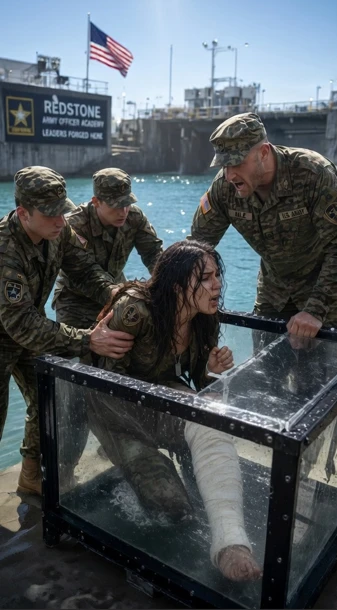
So how does an injured young officer survive when a terrified captain decides murder is safer than exposure—and what did Hale discover in my file that made him risk everything to silence me?
Part 2
The first lesson survival ever taught me is that panic burns oxygen faster than fear does.
When the glass box hit the river, the impact drove the air out of my lungs so hard I saw white for a second. Then the cold came. Not ordinary cold. River-at-night cold. The kind that enters through every seam in your thinking and tries to make confusion feel reasonable. Water slammed against the sides of the box, rolling it once, then again, until up and down became meaningless. My casted leg smashed into the far wall and pain lit through me like a live wire.
I wanted to scream.
Instead, I counted.
That habit came from my mother, not the academy. She taught me as a child that if terror ever arrives, numbers can keep you anchored long enough for thinking to return. Four-count inhale. Four-count hold. Four-count exhale. Inventory the world. What’s broken. What moves. What still belongs to you.
My wrists were zip-bound in front, not behind. That told me Hale wanted the scene to look like an accident during transport, not an execution with clear restraint marks. The confinement box itself was one of the academy’s obsolete endurance-training units—thick acrylic panels, vent slits, top latch mechanism, reinforced frame. I had seen them mothballed in storage during logistics rotation. Hale must have believed the current would do the rest before anyone noticed one missing.
He nearly got his wish.
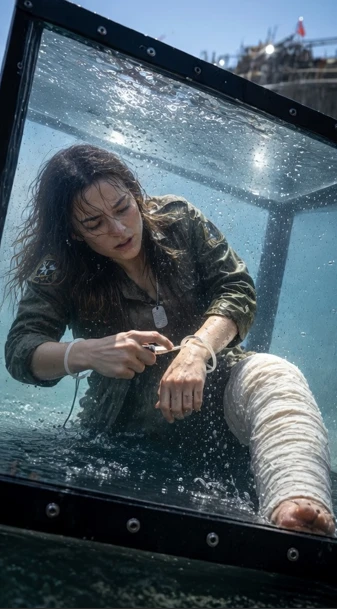
The box lodged between two half-submerged concrete barriers instead of being dragged straight downstream. That bought me minutes. Maybe less. Water was still pouring in through a cracked corner seam from the impact, and the box had settled on a slant that pinned my bad leg awkwardly under my own weight. My fingers were numb, but not useless. Taped under the inside edge of my cast, where the infirmary never found it because cadets learn to hide what stubbornness requires, was a short ceramic utility blade from field-craft training. Regulation said I shouldn’t have had it. Regulation also wasn’t underwater in the dark.
I cut the zip tie by feel.
Then I worked the top latch.
My hands slipped twice. The third time, something shifted. Not enough to open, just enough to tell me the mechanism had jammed under torsion rather than locked fully. I drove the ceramic blade into the rubber gasket seam and leaned my whole shoulder into it. The crack widened. Water rushed faster. Good. Pressure equalizes before openings do.
When the lid finally gave, the river punched into the box like it had been waiting personally for me to fail.
I don’t remember climbing out so much as fighting my way into air. Concrete scraped my palms. My cast dragged like an anchor. Somehow I got one arm over the barrier and hung there vomiting river water into the dark until my breathing returned in pieces. I lay in mud and reeds for what felt like an hour but was probably under six minutes before headlights swept the embankment above me.
For one savage instant I thought Hale had come back to finish it.
Instead, it was Sergeant Leah Mercer, the night-range NCO, returning from an ammunition log transfer. She spotted the shattered box first, then me. Later she told me I looked less like a cadet than like something the river had refused to keep. She called medical, military police, and command in under thirty seconds. While we waited, I grabbed her sleeve and told her exactly three words before the shock started taking me apart.
“Check Hale’s locker.”
That mattered because I already knew what Hale had seen in my file wasn’t only my parents’ names.
When he tore open my jacket and read my emergency clearance card, he also saw an attached restricted notation tied to a sealed disciplinary review board my father had quietly requested months earlier. I hadn’t been sent to Redstone merely to prove myself. My father and mother had heard whispers—cadet injuries disappearing from records, supply discrepancies, hazing complaints rewritten, one prior “drowning accident” never fully explained. They never told me because they wanted me to choose this life cleanly, not as bait. But the notation on that card meant Hale knew somebody above him had already started looking.
And that meant my near-murder wasn’t just panic.
It was containment.
By sunrise, military police had torn through Hale’s office, locker, training logs, and communication history. Sergeant Leah Mercer’s body-cam footage preserved my recovery site. The shattered box was recovered from the channel. My drug screen came back positive for a sedative no cadet should ever have in her system. Two loyal cadets broke within hours and admitted Hale ordered them to help “relocate” me after saying I had become a threat to command stability.
What they also admitted was worse.
There had been another cadet the previous year.
A drowning labeled accidental.
And hidden in Hale’s locker, behind old inspection binders and a false panel, investigators found a flash drive marked with a simple word:
HUDSON.
That drive didn’t just contain proof of my attack.
It contained videos, roster edits, falsified injury reports, and payment records tied to off-books contracts moving academy equipment to a private security vendor. Hale hadn’t tried to kill me only because of my name.
He tried to kill me because I had landed inside a system already built on silence, fraud, and at least one death before mine.
So when I woke fully in the hospital and saw both my parents standing at the foot of the bed in dress uniforms, I knew this case had already gone far beyond one violent captain.
The real question now was how high the rot climbed.
And whether the people above Hale would let him fall alone—or start burning evidence before I could stand up and name them myself.
Part 3
By the time I could sit upright without the room turning sideways, Redstone Army Officer Academy had become two places at once.
The public version was controlled and polished: temporary command reassignment, internal review, statements about maintaining the integrity of officer training, measured concern for cadet welfare. The private version—the real one—was raw wire and broken concrete. Investigators sealed the lower training annex. Military police photographed the river barriers. My blood samples, Hale’s messages, the flash drive marked HUDSON, and my recovery footage were all moved through protected chain-of-custody so fast it made people nervous.
People should have been nervous.
Captain Brandon Hale, to his credit or stupidity, didn’t collapse immediately. Men like him rarely do. He tried first to frame everything as a training-control incident gone wrong, then as an unauthorized disciplinary stunt caused by pressure and exhaustion. But once forensic review matched the sedative in my blood to a missing batch logged through his access code, and once the two cadets who helped move the box repeated their statements under counsel, his options narrowed into the kind of silence usually reserved for funerals and defendants.
Still, Hale was only the loudest part of the rot.
The flash drive proved it.
Inside HUDSON were edited injury reports, deleted complaint forms, procurement discrepancies, and a sequence of payment transfers routed to a civilian firm that should never have been receiving academy gear at all. Some of the missing equipment was minor enough to hide in training waste. Some of it wasn’t—optics, communication units, protective inserts, specialized range devices. Enough to mean someone beyond a sadistic captain had been profiting off a place built to train future officers. And buried among those files was the record that chilled everyone who reviewed it: the so-called accidental drowning of Cadet Erin Vance, fourteen months earlier, had been preceded by a disciplinary recommendation signed by Hale and quietly overridden at command level before her death.
I remembered Erin.
Not well, but enough. Quiet. Sharp. A distance runner. The kind of cadet people describe afterward as serious because they don’t know how else to speak about someone whose life was cut off by institutional cowardice.
My father wanted me protected once the scope became clear. My mother wanted me angry and careful, in that order. They agreed on one thing: I was now witness, victim, and officer cadet all at once, which made every word I spoke both powerful and dangerous. That was why I insisted on testifying early.
Not because I enjoyed it.
Because I knew men above Hale were already trying to turn the story into one bad actor and one emotional overreaction.
The hearing room was full the day I walked in on crutches, cast still on, jacket repaired but collar seam visible if anyone looked closely. I wanted it visible. Let them see what command arrogance had reached for when it thought it owned the stage. Hale sat at the far end of the room with a face carefully emptied of remorse. Beside him sat two attorneys and the brittle illusion that controlled language can survive physical evidence.
It didn’t.
I told the story plainly. The yard. Ethan in the mud. Hale’s hands on me. The torn jacket. The discovery of my identity. The sedation. The box. The river. Then Sergeant Leah Mercer testified. Then the medics. Then the cadets who helped carry me. Then the forensic analyst who opened HUDSON and showed, line by line, how injury reports had been rewritten and how Erin Vance’s file had been softened before burial under procedure.
The room changed when Erin’s mother stood up.
She hadn’t been scheduled to speak, but Judge Advocate protocol bent for grief sharpened by proof. She didn’t cry. That somehow made it worse. She simply asked how many officers had looked her in the eye and let her bury her daughter under the wrong story. No one answered, because sometimes the most honest answer is the room itself refusing to breathe.
Hale was convicted, of course. Assault, conspiracy, attempted murder, records fraud, and conduct unbecoming at a level so complete it stripped him of rank before sentencing ever finished. Several others fell with him—quartermaster officers, an admin major, one deputy commandant who suddenly remembered retirement was urgent. But the most important result wasn’t the conviction.
It was the firebreak.
The academy was forced open. Anonymous complaint channels were rebuilt. River training protocols changed. External audits became permanent. Erin Vance’s record was corrected publicly, and her name was spoken where silence had once protected the men who failed her. Ethan healed, though slowly. The first time he stood in dress uniform after the trial, he saluted me with a steadiness that made me more proud than any rank ever could.
And me?
I graduated.
Not because surviving the river made me extraordinary, but because surviving it clarified what kind of officer I wanted to become. My parents’ stars might have opened an investigation. They did not break the wall. Courage did. Mine, Leah’s, Ethan’s, the cadets who finally spoke, Erin’s mother who refused the softened lie. Systems don’t burn cleanly. People light them from inside.
Still, one thing remains unresolved.
In the final forensic sweep of HUDSON, investigators found a deleted outbound message sent seconds before Hale lost access to his devices. It contained only five words:
Transfer Echo Black before dawn.
No one has found Echo Black.
Not yet.
My father thinks it is another evidence cache. My mother believes it may be a name, not a file. I think it’s proof that Hale expected someone else to survive him.
So yes, he fell.
Yes, I lived.
Yes, justice reached the academy.
But somewhere beyond Redstone, something moved before sunrise.
And whatever Echo Black is, it wasn’t in the river with me.