The remote wetlands of South America are famous for raw beauty, rich biodiversity, and some of the most powerful predators on Earth. But even in protected habitats, wildlife is increasingly threatened by a modern danger that doesn’t belong in nature:
During a routine wildlife conservation patrol in a sunlit marsh, park rangers spotted something that instantly raised alarm. A massive green anaconda—one of the world’s largest snakes—was stretched across a muddy bank, barely moving. Instead of slipping into the water or reacting defensively, the reptile lay still, its body twisted in visible discomfort.
A Disturbing Sign: A Hard Bulge That Didn’t Belong
The team approached carefully. Even a weakened anaconda can be dangerously strong, using powerful constriction rather than venom. Up close, the problem became clear: a rigid, unnatural bulge sat in the middle of the snake’s body. It didn’t resemble a normal meal like a capybara, bird, or caiman. The shape was too hard, too sharp, and completely out of place.
Worse, the snake’s breathing was shallow and strained. The blockage appeared to be pressing into internal organs, putting the animal at risk of respiratory failure. Without fast intervention, the anaconda could have died slowly—an entirely preventable loss caused by litter carried into the wetland.
Emergency Wildlife Rescue Begins
The lead ranger initiated an emergency response. Using professional wildlife handling equipment, including control poles and secure transport tubes, the team stabilized the anaconda’s head and kept everyone safe while minimizing stress on the animal.
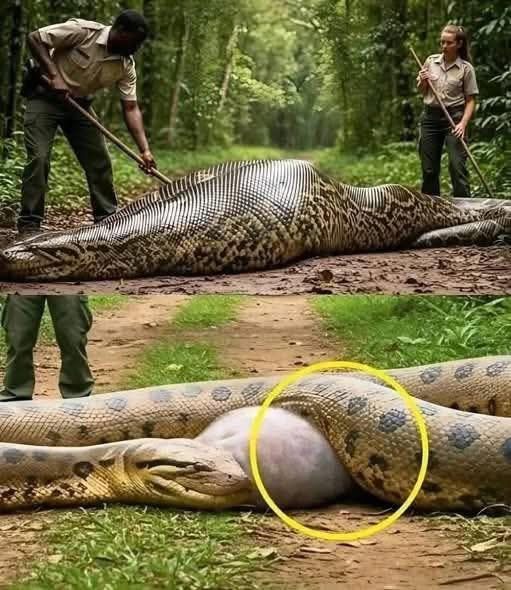
Then came the most delicate part: helping the snake expel what it had swallowed. Two trained handlers carefully worked along the anaconda’s muscular body, applying slow, controlled pressure to guide the obstruction upward through the digestive tract toward the throat. In the heat and humidity of the marsh, every movement mattered—too much force could cause internal injury.
After nearly an hour of coordinated effort, the object finally reached the mouth. The lead ranger was able to remove it safely, and the team immediately saw why the anaconda had been in such danger.
The Shocking Cause: Jagged Industrial Plastic
What came out wasn’t natural prey—it was a thick, jagged piece of industrial plastic debris. Likely carried downstream by river currents, the waste had ended up in the protected marshland where the anaconda mistook it for moving prey and swallowed it whole.
As soon as the plastic was removed, the exhausted snake took deep, unrestricted breaths. The rangers treated minor abrasions around the mouth and provided hydration support to aid recovery.
24-Hour Monitoring Before Release
Rather than releasing the anaconda immediately, the conservation team placed it in a secure observation enclosure within the wetland environment. For the next 24 hours, they monitored breathing, movement, and behavior—watching closely for signs of internal damage from the sharp plastic edges.
By morning, the anaconda’s natural alertness returned. It began coiling normally and tracking nearby activity, a strong sign that it was regaining strength.
Back to the Wild Where It Belongs
Once the final assessment confirmed the snake was stable, the rangers transported it back to the swamp channel where it had been found. When the enclosure opened, the massive reptile slid out, moved through the thick mud, and disappeared beneath the dark water—returning to its role as a top predator in the wetland ecosystem.
A Wake-Up Call About Plastic Pollution and Wildlife
This rescue ended in success, but the message is hard to ignore. Plastic waste and other non-biodegradable trash are reaching even remote habitats, endangering animals that are essential to ecosystem balance. Green anacondas help regulate prey populations and support the health of wetland food chains. When pollution enters these waterways, the damage spreads far beyond one animal.
It also highlights the value of trained park rangers and professional conservation teams—people who risk their safety to protect wildlife from threats that should never exist in nature.
If this story moved you, share it and leave a comment: What’s one practical step your community could take to reduce plastic waste in local rivers and wetlands?