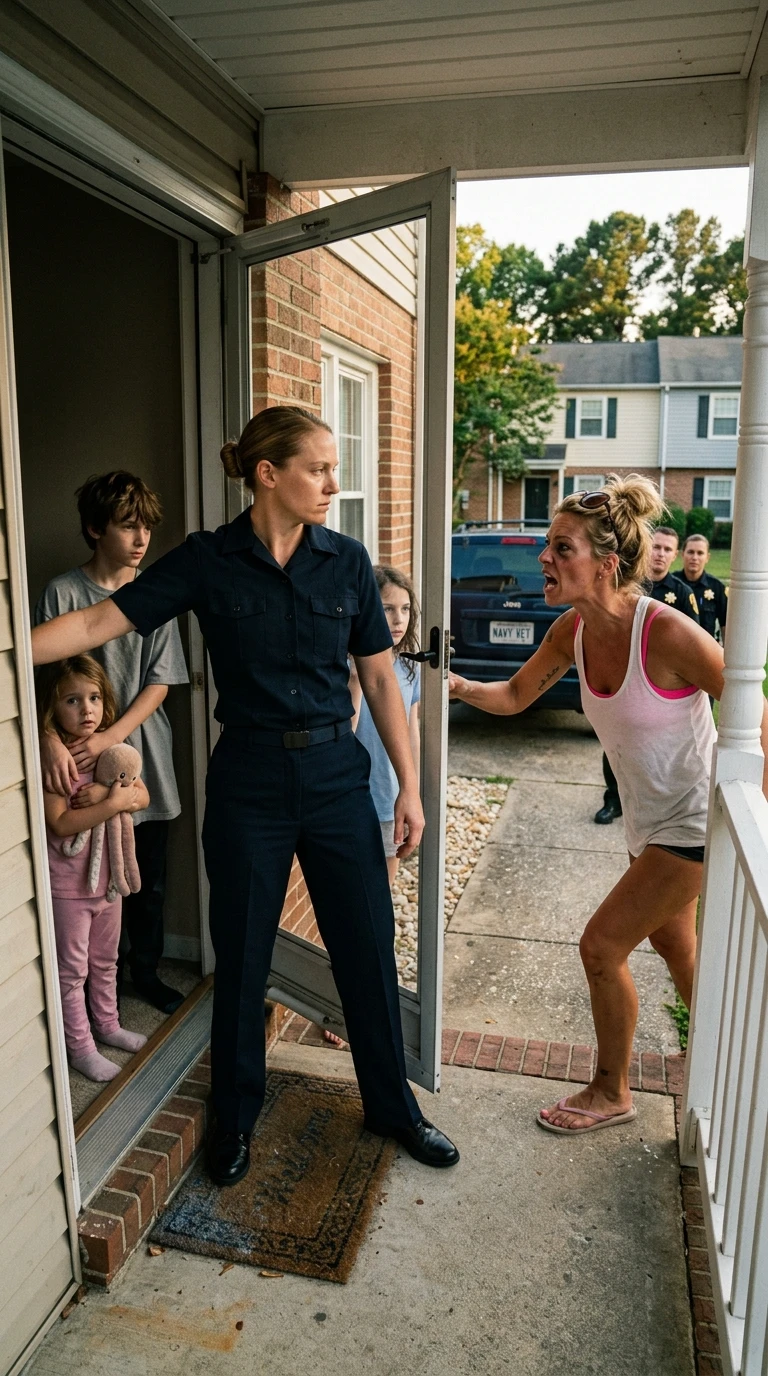
I Was Finally On Leave When My Sister Dropped Off Her 3 Kids And Said: “You’re In The Navy, You Know How To Handle Chaos. I’m Off To Florida.” I Didn’t Say A Word. I Just Watched Her Drive Away. Ten Days Later, She Came Back. She Had No Idea What I’d Done.
Part 1
I was two days into my first real leave in eight months when Sandra showed up on my porch like a hurricane in sandals.
The first day of leave, I’d slept so hard I woke up with pillow creases on my face and the taste of metal still in my mouth from months of carrier coffee. The second day, I’d done laundry, stood in my kitchen staring at a carton of eggs like it was a luxury item, and ignored every text that wasn’t from work. My townhouse in Norfolk felt unnaturally quiet after deployment. No boots pounding steel decks overhead. No clipped announcements crackling over speakers. No smell of fuel, hot wiring, and industrial cleaner soaked into every hallway.
Just the hum of the refrigerator and sunlight warming the wood floor in my living room.
It was the kind of quiet you don’t realize you miss until it lands on your shoulders and your whole body starts to unclench.
Then the doorbell rang.
Not a polite press either. Three sharp jabs. Impatient. Familiar.
I opened the door and saw my older sister standing there in giant sunglasses, a tank top the color of dried mustard, and a smile so fake I felt tired on sight.
Behind her were three kids and one overstuffed rolling suitcase with a broken zipper.
“Rachel,” she said, drawing my name out like we’d just had brunch last week instead of barely speaking for most of a year. “You look… wow. Tan.”
“I was deployed,” I said.
“Right. On your little boat thing.”
She said it lightly, like she hadn’t spent the last fifteen years taking shots at my career every chance she got. When I made petty officer, she said, “Congrats on learning how to yell in a uniform.” When I got commissioned, she called me “Captain Crunch.” When I deployed, she told people I was “basically on a floating office building with missiles.”
I should’ve shut the door right then.
Instead, I looked past her at the kids.
Ethan had gotten taller. He was maybe eleven now, all elbows and attitude, with hair that needed cutting and a look on his face like the whole world had personally offended him. Lily stood close to the suitcase, skinny and watchful, her dark hair knotted at the ends like it hadn’t seen a brush in a while. Molly, the youngest, had one sock on, one sock off, and sticky hands.
Sandra breezed past me into the house before I invited her.
“I need a huge favor,” she said over her shoulder. “You’re going to love this.”
That sentence had never once in my life been followed by anything good.
“What favor?”
She clapped her hands once, bright and false. “Quality time. You get quality time with your nieces and nephew.”
I just stared at her.
I remember the exact smell in that moment: her overripe vanilla body spray mixing with the stale fast-food smell coming off the suitcase. French fries. Hot car. Something sour underneath.
“Sandra,” I said slowly, “what are you talking about?”
The kids were already inside. Ethan kicked off his sneakers and dropped onto my couch like he paid the mortgage. Lily drifted into the living room and started touching everything with her fingertips, not curious exactly, more like she was checking if things were real. Molly spotted the bowl of seashells on my entry table, picked one up, and nearly put it in her mouth.
Sandra shoved the suitcase handle into my hand.
“I’m going to Florida,” she said. “Ten days. Maybe twelve. I need a reset.”
I laughed once because I honestly thought she was joking.
She wasn’t.
“You didn’t call.”
“You never pick up.”
“I was deployed.”
“Well, now you’re not.”
I looked at the kids again. “You can’t just leave them here.”
She folded her arms. “Why not? You’re off. You don’t have kids. You live alone in this little organized museum. Honestly, this is good for you.”
“Good for me.”
“Yes. You get to experience real life for once.”
I felt that one land.
Sandra had a talent for saying cruel things in the tone people use to offer gum. She’d done it since we were kids. If I got a good grade, she said I was showing off. If I worked late, I was obsessive. If I volunteered for the hard thing, she said I was desperate for approval. Nothing I did could just be what it was.
Now she swept one hand around my house.
“You always act like the Navy made you some kind of hero. Let’s see how all that discipline works with three actual human beings.”
Before I could answer, Molly started crying. Not loud, full-bodied crying. Dry crying. Thin and scratchy, like she’d already been crying before they got here.
I crouched in front of her. “Hey, sweetheart. You thirsty?”
She nodded immediately.
That made something cold move through me.
I stood up and looked at Sandra. “What do they need? Bedtime routine, medication, emergency contacts, school—”
She rolled her eyes. “Relax. You run drills on a ship. You can handle children.”
“I’m serious.”
“So am I. I need this.”
The words snapped out sharper than she probably intended, and for half a second I saw the real thing underneath: panic. Or maybe desperation. Then it was gone.
She leaned down, kissed the tops of the girls’ heads, ruffled Ethan’s hair even though he jerked away, and headed for the door.
“Don’t burn the place down,” she said.
“Sandra.”
She paused with one hand on the knob but didn’t turn around.
“If you walk out that door,” I said, “you answer your phone.”
She gave a little laugh. “You’re so dramatic.”
And then she left.
I stood in the doorway with the suitcase in one hand, staring at her dusty SUV backing out of my driveway like she’d just dropped off dry cleaning. The afternoon sun flashed on her rear window. Music thumped once when she rolled over the curb too hard. Then she was gone.
Behind me, Ethan shouted, “Do you have Wi-Fi?”
Lily asked, “Can we have snacks?”
Molly cried harder.
The next few hours were a blur of triage.
Water first. Then juice. Then figuring out who had eaten and when, which turned out to be nobody in any way I recognized as a real meal. Ethan wanted chicken nuggets. Lily said she only liked noodles with butter. Molly said she wanted cereal and then fell asleep on my couch with one hand in the cereal bowl.
When I opened the suitcase, I found a heap of wrinkled clothes, two mismatched shoes, a swimsuit, a cracked tablet with no charger, and exactly zero toothbrushes.
No pajamas either.
No medications. No school papers clipped neatly in a folder. No note.
Just a mess.
That first night I made spaghetti with store-bought meatballs because it was the only thing I had enough of. Ethan looked at his plate like I’d served him printer toner.
“This isn’t Chick-fil-A.”
“It is food,” I said.
Lily poured orange soda into her noodles and stirred it around like that was normal. Molly refused to eat unless she was sitting on the counter with my old Navy sweatshirt wrapped around her legs.
By bedtime, the house smelled like garlic bread, spilled soda, and kid sweat. There was tomato sauce on one cabinet, toothpaste nowhere, and all three children looked at me like I was the one who’d arrived from another planet.
“What time do you usually go to bed?” I asked.
Blank stares.
“Do you brush your teeth before or after stories?”
More blank stares.
Ethan finally shrugged. “Depends.”
“On what?”
“On if Mom’s home.”
The room went quiet in a way that made the air feel suddenly thicker.
I got them washed, wiped down, and into borrowed T-shirts. I gave Molly one of my old command softball shirts that came down to her ankles. Lily took one of my academy workout tees and wore it like a nightgown. Ethan muttered that he’d rather sleep in jeans until I gave him a look that would’ve stopped junior sailors in their tracks.
At 11:30 p.m., the girls were finally asleep. Ethan was pretending not to be scared in the guest room, lying stiff as a board on top of the blanket. I left the hallway light on and he didn’t argue.
Then I called Sandra.
Straight to voicemail.
I called again.
Voicemail.
I texted: Call me now.
Nothing.
At midnight, I went back to the suitcase to see if I’d missed anything useful. There was an inside pocket I hadn’t opened yet. I unzipped it and pulled out a crumpled packet of papers held together with a bent paperclip.
The top page was a school form stamped in red: URGENT — PARENT RESPONSE REQUIRED.
I stood there in my kitchen under the yellow light above the stove, holding that paper and listening to the strange, too-quiet breathing of three kids asleep in rooms that weren’t theirs.
Sandra wasn’t on vacation. Not really.
And whatever she’d dumped on my doorstep, it was already bigger than babysitting.
Part 2
The next morning started at 4:47 a.m. with Doritos.
I know the exact time because I’d only been asleep maybe three hours when I heard the television click on downstairs. My body came fully awake the way it does when you’ve spent years sleeping in places where any sound might matter. I was out of bed before I even realized I was moving.
I found Ethan on the couch in the blue wash of the TV, knees up, a family-size bag of Nacho Cheese Doritos open in his lap like it was breakfast. Cartoon voices bounced off the walls. The house smelled like processed cheese powder and stale air-conditioning.
He looked at me without surprise, like adults appearing out of nowhere at dawn was routine.
“You can’t be up watching TV at five in the morning,” I said.
He crunched another chip. “I was hungry.”
“There’s food in the kitchen.”
He gestured at the bag. “This is food.”
I took the remote off the coffee table and turned the volume down. “Not for breakfast.”
He leaned back deeper into the couch. “Mom lets me.”
That sentence was going to become a recurring weather pattern in my house.
By seven, the girls were up too. Lily moved around the kitchen in suspicious silence, which I’d already learned was more dangerous than noise. Molly cried because I gave her the blue cup instead of the yellow one, then cried harder because I found the yellow one and handed it over too fast.
I stood at the stove making scrambled eggs while caffeine dragged my brain into working order and thought, This is not that different from a casualty drill. Confusion, limited resources, multiple people already upset, and no one reading instructions.
The difference was that casualties don’t whine about toast shape.
After breakfast, I found the paper I’d seen the night before and started sorting the rest of the stack while the kids argued over cartoons.
There were crumpled homework sheets with teacher comments in the margins. A field trip form from over a month earlier. A note about Ethan missing gym shoes for the third time. A reminder for Lily to bring art supplies. Another page from the school counselor asking Sandra to please call.
Please.
That word did something to me. Teachers only put please in writing when they’ve already been ignored.
I called Sandra again.
Straight to voicemail.
I texted: School has been trying to reach you. Call me now.
Nothing.
By ten that morning, I’d reached the point every military woman reaches when the mess is bigger than the available patience: I made a system.
I tore a sheet out of a legal pad and wrote three names in block letters.
ETHAN
LILY
MOLLY
Underneath, I wrote:
This house is not a free-for-all.
Then I made a schedule. Not because I love schedules for their own sake, though Sandra would gladly tell you otherwise. I made one because structure is what you build when chaos is trying to eat the room.
Wake-up: 7:00
Breakfast: 7:30
Get dressed: 8:00
Screens off: 8:30
Reading or outside time: 9:00
Lunch: 12:00
Quiet time: 1:00
Dinner: 6:00
Baths: 7:30
Bedtime: 8:30
Nothing extreme. Nothing boot-camp. Just predictable.
I taped it to the fridge.
Lily read it and said, “This looks like prison.”
“It looks like a day,” I said.
Ethan snorted. “You really are Navy.”
I looked at him. “Yes.”
He smirked like he’d scored a point.
The first fight came over screen time. Of course it did. Ethan wanted his tablet, Lily wanted the TV, Molly wanted whatever the other two had. When I said screens were off until after lunch, Ethan gave me a hard stare and said, “You can’t make us.”
Kids say that sometimes not because they believe it, but because they need to know whether the adult in front of them believes it.
I held his stare. “Watch me.”
He muttered something under his breath.
“What was that?”
He lifted his chin. “I said you just like bossing people around.”
That one hit closer than I wanted. Mostly because it was the lazy version of everything Sandra had ever said about me.
I took a breath instead of snapping. “I like knowing everyone in this house is fed, dressed, and not turning feral by noon. If that feels like bossing to you, we’re going to have a long ten days.”
He laughed in my face.
For one ugly second, I wanted to bark at him the way I would at a sailor trying to test boundaries in front of a division. I wanted volume. Sharp edges. Immediate obedience.
But Ethan wasn’t one of my sailors. He was a kid standing in a kitchen that probably felt too clean, too quiet, too different, trying to see where the weak point was.
So I didn’t yell.
I handed him a dish towel.
“Dry,” I said, pointing at the clean plates by the sink.
He looked offended. “I’m not doing chores.”
“You live here right now. Everybody helps.”
“I don’t live here.”
The words came out fast, and there it was again, that little flash underneath the attitude. Fear. Confusion. Something unsettled.
“No,” I said more gently. “You don’t. But you’re staying here. So while you are, we act like people who take care of a place.”
He dried exactly two plates with the expression of a hostage.
Still, he did it.
That afternoon I called the school.
I introduced myself as their aunt and tried to keep my voice casual. “I’m helping out for a bit and wanted to check what they might need.”
The woman who answered didn’t even hide her relief.
“Oh, thank God,” she said.
Not hello. Not how can I help you. Thank God.
She put me through to the counselor, a woman named Ms. Alvarez whose voice carried the flat exhaustion of someone who’d been doing too much with too little support for too long.
“We’ve been trying to reach your sister for months,” she said. “Missed conferences, missing paperwork, no response to emails or calls. The children have come in hungry more than once.”
I closed my eyes.
Months.
“We weren’t sure anyone was actually checking on them,” she went on quietly.
I looked out through my kitchen window at Ethan in the backyard pretending not to play catch with Molly. He’d tossed a tennis ball too hard; she missed it and laughed anyway. Lily sat on the patio steps drawing on the back of a grocery receipt with one of my pens.
“Someone is now,” I said.
When I hung up, my hand was shaking.
That night, I made grilled cheese and tomato soup because it felt impossible to fail. The kitchen smelled like butter and browned bread. Lily asked for seconds. Molly ate without crying. Ethan said the soup was too hot, then finished it and scraped the bowl.
Progress in this house was going to come in weird shapes.
After dinner, I found a tiny pile of pebbles lined up under the guest bed. Molly’s collection. Under the couch cushion, I found Lily’s folded drawing of a house with no doors. In the bathroom cabinet, I found Ethan had hidden three candy bars behind my bandages and cold medicine.
Survival habits. Every one of them.
That realization sat in me all evening.
By day four, the open hostility in the house had shifted into something else. Not trust exactly. More like wary observation. They were taking my measure. Deciding if I meant what I said. Deciding if rules would hold.
That morning, Ethan challenged me to a push-up contest in the living room.
“You think Navy people are all strong,” he said, trying to sound sarcastic.
I raised an eyebrow. “How many can you do?”
He gave me twenty-two before he collapsed face-down on my rug and called me a show-off because I kept going.
Lily said “thank you” when I handed her a clean hairbrush.
Molly fell asleep with her cheek pressed against my old fleece jacket.
Small things. But real.
That evening, after the kids were finally asleep and I had exactly nine blessed minutes of silence, I opened my laptop to pay a utility bill.
There was an email in my inbox flagged urgent.
At first I thought it was spam. The subject line read: Suspicious Credit Activity Alert — Lt. R. Meyers.
I almost deleted it.
Then I opened it.
The card number ending wasn’t mine. The issuing bank wasn’t one I used. The billing address was Sandra’s old apartment.
I read the email twice, then a third time slower, cold moving up the back of my neck.
The account holder name was mine.
The address was hers.
And the charges on the screen included gas stations, restaurant tabs, and two kids’ tablets from Best Buy.
I sat there in the dim light from the stove clock, hearing the refrigerator hum and Molly’s faint cough from upstairs, and understood in one clean, terrible second that my sister hadn’t only dumped her kids on me.
She’d taken my name with her before she ever showed up.
Part 3
The first thought I had was scam.
Not because I believed it, exactly, but because scam was easier than the alternative.
Scam meant random, impersonal, fixable. Some bored guy in another state with a data breach and a laptop. Some algorithm spitting out alerts. Some bank error.
My sister opening credit in my name using my rank and information while I was deployed?
That felt too ugly to be real.
I clicked through the fraud email and called the number on the back-end security page, not the one in the email itself. Rule one. Verify. The woman in the fraud department had a voice like smooth paper.
“Can you confirm the billing address on the account?” I asked.
She read it back.
Sandra’s old apartment.
“Can you confirm the occupation field?”
There was a pause. “Military. U.S. Navy.”
I leaned back in my chair so hard it creaked.
It was real.
I answered her security questions, froze the account, started the formal fraud report, and listened while she listed transactions made over the last six months. Restaurants. Gas. Online orders. A patio set from Home Depot. DoorDash. A nail salon. Two tablets. A motel in Florida.
Every charge landed like something dropped into deep water. No splash at first. Just the understanding that it was sinking somewhere inside me.
When I hung up, I didn’t move for a minute.
Then I closed the laptop, stood up, and went to make waffles.
That was the part nobody tells you about a crisis. Most of it doesn’t happen in one dramatic scene with swelling music and a speech. Most of it happens while someone still needs breakfast.
Ethan and the girls came down fighting over a blanket. Molly had a cowlick sticking straight up. Lily wore one of my gray T-shirts tied at the waist because she’d decided it looked “less like pajamas that way.”
“Can we have syrup?” Molly asked.
“Yes.”
“The real one?”
I blinked at her. “There’s fake syrup?”
Ethan answered for her. “Mom buys the cheap kind.”
I opened the cabinet and found the maple syrup I’d bought months ago for exactly one brunch with a friend I never ended up having. I set it on the table. Molly looked at the bottle like I’d placed a diamond in front of her.
That did not help my mood.
After breakfast, while the kids were outside in the postage-stamp backyard, I pulled my old deployment email account open. I hadn’t logged into it in months. It was the account I used for travel notices, banking backups, the boring life-admin stuff you don’t think about until it suddenly matters.
There were mostly newsletters and autopay confirmations.
Then I saw it.
Subject: Urgent Child Welfare Concern — Request for Contact
The sender was a county caseworker.
The email was four months old.
I opened it and read every line twice.
Hi, Miss Meyers. We are attempting to reach Sandra Meyers regarding a flagged concern involving her children’s school and home stability. Since you are listed as a secondary emergency contact, we would appreciate a return call at your earliest convenience.
I never got that email because I’d been somewhere in the Indian Ocean on fourteen-hour days and broken sleep. I’d been carrying responsibility measured in aircraft, fuel loads, and personnel accountability while back home Sandra was typing my name into forms like I was an available backup generator.
I hadn’t even known she’d listed me.
That hit differently than the credit fraud.
The fraud was theft. Cold, deliberate, selfish.
This was something worse.
This was strategy.
She had put my name down because she knew exactly who I was. She knew I’d answer if I knew the kids were in trouble. She knew I’d move heaven, earth, and probably a county judge before I’d let them drift.
She knew because she’d spent our whole lives treating my reliability like a public utility. Always there. Always working. Free to use.
I called the caseworker and left a message. Then I called the school counselor back and set an in-person meeting for the next day.
That afternoon, I noticed Molly flinch when a pot lid slipped in the sink and clattered. Not startled. Flinched. Hands over ears, shoulders up, eyes wide.
I crouched beside her. “Hey. It’s okay.”
She pressed against my arm and whispered, “I thought Kyle was mad.”
The name meant nothing to me yet.
“Who’s Kyle?”
She tucked her face into my shirt and wouldn’t answer.
Later, I found Ethan in the hallway standing too still for a boy his age. Kids like Ethan are usually moving somehow, even when they’re pretending not to. But he stood with one shoulder against the wall, listening while I folded laundry.
“Who’s Kyle?” I asked without looking at him.
His mouth flattened. “No one.”
“That usually means someone.”
“He’s just a guy.”
“What kind of guy?”
He shoved his hands into his pockets. “Mom’s friend.”
Then he walked away.
Not long after that, I found Lily sitting cross-legged on the floor in the guest room with a sketchbook balanced on her knees. She snapped it shut when she saw me.
“Sorry,” I said. “I wasn’t spying.”
“You kind of were.”
“Fair.”
I sat down in the doorway instead of coming all the way in. “Can I ask you something?”
She shrugged without lifting her eyes.
“Do you like it here?”
That got me a glance.
Not warm. Not cold either. Measuring.
“It’s quiet,” she said finally.
“Good quiet or bad quiet?”
She thought about that. “At first bad. Now… not bad.”
I nodded like that was a perfectly reasonable distinction, because honestly it was.
She hugged the sketchbook to her chest.
“Who’s Kyle?” I asked.
Her fingers tightened around the cover. “Mom said he was temporary.”
Temporary.
That word sat ugly in the room.
Before I could ask another question, Ethan yelled from downstairs that Molly had locked herself in the bathroom, and the moment was gone.
That night, after baths and a negotiation over bedtime that felt like treaty work, I checked all three kids while they slept. Molly had curled around my old Navy fleece again, breathing through her mouth. Ethan had one sneaker still on. Lily’s sketchbook lay open beside her pillow, but she’d turned it facedown.
I should have left it there.
I know that. I do.
But there had already been too many clues with edges sharp enough to cut, and I was tired of pretending they didn’t fit together.
I picked it up carefully and turned it over.
The drawing on top showed four figures in a room. Three children in one corner. A woman by the door with yellow hair. A man near a table, one arm raised, a beer can in his other hand. No faces on anyone. Just blank ovals where their features should’ve been.
The table was drawn crooked, like it had been knocked sideways.
My throat went tight.
There are things you can explain away if you want to badly enough. Mess. Missed school. Bad parenting. Financial disaster.
A child drawing fear that specifically?
That’s harder.
I put the sketchbook back exactly where I found it and stood there in the dark, listening to the old house settle around me. Pipes ticking. The distant rattle of a passing truck. One of the girls turning over in bed.
Then I looked at the bruise on Molly’s arm I hadn’t let myself study too closely before. Finger-shaped. Faded but still there.
I thought of the caseworker email. The counselor’s exhausted voice. The credit fraud. The name Kyle. The way Ethan tested every rule like rules had never once held where he came from.
I had started this week thinking I was unexpectedly babysitting.
I went to bed understanding I was standing in the middle of something much more dangerous.
And I still didn’t know if Sandra had run from it—or built it herself.
Part 4
The next morning I called a Navy legal contact before I called anyone else.
Not because I wanted to bring the military into my family’s mess. I actually wanted the opposite. But Sandra had already dragged my name, my rank, and apparently my military ID number into whatever she’d been doing, and I’d been in uniform too long to wing it when the paperwork started to matter.
Commander Ellis had the dry, unhurried voice of a man who’d spent half his career talking people down from ledges they helped build.
“You need two lanes here,” he told me after I gave him the short version. “One is identity theft. The other is child safety. Do not wait for them to magically become the same problem.”
“Can I petition for temporary custody as their aunt?”
“Yes. Especially if you have documentation.”
I looked at the folder on my table. It was getting thick already.
“School reports,” I said. “Photos of bruises. Emails. Teacher notes.”
“Good. Keep it organized. Dates. Times. Screenshots. Originals if you have them.”
I almost laughed. “You know me.”
“I do,” he said. “Which is why I’m also telling you this: don’t let the fact that she’s your sister keep you from calling this what it is.”
That sat with me after we hung up.
The thing about family is that people assume the title changes the damage. Sister. Mother. Husband. Son. As if the vocabulary should soften the facts.
It doesn’t.
By noon I’d taken the kids to Target for toothbrushes, underwear, socks, hair ties, and the kind of emergency kid supplies you can buy in one numb sweep if you stop looking at the total. Ethan asked if he could pick his own cereal. Lily chose a sketchpad without being told. Molly carried a stuffed octopus bigger than her torso until I quietly added it to the cart.
No one asked if Sandra would reimburse me.
Not even me.
Back home, while the kids were upstairs building a blanket fort that somehow involved two dining chairs and a throw pillow I hadn’t seen in a year, I went back through the suitcase.
This time I checked every seam, pocket, and hidden compartment.
At the bottom, under a pair of damp swimsuits that smelled faintly mildewed, I found a thick stack of unopened mail rubber-banded together.
That was when the whole thing got uglier.
Some envelopes were addressed to Sandra at my house.
My house.
She had never lived there. Not once.
There were utility shutoff notices. A collections letter. A late notice from a pediatric clinic. Two credit card statements. Then an envelope stamped FINAL NOTICE from a collections agency.
I opened it and felt my jaw harden.
The debt was tied to a Target RedCard opened under the name Rachel M. Meyers.
Same misshapen signature I’d seen in the bank fraud packet. Same slanted handwriting on the paper correspondence request. Same pattern.
My name.
Her address.
My information.
Her spending.
I made a list and started calling. One creditor led to another. Each account took time to verify, but the story stayed the same. Opened within the last year. Billing tied to Sandra. Contact number tied to Sandra. Occupation or status field marked military on two of them.
Then one man in a fraud department read a detail that made me go cold.
“The application included a military identification number.”
I closed my eyes. “Can you repeat that?”
He did.
That moved it out of the category of reckless betrayal and into something with federal teeth.
I thanked him, hung up, and sat very still.
Upstairs, the kids were laughing about something. For a few seconds the sound floated down warm and ordinary, and I hated my sister with a clarity that felt almost peaceful.
Not because she’d stolen from me.
Because she’d done it while her kids were living like this.
Because she’d used my name not to survive, but to avoid consequences.
Because every dollar she charged in my identity had bought her time to keep failing them.
That afternoon, while I was making macaroni and slicing apple wedges, an old iPad on the counter lit up with a notification. It took me a second to realize it wasn’t mine. It was the cracked one I’d found in the suitcase, plugged in to see if it still worked.
The screen flashed a Gmail preview.
From: Kyle
You need to answer me. This is not my problem anymore.
My hand stopped over the cutting board.
I shouldn’t have opened it.
I knew that. I know it now too.
I opened it anyway.
Sandra was still logged in.
The thread went back weeks.
At first I thought Kyle might be the mastermind. The messages were hostile, money-focused, full of vague references to “the card situation” and “what you promised.” He called her irresponsible, dumb, dramatic. She called him useless, broke, and manipulative. It looked messy in the way bad relationships often do.
Then I hit the email that ended all my uncertainty.
Sandra had written: They’re better off with Rachel anyway. She’s a control freak, but she’ll take care of everything. Let her.
That line sat on the screen in bright white against gray.
No panic. No guilt. No confusion.
A plan.
A handoff.
The kind of sentence you write when you’re not overwhelmed in the moment. The kind you write when you’ve already decided who gets to carry the weight.
I kept reading.
There were references to Florida. To “laying low.” To needing “space until the school people calm down.” One message mentioned she’d already “used Rachel on the emergency forms before, so it’s fine.” Another mentioned “the Navy stuff making the credit apps go through faster.”
I stopped there because my hands were starting to shake too much to scroll.
I printed everything.
Every page. Every timestamp.
The printer spit the sheets out one by one with its cheap mechanical whine while the kitchen smelled like cheese powder and apples and the kind of anger that dries your mouth out.
When the kids came down, I had the evidence stacked neatly in a manila folder labeled with today’s date.
I served dinner like normal.
Ethan complained the macaroni had too much pepper. Lily quietly gave Molly the octopus when she started to whine. Nobody noticed that my voice had gone flatter, tighter, as if I were briefing a room full of officers instead of asking if anyone wanted more apples.
Later that night, Ethan stood in the kitchen doorway while I rinsed dishes.
“What happened?” he asked.
I looked at him. “What do you mean?”
“You get extra quiet when you’re mad.”
I almost smiled at that. “Do I?”
He shrugged. “Yeah.”
I dried my hands on a towel and leaned against the counter. “I found out some things about your mom. I’m handling it.”
His face closed right away. “Is she dead?”
The question hit me so hard it took a second to answer.
“No.”
He looked down. “Okay.”
Not relieved. Just okay.
That told me more than he meant it to.
When he went upstairs, I stood there under the kitchen light a long time, staring at the stack of printed emails.
Sandra hadn’t panicked and dumped the kids on me in a moment of collapse.
She had counted on me.
Counted on my job, my habits, my need to protect, my inability to walk away from children.
And if she’d planned all that in advance, then one question was suddenly a lot more urgent than where she’d gone.
What exactly did she think she’d be coming back for?
Part 5
The family law attorney’s office smelled like coffee, old carpet, and printer toner.
His receptionist had a jar of peppermints on the desk and a smile that told me she’d seen every kind of family disaster walk through that door and none of it surprised her anymore.
The attorney’s name was Daniel Mercer. Mid-forties, rolled-up shirtsleeves, no wasted words.
He read through my folder for nearly twenty minutes without interrupting. Just flipped pages, underlined dates, asked once for clarification on the fraud timeline, then sat back in his chair and laced his fingers.
“You’ve got two separate cases,” he said. “Identity theft and custody.”
“I know.”
“Which do you want to hit first?”
“The kids.”
He nodded like that was the only acceptable answer. “Good. We file for emergency temporary custody today. Blood relative, documented abandonment, school neglect, safety concerns, and evidence the mother is actively evading contact. That gives us a path.”
“And the fraud?”
“That doesn’t go away. But right now a judge is going to care more that three children were left without a plan than whether your sister bought patio furniture in your name. Both matter. One is more urgent.”
I looked down at the folder again.
Somewhere between the school forms, the bank statements, the caseworker email, and Lily’s drawing, I had stopped thinking in terms of what Sandra deserved and started thinking in terms of what the kids needed.
That shift mattered more than I wanted to admit.
That night I filled out emergency custody paperwork at my kitchen table while The Incredibles played in the living room and Molly periodically shouted “That’s the funny one!” at scenes she’d apparently seen before.
It felt surreal.
I was writing lines about abandonment, neglect, and emergency placement while listening to children laugh at a cartoon in my house. There was a bowl of grapes on the table. Ethan had left one sock near the fridge. The dishwasher thumped and hissed in the background.
Real life is offensively normal around the edges of its worst moments.
Ethan came into the kitchen for water and saw the paperwork.
“What’s that?”
I capped my pen. “Something to make sure you three can stay here legally while I sort things out.”
His eyes went to the words EMERGENCY CUSTODY on the top page. He didn’t ask the obvious question. Didn’t say, Are we in trouble? Are you taking us? Is Mom coming back?
He just nodded once and went back to the living room.
That nod stayed with me all night.
I checked on them before bed.
Molly had fallen asleep crosswise under my old fleece again, one hand in the octopus’s face. Lily was curled on her side with a pencil still tucked behind one ear. Ethan was asleep on top of the blanket, but this time both shoes were off.
I stood in the hallway and realized I was already listening to the house differently. Not as my quiet leave space. Not as a temporary crash site.
As a place I was responsible for from room to room.
The emergency order came through on Thursday morning.
I was at the stove making pancakes when my phone buzzed. Daniel’s name flashed across the screen, and when I answered, he said one word.
“Granted.”
I had to put my free hand on the counter.
Not because I was dramatic. Because I’d been carrying tension in my spine for days and it suddenly loosened all at once.
“Temporary emergency custody,” he said. “This is the first step, not the last. But it gives you legal authority now. School, medical, decisions. She cannot come collect them like luggage.”
I thanked him, hung up, and printed the order right there on my home printer. The pages were still warm when I slid them into a sheet protector and stuck them on the fridge between Ethan’s reading log and Molly’s crayon drawing of what looked like a purple tornado with legs.
“Why are you smiling weird?” Lily asked.
“I’m not smiling weird.”
“You are.”
“I just got good news.”
She looked at the paper, then at me. “About us?”
I met her eyes. “About making sure things stay stable.”
She didn’t smile back. That wasn’t her style. But some of the tension left her shoulders.
That same afternoon, I turned my hallway closet into a filing station.
School records on one shelf. Medical notes on another. Fraud documents in a locked box. Printed emails in chronological order. Photos labeled and backed up. I even started keeping a small notebook in the kitchen drawer to jot down anything the kids said that might matter later. Not because I wanted ammunition. Because memory gets slippery under pressure, and the truth deserved better than that.
Then I hired a private investigator.
His name was Mike Donnelly. Retired detective. Thick neck, smoker’s rasp, no patience for emotional speeches. Daniel recommended him, and after one phone call I understood why.
“Why do you want her found?” Mike asked.
“So I know where she is, who she’s with, and whether she plans to come back swinging,” I said.
“That all?”
“And I want it documented.”
He gave a short grunt that might have been approval. “Send me everything you have.”
I sent him Sandra’s number, her car description, the Florida motel charge from the stolen account, Kyle’s name, the Gmail screenshots, and every address she’d used on the fraudulent applications.
Then my mother called.
I saw her name on the screen and knew immediately Sandra had gotten to her first.
I answered anyway.
“Rachel,” Mom said, in the strained voice she used when she wanted to sound reasonable while already taking someone else’s side. “Sandra says you’ve gone completely overboard.”
I let that hang for a second. “Did she mention the part where she left her children with me and disappeared?”
“She needed a break.”
“She committed fraud.”
A pause. “Sandra says you’re exaggerating.”
Of course she did.
From the other end, I could hear the muffled sound of a TV and my father coughing. Home. Their same house. Same floral couch. Same people who’d spent our whole childhood asking me to be the mature one because Sandra was “sensitive.”
Mom lowered her voice. “Honey, you’ve always had this… military intensity. Not everything is a situation report.”
I leaned against the counter and stared at the custody order on the fridge.
“Three kids were left without medicine, school supplies, or a return plan,” I said. “The school had been trying to reach someone for months. She used my identity. This is not me being intense. This is me being the only adult in the room.”
My father came on the line then, abrupt and irritated. “Don’t use that uniform to make yourself some kind of martyr. She’s their mother.”
I laughed once, no humor in it at all. “Then she should’ve acted like one.”
He started to say my name in that warning tone fathers use when they think authority is still a thing between them and their adult daughters.
I hung up.
It left me shaking in a whole different way than the fraud had.
I could handle Sandra being selfish. I’d had a lifetime of practice.
What I couldn’t stomach was the speed with which my parents stepped around the facts to preserve the fantasy of her. That familiar old demand that I be competent and quiet at the same time. Fix it, Rachel. Just don’t make anyone uncomfortable while you do.
I stood there in my kitchen, phone in hand, and understood something I should have admitted years earlier.
Sandra hadn’t become Sandra in a vacuum.
Three days later Mike called.
“Found her,” he said.
My grip tightened on the phone. “Where?”
“Daytona Beach. Budget motel off Atlantic Avenue. Checked in under her own name. She’s with a guy named Kyle Draper. Record includes domestic disturbance calls, unpaid child support, one possession charge, and an appetite for bad decisions.”
I sat down slowly at the table.
“Has she asked about the kids?”
“Nope.”
“Any sign she’s coming back?”
“Not yet. But people like your sister? They come back when they need something.”
He emailed me the preliminary report ten minutes later.
I was halfway through reading it when I heard tires crunching hard at the edge of my driveway.
Not slowing.
Committing.
My whole body went still before I even looked up.
Somewhere behind me Molly was singing to her stuffed octopus in the living room. Ethan was in the backyard trying to teach Lily how to throw a spiral with a football that was too big for both of them. The late afternoon sun striped the kitchen floor gold.
Then a car door slammed outside.
And in the pit of my stomach, I knew before I reached the window exactly who had decided she was ready to collect what she’d left.
Part 6
For one second I didn’t move.
It wasn’t fear. It was calculation.
That had been trained into me so deeply it happened before emotion. Assess the situation. Identify the variables. Protect the people closest to the impact point. Then act.
I crossed the kitchen in three strides and looked through the narrow window by the front door.
Sandra’s SUV sat crooked in my driveway, one tire half on the grass. She climbed out wearing oversized sunglasses and a white tank top that showed a bright pink bikini strap underneath. Her hair was piled into a careless knot. She held her phone in one hand like a prop.
If you’d passed her at a gas station, you might’ve thought she’d just gotten back from the beach.
If you looked closer, you saw the cracks. The cheap motel tan line from a wristband. Mascara smudged under one eye. The restless twitch in her jaw. The kind of energy people carry when they’ve been living off adrenaline, bad choices, and somebody else’s money.
I turned away from the window and called out, calm and clear, “Kids, inside. Now.”
My tone was enough.
Ethan appeared first from the back door, football tucked under his arm, face already changing as soon as he saw mine. Lily came in behind him with grass on her knees. Molly trailed, humming, until she saw all three of us looking toward the front of the house and went quiet.
“Go to the living room,” I said. “Stay there.”
“Is it Mom?” Ethan asked.
I met his eyes. “Yes.”
That one word emptied the color from his face.
Lily’s fingers found Molly’s hand automatically.
“Are we leaving?” Molly whispered.
“No,” I said. “Not unless I say so.”
I pulled my phone out and dialed the non-emergency number I’d already saved after Daniel told me, very specifically, not to underestimate how ugly sudden custody confrontations could get.
The dispatcher answered. I gave my address, explained I had emergency custody documentation and the children’s mother had arrived unannounced after abandonment. My voice sounded cool even to me. Precise. Controlled.
Training again.
The doorbell rang before I finished the sentence.
Sharp. Repeated.
I told the dispatcher I needed officers present, ended the call, and opened the door only as far as the chain allowed.
Sandra pushed her sunglasses up and gave me a look somewhere between annoyance and performance.
“Well,” she said, “that’s dramatic.”
“Where have you been?”
“Oh my God.” She laughed and leaned one hip against the porch rail. “You sound exactly the same. No hello, no welcome back, straight to interrogation. This is why people think Navy girls are unbearable.”
I didn’t respond to that.
She glanced past me into the house. “Where are my kids?”
“Safe.”
Her smile thinned. “Cute. Move.”
“No.”
For the first time, something sharper came into her face. “Rachel.”
“You dropped them here with no plan and disappeared for almost two weeks.”
“It hasn’t been two weeks.”
“Twelve days and no contact. Close enough.”
“I needed a break.”
“You needed Florida, apparently. And a motel. And a man with a possession charge. And apparently several credit cards in my name.”
That landed. Hard.
Her expression changed so quickly it might have been funny under different circumstances.
“You went through my stuff?”
“You used my identity.”
She rolled her eyes like I was being theatrical. “Please. I borrowed your credit.”
I just stared at her.
Borrowed.
“That’s not a thing,” I said.
“God, you are so uptight. I was going to pay it back.”
“With what?”
“Don’t start.”
“No, let’s start. Let’s start with the bank alerts, the collections letters, the caseworker email, or the fact that you used my military information on credit applications. Pick one.”
Something ugly flashed in her face then, not shame, not really. Resentment.
“You always have to make everything bigger than it is.”
“Three children were living in neglect.”
“They were fine.”
Behind me I heard a floorboard creak.
Ethan had stepped into the hallway without my hearing him. He froze when Sandra saw him.
Her whole body changed instantly. Softer voice. Open hands. Smile back on.
“There’s my handsome boy.”
Ethan didn’t move.
It would’ve broken a different kind of heart. If she’d been expecting him to run to her, she got the truth instead: a long, flat stare from a child who had already learned not to trust the person saying honey in that voice.
“Come here,” she said.
He swallowed. “Are you here to take us back?”
Sandra laughed lightly. “Of course. I’m your mother.”
He looked at me, then at her again.
“No,” he said.
The word was quiet, but it hit like a dropped plate.
Sandra blinked. “What?”
“You were gone.”
The muscles in her jaw jumped. “Don’t be dramatic.”
That did it for me.
I opened the door fully and stepped onto the porch, pulling it mostly closed behind me so the girls wouldn’t hear every word.
“No,” I said. “You don’t get to call them dramatic after vanishing.”
Sandra folded her arms. “I knew you’d love this. You get one tiny taste of motherhood and suddenly you think you’re the savior.”
“This isn’t about me.”
“It’s always about you. Always. Ever since you put on that uniform, you act like the whole world needs your command voice and your little systems and your little perfect life.”
“You mean my job? The one you’ve mocked for fifteen years?”
She gave a snort. “Please. You inventory people on a boat and act like you fought God.”
I almost smiled. Not because it was funny. Because it was so predictable. Sandra insulted things she secretly depended on. My job. My steadiness. My house. My ability to function.
“You made your plan based on that exact job,” I said. “You counted on me being responsible enough not to let your kids suffer. So maybe don’t insult the thing that saved them.”
Her face hardened.
“Saved them from what? Me? Don’t flatter yourself.”
The sound of a car pulling up made us both look.
Two sheriff’s deputies stepped out. One man. One woman. Calm, professional, bored in the way good cops sometimes look when they’re trying not to add heat to a fire.
Sandra spun toward me. “You called the cops?”
“I called for witnesses.”
Her mouth fell open in genuine disbelief, and for the first time I saw it: she had thought she could bully this back into shape. Guilt me. Shame me. Roll over me with family language until I stepped aside.
That realization put iron in my spine.
The deputies came up the walkway. I handed over the emergency custody order before they even asked. The female deputy read it, checked the seal, then looked at Sandra.
“Ma’am, do you have documentation contradicting this order?”
Sandra lifted her chin. “I’m their mother.”
“That wasn’t my question.”
Sandra laughed once, short and furious. “This is insane. She’s stealing my kids because she likes pretending she’s in charge.”
“She did not take anything,” I said. “You left them.”
The male deputy held up a hand. “I need everyone calm.”
From inside the house, Molly started crying.
Sandra heard it and tried to move toward the door. I stepped sideways without thinking and blocked her.
Her eyes widened. “Move.”
“No.”
“You think because you wear a uniform and bark at people you’re their mother now?”
The front door behind me opened wider.
Lily stood there, one hand braced against the frame. Her face was pale but steady.
“You don’t get to yell in this house,” she said.
Nobody moved.
Sandra turned slowly. “Excuse me?”
Lily didn’t flinch. “You’re scaring Molly.”
It was such a small sentence. Not theatrical. Not rehearsed. Just true.
And it changed the entire porch.
The deputies felt it. I felt it. Even Sandra felt it, though she covered it fast with anger.
The female deputy looked at Sandra. “Ma’am, I’m going to ask you to step back from the residence.”
Sandra laughed again, but there was panic under it now. “This is unbelievable.”
No. Unbelievable would’ve been Ethan running to her. Molly smiling. Lily backing down.
This was just consequence arriving in a navy-blue county cruiser.
Sandra took one step backward, then pointed at me.
“This isn’t over.”
“No,” I said evenly. “It’s just finally documented.”
She glared at me long enough that I could practically hear all the old scripts running through her head, trying to find one that still worked. Guilty little sister. People-pleasing Rachel. Keep the peace Rachel. Don’t embarrass the family Rachel.
She wasn’t looking at that woman anymore.
She was looking at me.
And I was done stepping aside.
Sandra shoved past the deputies, got in her SUV, and peeled out of my driveway so hard gravel spat against the curb.
When she was gone, the silence she left behind felt strange and raw. The deputies took my statement, copied the order information, and gave me a case number. The male deputy suggested I keep doors locked and call immediately if she returned. The female one looked past me into the hallway where Ethan stood with one arm wrapped around Molly and softened just a little.
“You did the right thing,” she said quietly.
When they left, I closed the door and leaned my forehead against it for one second.
Just one.
Then I turned around.
The kids were all in the hallway now.
Ethan trying too hard to look unaffected. Lily with her mouth set in a stubborn line. Molly half-hidden behind my leg, clutching the octopus.
“Is she coming back?” Molly asked.
I crouched so I was eye level with her. “Not today.”
“What about later?” Ethan asked.
There it was. The real question. The one under all of it.
I stood up slowly. “Later, we handle in court.”
The word hung in the hall like a weather front.
Sandra had gone from denial to fury too fast for me to miss it. That kind of rage only comes out when someone knows the facts won’t save them.
I should have felt relieved after she left.
Instead, a cold little instinct kept tapping at the back of my mind.
Sandra had not driven away looking beaten.
She had driven away looking like someone who still believed she had one more move.
And Monday morning, I was going to find out what it was.
Part 7
Courtrooms always smell colder than the rest of the building.
Air-conditioning, paper, floor polish, old coffee. The kind of chill that sits in your sleeves and reminds you this place was built for procedure, not comfort.
I wore my service uniform.
Not for theater. Not because I wanted points. Because it reminded me, physically, what I was made of. Pressed lines. Polished shoes. Name tape centered. Every detail in place. I’d spent enough years in uniform to know that sometimes the ritual of getting dressed is its own form of bracing.
Daniel met me outside Courtroom 3B with a leather folder under one arm.
“She’s here,” he said.
“Of course she is.”
“She’s late.”
“Also of course.”
I looked past him and saw Sandra at the far end of the hall, sunglasses still on indoors, arguing with a public defender-looking attorney while balancing a giant iced coffee. She looked like someone who’d mistaken a custody hearing for a dentist appointment she might skip if it got inconvenient.
She didn’t look at me.
That was new.
Usually Sandra wanted the eye contact. Wanted the emotional transaction. Wanted to make sure she’d gotten under your skin.
Not looking at me meant one of two things: she was rattled, or she was trying to perform not caring.
Probably both.
The kids were with a court-appointed caseworker in a side room. The judge didn’t plan to have them testify unless necessary, which I was grateful for in a way I couldn’t put into words. Ethan had nodded when I told him that, acting like it didn’t matter. Lily had just asked if courtrooms were always so beige. Molly had wanted to know if judges wore crowns.
I’d told her sadly, no.
When we entered, Sandra finally glanced at me. Her gaze skimmed over the uniform, and her mouth tightened.
Good.
The judge came in exactly on time, an older woman with silver hair, sharp glasses, and the expression of somebody who’d heard every excuse a bad parent could invent and was bored by most of them.
We rose. We sat.
Then the facts started.
Daniel didn’t grandstand. That was one reason I trusted him. He laid the case out cleanly. Timeline first. Sandra dropping off the children without notice. No care instructions. No emergency contacts. No return date in writing. No response for nearly two weeks.
Then the school documentation.
Ms. Alvarez, the counselor, appeared by video and spoke with the measured, careful honesty of a person who understood exactly how much her words mattered. She described missed meetings, repeated concerns, hungry children, lack of supplies, and months of failed attempts to reach Sandra.
Next came the caseworker email. Then the bruises. Then Lily’s drawing, which Daniel submitted without forcing her to explain it herself. Then Mike’s affidavit confirming Sandra’s location in Florida during the abandonment period, along with the history attached to Kyle Draper.
Sandra’s attorney tried to object to a couple of details. The judge allowed most of it anyway.
Then Daniel turned to the identity theft piece.
He didn’t make it the centerpiece. He didn’t need to. But when he introduced the fraudulent accounts, the statements, and the use of my military information, the room changed. Even Sandra sat up straighter.
The judge looked over her glasses. “These accounts were opened using the petitioner’s name and credentials?”
“Yes, Your Honor,” Daniel said. “Multiple accounts. The respondent’s addresses and phone numbers appear throughout. Fraud reports have been initiated.”
Sandra laughed under her breath.
The judge looked at her. “Do you find this amusing?”
“No, Your Honor. I just think my sister is being dramatic.”
There it was. The family script.
I watched the judge take Sandra in with one slow, unimpressed look.
“Then this would be your opportunity to explain why the children were left for twelve days without documentation, why the school had been unable to reach you for months, and why debt in your sister’s name appears linked to your residences.”
Sandra straightened like she was about to deliver something compelling.
“I was overwhelmed,” she said. “I’m a single mother. I needed help. Rachel has always judged me. She thinks because she’s in the military and everything in her life is lined up in little boxes that she understands people.”
That old sting was still there, I noticed. Smaller than it used to be, but there. Sandra knew which part of me had spent years trying not to sound too hard, too sharp, too command-like in civilian rooms.
“She doesn’t know what children need,” Sandra went on. “Children need love. Not rules.”
The judge’s face didn’t change.
“Did love include leaving them without school supplies, medical instructions, or a return plan?”
Sandra opened her mouth. Closed it.
Daniel slid one final piece into evidence: the printed email where Sandra had written, They’re better off with Rachel anyway. Let her.
That did it.
For the first time all morning, Sandra lost the expression. The one that said she was merely misunderstood. The one that let everyone around her work harder to preserve the idea of her than she ever did.
“Out of context,” she snapped.
“Is it?” the judge asked.
Silence.
Then the judge turned to me.
“Lieutenant Meyers.”
I stood.
“Is it your intention to seek full legal and physical custody of these children?”
That question had weight. Not because I didn’t know my answer. Because some part of me still registered the line it represented. Before and after. Temporary and chosen. Aunt and something more permanent, more binding, more life-changing.
I looked toward the side door where the kids waited with the caseworker. I couldn’t see them, but I felt them there anyway, the way you feel the presence of people you’ve already arranged your breathing around.
“Yes, Your Honor,” I said. “It wasn’t how I planned my leave. It wasn’t how I planned my life. But they need stability, and I can provide it. I will not send them back into chaos because it’s more convenient for the adults.”
Sandra made a sound like disgust.
The judge ignored her.
“I am continuing temporary emergency custody with the petitioner,” she said. “The children will remain in Rachel Meyers’s care. The court further orders a full custody evaluation, a psychological assessment for the respondent, completion of a parenting course, and supervised visitation only if and when this court deems it safe. Given the fraud allegations, I am also referring records to the appropriate authorities.”
The gavel wasn’t loud. Real courtrooms rarely are. But the meaning of the moment hit anyway.
Sandra had expected, at minimum, room to negotiate.
What she got was supervised visitation maybe someday.
After the hearing, we filed into the hallway under fluorescent lights that made everyone look tired and slightly green. Sandra came out first, moving fast, anger stiffening her spine.
She stopped in front of me for exactly two seconds.
“You always wanted to win,” she said.
I looked at her. Really looked.
Her lipstick was chipped. The fake tan at her wrists was uneven. Her coffee had stained one fingernail. There was no mystery left in her, no larger-than-life force, no sister-shadow from childhood towering over me.
Just a woman who had made terrible decisions and confused everybody else’s cleanup for her own power.
“This isn’t winning,” I said. “This is what happens after you leave children behind.”
She gave me a hate-filled smile. “You think they’ll love you for this?”
I didn’t answer because love wasn’t the point.
Sandra waited like she expected the silence to crack open into guilt.
It didn’t.
She walked away first.
The kids came out a minute later with the caseworker. Molly ran into my legs so hard I almost stumbled. Ethan hung back but close. Lily looked toward the hallway Sandra had disappeared down and asked, “Are we going home now?”
Home.
The word hit deep.
“Yes,” I said.
We stopped for milkshakes on the way back because I needed them to have one memory of that day involving whipped cream instead of legal language. Ethan got chocolate. Lily chose strawberry and then regretted it halfway through and traded with Molly. I got black coffee and didn’t drink most of it.
That night, after they were asleep, I sat at my kitchen table and drafted a disclosure statement for my chain of command.
Complete transparency. Timeline. Fraud. Custody. Court order. Actions taken.
If there was one thing years in the Navy had taught me, it was that secrets rot faster than steel. If this touched my clearance or record, it would be better coming from me than from some background flag six months later.
I hit send just before midnight.
The house was quiet except for the dishwasher and the faint buzz of the fridge.
I should have slept.
Instead I lay awake staring at the ceiling, replaying the hearing, Sandra’s face, the judge’s voice, the children saying home without hesitation.
At 7:12 the next morning, my phone rang.
Commanding Officer Harris.
I sat up before I was fully awake and answered.
“Lieutenant Meyers,” she said. “We received your report.”
Her tone was unreadable.
My pulse kicked once, hard.
“We need to discuss next steps,” she said.
And after everything Sandra had already tried to take from me, I still couldn’t tell whether the next blow was headed for my career—or toward her.
Part 8
My commanding officer did not waste words.
That was one of the reasons I respected her.
“Be in my office at 0900,” she said.
No dramatic pause. No hinting. No “don’t worry” either, which honestly I appreciated more. In the military, false reassurance is just another flavor of incompetence.
I got the kids ready for school with my nerves tucked down tight under routine.
Backpacks. Lunches. Hair brushed. Permission slips signed. Molly insisted on wearing sneakers with tiny silver stars that flashed when she walked. Ethan pretended he didn’t care that I checked his math sheet before he left. Lily slipped a folded sticky note onto the coffee maker while I was packing apples.
I found it after they’d gone.
You look mad-scared, it said in her neat, compact writing. It’s okay if you are.
That one almost got me.
At command, Captain Harris had my statement on her desk with three colored tabs sticking out of it. She was a compact woman with iron-gray hair and the kind of stillness that made other people stop fidgeting around her.
She gestured for me to sit.
“We reviewed your disclosure,” she said. “It raises concerns.”
I held my face neutral. “Understood, ma’am.”
She tapped the fraud section. “Not concerns about your integrity. Concerns about exposure. Identity theft involving military credentials is serious. We’ve already looped in legal and security so this does not sit untreated and bite you later.”
I exhaled carefully.
Then she said something I had not expected.
“We also reviewed the custody matter. The court documentation. Your timeline. Your actions.”
I waited.
Captain Harris leaned back slightly. “Lieutenant, you handled a cascading personal crisis with transparency, discipline, and sound judgment under pressure. Most people in that position would have hidden half of it out of embarrassment or let the chaos spread. You didn’t.”
For a second, I didn’t know what to do with that.
Praise has always landed strangely on me. Maybe because with Sandra and my parents, competence was assumed but never admired. It was just the thing I was supposed to keep offering. Quietly. Efficiently. Without needing acknowledgment.
Captain Harris slid a paper across the desk.
“We’re recommending you for a commendation,” she said.
I stared at her.
“Ma’am, with respect—”
“No.” Her mouth twitched at one corner. “Do not undermine it for me by pretending this was babysitting. You stabilized three minors, navigated civil and criminal exposure, protected your command by reporting early, and built documentation cleaner than some investigations I’ve seen. That is leadership.”
Something hot pricked behind my eyes, and I hated that. Not because I was ashamed of emotion. Because I had work to do and preferred my face operational.
“Thank you, ma’am,” I said.
“You’re welcome. One more thing.” She folded her hands. “You have options if you need reassignment or temporary accommodation while this plays out. I’m not pushing you off the line. I’m telling you your service record has earned flexibility. Use it if needed.”
When I left her office, the world looked weirdly brighter, as if the sun outside had moved while I was in there and dragged the whole day with it.
By lunchtime, Daniel called.
“The fraud side is heating up,” he said. “A detective wants your formal statement. Because she used your military identification number, there’s additional interest.”
“Meaning?”
“Meaning your sister did not do herself any favors.”
That afternoon I sat in an interview room at the precinct with a detective who smelled faintly of aftershave and peppermint gum and walked him through every document in my file. Every account. Every address. Every email. He asked clean questions and took notes without interrupting.
When we got to the email thread with Kyle, he shook his head once.
“She really thought writing this stuff down was smart?”
I thought of Sandra’s whole life. The shortcuts. The improvisations. The belief that consequences were basically weather—annoying, but something other people dealt with.
“She thought family would keep it quiet,” I said.
The detective nodded like he’d heard that before.
Back home, I found Ethan at the table helping Molly sound out words on a cereal box. He looked up when I came in.
“Did you get in trouble?” he asked.
“No.”
He looked relieved for one beat, then covered it with a shrug. “Okay.”
Lily came in from the backyard with marker smudged on her wrist. “Molly drew on the fence.”
“It washes,” I said.
That was the thing that had started sneaking up on me in those weeks. My sense of proportion had changed. I’d spent years working in environments where tiny errors could become big emergencies. Here, I was learning the reverse too. A big-looking mess might just be crayons on a fence and a little soap. A sharp tone from Ethan might actually mean he was scared. A slammed door might mean Lily was embarrassed, not disrespectful.
Same vigilance. Different terrain.
Two days later, my parents came to the house.
They did not call first.
Again, of course they didn’t.
I opened the door and saw my mother in a lavender cardigan she always wore when she wanted to look gentle and persuasive. My father stood beside her with his jaw already set, as if he expected resistance and had decided to be offended by it in advance.
“We’re here to talk sense into you,” Dad said before I could speak.
“Then you’re at the wrong address,” I said.
Mom sighed. “Rachel, please. Sandra made mistakes.”
“She abandoned her children.”
“She was overwhelmed.”
“She used my identity.”
Mom flinched at that, but only slightly. “Family should not destroy family over money.”
It is a strange thing when the room in your own chest goes cold.
Over money.
As if the numbers on paper were the injury. As if the children upstairs were not.
As if family meant I owed silence more than truth.
I stepped outside and closed the door behind me so the kids wouldn’t hear.
“This is not about money,” I said. “This is about what she did to those children and what she did using my name.”
Dad crossed his arms. “You always do this. You make yourself judge and jury because the Navy taught you obedience and paperwork.”
The Navy taught me a lot of things. How to stay calm in a fire. How to read people under stress. How to keep moving when fatigue was chewing holes in the edges of my thoughts.
But it had not taught me the sentence that came out of my mouth next. That one was mine.
“No,” I said. “Life taught me that if I keep protecting Sandra from the consequences of her choices, she’ll keep offering other people up in her place.”
They both went quiet.
I think that was the first time I’d ever said it out loud with no softening around the edges.
Mom’s eyes filled instantly. “We are still her parents.”
“And I’m still her sister,” I said. “That’s why she thought I’d keep cleaning up after her. I’m done.”
Dad shook his head like I was the disappointment here.
That hurt. It did. I’m not made of stone. But it hurt in an old, recognizable way. Which meant it no longer had the power to rearrange me.
“You can have a relationship with me and the children,” I said. “Or you can campaign for Sandra. You don’t get both.”
Mom’s mouth trembled. Dad called me cold.
I did not open the door wider.
When they left, Molly was standing halfway down the hallway in her star sneakers.
“Were they mad?” she asked.
“A little.”
“At you?”
“Yes.”
She thought about that, then slipped her hand into mine. “Okay.”
That night, while folding laundry, I found a crumpled paper in Ethan’s jeans pocket. I almost tossed it before noticing the title written across the top in his blocky handwriting.
Things that make me feel safe.
The list had five items.
When the door is locked at night.
When there is real food in the house.
When Rachel says what’s going to happen and then that’s what happens.
When Lily stops checking the window.
When Mom doesn’t come back.
I sat down on the edge of my bed with that paper in my hands and stared at the last line until the words blurred.
It didn’t make me feel triumphant.
It made me feel the size of what had already been broken.
Three days later, Daniel called with the date for the final custody hearing.
Sandra was contesting.
And apparently, she was requesting visitation too.
After everything, she still believed she’d be given another chance on demand.
She had no idea how thoroughly I’d stopped being the sister who confused mercy with surrender.
Part 9
By the time the final hearing was set, the house had developed its own rhythm.
Not peaceful exactly. I had three kids, a full-time job, and a legal war still humming in the background. But stable. Solid. Predictable in the right ways.
That mattered more than quiet ever could.
Ethan started setting his alarm instead of waiting for me to wake him. He still grumbled, but it was more habit than rebellion now. He had a way of leaning in without admitting he was doing it. One Saturday morning he stood in the kitchen doorway and said, “How do you know when chicken is done?”
I looked up from the grocery list. “You asking to cook?”
He scowled. “Maybe.”
So I taught him. Not with a speech. With a pan, a thermometer, and the boring miracle of not mocking him when he asked questions. He took it seriously in the way boys his age often do when they sense the work is real.
Lily joined art club at school after Ms. Alvarez pulled me aside and said, “She needs somewhere to put all that attention besides survival.” The first time Lily came home with paint under her fingernails instead of tension in her shoulders, I stood in the kitchen pretending not to stare.
Molly stopped sleeping with my old Navy fleece and started sleeping with the stuffed octopus tucked under one arm like a tiny hostage negotiator.
Healing is not cinematic. It is repetitive. It is lunchboxes. It is replacing toothbrushes on time. It is a child learning that the answer you gave yesterday will still be the answer tomorrow.
Sandra, meanwhile, had done almost nothing the court required.
She missed the first parenting class. Rescheduled the psychological evaluation. Showed up late to supervised visitation intake and then left before paperwork was complete because, according to her email to Daniel, the caseworker had been “disrespectful.”
The word made me laugh out loud.
Consequences always feel like disrespect to people who never expect to face them.
Then the letter came.
Actual paper. Mailed to my house in Sandra’s handwriting, slanted and rushed.
Rachel,
This has gone far enough. You made your point. The kids need their real mother and you know it. I was going through a hard time and instead of helping me, you used your military thing and your lawyer to turn everything against me. One mistake should not cost me my family. We both know Mom and Dad always pushed us against each other. Don’t keep punishing me because you were always jealous that I had what you didn’t. Let me see my children. You owe me that much.
I read it twice.
The genius of Sandra had always been that she could pack three manipulations into one sentence and still sound wounded doing it.
I folded the letter, scanned it, and sent it straight to Daniel.
I did not show it to the kids.
That wasn’t secrecy. That was filtration. Children do not need every toxic thing spoken over their lives just because it exists.
That same week, a detective called to let me know Sandra had been formally charged on the fraud complaint. Not arrested yet. Just charged. There were processes. Paperwork. Possibilities of plea deals. But the machine had started moving.
I sat at the kitchen table after that call, fingers wrapped around a mug of coffee gone cold, and waited for guilt.
It didn’t come.
Sadness did, a little. Not for Sandra exactly. For the fact that every road had led here because she had never once stopped walking over other people to reach whatever she wanted next.
But guilt? No.
You do not owe immunity to someone just because you share childhood wallpaper with them.
A few days later, my mother left me a voicemail that began with, “I know you’re angry,” and ended with, “Family is forever.”
I deleted it halfway through.
There was a time those words would’ve trapped me for days. Family is forever. Family is all you have. Blood is blood.
Here’s what nobody says out loud: forever is only noble when it’s mutual. Otherwise it’s just a chain somebody hands you and asks you to call it love.
On Thursday night, Molly walked into the kitchen while I was packing school lunches and tugged on my shirt.
“Mom?”
The word hit the room and hung there.
She froze immediately, eyes huge. “I mean—”
I crouched down and looked at her.
“What, honey?”
Her face crumpled a little with uncertainty. “Can I have the bunny crackers in my lunch?”
I nodded as if nothing unusual had happened. “Yes.”
She relaxed so fast it made my chest ache.
I did not correct her.
Later, when the kids were in bed, I stood alone in the kitchen with the crackers still in my hand and let myself feel that moment all the way through.
Not as replacement. Not as theft. Not as a title I’d earned by winning some contest against Sandra.
As trust.
As naming the person who stayed.
The final hearing arrived gray and damp, the kind of Virginia morning where everything outside looks washed in dishwater light. The parking lot gleamed with rain. My shoes clicked too loudly in the courthouse hallway.
This time Sandra did show up early.
Maybe because losing children on paper had finally pierced whatever cocoon of self-pity she’d been living in. Maybe because the fraud charges had made the whole thing feel less optional. Maybe because she thought if she looked sober and punctual for once, the universe would hand her a clean slate.
She wore a navy blouse as if trying to resemble responsibility. It did not work.
The judge reviewed compliance first.
Or rather, lack of it.
Missed classes. Incomplete evaluation. Failure to establish housing fit for children. No repayment on fraudulent accounts. No meaningful contact with the school. No evidence of stable employment. No evidence, period, that Sandra had done the hard, boring work required to be trusted again.
Sandra’s attorney made one last attempt at humanizing her. Stress. Hardship. Limited support system. Emotional struggles.
All true, maybe.
And still not enough.
Pain can explain behavior. It does not excuse sacrificing children to it.
Then the judge looked at me and asked, “Are the children doing well in your care, Lieutenant Meyers?”
I thought of Ethan overcooking chicken and learning anyway. Lily’s paintings getting brighter. Molly asking for bunny crackers. The list in Ethan’s pocket. The sticky note on my coffee maker. The fact that nobody in my house startled at every noise anymore.
“Yes, Your Honor,” I said. “They’re doing more than well. They’re stabilizing.”
The judge nodded once, then turned to Sandra.
“Love is not a declaration,” she said. “It is demonstrated in care, consistency, safety, and follow-through. This court has not seen enough of any of those from you.”
Sandra started crying then.
Not the quiet crying of someone finally grasping the harm they caused. The angry kind. The kind with resentment in it.
She looked at me through tears like I had done something unforgivable.
Maybe in her version of the story, I had.
The judge issued the ruling: permanent legal and physical custody to me. Visitation denied unless and until Sandra completed every prior requirement and petitioned again with proof of sustained stability.
Done.
Not forever in the cosmic sense. Courts love review language. But done in the sense that mattered to living people. Done in the sense that tomorrow morning the kids would wake up in my house and nobody could drag them out with a sob story.
When it was over, Ethan came out of the waiting room with the caseworker and looked from my face to Daniel’s.
“Well?” he asked.
I knelt in the courthouse hallway, rain smell drifting in every time the outer doors opened.
“You’re home,” I said.
He did not cry.
He nodded once, fast, and looked away because he was at the age where relief embarrasses you if anybody sees it too clearly.
Lily leaned into my shoulder. Molly climbed into my lap with all the confidence of somebody who no longer believed the ground under her could disappear.
Sandra walked past us without a word.
I let her.
Some things are not dignified enough to chase.
Part 10
The final paperwork came in the mail on a Wednesday.
No orchestra. No thunderclap. No cinematic beam of light through the blinds. Just regular afternoon sun on my kitchen counter and the sound of Molly in the backyard trying to teach the dog next door how to sit through the fence.
I slit the envelope open with a butter knife because I could never find the actual letter opener when I needed it.
Permanent legal custody granted to Rachel Meyers.
Signed. Stamped. Entered.
I read it once. Then once more, slower.
Then I set it flat on the counter and stood there with both hands braced on the laminate, breathing in the smell of coffee, dish soap, and the tomato basil soup I’d planned for dinner.
It was done.
Not the emotional part. That would keep unfolding for years in ordinary places. Parent-teacher meetings. Dental appointments. Hormones. Report cards. Nightmares. First dances. The long work of helping three children build a life that didn’t feel temporary.
But the legal uncertainty was done.
I clipped the order to the fridge under a magnet shaped like a tiny anchor. When Ethan came in ten minutes later, sweaty and grass-streaked, he read the first line and said, “So that’s the final final one?”
“Yes.”
He nodded and reached for the orange juice. “Okay.”
That was all.
And somehow that felt right. The biggest changes in our lives had all been made of small, steady things. Toothbrushes. Schedules. Locked doors. Real food. Showing up again in the morning.
A week after the order arrived, Sandra called from an unknown number.
I almost didn’t answer, but I’d learned not to ignore unknowns while active fraud and custody threads were still out there.
Her voice hit my ear and every muscle in my shoulders tightened anyway.
“Rachel.”
Not angry this time. Soft. Tired. A little frayed around the edges. The voice of someone trying a new costume on.
“What do you want?”
A pause. Then, “I just wanted to talk.”
“No.”
“Can you not be like that for one second?”
I leaned against the counter and watched rain gather on the backyard railing.
“Like what?”
“Cold. Military. Superior.”
There it was. Even now. Even after court, after the charges, after the lost custody. She still needed the story where my problem was tone.
“You lost the right to critique my personality somewhere around the first fraudulent application,” I said.
She let out a breath. “I made mistakes.”
“You made choices.”
“I was in a bad place.”
“And the kids were in a worse one.”
Silence.
Then she tried the next script.
“I miss them.”
I looked at the fridge. The custody order. Lily’s art-club flyer. Molly’s drawing of our house with a chimney tall enough for Santa to spot from orbit. Ethan’s baseball schedule, though he’d only made JV as equipment manager after not making the team and deciding he still wanted to be part of it.
“Missing someone isn’t the same as caring for them,” I said.
“That’s harsh.”
“No. Harsh was leaving them.”
Her breathing changed on the line. I could hear the anger coming back, familiar as weather. “You always think you’re better than me.”
It surprised me that I felt almost nothing hearing it anymore.
“I think I’m done doing this with you,” I said.
“So that’s it? You don’t forgive me?”
I looked out the window at the damp little yard and thought about all the ways that word gets used against women like me. Forgive. Be the bigger person. Let it go. Keep peace. Move on. As if forgiveness were morally superior no matter who it cost.
“No,” I said. “I don’t.”
She laughed once, disbelieving. “Over some paperwork and a bad couple of weeks?”
The old Sandra move: shrink the damage until the victim looks unreasonable for bleeding.
“Over what you did to your children,” I said. “And over the fact that every apology from you arrives holding out its hand for something.”
She didn’t answer.
I kept going because some truths should be said cleanly at least once.
“You don’t get to show up late with regret and call it love. Love that arrives only after the damage is done isn’t love I trust. It’s just another mess asking to be let back in.”
Her breath hitched. Maybe from anger. Maybe from finally hearing me mean it.
Then she said, very quietly, “You always were crueler than people think.”
Maybe I was. Or maybe I was finally visible to her in the one shape she couldn’t use.
“Goodbye, Sandra.”
I hung up.
My hand shook a little afterward. Not from doubt. From release.
I blocked the number and went outside to help Molly with her chalk.
That was the actual shape of closure, I learned. Not a dramatic speech that fixes the past. Not tears on a staircase. Just choosing where your energy goes next and refusing to reroute it back into the fire.
The Navy approved my transfer into a reserve-heavy role with more stable hours and less travel. Captain Harris signed off without making me explain twice. “You know your priorities,” she said. “That’s a strength, not a compromise.”
So I built us a life around that.
Morning school runs with coffee balanced in the cup holder and somebody always forgetting a folder until we were halfway down the block.
Friday pizza nights where Ethan pretended plain cheese was the only valid option and Lily insisted pineapple was proof of civilization.
Molly’s knock-knock jokes, none of which made sense.
Thanksgiving with too many casseroles because I still cooked like I was feeding half a ship.
Christmas where the tree leaned a little because the stand was old and nobody cared enough to fix it as long as the lights stayed on.
Lily’s art started changing in ways that made teachers stop me in hallways just to say they’d noticed. Less gray. Less faceless corners. More sky. More doors. Ethan grew into the kind of kid who held them open for people without being told. He still had temper in him, but now he used it mostly on injustice and broken lawnmowers. Molly lost her habit of hiding crackers under her pillow.
Even the house sounded different.
No more listening for impact. No more silence loaded with caution.
Just living.
Real living is loud. It is cereal bowls in the sink and wet towels on bathroom floors and somebody using all the hot water. It is homework spread across the table and school glue stuck to your sleeve and arguments about whose turn it is to take out the trash.
It is also, if you do it right, safety so ordinary nobody thinks to name it every day.
One night, months after the final order, I found Ethan at the kitchen table doing fractions with the kind of concentration that made his eyebrows pull together.
“You busy?” he asked without looking up.
“I can be.”
He pushed the worksheet toward me. “I hate mixed numbers.”
“That’s because mixed numbers are cowards.”
He laughed. Then he got quiet.
After we worked through three problems, he said, “You didn’t have to do any of this.”
I set my pencil down.
“Do what?”
“All of it.” He made a vague gesture that somehow meant legal battle, packed lunches, courtrooms, dentist forms, bedtime rules, all of it at once. “You could’ve just called somebody.”
I leaned back in the chair and looked at him. He was old enough now that the question wasn’t really a child’s question anymore. It was a moral one.
“I know,” I said.
“Then why did you?”
Because somebody had to was true, but not complete.
Because I’m good at fixing disasters was also true, but still not enough.
The real answer had grown slowly, quietly, over months of routine.
“Because after a while,” I said, “it stopped feeling like taking you in. It started feeling like keeping what was already mine to protect.”
He looked down at the worksheet for a second. Then he nodded, once, like he understood more than a kid his age should have to.
I went to bed that night thinking about how different strength looked now.
There was a time I thought strength was endurance. Staying upright at sea. Taking the hard post. Carrying more than the next person without complaint.
Some of it is that. The Navy gave me steel where I needed it.
But this taught me the softer version too. The stronger one, maybe. The version made of showing up every day in ways nobody applauds. The version that keeps promises in grocery aisles and school parking lots and small suburban kitchens.
Sandra had dropped her children on my doorstep like they were another burden she could run from. She had mocked my career, borrowed my name, underestimated my patience, and mistaken my sense of duty for weakness.
She thought three kids and a legal mess would break me.
What she never understood was that structure is not the opposite of love.
For people who’ve lived in chaos, structure is love with its sleeves rolled up.
And in the end, that was the move she never saw coming.
I didn’t destroy her.
I didn’t chase her.
I didn’t forgive her.
I just built something stronger than the damage she left behind and locked the door against her excuses.
Then I fed the kids dinner, checked the backpacks, turned off the lights, and went on with the life she had tried to dump in my lap.
It turned out to be the best life I ever had.
THE END!