Mia suddenly shouted through the phone. “Put me on speaker. Now.”
Elena’s fingers slipped on the cracked screen because there was blood on her hands. The biker’s eyes were half-closed, his breathing shallow, and for one terrifying second she thought he had stopped listening entirely. Then his mouth moved, but only one word came out.
Rowan whispered. “Mia…”
On the other end, Mia went silent. Not calm silent. Not confused silent. The kind of silence that sounded like someone had been hit by a memory they weren’t ready to face.
Elena pressed the phone closer to his face, trying not to cry. She could hear another voice in the background now, someone asking Mia what was wrong, but Mia didn’t answer them. She only breathed harder, like she was standing in a room that had suddenly become too small.
Mia’s voice broke. “Dad, don’t you dare leave before I get there.”
Rowan’s hand twitched toward the phone, but he was too weak to lift it. Elena grabbed his fingers and placed them against the screen, and the moment she did, his face changed. Not from pain. From something heavier.
The sirens were still far away.
Then Mia said one more thing, so low Elena almost missed it.
Mia whispered. “There’s something you don’t know…”
Elena looked down at Rowan, and his eyes opened just enough to show fear.
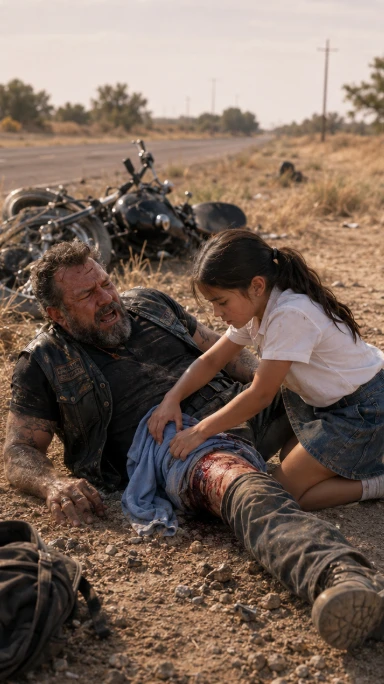
The first thing Rowan Maddox thought when he opened his eyes in the dust was not that he might die, but that no one would care enough to look for him. The second thing he thought was worse: maybe they would look, see the leather vest, the scar over his brow, the old motorcycle club patches stitched across his back, and decide the world had lost nothing important.
The sky above him was a hard California blue, too bright and too clean for the mess he had made of himself on the side of that road. His motorcycle lay thirty feet away, twisted into the dry grass like a wounded animal, one wheel still turning slowly with a faint metallic click. Somewhere nearby, gasoline dripped in steady, patient drops, and every breath Rowan took scraped through his ribs as if something inside him had cracked open.
He tried to lift his head once and a white bolt of pain shot through his leg so violently that he almost blacked out again. The world narrowed to heat, gravel, blood, and the bitter taste of dirt between his teeth. He had survived bar fights, bad deals, police raids, prison threats, and years of being the kind of man other men lowered their voices around, but none of that mattered now. Out here, on a forgotten road outside Stockton, he was just an old man bleeding into the dust.
He had taken this road because it was quiet. That was what he told himself, at least. The truth was that quiet had become the only place where he did not have to pretend he was still feared, still strong, still untouched by everything he had lost.
His daughter, Mia, had stopped answering his calls eleven months earlier. At first, Rowan had blamed her husband, then her job, then the fact that she had a child now and no time for an old disappointment of a father. But lying there with his boot twisted at an angle it should never have been, he understood something with terrible clarity. Mia had not walked away because she was too busy. She had walked away because he had spent her whole life teaching her that loving him meant standing too close to danger.
The crash had happened fast, but the seconds before it stretched in his mind like a warning he had ignored. He remembered leaning into the curve, the sun flashing against his chrome, the familiar growl of the engine beneath him. Then the front tire hit loose gravel, the bike bucked, and the road turned sideways.
For one suspended instant, before his body struck the asphalt, Rowan saw Mia at six years old running through a laundromat with a pink hair clip slipping down her curls. He saw her at fourteen sitting at the kitchen table while he came home with blood on his knuckles and lied about it. He saw her at twenty-eight, standing in his doorway with tears in her eyes, telling him she could not keep explaining him to her little boy.
Then the road took him.
Now there was only the dry wind pushing weeds against his face and the far-off hum of a world continuing without him. He tried to reach for his phone, but his right arm would not obey. His left hand clawed at the gravel, found nothing, and dropped again.
Rowan closed his eyes. It embarrassed him, the smallness of the sound that left his throat. It was not a shout, not a curse, not the angry roar people expected from Rook Maddox. It was almost a prayer, though he had not prayed in years.
“Not like this,” he rasped.
No one answered.
A truck passed sometime later, or maybe he imagined it. He heard tires, felt a faint vibration through the ground, and tried to move his arm. The sound faded. Dust settled over him again, and with it came the old, bitter certainty he had carried like a second skeleton.
He had spent years making sure people were afraid of him, and now fear was the reason no one stopped.
Two hundred yards down the same road, Elena Cruz was walking home with one hand gripping the strap of a backpack that seemed too heavy for her small shoulders. She was ten years old, though strangers often guessed eight because she had a round face, quiet eyes, and a way of shrinking whenever adults raised their voices. That afternoon, she was thinking about the red mark on her spelling test and how her mother would say a grade was not a measure of her heart.
Elena’s mother, Marisol, worked double shifts at a nursing home and believed in two things with equal stubbornness: kindness and caution. She told Elena to help people, but never follow strangers. She told her to be brave, but never foolish. Elena carried those lessons like two stones in her pockets, and most days, they did not contradict each other.
Then she heard the crash.
It was not just a loud sound. It was a tearing, ripping, terrible sound that made the birds burst from the fence line and sent a cold shock through Elena’s stomach. She stopped in the middle of the road, her fingers tightening on her backpack strap.
For a moment, she did what any child might do. She looked behind her, hoping an adult would appear. There was no one. The road behind her shimmered empty in the heat.
Another sound came after the crash, lower this time, almost swallowed by the wind. A groan. Human, hurt, desperate.
Elena took one step forward, then another. Her mother’s voice rose inside her head, sharp with fear. Stay away from strangers. Find help first. Don’t go near danger. But the groan came again, and it had a brokenness in it that made her feet move before she had permission from her fear.
She ran.
When she reached the bend, she saw the motorcycle first. It was black, enormous, and ruined, its chrome bent, its mirror shattered into tiny bright pieces scattered over the asphalt. Then she saw the man.
He looked like every warning her mother had ever given her made flesh. Leather vest. Big arms. Beard streaked with gray. A face cut by old scars and fresh pain. One hand was clenched in the dirt, and his chest rose in short, uneven jerks.
Elena froze so suddenly that her backpack slid from one shoulder and thudded against her hip. She wanted to turn around. She wanted to run to the nearest house, except the nearest house was far away, and the man on the ground made a sound that was not frightening at all. It was fragile.
His eyes opened halfway. They were pale, unfocused, and filled with pain.
Rowan saw a child standing over him and thought he must already be dying. The sun behind her turned her outline soft and golden, and for one confused second, he saw Mia as a little girl, hovering at the edge of his hospital bed after one of his old fights. Then his vision cleared, and panic hit him harder than the crash.
“Go,” he forced out. “Get away.”
Elena swallowed. “Sir, can you hear me?”
Rowan tried to make his voice rough enough to scare her into leaving. “I said go. Dangerous.”
Elena looked around. There were no flames, but the motorcycle smelled of gas. The man’s leg was bleeding badly, and his face had gone the frightening gray color she had seen once on an old man at the nursing home when her mother brought her lunch. She remembered Marisol pressing towels hard against a wound and saying pressure first, panic later.
Elena dropped her backpack beside him and knelt.
Rowan’s eyes widened. “Kid, no.”
Elena’s hands shook as she touched his shoulder, but her voice came out steadier than she felt. “I’m going to help you.”
“You don’t know me.”
“I know you’re hurt.”
That answer did something to him. It passed through the pain and struck a place in Rowan that had not been touched kindly in years. He wanted to argue, to tell her that she was wrong, that the world did not work that simply, but then his breath caught and he groaned through clenched teeth.
Elena looked at his leg and felt her stomach turn. She did not let herself look too long. She pulled off her light blue sweater, the one she had bought from a thrift store with coins saved from helping her neighbor water plants. It was her favorite because it made her feel older and prettier, but in that moment, it became only cloth.
She wrapped it around his thigh with clumsy urgency, trying to remember everything her mother had explained after work one night. Above the wound. Tight enough to slow it. Don’t loosen it because you feel sorry for them. Her fingers slipped, and she bit her lip so hard it hurt.
Rowan made a sound that rolled out of him like thunder. His back arched, and Elena flinched, but she did not let go.
Elena pulled harder. “I’m sorry. I’m sorry, but I have to.”
Rowan gasped, eyes squeezed shut. “You’re ten.”
“I’m almost eleven.”
“That doesn’t make this better.”
“It makes me stronger than ten.”
A laugh almost came out of him, but it turned into a cough. Pain flashed across his face, and Elena’s fear rose again. She looked toward the empty road, willing a car to appear, but the heat waves bent the horizon into nothing.
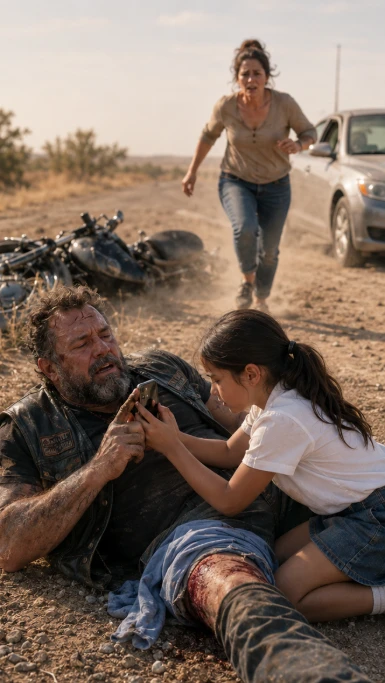
She found his phone after searching his vest pockets with trembling fingers. The screen was cracked but still alive. It asked for a passcode.
Elena held it near his face. “What’s your code?”
Rowan blinked, trying to focus. He almost gave her the wrong number. His mind was slipping in and out, drifting toward dark edges.
“Zero seven,” he breathed. “Nine one. Zero four.”
Elena typed it carefully. The phone opened to a photo of a woman with dark hair holding a small blond toddler on her hip. Elena stared for half a second, understanding at once that the woman must be his daughter and the child must be his grandchild.
“Who do I call?” she asked.
Rowan’s jaw tightened. Even half-conscious, shame moved through him like a reflex. His contact list held men who would come with guns, men who would ask the wrong questions, men who would turn even rescue into trouble. There was only one person he wanted, and she was the one most likely not to answer.
“Mia,” he whispered.
Elena found the name. There were missed calls below it, some months old, some never returned. She pressed the number and put the phone to her ear.
It rang once.
Twice.
Three times.
Rowan stared at the sky, and Elena watched something in him collapse before anyone had spoken. It was not his body this time. It was hope.
Then a woman’s voice snapped through the phone, guarded and tired. “Dad? What happened? Why are you calling me?”
Elena’s throat went dry. “Hi. My name is Elena. Your dad had an accident.”
There was a pause so sharp it felt like the whole road held its breath.
“What kind of accident?” Mia demanded.
Elena looked at Rowan, then at the blood darkening her sweater. She forced herself not to cry. “A motorcycle accident. He’s awake, but he’s hurt bad. I’m on the road near the old almond packing building. Please come. Please call an ambulance too.”
Mia’s voice changed instantly. The anger dropped out, leaving raw terror underneath. “Is he breathing?”
“Yes.”
“Is he talking?”
“A little.”
Mia’s breath shook through the line. “Put me on speaker.”
Elena tapped the screen and held the phone close to Rowan’s face.
Mia’s voice broke. “Dad?”
Rowan turned his head slightly, and tears collected in the dirt at the corner of one eye. He had imagined hearing her voice again so many times, always with some clever apology ready, some defensive joke, some explanation that protected his pride. Now he had nothing left but the truth.
“Mia,” he whispered. “I’m sorry.”
Mia made a sound that seemed torn from the deepest part of her. “Don’t you dare do this over the phone. Don’t you dare say goodbye to me like this.”
Rowan closed his eyes. “Tried calling.”
“I know,” she said, and her voice shook harder. “I know, Dad. I saw. I just couldn’t— I didn’t know how to pick up.”
Elena looked away because the moment felt too private, too painful for her to witness. But Rowan’s hand twitched toward the phone, and she gently placed his fingers against it. His calloused thumb touched the cracked screen as if he could reach through it.
Rowan tried to breathe deeper and failed. “I scared you your whole life.”
Mia cried openly now. “Yes.”
“I thought I was protecting you.”
“You made everything feel like a storm.”
“I know.”
For the first time in his life, Rowan Maddox did not defend the damage he had done.
The sirens had not come yet. The road remained empty except for Elena, a dying motorcycle, and a man whose life was leaking out one minute at a time. Elena pressed one hand against the sweater around his leg and held the phone with the other, her small body braced against a responsibility far too large for her.
Mia’s voice sharpened again, trying to become useful through panic. “Elena, listen to me. I’m calling 911 on my husband’s phone right now. Stay with him. Keep him awake if you can. Don’t move him.”
“I won’t.”
“What’s your last name?”
“Cruz.”
“Elena Cruz,” Mia said, as if memorizing it might keep her from falling apart. “You are doing amazing. Do you hear me?”
Elena nodded, then remembered Mia could not see her. “Yes.”
Rowan’s breathing grew shallow. His eyes drifted closed again.
Elena shook his shoulder lightly. “Rook. Stay awake.”
His eyelids fluttered. “You know that name?”
“You told me.”
“Bad habit.”
“What?”
“Letting people call me that.”
Elena glanced at his vest, at the patches and the hard-looking symbols she did not understand. “Why do they call you Rook?”
He swallowed, struggling. “Because I didn’t move unless I had to. Like the chess piece.”
Elena frowned. “Rooks move straight.”
A faint, pained smile crossed his face. “Yeah. I guess I forgot that part.”
She did not know why that made her sad, but it did. She shifted closer so her shadow covered his face from the sun. The smell of gas and dust made her dizzy, but she planted her knees in the gravel and refused to move.
“Tell me about Mia,” Elena said.
Rowan’s eyes opened a little. “Bossy little thing.”
“Mia?”
“No. You.”
Elena almost smiled. “My mom says bossy is good when someone needs help.”
“Your mom sounds smart.”
“She is. She works at Fairview Nursing Home. She knows what to do when people get hurt. I don’t know everything, but I know some things.”
“You know more than most grown men I’ve met.”
The compliment steadied her. She looked at the phone, still open, with Mia breathing and crying on the other end while speaking to emergency services. Elena lowered her voice.
“Tell me about your grandson.”
Rowan’s face changed. It softened in a way that made him look less like a warning and more like an old photograph someone had folded too many times.
“Caleb,” he whispered. “He’s three. Likes dinosaurs. Calls me Grandpa Rook because I thought it was funny once.”
“Do you see him a lot?”
The question landed hard. Rowan looked away.
Elena understood enough not to ask again. Instead, she reached into her backpack and pulled out a small bottle of water. She remembered not to give him any to drink, another one of her mother’s rules, but she wet the corner of a napkin and touched it carefully to his cracked lips.
Rowan’s eyes filled again. “Why are you doing this?”
Elena kept her eyes on the napkin. “Because you’re here.”
“That’s not a reason.”
“It is to me.”
He stared at her, and for a moment the roar of his old life faded—the engines, the fights, the slammed doors, the names people had called him, the names he had earned. In its place was a child kneeling in the dirt with scraped knees, giving up her sweater, her safety, and her afternoon because she had found him breathing.
Elena did not save him because she knew he was good; she saved him because she refused to let pain be proof that someone was worthless.
The first siren finally rose in the distance, thin at first, then growing louder. Elena’s shoulders sagged with relief, but Rowan’s hand suddenly closed weakly around her wrist. His grip had almost no strength, yet she felt the urgency in it.
“Don’t leave,” he whispered.
“I’m not.”
“People leave.”
“I’m not people.”
He looked at her, confused by the simplicity of that answer. Then another sound came, rougher and closer than the sirens: tires shrieking against gravel. A dusty silver car flew around the bend and skidded to a stop crookedly beside the road.
Mia jumped out before the driver’s door had fully opened.
She looked exactly like the photo on Rowan’s phone, only more frightened. Her hair was pulled into a messy knot, her face pale, her mouth trembling as she took in the motorcycle, the blood, the child kneeling beside her father. For half a second, she seemed unable to move.
Then she ran.
Mia dropped beside Rowan, one hand hovering over him because she did not know where she could touch without hurting him. “Dad. Dad, look at me.”
Rowan turned his head. “You came.”
Mia let out a broken laugh that was almost a sob. “Of course I came.”
“Wasn’t sure.”
Her face twisted. “I was angry. I wasn’t gone.”
That sentence cut through him more deeply than pain. He had mistaken silence for abandonment because abandonment was what he believed he deserved. Mia pressed her forehead lightly to his shoulder, avoiding the worst of his injuries, and for a moment she looked like the little girl who had once waited by windows for him to come home.
The ambulance arrived in a blast of sound and dust. Paramedics moved quickly around them, asking questions, checking vitals, taking over pressure from Elena’s small hands. When one of them gently guided her back, she stood on trembling legs and realized her palms were red, her sweater ruined, and her knees bleeding from the gravel.
Marisol arrived moments later, breathless and terrified, having been called by Mia after the ambulance. She parked behind the emergency vehicles and ran toward her daughter with a cry that seemed to tear the afternoon open.
“Elena!”
Elena turned, and only then did she start crying. Marisol wrapped her arms around her, holding her so tightly Elena could barely breathe, rocking once as if confirming her child was whole.
Marisol kissed the top of Elena’s head. “What were you thinking? Mija, what were you thinking?”
Elena sobbed into her mother’s shirt. “He was alone.”
Marisol looked past her daughter at Rowan as the paramedics prepared to lift him. Her expression shifted through fear, anger, and something more complicated. She saw the vest. She saw the motorcycle. She saw the man people would have told her not to help. Then she saw the way he was looking at Elena, not like a threat, but like a drowning man looking at the shore.
Rowan’s voice rasped from the stretcher. “Ma’am.”
Marisol stiffened but turned toward him.
Rowan tried to lift his hand and failed. “Your girl saved my life.”
Marisol’s eyes filled, though her jaw stayed tight. “She should not have had to.”
“No,” Rowan whispered. “She shouldn’t.”
The paramedics lifted him into the ambulance. Mia climbed in after them, but before the doors closed, Rowan turned his head toward Elena. His face was gray, his beard dusty, his eyes wet and fierce with gratitude.
“Elena Cruz,” he said, each syllable dragged through pain, “you hear me?”
Elena stepped closer, still held by her mother.
Rowan’s voice broke. “I won’t waste what you did.”
The ambulance doors closed on the man everyone feared, but the promise he made through those doors became the first honest thing he had built in years.
The hospital turned the hours that followed into a blur of fluorescent lights and waiting-room coffee. Elena and Marisol were told they could go home, but Mia asked them to stay just long enough for the doctors to say whether Rowan would live. Marisol hesitated, torn between protecting her daughter from more fear and honoring the fact that Elena had already become part of the story.
So they stayed.
Elena sat in a plastic chair with a blanket around her shoulders and her hands folded in her lap. Dried blood marked the edges of her fingernails no matter how many times the nurse helped her wash. Every time a doctor walked through the doors, Mia stood up so fast the chair scraped the floor.
Mia’s husband arrived with Caleb, who was sleepy and confused, clutching a stuffed green dinosaur. When he saw his mother crying, his little face crumpled. Mia pulled him into her lap and whispered that Grandpa Rook had been hurt, but the doctors were helping him.
Caleb looked across the waiting room at Elena. “Are you the girl?”
Elena blinked. “What girl?”
“The helper girl.”
Mia covered her mouth.
Elena did not know what to say, so she nodded. Caleb climbed down from Mia’s lap, walked over, and held out his dinosaur with solemn generosity.
Caleb whispered, “He helps when people are scared.”
Elena accepted the dinosaur carefully, and that tiny gesture nearly broke every adult in the room.
Hours later, a surgeon came out wearing tired eyes and a careful expression. Rowan had lost a dangerous amount of blood. His leg was broken in two places. Several ribs were fractured, and there were internal injuries that would take time to understand fully. But he was alive, and the surgeon said something that made Mia turn toward Elena as if seeing her for the first time all over again.
“If that tourniquet had not been applied when it was, the outcome would likely have been very different.”
Marisol pressed a shaking hand to her mouth. Elena looked down at the dinosaur in her lap and felt no pride, only a strange heaviness. She had not imagined saving a life would feel like this. It did not feel shining or heroic. It felt terrifying, like standing very close to a door that had almost closed forever.
Rowan woke two days later in the intensive care unit with tubes in his arms and Mia sleeping in a chair beside him. For several minutes, he simply watched her. She looked exhausted, older than he wanted her to look, and there was a crease between her eyebrows that he knew he had helped put there.
He could not speak at first. His throat burned from the tube that had been removed. When Mia opened her eyes and saw him watching her, she sat forward so quickly she knocked her purse to the floor.
“Dad?”
Rowan’s voice was barely there. “Still mad?”
Mia laughed once, then cried. “Furious.”
“Good.”
“Good?”
“Means you’re still here.”
She took his hand carefully, avoiding the IV. “I don’t know how to do this.”
“Me neither.”
“That’s not comforting.”
“Never been good at comforting.”
Mia looked at him, and for once he did not look away first. There were years between them, stacked with missed birthdays, broken promises, slammed doors, and the terrible patience of a daughter waiting for a father to become safe. One accident could not erase any of it. One apology could not rebuild a childhood.
But something had cracked open on the road, and through it, a different future was barely visible.
Rowan swallowed. “I need to tell you things. Not excuses.”
Mia’s hand tightened around his. “Then tell me slowly.”
So he did. Not all at once, and not well at first. He told her about the fear he had mistaken for strength, about the men he had followed because they made him feel untouchable, about how being feared had become easier than being honest. He admitted that he had let danger sit at their table and call it loyalty.
Mia listened with tears slipping silently down her face. Sometimes she turned away. Sometimes she asked questions that hurt him more than his injuries. Sometimes she said nothing at all, and the silence punished him exactly as much as it should.
When Elena visited him a week later, she stood in the doorway of his hospital room wearing a borrowed yellow sweater and holding a handmade card from her class. Rowan looked smaller in the bed than he had on the road, without the motorcycle, without the boots, without the armor of leather and rumor. But his eyes were clear.
Elena stepped inside shyly. “Hi, Rook.”
Rowan’s mouth trembled. “Hi, Doc.”
“I’m not a doctor.”
“Not yet.”
She smiled despite herself. Marisol stood behind her with crossed arms, still wary, still grateful, still a mother first. Mia stood by the window with Caleb on her hip, watching the strange little circle form around the bed.
Elena handed Rowan the card. Children from her class had signed it after hearing only that she had helped an injured man. Some had drawn motorcycles. One had drawn a superhero cape on a stick figure with curly hair.
Rowan stared at the card for a long time.
Elena shifted on her feet. “Are you okay?”
He nodded, but his eyes were wet. “No one ever drew me as the person being saved before.”
Marisol’s face softened despite herself.
Rowan looked at Elena, then at Marisol. “I know saying thank you isn’t enough.”
Marisol’s voice was quiet. “No. It isn’t.”
“I know.”
“Good.”
There was no cruelty in her answer, only truth. Rowan respected it. Maybe for the first time in his life, he understood that gratitude did not entitle him to forgiveness, and remorse did not erase the fear others had carried because of him.
He looked back at Elena. “I made you a promise.”
Elena nodded.
“I’m going to keep it.”
The months that followed tested that promise more than the accident had. Healing was humiliating. Rowan had to learn patience from nurses half his size and accept help from people he once would have shoved aside. His leg healed crooked enough to leave him with a permanent limp, and his ribs ached whenever the weather shifted.
Worse than the body was the quiet.
Without the bike, without the club, without the routines that had kept him moving from one bad choice to the next, Rowan had to sit with himself. He sold the motorcycle as soon as he could sign the paperwork, and when the buyer asked why, Rowan said only that it had already taken him as far as it needed to.
Men from his old life came by twice. The first time, Mia was visiting with Caleb, and Rowan saw fear flash through his daughter’s body before she could hide it. That was enough. He met the men outside the rehabilitation center with a cane in one hand and told them not to come back.
One of them laughed. “You getting soft, Rook?”
Rowan looked through him. “No. I’m getting done.”
The second time they came, he did not go outside. He called the police himself, hand shaking as he did it, not because he was afraid of them, but because choosing a lawful life felt like stepping onto a bridge he had mocked other men for crossing. When the patrol car arrived, the old friends left cursing his name.
That night, Mia brought him soup and found him sitting in the dark.
Mia set the container down. “Do you regret it?”
Rowan took a long time to answer. “I regret that it took a child bleeding through her sweater to make me brave.”
Mia sat beside him. She did not forgive him in that moment. Forgiveness, when it came at all, came in pieces too small to name. But she stayed through dinner, and Caleb fell asleep against Rowan’s good side, and for the first time in years, Rowan did not feel like a visitor in his own family.
He learned that redemption was not a speech, not a grand gesture, but the daily refusal to become the man people had reason to fear.
The foundation began as an envelope.
Rowan had received a settlement from insurance and had more money than he expected after selling the bike, old parts, and a storage unit full of things tied to a life he no longer wanted. He put cash into an envelope and gave it to Marisol for Elena’s school supplies. Marisol handed it back immediately.
“We are not charity,” she said.
Rowan accepted the envelope without argument. Old Rowan would have pushed. New Rowan went home and thought about the difference between helping and buying relief from guilt.
A week later, he returned with something else: a meeting room at the community center, three local volunteers, and a proposal. He wanted to start a fund for children in the area who wanted medical training, first-aid certification, tutoring, or after-school programs. He wanted Marisol on the advisory board. He wanted Mia to handle the paperwork because she worked in nonprofit administration and trusted rules more than promises.
Marisol listened in silence.
Mia narrowed her eyes. “You understand this can’t be about making you look good.”
Rowan nodded. “Put someone else’s name on it.”
Elena, who had been doing homework at the corner table, looked up. “What name?”
Rowan turned toward her. “Yours, if your mother allows it.”
Elena’s eyes widened. Marisol inhaled sharply.
Rowan lifted a hand before anyone could object. “Not because you owe me. Because I owe the world proof that what you did can keep moving.”
Marisol stared at him for a long time. “And if we say no?”
“Then I still do the work. Quietly.”
That answer mattered more than the offer. Marisol saw it. Mia saw it too. Elena did not fully understand the adult weight in the room, but she knew something important had shifted because her mother’s shoulders lowered.
The Elena Cruz Courage Fund started small. A donated cabinet of first-aid supplies. Weekend classes at the community center. Scholarships for basic medical training. Rides for students whose parents worked late. Rowan attended every session, sitting in the back with his cane across his knees, making coffee, stacking chairs, and listening more than he spoke.
At first, people whispered. Parents recognized him. Some remembered his club days, his fights, the night police cars surrounded a bar he used to frequent. They watched him with narrowed eyes, waiting for the trick.
Rowan let them watch.
He did not tell them he had changed. He showed up early. He stayed late. He apologized when apologies were needed, even when they were not accepted. He fixed broken tables, paid overdue fees anonymously when families struggled, and learned to ask children what they needed instead of assuming he knew.
Elena kept growing. At eleven, she completed her first youth first-aid course and corrected Rowan when he mislabeled gauze. At thirteen, she gave a nervous speech at a fundraiser and forgot the middle part until Rowan tapped his chest twice, their silent signal for breathe. At sixteen, she volunteered at the same nursing home where her mother worked, moving through halls with a calm that reminded people of Marisol.
Rowan watched from a distance when he could. He never tried to own her story. When reporters came after a local paper wrote about the fund, he refused to stand in the center of the photograph. He stepped to the side, letting Elena and Marisol take the light.
But Elena always found him afterward.
Elena adjusted his crooked tie after one event. “You look like you lost a fight with a closet.”
Rowan grumbled. “I used to be intimidating.”
“You still are. Just to neckties.”
Mia laughed from behind them, and Rowan turned toward the sound as if it were music he had once forgotten existed. She had begun calling him every Sunday evening. Some calls lasted five minutes. Some lasted an hour. Sometimes she was angry again, remembering something from childhood that still hurt, and Rowan had learned not to rush her past it.
“I’m sorry,” he would say when there was nothing else honest to say.
And slowly, those words stopped sounding like a performance. They became a door he kept opening, even when he was afraid of what stood on the other side.
Years passed, and the road outside Stockton changed almost not at all. The old almond packing building lost more paint. The weeds grew high and were cut back. The curve remained dangerous until enough signatures from the community, led by Mia and Marisol, forced the county to install warning signs and resurface the gravel-strewn shoulder.
On the day the new road signs went up, Rowan stood at the bend with Elena. She was eighteen then, taller, sharper in the face, with her hair pulled back and her eyes still carrying the same quiet courage. They stood a few feet from the place where his blood had darkened the dust.
Elena looked at the sign. “Do you think about it a lot?”
Rowan leaned on his cane. “Every day.”
“Does it still scare you?”
“Yes.”
She turned toward him. “Good or bad?”
He considered lying, but Elena had always been able to hear the difference. “Both. Bad because I remember almost dying. Good because I remember not being left there.”
Elena looked down at the road. “I was scared too.”
“I know.”
“No, I mean really scared. People always say I was brave like I didn’t want to run. I wanted to run.”
Rowan turned fully toward her. The wind moved dust around their shoes, and traffic hummed far away. He knew better now than to rush into comfort that erased truth.
“Elena,” he said gently, “bravery isn’t staying because you’re not scared. It’s staying while fear is screaming at you to save only yourself.”
She swallowed, and for a moment she was ten again, kneeling in gravel with a ruined blue sweater. Then she nodded.
The road had not made her fearless; it had taught her that fear could stand beside compassion and still not win.
When Elena received her acceptance letter to medical school, Marisol screamed so loudly the neighbor came over thinking something terrible had happened. Mia organized a celebration at the community center, and Rowan arrived with a cake so large it barely fit through the door. Caleb, now older and missing two front teeth, insisted on writing “Dr. Elena Soon” across the top in blue icing.
Elena cried when she saw it. She tried to hide it by laughing, but Marisol pulled her close and kissed both cheeks. Rowan stood back, clapping with everyone else, until Elena crossed the room and hugged him.
He froze for half a second, still sometimes surprised by tenderness when it came without warning. Then he hugged her carefully, his large hands gentle across her back.
Elena whispered, “You helped make this happen.”
Rowan’s throat tightened. “No, Doc. You were already headed there.”
“But you helped clear the road.”
He closed his eyes. That was more mercy than he deserved, and he knew enough now not to argue with mercy when it arrived. He simply held her a moment longer and let the gratitude move through him without trying to turn it into words.
Medical school was harder than Elena expected. There were nights she called her mother crying from exhaustion, mornings she doubted herself, exams that made her feel like the little girl with the red mark on her spelling test. Rowan sent letters because he was better on paper than on the phone. His handwriting was rough, and his messages were never poetic, but she kept every one.
One letter arrived after her first anatomy lab, when the reality of the human body’s fragility had shaken her.
You once held pressure on a wound with shaking hands and did not let go. Don’t let a bad day convince you that you are not built for this. You were built by every moment you stayed.
Elena read that line three times. Then she folded the letter and taped it above her desk.
By the time graduation came, Rowan was older in ways no one could deny. His beard had gone almost completely silver, his limp had deepened, and he moved more slowly through crowds. But his eyes were clear, and when he put on a suit for Elena’s medical school ceremony, Mia only had to fix his tie twice.
The auditorium was full of families carrying flowers, balloons, cameras, and years of sacrifice. Marisol sat near the front, her hands clasped so tightly her knuckles paled. Mia sat beside her with Caleb, now old enough to pretend he was not emotional and young enough to fail. Rowan sat on Marisol’s other side, cane resting against his knee.
When Elena’s name was called, the room seemed to rise around her.
She walked across the stage in her graduation gown, and for one dizzying second, she saw everything at once: her mother’s tired hands packing lunches after double shifts, Mia crying into a hospital phone, Caleb offering a dinosaur, Rowan lying in the dust with fear in his eyes, and the blue sweater she had never seen again because it had been cut away by paramedics and carried into someone else’s survival.
The dean placed the hood over her shoulders. Applause crashed through the auditorium. Elena smiled for the photograph, but her eyes searched the crowd until she found them.
Marisol was crying openly. Mia had one hand over her mouth. Caleb pumped both fists in the air. And Rowan Maddox, the man people once crossed streets to avoid, sat with his back straight and tears shining in his eyes.
He did not shout. He did not make the moment about himself. He simply lifted his hand and tapped two fingers against his chest, right over his heart.
Breathe.
Elena laughed through her tears and tapped her own chest in return.
In that crowded auditorium, the life she had saved became the witness to the life she had chosen.
After the ceremony, people gathered outside beneath a soft afternoon sun. Marisol held Elena’s face in both hands and called her doctora until Elena blushed. Mia hugged her so tightly they nearly dropped the flowers. Caleb asked whether this meant she could now fix his soccer ankle for free forever.
Rowan waited until the crowd thinned. He stood near a tree, one hand on his cane, watching Elena move through congratulations with the same quiet steadiness she had carried on the road. When she finally came to him, neither of them spoke at first.
Elena looked at his suit. “The tie survived.”
Rowan glanced down. “Barely.”
She smiled, but her eyes were wet. “I’m glad you’re here.”
Rowan took a breath that trembled. “I almost wasn’t.”
“I know.”
“No,” he said softly. “I mean before the accident. I was alive, but I wasn’t here. Not really.”
Elena’s smile faded into something gentler.
Rowan looked toward Mia, who was laughing with Marisol, Caleb leaning against her side. “I thought the crash was the worst day of my life. For a while, I even thought it was punishment.”
“Was it?”
He shook his head slowly. “No. It was the day someone stopped running from me long enough for me to see what I had become.”
Elena stepped closer and hugged him. Rowan closed his eyes, one hand resting carefully on her shoulder, the other gripping his cane. He did not feel like a rescued man in that moment. He felt like a man still being rescued, day by day, by the promise he kept choosing not to break.
Years earlier, on a road no one thought mattered, a frightened child had knelt beside a feared man and tied her favorite sweater around his wound. She had not known his crimes, his failures, his regrets, or the daughter waiting behind a wall of hurt. She had known only that he was breathing and that breath was worth defending.
That choice did not turn Rowan into a saint. It did not erase Mia’s childhood or Marisol’s fear or the long shadow of the man he had been. But it gave him a place to begin, and he spent the rest of his life proving that beginnings are not always clean, beautiful, or deserved.
Sometimes they are written in dust. Sometimes they arrive with sirens. Sometimes they wear the hands of a ten-year-old girl who is terrified and stays anyway.