Diesel lowered his voice. “Eileen, the boys heard about the crown…”
The whole front of Walmart seemed to freeze around that sentence. One cashier stopped scanning a bag of apples. A mother pulled her child closer by the shoulder. Even the store manager, who had been walking toward the entrance, slowed down when he saw fourteen bikers standing behind Diesel with their caps in their hands.
Eileen did not step back. She looked at the bouquet in Diesel’s massive hands, then at the men behind him, then at the patch on his vest that had made so many people afraid before he ever opened his mouth. For a second, her eyes moved like she was measuring something no one else in the store could see.
Diesel swallowed hard. “They wanted to come say something to you.”
One of the bikers shifted his boots against the floor. The sound was small, but in that silence it felt loud enough to make everyone turn. Brenda, the cashier from register two, whispered under her breath, but Eileen heard her anyway.
Brenda whispered. “Eileen… do you want me to call someone?”
Eileen kept both hands on the counter. She looked at Diesel, not the bikers, not the flowers, not the people staring from every aisle.
Eileen said quietly. “No.”
Diesel’s grip tightened around the bouquet. His face looked different now, not hard, not threatening, but almost nervous. As if this moment mattered more than he had expected it to.
Then he reached inside his leather vest.
Half the store flinched.
Eileen’s eyes narrowed, but she still didn’t move. Diesel pulled out a small envelope, worn at the edges, with a child’s crooked sticker pressed across the flap. On the front, someone had written EILEEN in uneven letters.
Diesel placed it on the counter like it was something fragile.
Diesel said. “Hattie wanted you to have this first.”
Eileen stared at the envelope, and for the first time since the bikers walked in, her smile disappeared.
The first thing people noticed was not the crown. It was the man wearing it.
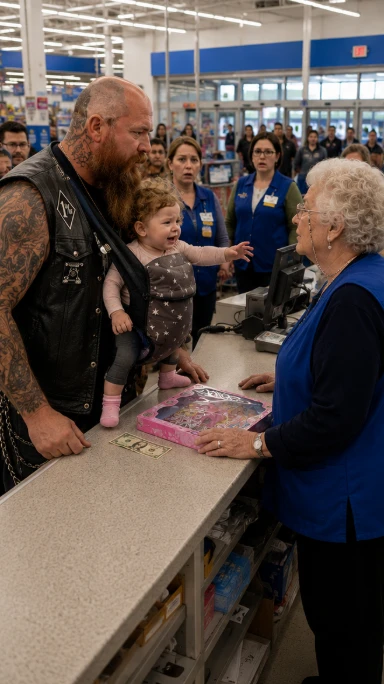
At four in the afternoon on a late October Saturday, the Walmart on the east side of Tulsa had already reached that restless, fluorescent kind of chaos where carts clipped ankles, children cried near the candy racks, and tired adults moved through the aisles with the blank determination of people who just wanted to get home. Then Diesel walked through the automatic doors with a three-year-old girl strapped to his chest, and for a few seconds, the front of the store seemed to forget how to breathe.
He was the kind of man strangers measured before they looked him in the eye. Six foot four, broad as a refrigerator, with a shaved head, a red-brown beard that fell nearly to the fourth button of his leather cut, and arms covered in old prison-style tattoos that disappeared beneath his sleeves. On the side of his neck, just below his jaw, a dagger tattoo pointed down like a warning, and on the front panel of his vest, a diamond-shaped patch sat in black and white thread for anyone who knew what it meant.
But tucked against all that leather and ink was Hattie.
She sat in a charcoal-gray Snugli with tiny white stars printed across it, her curls brushing the underside of Diesel’s beard and her pink-socked feet poking out through the bottom openings. Her cheeks were round from sleep, her fingers sticky from whatever snack he had given her in the parking lot, and her eyes were wide with the serious concentration of a child entering the kingdom of bright plastic things. Diesel adjusted one strap with a hand big enough to cover the back of her head and pushed a cart forward with the other.
At the customer service desk, Eileen watched them come in.
She had been working that desk for eleven years, long enough to know every sound the store made and every kind of trouble that usually walked toward her. Seventy-two years old, with white hair set in tight curls and reading glasses hanging from a beaded chain around her neck, she wore her blue vest like a uniform earned through weather, patience, and more returns than any human soul should have to endure. Her name tag said ASK ME ABOUT GROCERY PICKUP, though most people came to ask her about broken blenders, wrong receipts, missing refunds, and why the world had personally disappointed them.
The two cashiers closest to the entrance went quiet when Diesel passed. One looked down at her scanner with sudden devotion. The other pretended to straighten bags already perfectly straight.
Eileen did not look away.
She watched Diesel pause near the carts and shift his weight, careful not to jostle Hattie. He leaned down slightly, murmuring something Eileen couldn’t hear, and the little girl answered by patting both palms against his chest. Then he headed toward the toy aisle, his boots heavy on the linoleum, his daughter riding against his heart as if that was the safest place in the world.
For eleven minutes, Eileen helped a woman exchange a coffee maker, told a man that no, she could not accept a return on a half-eaten rotisserie chicken, and handed a roll of receipt paper to a cashier who had run out at register four. But part of her kept glancing toward the toy aisle. Not because she was afraid of Diesel, exactly, but because she had worked in public long enough to know that the people others feared were often the ones watched hardest, judged fastest, and misunderstood before they ever opened their mouths.
When Diesel came back out, he was carrying a large pink cardboard box.
It was nearly half the size of Hattie, printed with glittering letters and a picture of a smiling little girl in a tutu. DELUXE PRINCESS CROWN AND TIARA SET — AGES 3+. Three plastic crowns, five rings, a wand, and clip-on earrings sealed inside the kind of packaging that looked designed to survive a tornado. Diesel held it awkwardly in one hand, as if he had lifted engines, furniture, and full-grown men before, but this particular box required tenderness.
Hattie saw the picture through the plastic window and reached for it. Her little fingers pressed against the clear shell, sliding over the printed crown she could not touch. For a second, her face remained hopeful.
Then her lower lip began to tremble.
May you like
A Biker Found An Abandoned Autistic Boy At A Car Dealership—Then Saw The Note Taped To His Back
Diesel stopped in front of the register. He looked down at the box, then at the cashier, then back at Hattie, whose breath had caught in that tiny, dangerous rhythm every parent recognizes. It was not a full cry yet. It was the warning tremor, the first crack in the dam, the forty-second countdown before a child’s heartbreak became public sound.
Diesel’s shoulders tightened.
The cashier gave him the careful smile of someone who had already decided not to make any sudden movements.
Diesel looked at the package again. It was sealed shut with hard plastic pressed around every edge. No tear strip. No easy tab. No mercy. He turned the box over once, searching for a way in, while Hattie’s small hand knocked softly against the plastic.
“Daddy,” she whispered.
That was all she said, but Diesel’s face changed.
The hard set of his mouth softened so suddenly that Eileen felt it from across the front end. He stared at his daughter as if that one small word had gone straight through the leather, past the tattoos, past every bad year and ugly rumor, and found the one place in him the world did not get to touch. Then he tucked the box under one arm and walked away from the register.
He came straight to Eileen’s customer service desk.
The store did that quiet thing again. Not silence exactly, but a pulling back. The hum of lights remained, and carts still squeaked, but people’s attention bent toward him from every direction. A woman near the lottery machine nudged her husband. One of the teenage boys by the self-checkout smirked until Diesel’s shadow crossed the counter.
Diesel set the pink box in front of Eileen. Then he pulled a worn leather wallet from his back pocket and laid a twenty-dollar bill on top of the package with two fingers.
His voice, when it came, was so gentle it seemed impossible that it belonged to him.
Diesel lowered his eyes respectfully. “Ma’am, I want to buy this. Then I want to open it right here. Then I want to wear one of the crowns around your store with my kid. Is that okay?”
Eileen looked at the money, then at the box, then at the little girl strapped to his chest. Hattie’s eyes were wet now, her breath shuddering as she stared at the unreachable crown. Eileen had seen children scream for toys, parents snap from exhaustion, and grown adults throw tantrums over expired coupons, but this was different.
This giant of a man was asking permission not because he needed it, but because he wanted to do right by the store, by her, and by his daughter.
Eileen took the twenty.
Eileen slid open her drawer. “Sir, you go right ahead.”
A cashier exhaled behind him, as if she had been holding her breath through the whole conversation. Diesel gave one slow nod, but he did not move until Eileen pulled out the heavy-duty industrial scissors she kept for opening stubborn packaging and slicing through shipping bands. The scissors looked small in her hands, though they were the sort that could cut through cardboard, plastic ties, and most of the nonsense people brought to her desk.
She turned the box toward herself and began to cut.
The plastic resisted with sharp pops. Eileen worked carefully, trimming the edges back so nothing jagged would scrape Hattie’s fingers. Diesel stood utterly still, one hand cupped lightly under his daughter’s socked feet, the other resting on the counter as if he were afraid that any wrong movement might make the fragile moment break. Hattie watched every snip with desperate attention.
The first crown came free.
It was ridiculous. Shimmering pink plastic, fake heart-shaped rubies, tiny molded swirls meant to imitate royal metalwork. It weighed almost nothing. Under the fluorescent lights, it glittered with all the grace of cheap packaging and childhood magic.
Eileen held it up.
Diesel did not hesitate.
He took the crown between two huge fingers and placed it on his own shaved head, carefully lowering it above the dagger tattoo on his neck. It sat crooked, too small, and completely perfect. Then he took the smaller tiara from Eileen’s hand and eased it into Hattie’s curls with a gentleness that made the cashier at register three stop pretending not to watch.
Hattie blinked once.
Then she laughed.
It was not loud, not dramatic, not the kind of laugh that turns heads across a store. It was a tiny, breathless burst of joy that seemed to spill out of her before she knew what to do with it. She reached both hands up and patted Diesel’s cheeks, catching the edge of his beard between her fingers.
Eileen smiled despite herself.
Eileen leaned on the counter. “You look real pretty, honey.”
Diesel touched two fingers to the edge of the crown, as solemn as if she had pinned a medal on him.
Diesel nodded. “Thank you, ma’am.”
A few people nearby laughed softly, but there was no cruelty in it. The sound loosened something. The cashier at register four grinned. An older man waiting to return a leaf blower shook his head and smiled down at his shoes. Diesel picked up the opened box, tucked the extra pieces into the cart, and started back toward the aisles with Hattie wearing her tiara like she had just been crowned queen of Tulsa.
For the next forty-five minutes, Walmart belonged to them.
Diesel walked through grocery first, his crown wobbling above his ears every time one boot came down. Hattie waved the plastic wand Eileen had freed from the packaging, smacking it gently against Diesel’s vest whenever she wanted him to stop. He obeyed every time. If she pointed at bananas, he stopped at bananas. If she reached toward yogurt tubes, he paused with grave consideration, as if choosing the correct flavor were a matter requiring council.
People stared, of course.
Some tried not to. Some failed openly. A woman in the cereal aisle stood frozen with a family-sized box of Cheerios in her hand while Diesel compared two kinds of oatmeal. A man near the freezer section took one glance at the patch on Diesel’s vest, one glance at the plastic crown, and suddenly found the frozen peas fascinating. Near the end cap by snacks, three teenagers began to snicker into their sleeves.
Diesel turned his head.
He did not glare. He did not threaten. He simply looked at them, crowned in pink, with his daughter waving a wand against his chest.
The laughter died so fast it almost made Eileen, watching from the front, laugh herself.
But Diesel did not seem embarrassed. That was what stayed with her. He did not walk like a man enduring humiliation for his daughter’s sake. He walked like a father whose child had asked him to enter her world, and he had accepted the invitation without negotiation. His shoulders stayed broad. His chin stayed level. The crown sat crooked, but he never reached up to fix it unless Hattie did.
By the dairy coolers, a little boy in a Spider-Man hoodie stared at Diesel with round eyes.
The boy tugged at his mother’s sleeve. “Mom, why does that man have a princess crown?”
His mother turned red and tried to pull him away, but Diesel stopped his cart and looked down.
Diesel rested one hand on Hattie’s back. “Because my princess needed company.”
The boy considered this with the seriousness of a judge.
Then he nodded. “That makes sense.”
His mother covered her mouth, half mortified and half moved, while Diesel continued toward the milk. Hattie leaned back against him, satisfied, and rested one small hand over the patch on his vest as though she had claimed the whole dangerous world and found it soft enough to sleep against.
Eileen saw him again near the front forty-five minutes later.
The cart held diapers, apple juice, frozen chicken nuggets, bananas, two gallons of milk, and the princess set box, now torn open and missing its most important pieces. Diesel checked out at register two. The cashier, a woman named Brenda who had been working there since the building opened in 2007, scanned each item with a smile she kept trying to hide.
Brenda nodded toward the crown. “Special occasion?”
Diesel looked down at Hattie, who had started chewing lightly on the end of the wand.
Diesel’s mouth twitched. “Every Saturday with her is a special occasion.”
Brenda’s smile faltered into something softer.
No one at the front end said much after that. They just watched Diesel gather the bags, balance them in the cart, and make sure the tiara was not slipping into Hattie’s eyes. Before he left, he turned toward customer service and lifted one hand to Eileen.
It was not a wave exactly. More like a promise acknowledged.
Eileen lifted her hand back.
That should have been the end of it.
That night, after her shift, Eileen went home to the small brick house she had lived in since her husband was alive. She kicked off her shoes by the door, rubbed the deep ache at the base of her spine, and warmed leftover soup in the microwave while the local news murmured from the living room. Her daughter called from Broken Arrow, asked if work had been wild, and Eileen told her about the crowned biker and the little girl with the wand.
Her daughter laughed until she heard Eileen’s voice change.
Then she asked, “Mom, are you crying?”
Eileen wiped under one eye with the heel of her hand and looked at the steam rising from her soup.
Eileen tried to laugh. “No, I just had a long day.”
But that was not the truth. The truth was that for one small afternoon, she had been allowed to witness something pure in a place where people usually came to complain. She had watched a man the world had already judged choose tenderness in public, and she had watched a child believe, without question, that her father would become whatever she needed him to be.
The next morning, her granddaughter sent her a link.
“Grandma,” the message said, “is this you?”
Eileen tapped the screen with one finger and frowned through her reading glasses.
It was a photo taken in the reflection of a dairy cooler. Diesel stood slightly angled, phone lifted, patches and tattoos visible, beard heavy against his chest, Hattie strapped to him with her tiny tiara bright in her curls. On Diesel’s head sat the pink crown, crooked and shining. The freezer reflection blurred the edges of the image, but not the feeling in it.
Under the photo, Diesel had written:
Most people see the ink and the vest and think they’re supposed to be scared. But today, a lady named Eileen at Walmart saw a father. She didn’t see a one-percenter. She saw a man who wanted to make his girl smile. Respect your elders. They see things the rest of the world misses.
Eileen stared at the screen.
At first, there were only a few thousand shares. Then tens of thousands. Then people she had not heard from in years began calling. By Monday, the store manager had printed the post and taped it in the break room, where every employee stood around reading it during lunch. By Wednesday, local news called the store. By Thursday, the number had climbed past anything Eileen understood.
Seven million shares.
People wrote things under the photo that made her sit very still at night. Some said their fathers had never done anything so gentle. Some said they had judged men like Diesel all their lives and now felt ashamed. Some said their mothers had worked customer service counters until their bodies broke, and it mattered to see one of them honored. One woman wrote that her husband had worn fairy wings through a grocery store for their daughter before he died, and she had not thought about that day in years.
Diesel did not come back that week.
Eileen told herself that was fine. People had lives. Viral things moved on. Stores returned to normal. By Friday, the customers were complaining again, the scanners were jamming again, and someone tried to return a Halloween costume that smelled suspiciously like a party.
But on Saturday afternoon, exactly one week after the crown, the windows began to tremble.
At first, Eileen thought it was thunder. The sky outside was gray enough for it, low and heavy over the parking lot. Then the sound deepened into a rolling growl that made the automatic doors shiver in their tracks. People near the entrance turned toward the glass.
Motorcycles.
Not one. Not two. A line of them rolled into the parking lot, chrome flashing under the dull sky, engines rumbling in staggered rhythm. Fourteen bikes came in behind Diesel’s Harley, each one ridden by a man broad enough, scarred enough, and serious enough to make the entire front end of Walmart stop pretending it was not watching.
Eileen felt Brenda appear beside her.
Brenda whispered, “Lord help us.”
The bikes shut off one by one.
The silence that followed was somehow louder.
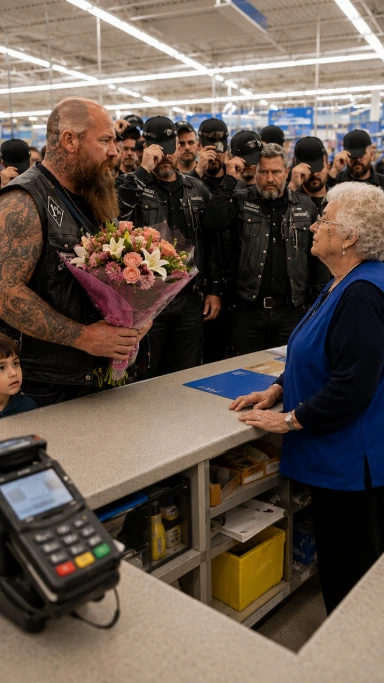
Through the glass, Eileen saw Diesel swing one leg over his Harley. He was not wearing the crown this time. Hattie was not strapped to his chest. Instead, he held a massive bouquet of flowers wrapped in brown paper and tied with twine. Behind him, fourteen men in leather vests and heavy boots gathered into a line.
Then they came inside.
The automatic doors opened, and the store seemed to shrink around them. The men did not wander. They did not look toward electronics or sporting goods or the grocery aisles. They walked in formation, boots landing heavy and steady on the linoleum, and every person at the front end moved aside without being asked.
A teenager at self-checkout abandoned his machine with a frozen pizza still on the scanner. A mother pulled her toddler closer. The assistant manager, who had once said he had handled Black Friday crowds and did not scare easy, disappeared toward the office.
Eileen stayed behind the desk.
Her hands rested on the counter. Her glasses hung against her vest. Her face did not change, though her heart beat a little harder than usual, not from fear, but from the absurdity of it all. She had survived raising three children, burying one husband, working retail through holiday seasons, and explaining return policies to men who thought volume was an argument. A line of bikers was not going to be the thing that made her step back.
Diesel stopped in front of her.
The men behind him stopped too.
Then, as one, all fourteen removed their caps.
The gesture moved through the front of the store like a wind no one expected. Rough hands lifted caps from shaved heads, gray hair, scars, and sweat-darkened brows. The men held them against their chests. Diesel stepped forward with the bouquet.
Diesel’s voice carried across the front end. “Eileen, the boys heard about the crown. They wanted to say thank you for looking after our brother and his girl.”
For a moment, Eileen did not answer.
The bouquet was ridiculous in its own way. Too big, too bright, full of sunflowers, roses, and little white filler flowers that shed pollen onto the counter. Tucked into the paper was a gift card for a steakhouse across town, the sort of place Eileen passed every week and never entered because she could not justify spending that much on herself.
Her throat tightened.
She looked from Diesel to the men behind him. Men with patched vests and heavy rings. Men who looked as if they had been built by bad roads, hard choices, and long years of not being welcome anywhere polite. Yet there they stood, hats in hand, waiting like schoolboys before a grandmother.
Eileen reached across the counter and patted Diesel’s massive tattooed hand.
Eileen smiled. “Well, it’s about time you boys showed up.”
A few of the bikers blinked.
Diesel’s mouth twitched.
Eileen pointed toward aisle six. “But if you’re going to stay, I expect you to help Mrs. Gable find the heavy dog food. Her back is out, and those forty-pound bags don’t carry themselves.”
For one perfect second, no one moved.
Then Diesel turned his head slowly toward the men behind him.
Diesel said, “You heard the lady.”
Something broke open in the store, not loud enough to be called laughter at first, but close. Brenda covered her mouth. The woman at lottery wheezed. One of the bikers, a man with a gray braid and a scar across his eyebrow, looked toward aisle six as if he had just received a battlefield assignment.
He nodded once. “Yes, ma’am.”
And that was how the toughest crew in north Tulsa began helping grandmothers shop at Walmart.
It started with Mrs. Gable, who was ninety pounds on a generous day and had been staring at the dog food like it had personally betrayed her. Two bikers followed Eileen’s instructions and carried three bags into her cart while she told them the entire medical history of her dachshund. One man, who looked like he might have once bitten through a chain-link fence, listened with solemn attention and asked whether the dachshund preferred chicken or beef.
By the produce section, another biker helped a woman reach apples from the back of the display. Near pharmacy, Diesel lifted a case of bottled water for an older couple while the husband tried to pretend he could have done it himself. At the checkout lanes, one of the bikers bagged groceries with such focused intensity that Brenda had to correct him twice for putting bread under canned beans.
The store did not know what to do with them.
At first, people watched like they were waiting for the trick. Surely something would happen. Surely the men would get bored, loud, offended, or dangerous. But they did not. They carried, reached, lifted, pushed carts, fetched motor oil, and stood patiently while elderly women debated brands of paper towels as if national security depended on softness.
Eileen moved among them like a general in comfortable shoes.
She pointed one toward the pet aisle. She sent another to help with a microwave return. She told Diesel to bring more bags to register two. When the assistant manager finally emerged from the office, pale and trying to look official, Eileen handed him a clipboard and told him to stop standing in the way.
At one point, a little girl in a purple coat approached Diesel near the toy aisle. She could not have been older than six. In her hands, she held a boxed doll almost as tall as her torso, and behind her, her mother looked both embarrassed and nervous.
The girl looked up at Diesel’s beard, his tattoos, his vest, and finally his face.
She asked, “Are you the princess man?”
Diesel looked down at her for a long moment.
Then he nodded gravely. “That depends who’s asking.”
The girl held up the doll. “I need this from the top shelf.”
Her mother whispered, “Sweetheart, no, don’t bother him.”
But Diesel had already reached up. He took down the doll, placed it carefully in the girl’s cart, and crouched just enough that he could speak to her without towering.
Diesel said, “A princess should never be afraid to ask for backup.”
The girl smiled so wide her mother’s eyes filled with tears.
Eileen saw the mother mouth thank you as Diesel stood. He nodded once, embarrassed now in a way he had not been embarrassed by the crown. Maybe kindness was harder for him when it was noticed. Maybe he had spent too many years being expected to frighten people, and not enough years being expected to comfort them.
Near the front, the local news arrived.
A young reporter hurried in with a cameraman behind her, both of them breathless and delighted, as if they had stumbled onto exactly the sort of story that made people watch the evening broadcast without feeling worse about the world. The manager reappeared instantly, smoothing his vest and trying to place himself near the center of things.
But the reporter walked past him.
She went straight to Eileen.
The reporter smiled. “Are you the Eileen from the post?”
Eileen looked over the top of her reading glasses. “Depends who’s asking and whether you’re returning something without a receipt.”
The cameraman laughed.
The reporter asked if she could film, and Eileen shrugged as if she had not spent the last week being sent links by relatives in three states. She did not know what to say to cameras. She did not have a speech prepared. She was not a hero. She had cut open a toy with store scissors and treated a father like a father.
But when the reporter asked why she had helped Diesel that day, Eileen looked toward the toy aisle, where he was now helping an elderly man choose a bicycle helmet for his grandson.
Eileen’s face softened.
Eileen said, “People come up to that counter all day wanting me to see their problem. That day, I saw his little girl first.”
The reporter waited, sensing there was more.
Eileen folded her hands on the counter. “And when you see the child first, sometimes you see the parent better.”
Diesel heard that from halfway across the front end.
He did not turn around immediately. He stood very still with one hand resting on the handle of a cart. The biker beside him, the one with the gray braid, glanced at him and said nothing.
The news camera caught none of what happened in Diesel’s face, because he kept it angled away. But Eileen saw enough. She saw his jaw tighten, his eyes lower, and one hand close briefly into a fist before opening again. Not anger. Not shame. Something heavier.
Later, he would tell her why.
Hattie’s mother had left when Hattie was eighteen months old. Some people said it was because Diesel’s life was too rough. Some said it was because she was too tired. Some said things they had no right to say at all. What mattered was that Diesel had woken up one morning with a baby girl, a half-empty closet, and no instruction manual for becoming soft enough.
He had learned by failing.
He had learned which diapers leaked, which lullabies worked, which cartoons Hattie loved, and how to braid curls badly enough that strangers sometimes offered help. He had learned to lower his voice at preschool pickup. He had learned that a three-year-old could be more frightening than any man he had ever faced, because she needed him to be good every day, not just tough once.
And on that Saturday in Walmart, when Hattie had pointed at a princess crown and said, “Daddy. That,” something in him had answered before pride could interfere.
He had spent half his life proving he was dangerous, but his daughter had asked him to prove he was hers.
By the time two hours had passed, the front of the store looked like a strange little parade had moved through it. Bikers pushed carts for widows. Grandmothers gave instructions. Children asked questions adults were too nervous to ask. People who had stared in fear at the beginning now smiled when the men passed.
One customer tried to take a photo without asking. Diesel saw him and simply held up a hand.
Diesel said, “Not the old ladies. Ask first.”
The man lowered his phone so fast he nearly dropped it.
Eileen caught that too.
She had spent years watching people become props in other people’s stories. The crying cashier. The angry customer. The strange man. The sweet old lady. The scary biker. Everyone reduced to a type, flattened into a post, a joke, a warning, or a headline. Diesel, for all his reputation, seemed to understand that better than most.
When the rush finally slowed, Diesel came back to the customer service desk. The bouquet now sat in a plastic bucket someone had borrowed from the floral section. The steakhouse gift card was tucked safely in Eileen’s vest pocket, though she had already decided she would take Brenda with her because Brenda had covered her Saturday breaks for years without complaint.
Diesel rested both hands on the counter.
For a while, neither of them spoke.
Then he took something from inside his vest.
It was the pink crown.
The same one. A little bent now, one fake ruby missing, the plastic scratched from being shoved into a saddlebag or tossed into a truck console. He set it carefully on the counter between them.
Eileen stared at it.
Diesel cleared his throat. “Hattie wanted you to have this.”
Eileen’s eyes flicked up. “Now why would that baby give away her daddy’s crown?”
Diesel swallowed. His voice came out rougher than before.
Diesel said, “She said you helped make me a princess.”
For a moment, Eileen could not find a single practical thing to say. Her throat closed in a way that annoyed her. She was not a woman who cried easily at work. Crying at work gave customers ideas.
Brenda failed entirely and turned away, wiping both eyes with a receipt strip.
Eileen picked up the crown. It weighed nothing. That was the absurd part. A cheap toy from a sixteen-dollar set, bent at one edge, missing a ruby, worth less than the gum near register seven. Yet in her hands it felt heavier than the bouquet, heavier than the gift card, heavier than seven million people tapping share from couches and kitchen tables.
It was proof that a small kindness, done without witnesses in mind, could travel farther than fear ever had.
Eileen looked at Diesel. “You tell Hattie I’ll keep it safe.”
Diesel nodded, but he did not leave.
His eyes shifted toward the counter, then toward the men waiting near the entrance. They were pretending not to watch, which meant all of them were watching.
Diesel said, “There’s something else.”
Eileen braced herself. In customer service, “something else” usually meant the part of the problem that cost money.
Diesel pulled an envelope from inside his vest and slid it across the counter.
Eileen did not touch it right away. “What’s this?”
Diesel looked uncomfortable now, truly uncomfortable, the way men like him sometimes did when the conversation moved away from engines, weather, or rules they could enforce.
Diesel said, “People from the post started sending messages. Some asked where to send flowers. Some wanted to buy you dinner. Some wanted to do something for Hattie. I told them no money for me.”
Eileen’s brows drew together. “Diesel.”
He lifted one hand gently, stopping her before she could scold him.
Diesel said, “So we made it a thing. Not big. Not official. Just… if somebody wants to honor what happened, they buy a crown toy, a doll, a coat, whatever, and bring it for a kid who needs it. We talked to a shelter over by Admiral. They got families coming in with nothing.”
Eileen stared at the envelope.
Diesel tapped it once. “That’s the first list. Ages. Sizes. What they need before Christmas. The boys are doing a ride next month.”
Behind him, one of the bikers coughed and looked intensely at the floor.
Diesel added, quieter, “We were hoping you’d tell us when we’re doing it wrong.”
Eileen looked past him at the line of men who had spent the afternoon carrying groceries for strangers because she had told them to. She looked at the shoppers still pretending not to listen. She looked at the crown in her hand, its pink plastic catching the fluorescent light.
Then she laughed.
Not because it was funny, not exactly. Because life, after all her years, still had the nerve to surprise her in a Walmart customer service line.
Eileen opened the envelope and scanned the handwritten list inside. Children’s coats. Shoes. Baby wipes. Pajamas. Toys for ages two through twelve. Grocery cards. Laundry detergent. The practical needs of families trying to survive, mixed with the small bright things children remembered longer than adults expected.
Her eyes blurred before she reached the bottom.
She took off her glasses and wiped them on her vest.
Eileen said, “First thing you’re doing wrong is handwriting this mess like a ransom note.”
One of the bikers barked a laugh.
Eileen pointed at him without looking. “Don’t you start. You boys bring me a proper notebook, three folders, and a pack of pens that actually work. If we’re helping children, we’re not doing it sloppy.”
Diesel’s expression changed slowly, as if relief had to fight its way through old habits.
Diesel nodded. “Yes, ma’am.”
“And no scary nonsense when you drop things off,” Eileen continued, warming to the task. “You call ahead. You ask what they need. You don’t make those mothers feel like they owe you a performance of gratitude just because you showed up with coats.”
Diesel lowered his eyes. “Understood.”
“And if there are crowns,” she said, lifting the bent pink one slightly, “you make sure every child who wants one gets one. Boys too, if they ask. Nobody gets laughed at for wanting a little sparkle in a hard life.”
Diesel’s mouth pressed into a line.
For a second, he looked exactly like the man from the dairy cooler photo. Big, tattooed, dangerous to anyone who only knew how to read surfaces. Then his eyes softened, and all of that fell away again.
Diesel said, “Hattie would like that.”
The news report aired that night.
It could have made a joke of them. It could have leaned hard into the contrast, turned Diesel into a novelty, Eileen into a sweet old prop, and the other bikers into background decoration for a feel-good segment. But maybe the reporter had listened closely, or maybe the camera had caught enough truth that even television could not flatten it completely.
The clip showed Diesel lifting dog food into Mrs. Gable’s cart. It showed Eileen directing bikers like a queen with a scanner. It showed a little girl asking for help with a doll and a man in a patched vest treating her question like royal business. It ended with Eileen holding the bent pink crown behind the customer service desk.
People shared that too.
But what happened afterward mattered more than the numbers.
The next Saturday, a cardboard box appeared near the customer service desk with a handwritten sign taped to the front: CROWNS, COATS & KINDNESS DRIVE. The handwriting was Eileen’s because she refused to let Diesel make the sign. By noon, it held three dolls, two winter coats, a package of socks, a toy truck, and one plastic tiara set just like Hattie’s.
By the following week, there were four boxes.
By December, the shelter had to ask them to pause toy donations and send grocery cards instead because the storage room was full. Diesel’s club organized rides, but Eileen organized everything else. She made lists, checked sizes, called ahead, corrected assumptions, and told grown men when their idea of “helpful” was actually just loud.
Hattie came in often.
Sometimes Diesel brought her in the Snugli even though she was getting too big for it. Sometimes she walked beside him, one hand wrapped around two of his fingers, her curls bouncing under whatever crown she had chosen that day. She always visited Eileen first.
One afternoon, she climbed onto the little step stool behind the service desk and placed a sticker on Eileen’s vest.
Hattie patted it flat. “For you.”
The sticker was a crooked silver star.
Eileen looked down at it. “Am I official now?”
Hattie nodded seriously. “You’re the queen.”
Diesel looked away, but not fast enough to hide his smile.
Eileen wore that sticker for the rest of her shift. When a customer complained about waiting in line, she looked down at the silver star and found, to her surprise, a little extra patience. When another customer accused her of personally ruining his refund, she touched the edge of the pink crown tucked under the counter and reminded herself that even in Walmart, especially in Walmart, people sometimes arrived carrying pain they did not know how to set down.
Months later, when the story had faded from the internet and been replaced by newer outrage, newer sweetness, newer reasons for strangers to shout or cry, the crown remained at the customer service desk.
Eileen kept it on the highest shelf behind her, next to the extra receipt paper and the binder of return policies. Most people never noticed it. Some did and asked. When they asked, Eileen told the short version if the line was long and the longer version if the evening was slow.
She always began with the same thing.
“People thought they knew what they were looking at.”
Then she would tell them about a Saturday afternoon in late October. About a man in a leather cut with a three-year-old daughter strapped to his chest. About a sealed princess crown set, a lip beginning to wobble, and a father brave enough to become ridiculous before he let his little girl feel alone in her wanting.
She would tell them about the bikers who came back with flowers and left carrying dog food. About the shelter lists. About the children who received coats, dolls, trucks, pajamas, crowns, and the strange comfort of knowing strangers had thought of them before Christmas. About Hattie, who still believed Eileen had made her daddy a princess.
And sometimes, if the person listening seemed like they needed it, Eileen would take the crown down.
She would set it on the counter, pink plastic and missing ruby and all, and let them see how ordinary it was.
Because that was the part people missed.
There had been no miracle in the plastic. No magic in the glitter. The crown had not changed Diesel into a father, and it had not changed Eileen into a kind woman, and it had not changed a motorcycle club into men capable of tenderness. All of that had already been there, hidden beneath the things people usually noticed first.
The crown had only made the truth visible.
And in a world that loved to decide what people were from ten feet away, maybe that was enough.
On the first anniversary of the day Diesel walked into Walmart with Hattie in the Snugli, fourteen bikes rolled into the parking lot again. This time, nobody went quiet for the same reason. Customers looked up, recognized them, and smiled. Brenda waved from register two. Mrs. Gable, who now timed her shopping suspiciously close to their visits, waited near the pet aisle with a list she absolutely could have handled herself but preferred not to.
Diesel came in last, holding Hattie’s hand.
She was taller now, too tall for the Snugli, wearing little boots, a denim jacket, and a pink crown that flashed under the fluorescent lights. In her other hand, she carried a small gift bag. She walked straight to customer service with the solemn purpose of a child entrusted with important ceremony.
Eileen leaned over the counter. “Well, look who it is.”
Hattie lifted the bag with both hands.
Hattie said, “For you.”
Inside was a new crown.
Not plastic this time, but metal painted pink, with sturdier fake gems and a velvet-lined band that looked far too fancy for the top shelf behind customer service. Eileen touched it with two fingers, suddenly unable to joke.
Diesel cleared his throat.
Diesel said, “She picked it herself.”
Hattie nodded. “Because queens need good crowns.”
Eileen looked at the little girl, then at Diesel, then at the men waiting behind him with their caps already in their hands. Around them, Walmart continued in all its ordinary noise: scanners beeping, carts squeaking, children asking for candy, someone complaining near returns, the deli case humming under bright lights. Nothing about the place looked holy.
Yet Eileen felt, for one breath, as if she stood in the middle of something sacred.
She took off her glasses and set them on the counter. Diesel watched her with careful concern, maybe thinking she might cry. She almost did. But then she picked up the crown, placed it on her white curls, and stood as straight as her tired back allowed.
The front end erupted.
Brenda clapped first. Mrs. Gable whistled. A child near self-checkout shouted, “The queen!” and that was enough to make half the store laugh. Diesel bowed his head, and behind him, fourteen bikers bowed with him, caps pressed to their chests, boots planted on linoleum that had seen spills, tantrums, arguments, and now this.
Eileen looked down at Hattie.
Eileen said, “How do I look?”
Hattie beamed. “Real pretty.”
The words struck Eileen so gently and so deeply that for a moment she was back at the beginning, watching Diesel place a cheap crown on his shaved head while his daughter laughed against his beard. One small kindness had opened a door, and through it had come flowers, motorcycles, grocery bags, coats, children’s gifts, and a thousand people reconsidering what they thought they knew.
Diesel leaned closer, his voice low enough that only Eileen heard.
Diesel said, “Thank you for seeing me right.”
Eileen looked at him for a long moment.
She saw the tattoos. She saw the patch. She saw the old hardness, the warnings written into his skin, the life he had lived before that little girl made softness nonnegotiable. But she also saw the father in the dairy cooler reflection, the man who had worn pink plastic through Walmart because his daughter’s joy mattered more than any stranger’s opinion.
Eileen patted his hand again, just as she had the first time.
Eileen said, “Honey, I didn’t see anything that wasn’t already there.”
Diesel turned his face away then, but not before she saw his eyes shine.
For the rest of that afternoon, the bikers carried groceries. Hattie handed out tiaras from a donation box to children whose parents said yes. Eileen wore her new crown behind the desk while processing returns with royal authority, informing one man that even queens could not refund an air fryer missing half its parts.
And when the day finally ended, when the bikes had rolled away and the automatic doors sighed shut behind the last of the Saturday crowd, Eileen took the old bent plastic crown from the shelf and placed it beside the new one.
The two crowns looked nothing alike.
One was cheap, scratched, and missing a ruby. The other was bright, sturdy, and chosen with love by a child who believed queens worked customer service desks. Eileen stood there for a while, looking at them together beneath the fluorescent lights.
Then she turned off the small lamp behind the counter, gathered her purse, and walked toward the exit with the slow, steady steps of a woman who had learned long ago that the world could be cruel, but had not yet lost its ability to surprise her.
Outside, the October air had gone cool again.
The parking lot lights buzzed overhead. Somewhere in the distance, a motorcycle engine faded into the Tulsa dark. Eileen paused near the doors, one hand on the strap of her purse, and smiled to herself.
Tomorrow, there would be more complaints. More wrong receipts. More tired parents. More people walking in already angry because life had pressed too hard on them before they ever reached her counter.
But there would also be the crowns.
There would be the memory of a little girl’s laugh, a father’s quiet courage, and fourteen dangerous-looking men standing in a Walmart with their caps in their hands because one elderly woman had treated their brother like a human being.