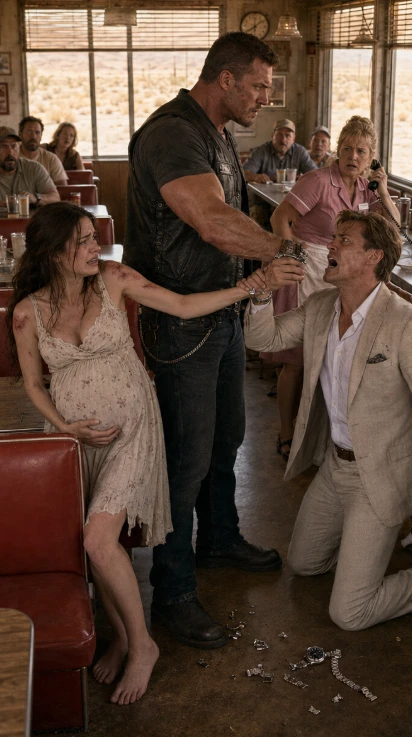
Silas stood over Richard without blinking, his hand still locked around the expensive wristwatch that had just snapped onto the diner floor. For one long second, nobody in the room breathed, and Clara pressed herself against the booth as if she still wasn’t sure whether this was rescue or the beginning of something worse. Then Richard glanced at the silent crowd, straightened what he could of his suit, and let a thin smile return to his face.
Richard looked at Clara, not at Silas. “Tell them what happens if you keep lying.”
Clara’s lips parted, but no words came out. Her eyes flicked to the door, then to Silas, then down to her own bruised arm as if she had just remembered something even more frightening than the man in front of her. And when Silas followed her gaze, he saw it too—the dark mark near her collarbone, and the way her other hand had already moved protectively over her stomach as Richard took one slow step forward again.
The woman burst out of the rusted Honda barefoot and pregnant, one hand clamped around the torn fabric at her shoulder, and every person at the Black Mountain Rest Stop saw enough to understand she was running for her life. Yet when she screamed for help, the desert went silent in a way that felt more cruel than the heat itself, because fear was not the only thing holding people back. Judgment was already choosing sides before the real monster had even stepped out of his car.
The Mojave Desert sun hung over the highway like a punishment. Heat trembled above the cracked asphalt, turning the distant road into a wavering silver ribbon, and the air smelled of dust, gasoline, and overcooked fryer oil drifting from the diner’s vents. Travelers moved slowly between cars and vending machines, shielding their eyes, wiping sweat from their necks, speaking in low, exhausted voices as if the desert had pressed its palm over everyone’s mouth.
Then the Harley arrived.
It came in from the west with a growl that rolled across the lot before the motorcycle itself appeared, deep and uneven, not like an engine so much as something alive warning the world not to stand too close. A few heads turned first. Then all of them did. The custom 1998 Harley-Davidson Fat Boy pulled into the far end of the lot, black paint sun-blasted at the edges, chrome flashing like broken glass, the rider sitting heavy and still in the saddle.
His name was Silas, though no one there knew it. To the strangers frozen between their SUVs and gas pumps, he was only a shape made of leather, scar tissue, and bad assumptions. He killed the engine, and the sudden silence felt worse than the noise, as if the desert itself had stopped breathing.
The kickstand struck the pavement with a metallic clink sharp enough to make a boy near the soda machine flinch. Silas stepped off the bike slowly, unfolding to his full height, six feet four inches of road-worn muscle beneath a black leather vest faded by sun and time. His arms were corded and scarred, his shoulders broad enough to block the glare, and his boots hit the asphalt with the calm weight of a man who had long ago stopped asking the world to make room for him.
But his size was not what made the tourists look away. It was his face.
A jagged scar tore from his right temple down along his cheek and disappeared near his jaw, pale and raised against skin weathered by years under open sky. It looked vicious, not like an accident but like a memory that had survived a war. His eyes were flat gray, cold and unreadable, the kind of eyes people invented stories about because it was easier than wondering what had put the emptiness there.
A mother quietly reached over and pulled her daughter closer. A man in a golf shirt locked his truck with a double beep, though Silas was twenty yards away and walking in the opposite direction. Someone near the pumps muttered something about bikers, and someone else gave a nervous laugh that died as soon as Silas glanced in their direction.
Silas heard all of it. He always did. Fear had a sound; contempt had another. He had lived long enough to know the difference, and he had also lived long enough to stop caring which one people chose when they looked at him.
He crossed the lot without hurry, passing between families, retirees, truckers, and college kids who suddenly found reasons to check their phones. The diner door swung open under his hand, and the cheerful bell above it jingled in a bright little burst that sounded almost insulting. Inside, the air-conditioning hit him first, then the smell of coffee, grilled onions, and old grease.
The diner was narrow and sun-faded, with red vinyl booths along one wall, a long counter on the other, and a cracked tile floor polished by thousands of passing feet. A waitress in her late fifties paused with a coffee pot in one hand and a forced smile on her face. Conversations dipped when Silas entered, not ending completely, just lowering into the cautious murmur people used around danger they did not understand.
He did not ask for attention. He only took the farthest booth, the one with his back near the wall and his view on the door, because old habits were harder to kill than men. The waitress came over, poured coffee without asking, and slid a laminated menu toward him.
“Anything else, honey?” she asked, trying to sound normal.
Silas looked at the coffee, then at her name tag. Marlene. Her hand shook a little when she set the cup down, but she did not step back from him the way others did.
“Black is fine,” he said.
His voice was low and gravelly, roughened by cigarettes, dust, and years of swallowing words before they became regrets. Marlene nodded and moved away, glancing once at the scar and then choosing, deliberately, not to glance again. Silas noticed. He noticed everything.
Outside, life resumed in pieces. A family argued over snacks. A trucker leaned against his cab, speaking into a phone. A man in a crisp polo shirt stood near the entrance with an iced coffee, laughing too loudly at something his wife had said. The highway stretched beyond them all, empty and glittering, leading nowhere kind.
Silas wrapped one hand around the coffee cup and let the heat settle into his palm. He had not planned to stay long. He never did. Rest stops were for fuel, caffeine, and moving on before the eyes became too heavy to ignore.
Then tires screamed across the pavement.
The sound knifed through the diner so violently that every head snapped toward the windows. Outside, a rusted blue Honda Civic swerved into the lot and stopped crooked across two spaces, its front bumper trembling, its engine coughing like it might die from fear. For a second, no one moved. Then the driver’s door flew open.
Clara stumbled out.
She was twenty-eight, though terror had pulled her face older. Her dark hair clung damply to her cheeks, her lips were split, and her dress hung torn at one shoulder, the pale fabric smeared with dirt. She was heavily pregnant, one arm curved instinctively beneath the round weight of her belly, the other reaching blindly for balance as her bare feet touched the burning pavement.
A sound went through the crowd, not sympathy exactly, but surprise sharpened by discomfort. Clara staggered away from the car as if something inside it were still chasing her. Her eyes darted from face to face, pleading before her mouth could form the words.
“Please,” she choked, stopping in front of the man with the iced coffee. “Please help me.”
The man looked at her bruise first. It spread across her collarbone in darkening purple, ugly against her skin. Then he looked at her belly, her torn dress, her shaking hands, and finally beyond her to the road, searching for an explanation that did not require him to become involved.
“I—I don’t know what’s going on,” he said, stepping back.
Clara reached toward him, not touching, just begging the space between them. “He’s coming. Please, call someone. Don’t let him take me.”
His wife took his arm. “Maybe we shouldn’t get involved.”
Clara turned to a woman holding a small dog, then to an elderly couple, then to a young man in sunglasses leaning against a vending machine. Every face tightened, softened, and closed in the same sequence. People saw the danger. Then they saw the inconvenience. Then they chose the version of themselves that would be easiest to live with for the next ten minutes.
Inside the diner, Silas set his coffee down.
He watched through the window as Clara moved from stranger to stranger, leaving faint dusty footprints on the pavement. Her breathing came too fast. Her body leaned forward in that particular way of someone who had already run past exhaustion and was being held up only by terror. When she turned, the sunlight caught the side of her neck, revealing another bruise, older and yellowing beneath the fresh one.
The bell above the diner door jingled as two teenagers slipped inside, whispering and staring back at the parking lot. Someone at the counter said, “Looks like trouble.” No one answered.
Then the black Range Rover arrived.
It glided into the lot with polished arrogance, silent compared to the Honda, its paint reflecting the sun in flawless sheets. It pulled in behind Clara’s car, blocking it neatly, deliberately, leaving no space for escape. The driver’s door opened, and Richard stepped out.
He was handsome in the curated way of men who knew mirrors had always been kind to them. His linen suit was pale and tailored, his sunglasses expensive, his shoes absurdly clean for a desert rest stop. He looked like a man who belonged at charity dinners, courthouse fundraisers, and golf courses where judges laughed at his jokes before he finished telling them.
“Clara, darling,” he called, his voice smooth enough to make the words sound affectionate to anyone who wanted them to be. “You’re frightening people.”
Clara froze.
That was the first thing Silas noticed—not that she looked afraid when Richard appeared, but that she stopped moving completely, as if her body had learned stillness could sometimes reduce damage. Her hand tightened under her belly. Her lips parted, but no sound came out.
Richard approached slowly, raising both hands in a gesture of harmless apology to the onlookers. He smiled at the man with the iced coffee, then at the elderly couple, then toward the diner windows, performing concern with practiced ease.
“I’m so sorry, everyone,” Richard said. “My wife has had a difficult morning. Pregnancy can be very hard emotionally. She’s been confused.”
Clara shook her head, small and frantic. “No. No, please, that’s not true.”
Richard’s smile did not change, but his eyes did. The warmth vanished from them so quickly that only Clara seemed to catch it. Silas caught it too, from behind diner glass and across twenty yards of heat.
Richard kept his voice gentle. “Sweetheart, you left the house barefoot. You nearly caused an accident on the highway. Let’s not turn this into something uglier than it needs to be.”
“She’s bleeding,” a teenage girl whispered from inside the diner.
Her father gave her a warning look. “Quiet.”
The man with the iced coffee cleared his throat. “Sir, maybe you should take her somewhere. Hospital, maybe.”
Richard turned toward him with grateful sadness, as if relieved someone rational had finally spoken. “Exactly. Thank you. That’s what I’ve been trying to do. She has refused medical advice before. There’s a history here.”
That was all it took. History. Medical advice. Hormones. Unstable. The words settled over the parking lot like dust, coating what people had seen with what they preferred to believe. Clara’s torn dress became evidence of a breakdown. Her bruises became something explainable. Her terror became an embarrassment.
The crowd did not need Richard to prove she was lying. They only needed him to look more believable than her pain.
Clara understood the shift as it happened. Silas saw it pass across her face, that second kind of fear, the one that comes when a victim realizes the room has chosen the abuser because he speaks more calmly. She backed away, first one step, then another.
Richard’s jaw tightened.
“Clara,” he said softly.
She turned and ran for the diner.
The door burst open hard enough to slam against the wall. The bell shrieked above her head as Clara stumbled inside, one hand braced against the nearest booth, her chest heaving. Every customer stared. The air-conditioning made her shudder violently, sweat cooling on her skin.
“Please,” she said, looking from face to face. “Please call the police. He’s going to kill me.”
No one moved.
Marlene stood behind the counter with the coffee pot still in her hand. Her eyes went to Clara’s bruised collarbone, then her swollen belly, then to the front door as Richard entered behind her with the calm disappointment of a man arriving late to a meeting.
“Now you’ve upset everyone,” Richard said.
His tone was quiet, but there was possession in it. He did not look like a man chasing his wife. He looked like a man retrieving property that had rolled under a table. He walked to the counter, drew a hundred-dollar bill from his wallet, and placed it beside the register with two fingers.
“Drinks are on me,” he said, smiling at Marlene. “I apologize for the disturbance.”
Marlene did not touch the money. “Sir, she asked us to call the police.”
Richard’s smile thinned. “And you’re welcome to, if you feel that’s necessary. But I promise you, this is a family matter complicated by mental health concerns. I have documentation in the car.”
The word documentation did what money had not quite finished. It made the situation sound official. It gave cowards a legal-sounding place to hide.
Clara shook her head violently. “He keeps papers for everything. He makes everything look clean.”
Richard sighed, and the sound was theatrical, weary, almost loving. “This is exactly what I mean.”
He reached her then.
Clara tried to pull away, but Richard’s hand closed around her upper arm, fingers digging precisely into the tender place where bruises were already blooming. Her face twisted in pain before she could stop it, and a raw scream tore from her throat.
It filled the diner. It hit every wall. It entered every person there.
And still no one moved.
The man in the polo shirt looked down at his iced coffee as if the plastic cup had become fascinating. The elderly couple stared at their plates. The teenage girl’s eyes filled with tears, but her father gripped her wrist under the table. A trucker near the counter shifted his weight, then looked toward Richard’s watch, his suit, his car through the window, and decided silence was safer.
Clara gasped, “You’re hurting me.”
Richard leaned close enough that only she should have heard him. “You should have thought of that before embarrassing me.”
Silas heard him.
The booth creaked as Silas moved, but he did not stand yet. He simply extended one arm across the aisle with terrible calm, and his hand closed around Richard’s wrist.
The effect was immediate.
Richard stopped pulling. His eyes dropped to the hand gripping him, then rose to Silas’s face. The diner seemed to shrink around them. Clara froze, Richard froze, and every person who had pretended not to see suddenly saw nothing else.
Silas’s fingers tightened.
The links of Richard’s expensive watch snapped one by one, tiny metallic cracks in the suffocating silence. The broken watch slid loose and struck the tile floor with a bright clatter.
“The lady,” Silas said, his voice low enough to make people lean away from it, “doesn’t seem to want to go with you.”
Richard stared at him, stunned first by pain, then by insult. His polished mask slipped just enough for ugliness to show beneath it. “Let go of me.”
Silas did not.
Richard tried to yank free, but Silas’s grip did not shift. It was not dramatic. It was not fast. It was worse than that. It was immovable.
“Do you have any idea who I am?” Richard demanded.
Silas looked at him with those flat gray eyes. “No.”
Richard’s face flushed. “Then you should learn quickly. I know sheriffs. I know judges. I could ruin you before sundown.”
Silas rose.
The movement changed the room. Sitting, he had been large. Standing, he became something that belonged to storms and old warnings. His shoulders blocked the window light, throwing Richard’s pale suit into shadow, and for the first time since arriving, Richard looked small.
Clara stepped back from them, clutching her arm, breathing in shallow bursts. Silas did not take his eyes off Richard. He twisted the trapped wrist just slightly, not enough to break it, enough to make Richard’s knees soften.
Richard made a sound he would have denied until his grave.
Silas leaned closer. “I know exactly what you are.”
“You assault me in front of witnesses, and you’re finished,” Richard hissed through his teeth.
Silas’s scarred face remained inches from his. “I have spent my life meeting monsters who wear clean shirts and speak in full sentences. They all think the same thing. They think a suit turns cruelty into authority.”
Richard swallowed.
Silas tightened his grip once more, and Richard’s breath hitched. “But out here in the dirt, money doesn’t make a sound.”
A chair scraped at the back of the diner. Someone whispered, “Jesus.” Marlene had finally reached for the phone behind the counter, her fingers moving quickly over the buttons. Richard noticed and snapped his head toward her.
“Don’t you dare,” he said.
Silas moved before the words finished leaving Richard’s mouth. He stepped between Richard and the counter, dragging Richard with him by the wrist as easily as if he were moving a stubborn child.
Marlene lifted the phone to her ear and spoke with a steadiness that made her look ten years younger. “I need police and an ambulance at Black Mountain Rest Stop. Pregnant woman injured. Domestic assault in progress.”
Richard’s face changed completely then. Charm vanished. The grieving husband, the patient caretaker, the respectable man—every one of those costumes burned away, leaving only rage. He looked at Clara with such hatred that she recoiled against the booth.
“You stupid girl,” he spat. “Do you know what you’ve done?”
Silas shoved him back one step, still holding the wrist. “Look at me.”
Richard ignored him. “You think anyone will believe you? After everything your doctor wrote? After the calls? After the neighbors saw you screaming?”
Clara’s face drained of color.
Silas caught that too. The words had landed somewhere deep, somewhere prepared. Richard was not improvising. He had built this cage long before she ran from it.
Marlene spoke into the phone, giving details. Outside, people had begun gathering near the windows, no longer pretending not to watch. The man with the iced coffee stood in the doorway, pale and useless, his wife pressed behind him. The teenage girl had escaped her father’s grip and was filming with trembling hands.
Richard saw the phone camera and tried to straighten. He adjusted his voice, smoothness returning by force. “This is a private medical emergency. My wife is not well. You are all exposing yourselves to liability by interfering.”
Clara’s laugh broke out of her like something cracked. It was not amusement. It was disbelief sharpened to pain.
“He told my doctor I was imagining things,” she said, her voice shaking. “He told my sister I was dangerous. He told my boss I was having episodes so they would stop answering my calls.”
Richard’s eyes flicked toward her. “Stop.”
Clara pressed one hand to the booth, fighting to stay upright. “He took my phone two days ago. He locked the back gate. He said if I left, he would tell everyone I was unstable and have the baby taken from me.”
A silence followed that was different from the first. The earlier silence had been avoidance. This one had weight. People were beginning to understand that their refusal to act had not been neutral. It had been participation.
Richard laughed once, sharp and false. “Listen to her. Listen to how paranoid that sounds.”
Clara turned toward the room, tears streaking clean lines through the dust on her face. “There are cameras in the house. He watches me from his office. He changed the security codes. He keeps my car keys in a safe.”
Richard lunged toward her.
He got less than one foot.
Silas wrenched him back and slammed his palm flat against Richard’s chest, pinning him against the edge of the counter hard enough to rattle the cups stacked near the register. Richard sucked in air, stunned more by humiliation than pain.
For the first time, the man who had controlled every room he entered was trapped in one where his money could not reach the walls.
“Touch her again,” Silas said, “and you’ll leave here with more than a broken watch.”
The diner held still. No one doubted him. Not Richard, not Clara, not the strangers who had spent the last several minutes rehearsing excuses inside their heads.
Richard’s mouth tightened. “You’re threatening me.”
Silas looked down at him. “No. I’m explaining the weather.”
Outside, the desert wind pushed dust across the lot in pale sheets. Sirens were not audible yet, but the promise of them had entered the room. Richard knew it. He began calculating again. His eyes moved from Marlene to the phone camera to the customers, measuring damage, building his next story.
Then Clara made a sound, soft and terrified.
Silas turned his head.
She had lowered herself into the nearest booth, both hands around her belly. Her face had gone gray beneath the sweat and bruises. Marlene dropped the phone cord and hurried around the counter with surprising speed.
“Sweetheart?” Marlene said. “Talk to me.”
Clara tried to breathe, but the breath caught. “Something’s wrong.”
Richard’s expression flickered. Not concern. Irritation.
“She does this,” he said quickly. “Panic attacks. She exaggerates pain.”
Clara’s eyes filled with horror. “No. No, this is different.”
Marlene looked at the floor beneath the booth and went still. A small dark stain had appeared where Clara’s dress met the vinyl seat. For one second, the waitress’s face showed everything: fear, anger, and the immediate knowledge that the situation had moved beyond argument.
Marlene turned sharply. “Ambulance, now. Tell them there may be pregnancy complications.”
The phone was still connected. Someone behind the counter repeated the words to dispatch with a voice shaking so badly it almost broke.
Richard’s patience snapped. “This is absurd. She is my wife. I am taking her to my doctor.”
Silas did not look away from Clara. “You’re not taking her anywhere.”
Richard’s smile returned, but it was broken now, all teeth and fury. “And what are you going to do? Kidnap her from her husband?”
Silas bent, picked up Richard’s keys from where they hung halfway out of his pocket, and tossed them across the diner. They skidded under the far counter. Then he took Richard by the back of the collar and marched him toward the door.
Richard fought once, twisting hard, but Silas drove him forward with one controlled shove. The door burst open, the bell shrieking again, and heat rushed into the diner like an animal. Outside, the gathered crowd scattered as Silas forced Richard down onto the dust beside the Range Rover.
“Sit,” Silas said.
Richard stumbled but stayed upright, face blazing. “You’ll regret this.”
Silas shoved him once more, and Richard landed on the ground in his linen suit, palms scraping against gravel.
“I said sit.”
For a moment, everyone saw the impossible image: the immaculate man in the dirt, the outlaw standing over him, the pregnant woman behind diner glass trying not to collapse. Phones rose now. People were finally eager to record what they had been unwilling to stop.
Richard looked around at them, his humiliation fermenting into panic. “You’re all witnesses to assault. You saw him attack me.”
The man with the iced coffee stepped back again, cowardice still reflexive. But then the teenage girl lifted her phone higher.
“I recorded you grabbing her,” she said, voice trembling. “I recorded what you said.”
Her father whispered her name sharply, but she did not lower the phone. Her eyes stayed on Richard with a kind of frightened disgust that seemed to steady her.
Marlene appeared in the doorway behind Silas, one arm around Clara’s shoulders. “I told dispatch everything.”
Richard’s gaze snapped to Clara. “You’re done. Do you hear me? You’ll never see that baby without me standing in the room.”
Clara flinched as if struck.
Silas stepped closer to Richard, placing himself directly between them. “Look at her again like that, and I’ll bury your teeth in this parking lot.”
Richard shut his mouth.
The threat was ugly. It was also, for the first time that day, honest enough for everyone to understand. Nobody called Silas respectable. Nobody mistook him for gentle. But he had drawn the only line in that entire place that protected the person who needed protection.
Minutes stretched under the sun. The highway hummed in the distance. The air-conditioning from the diner leaked weakly through the open door, mixing with dust and hot metal. Richard sat in the dirt, breathing hard, his suit collecting stains, his face stripped of every mask except hatred.
Silas stood over him like a silent wall.
Inside, Clara remained in the booth with Marlene kneeling beside her, a damp towel pressed to her forehead. The teenage girl’s mother had finally brought water. The trucker had moved a chair to block the aisle so Clara had more room. Small acts, late acts, ashamed acts, but acts at last.
Clara looked through the window at Silas. He did not look back often. When he did, his face softened so little that most people would have missed it. Clara did not. People who live with danger learn to read the smallest changes in a room.
The first police cruiser arrived with lights flashing but no siren. Then another followed. Two officers stepped out, hands near their belts, eyes immediately drawn to Silas standing over Richard like the cover of a warning pamphlet.
Richard saw salvation and began performing before they reached him.
“Officers,” he shouted, scrambling halfway up. “Thank God. This man attacked me. My wife is suffering a severe psychiatric episode, and these people have interfered with my ability to get her medical care.”
One officer looked from Richard to Silas. “Sir, step back.”
Silas did. Slowly. He raised both hands just enough to show they were empty, then moved three steps away from Richard. He knew what he looked like. He knew how quickly rooms, courts, and cops made decisions when men like him stood near men like Richard.
Richard seized the moment. “You need to arrest him. He assaulted me, stole my keys, and prevented me from helping my wife.”
The second officer looked toward the diner windows, where half a dozen phones remained pointed outward. Marlene came through the door, furious and shaking.
“That man grabbed her hard enough to make her scream,” she said, pointing at Richard. “She begged for help. He told everyone she was unstable. She’s pregnant and injured, and there’s blood.”
The officer’s expression changed. “Where is she?”
“Inside,” Marlene said. “Ambulance is coming.”
Richard stepped forward. “I am her husband. I need to be with her.”
“No,” Clara said from the doorway.
The word was quiet, but everyone heard it.
She stood with one hand braced on the frame and Marlene’s arm around her waist. Her face was pale, her lips trembling, and she looked seconds away from falling. But her eyes were fixed on Richard with a clarity that made him stop moving.
“No,” Clara repeated. “I don’t want him near me.”
Richard’s face tightened. “Clara, don’t make this worse.”
She swallowed, and the movement seemed to hurt. “You made it worse when you locked me in the bedroom. You made it worse when you took my phone. You made it worse when you told everyone I was crazy so no one would believe me.”
The first officer turned toward Richard. “Sir, stay where you are.”
Richard raised his hands, laughing in disbelief. “You’re taking this seriously? Look at her. She’s hysterical.”
The teenage girl stepped forward, holding out her phone. “I have video.”
Then the trucker spoke. “I heard him threaten her.”
The man with the iced coffee opened his mouth, closed it, then looked at his shoes. His wife nudged him hard enough to make him stumble.
He finally said, barely audible, “She asked me for help before he got here.”
Clara looked at him, and the pain in her expression was worse than anger. It said she remembered his retreat. It said she would always remember.
The truth did not arrive like lightning. It arrived piece by piece, dragged into the open by people trying to repair the moment when they had failed her.
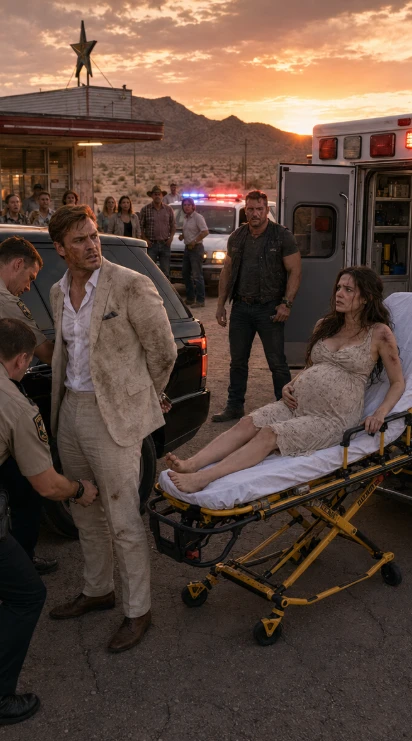
The ambulance pulled in then, siren chirping once as it stopped near the diner. Paramedics moved fast, guiding Clara back inside, asking questions, checking her blood pressure, easing her onto a stretcher. She gripped Marlene’s hand until the waitress had to walk beside her, murmuring that she was all right, that help was here, that she was not alone now.
Richard tried once more to follow.
Silas moved half a step.
That was enough.
The officer intercepted Richard before Silas had to touch him. “Sir, I said stay back.”
Richard’s voice lowered, deadly and controlled. “Officer, you are making a mistake that will cost you.”
The officer’s jaw hardened. “Turn around.”
Richard blinked. “Excuse me?”
“Turn around and put your hands behind your back.”
The parking lot went very still again, but this time the silence did not protect Richard. It watched him lose.
Richard laughed. “You can’t be serious.”
The officer took his arm. Richard tried to pull away, and the second officer moved in at once. Within seconds, the man who had arrived polished and untouchable was bent over the hood of his Range Rover with his wrists locked behind him. The click of handcuffs carried across the lot with almost the same sharpness as Silas’s kickstand had earlier.
Clara heard it from the stretcher.
Her eyes closed.
Not in peace. Not yet. But in the first fragile release of a body realizing the chase had stopped.
As the officers searched Richard, one of them found a second phone in his jacket pocket. Then another set of keys. Then a small remote tagged with a security company logo. Clara, half-conscious but alert enough to see it, began shaking.
“That’s the gate remote,” she whispered to the paramedic. “He said I couldn’t leave unless he opened it.”
The officer held it up, his expression darkening. “Ma’am, is there anything else we need to know?”
Clara looked at Richard, then away. Her voice thinned with fear and exhaustion. “There are files in his office. He records everything. He said if I ever told anyone, he’d make me disappear inside a diagnosis.”
Richard twisted against the cuffs. “Shut up.”
Silas stepped toward him, but the officer beat him to it, pushing Richard back against the car.
“Do not speak to her,” the officer said.
Richard’s control cracked completely. “She is my wife.”
Clara lifted her head from the stretcher with visible effort. Her hair stuck to her cheek, her bruises dark against the fluorescent ambulance light, but something in her face had changed. Fear was still there. Pain was still there. But beneath both, a new thing had begun to stand.
“No,” she said. “I was your prisoner.”
No one moved.
The words seemed to travel across the parking lot and settle in every chest. The teenage girl lowered her phone. Marlene pressed a hand to her mouth. The man with the iced coffee looked like he might be sick.
Richard stared at Clara with such hatred that the second officer stepped between them without being asked.
Then the paramedics loaded Clara into the ambulance.
Silas remained near his Harley, a few yards away from the crowd, as if there were an invisible border between him and everyone else. He had done what needed doing, and now he had returned to the edge where people preferred him. The sun had begun to lean west, turning the desert gold and cruelly beautiful, throwing long shadows across the lot.
Marlene approached him first.
She carried the hundred-dollar bill Richard had left on the counter. Without a word, she folded it once, then twice, and shoved it into the trash can beside the diner door.
Silas watched her.
Marlene wiped her eyes with the heel of her hand. “Coffee’s on the house if you want another.”
Silas glanced toward the ambulance. “I’m fine.”
“She might not have made it out of here if you hadn’t stood up.”
He said nothing.
Marlene studied his scar, not with fear this time, but with the sorrow of someone old enough to recognize that some wounds came from standing between violence and someone smaller. “You knew what he was.”
Silas looked across the lot at Richard being guided into the back of a cruiser. “I knew the shape of it.”
That was all he offered.
The ambulance doors remained open while the paramedics secured Clara. She turned her head toward the window, searching until she found him. Silas stood beside the Harley, one hand resting on the handlebar, his scar lit by the lowering sun. To anyone else, he still looked terrifying. To Clara, he looked like the first solid thing in a world that had been shifting under her feet for months.
She raised her hand weakly.
Silas did not move at first.
Then he stepped closer to the ambulance, stopping just outside the open rear doors. A paramedic adjusted a monitor while Marlene stood nearby, pretending not to cry. Clara’s eyes held his with a question too large for a stranger.
“Why?” she whispered.
Silas looked down at his boots, then at the desert beyond the rest stop. For a moment, he was not there. He was somewhere far older, in another room, another year, with another woman begging someone to believe her.
His mother had been smaller than Clara, with hands rough from cleaning houses and a laugh that vanished months before she died. Silas had been sixteen when she came to his room with a split lip and told him not to interfere. He had interfered anyway, too late, too young, too full of rage and not enough strength. The scar on his face had come from that night. The silence in his eyes had come from the morning after.
He touched the raised line along his cheek with two finger