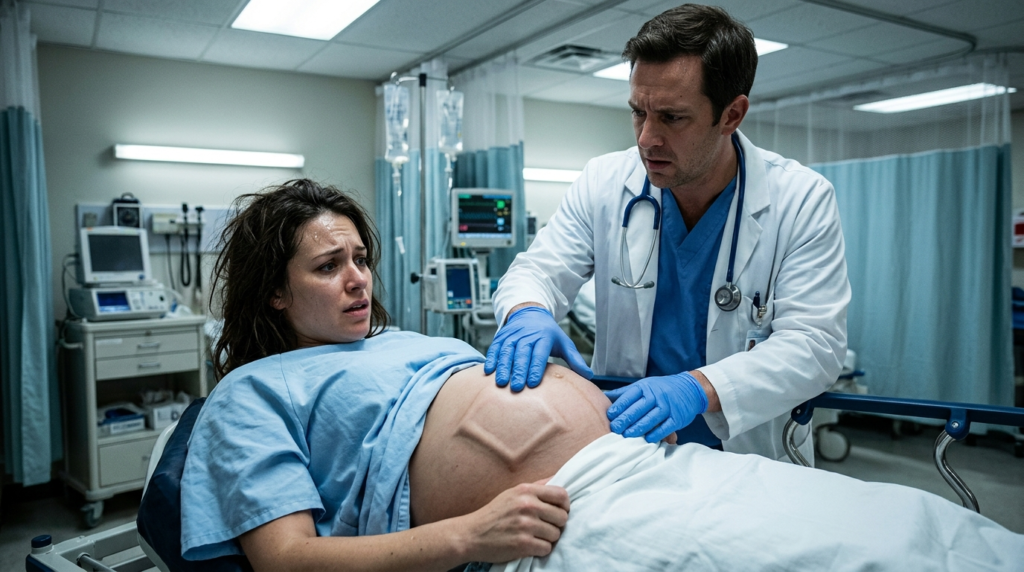
I have worked the graveyard shift in emergency medicine at Chicago Memorial Hospital for over twelve years, but absolutely nothing could have prepared me for the freezing, unnatural mass I found hiding beneath a terrified expectant mother’s skin.
You think you get used to the horrors. You think that after a decade of gunshot wounds, multi-car pileups, and the general chaos of a sprawling American city at 3:00 AM, your blood stops running cold. You build a wall. You learn to detach. You learn to look at a patient as a puzzle to be solved rather than a human tragedy unfolding in real-time.
But every doctor has that one case.
The one case that slips through the cracks of your armor. The one that keeps you staring at the ceiling fan at four in the morning, wondering about the sheer depths of human depravity. For me, that case walked through the sliding glass doors on a blistering Tuesday night in late January.
Outside, a brutal midwestern blizzard was hammering the city. The snow was falling so thick and fast that it looked like television static under the harsh orange glow of the streetlights. Our ER was unusually quiet. The storm had forced most people to stay off the roads. The waiting room was mostly empty, save for a few sleeping homeless folks seeking refuge from the sub-zero temperatures and a teenager with a sprained ankle.
I was standing by the nurses’ station, holding a lukewarm cup of bitter hospital coffee, charting some notes from an earlier case. The hum of the fluorescent lights was the loudest sound in the room.
Then, the automatic doors hissed open.
A blast of freezing, snowy air rushed into the lobby, scattering a stack of intake forms on the triage desk. I looked up.
A couple stood in the entryway.
The man was tall, broad-shouldered, and immaculately dressed despite the weather. He wore a heavy wool overcoat, leather gloves, and expensive boots. His posture was rigid, his jaw set. But it was his grip that immediately caught my attention. His right hand was clamped around the woman’s upper arm. Not a supportive, guiding touch. It was a vice grip. His knuckles were practically white.
The woman looked like she was barely holding onto consciousness.
She appeared to be in her late twenties, though her face was so pale and drawn it was hard to tell. Her blonde hair was matted with melted snow and sweat, clinging to her forehead. She was wearing a thin gray sweatpants set that was entirely inappropriate for the Chicago winter, and a poorly fitted winter coat that wouldn’t zip up.
It couldn’t zip up because she was heavily pregnant.
I mean, heavily. Her abdomen protruded massively, stretching the fabric of her shirt to its absolute physical limits. To my experienced eye, she looked at least eight and a half months along, maybe even full term. But something about the shape of it was subtly wrong. It was too high, too rigid.
Advertisement
She was trembling violently. Not just from the cold, but from deep, agonizing spasms. She wasn’t making a sound, but tears were continuously spilling over her eyelashes and cutting tracks through the grime on her cheeks.
I put my coffee down immediately. My instincts kicked into overdrive.
“Triage,” I muttered to Nurse Brenda, who was already on her feet, grabbing a wheelchair.
We rushed over to the couple. Brenda practically slid the wheelchair under the woman before she collapsed. The moment the woman’s weight settled into the chair, she let out a sharp, choked gasp, curling inward, wrapping her arms around her massive belly protectively.
“What’s going on? How far along is she?” Brenda asked, her voice calm but authoritative.
The woman opened her mouth to speak, her lips cracked and blue, but the man cut her off instantly.
“She’s having severe abdominal pains,” the man said smoothly. His voice was deep, perfectly modulated, completely at odds with the frantic situation. He didn’t look at his wife; he looked directly at me. “It’s just complications. She’s been having a difficult third trimester. We need to see a doctor immediately. Give her something for the pain.”
“I am a doctor,” I said, stepping forward. “I’m Dr. Hayes. Sir, I need you to let go of her arm.”
He held on for a fraction of a second too long before slowly releasing his grip. The fabric of her sweatshirt remained wrinkled where his fingers had dug in.
“Okay, let’s get her into Trauma 3,” I instructed Brenda. I knelt down slightly to catch the woman’s eye. “Ma’am? Can you tell me your name?”
Her eyes darted frantically to the man, then back to me. They were wide, dilated, and filled with an absolute, primal terror. She didn’t say a word. She just gave a tiny, almost imperceptible shake of her head.
“Her name is Sarah,” the man said, his tone sharpening. “And I’m her husband, Mark. I’ll be coming back with her.”
“Actually, sir, standard hospital policy for labor and delivery complications requires us to do an initial assessment alone,” Brenda lied smoothly, reading the exact same red flags I was. “You can wait right here at the desk and fill out her intake paperwork.”
Mark’s friendly facade cracked. His eyes narrowed, and his body language became aggressively dominant. “I’m not leaving my wife. She’s distressed. She needs me.”
“Mr. Mark,” I stepped between him and the wheelchair, squaring my shoulders. I’m not a small guy, and I wasn’t in the mood to play games. “Your wife is in acute medical distress. I need to get her on a monitor right now to check the baby’s heartbeat. You standing here arguing with me is wasting precious time. Paperwork. Now. We will come get you in five minutes.”
He glared at me, a cold, dead stare that made the hair on the back of my neck stand up. But there were two security guards standing by the metal detectors, and he knew it. He let out a harsh breath, his jaw tightening.
“Fine. Five minutes, Doctor. Do not do anything without my consent.”
Brenda spun the wheelchair around, and we hurried down the long, bright corridor toward the trauma bays. The moment the heavy wooden door of Room 3 clicked shut behind us, the atmosphere in the room shifted. It was as if the air had suddenly been sucked out.
Sarah let out a pathetic, ragged sob.
“It’s okay, Sarah,” I said, keeping my voice low and soothing. “You’re safe here. He’s out in the waiting room. He can’t come in.”
Brenda was moving quickly, hooking up blood pressure cuffs and oxygen sensors. “I need to get a fetal monitor on you, honey,” Brenda said softly. “Can you lay back for me?”
Sarah shook her head violently, pressing her back against the wall next to the examination bed. She was hyperventilating now, clutching her swollen stomach with both hands. Her knuckles were white.
“No… no, please,” she whispered. Her voice was raspy, broken. “You don’t understand. You can’t.”
“Sarah, you’re in a lot of pain,” I said, taking a step closer, raising my hands to show I wasn’t going to force her. “I’m looking at your abdomen. The skin is dangerously stretched. I need to make sure the baby isn’t in distress. Are you having contractions? Did your water break?”
“There’s no…” She choked on her words, coughing violently. “It hurts. It hurts so much. It’s tearing.”
Her blood pressure numbers popped up on the monitor. 160 over 100. Dangerously high. Her heart rate was sitting at 135 beats per minute. She was tachycardic. She was going into shock.
“Brenda, page OB-GYN, get Dr. Evans down here now,” I ordered.
“No!” Sarah screamed, suddenly lunging forward and grabbing the front of my scrubs. Her grip was surprisingly strong for someone so weak. “No more doctors! Don’t call anyone! He’ll kill me. He’ll kill me if he finds out I let you look!”
“Who will kill you? Mark?” I asked, my heart hammering in my chest. “Sarah, if you are in danger, I can call the police right now. We have officers downstairs.”
“No police!” she sobbed frantically, her eyes darting around the room as if he might be hiding in the cabinets. “He owns them. He owns everyone. Just… just give me painkillers. Please. Let me go back out there.”
“I can’t do that,” I said firmly, but gently. “You are medically unstable. I cannot release you. Sarah, whatever is happening, whatever he did to you, we can protect you. But I need to examine you. Right now.”
She let go of my scrubs and collapsed back onto the exam table. The fight just completely drained out of her. She looked at the ceiling, tears pooling in her ears. She looked like someone who had entirely given up on life.
“It’s too late,” she whispered. “It’s already inside me.”
I didn’t know what she meant. I assumed it was the delirium of pain, or perhaps psychiatric distress induced by domestic abuse. Pregnant women in abusive situations often suffer immense psychological trauma.
“I’m going to lift your shirt now, Sarah,” I told her, narrating my actions so I wouldn’t startle her. “I need to feel the position of the baby.”
She didn’t resist. She just closed her eyes and let her arms fall limp to her sides.
I pulled up the hem of her thin gray sweatshirt.
The first thing that hit me was the bruising. The lower half of her abdomen was a canvas of horrifying colors—deep purples, angry blacks, and sickly yellows. It looked like she had been repeatedly struck with a heavy object. But the bruising wasn’t random. It was localized around a jagged, poorly healed scar that ran horizontally across her lower belly. It wasn’t a standard C-section scar. It looked crude.
“Good god,” Brenda whispered from the other side of the bed.
“Sarah, who did this to you?” I asked, my voice barely containing my anger.
She didn’t answer.
I put on a fresh pair of latex gloves. “I’m going to press down now. Tell me where it hurts the most.”
I placed my hands gently on the top of her swollen stomach.
I have delivered dozens of babies in the ER. I know exactly what a pregnant abdomen feels like. It’s firm, yes, but there’s a distinct, organic yield to it. You can feel the fluid. You can feel the rounded curves of a human head, the sudden, sharp kick of a tiny foot. It feels like life.
The moment my fingertips pressed into Sarah’s flesh, my brain short-circuited.
There was no yield. There was no fluid.
My hands met a resistance that defied logic. The skin was stretched so tightly over whatever was underneath that it felt like it might split open right then and there. I pressed a little harder, trying to locate a fetal pole.
Instead, my index finger traced a perfectly straight, horizontal line.
I stopped breathing.
My heart slammed against my ribs. I moved my hands down, dragging my fingertips along the skin. The line turned at a perfect, sharp ninety-degree angle. It went down. Another ninety-degree angle.
It was a rectangle.
A large, perfectly rigid rectangle buried deep within her abdominal cavity. It was completely unyielding. It was cold. It felt dense, heavier than bone, and completely devoid of organic curvature.
I looked up at Sarah’s face. Her eyes were still closed, but more tears were leaking out.
“Doctor Hayes?” Brenda asked, noticing my frozen posture. “What is it? Is the baby breech?”
Advertisement
I couldn’t speak. I moved my hands to the center of the rectangular mass and pressed down flat. There was no heartbeat. There was no movement. There was just the undeniable, horrific sensation of solid plastic and metal pressing back against the fragile lining of her stomach.
I looked at the jagged, infected scar at the bottom of her belly.
Then I looked at the door leading out to the waiting room, where her husband was sitting.
There was no baby in there.
CHAPTER 2: The Assessment
I stood frozen beside the examination table, my hands still hovering inches above Sarah’s unnaturally swollen abdomen.
The silence in Trauma Room 3 was deafening, broken only by the rhythmic, frantic beeping of the heart rate monitor. The fluorescent lights above seemed to hum louder, casting harsh, clinical shadows across her pale, terrified face.
My mind was desperately trying to reconcile what my hands had just felt with what my eyes were seeing.
Medical school trains you for tumors. It trains you for ectopic pregnancies, for massive hernias, for bowel obstructions, and severe organ hepatomegaly. It trains you to identify the soft, yielding curve of a biological anomaly.
It does not train you to find sharp, rigid, ninety-degree corners buried beneath human tissue.
“Doctor?” Nurse Brenda’s voice sliced through my paralysis. It was tight, laced with an edge of panic I rarely heard from her. She had been an ER nurse for twenty years; she had seen it all. But she was looking at my face, and whatever she saw there terrified her. “Dr. Hayes. What is it? Talk to me.”
I swallowed hard. My throat felt like sandpaper.
“It’s not a baby,” I whispered. The words felt foreign leaving my mouth. I didn’t want to say them too loudly, almost as if saying them at full volume would make the nightmare real.
Brenda stepped closer, her brow furrowing. “What do you mean it’s not a baby? She’s clearly…” She trailed off as she looked down at the massive, protruding stomach, then at the crude, angry scar slicing across the bottom of it.
“Feel it,” I instructed, stepping back slightly to give her room. “Just… very gently. Palpate the upper quadrant.”
Brenda hesitated, then snapped on a fresh pair of purple nitrile gloves. She reached out, her hands trembling slightly, and pressed her fingertips against the taut, bruised skin just below Sarah’s ribcage.
I watched the exact moment her brain registered the impossibility.
Brenda gave a sharp, involuntary gasp and snatched her hands back as if she had been burned. Her eyes went wide, darting from the stomach to my face, then down to Sarah.
“That’s… that’s solid,” Brenda stammered, her professional composure cracking. “That feels like a box. A metal box. Dr. Hayes, what the hell is inside her?”
Sarah let out a low, agonizing moan. Her head rolled to the side, her eyes fluttering. She was drifting in and out of consciousness, her body shutting down from the sheer trauma of whatever had been done to her.
“I don’t know,” I said, my voice hardening as training took over. Panic is a luxury an ER doctor cannot afford. “But we are going to find out. Brenda, I need the portable ultrasound machine in here right now. Page Dr. Evans in OB-GYN again, tell her it’s a Code Crimson. And get me a portable X-ray unit. Stat.”
“What about the husband?” Brenda asked, already moving toward the door.
“Keep him out,” I ordered, my tone leaving no room for argument. “If he tries to come through those double doors, you tell security to put him on the floor. He does not get near this room.”
Brenda nodded sharply and slipped out the heavy wooden door, pulling it tightly shut behind her.
I turned my attention back to my patient.
“Sarah,” I said gently, leaning down close to her ear. “Sarah, stay with me. Open your eyes.”
Her eyelids fluttered, revealing bloodshot, unfocused pupils. Her breathing was shallow and rapid. The monitor showed her oxygen saturation was dropping to 89%.
“I’m going to put an oxygen mask on you,” I told her, grabbing a plastic non-rebreather mask from the wall unit and slipping the elastic band over her sweaty blonde hair. “Take slow, deep breaths for me.”
She fought the mask for a second, her hands weakly batting at my wrists, before exhaustion took over. She lay still, taking ragged breaths that fogged up the clear plastic.
I moved to the side of the bed and carefully inspected the horrific wound on her lower abdomen.
Now that I was looking at it closely, under the glaring examination lights, the reality of it made my stomach churn. It wasn’t just a crude incision. It was a butchery.
The cut spanned nearly ten inches across. The stitches holding it together were thick, black, and completely asymmetrical. They looked like heavy-duty nylon thread—the kind you would use to repair a canvas tent or an upholstery seam, not human skin. The tissue around the stitches was necrotic, fading from angry red to a sickly, gangrenous black.
Thick, foul-smelling yellow fluid was beginning to seep from the edges of the incision where the skin was stretching to its absolute breaking point.
She wasn’t just in pain. She was going into severe septic shock. Her body was desperately fighting a massive, overwhelming infection caused by a foreign object that had been violently shoved inside her abdominal cavity.
“You’re going to be okay,” I lied to her. It’s the lie we tell when the truth is too horrible to speak. “We’re going to help you.”
“He’ll know,” she rasped, her voice muffled by the oxygen mask. She reached out blindly, her fingers grabbing the edge of my scrub top. “He has a tracker. He knows everything.”
“A tracker?” I asked, my blood turning to ice. “Sarah, what is inside you? What did he put inside you?”
Before she could answer, the door flew open.
I spun around, my fists instinctively clenching, expecting to see Mark’s towering, furious figure.
Instead, it was Brenda, pushing the heavy portable ultrasound machine. Right behind her was Eddie, our senior radiology technician, maneuvering the bulky portable X-ray unit through the narrow doorway.
“X-ray is here, Doc,” Eddie said, his eyes immediately falling on Sarah’s abdomen. He stopped dead in his tracks. “Jesus Christ. Is she having multiples?”
“It’s not a pregnancy, Eddie,” I said curtly. “I need an AP and lateral view of the abdomen, immediately. Shield her upper chest. Let’s move.”
Eddie blinked, snapping out of his shock, and immediately began positioning the heavy lead plates and the X-ray arm.
While he worked, I grabbed the ultrasound probe and squirted a generous amount of blue conductive gel onto Sarah’s stretched, bruised stomach.
“I’m going to press down with the wand, Sarah. It’s going to be cold,” I warned her.
I pressed the transducer against the skin just above her belly button and looked up at the digital monitor.
Normally, an obstetric ultrasound is a cloudy, swirling mixture of greys and blacks. You look for the anechoic black pools of amniotic fluid, the bright white calcifications of fetal bones, the pulsing flutter of a tiny heart.
The screen in front of me showed none of that.
It was a solid, impenetrable wall of blinding white.
“What the hell is that?” Brenda whispered, standing over my shoulder.
In ultrasound imaging, sound waves bounce back when they hit something dense. Bone shows up bright white. Fluid shows up black.
The image on the screen was a massive, completely solid acoustic shadow. The sound waves couldn’t penetrate it at all. It was a massive brick of hyper-echoic material.
I slid the probe down, dragging it through the gel toward the horrible, infected scar.
The white line on the screen remained perfectly straight. Then, a sharp, distinct corner appeared.
“It’s a container,” I muttered, sheer disbelief washing over me. “It’s a literal box. Made of high-density plastic or polymer. The sound waves are completely bouncing off the surface. I can’t see what’s inside it.”
I moved the probe to the side, tracing the dimensions. It was enormous. At least twelve inches long, eight inches wide, and who knows how deep. It was taking up her entire abdominal cavity, pressing her intestines flat against her spine, pushing her stomach and liver up against her diaphragm.
That explained her shallow breathing. Her lungs literally had no room to expand. The object was suffocating her from the inside out.
“Doc, X-ray is ready. I need you to step back behind the lead shield,” Eddie called out.
I wiped the gel off Sarah’s stomach with a towel, my hands shaking slightly. “Hold still, Sarah. Just for a second.”
I stepped behind the rolling lead barrier with Brenda.
“Clear!” Eddie shouted, pressing the trigger. The machine buzzed loudly.
“Get the lateral view,” I ordered.
Eddie adjusted the machine, moving the plate to her side. “Clear!” Another loud buzz.
“Push those to the monitor right now,” I said, stepping back out from behind the shield.
Eddie tapped a few buttons on his console, and a second later, the two large screens on the wall illuminated with the stark black-and-white contrast of the X-ray films.
The silence in the room returned, heavier and more suffocating than before.
We all stared at the monitors. Nobody breathed.
The anterior-posterior view was horrifying enough. Sitting right in the center of her pelvic basin, dwarfing her skeletal structure, was a massive, dark, rectangular void. Its edges were perfectly straight, unnatural and stark against the organic curves of her spine and ribs.
But it was the lateral view—the side profile—that made my stomach drop into my shoes.
The box wasn’t just sitting there. It had been wedged forcefully behind her abdominal wall. You could see the horrific internal damage. Her organs were crushed. Her intestines were violently displaced.
But that wasn’t the worst part.
Inside the dark void of the box, the X-ray revealed faint, intricate shadows. Wires.
Intricate, coiled wires crisscrossing back and forth, connecting to a dense, solid, metallic cylinder right in the center of the plastic container.
“Dr. Hayes…” Eddie’s voice was a barely audible squeak. He took two steps backward, his eyes glued to the screen. “Is that… is that a bomb?”
My mind raced. I am a doctor. I fix broken bones, I stitch up lacerations, I stop bleeding. I don’t defuse explosives.
“I don’t know,” I said, my voice eerily calm as pure adrenaline flooded my system. “It could be a medical device. A battery pack. A motorized pump. I don’t know.”
“Who the hell sews a motorized pump inside someone with a needle and thread in a basement?!” Brenda hissed, her panic rising. “Doc, if that’s an IED…”
“We don’t know what it is,” I repeated, turning to look at Sarah.
She was looking at the monitors too. Tears were streaming down the sides of her face, pooling in her ears.
“Sarah,” I said, walking back to her bedside and leaning over her. “Sarah, you need to tell me what is inside you. Right now. Are we in danger? Is the hospital in danger?”
She shook her head weakly. “Not… not a bomb.”
“Then what are the wires? What is the cylinder?” I demanded, my professional detachment completely gone.
“It keeps… it keeps it cold,” she gasped, her eyes squeezing shut in agony. “It has to stay cold.”
A refrigeration unit.
Someone had surgically implanted a refrigerated, climate-controlled lockbox inside a living human being.
The implications of that hit me like a freight train. You don’t build a climate-controlled, surgically implanted vault to smuggle drugs. You don’t build it to smuggle money or weapons.
You build it to transport biological material.
Organs. Viruses. Or something far, far worse.
Suddenly, a loud, violent crash echoed from the hallway outside, making all of us jump.
It was followed by a man’s voice, roaring in fury.
“Get your hands off me! I want to see my wife!”
It was Mark.
“Brenda, lock the door,” I ordered instantly.
Brenda lunged for the heavy wooden door, turning the deadbolt just as a massive weight slammed against it from the outside. The wood splintered slightly around the hinges, but the lock held.
“Open this door!” Mark bellowed, his voice muffled but terrifyingly loud. He pounded a heavy fist against the wood. “Sarah! Tell them to open the door!”
“Sir, you need to step back!” I heard the muffled voice of one of our security guards shouting from the hallway. “We will use force!”
“You touch me again, rent-a-cop, and I will break your neck,” Mark’s voice dropped to a lethal, deadly calm. It was infinitely more terrifying than his shouting. “Dr. Hayes. I know you’re in there. You have three seconds to open this door before I put a bullet through it.”
Eddie dove to the floor, scrambling behind the heavy X-ray machine.
Brenda looked at me, her eyes wide with terror, her hands pressed against her mouth.
I looked at the X-ray on the wall. I looked at the crude, rotting stitches on Sarah’s abdomen. And I looked at the heavy door, bowing slightly under the pressure of the monster outside.
“Call the police,” I whispered to Brenda. “Code Silver. Active shooter protocol. Do it now.”
Brenda grabbed the wall phone with trembling hands and dialed the emergency extension.
“Sarah,” I said, grabbing her hand. It was ice cold. “I need you to tell me exactly what is in the box. Whatever it is, I have to know to save you.”
“You can’t save me,” she sobbed, coughing violently. Blood flecked the inside of her oxygen mask. Her internal bleeding was worsening. The sharp edges of the box were lacerating her organs. “The timer… it’s almost out.”
“What timer?” I asked, my heart hammering against my ribs.
“The battery,” she whispered, her voice fading rapidly. “If the battery dies… the lock opens.”
“And if the lock opens?” I pressed, leaning in closer.
She looked at me, her eyes wide and completely hollow. “Then it gets out.”
CHAPTER 3
“Then it gets out.”
Those four words hung in the freezing air of Trauma Room 3, heavier than the massive lead shields in the corner, colder than the Chicago blizzard raging outside.
Sarah’s eyes rolled back into her head. The heart monitor next to her bed went from a frantic, rapid rhythm to a chaotic, erratic screech.
“She’s crashing!” Brenda screamed, dropping the phone. “V-tach! She’s going into ventricular tachycardia!”
BANG.
A deafening explosion of sound ripped through the hallway just outside our door. It wasn’t a fist against the wood this time. It was a gunshot.
The heavy oak door splintered, a massive chunk of wood blowing inward, spraying jagged shrapnel across the sterile tiles. A perfectly round hole appeared dead center in the wood, surrounded by a spiderweb of cracking lacquer.
Eddie, the radiology tech, let out a high-pitched yell and scrambled tighter into a ball beneath the rolling X-ray console.
“Get down!” I roared at Brenda, grabbing her by the shoulder and dragging her down to the floor behind the metal cabinets.
I kept my hand firmly on the back of Brenda’s neck, my own heart threatening to beat its way out of my ribcage. The smell of cordite and burned gunpowder instantly flooded the room, overpowering the metallic scent of blood and the sterile chemical odor of the hospital.
“Code Silver,” the PA system above us clicked on. The automated voice was horribly, terrifyingly calm. “Code Silver. Emergency Department. Seek shelter immediately. Lock all doors.”
Outside in the hallway, absolute chaos erupted.
“Drop the weapon! Drop it right now!” a male voice bellowed. It sounded like one of our armed security officers, but his voice was cracking with pure adrenaline and terror.
“I want my wife!” Mark’s voice roared back, completely unhinged. He sounded like a wild animal. “Open this door or I blow your head off!”
BANG. BANG.
Two more shots echoed. The ceiling tiles outside rained down into the corridor with a wet crunch. Someone was screaming. I couldn’t tell if it was a nurse, a patient, or a guard.
My mind was spinning, fragmenting into a million different directions. I was trapped in a room with an active shooter on the other side of a wooden door. I had a young, violently abused woman dying on the table above me. And she had a mechanical, climate-controlled vault stitched into her organs that was counting down to something catastrophic.
“Dr. Hayes,” Brenda whimpered, her hands clamped tightly over her ears. She was trembling so violently her knees were knocking against the tiles. “He’s going to come in. He’s going to kill us.”
“He’s not,” I lied. The words felt like ash in my mouth.
Above us, the heart monitor began a steady, continuous tone.
BEEEEEEEEEEEEEP.
Sarah’s heart had stopped. The strain of the shock, the massive internal infection, and the sheer terror had finally caused her heart to simply give up.
My medical training violently overpowered my human fear.
I couldn’t just crouch here while a patient flatlined two feet above my head. I didn’t care if there was a gun pointed at the door. I didn’t care if a bioweapon was about to open up. I am an ER doctor. My job is to keep the human being in front of me alive.
“Stay here,” I hissed to Brenda.
I scrambled up from the floor, keeping my head ducked low beneath the level of the bullet hole in the door. I lunged for the crash cart parked against the far wall, tearing open the top drawer.
“Eddie!” I shouted over the blaring alarm. “I need hands! Now!”
Eddie was crying silently behind his machine, his face pale green. He shook his head wildly, pressing his back against the wall. He was completely paralyzed by fear.
“Eddie, if you don’t help me right now, she dies! Get up!” I screamed. It was the loudest I had ever raised my voice in twelve years of medicine.
The authority in my voice snapped him out of his trance. He crawled on his hands and knees, keeping his head down, until he reached the side of the bed.
“Start chest compressions,” I ordered, grabbing a syringe of epinephrine from the crash cart. “Hard and fast. Two inches deep. Do not stop until I tell you.”
Eddie climbed onto the step stool next to the bed, laced his fingers together, and began slamming his palms down onto Sarah’s chest.
Crunch. I heard the sickening sound of her ribs cracking under the force of the compressions, but it was necessary. You have to break ribs to save a life during CPR.
Outside the room, the chaotic shouting grew louder. But this time, I heard the distinct, heavy thud of tactical boots sprinting down the linoleum corridor.
“Chicago PD! Drop the weapon! Get on the ground!”
Multiple voices. Heavy armor. Flashlights sweeping across the glass window of our door.
“I’m not leaving without—” Mark’s voice was cut off by the terrifying, violent sound of a massive physical struggle. Bodies slamming into drywall. The clatter of a heavy metal object—a gun—skittering across the floor.
“Suspect is down! Cuff him! We need medics out here, we have a guard hit in the shoulder!”
The immediate threat of the shooter was neutralized, but the nightmare inside Trauma Room 3 was just beginning.
I injected the epinephrine directly into Sarah’s IV line, flushing it with a syringe of saline.
“Come on, Sarah,” I muttered, my eyes glued to the monitor. “Come back to us.”
“Doc, the box,” Eddie grunted between compressions, sweat pouring down his forehead and dripping onto his lead apron. “I can feel the box. Every time I press down on her chest, I can feel it pushing up against her diaphragm. It’s too big.”
He was right.
The plastic container was so massive that it was literally acting as a wedge, preventing her lungs from inflating and stopping the compressions from effectively squeezing her heart. We were trying to pump blood, but the box was crushing her inferior vena cava, blocking the blood from returning to her upper body.
“Hold compressions,” I commanded.
Eddie stopped. We all stared at the screen.
For three agonizing seconds, there was nothing but a flat green line.
Then, a tiny, weak spike. Then another.
The rhythm was incredibly slow, incredibly faint, but it was there. Her heart had restarted, but she was hovering right on the edge of the abyss. Her blood pressure was practically non-existent.
“She’s back, but she’s not stable,” I said, my voice tight.
I looked down at her swollen, bruised stomach. The crude, necrotic stitches were literally weeping yellow pus and dark, foul-smelling blood. The skin was stretched so tight it looked translucent, and I could clearly see the sharp, rectangular outline of the heavy plastic vault pushing against the underside of her flesh.
She was bleeding internally. The sharp edges of the box had lacerated her organs, and the infection was rapidly turning into fatal sepsis.
“We need to get her to surgery,” Brenda said, finally standing up from behind the cabinets. She was pale, but her nursing instincts were taking over. “I’ll call the OR. We need a trauma surgeon down here.”
“The hospital is on Code Silver lockdown,” I reminded her grimly. “The elevators are shut down. The fire doors are sealed. Nobody is coming down here, and we can’t take her up.”
“Then we wait for the police to clear the scene,” Brenda argued. “The SWAT team is right outside.”
“Brenda, look at the monitor,” I pointed a blood-stained glove at the screen. “Her pressure is dropping again. She is bleeding out into her abdominal cavity. If we wait for the all-clear, she will be dead in less than five minutes.”
“So what do we do?” Eddie asked, wiping sweat from his eyes.
I looked at the heavy, rusted needlework holding her abdomen together. I looked at the faint, glowing red light that was barely visible through her stretched skin, pulsing from somewhere deep inside the plastic box.
The timer… it’s almost out.
“We take it out,” I said.
Brenda stared at me as if I had lost my mind. “Here? In the ER? Dr. Hayes, this is a non-sterile environment. We don’t have anesthesia. We don’t have blood products. We don’t even know what that thing is!”
“I know it’s killing her,” I shot back, stepping up to the surgical tray and grabbing a bottle of Betadine. “And I know that whatever is inside it is about to get out. We have no choice.”
I didn’t wait for her to agree. I poured the dark brown iodine solution directly over Sarah’s lower abdomen, completely soaking the rotting stitches and the bruised skin.
“Brenda, get me a number ten scalpel, suction, and every piece of sterile gauze we have in this room. Eddie, you are on suction duty. When I open her up, there is going to be a massive amount of fluid. I need you to keep the field clear so I can see what I’m pulling out.”
Brenda hesitated for only a fraction of a second before her training kicked in. She ripped open a sterile emergency laparotomy kit and slapped a heavy metal scalpel into my outstretched palm.
“No anesthesia?” she asked quietly.
“She’s completely unconscious and her blood pressure is too low to survive sedatives anyway,” I said, positioning the blade at the right edge of the crude incision. “We have to go fast.”
I pressed the sharp steel into her flesh.
I didn’t need to make a fresh cut. I simply ran the blade under the thick, black nylon threads that Mark had used to sew her shut.
The moment I cut the first three stitches, the sheer pressure built up inside her abdomen forced the wound open violently.
A horrifying mixture of dark, coagulated blood and foul, infected fluid erupted from the incision, splashing onto my scrubs and pooling on the linoleum floor. The smell was indescribable—a sickening, sweet rot of gangrene mixed with the sharp tang of copper.
“Suction!” I yelled, gagging slightly.
Eddie jammed the plastic suction wand into the pooling blood. The machine gurgled loudly, working overtime to clear the horrific mess.
With the fluid cleared, the true extent of the nightmare was revealed.
Sitting squarely in the center of her pelvic basin, entirely coated in blood and organic matter, was a massive, grey, industrial-grade plastic case.
It looked like a heavy-duty tactical equipment box, the kind used by the military to transport sensitive electronics. It was roughly fourteen inches long, ten inches wide, and at least six inches deep. It had heavy metal hinges on one side and a thick, rubberized locking clasp on the other.
And buried right next to the clasp, covered in a thin membrane of human tissue, was a small digital display.
The numbers on the display were glowing a faint, angry red.
00:04:12.
Four minutes and twelve seconds.
“Oh my god,” Brenda whispered, stumbling backward. “It’s a timer. Dr. Hayes, it really is a bomb.”
“It’s a lock,” I corrected her, my hands shaking as I reached into the bloody cavity. “She said if the battery dies, the lock opens.”
I slid my gloved fingers down the sides of the massive plastic case. The tissue around it was completely necrotic. The box had been shoved in violently, displacing her intestines upward and crushing her bladder against her pelvic bone.
The plastic was freezing cold. It literally radiated a chilling, unnatural temperature that sapped the heat right out of my hands.
“It’s wedged in tight,” I grunted, trying to get a grip on the slick, bloody plastic. “Eddie, put the suction down. I need you to help me lift it.”
Eddie looked like he was about to pass out, but he stepped forward, plunging his hands into the horrific surgical field.
“On three,” I said. “One. Two. Three. Pull!”
We both heaved.
A sickening, wet suction sound echoed through the room as the massive box shifted against her internal organs. Sarah let out a terrifying, breathy groan, even though she was unconscious.
“It’s caught on something,” Eddie panicked. “It won’t come!”
I let go with one hand and reached deeper, feeling blindly beneath the heavy plastic.
My fingers brushed against something thick, wet, and pulsing.
“It’s tangled in her omentum and bowel,” I said, my voice rising in panic. “The edges of the box snagged her intestines. If we just rip it out, we’ll tear her bowel completely open. She’ll die of massive internal hemorrhaging in seconds.”
I grabbed a pair of surgical scissors from the tray.
“I have to cut the tissue away from the plastic,” I said. “Hold it steady, Eddie.”
I spent the next two minutes performing the most terrifying, blind surgery of my entire career. I was working almost entirely by feel, using the blunt-tipped scissors to carefully snip away the delicate connective tissue that had adhered to the freezing cold plastic.
Every second felt like an hour. The only sounds in the room were the frantic beeping of the heart monitor, the heavy breathing of the police officers in the hallway outside, and the quiet, mechanical hum coming from inside the box.
I glanced at the timer.
00:01:45.
Less than two minutes.
“Got it,” I gasped, snipping the last thick band of tissue. “It’s free. Pull it out!”
Eddie and I grabbed the heavy plastic handles on the sides of the case and lifted.
With a final, awful squelch, the massive grey box came completely free of Sarah’s body. It was incredibly heavy, at least twenty pounds.
“Table!” I shouted.
Brenda shoved a stainless steel surgical instrument table toward us. Eddie and I slammed the bloody box down onto the metal surface. It hit with a heavy, resounding thud.
I instantly turned my back on the box, grabbing a massive stack of sterile gauze.
“Brenda, apply direct pressure here,” I ordered, packing the massive, gaping void in Sarah’s abdomen with the white cotton. “She is bleeding heavily from the displaced vessels. We need to pack it tight.”
We worked frantically for sixty seconds, stuffing roll after roll of gauze into the wound, desperately trying to staunch the massive arterial bleed.
“Pressure is stabilizing,” Brenda reported, her hands completely soaked in red. “Her heart rate is dropping back to 110.”
I let out a massive, ragged breath. We had bought her time. She was still in critical condition, but the crushing pressure was gone. Her lungs could expand. The immediate threat to her life had been removed from her body.
But the real threat was now sitting on the metal table behind us.
Click. The sound was sharp, mechanical, and painfully loud in the sudden quiet of the room.
I turned around slowly, the bloody gauze still clutched in my hands.
The digital timer on the front of the box had hit 00:00:00.
The faint red glow died out entirely.
The heavy rubberized latch on the front of the box suddenly snapped upward on its own, propelled by a spring-loaded mechanism.
A sharp hiss of pressurized air escaped from the seam of the lid, blowing a fine mist of frozen condensation and blood into the air. The temperature in the room seemed to drop ten degrees in a single second.
“Dr. Hayes,” Eddie whispered, backing away slowly until his shoulders hit the concrete wall. “What is it doing?”
The heavy plastic lid of the box slowly, deliberately, began to push itself open.
A thick, dense cloud of freezing white vapor rolled over the lip of the container, spilling down the sides of the stainless steel table like a waterfall of dry ice.
I couldn’t move. I couldn’t run. My feet felt like they were cemented to the floor.
I watched as the fog cleared just enough for me to see into the center of the heavy, climate-controlled vault.
There was no bomb. There were no drugs. There was no bio-weapon.
Sitting in the dead center of the freezing container, resting on a bed of medical-grade shock-absorbent foam, was a completely clear, thick glass cylinder.
And inside that glass cylinder, floating in a pale, yellowish preservation fluid, was something that made my medical degree feel entirely useless, and made my soul turn absolutely cold.
It was looking right at me.
CHAPTER 4: The Cargo
I stood absolutely paralyzed, the bloody surgical gauze slipping from my numb fingers and dropping onto the cold linoleum floor.
The thick mist of freezing vapor continued to cascade over the edges of the heavy plastic vault, pooling around my blood-soaked boots. The harsh fluorescent lights of Trauma Room 3 reflected off the curved, flawlessly polished surface of the glass cylinder sitting in the center of the dark container.
Advertisement
My mind simply refused to process the visual information my eyes were sending it.
Inside the thick glass tube, suspended perfectly in a pale, yellowish, illuminated fluid, was a human child.
It wasn’t a fetus. It wasn’t a medical specimen. It was a fully formed, living, breathing infant. It looked to be perhaps a month old, though it was impossibly small, likely born prematurely.
The child was suspended by a complex web of incredibly thin, synthetic tubes that were securely fastened to its tiny nose, mouth, and a central port on its abdomen. The yellowish fluid surrounding the baby was gently bubbling, oxygenating the liquid in a horrific, high-tech simulation of a mother’s womb.
And the baby’s eyes were wide open.
They were a deep, cloudy blue, and as the heavy lid of the vault snapped fully open, the sudden change in light caused the infant to flinch. Its tiny, fragile hands, prune-like from the liquid, twitched against the glass. It was looking right at me.
“Dr. Hayes…” Brenda’s voice was nothing but a hollow, terrified breath behind me. She was still holding pressure on Sarah’s ruined abdomen, but her head was craned over her shoulder, her eyes locked on the cylinder. “Is that… is that a real baby?”
“It’s a child,” I whispered, the sheer, unadulterated evil of the situation washing over me like a bucket of ice water.
This wasn’t a bomb. It wasn’t a biological weapon or a stash of smuggled narcotics.
It was the ultimate, unimaginable extreme of human trafficking.
Mark hadn’t brought his pregnant wife to the hospital because she was having complications. He had brought her because the crude, black-market surgical incision on her abdomen had become severely infected, and she was dying. But she wasn’t a mother. She was a mule. A living, breathing piece of human luggage, sliced open and stuffed with a stolen, military-grade transport incubator to smuggle a kidnapped infant past security checkpoints.
If the battery dies… the lock opens.
Sarah’s desperate, fading words echoed in my skull.
Then it gets out.
She hadn’t been warning me about a monster escaping. She had been terrified for the child. She knew that if the heavy external lock opened in a non-sterile environment, the fragile, climate-controlled ecosystem keeping the infant alive would completely collapse.
And she was right.
A sharp, mechanical warning siren suddenly blared from the base of the plastic vault. A red light began flashing furiously next to the glass cylinder.
HISS.
A valve at the bottom of the glass tube violently snapped open. The pale yellow preservation fluid instantly began to drain out, pouring into a secondary reservoir hidden in the base of the heavy box.
“The fluid is draining!” Eddie yelled, backing further away against the wall. “Doc, the machine is shutting down!”
The moment the liquid dropped below the baby’s chest, the child’s mouth opened in a silent, agonizing scream. The tiny synthetic tubes connecting it to the life-support system began to aggressively violently vibrate, pumping empty air. The infant was suffocating. It was freezing to death in the harsh, sixty-eight-degree air of the emergency room.
“Eddie, get over here!” I roared, the shock instantly evaporating, replaced by a massive surge of pure adrenaline. “Brenda, do not take your hands off Sarah’s wound! Keep applying pressure!”
I lunged forward, grabbing the thick glass cylinder with both of my bloody hands. It was locked into the base of the vault by heavy steel clamps. I yanked upward with all my strength, but the metal wouldn’t budge.
Inside the draining tube, the baby was thrashing weakly. Its skin was rapidly turning a terrifying shade of cyanotic blue. It couldn’t breathe the open air. Its lungs were entirely saturated with the synthetic fluid.
“I need to break it!” I shouted, looking frantically around the bloody trauma room. “Eddie, give me the oxygen tank!”
Eddie scrambled to the rolling transport gurney in the corner, unhooking the heavy, solid steel D-cylinder of compressed oxygen. He sprinted over and shoved the heavy green metal tank into my hands.
“Turn your head!” I screamed.
I raised the heavy steel tank above my right shoulder and brought it down with every ounce of physical strength I possessed, smashing the heavy brass valve directly into the center of the curved glass.
The sound of the impact was deafening.
The incredibly thick, reinforced glass spider-webbed, but it didn’t shatter.
The baby was completely blue now. Its tiny limbs were going limp. The heart monitor on the side of the vault showed a rapidly dropping pulse.
“Break!” I bellowed, swinging the tank a second time.
CRASH.
The glass violently exploded outward. Shards of thick, crystalline shrapnel rained down over the metal surgical table and clattered across the linoleum floor. The remaining preservation fluid rushed out in a tidal wave, soaking my scrubs and pouring over my boots.
I instantly dropped the heavy oxygen tank. I didn’t care about the jagged shards of glass cutting through my latex gloves. I reached directly into the ruined cylinder and gently scooped the tiny, freezing infant into my hands.
The child weighed almost nothing. Maybe three pounds. It was covered in a slick, synthetic residue, and its core temperature was dangerously low.
“I need a neonatal resuscitation warmer immediately!” I barked, turning away from the ruined box and sprinting toward the pediatric trauma bay on the other side of the room. “Eddie, grab a sterile towel and the pediatric crash cart! Move!”
I laid the tiny, motionless infant onto the padded warming bed, immediately clicking the overhead radiant heaters to their maximum output.
“Come on, little one,” I muttered, grabbing the edge of a sterile blue towel Eddie handed me and vigorously rubbing the baby’s chest and back. The friction was designed to stimulate the nervous system and encourage independent breathing.
But there was no response. The infant was completely flaccid.
“Heart rate is dropping below sixty,” I said, my eyes scanning the tiny chest for any sign of a breath. Nothing. “Eddie, I need to intubate. Get me a Miller zero blade and a 2.5 endotracheal tube. And hook up the meconium aspirator. The lungs are full of that synthetic fluid.”
My hands, usually steady under the most extreme pressure, were trembling slightly. I am trained for chaos, but the sheer cruelty of what I was looking at was threatening to tear my focus apart. Someone had treated this human soul like a piece of contraband jewelry.
Eddie slapped the tiny metal laryngoscope into my palm.
I carefully tilted the infant’s fragile head back, sliding the lighted metal blade over its tiny tongue. I lifted gently, illuminating the incredibly small vocal cords.
“Suction,” I commanded.
Eddie fed the tiny plastic suction catheter down into the airway. Thick, yellowish fluid instantly rushed up the clear plastic tubing. We had to clear the synthetic amniotic liquid out before I could push oxygen in.
“Airway is clear. Hand me the tube.”
I took the tiny, flexible breathing tube and carefully threaded it past the vocal cords and down into the baby’s trachea.
“Tube is in. Bag him,” I ordered.
Eddie attached the small, squishy pediatric resuscitator bag to the end of the tube and began gently squeezing it.
I grabbed my stethoscope, pressing the cold metal diaphragm against the baby’s tiny chest.
Squeeze. I heard the beautiful, rushing sound of air filling the left lung.
Squeeze.
Air filled the right lung.
“We have good bilateral breath sounds,” I reported, a massive wave of relief washing over me. “Keep bagging. One breath every three seconds.”
But the crisis wasn’t over. I moved my fingers down to the incredibly thin umbilical stump that was still attached to the infant. I pressed my fingertips against it, feeling for a pulse.
It was faint. Dangerously faint.
“Heart rate is still too low,” I said grimly. “We need to start compressions.”
I placed both of my thumbs side-by-side on the center of the baby’s incredibly small sternum, wrapping my fingers around its back for support.
“One, two, three, breathe,” I counted out loud, pressing down with my thumbs just a fraction of an inch. “One, two, three, breathe.”
We worked in absolute, terrifying unison. On the other side of the room, Brenda was still fiercely pressing down on Sarah’s open abdomen, her scrubs completely soaked in the mother’s blood. The room looked like a war zone. Glass, blood, rotting tissue, and advanced medical technology were scattered everywhere.
For two agonizing minutes, we continued the neonatal CPR.
Then, beneath my thumbs, I felt it.
A strong, sudden flutter.
I stopped compressions and grabbed my stethoscope again.
The rhythm was rapid. It was steady. It was beautiful.
“Heart rate is coming up,” I said, a massive, involuntary sigh shuddering out of my chest. “He’s at 120. 130. He’s stabilizing. Eddie, keep bagging him, but slow down the rate. He’s starting to initiate his own breaths.”
The tiny chest shuddered, pulling in a sharp, independent gasp of air. The blue tint of his skin slowly began to fade, replaced by a healthy, flush pink.
Suddenly, the shattered wooden door of the trauma room was kicked violently entirely off its hinges.
“Police! Nobody move! Show me your hands!”
Five heavily armored SWAT officers stormed into the room, assault rifles raised, sweeping the corners. Red laser sights danced wildly across the cabinets, the X-ray machine, and finally settled on me.
“Hands in the air! Step away from the tables!” the lead officer bellowed, his voice muffled by a heavy tactical helmet.
“I have a critically unstable patient!” I screamed back, refusing to step away from the baby warmer. I kept my hands hovering right over the infant. “I am the attending physician! Lower your weapons! There are no threats in here!”
The officers froze, their eyes taking in the absolute carnage of the room.
They saw Brenda, kneeling in a massive pool of blood, holding a woman’s sliced-open stomach together. They saw the shattered, high-tech glass vault on the surgical table. And then, they saw me, standing over a tiny, intubated infant.
Slowly, the lead officer lowered his rifle. He reached up and pulled off his tactical mask. He looked like he was going to be sick.
“Jesus Christ,” the officer whispered, staring at the bloody, empty plastic case. “Is that… did that come out of her?”
“Yes,” I said, my voice completely devoid of emotion. I was running entirely on fumes. “Where is the man from the hallway? The husband.”
“We have him detained in the lobby,” the officer replied, stepping further into the room and holstering his sidearm. “He shot one of your security guards in the shoulder. We had to taze him three times to get him down.”
“Good,” I said coldly. “Tell your commanding officer to call the FBI. Right now. You are dealing with a black-market human smuggling ring.”
The rest of the night was a blur of flashing sirens, federal agents, and overwhelming exhaustion.
Once the scene was secured, a specialized trauma surgical team was finally allowed down to the ER. They rushed Sarah up to the main operating rooms. It took them six hours of incredibly complex abdominal surgery to repair the massive internal damage the heavy plastic vault had caused. They had to resect a foot of her necrotic bowel and pump her full of massive doses of broad-spectrum antibiotics to fight off the severe sepsis.
The baby was rushed upstairs to the Neonatal Intensive Care Unit. The moment the NICU team took over, I walked into the doctors’ lounge, sat down on the cheap leather sofa, and stared at my blood-stained hands for an hour in total silence.
The truth came out slowly over the next few weeks, pieced together by federal investigators and Sarah’s own horrifying testimony once she woke up from her medically induced coma.
Mark was not her husband. His real name was irrelevant; he was a high-level courier for a brutally efficient, ultra-exclusive international trafficking syndicate.
The syndicate catered to the darkest, most twisted desires of billionaires and untouchable elites around the world. In this specific case, a wealthy buyer in Eastern Europe had paid an exorbitant sum for a very specific child.
The infant I pulled from that glass cylinder was the missing child from an Amber Alert that had been dominating the national news cycle for three weeks. He had been stolen straight out of a maternity ward in Seattle by a coordinated team of professionals.
But smuggling a living, breathing infant across international borders, past highly advanced airport security, thermal scanners, and customs agents, is nearly impossible.
So, they used Sarah.
She was a runaway, a vulnerable young woman snatched off the streets of Portland. They kept her drugged and locked in a basement clinic. A black-market surgeon had sliced her open and forcibly implanted the stolen, military-grade biomedical transport vault directly into her abdominal cavity.
The vault was designed to keep highly sensitive transplant organs alive for days. The syndicate had heavily modified it to sustain a small infant in a state of suspended animation.
They dressed Sarah in maternity clothes and forced her to play the role of Mark’s heavily pregnant wife. A pregnant woman’s swollen abdomen rarely draws suspicion. If they had to fly private, no one would question her size. If they encountered a metal detector, they had forged medical documents claiming she had an implanted spinal cord stimulator.
It was a flawless, flawlessly evil plan.
It only failed because the crude surgery performed on Sarah was inherently flawed. The massive plastic box had caused an immediate, overwhelming internal infection. Her body began to violently reject the foreign object. The pain had become so blinding, and the fever so high, that she began to lose consciousness in the car on the way to the private airfield outside Chicago.
Mark, realizing that a dead mule would mean a dead battery for the vault, was forced to divert to the nearest emergency room to get her stabilized. He thought he could bully the staff, get her pumped full of painkillers and antibiotics, and get back on the road before anyone looked too closely.
He severely underestimated the sheer, stubborn will of an ER doctor who refused to back down.
Mark is currently sitting in a federal supermax prison, awaiting trial on charges ranging from kidnapping and attempted murder to international human trafficking. He will never see the outside of a cell again.
Sarah survived. It was a long, brutal road to recovery, both physically and psychologically. But the federal government placed her into a highly protected witness relocation program, giving her a completely new identity and a chance at a real life far away from the monsters that had used her.
As for the baby…
Two months after that horrific blizzard, I walked up to the fourth floor of the hospital.
The NICU was quiet, warm, and bathed in soft light. The steady, reassuring beeping of monitors filled the air—a stark contrast to the terrifying alarms of the ER.
I stood by the window of Room 412, looking through the glass.
Inside, a young couple was sitting by a crib. The mother was weeping softly, holding a tiny, fragile bundle against her chest. The father had his arm wrapped around her shoulders, his face buried in her hair.
They were the parents from Seattle. They had finally gotten their son back.
I watched the baby’s tiny, healthy pink hand reach up and wrap tightly around his mother’s finger. He was breathing perfectly on his own. There were no tubes. There was no freezing plastic. There was only warmth, and life, and love.
I didn’t knock on the door. They didn’t need to meet the man who had pulled their child from a nightmare. They just needed to hold him.
I turned away from the window, feeling a profound, heavy sense of peace settle into my chest for the first time in sixty days.
You think you get used to the horrors of the emergency room. You think the darkness of the world can’t surprise you anymore. And sometimes, you stare directly into the face of a true monster, and it nearly breaks you.
But then you see a tiny hand gripping a mother’s finger, and you realize exactly why you put the scrubs on every single night.
The darkness is real. It is deep, and it is terrifying.
But it will never be stronger than the light.