I always believed my family’s harsh words were just their way of being old-school, but I never realized that their stubborn blindness would nearly destroy my six-year-old daughter at our annual lakeside reunion.
The July heat in upstate New York was oppressive, hitting a brutal eighty-five degrees by mid-afternoon.
Classic rock music blared from a portable speaker on the deck of my family’s old lake cabin, competing with the loud laughter of my uncles and the thick, smoky aroma of barbecued ribs burning on the grill.
It was supposed to be a celebration, our first massive family gathering in two years.
But for me, the entire afternoon felt like walking through a minefield.
Ever since my wife, Sarah, passed away in a tragic car accident, my family had transformed from a regular, supportive network into a panel of hyper-critical judges, constantly scrutinizing every single move I made as a single father.
They whispered behind my back at Thanksgiving, sighed openly at Christmas, and never missed an opportunity to tell me that I was raising my daughter, Lily, to be too soft.
“You’re coddling her, Mark,” Aunt Clara had told me the moment we pulled into the gravel driveway. “A girl needs structure, not a father who gives in to every single whim because he feels guilty.”
I had ignored her, just like I always did, trying to focus entirely on giving Lily a fun weekend by the water.
But by three in the afternoon, I noticed something was deeply wrong.
While all her cousins were splashing around in the shallow water of the lake, screaming with joy and throwing colorful beach balls, Lily was sitting completely isolated under the shade of the porch.
She was curled up into a tight, defensive ball, her knees pulled all the way up to her chin.
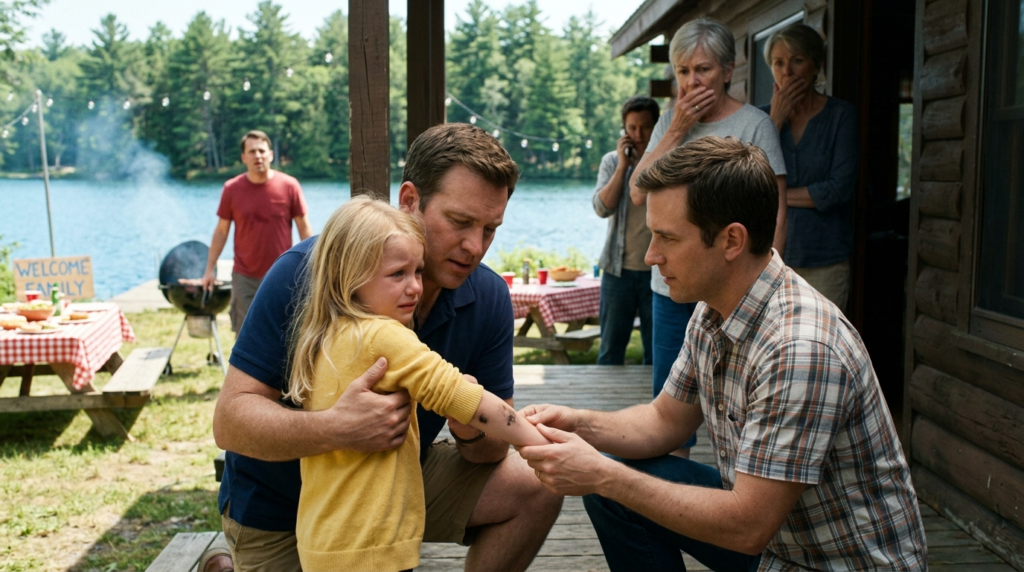
Strangest of all, despite the sweltering, humid heat that had everyone else sweating in t-shirts and shorts, Lily was wearing a thick, long-sleeved yellow sweater.
I walked away from the picnic tables, a cold knot of anxiety tightening in my stomach, and approached her.
“Lily, sweetie?” I knelt on the warm wooden planks of the porch, trying to catch her eye. “What’s going on, buddy? Why do you have your winter sweater on? You must be burning up out here.”
Lily didn’t look up at me. She kept her face buried deep in her knees, but I could see her small shoulders shaking.
She was crying, but it wasn’t the loud, dramatic wailing of a child throwing a temper tantrum. It was a silent, terrified weeping that broke my heart.
“Hey, talk to me, pumpkin,” I whispered, reaching out to gently place a hand on her shoulder.
The moment my fingers brushed against her fabric, Lily flinched violently, letting out a sharp, choked gasp as she scrambled backward into the corner of the porch, staring at me with wide, terrified eyes.
“Don’t touch me! Daddy, please, it hurts!” she whimpered, clutching her right arm tightly against her ribs.
Before I could even process her reaction, the screen door slapped shut behind me. Aunt Clara walked out, holding a large plastic bowl of potato salad, her face twisted into a look of pure annoyance.
“Oh, for heaven’s sake, Mark, look at this,” Clara sighed loudly, making sure her voice carried across the yard to where the rest of the adults were standing. “She’s doing it again. The exact same dramatic routine to get everyone to look at her.”
Uncle Todd looked up from the grill, wiping his brow with a stained dishtowel. “She’s hogging the spotlight, Mark. You need to put your foot down. In our day, if we threw a fit at a family party, we’d get a real reason to cry. She’s just upset because the other kids didn’t want to play her games.”
“She’s not throwing a fit!” I snapped back, my protective instincts flaring up instantly. “Look at her, Todd. She’s genuinely terrified. Something is wrong.”
“What’s wrong is that she knows exactly how to manipulate you,” Clara countered, stepping closer, her voice dripping with condensation. “She sees everyone having a good time, realizes she isn’t the center of attention, and puts on a big show. And look at you, falling for it hook, line, and sinker. You’re teaching her that tears get her whatever she wants.”
Lily buried her face back in her lap, her tiny frame trembling uncontrollably as my family’s harsh voices echoed around the deck.
I could feel the judgmental stares of my siblings and cousins from the lawn. They all thought the same thing. They thought I was a weak, grieving father who let a six-year-old run his life.
“Lily,” I said gently, ignoring the murmurs behind me. “Did you fall down? Did you hurt your arm on the playground earlier?”
She shook her head rapidly, refusing to look at me, her fingers gripping the fabric of her sleeve with a white-knuckled intensity.
“See? She won’t even answer you because she knows she’s lying,” Clara scoffed, setting the bowl down heavily on a patio table. “Let me handle this. Lily, stand up right now and go play with your cousins. Stop ruining your father’s day.”
Clara reached down aggressively, intending to grab Lily by the arm and pull her up to her feet.
“Don’t touch her, Clara!” I yelled, stepping directly between them, my heart hammering against my ribs.
The sharp tone of my voice caused a sudden hush to fall over the backyard. The music kept playing, but the laughter died down. My brother-in-law, David, who had been sitting quietly in a lawn chair sipping a beer, stood up and walked over to the porch.
David was a quiet, observant man, a former high school football coach who rarely got involved in family drama. He looked at me, then looked down at Lily, his eyes narrowing as he analyzed her posture.
“Hold on a second, Clara,” David said, his voice calm but authoritative. “Look at the cuff of her right sleeve.”
I looked down immediately. At first, I didn’t see anything out of the ordinary. But as Lily shifted slightly, trying to shrink away from the crowd, the sunlight caught the edge of her yellow cuff.
There was a dark, damp stain spreading through the thick fabric near her wrist. It wasn’t water from the lake. It was too thick, too dark, and it had a faint, ominous rusty tint to it.
David knelt down on the other side of Lily. He didn’t look at Clara or the rest of the family. His entire focus was on my daughter.
“Hey there, Lily bug,” David said softly, using the nickname he had given her when she was a toddler. “Can I see your hand for just a second? I promise I won’t hurt you. I just want to see your pretty watch.”
Lily looked up through her tear-stained eyelashes, her bottom lip trembling. She trusted David. Slowing her breathing down, she tentatively extended her right hand, though her entire arm was shaking like a leaf.
David gently caught her fingertips, holding her hand with absolute stillness. He didn’t pull. He just held her steady, his eyes locked onto the damp, dark spot on her yellow sleeve.
The entire porch went dead silent. Aunt Clara opened her mouth to speak, but David raised a single finger, cutting her off without looking up.
Slowly, with meticulous care, David pinched the edge of the yellow fabric and began to slide the long sleeve up her forearm.
The words died completely in Aunt Clara’s throat.
The casual indifference on Uncle Todd’s face vanished instantly, replaced by a sudden, sickening pale mask of horror.
I looked down at my daughter’s exposed arm, and the air was sucked violently from my lungs.
CHAPTER 2
Underneath the thick, coarse wool of that yellow sweater, my daughter’s skin was unrecognizable.
From her wrist all the way up to her elbow, her tiny forearm was covered in deep, jagged lacerations that had been crudely and violently torn open. The flesh was swollen to twice its normal size, a horrific shade of angry purple and mottled green. But what made my knees completely buckle was the sight of thick, dark red blood mixed with yellowish fluid oozing from three distinct, deep puncture wounds.
It was unmistakably the unmistakable imprint of an animal’s jaws. A massive, violent animal bite.
Worse than the visual trauma was the sudden, sickening odor that drifted up into the humid afternoon air the moment the fabric was lifted. It was the smell of decaying, infected flesh. Bright red streaks—the terrifying, undeniable hallmark of blood poisoning—were already snaking their way past her elbow, racing up towards her shoulder and her heart.
My mind went completely blank. The world around me tilted on its axis, the cheerful sounds of the distant lake and the classic rock music fading into a dull, underwater roar.
“Oh my God,” David breathed, his hands shaking so violently he almost dropped her wrist. His voice, usually so steady and commanding, cracked with sheer terror. “Mark… oh my God, look at her arm.”
Aunt Clara dropped the plastic bowl of potato salad she was holding. It hit the wooden deck with a loud, wet thud, splattering across her expensive sandals, but she didn’t even blink. Her face turned a ghostly, translucent white, her hands flying up to cover her mouth as a muffled gasp escaped her lips.
Uncle Todd, who had been standing by the grill with an arrogant smirk just seconds ago, froze entirely. The metal tongs slipped from his hand, clattering loudly against the iron grate. He took a hesitant, staggering step forward, his eyes wide as he stared at the horrific wound he had just dismissed as a “dramatic routine.”
“Lily,” I choked out, my voice barely a whisper as tears flooded my eyes, blurring my vision. I dropped to both knees, completely ignoring the splattered food on the floor, and pulled her into my chest with desperate, trembling care. “Lily, baby, what happened? Oh my god, what happened to your arm?”
The moment I held her, I realized just how burning hot her little body was. Through the thick yellow sweater, she felt like a furnace. She wasn’t just crying from emotional pain; she was burning alive with a raging, systemic fever.
“I’m sorry, Daddy,” Lily whimpered, her voice incredibly weak, her head rolling heavily against my shoulder. She was losing the strength to even hold herself upright. “I’m sorry. I didn’t mean to be bad. Please don’t let them take me away. Please don’t go to jail.”
Her words sent a chilling shockwave straight down my spine. Jail? Take her away? Who had put those terrifying thoughts into my six-year-old daughter’s head?
“David, call 911 right now!” I roared, the panic finally breaking through my paralysis. My voice boomed across the entire backyard, shattering the silence. “Tell them we have a child in septic shock from a massive, infected animal attack! Tell them to hurry!”
David was already moving before I even finished the sentence. He ripped his phone from his pocket, his thumbs flying across the screen as he sprinted toward the edge of the porch to get a clearer signal. “Yes, this is an emergency,” I heard him shout into the receiver, his voice tight with controlled panic. “We need an ambulance immediately. Upstate New York, Pine Lake Road, cabin number forty-two. A six-year-old female, severe infected lacerations, high fever, losing consciousness…”
The rest of the family on the lawn had completely stopped what they were doing. My siblings, my cousins, the older teenagers—everyone stood frozen in place, staring up at the porch in absolute, stunned horror. The illusion of the perfect, joyful family reunion had vanished in an instant, replaced by a suffocating cloud of guilt and dread.
Aunt Clara took a trembling step toward us, her eyes welling with tears. “Mark… I—I didn’t know… I thought she was just—”
“Get away from her!” I screamed, turning on her with a raw, primal rage that I didn’t even know I possessed. “Don’t you dare come near her! You said she was faking it! You said she was trying to hog the spotlight! She is dying, Clara! My daughter is dying right in front of us, and you wanted to drag her out by her arm!”
Clara flinched as if I had physically struck her. She stumbled backward, sobbing openly, her hands shaking against her chest. Nobody came to her defense. Not Todd, not my brothers, nobody. The weight of their collective judgment had turned into an unbearable burden of shame.
I turned all my attention back to Lily, gently cradling her uninjured side. Her skin felt dry and papery, a terrifying sign of severe dehydration and advanced infection. Her blue eyes were glassy, struggling to focus on my face.
“Lily, look at me, sweetie,” I begged, my tears dripping onto her pale cheek. “Who did this to you? Where did this happen? You have to tell Daddy. I promise you, nobody is going to jail. Nobody is going to take you away from me. I love you more than anything. Please, baby, tell me what happened.”
Lily swallowed hard, her small throat clicking. She looked around the porch, terrified, as if someone was watching her from the shadows of the pine trees surrounding the cabin.
“Mrs. Gable…” Lily whispered, her voice so faint I had to press my ear almost directly against her lips to hear her. “Mrs. Gable’s big doggie…”
The name hit me like a physical blow to the chest.
Mrs. Gable was our seventy-year-old neighbor back home. When my wife Sarah died, I was completely overwhelmed trying to balance my full-time job and taking care of Lily. Three weeks ago, my regular daycare closed down for summer renovations, and Mrs. Gable, a seemingly sweet, grandmotherly woman who lived just down the street, offered to watch Lily in the afternoons. She seemed like a godsend. She was quiet, kept to herself, and always baked cookies for the neighborhood kids.
But I had never seen a dog at her house. Not once.
“Mrs. Gable has a dog?” I asked, my heart hammering a frantic rhythm against my ribs.
Lily nodded weakly, a tear rolling down her temple. “In the basement. She keeps him in the dark basement. She said he’s a guard doggie. He’s big and black, and his ears are cut short. He… he got out of the basement on Tuesday when she was in the kitchen.”
I felt a sickening wave of nausea wash over me as the puzzle pieces began to violently fall into place. Tuesday. Today was Saturday. That meant my little girl had been carrying this horrific, festering wound inside her body for four entire days. Four days of agonizing, unbearable pain, completely hidden beneath long sleeves in the middle of a brutal summer heatwave.
“Why didn’t you tell me, pumpkin?” I choked out, my chest aching so badly I could barely breathe. “Why didn’t you let me see?”
“Mrs. Gable told me not to,” Lily sobbed, a fresh wave of terror washing over her pale face. “The doggie bit me and dragged me on the floor. I screamed, and she ran downstairs and hit the doggie with a broom. Then she took me to the bathroom and washed it with burning soap. It hurted so bad, Daddy… it hurted so bad.”
Lily paused, gasping for air, her tiny fingers tightening on my shirt with what little strength she had left.
“She told me that if I told you, the police would come,” Lily whispered, her eyes wide with a deep, psychological trauma that no child should ever experience. “She said it was my fault for opening the basement door. She said you would go to jail because you left me with her, and the government would put me in an orphanage where I would never see you again. She made me swear on a bible, Daddy. She said the big doggie would come to our house and eat me if I ever told a single soul.”
A deafening, ringing silence fell over me. The sheer, calculated cruelty of it was beyond comprehension. An old woman, a trusted neighbor, had actively terrorized a grieving, six-year-old child into silence to protect her illegal, dangerous animal, leaving her to literally rot from the inside out out of pure self-preservation.
“Mark,” David said, stepping back onto the porch, his face grim. “The ambulance is on its way, but because we’re out here by the lake, it’s going to take at least twenty minutes. The dispatcher said we need to keep her cool, elevate the arm if possible, and try to lower her temperature with cool, damp cloths. We can’t wait out here in the sun.”
“Bring her inside,” Uncle Todd said, his voice entirely stripped of its earlier bravado. He looked physically ill, his hands trembling as he pointed toward the screen door. “We have ice in the kitchen. We have clean sheets. Mark, please… let us help.”
“Get out of my way,” I said coldly, my voice dangerously quiet.
I carefully lifted Lily into my arms. She was a dead weight now, her head falling limply back against my shoulder. Her breathing was becoming shallow and rapid. I didn’t look at Todd. I didn’t look at Clara. I carried my daughter past them, through the screen door, and into the cool, shadowed living room of the cabin.
David followed me immediately, rushing into the kitchen to grab clean towels and cold water.
I laid Lily down gently on the large plaid sofa, carefully propping her infected right arm up on a throw pillow. Every time the swollen skin shifted, a low, heartbreaking groan escaped her lips. Her fever was climbing rapidly; I could feel the radiant heat coming off her face from a foot away.
“You’re safe now, Lily. Daddy’s here,” I kept repeating, over and over like a mantra, though I was completely falling apart inside. “The ambulance is coming. You’re going to be okay. I promise you, you’re going to be okay.”
But as I looked at the dark red streaks reaching closer and closer to her shoulder, a terrifying thought gripped my heart. What if she isn’t okay? What if the infection has already spread too far?
Outside, the distant, faint sound of a siren began to echo through the pine trees, cutting through the heavy summer air. It was still miles away, but it was coming.
I held my daughter’s uninjured hand, waiting in the dim light of the cabin, while the family that had just accused her of lying stood outside in the silence of their own devastating shame. But as the sirens grew louder, a cold, dark resolve began to harden inside me.
If Lily survived this night, Mrs. Gable was going to pay for what she did. And nothing on heaven or earth was going to stop me.
CHAPTER 3
The ticking of the old grandfather clock in the corner of the cabin’s living room sounded like a countdown. Every strike of the pendulum echoed against the exposed pine walls, a brutal reminder that time was rapidly slipping away. Lily lay stretched out on the plaid sofa, her small body trembling so violently that the cushions shook beneath her. The raging fever had taken full control of her now, turning her pale cheeks a deep, unnatural crimson while the rest of her skin looked completely drained of life.
David came rushing back from the kitchen, holding a large plastic bowl filled with ice water and a stack of clean white hand towels. His face was entirely stripped of its usual composure. He set the bowl down on the coffee table with a heavy thud, splashing water over the edge, but he didn’t care. He quickly soaked a towel, wrung it out with his large, calloused hands, and handed it to me.
“Put it on her forehead, Mark,” David whispered, his voice tight, his eyes darting toward the hallway where the rest of the family was quietly gathering near the screen door. “The dispatcher said we need to keep her core temperature down as much as possible. If it gets any higher, she could start having seizures.”
I took the freezing towel and gently pressed it against Lily’s burning forehead. The moment the cold fabric touched her skin, she let out a sharp, pathetic gasp. Her eyes didn’t open. They remained tightly shut, her eyelids fluttering rapidly as if she were trapped in a horrific nightmare.
“Cold, Daddy… so cold,” she mumbled, her speech slurred, her voice barely carrying above the low hum of the refrigerator. “Make the dark go away. Please don’t let him back out.”
“I’ve got you, Lilybug. Daddy’s right here,” I said, my voice cracking completely as a hot tear spilled over my cheek and fell onto her shoulder. I grabbed another towel, soaked it in the ice water, and carefully wrapped it around her upper arm, staying just inches away from the perimeter of the angry, swollen wound.
The heat radiating from her arm was terrifying. It felt like holding a hot iron. The red streaks were visibly advancing, creeping higher up the delicate skin of her bicep like a spider’s web of poison. The sickening, sweet odor of infection was growing stronger in the confined space of the living room, a constant, physical reminder of the negligence that had brought my daughter to the brink of death.
Through the screen door, I could hear the muffled, frantic murmurs of my family. The loud, arrogant voices that had dominated the afternoon were entirely gone, replaced by a tense, heavy silence. Suddenly, the screen door creaked open, and the soft sound of sandals stepped onto the hardwood floor.
I didn’t even have to look up to know who it was. The scent of Aunt Clara’s expensive perfume trailed into the room, now completely ruined by the heavy tension in the air. She stopped a few feet away from the sofa, her hands clasped tightly together, her shoulders slumped in a posture of complete defeat.
“Mark…” Clara’s voice was trembling, entirely stripped of the sharp, judgmental edge she had used against me for the past two years. “Please, let me help you. I can get more ice from the neighbor’s cabin. I can… I can hold her other hand. Just let me do something.”
I didn’t turn my head. I didn’t look at her face. I kept my eyes locked onto my daughter’s shallow, rapid chest movements. The rage inside me hadn’t cooled down; it had crystallized into something solid, cold, and absolute.
“Get out,” I said, my voice dangerously quiet, completely flat.
“Mark, please,” Clara begged, a choked sob escaping her throat. “I am so deeply sorry. I thought… we all thought you were just going through so much with Sarah, and we thought she was just acting out because of the transition. We never imagined—”
“I told you to get out, Clara,” I interrupted, finally turning my gaze to look at her.
When my eyes met hers, she froze. The raw, unadulterated fury in my expression made her step back involuntarily.
“You didn’t care about the truth,” I said, each word dripping with venom. “You just wanted an excuse to tell me I was a failure. You wanted to validate your own miserable opinions about how I raise my daughter. You stood out there on that porch and accused a dying six-year-old girl of manipulating her family for attention. If David hadn’t stepped in, you would have dragged her into that yard by an arm that is literally rotting from a dog bite. You are dead to me, Clara. This entire family is dead to me. Now get the hell out of this room before I throw you out myself.”
Clara’s face crumpled entirely. She covered her mouth with both hands, turned around, and fled back out the screen door, sobbing loudly.
David didn’t say a word to defend her. He just looked down at the floor, his jaw clenched, silently soaking another towel in the ice water. He knew I was right. The family’s toxic habit of constant scrutiny and judgment had almost cost my daughter her life.
Suddenly, the distant wail of the siren flared loudly, echoing sharply off the surface of the lake. It was finally turning onto Pine Lake Road. The sound grew larger, deeper, until the flashing red and blue lights began to dance across the pine trees outside, cutting through the shadows of the living room.
The heavy gravel shifted violently outside as a massive ambulance pulled into the driveway, accompanied by a loud squawk of its brake system. Within seconds, the screen door flew open, and two paramedics rushed into the cabin, carrying heavy trauma bags and a collapsible gurney.
The lead paramedic was a tall, stern-faced man in his late forties named Marcus. The second was a younger woman, her hair pulled back tightly in a ponytail, her eyes sharp and alert.
“What do we have?” Marcus asked loudly, dropping his bag beside the sofa and immediately kneeling down next to Lily.
“Six-year-old female,” David answered rapidly, stepping back to give them space. “Advanced septic shock from an animal bite. The attack happened four days ago on Tuesday. It was hidden under her sweater until twenty minutes ago. High fever, altered mental status, and she’s losing consciousness.”
The female paramedic immediately pulled out a digital thermometer and pressed it against Lily’s ear. A sharp beep echoed through the room. “Vitals are critical,” she announced, her voice tight. “Temp is 104.7. Heart rate is 145, blood pressure is dropping fast at 80 over 45. She’s burning up, Marcus.”
Marcus didn’t waste a single second. He pulled a pair of trauma shears from his belt and carefully sliced the yellow sweater down the center, removing the thick fabric entirely. When the wound was fully exposed to the bright overhead lights of the cabin, both paramedics fell completely silent for a fraction of a second.
The younger paramedic let out a quiet, sharp breath through her nose.
“This is an unstable, severe infection,” Marcus said, his professional demeanor hardening as he reached into his bag for an IV kit. “The tracking lines are already past the axillary lymph nodes. We have a massive systemic infection here. We need to establish a large-bore IV immediately, start a fluid bolus, and get her on high-flow oxygen.”
I watched in a state of absolute terror as they worked on my baby girl. The younger paramedic placed a clear plastic oxygen mask over Lily’s nose and mouth, the elastic band cutting into her fine blonde hair. Lily didn’t even fight it. She didn’t flinch when Marcus inserted a large needle into the back of her left hand to start the IV line. She was completely unresponsive now, her head rolling limply to the side, her breathing heavy and wet against the plastic mask.
“Is she going to make it?” I asked, my voice trembling so badly I could barely form the words. I grabbed Marcus’s shoulder, my fingers digging into his heavy uniform shirt. “Please, tell me. Is my daughter going to die?”
Marcus looked up at me, his eyes entirely serious. He didn’t offer any empty, comforting platitudes. “Sir, your daughter is incredibly sick. Her body is fighting a massive battle against an aggressive bacteria right now. We are doing everything we can to stabilize her, but we need to get her to a pediatric trauma center immediately. St. Jude’s Children’s Hospital is thirty miles away. We’re going to transport her hot. I need you to gather her shoes and any identification, and you can ride in the back with us. We leave in sixty seconds.”
I scrambled around the room like a madman, grabbing Lily’s small pink sneakers from near the door and shoving my wallet into my pocket. My hands were shaking so violently I could barely function, but the sheer adrenaline kept me moving.
Within a minute, Marcus and the other paramedic lifted Lily’s limp body onto the gurney, securing the heavy black straps across her chest and legs. They wheeled her rapidly out of the cabin, the wheels clattering loudly against the wooden porch steps.
As we stepped outside into the bright, hot afternoon air, the entire family was gathered on the gravel driveway. They stood in a semi-circle, completely silent, watching the paramedics load my unconscious daughter into the back of the emergency vehicle.
Uncle Todd stepped forward, his eyes red-handed, his face covered in a layer of sweat. “Mark… let me drive you. You shouldn’t be alone in the back of that thing. Let me follow them.”
I didn’t even look at him. I climbed up the high metal step into the cramped, sterile interior of the ambulance and slammed the heavy double doors shut right in his face, cutting off the entire family from my sight.
The lock clicked into place, and a second later, the ambulance lurched forward, its tires spinning wildly in the loose gravel as the driver accelerated down Pine Lake Road, the sirens roaring to life with a deafening, continuous scream.
The ride to the hospital was a blur of absolute chaos and terror.
The back of the ambulance felt entirely claustrophobic, packed with medical equipment, monitors, and the heavy scent of rubbing alcohol. The younger paramedic sat at the head of the gurney, constantly adjusting the oxygen flow and checking Lily’s pupil responses with a small penlight. Marcus was kneeling on the floor, stabilizing her right arm with a clean sterile dressing, trying to absorb the fluid oozing from the deep punctures without putting pressure on the swollen tissue.
“Vitals are still sliding,” the female paramedic called out over the roar of the engine as the vehicle rocked violently around a sharp curve. “Heart rate is clicking up to 155. She’s starting to exhibit signs of severe respiratory distress.”
Every beep of the heart monitor felt like a physical blow to my chest. I sat on the narrow bench on the side, holding Lily’s small, uninjured left hand tightly against my lips. Her hand felt so tiny, so fragile against my rough palms.
“Hold on, Lily. Please, just hold on,” I whispered into her skin, closing my eyes tightly. “Don’t leave me, baby. You’re all I have left. Your mom is waiting for you to grow up. Don’t go to her yet. Please.”
The thought of losing Lily filled me with a dark, suffocating emptiness. Ever since the car accident that took Sarah, Lily had been my entire world, the only reason I got out of bed in the morning, the only light in a deeply darkened life. The idea that she had been suffering in absolute silence for four entire days, carrying the weight of an adult’s terrifying threats on her tiny shoulders, made my stomach violently churn with guilt. I should have noticed. I should have made her take off that sweater. I should have looked closer.
“Don’t do that to yourself, dad,” Marcus said suddenly, looking up from the gurney, his eyes assessing the expression on my face. “Abusive people, negligent people—they know exactly how to terrify a child into compliance. They use their size, they use fear, and they exploit a child’s natural desire to protect their parents. This isn’t on you. You didn’t do this. Your only job right now is to stay strong for her when she wakes up.”
I nodded weakly, swallowing the thick lump of emotion in my throat, but the guilt remained, heavy and suffocating.
After thirty agonizing minutes of high-speed driving, the ambulance swung sharply to the left, the brakes groaning as we pulled into the concrete bay of the St. Jude’s Children’s Hospital Emergency Department.
The moment the doors flew open, a team of six doctors and nurses clad in blue scrubs was already waiting for us. Marcus and his partner pushed the gurney out of the vehicle, yelling out a rapid-fire medical report as they sprinted through the automatic sliding doors into the trauma bay.
“Six-year-old female, septic from an untreated animal bite, hypotensive, tachycardic, altered mental status!” Marcus shouted, his voice echoing off the bright white corridor walls.
I tried to follow them, my boots clattering against the polished linoleum, but a large, firm hand caught me by the shoulder. A female nurse with a kind but unyielding expression stepped directly in front of me, stopping me at the threshold of the trauma room.
“Sir, you need to stay back,” she said gently but firmly, pushing me toward the waiting area. “Our trauma team needs complete access to her right now to insert a central line and start aggressive antibiotic therapy. I promise you we will keep you updated every single minute, but right now, the best place for you is in the waiting room.”
The heavy double doors swung shut, locking automatically, completely separating me from my daughter.
I stood there for a long moment, my hands pressed flat against the cold glass windows, watching the blurry shapes of medical professionals moving frantically around the bed where my daughter lay. I could see the bright overhead surgical lights reflecting off the glass, a sterile, unforgiving landscape that felt entirely removed from the warm, sunny lakeside cabin we had left behind.
The waiting room was entirely empty, saved for the low hum of a vending machine and the quiet drone of a television mounting in the corner playing a daytime talk show. The contrast was sickening. The world outside was moving along perfectly, completely unaware that my entire life was hanging by a thread inside that trauma room.
I collapsed into one of the vinyl chairs, burying my face in my hands. The scent of the cabin, the faint smell of woodsmoke and lake water, was still clinging to my clothes, a mocking reminder of how quickly a normal day could transform into a waking nightmare.
Nearly two hours passed in absolute silence. I didn’t move. I didn’t look at my phone, which was buzzing continuously in my pocket with text messages and missed calls from my family. I ignored them all. They didn’t deserve to know. They didn’t deserve to share in this grief.
Finally, the heavy double doors clicked open, and a doctor walked into the waiting room. He was a short man in his early fifties, wearing a dark green surgical scrub suit, a heavy stethoscope hanging around his neck. His face looked incredibly tired, his brow furrowed with a deep line of concern.
I stood up instantly, my legs nearly giving out beneath me. “Doctor? How is she? Is she… is she alive?”
The doctor stopped a few feet away, pulling off his surgical mask. “Mr. Vance? I’m Dr. Keller, the pediatric infectious disease specialist on call. Your daughter is alive, but she is in an incredibly critical state. The infection in her arm is advanced necrotizing fasciitis, compounded by deep tissue cellulitis from a severe animal bite. The bacteria has entered her bloodstream, causing widespread sepsis.”
He paused, taking a deep breath that made my heart freeze entirely.
“We have already started her on a high-dose cocktail of broad-spectrum IV antibiotics,” Dr. Keller continued, his voice calm but completely direct. “We had to take her down to the operating room immediately to perform an emergency surgical debridement. We needed to cut away the dead, infected tissue from her forearm to prevent the infection from spreading further up her body and causing total organ failure.”
“Did you… did you have to save the arm?” I choked out, the terrifying word amputation flashing through my mind like a lightning bolt.
“We managed to save the limb for now,” Dr. Keller said, his expression softening slightly. “But the damage to the muscle tissue and tendons is extensive. She will require multiple follow-up surgeries over the next few weeks. Right now, our primary concern isn’t the physical function of the arm; it’s her survival. We have stabilized her blood pressure with vasopressors, but her body is still fighting a massive war. The next twenty-four hours are absolutely critical.”
I let out a ragged, trembling breath, my hands gripping the back of a waiting room chair to keep myself upright. “Can I see her?”
“She is being moved to the Pediatric Intensive Care Unit right now,” Dr. Keller said, nodding. “She is currently heavily sedated and on a ventilator to help her breathe while her body rests. You can go back and sit with her, but I need to warn you, Mr. Vance… she looks very vulnerable right now. There are a lot of tubes and monitors.”
“I don’t care,” I whispered, my voice thick with tears. “I just need to be with my baby.”
“Before you go back,” Dr. Keller said, his tone shifting into something sharper, his eyes narrowing slightly. “We had to file an automatic mandatory report with the state police and Child Protective Services. An animal bite of this magnitude, left untreated for four days, is a clear indicator of severe abuse or extreme negligence. There are two state troopers waiting at the main entrance to speak with you. They need to know exactly what happened to your daughter.”
A cold, dark wave of realization washed over me. The time for panic was over. The time for weeping was over. The legal system was moving, and I needed to ensure that the monster who had done this to my child faced the full, crushing weight of the law.
“Show me where they are,” I said coldly, my jaw tightening as the image of Mrs. Gable’s sweet, deceptive face flashed in my mind. “I have a lot to tell them.”
CHAPTER 4
The double doors of the Pediatric Intensive Care Unit felt like a barrier between two entirely different universes. Behind me lay the sterile, quiet waiting room, a space heavy with the unspoken grief of dozens of strangers. Ahead of me was the battleground where my six-year-old daughter was fighting for her life.
Before I could step through those doors, I had to face the two state troopers waiting near the security desk. Trooper Miller, a tall man with a weathered face and a sharp, no-nonsense gaze, stepped forward. Beside him was Trooper Davis, a younger officer whose expression was a mix of intense focus and profound sympathy. They looked at my clothes, which were still stained with the spilled potato salad from the cabin porch and the dark, damp fluids from Lily’s sweater.
“Mr. Vance?” Trooper Miller asked, his voice low and respectful, acknowledging the sheer exhaustion radiating from my body. “I’m Trooper Miller, this is my partner, Trooper Davis. Dr. Keller contacted our dispatch. We understand this is a horrific situation, but we need to take your statement immediately regarding how your daughter sustained these injuries.”
I took a deep breath, the cold hospital air burning my lungs. I didn’t want to talk to them. I wanted to be by my daughter’s bedside, holding her hand, but I knew that every second I delayed was a second of freedom for the monster who had terrorized my child.
“I’ll tell you everything,” I said, my voice raspy and hollow. “But we need to sit down. My knees are about to give out.”
We moved to a small, private consultation room just off the main hallway. The room contained nothing but a round wooden table and four vinyl chairs. It was the kind of room where doctors broke the worst possible news to families. I collapsed into a chair, rubbing my face with my trembling hands.
“Start from the beginning, Mr. Vance,” Trooper Davis said, opening a small leather-bound notepad. “When did you first notice something was wrong?”
I closed my eyes, the events of the afternoon flashing behind my eyelids like a recurring nightmare. I told them about the annual family reunion at the lakeside cabin. I described how the brutal heat had everyone in shorts and t-shirts, while Lily sat isolated in a corner, wrapped tightly in a thick, long-sleeved winter sweater.
“My family thought she was throwing a temper tantrum,” I said, a bitter, sharp edge creeping into my tone. “They accused her of faking her pain just to get attention because I’m a single father and they think I coddle her. My wife passed away two years ago, and ever since, they’ve scrutinized every single thing I do. They thought Lily was just manipulating me.”
The troopers listened intently, Miller nodding slowly as I spoke.
“Then my brother-in-law, David, noticed a dark stain on her cuff,” I continued, my voice cracking as the raw emotion threatened to overwhelm me again. “He pulled up her sleeve. Her arm… it was completely destroyed. It was swollen, purple, leaking fluid, and covered in deep puncture wounds. That’s when we called 911.”
“Did she tell you who did it?” Trooper Miller asked, his pen hovering over his notepad.
“Yes,” I whispered, the anger inside my chest tightening like a coiled spring. “She told me it happened on Tuesday. Today is Saturday, officers. She carried that horrific, festering infection inside her body for four entire days because she was too terrified to say a word. She said it was Mrs. Gable’s dog.”
Trooper Miller’s eyebrows shot up in sudden surprise. “Mrs. Gable? The elderly woman who lives on Elm Street?”
“Yes,” I said, slamming my fist lightly against the wooden table, the frustration boiling over. “My regular daycare closed down for the summer, and she offered to watch Lily in the afternoons. She seemed sweet. She seemed like a lonely grandmother who just wanted to help a grieving neighbor. But Lily told me a completely different story today. She said Mrs. Gable keeps a massive, aggressive black dog hidden away in her dark basement. On Tuesday, the dog got out while Mrs. Gable was in the kitchen.”
I paused, swallowing the thick lump of nausea rising in my throat as I forced myself to repeat my daughter’s terrifying words.
“Lily said the dog attacked her, bit her arm, and dragged her across the kitchen floor. She was screaming for her life. Mrs. Gable ran downstairs, hit the animal with a broom to get it off her, and then dragged Lily into the bathroom. She washed the wounds with burning soap, but she didn’t call an ambulance. She didn’t call me. She didn’t take her to an urgent care clinic.”
Trooper Davis stopped writing, his jaw dropping slightly. “She didn’t seek any medical attention for a child with a severe animal bite?”
“No,” I spat out, the tears finally spilling over my lower lids. “Instead, she chose to psychologically torture a traumatized six-year-old girl to protect herself. She told Lily that it was her fault for opening the basement door. She told her that if she told me, the police would come and throw me in jail for leaving her there. She told Lily that the government would drag her away to an orphanage where she would never see her father again. She made my little girl swear an oath on a Bible, and then she threatened her, saying that if she ever told a single soul, the big black dog would break out of the house, come to our home, and eat her alive.”
The consultation room went dead silent. The only sound was the low, electric hum of the fluorescent lights overhead.
Trooper Miller’s face had turned an intense, dangerous shade of pale. His hand gripped his pen so tightly his knuckles turned a sharp white. He looked at his partner, a silent message passing between them that required no words.
“A child endangerment charge, criminal negligence, tampering with a witness, and extreme cruelty,” Miller said, his voice dropping an octave into a tone of absolute authority. “That woman didn’t just neglect an injury, Davis. She actively attempted to let a child die of sepsis to cover up an illegal animal ring or a dangerous dog violation.”
Miller stood up instantly, adjusting his heavy utility belt. He looked down at me, his expression softening just a fraction.
“Mr. Vance, I want you to go upstairs and be with your daughter. Do not worry about Mrs. Gable. My partner and I are contacting the local precinct back in your hometown immediately. We are securing a search warrant for that property, and we are sending units to Elm Street right now. I promise you, by the time your daughter wakes up from surgery, that woman will be in handcuffs.”
“Thank you,” I choked out, wiping the tears from my eyes as I stood up on unstable legs. “Please… don’t let her get away with this.”
“She won’t,” Trooper Miller said firmly. “Get some rest, dad. Your little girl needs you.”
I left the consultation room and walked toward the elevators, my heart heavy but a small spark of justice burning in my chest. I took the elevator up to the third floor, following the bright yellow signs that led to the Pediatric Intensive Care Unit.
When I passed through the secure entrance, a nurse guided me down a quiet, dimly lit corridor to Room 304.
The sight that greeted me inside that room shattered what little emotional strength I had left.
Lily looked absolutely microscopic in the center of the massive, high-tech hospital bed. The bright pink sneakers I had grabbed from the cabin were sitting neatly in a plastic bag in the corner, a heartbreaking contrast to the sterile environment. A thick, clear plastic tube was taped into her mouth, connected to a mechanical ventilator that hissed and clicked rhythmically, forcing air into her fragile lungs.
Her right arm was heavily wrapped in layers of thick white sterile gauze, elevated on a specialized foam ramp to reduce the severe swelling. Multiple clear IV lines ran into the back of her left hand and a central line near her collarbone, delivering a continuous stream of powerful antibiotics, pain medications, and fluids into her system.
A digital monitor mounted above the bed displayed a chaotic array of colored numbers—her heart rate, blood pressure, and oxygen saturation levels. The numbers were stable for now, but they were a constant reminder of how close she was to the edge.
I pulled a heavy vinyl armchair close to the side of the bed, being careful not to disturb any of the wires. I reached out and gently took her small, uninjured left hand in mine. Her skin was still warm from the fever, but it didn’t have that terrifying, radiating heat it had possessed at the cabin.
“I’m here, Lilybug,” I whispered, pressing her soft knuckles against my forehead. “Daddy’s right here. I’m not going anywhere. You’re safe now. Nobody is going to jail, and nobody is ever going to take you away from me.”
I sat in that chair for hours, watching the slow rise and fall of her chest, perfectly synchronized with the mechanical click of the ventilator. The guilt weighed heavily on my shoulders. I was her father. I was supposed to protect her. How had I missed the signs? How had I allowed her to suffer in silence for four entire days right under my nose?
As the night deepened, my phone began to buzz continuously in my pocket. I pulled it out, the bright screen illuminating the darkened hospital room.
There were 47 missed calls and over a hundred text messages. They were all from my family.
I opened the message thread from Aunt Clara. “Mark, please answer us. We are all at the cabin waiting for news. We haven’t stopped crying. I am so incredibly sorry, Mark. I didn’t know. Please tell us Lily is going to be okay. Let us come to the hospital.”
I scrolled down to a message from Uncle Todd. “Mark, I’m sick to my stomach. I can’t believe I said those things to you on the porch. I want to help. I can cover all the medical expenses, whatever the insurance doesn’t take. Just let me know she’s stable.”
I stared at the messages with a profound sense of detachment. The words felt empty, hollow, and entirely self-serving. They weren’t crying for Lily; they were crying because the mirror had been held up to their own toxic, judgmental nature, and they hated what they saw. They had chosen to believe a narrative of manipulation rather than extending a hand of compassion to a suffering child. If it hadn’t been for David, Lily would have passed out in that cabin, her body shutting down from septic shock while they sat outside eating barbecue and laughing.
I clicked on the group chat containing my siblings, my aunts, and my uncles. My fingers were steady as I typed out a single, final response.
“Lily is in the Intensive Care Unit on a ventilator after undergoing emergency surgery to cut away dead tissue from an advanced, infected dog bite. She was terrorized into silence by our neighbor. She carried that pain for four days because she was scared of losing me. You all stood on that porch and called her a liar. You told me I was a failure of a father. You lost the right to call yourselves her family the moment you turned your backs on her tears. Do not call me again. Do not come to this hospital. If I see any of you near my daughter, I will have hospital security remove you immediately. We are done.”
I hit send, and before anyone could reply, I systematically blocked every single one of their numbers. I blocked them on social media, deleted their contacts, and severed the ties that had bound me to them for my entire life. It wasn’t an act of petty anger; it was an act of survival. Lily and I needed a life built on unconditional trust and safety, not constant criticism and cruel assumptions.
Around three o’clock in the morning, the quiet of the room was broken by a soft knock on the door. I turned my head to see Trooper Miller standing in the doorway, his uniform jacket removed, looking incredibly tired but holding a manila folder in his hand.
I stood up gently, releasing Lily’s hand, and stepped out into the quiet hallway to speak with him.
“Did you find her?” I asked, my voice tight.
Trooper Miller nodded, a grim, satisfied smile touching his lips. “We found her, Mr. Vance. And we found exactly what your daughter was talking about.”
He opened the folder, revealing a series of high-resolution photographs taken by the forensics team.
“Our local units raided the Elm Street property around midnight,” Miller explained, pointing to a photograph of a large, suburban house. “On the surface, it looked completely normal. But when officers entered the kitchen, they smelled a severe odor of animal waste. They discovered a heavy wooden trapdoor hidden beneath a rug in the pantry, secured with a thick iron bolt from the outside.”
He flipped to the next photograph, and my stomach churned.
“Inside the basement, living in pitch-black conditions without food or clean water, was an unregistered, ninety-pound Cane Corso mix. The animal was covered in scars, highly aggressive, and was being kept in a makeshift iron cage. We discovered that Mrs. Gable’s adult grandson, who has a prior criminal record for illegal dogfighting, had been using her basement to hide and breed high-value, dangerous guard dogs.”
“Did she admit to it?” I asked, my fists clenching at my sides.
“She collapsed into tears the moment our officers pulled the dog out of the basement,” Miller said. “She confessed to everything. She admitted that the dog had broken loose on Tuesday and attacked Lily. She admitted that she deliberately withheld medical care because she knew she would face massive fines, the animal would be euthanized, and her grandson would go back to prison for violating his parole. She explicitly confirmed that she threatened your daughter with jail and the orphanage to ensure she wouldn’t say a word.”
Miller closed the folder with a sharp snap. “Mrs. Gable is currently booked at the county jail. She is being held without bail on multiple felony charges, including first-degree child endangerment, criminal negligence resulting in bodily harm, and tampering with a witness through intimidation. Her grandson was picked up an hour ago at a motel across town. They are both looking at significant, long-term prison sentences, Mr. Vance. The state attorney is personally handling this case. They are going to throw the book at them.”
A massive, overwhelming wave of relief washed over me, so intense that I had to lean against the hospital wall to keep from falling. The monster was behind bars. The lies had been exposed. The legal system had worked exactly the way it was supposed to.
“Thank you, officer,” I whispered, a tear running down my cheek. “Thank you for believing her.”
“Your daughter is a hero, Mark,” Miller said gently, using my first name for the first time. “She endured more pain in four days than most adults do in a lifetime, just to protect her dad. You make sure you tell her that when she wakes up.”
I watched Trooper Miller walk down the hallway until he disappeared around the corner. I turned back into Room 304, closing the door quietly behind me, and reclaimed my seat next to Lily’s bed. The darkness of the night slowly began to give way to the soft, pale blue light of a new dawn filtering through the hospital window.
On Monday morning, six days after the horrific attack, the medical team decided that Lily’s vitals were strong enough to begin weaning her off the heavy sedation.
Dr. Keller stood at the foot of the bed, watching closely as the respiratory therapist carefully removed the tape from Lily’s face and deflated the small cuff on the breathing tube. With a swift, practiced motion, the therapist pulled the thick clear tube from her throat.
Lily gasped, coughing lightly as her body adjusted to breathing the room air on her own. The nurse immediately placed a light, comfortable oxygen mask over her nose to help her transition.
I leaned over the bed, my heart racing a mile a minute. “Lily? Lily, sweetie, can you hear me?”
Her eyelids fluttered, struggling against the residual weight of the medication. Slowly, those beautiful, glassy blue eyes opened, looking around the bright white room in immediate confusion and panic. Her gaze darted to the heavy bandages on her right arm, and her tiny frame began to tense up, a whimper escaping her throat.
“Daddy?” she whispered, her voice incredibly raspy, barely audible. “Are… are the police here? Did you go to jail?”
“No, baby. No, look at me,” I said, grabbing her face gently with both hands, forcing her to lock her eyes onto mine. “Look at my face, Lilybug. I am right here. I am completely safe. Nobody is in jail except for Mrs. Gable. The police came, and they found the bad doggie, and they took him away where he can never, ever hurt anyone again. Mrs. Gable is never coming back. You did nothing wrong, Lily. You were so brave. You saved us.”
Lily stared at me for a long, silent moment, processing the words through the fog of her recovery. Slowly, the intense terror that had dominated her expression for the past week began to melt away, replaced by a profound, beautiful sense of relief. Her lower lip trembled, and two large tears rolled down her cheeks.
“I don’t have to wear the yellow sweater anymore?” she whispered softly.
“No, sweetie,” I sobbed, pulling her small, fragile body into a tight, protective embrace, being incredibly careful of her injured arm. “You never have to wear it again. You can wear whatever you want. We are going to go home, and we are going to start over.”
The road ahead of us wasn’t easy. Lily spent another two weeks in the Pediatric Intensive Care Unit, undergoing two additional surgical procedures to repair the damaged muscle tissue and ensure the necrotizing infection was completely eradicated from her system. She faced months of intensive physical therapy to regain the full use of her fingers and her wrist, and the deep, jagged silver scars on her forearm would remain with her for the rest of her life.
But the physical scars were nothing compared to the resilience of her spirit. We worked with a wonderful pediatric trauma therapist who helped Lily process the psychological abuse she had suffered at the hands of our neighbor, slowly rebuilding her sense of safety and trust in the world.
As soon as she was discharged from the hospital, I put our house on Elm Street up for sale. I couldn’t bear to look at the property down the road, and I didn’t want Lily to ever have to walk past the place where her childhood innocence had been so violently threatened. We packed up our belongings, said goodbye to the shadows of our past, and moved to a beautiful, quiet town two hours away, nestled close to the mountains.
We never spoke to Aunt Clara, Uncle Todd, or the rest of the extended family again. They tried to send letters, flowers, and financial offers to the hospital, but I returned every single package unopened. They had shown me exactly who they were when the stakes were highest, and I refused to allow their toxic judgment to ever pollute my daughter’s life again. David was the only one I kept in touch with; he had been the one to look past the family’s blindness and see the truth, and he remained a pillar of support for us as we rebuilt our lives.
One warm afternoon in late September, three months after the reunion, I sat on the back porch of our new home, watching Lily run through the grass.
The autumn air was crisp, but the sun was shining brightly, casting a golden hue over the yard. Lily was wearing a bright pink, short-sleeved t-shirt, her scarred right arm completely exposed to the world without a single shred of shame or fear. She was laughing loudly, chasing a colorful butterfly through the flowers, her movements free, vibrant, and full of life.
She stopped suddenly, turning her head to look back at me, her blue eyes sparkling with absolute joy.
“Daddy, look!” she screamed, pointing at the sky. “The clouds look like a giant castle!”
“It sure does, Lilybug!” I called back, a deep, profound sense of peace settling into my chest for the first time in years.
My family had thought she was faking her pain for attention, but in her silence, she had shown a strength that put them all to shame. We had survived the darkness of the basement, the cruelty of our neighbors, and the betrayal of our own blood. Standing there in the golden sunlight, watching her smile, I knew that whatever challenges the future held, we were going to be completely okay. Just the two of us.