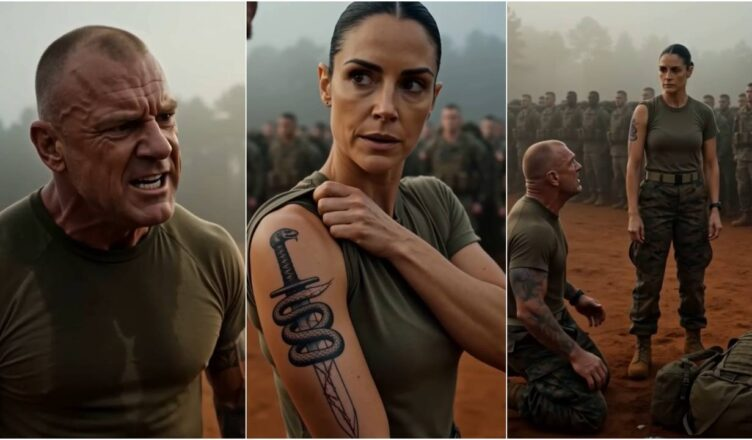
It rose off the red clay and the pine line in slow, wet waves, settling over Bravo Company before first formation was fully set. The humidity soaked through OCP blouses, turned ruck straps heavy against shoulders, and made the air feel too thick to breathe cleanly.
Rows of soldiers stood in formation with heavy packs at their boots. Nobody talked. Boots shifted softly in the dirt. Fabric rustled. Insects screamed from the edge of the trees. Somewhere beyond the yard, a bird called once and went quiet.
Staff Sergeant Clara Vance stood in the last rank with her chin level and her hands resting on the top of her ruck.
She was thirty-two, athletic, controlled, and quiet in a way that made people underestimate her. Her paperwork said logistics. Recently reassigned. Prior overseas tours. Useful but unremarkable. Sent to a line company for a steadier rhythm: inventories, layouts, hand receipts, range days, field problems, sleep.
That was the paper version.
Advertisements
The real version lived under black bars, temporary taskings, classified attachments, and unit names that changed depending on who was asking.
Clara never corrected the paper version.
It was safer that way.
Sergeant First Class Kaelen stepped out of the front rank like a man walking onto a stage.
He was broad and hard-faced, early forties, shaved head, weathered skin, and the kind of aggressive authority that needed an audience to survive. Men like Kaelen did not simply give corrections. They performed them. They picked one soldier, leaned hard until they found a weak place, and turned the damage into a lesson for everyone else.
That morning, he chose Clara.
He crossed the red clay with his jaw set and his shoulders squared, stopping so close to her that the soldiers beside her stiffened. Clara looked straight ahead.
Kaelen let the silence gather.
Then he shoved her hard in the chest.
Clara staggered one step back, boots scraping through the dirt, but she did not fall. Her heavy ruck slipped from her hands and crashed into the red clay at her feet with a dull, ugly thud.
Soldiers flinched.
No one spoke.
Kaelen’s face stayed turned toward Clara so everyone could see him.
“This is Bravo Company, not a supply closet.”
His voice cracked across the formation.
Clara’s breathing did not change.
Kaelen pointed sharply at her chest.
“You stand there like dead weight while real soldiers do the hard part.”
Then he looked down at the ruck in the dirt, and something mean brightened in his eyes.
Before anyone could brace for it, he kicked it.
The pack tumbled sideways through the red clay. Dust burst up. A canteen snapped loose, rolled across the ground, and stopped near a private’s boot. A loose strap slapped against the metal frame.
Clara did not react.
That seemed to irritate him more.
Kaelen stared down at the scattered gear, then back at her with a mocking sneer.
“Look at that. Even your gear wants out.”
The silence changed.
Not louder.
Heavier.
Clara lowered her eyes to the fallen ruck.
For a moment, she only looked at it. Then she reached across with her left hand, found the Velcro tab on her right cuff, and peeled it open.
The sound was small.
In that formation, it cut like a blade.
She rolled the sleeve up past her elbow.
Morning light touched the scars first.
Then the tattoo.
A narrow black dagger pointed down along her right forearm, wrapped tightly by a cobra. The raised cobra head sat near the guard of the blade. Old scar tissue broke through the ink in jagged lines, splitting the coils, cutting across the dagger, turning the symbol into something that looked less drawn on her skin than fought through it.
Most of Bravo Company saw scars and black ink.
Kaelen saw a ghost.
His eyes shifted to the tattoo.
His face changed instantly.
The confidence drained out first. Then the color. His mouth tightened as if he had forgotten how to breathe. His eyes widened, fixed on Clara’s exposed arm.
Years earlier, near the Euphrates, Kaelen had heard a story in a casualty collection point from men too wounded to lie properly. They spoke of an extraction team that moved through broken concrete and smoke while rounds cracked overhead. They spoke of a woman who dragged men out alive after everyone else had been told the position was lost. A medic had sketched the symbol on the back of an MRE sleeve because the men kept mentioning it: a cobra wrapped around a dagger, burned and torn by shrapnel.
Kaelen had laughed when he first heard it.
Not because it was funny.
Because men like him survived by calling anything bigger than themselves a myth.
Now that myth was standing in front of him, silent, scarred, and looking at the ruck he had kicked into the dirt.
Clara lifted her eyes to him.
“Pick it up.”
Her voice was low.
Controlled.
Dangerous only because it did not need to be loud.
Kaelen’s jaw locked. His breathing broke. He took one step back, then another, still staring at her arm.
“Jesus Christ… not you.”
The words came out barely above a breath.
Then his knees hit the red clay.
Not because Clara touched him.
Not because anyone ordered him.
Because recognition finally reached the part of him that fear had kept alive.
The entire formation froze.
Kaelen knelt in front of Clara with the ruck still lying between them, the spilled canteen resting in the dust, the Georgia heat pressing down on everyone. Behind them, rows of soldiers stood rigid, eyes forward but seeing everything.
Nobody understood all of it.
Everyone understood enough.
Clara did not move.
Her scarred forearm stayed uncovered in the hard morning light while the man who had tried to humiliate her stared as though he had kicked open the wrong door and found something waiting on the other side.
The field movement was delayed twenty-three minutes.
That was the first thing the battalion commander noticed.
Lieutenant Colonel Mercer did not care for delays in front of companies, especially when those delays came from senior NCOs losing control of formations. By 07:10, he had heard three versions of what happened. By 07:25, he had watched the company first sergeant’s face tighten when Clara’s name came up.
By 08:00, Kaelen was standing outside the battalion conference room, sweating through the back of his blouse for reasons that had nothing to do with Georgia heat.
Inside the room sat the battalion commander, the command sergeant major, the company commander, the first sergeant, and Clara Vance.
Her sleeve was down again.
That made Kaelen feel worse.
Mercer looked at him without raising his voice.
“Sergeant First Class Kaelen, did you shove Staff Sergeant Vance in front of the company?”
Kaelen’s mouth opened, then closed.
“I was correcting a soldier, sir.”
“That was not the question.”
Kaelen swallowed.
“Yes, sir.”
“Did her ruck fall because of it?”
“Yes, sir.”
“Did you then kick that ruck across the formation yard?”
Kaelen glanced toward the command sergeant major, searching for help and finding none.
“Yes, sir.”
“Did you call her dead weight?”
Kaelen’s jaw tightened.
“Yes, sir.”
Mercer leaned back.
“Then you weren’t correcting a soldier. You were performing.”
The room went still.
For years, Kaelen had survived by knowing which commanders cared more about results than methods. He knew how to bury cruelty inside words like standards, discipline, readiness, toughness. He knew how to make humiliation sound like leadership. He knew how to make frightened soldiers look like weak soldiers.
But this room was different.
Because Clara had not filed a complaint.
That was what frightened him most.
She had simply given a statement. Calm. Exact. No embellishment. No emotion. Ten soldiers had already confirmed every part of it. No one needed to be persuaded. They had all seen it.
Then the first sergeant placed a folder on the table.
“This is not the first time,” he said.
Kaelen’s eyes moved to the folder.
It was thin.
Then another folder landed beside it.
Then another.
One was an Equal Opportunity complaint from a female specialist Kaelen had called useless after she refused to laugh at his jokes. One was a sworn statement from a corporal who had been forced to buy platoon equipment with his own money because Kaelen told him reimbursement would “make him look soft.” One involved donated field gear that had gone missing. Another described soldiers being pressured to pay cash into an unofficial platoon fund no officer had authorized.
By noon, the folders had multiplied.
By the end of the day, the battalion had opened a commander’s inquiry.
By the next morning, the Inspector General had been notified.
And once people realized Kaelen could bleed, they stopped being afraid to tell the truth.
A private admitted Kaelen had used weekend passes as leverage, granting favors to soldiers who ran errands for him and punishing those who refused. A specialist produced screenshots showing Kaelen had pressured junior troops to do work on his rental property. A sergeant came forward with records showing training equipment had been signed out under one purpose and used for Kaelen’s private benefit.
Then came the worst part.
A former soldier, now out of the Army, sent a statement saying Kaelen had buried a safety report after a heat casualty during a previous rotation. The soldier had collapsed during a forced movement after warning twice that he was dizzy. Kaelen had mocked him in front of the platoon and later pressured witnesses to describe it as personal weakness instead of leadership failure.
That man still had kidney damage.
The inquiry widened.
Kaelen was suspended from platoon sergeant duties immediately. His office was cleared while he stood in the hallway watching a lieutenant he used to intimidate inventory his desk.
He was reassigned to battalion headquarters pending investigation.
Everyone understood what that meant.
He was no longer trusted with soldiers.
For the first time in years, Kaelen had nothing to command except his own panic.
The company changed around Clara after that morning.
Not all at once. Soldiers did not suddenly know how to speak to her. Some avoided her out of discomfort. Some stared too long at her right sleeve. A few wanted the legend explained to them like a war movie.
She gave them nothing.
But the truth found its way out anyway.
Not from Clara.
From the command sergeant major.
Three days after the canceled field problem, Bravo Company stood in the same yard under the same brutal Georgia sun. Kaelen was not in front of them this time.
Command Sergeant Major Ellis stepped before the formation. He was an old infantryman with silver at his temples and a voice that never needed volume to carry.
“I’m going to say this once,” he said. “What happened here was not discipline. It was misconduct.”
Nobody moved.
Ellis let that settle.
“Staff Sergeant Vance’s tattoo is not decoration. It is associated with a joint recovery element that operated under conditions most people in this formation will never be briefed on. That symbol was carried by a small team after an operation where multiple American personnel were recovered under fire. Some of those men are alive because people like Staff Sergeant Vance did not leave them behind.”
A different kind of silence settled over the company.
Clara stood in formation, jaw still, eyes forward.
Ellis continued.
“You do not need every detail. You are not entitled to every detail. What you are required to know is this: rank is authority. It is not permission to humiliate people. Leadership is responsibility. It is not ownership.”
His gaze hardened.
“And any NCO who forgets that will lose the privilege of leading soldiers.”
Kaelen heard about the speech from someone else.
That hurt more than he expected.
Not because he felt shame yet. Shame came later. At first, he felt only the terror of exclusion. The Army had been his stage, his shield, his excuse. Without a formation in front of him, without soldiers flinching at his voice, he was just a man in a uniform that no longer protected him.
The investigation lasted six weeks.
It was not dramatic from the outside. No one dragged him away in handcuffs. No one shouted through the hallways. The Army’s machinery moved colder than that.
His evaluation report was flagged. His pending school slot disappeared. His name was removed from a promotion list. He received a general officer memorandum of reprimand filed permanently in his record. Then came Article 15 proceedings for cruelty and maltreatment, dereliction of duty, misuse of position, and conduct unbecoming the trust placed in a senior NCO.
The unofficial fund became a financial investigation.
The rental property errands became misuse of subordinate labor.
The buried heat injury report became the thing no one could excuse.
By the time the brigade commander finished reading the findings, Kaelen’s career was already dead. The only question left was whether the body would be buried quietly or publicly.
It was not quiet.
He was relieved for cause.
Reduced in grade.
Removed from leadership permanently.
His retirement packet was delayed under investigation, and when the separation process finally began, it came with a characterization that made every civilian employer ask questions he could not answer cleanly.
The men who used to laugh too loudly at his jokes stopped answering his calls.
The younger soldiers he had bullied watched him carry a cardboard box out of battalion headquarters without saying a word.
That was the part he remembered most.
No one saluted him.
No one mocked him either.
They simply watched.
Somehow their silence was worse than hatred.
On his last day in the unit, Kaelen saw Clara near the motor pool.
She was checking a layout with two junior soldiers, kneeling beside open rucks, patient and exact. One private was nervous, fumbling through a packing list. Clara did not humiliate him. She corrected him quietly, showed him how to balance the weight, and made him do it again until he understood.
Kaelen stood several yards away, holding his clearing papers.
For a moment, he saw the difference with painful clarity.
He had always thought fear made soldiers sharp.
Clara made them better without making them small.
She noticed him but did not stop what she was doing.
That, too, was a punishment.
He approached anyway.
“Vance.”
The two soldiers looked up.
Clara finished tightening a strap before she stood.
“Sergeant,” she said.
Not Sergeant First Class.
Just Sergeant.
The missing words landed exactly where she placed them.
Kaelen’s face twitched.
“I didn’t know who you were,” he said.
Clara studied him.
“That’s what you regret?”
He had prepared an apology during the walk over. Something about stress. Standards. A bad morning. Something that sounded like accountability without requiring him to give up too much.
But her question stripped it down to bone.
Because the truth was ugly.
He regretted choosing the wrong target.
Not the cruelty.
Not at first.
His mouth tightened.
Clara stepped closer, her voice low enough that only he could hear.
“You didn’t need to know who I was. You needed to know who you were supposed to be.”
Kaelen looked away.
For the first time since the formation yard, he did not have a reply.
Clara turned back to the soldiers.
“Finish the layout.”
The conversation was over.
A month later, Bravo Company went to the field without him.
The morning was hot again. The red clay stuck to boots. Rucks sat heavy at soldiers’ feet. The same yard. The same pine line. The same Georgia humidity pressing down on everyone.
But the silence was different.
It no longer belonged to fear.
Clara stood near the rear of the formation, her right sleeve down, her hands relaxed at her sides. A young private in front of her shifted under the weight of his pack. He glanced back once, embarrassed.
Clara looked at the straps cutting into his shoulders.
“After formation,” she said quietly, “I’ll fix that fit.”
The private nodded.
“Yes, Staff Sergeant.”
At the front of the company, the new platoon sergeant gave instructions clearly, without theater. No insults. No performance. No public sacrifice disguised as leadership.
The formation stepped off.
Boots struck red clay in rhythm. Dust lifted behind them. The company moved toward the pine line, into the heat, into the work.
Clara walked with them.
The tattoo remained hidden beneath her sleeve.
Not because she was ashamed of it.
Because she no longer needed to prove what it meant.
The people who mattered already knew.
It meant she had gone into places others ran from.
It meant she had carried men out when rank, fear, and common sense all said to leave.
It meant survival had marked her, but had not made her cruel.
And for Kaelen, wherever he ended up after the Army, it meant the beginning of the end.
Not because he had insulted a legend.
Because in trying to break one quiet soldier in front of everyone, he had finally exposed the truth about himself.