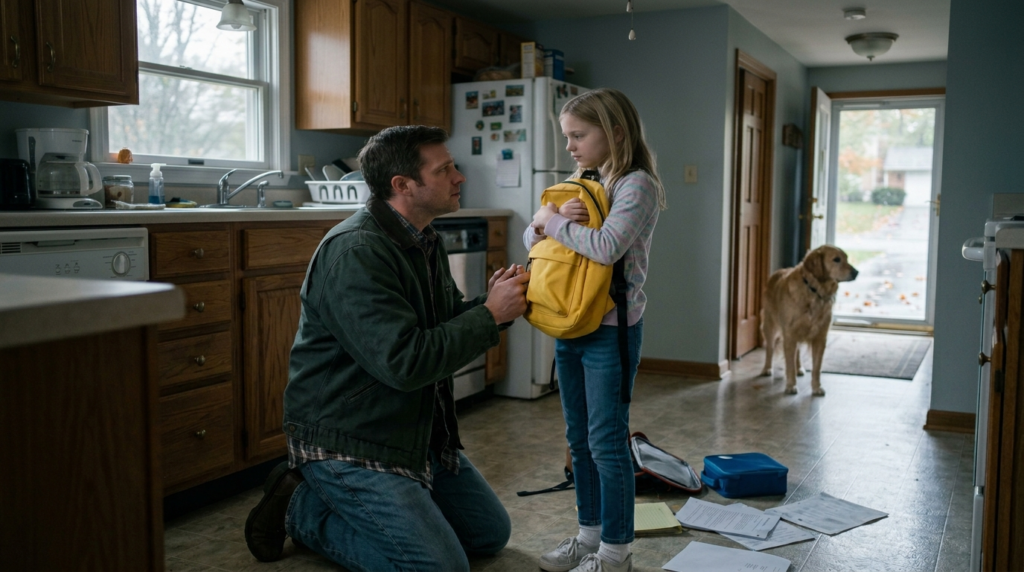
I’ve been a protective father for seven years, but nothing in my life prepared me for the moment I lifted my daughter’s shirt in our kitchen and realized the school had been lying to me all day.
The afternoon started like any other chilly Tuesday in October. I was sitting in my truck in the pickup line outside Oakridge Elementary, watching the heavy double doors of the school open as a sea of children flooded out into the crisp air.
I always looked for Lily’s bright yellow backpack first. She was usually bouncing, running ahead of her friends, eager to tell me about her art projects or what she ate for lunch. But today, she was at the very back of the line.
As she got closer, my heart sank. Her right leg was dragging heavily against the concrete pavement. Her shoulders were hunched forward, her chin tucked tight into her chest, and her face was completely pale. She looked like she was carrying the weight of the world on her tiny frame.
I threw my truck into park, leaped out of the driver’s seat, and hurried toward the gate. Before I could even reach her, Ms. Gable, the veteran playground aide who supervised the afternoon dismissal, stepped in front of me with her clipboard held tightly against her chest.
“Don’t baby her, David,” Ms. Gable said, her voice dripping with an annoying, practiced condescension that immediately set off alarm bells in my chest. She didn’t even look down at Lily, who was now leaning heavily against the chain-link fence.
“What do you mean?” I asked, my eyes darting between the aide and my daughter. “Look at her, Ms. Gable. She can barely put any weight on her right side. Did she fall off the jungle gym? Did someone hurt her?”
Ms. Gable let out a dry, exasperated sigh and rolled her eyes. “She’s been doing that since the end of recess. I looked her over myself. There isn’t a scratch on her ankle or her knee. She didn’t get her way during the group game today, and now she’s just limping for sympathy.”
I stared at her, completely stunned by the sheer lack of empathy in her voice. “Lily doesn’t fake injuries,” I said, my voice dropping an octave as a wave of protective anger began to build in my chest.
“Oh, they all do at this age,” Ms. Gable brushed me off, turning her attention back to the line of children. “She just wants you to carry her to the truck and spoil her with ice cream. Trust me, the moment you stop paying attention to it, the limp will miraculously disappear.”
I didn’t argue with her any further. The cold, mechanical way she dismissed my child made it clear that talking to her was a complete waste of time. I knelt down in front of Lily, gently wiping a smudge of dirt from her cheek. “Hey, bug,” I whispered. “Can you make it to the truck if I hold your hand, or do you want Daddy to carry you?”
Lily didn’t answer. She didn’t even look up at me. She just silently reached out and gripped my fingers with a terrifying, desperate strength. Her hand was ice-cold despite the mild weather.
As we walked slowly toward the truck, every single step looked like pure agony for her. She wasn’t crying out, which somehow made it worse. It was a silent, stoic endurance that felt completely unnatural for a seven-year-old child.
I helped her into the passenger seat, carefully buckling her seatbelt. Usually, she would immediately start babbling about her day, but today, she just stared straight ahead through the windshield, her small body completely rigid.
“Lily, does your leg hurt badly?” I asked gently, shifting the truck into drive and pulling out of the school parking lot. “Did something happen on the playground that Ms. Gable didn’t see?”
She shook her head slowly, keeping her eyes fixed on the road ahead. “I just want to go home,” she whispered, her voice cracking slightly.
The ten-minute drive back to our suburban house felt like an eternity. The silence inside the cabin of the truck was heavy, suffocating, and filled with an unspoken dread. I kept glancing over at her, noticing how she was holding her arms tightly across her stomach, bracing herself every time we hit a small bump in the asphalt.
When we finally pulled into our driveway, I hurried around to her side and opened the door. “Alright, sweetie, let’s get you inside,” I said, reaching in to lift her up.
As my hands wrapped around her waist to lift her out of the seat, Lily let out a sharp, piercing gasp of pain that cut right through my soul. She didn’t just wince—she completely doubled over, her face contorting in pure agony.
“I’m sorry, I’m sorry!” I panicked, immediately loosening my grip and letting her stand on her own feet. “Where does it hurt, Lily? Talk to me, please. Tell Daddy what hurts.”
“My tummy,” she sobbed, finally letting the tears fall as we slowly made our way through the front door and into the quiet safety of our kitchen.
The house was completely still. I guided her over to the kitchen island, helping her lean against one of the wooden barstools. I thought maybe she had a severe stomach flu, or perhaps she had taken a hard blow from a soccer ball during recess that the school staff had completely ignored.
“Let me take a look, bug,” I said, kneeling down on the hardwood floor so I was at eye level with her midsection. “I just want to see if there’s any redness, okay?”
Lily hesitated, her tiny hands trembling as she slowly released her grip on her own shirt. She nodded silently, her lower lip quivering as she looked down at me with eyes full of a strange, heartbreaking shame.
I reached out, my fingers catching the hem of her pastel-colored t-shirt. I gently lifted the fabric up past her waist, expecting to see a bit of redness or maybe a minor scrape from the playground gravel.
Instead, the air left my lungs completely.
The space beneath her ribs wasn’t just red. Wrapped tightly around her tiny, fragile midsection was a massive, horrific pattern of deep purple and sickening yellow bruises. The marks were perfectly linear, perfectly defined, and entirely unmistakable.
It was the distinct, overlapping impression of a thick, heavy leather belt.
The bruising was so severe that I could see the exact indentation where the metal edge of a buckle had dug deep into her soft skin near her hip, breaking the blood vessels beneath. This wasn’t an accident from a swing. This wasn’t a playground tumble.
This was a brutal, intentional assault.
And the school playground aide had spent the last two hours telling me my daughter was just faking it for attention.
A terrifying realization washed over me as I stared at the violent marks on my innocent daughter’s body. The school wasn’t just negligent. They were actively covering up a nightmare, and I was about to find out exactly how deep this horror went.
The silence in our kitchen was so loud I could hear the rhythmic ticking of the wall clock over the refrigerator. It sounded like a countdown. I stayed on my knees, my hands hovering just inches away from Lily’s skin, completely paralyzed by the sight before me. My mind refused to accept what my eyes were seeing.
The bruising wasn’t just a single mark. It was a violent, chaotic lattice of deep indigo, angry crimson, and sickening greenish-yellow fluid trapped beneath her delicate skin. It formed a perfect, thick band that wrapped around her right hip and extended across her lower abdomen.
The shape was impossible to mistake. It was the exact width of a standard leather work belt. Near the edge of her hip bone, the skin was split slightly, surrounded by a perfectly square, dark purple indentation where a heavy metal buckle had been pressed into her with immense force.
“Lily,” I whispered, my voice cracking so badly the word barely left my throat. I tried to swallow, but my mouth was completely dry. A hot, toxic wave of adrenaline surged from the back of my neck down to my chest, making my heart hammer against my ribs like a trapped animal. “Lily, oh my god. Bug, what happened?”
She didn’t look at me. She kept her chin pinned to her chest, her small shoulders hunched inward as if she could make herself small enough to disappear entirely. A single, heavy tear dropped from her cheek, landing directly on the pale pink fabric of her shirt that I was still holding up.
“I’m sorry, Daddy,” she sobbed, her voice a tiny, fragile whimper that broke my heart into a million pieces. “I’m sorry. I didn’t mean to. I tried to be quiet.”
“No, no, no, baby, look at me,” I said, forcing my voice to drop into the softest, most reassuring tone I could muster, even though every muscle in my body was screaming with an urge to tear the school apart. I gently let go of her shirt, letting the fabric fall back down to cover the horrific marks. “You have nothing to be sorry for. You did nothing wrong. Look at Daddy, please.”
Slowly, painfully, she raised her head. Her bright blue eyes, usually so full of life and mischief, were bloodshot, swimming in tears, and filled with a profound, heavy shame that no seven-year-old child should ever even understand.
I reached out and gently cupped her face with my trembling hands, using my thumbs to wipe away the wet tracks on her cheeks. “Who did this to you, Lily? You need to tell me. Did someone at school do this?”
She swallowed hard, her tiny frame shivering violently despite the warmth of the kitchen. She glanced toward the window, her eyes darting around nervously as if she expected someone to be watching us through the glass.
“Mr. Jennings,” she whispered so softly I almost didn’t hear it.
The name hit me like a physical blow to the chest. Mr. Jennings was the school custodian. He was a quiet, imposing man in his late late-50s who had worked at Oakridge Elementary for over a decade. He was always around, fixing things, cleaning the halls, moving boxes. I had seen him dozens of times during school events, always nodding politely to parents from the shadows of the gymnasium.
“Mr. Jennings did this?” I asked, my blood turning to pure ice. “Where? When did he do this, Lily?”
“During afternoon recess,” she said, her voice shaking as she gripped the edges of her shirt. “I went inside to use the restroom by the old gym because the playground ones were locked. The hallway was really dark, and the door was heavy. I accidentally knocked over one of his big yellow buckets. The water went everywhere.”
She stopped, a full-body shudder wracking her small frame. She closed her eyes tight, tears squeezing out from the corners.
“And then what happened, sweetie?” I urged gently, squeezing her shoulders to keep her grounded, to let her know she was safe with me.
“He got really mad,” Lily whispered, her lower lip quivering. “He grabbed my arm and pulled me into the big supply room where they keep the mops. He told me I was a bad kid who didn’t respect school property. He said he was going to teach me a lesson so I wouldn’t make a mess ever again. He took off his belt, Daddy. He told me if I screamed, he would make sure I never saw you again.”
A violent shudder went through me. The sheer, unadulterated malice of it made me physically sick. A grown man had cornered my seven-year-old daughter in a dark utility closet and used a leather belt on her because of a spilled mop bucket.
“But what about Ms. Gable?” I asked, the confusion blending with my raging anger. “When I picked you up, she told me you were just faking a limp for sympathy. She said she looked you over.”
Lily opened her eyes, looking up at me with an expression of pure, unvarnished terror. “Ms. Gable found me afterward. I was crying on the floor in the hallway. She didn’t look at my tummy. She just pulled me up by my arm and told me to stop crying or I’d get the whole school in trouble. She told me to walk with a limp and tell everyone my ankle hurt if anyone asked. She said if I told you the truth, Mr. Jennings would come to our house at night.”
The puzzle pieces clicked together with a sickening, horrific finality. Ms. Gable wasn’t just an incompetent, cynical old woman who didn’t care about the kids. She was actively covering for him. She had seen my daughter in agony, realized what the custodian had done, and instead of calling the police or an ambulance, she had threatened a traumatized little girl into silence and manufactured a fake story about a playground injury to feed to me at the pickup line.
They had weaponized my daughter’s fear against her, using me—her own father—as a threat to keep her quiet.
“Daddy’s here,” I said, my voice thick with unshed tears as I pulled her into my arms, holding her tightly but carefully, making sure not to press against her bruised midsection. “I am so sorry I wasn’t there to protect you. But I am here now. Nobody is ever going to hurt you again. I promise you, Lily. Nobody.”
She buried her face into my neck, her small hands clutching the fabric of my denim jacket as she wept silently. I held her for a long time, listening to the sound of her breathing, feeling the fragile rise and fall of her chest, while my mind raced through the immediate steps I needed to take.
I couldn’t just drive to the school and confront them. If I went there in this state, fueled by pure, blinding rage, I would end up in a jail cell, and Lily would be left alone with no one to protect her. I had to be smart. I had to play this perfectly by the book to ensure these monsters never escaped justice.
“Lily, listen to me,” I said, pulling back slightly so I could look her in the eyes. “We need to go to the hospital. We need a doctor to look at your tummy and make sure you’re okay inside. Can you do that for me?”
She nodded quickly, trusting me completely, though her eyes were still wide with apprehension. “Will the police be there?”
“Yes, baby. The police will be there, and they are going to help us,” I said.
I stood up, my knees popping from the cold hardwood floor. I carefully helped Lily down from the barstool, making sure she didn’t have to strain her abdominal muscles. I grabbed her heavy winter coat from the hook by the door, gently draped it over her shoulders without forcing her arms through the sleeves, and carried her out to the truck.
The drive to the county hospital felt surreal. The late afternoon sun was dipping below the horizon, casting long, eerie shadows across the suburban streets of our town. Everything looked completely normal. People were raking leaves in their front yards, neighbors were walking their dogs, and cars were idling at stoplights. The world was moving along as if nothing had changed, while my entire reality had just been shattered into a thousand jagged pieces.
I kept one hand on the steering wheel and reached across the center console to hold Lily’s small, cold hand. She stared out the passenger window, watching the streetlamps flicker to life one by one.
When we arrived at the emergency room, the parking lot was crowded. I parked the truck, rushed around to the passenger side, and lifted Lily into my arms, cradling her against my chest. She didn’t complain about the pain this time; she just locked her arms around my neck, hiding her face from the bright neon signs of the hospital entrance.
I pushed through the heavy sliding glass doors of the ER, the sharp, sterile smell of antiseptic and rubbing alcohol instantly hitting my nose. The waiting room was filled with coughing patients, crying toddlers, and the low murmur of a television playing a daytime talk show in the corner.
I walked straight past the rows of plastic chairs and approached the heavy bulletproof glass of the triage desk. A nurse with tired eyes and a green scrub top looked up from her computer screen.
“Hi, how can we help you today?” she asked mechanically, her fingers hovering over her keyboard.
“My daughter needs to be seen immediately,” I said, my voice remarkably steady despite the chaotic storm raging inside my head. “She has been severely assaulted.”
The nurse’s posture changed instantly. Her fingers dropped from the keyboard, and her tired eyes locked onto mine, then shifted down to Lily, who was trembling in my arms. “What happened, sir?”
“She was beaten with a leather belt at her school by a staff member,” I said, stating the facts clearly, though the words felt heavy and disgusting in my mouth. “She has extensive, severe bruising across her midsection and abdomen. She’s having trouble walking.”
The nurse didn’t ask another question. She stood up from her desk, unlocked the heavy security door leading to the back of the ER, and motioned for me to follow her. “Bring her right through here, dad. We’re getting her a room immediately.”
She led us down a long, bright hallway lined with medical equipment and busy doctors. We were brought into a small, private examination room with a patient bed, a stainless-steel sink, and a monitor ticking quietly against the wall.
“Put her right here on the bed, gently,” the nurse said, her voice now filled with a deep, professional urgency. “I’m calling the attending pediatrician and the social worker on duty. We are also required by law to notify law enforcement immediately. Is that alright with you?”
“Yes,” I said, carefully placing Lily on the crisp white paper covering the mattress. “Please call them. Call everyone.”
Within five minutes, the small room became a hub of quiet, intense activity. A female pediatrician named Dr. Evans entered, followed closely by a hospital social worker named Marcus, who carried a small clipboard. Both of them had calm, gentle demeanors, but I could see the underlying tension in their eyes.
“Hi, Lily,” Dr. Evans said, kneeling down next to the bed so she was at eye level with my daughter. “My name is Dr. Evans. I hear your tummy is hurting a little bit today. Is it okay if I take a look?”
Lily looked at me, silently asking for permission. I nodded, stepping closer to the bed and taking her hand. “It’s okay, bug. Dr. Evans is going to help make the pain go away.”
Lily gave a small, hesitant nod. Dr. Evans reached forward and gently unbuttoned Lily’s coat, setting it aside. Then, with practiced, incredibly gentle movements, she rolled up the pale pink t-shirt.
The moment the bruising was exposed to the harsh, bright fluorescent lights of the examination room, a heavy, suffocating silence fell over the space.
Marcus, the social worker, let out a sharp, quiet breath through his nose, his knuckles turning white as he gripped his clipboard. Dr. Evans didn’t speak for a few seconds. She just stared at the violent, overlapping purple bands across my daughter’s stomach, her eyes darkening with a mixture of professional focus and profound human disgust.
“Marcus,” Dr. Evans said quietly, her voice cold and precise. “Get the forensic camera. We need full photographic documentation of these patterns before we send her down for an ultrasound. I want to check for internal bleeding or organ trauma immediately.”
The word trauma echoed in my ears like a gunshot. Internal bleeding. Organ damage. The reality of what that man had done to my little girl was scaling up into a horrific new dimension.
As Marcus left the room to fetch the camera, two uniform police officers from the local precinct pushed through the curtained doorway. The lead officer was a tall, broad-shouldered man with a shaved head and a serious expression, his badge gleaming under the bright lights. His tag read Officer Martinez.
“Sir, I’m Officer Martinez,” he said, stepping into the corner of the room to give the doctor space. “We received the dispatch call from the triage desk. Can you tell us exactly what happened today?”
I looked from the officer back to my daughter, who was staring at the ceiling, her tiny hand gripping mine so tightly her fingernails were digging into my skin. I took a deep breath, suppressing the tremor in my jaw, and began to recount every single detail—from the moment I noticed her limping in the school pickup line, to Ms. Gable’s dismissive lies, to the heartbreaking confession Lily had made on our kitchen floor.
As I spoke, Officer Martinez wrote down notes in a small black booklet, his jaw tightening with every sentence. When I mentioned the custodian, Mr. Jennings, and the playground aide’s cover story, the second officer let out a low curse under his breath.
“You’re saying the school staff member actively told the child to fake an ankle injury to hide this?” Officer Martinez asked, his voice dropping into a hard, dangerous register.
“Yes,” I said, looking him dead in the eye. “Ms. Gable threatened her. She told her that if she told me the truth, the custodian would come to our house. They used her fear to protect themselves.”
Officer Martinez closed his notebook with a sharp snap. He looked at his partner, then back at me. “Mr. Vance, I need you to stay here with your daughter while the medical team finishes their evaluation. We are going to secure a warrant and dispatch units to Oakridge Elementary and both suspects’ residences immediately. This isn’t just an assault. This is an active conspiracy to conceal a felony involving a minor.”
“Just find them,” I said, my voice dropping to a harsh whisper. “Don’t let them leave that school.”
“We won’t,” Martinez promised, turning on his heel and exiting the room with his partner, their heavy duty belts clanking against their frames as they hurried down the hallway.
Marcus returned with a specialized digital camera, and for the next fifteen minutes, I had to watch in agonizing silence as they photographed the violent imprints on my daughter’s body. Every flash of the camera lens felt like a physical strike against my own skin. Lily kept her eyes closed, tears silently leaking down her temples into her hair as the medical team documented the evidence of her nightmare.
Once the photos were taken, two orderlies arrived with a gurney to take Lily down to the radiology department for her emergency ultrasound. I walked alongside her, holding her hand as we traversed the labyrinth of hospital corridors, my mind completely consumed by a dark, burning desire for retribution.
The school thought they could hide this. They thought they could bully a seven-year-old girl into carrying their disgusting secret. They thought I would just blindly trust their word and go home.
But they had underestimated how far a father would go to protect his child. And as the heavy double doors of the radiology department closed behind my daughter, I knew that the storm was only just beginning for Oakridge Elementary.
The double doors of the radiology department swung shut with a heavy, muffled thud, cutting me off from my daughter. I stood alone in the sterile, brightly lit corridor, my hands still shaped as if they were cradling Lily’s small body. The air in the hallway felt freezing, smelling intensely of chemical floor cleaner and old coffee.
I sank into a row of connected plastic waiting room chairs, the cheap blue plastic cracking slightly under my weight. I buried my face in my hands. The silence here was different from the silence in our kitchen. It was clinical, heavy with the collective anxiety of every desperate person who had ever waited in these halls for terrible news.
Every second felt like an hour. My mind kept betraying me, looping back to the image of Lily’s stomach under those harsh fluorescent lights. The deep, violent imprints of the leather belt seemed burned into the back of my eyelids. I could still see the sharp, square edge where the metal buckle had torn through her skin.
A crushing weight of guilt settled over my chest, making it hard to draw a full breath. I was her father. My one job in this world, the absolute bare minimum expected of me, was to keep her safe from the monsters of the world. And yet, I had handed her over to Oakridge Elementary every single morning, kissing her forehead and telling her to have a good day, completely oblivious to the nightmare waiting for her in the shadows of the building.
I thought about all the small signs I might have missed over the past few weeks. Had she been quieter than usual? Had she hesitated before putting on her backpack? I tried to dissect every memory, every conversation, searching for clues that I had blindly overlooked. The anger inside me was a living, breathing thing now, a white-hot furnace roaring in my gut, but the guilt was a cold, suffocating tide that threatened to drown me.
“Mr. Vance?”
I snapped my head up. Marcus, the hospital social worker, was standing a few feet away. He had replaced his clipboard with two paper cups of cafeteria coffee. He held one out to me, his expression gentle but guarded.
“Thank you,” I muttered, my voice sounding raw and hollow as I took the warm cup. I didn’t drink it. I just held it between my palms, letting the heat thaw my freezing fingers.
Marcus sat down in the chair next to me, leaving an empty seat between us to give me space. He didn’t offer any empty platitudes or clichés. He just sat with me in the heavy quiet.
“The medical team is being very thorough,” Marcus said softly after a long moment. “Dr. Evans is one of our best pediatricians. She’s checking every square inch to ensure Lily gets exactly the care she needs. The ultrasound will tell us if there’s anything internal we need to worry about.”
“How does this happen, Marcus?” I asked, staring blankly at the polished linoleum floor. “How does a grown man do that to a seven-year-old girl? In a school. Surrounded by teachers and staff. How does nobody hear her? How does nobody stop it?”
Marcus sighed, a deeply weary sound. “I wish I had an answer for you, David. In my line of work, I see the worst parts of humanity. But what I can tell you is that you did the right thing. You listened to her. You didn’t let that staff member brush you off. You brought her here. You are protecting her right now.”
Before I could reply, the heavy doors of the radiology wing opened again. Dr. Evans walked out, her blue scrubs rustling as she approached us. Her face was completely unreadable, a mask of professional control, but her eyes held a profound seriousness that made my heart stop.
I stood up immediately, nearly spilling the untouched coffee onto the floor. “Is she okay? What did the ultrasound show?”
Dr. Evans stepped closer, placing a comforting hand on my forearm. “She’s stable, David. Please take a breath. The ultrasound confirmed that there are no ruptured organs. Her spleen, liver, and kidneys are intact, which is our greatest relief right now.”
I let out a long, shuddering breath I didn’t realize I’d been holding. My shoulders dropped an inch. “Thank God.”
“But,” Dr. Evans continued, her tone shifting into a harder, more clinical register, “the trauma to her abdominal wall is severe. The impact caused significant deep-tissue hematomas. The muscle layers beneath the skin are badly bruised and swollen, which is why she’s experiencing such intense pain when she tries to engage her core or walk. We are going to admit her overnight to keep her on intravenous pain management and monitor her for any delayed internal bleeding.”
“Can I see her?” I pleaded. “I don’t want her to wake up alone in a hospital room.”
“Of course,” Dr. Evans smiled gently, the strict professional facade softening for a brief moment. “They are moving her up to the pediatric wing on the fourth floor right now. She’s very tired, and we’ve given her something to help manage the pain, so she might be drifting in and out of sleep. Just be there, hold her hand, and let her know she’s safe.”
“Thank you, Doctor. Truly,” I said, handing my full coffee cup back to Marcus before hurrying toward the elevators.
The pediatric wing was vastly different from the chaotic, sterile environment of the emergency room. The walls were painted with cheerful, bright murals of cartoon animals and ocean scenes, an intentional effort to mask the grim reality of a children’s hospital. But to me, the colorful paintings just felt jarring and strange against the backdrop of my daughter’s suffering.
I found Lily’s room at the end of the hall. It was dark inside, illuminated only by the soft, ambient glow of the vitals monitor and the amber streetlights filtering through the window. Lily looked incredibly small in the oversized hospital bed, her pale face framed by the stark white pillows. An IV line was taped to the back of her tiny hand, the clear fluid dripping steadily into her vein.
I pulled a heavy vinyl armchair up to the side of the bed. I reached through the metal safety railing and carefully took her free hand, wrapping my fingers around her tiny, warm palm. Her breathing was slow and shallow, her chest rising and falling in a rhythmic, medicated sleep.
I sat there for what felt like hours, watching the green lines blink on the heart monitor. The steady beep… beep… beep became a comforting anchor, proving to me that she was still here, still fighting, still safe under my watch.
Around 8:30 PM, the heavy wooden door of the room creaked open, throwing a shaft of bright hallway light across the floor. I turned around to see Officer Martinez stepping quietly into the room. His uniform shirt was slightly wrinkled, and he looked entirely drained, but his expression was fiercely intense.
He nodded to me, signaling for me to step out into the hallway so we wouldn’t disturb Lily. I carefully released her hand, kissed her forehead, and crept out of the room, closing the door softly behind me.
“Did you find them?” I asked immediately, my voice a sharp, desperate whisper the moment the door clicked shut.
Officer Martinez leaned against the corridor wall, crossing his arms over his chest. “We got them, David. Both of them.”
A cold, grim satisfaction settled into my bones, but I wanted the details. I wanted to know every single thing that had happened when the law finally caught up to the monsters who had broken my daughter. “What happened at the school?”
“We dispatched three units to Oakridge Elementary right after we left your ER room,” Martinez said, his jaw tightening. “The afternoon activities were still wrapping up, so the administration was still on site. We found the custodian, Arthur Jennings, in the basement maintenance locker room. He was sitting on a bench, changing out of his work boots.”
“Did he fight you?” I asked, my fists clenching at my sides.
“He tried to play dumb at first,” Martinez replied, his voice dropping into a low, dangerous growl. “He claimed he didn’t know what we were talking about, said he hadn’t seen Lily all day. But when my partner informed him that we had a signed warrant based on a victim’s detailed statement and that forensic teams were on their way to search the gym supply room, his whole demeanor changed. He became completely silent, stone-faced. We cuffed him right there in front of the assistant principal.”
“And Ms. Gable?”
Martinez let out a harsh, cynical laugh. “Gable tried to run. When she saw the blue lights pulling into the school bus loop, she walked out the kitchen exit and headed toward her sedan in the back lot. One of our perimeter officers cut her off before she could even get her keys out of her purse. She threw a massive fit, screaming that she was a respectable educator and that we were ruining her life. She was crying hysterically by the time they put her in the back of the cruiser.”
“Good,” I muttered, a dark feeling of vindication washing over me. “I hope she rots in there.”
“They’re both down at the county jail right now, being booked on multiple felony counts,” Martinez said. “Jennings is facing aggravated child abuse and felony assault with a deadly weapon—the belt qualifies under the statute given Lily’s age and the severity of the trauma. Gable is being charged with felony child endangerment, failure to report abuse as a mandatory reporter, and accessory after the fact for actively threatening a minor to conceal a crime.”
I nodded, absorbing the legal terminology, but something was still bothering me. It felt too calculated. The way Gable had immediately manufactured a cover story, the way she had threatened Lily with Jennings coming to our house—it felt like a routine. It felt like an operation that had been run before.
“Officer,” I said, looking him directly in the eyes. “Is that all? Is it just the two of them? Because the way Gable acted at the pickup line… it felt like she knew exactly what to say to throw me off. It felt like she had done this before.”
Officer Martinez looked down at his boots for a brief second, a heavy silence stretching between us in the quiet hospital hallway. When he looked back up, his eyes were filled with a dark, troubling truth.
“You’re sharp, Mr. Vance,” Martinez said quietly. “And you’re right to ask. While our units were securing the scene at the school, we demanded access to the main administrative office to seize the security camera DVR servers for the hallway outside the old gymnasium.”
My heart skipped a beat. “And?”
“The server room was locked, but when we forced the principal, Gregory Higgins, to open it, we found the main system administrator console pulled up on the desktop,” Martinez said, his voice dropping to a harsh whisper. “The logs showed that someone had accessed the video files for the gym hallway exactly forty-five minutes before we arrived. The entire three-hour block of footage from this afternoon—the exact timeframe of Lily’s recess and her assault—had been completely wiped from the hard drives.”
I stared at him, the white-hot rage roaring back to life in my chest, hotter and more terrifying than before. “The principal? The principal tried to delete the evidence?”
“We caught him red-handed, David,” Martinez said, placing a firm, grounding hand on my shoulder to keep me from shouting. “Higgins claimed it was a routine system backup error, but our digital forensics unit already pulled the user credentials used to execute the delete command. It was Higgins’ own administrative login. We arrested him right there in his office for obstruction of justice and tampering with physical evidence.”
The corruption didn’t just stop at a cruel custodian and a cynical playground aide. It went all the way to the top of the school administration. The very people entrusted with the safety of hundreds of innocent children every single day were actively destroying evidence of a brutal felony to protect their school’s reputation, their funding, and their own careers.
“They tried to erase her,” I whispered, my voice shaking with a terrifying mixture of grief and fury. “They tried to pretend like my little girl didn’t matter.”
“They failed,” Martinez said firmly. “They didn’t realize that the digital files leave a shadow footprint on the server cluster. Our tech guys are already reconstructing the deleted sectors as we speak. We are going to get that footage back, David. And when we do, it’s going to put every single one of them away for a very, very long time.”
Martinez gave my shoulder a supportive squeeze. “Get some rest, dad. You’ve had a long night, and Lily is going to need you to be strong tomorrow when the detectives come by to take a formal, recorded statement with the child advocate. I’ll keep you updated on the arraignment hearings.”
“Thank you, Officer Martinez. For everything,” I said.
He turned and walked away, his heavy footsteps echoing down the long, quiet hallway of the pediatric wing. I stood alone outside Lily’s door for a long minute, letting the absolute horror of what the police had uncovered sink in. Oakridge Elementary wasn’t a school anymore. It was a crime scene, a den of wolves disguised as protectors.
I pushed the door open and stepped back into the dark room. Lily had shifted slightly in her sleep, her brow furrowed in a small, tense line as if she were having a bad dream. I sat back down in the vinyl chair, taking her small hand back into mine.
“I’m right here, bug,” I whispered into the quiet dark, the monitor tracking her steady heartbeat. “The monsters are gone. Daddy took care of them.”
But as I watched her sleep, staring at the white hospital sheets, I knew the battle wasn’t over. The school administration had tried to bury the truth, which meant there were likely other victims, other secrets hidden within those brick walls. Tomorrow, the legal storm would hit our town, and I was going to make sure it tore down everyone who had ever allowed my daughter to be hurt.
The dawn crept into the pediatric ward of County Memorial Hospital not with a bright burst of sunshine, but with a slow, heavy gray mist that clung to the windowpane. I hadn’t slept a single wink. Every time I closed my eyes, the sterile hum of the hospital machinery blended with the memory of Lily’s small, broken voice in our kitchen. I stayed anchored in that uncomfortable vinyl chair, my fingers lightly interlaced with hers, watching the slow, rhythmic rise and fall of her chest.
Around seven in the morning, the clear fluids in her IV line began to run low, causing the monitor to emit a sharp, rhythmic beep. A nurse stepped softly into the room, her rubber-soled shoes squeaking faintly against the polished floor. She offered a warm, sympathetic smile as she skillfully swapped out the plastic bag, checking the vitals monitor with a practiced eye.
“Her vitals are holding remarkably steady, Mr. Vance,” she whispered, keeping her voice low so as not to disturb the sleeping seven-year-old. “The doctors will be doing their morning rounds in about an hour, but from what I can see, the pain medication is doing its job. She’s resting comfortably.”
“Thank you,” I rasped, my throat feeling like it was lined with sandpaper. I cleared it quietly. “Has there been any sign of internal complications from the lab work?”
“Nothing new,” she reassured me, patting the edge of the blanket. “The deep-tissue trauma is going to take a long time to heal, and she’s going to be incredibly sore for a few weeks, but her body is fighting back. You should try to close your eyes, dad. You look like you’re about to collapse.”
I nodded politely, but we both knew I wouldn’t sleep. The moment she left, I leaned forward, resting my forehead against the cold metal guardrail of the bed. The weight of the last twenty-four hours was crushing, a physical pressure centering right behind my eyes.
An hour later, Lily began to stir. Her small fingers twitched within mine, and a faint, muffled groan escaped her lips as she tried to shift her weight onto her side. The movement instantly engaged her bruised abdominal muscles, causing her eyes to snap open with a sharp, involuntary gasp of pain.
“Easy, bug, easy,” I said instantly, rising from the chair and gently placing a hand on her shoulder to guide her back onto the pillows. “Don’t try to roll over just yet. Keep your tummy flat. Daddy’s right here.”
She blinked against the soft light of the room, her blue eyes looking cloudy and exhausted before they finally focused on my face. The sheer terror that had consumed her the previous night had faded slightly, replaced by a dull, heavy weariness.
“Does it still hurt, Daddy?” she whispered, her voice barely audible over the hum of the wall monitor.
“It’s going to hurt for a little while, sweetie, but the doctors are giving you special medicine to make it better,” I said, leaning down to press a soft kiss against her forehead. Her skin felt cool and normal, a small comfort against the raging fire of my anxiety. “The bad men can’t get in here. You’re completely safe.”
She nodded slowly, her lower lip trembling just a fraction before she locked her eyes onto the colorful cartoon sea creatures painted on the opposite wall. “Are they still at the school?”
“No, baby. The police went to the school last night. Mr. Jennings, Ms. Gable, and the principal… they’re all locked up in a place where they can never, ever hurt another child again. I promise you.”
A visible wave of relief washed over her small frame. Her shoulders dropped slightly into the mattress, and the tight, defensive posture she had maintained since yesterday afternoon finally began to loosen.
At 9:00 AM, a gentle knock sounded on the door. Dr. Evans entered, accompanied by a woman in a sharp grey blazer who carried a small, kid-friendly stuffed animal under her arm. Her name was Clara, and she was a certified forensic interviewer from the County Child Advocacy Center.
“Good morning, David. Morning, Lily,” Dr. Evans said, her tone warm and encouraging. “We have some friends here who need to talk to Lily for just a little bit, okay? They want to make sure we have everything documented perfectly so the police can finish their paperwork.”
Clara stepped forward, pulling up a small stool to the opposite side of the bed. She didn’t look like a cop or a lawyer; she had a gentle, grandmotherly aura that immediately seemed to put Lily at ease. She set the stuffed bear down on the edge of the blanket.
“Hi, Lily,” Clara said softly. “I brought a friend for you to hold if you’d like. My job is to listen to brave kids tell their stories, and I heard you were the bravest girl in the whole city yesterday.”
Lily reached out her non-IV hand and pulled the plush bear against her chest, using it as a shield. “Daddy said I don’t have to go back to that school.”
“You never have to go back there if you don’t want to, sweetheart,” Clara promised, opening a small folder on her lap. “But right now, I need you to tell me exactly what happened by the old gym. Take your time, and if you want to stop or take a break, just tell me or your dad.”
For the next forty-five minutes, I had to sit there and listen to my seven-year-old daughter recount the worst moment of her life. I listened to her describe the heavy, dark hallway, the metallic clang of the falling mop bucket, and the terrifying speed with which the custodian had turned on her. She detailed the heavy grip on her arm, the cold darkness of the utility closet, and the sharp, terrifying sound of a leather belt being pulled through denim loops.
Every word she spoke felt like a physical turning of a knife in my chest. My hands balled into fists so tight that my fingernails bit deep into my palms, leaving small red crescents in the skin. I wanted to scream. I wanted to tear down the walls of that hospital. But for Lily, I forced myself to remain perfectly still, a calm, unmoving pillar of support at the side of her bed.
When Clara finished her interview, she thanked Lily, gave her a high-five, and stepped out into the hallway, gesturing for me to follow her for a moment.
“She did incredibly well, David,” Clara said, her voice dropping into a professional, serious tone the moment the door clicked shut behind us. “Her timeline is perfectly consistent, and the level of detail she provided regarding the utility room layout and the specific threats used by both Jennings and Gable is ironclad. This text matches up flawlessly with the physical evidence documented by the medical team.”
“What happens now?” I asked, leaning against the wall, feeling entirely drained.
“The District Attorney’s office is already preparing the formal arraignment packages,” Clara explained. “Because of the severity of the injuries and the clear evidence of a coordinated cover-up, they are going to push for maximum bail for all three suspects. They want to ensure none of them step foot outside a jail cell before the trial.”
As she spoke, Officer Martinez walked down the corridor, holding a thick manila folder under his arm. His face was set in a hard, grim expression that told me he hadn’t slept either.
“Mr. Vance,” Martinez said, nodding to Clara before turning his focus to me. “Our digital forensics unit worked through the night on the school’s server cluster. They managed to recover the deleted sectors from the video surveillance system.”
My breath caught in my throat. “What did the footage show?”
Martinez took a deep breath, his knuckles whitening against the folder. “It confirmed everything. The camera in the north hallway captured the entire sequence. It shows Lily entering the restroom area at 1:45 PM. Two minutes later, Jennings is seen walking toward the utility room. At 1:52 PM, the camera catches the actual commotion—the door to the utility room opens briefly, and you can clearly see the physical struggle before the door is slammed shut from the inside.”
He paused, his jaw tightening as he stared at the floor for a brief second before continuing.
“But the most damning piece of evidence comes twenty minutes later,” Martinez whispered, his voice trembling with a quiet, professional fury. “The footage shows Lily stumbling out of that hallway, clearly doubled over in agony. Ms. Gable intercepts her at the water fountain. You can see Gable grab Lily by the upper arm, shake her violently, and point directly at her face while speaking aggressively. Then, less than ten minutes after that, the principal, Gregory Higgins, walks down that exact hallway, meets with Gable, and looks directly into the utility room where Jennings is still inside. They stood there for three minutes, talking calmly, before walking back to the main office together.”
The sheer, calculated malice of it left me speechless. It wasn’t just a moment of panic or an isolated mistake by a bad employee. It was a boardroom meeting held in a school hallway, where three grown adults decided that a little girl’s life and safety were completely secondary to protecting their own careers and the reputation of their institution.
“They knew,” I whispered, the words tasting like ash. “Higgins knew what happened before I even arrived at that school.”
“He knew everything,” Martinez confirmed, tapping the folder. “And that’s exactly why the DA is upgrading his charges this morning. He’s no longer just facing obstruction. They are looping him into the conspiracy to commit child endangerment and accessory to a felony. He’s going down with the rest of them.”
“When is the hearing?”
“Tomorrow morning at 9:00 AM at the county courthouse,” Martinez said. “You don’t need to be there, David. Lily needs you here. The state has more than enough evidence to secure the indictments without you standing in that courtroom.”
“No,” I said, my voice cutting through the quiet hallway with a cold, absolute certainty. “I’ll be there. I want them to see my face. I want them to know that their little plan failed completely.”
Martinez looked at me for a long moment, seeing the unyielding determination in my eyes, and slowly nodded. “Alright, David. I’ll make sure there’s a seat reserved for you right behind the prosecution table.”
By that afternoon, the news of the arrests had leaked to the local media. The hospital room’s small television, kept on a low volume, began broadcasting breaking news alerts with a large, bold graphic: “HORROR AT OAKRIDGE ELEMENTARY: PRINCIPAL AND STAFF ARRESTED IN BRUTAL CHILD ABUSE COVER-UP.”
I quickly turned the TV off before Lily could see the images of her school flashing across the screen. But outside the hospital walls, the community was already erupting into a frenzy of shock and righteous anger. Parents who had trusted Oakridge with their children for years were realizing that the friendly neighborhood school was harboring a network of abusers and enablers.
The next morning, I left Lily under the watchful care of her aunt and the hospital security staff, who had placed a guard outside her door to ensure no rogue reporters could get close to her. I drove down to the county courthouse through a heavy downpour, the windshield wipers clacking furiously against the glass.
The courthouse steps were swarming with local news crews, satellite trucks, and a large crowd of furious parents holding handwritten signs demanding justice for Lily. I pushed past the cameras, keeping my head down, and made my way through the heavy metal detectors into Room 302.
The courtroom was packed to maximum capacity. The air inside was tense, heavy with the murmurs of reporters and spectators. I took my seat directly behind the prosecutor’s table, my eyes fixed entirely on the heavy wooden door near the side of the room where the detainees were brought in.
At exactly 9:00 AM, the bailiff called the court to order, and Judge Thomas took his seat at the bench.
“Bring in the defendants for case number 26-CR-4402,” the judge ordered coldly.
The side door opened, and a heavy silence fell over the entire courtroom. Arthur Jennings entered first, dressed in a bright orange jumpsuit, his hands and ankles shackled with heavy steel chains that clanked loudly against the hardwood floor. The imposing, confident man I had seen roaming the school halls looked small, his shoulders hunched, his eyes fixed firmly on the ground to avoid the furious glares from the gallery.
Behind him walked Ms. Gable. The smug, condescending sneer she had used against me at the pickup line was entirely gone. Her hair was unkempt, her face pale and streaked with tears, her hands trembling violently within her cuffs as she tried to hide behind her public defender.
Finally, Gregory Higgins entered. The former principal, a man who prided himself on his pristine suits and professional reputation, looked completely broken. His expensive tie was gone, his collar was open, and the absolute humiliation of his situation seemed to weigh heavily on his frame.
The prosecutor stood up, her voice ringing out through the courtroom like a bell as she read the formal indictments. She detailed the charges with an unyielding precision, describing the brutal assault in the utility room, the terrifying threats hurled at a seven-year-old child, and the deliberate, calculated attempt to wipe the digital servers to erase the crime.
When she finished, the defense attorneys tried to argue for a reasonable bail, citing their clients’ lack of prior criminal records and deep roots in the community. Higgins’ lawyer even tried to claim his client was acting under immense stress and panicked, rather than acting with malicious intent.
Judge Thomas didn’t let him finish. He slammed his gavel down with a sharp, echoing crack that silenced the entire room.
“I have reviewed the preliminary forensic reports and the recovered video evidence provided by the state,” Judge Thomas said, his voice dripping with an icy, unyielding disgust. “What I see in these documents is not a lapse in judgment or a momentary panic. It is a systematic, cruel, and entirely depraved betrayal of the sacred trust placed in our educational system. A seven-year-old child was left unprotected in an environment where she should have been safest, and the very people paid to protect her chose to weaponize her fear to save their own skin.”
The judge leaned forward, his eyes locking onto the three defendants with absolute finality.
“Bail for Arthur Jennings is set at two million dollars, cash or surety. Bail for Mary Gable is set at five hundred thousand dollars. Bail for Gregory Higgins is set at seven hundred and fifty thousand dollars. They will remain in custody until trial. Court is adjourned.”
The gavel struck one final time. As the bailiffs stepped forward to lead the defendants back to the holding cells, Gregory Higgins turned his head slightly, his eyes scanning the crowded gallery before finally locking directly onto mine.
I didn’t blink. I didn’t yell. I didn’t look away. I just sat perfectly straight in my chair, staring back at him with an unyielding, cold intensity that let him know, without a shadow of a doubt, that he had lost everything. He quickly looked away, his head dropping into his chest as the heavy metal door slammed shut behind him.
A heavy wave of relief washed over me as I stepped out of the courthouse back into the cool morning air. The rain had stopped, and the clouds were finally beginning to break apart, allowing small slivers of pale blue sky to peek through. The legal battle was far from over—there would be hearings, motions, and a full trial to endure—but the monsters had been stripped of their power, exposed to the light of day, and locked away where they could never hurt another soul.
I drove back to the hospital, the heavy weight that had been resting on my chest for the past forty-eight hours finally starting to dissipate. When I walked back into Lily’s room, the blinds were open, filling the space with warm, natural daylight. She was sitting up in bed, color returning to her cheeks, eating a small bowl of fruit while watching a cartoon on a tablet.
“Hey, bug,” I said softly, stepping up to the side of the bed.
She looked up, her face breaking into the first genuine, beautiful smile I had seen since Tuesday afternoon. “Hi, Daddy. Look, the doctor said if I finish my breakfast, I can go home today.”
“That’s amazing news, sweetie,” I smiled, pulling the vinyl chair back up to her side and taking her small hand back into mine.
The physical bruises around her midsection would fade over the coming weeks, changing from purple to yellow before vanishing entirely. The emotional scars would take much longer to heal, requiring time, patience, and a lot of professional therapy to navigate the deep-seated trauma of that dark hallway. We would likely move away from this district, find a new home, and start fresh in a place where those brick walls couldn’t haunt her dreams.
But as I sat there watching my daughter laugh at a cartoon, feeling the steady, warm strength of her hand gripped firmly inside mine, I knew we were going to make it. The school had tried to bury her story, tried to use her fear to keep her quiet, but they had underestimated the fierce, unbreakable bond between a father and his child.
We had broken through the silence, pulled the horror into the light, and ensured that justice would be served. And from this day forward, I would spend every single breath making sure my little girl knew that no matter how dark the world got, her dad would always be there to tear the monsters apart.