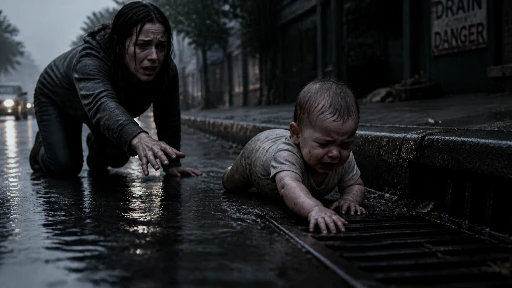
I’ve told this story once before, but I still wake up in a cold sweat thinking about that dark highway. The sound of that heavy dragging is something I don’t think I will ever unhear.
CHAPTER 1: A Woman’s Shoe In The Dark
I had the thermal blanket tucked tight around her small shoulders when her arm shot out, rigid as a board.
Her tiny fingers grabbed the rubber seal of the ambulance door, pulling her whole weight against my chest.
She wasn’t looking at the flashing red lights or the warm heater vents, but staring straight out into the black night, aiming her hand at the storm grate fifty feet away.
She was maybe nine months old. Found sitting alone in the wet grass of the shoulder on Interstate 80.
Miller and I had expected the worst when the dispatch came in. A driver had spotted something pink moving near the guardrail.
But she was whole. Freezing, soaked through her little pink onesie, and shivering violently, but physically unhurt.
We got her into the back of the rig. The heater was blasting, the doors were pulled half-shut to block the wind, and we should have been feeling a massive wave of relief.
Instead, the baby wouldn’t stop screaming.
It wasn’t a normal infant cry. It was a ragged, breathless shrieking.
Every time Miller tried to pull the heavy rear doors completely closed to trap the heat, the little girl thrashed with a strength that terrified me.
She fought the foil blanket. She fought my grip.
She kept twisting her tiny body back toward the open gap, pushing her face into the biting winter air.
“Close the doors, Miller,” I yelled over the howl of the wind. “She’s losing heat fast.”
“I’m trying,” he grunted, grabbing the heavy metal handle. “She’s practically lunging out of your arms.”
He was right. I had to lock both my hands around her waist just to keep her from tumbling off the gurney onto the metal floor.
She was pointing.
A single, tiny finger, shaking in the freezing air, aimed dead at the edge of the asphalt.
There was nothing out there but the rusted iron bars of a wide storm drain set deep into the concrete. Beyond that, just black trees and a steep drop-off into the woods.
Advertisement
“She’s just scared,” Miller said, finally getting the latch to engage. “Let’s just get rolling to County General.”
But as the heavy door swung on its hinges, blocking her view of the drain completely, the baby’s eyes went wide.
She let out a sound I will never forget.
A raw, terrified gasp, followed by a wail so loud and desperate it made the hair on my arms stand up. She clawed frantically at my collar, her eyes glued to the sliver of space before the door clicked shut.
I looked down at her face.
You do this job long enough, you learn the difference between pain, cold, and pure panic.
This was panic.
She wasn’t looking away from the dark. She was looking for it.
“Wait,” I told Miller.
I pushed past his arm and kicked the door back open.
The winter wind rushed in, stinging my face. The baby instantly went silent.
She didn’t stop shivering, but the screaming stopped. She just stared right past me at the iron grate on the shoulder, her chest heaving.
“What are you doing?” Miller asked, his hands hovering over the pediatric oxygen mask. “We need to go. Now.”
“Hold her,” I said.
I passed the wriggling bundle of pink fabric and thermal foil into his arms. The baby immediately started thrashing again, reaching for me, then reaching for the open door.
I grabbed my heavy Maglite from the holster on the wall.
“Give me thirty seconds,” I told him.
I stepped out of the rig. The asphalt was slick with freezing rain.
My boots crunched against the loose gravel as I walked toward the edge of the shoulder. The highway was dead quiet, save for the low rumble of our diesel engine idling behind me.
The closer I got to the storm drain, the darker it felt.
Advertisement
The iron bars were thick, rusted red at the joints, partially covered in wet dead leaves. I stood over the grate. The black space below dropped down at least ten feet before curving into a long concrete lateral tunnel.
I clicked on the flashlight.
The bright white beam cut through the dark, illuminating the dry concrete floor of the catch basin.
Nothing but dirt, old food wrappers, and rocks.
I let out a breath I didn’t realize I was holding.
“Nothing,” I whispered to myself. Just the wind playing tricks on a terrified kid.
I started to turn around to tell Miller to hit the sirens so we could finally leave.
Then I heard it.
It wasn’t coming from the basin directly below. It was coming from deep inside the lateral pipe that ran directly beneath the four lanes of the highway.
A steady, rhythmic sound.
Scrape. Pause. Scrape. Pause.
Like heavy metal dragging against dry concrete.
I dropped to my knees, ignoring the freezing puddle soaking through my uniform pants, and pressed my hands against the wet iron bars of the grate.
I angled the flashlight beam as far down the dark lateral tunnel as I could.
The light caught the edge of something wedged against the curved concrete wall, twenty feet back in the pitch black.
It was a woman’s muddy white sneaker.
And the scraping sound was getting closer.
CHAPTER 2: Turn Off The Lights
The muddy white sneaker stopped moving.
I stayed frozen on my knees in the freezing mud of the highway shoulder, my flashlight beam shaking just enough to make the shadows dance against the curved concrete walls of the lateral pipe.
Advertisement
The heavy, rhythmic scraping had ceased the moment the bright halo of my Maglite hit the shoe.
For ten agonizing seconds, the only sounds were the low, steady idle of the ambulance engine behind me and the sharp hiss of sleet bouncing off the rusted iron bars of the grate. My uniform pants were soaked through, the icy puddle numbing my shins, but I couldn’t feel the cold. I couldn’t feel anything except the heavy, sudden pounding of my own heart against my ribs.
“Hey!” I shouted.
My voice cracked, echoing down into the dark, corrugated tunnel. The sound bounced off the wet concrete and faded away into the pitch black beneath the interstate.
Nothing moved. The white sneaker remained wedged against the side of the pipe, pointing awkwardly inward.
“This is EMT rescue,” I yelled, pressing my face closer to the freezing iron bars, ignoring the smell of wet decay, old oil, and stagnant water rising from the catch basin below. “Can you hear me? Are you hurt?”
I held my breath, straining to listen over the wind.
At first, there was nothing. Then, a sound drifted up from the darkness.
It was a wet, ragged intake of air. A human gasp.
It was followed by the faint sound of fabric sliding against wet stone. The sneaker twitched. Then, very slowly, it dragged forward another six inches into the light.
Someone was crawling on their stomach through the lateral pipe, dragging their body weight through the freezing mud and debris. They were coming toward the catch basin, toward me.
“Hold on,” I yelled down into the grate. “Just stay right there. Do not move. I have to get the grate off. Keep your energy.”
I scrambled backward, slipping in the wet grass, and pushed myself up to my feet.
I turned and sprinted back toward the rear doors of the ambulance. The bright red and white strobe lights painted the wet trees lining the highway in frantic, flashing bursts of color.
I ripped the heavy right-side door open. A blast of glorious, artificial heat hit me in the face, carrying the smell of sterile gauze and saline.
Miller was sitting on the bench seat, strapping a tiny pediatric blood pressure cuff to the baby’s leg. The little girl was still fighting him, her face red and streaked with tears, her tiny fingers still curling and uncurling toward the open air.
“Miller,” I gasped, out of breath. “I need the Halligan bar. Now.”
Miller looked up, his brow furrowed in confusion. “What? Why? Did you drop your radio?”
“There is someone in the storm drain,” I said, my voice dead serious. “Inside the lateral pipe. They’re crawling toward the basin.”
Miller stared at me for a half-second, his brain trying to process the impossibility of the statement. “What do you mean, inside the pipe? It’s thirty degrees out there. The lateral runs right under the highway.”
Advertisement
“I don’t care where it runs,” I snapped, leaning into the rig and throwing open the exterior side-compartment door where we kept our heavy extrication tools. “There is a person down there. A woman, I think. I saw her shoe. Get on the radio. Call dispatch. I need a heavy rescue unit, police backup, and tell them we have a confined-space scenario.”
“A confined space?” Miller repeated, finally standing up. He looked down at the baby, who had suddenly stopped crying the exact moment I said the word ‘drain’. The infant was staring at me, her wide, wet eyes fixed perfectly on my face.
“Call it in, Miller,” I ordered, grabbing the heavy, cold steel of the Halligan bar—a thirty-inch forcible entry tool with a claw on one end and a wedge on the other.
“I’m on it,” he said, reaching for the dashboard mic. “You’re going to try to pry that iron grate alone? Those things weigh two hundred pounds and they’re sealed with road salt.”
“I have to try,” I said. “She’s freezing to death down there.”
I turned back to the storm drain, the heavy iron bar swinging at my side.
The sleet was turning into a driving freezing rain, coating the asphalt in a dangerous, invisible layer of ice. I slipped twice before I reached the shoulder, dropping to my knees right beside the grate.
I aimed my flashlight down into the basin.
The sneaker had advanced another two feet. I could now see the dark outline of a leg clad in torn, mud-soaked denim.
“I’m going to get you out,” I yelled down, my voice echoing off the concrete. “I’m prying the grate right now. Move your head back so nothing falls on you.”
I didn’t wait for a response. I jammed the adze wedge of the Halligan bar into the tight gap between the heavy iron grate and the concrete frame set into the asphalt.
I leaned my entire body weight onto the opposite end of the bar.
The iron didn’t budge.
It was cemented in place by years of rust, dirt, and road salt. The metal was basically fused to the concrete.
I gritted my teeth, repositioned my boots on the slick asphalt, and threw my weight down again, bouncing my chest against the steel bar.
A sharp, cracking sound echoed over the highway. A chunk of rusted iron flaked off, but the grate remained locked.
“Come on,” I growled, my muscles burning. I pulled the bar out, flipped it over, and drove the prying claw directly into the corner joint.
I stood up, stomped the heel of my boot onto the end of the bar, and pushed down with everything I had.
With a deafening shriek of tearing metal, the corner of the grate popped upward, breaking the rust seal.
I dropped the bar, shoved my thick leather rescue gloves under the exposed lip of the iron grate, and lifted.
Advertisement
The pain in my lower back was immediate and blinding. The grate was impossibly heavy, a massive grid of solid steel. I screamed through my teeth, pulling upward until the grate tilted backward and slammed heavily onto the wet grass, exposing the black, rectangular drop down into the catch basin.
The smell of the subterranean pipe rushed up to meet me—a heavy, suffocating odor of wet earth, decaying leaves, and something sharp and metallic. Like pennies.
I grabbed my flashlight and leaned over the open hole.
The drop was about eight feet down to the dry concrete floor of the basin. The lateral pipe fed directly into the bottom of this pit.
And sticking halfway out of that dark pipe was the lower half of a woman’s body.
She had stopped moving.
“Hey!” I yelled, shining the light directly onto her torn jeans. “I have the grate open. I’m coming down. Do not move.”
I swung my legs over the edge of the concrete frame. I found a narrow foothold on a protruding drainage lip, gripped the icy edge of the street-level asphalt, and lowered myself down into the hole.
I dropped the last three feet, my boots splashing into an inch of freezing mud at the bottom of the basin.
It was freezing down here. The wind whipping across the highway above created a terrible vacuum effect, sucking the icy air straight down the pipe.
I crouched low, aiming the flashlight into the lateral tunnel.
“Ma’am,” I said, keeping my voice calm and steady. “I’m a paramedic. I’m right here. I need to pull you out.”
She didn’t respond. Her legs were perfectly still.
Dread pooled in my stomach. Hypothermia does terrible things to the human body. Once the core temperature drops past a certain point, the victim stops shivering. They get lethargic. They go to sleep, and they don’t wake up.
I reached forward and grabbed her left ankle.
The moment my gloved hand touched her soaked jeans, she flinched violently.
A weak, muffled sound came from deep inside the pipe, past her body. It sounded like a sob.
“I’ve got you,” I said, adjusting my grip to both of her calves. “I’m going to pull. Just let your body slide. Ready? One, two, three.”
I leaned back, using my legs to pull her weight toward me.
She was dead weight, her clothes heavy with mud and freezing water. As I dragged her slowly out of the lateral pipe and into the open catch basin, her torso cleared the corrugated steel.
Advertisement
She was wearing a dark blue winter coat, shredded along the sleeves where she had been dragging her elbows against the sharp concrete. Her hands were raw, bleeding, and caked in dirt. Her long, dark hair was plastered to her face in wet, frozen clumps.
I pulled her completely into the basin, gently rolling her onto her side.
She was shivering so violently that her teeth were audibly clicking together. Her lips were completely blue, her skin a terrifying shade of pale gray in the harsh beam of my flashlight. She looked to be in her mid-twenties.
“You’re okay,” I said, quickly unzipping my own heavy winter uniform jacket and throwing it over her freezing shoulders. “You’re safe. My rig is right above us. We’re going to get you into the heat.”
I pressed two fingers to her carotid artery. Her pulse was erratic, fluttering like a trapped bird.
She slowly opened her eyes. They were wide, bloodshot, and completely devoid of relief.
She stared at me, then looked past me, staring up at the rectangular patch of open night sky above our heads. The red strobe lights from the ambulance flashed violently against the surrounding trees.
Her raw, bleeding hand suddenly shot out and grabbed the collar of my shirt.
Her grip was shockingly strong for someone so cold. She pulled me down until her frozen face was inches from mine.
“Did they see the lights?” she whispered. Her voice was raspy, destroyed.
“Who?” I asked gently, trying to pry her hand off my collar without hurting her. “Nobody is out here. It’s just me and my partner. We have an ambulance right up top.”
“The lights,” she choked out, her eyes darting frantically toward the red flashes reflecting off the wet asphalt above. “Turn them off. You have to turn them off.”
“I can’t turn the emergency lights off on an active highway,” I said, slipping my arms under her armpits, preparing to lift her toward the street level. “It’s protocol. Now, I need you to help me. I’m going to boost you up.”
“No,” she gasped, thrashing in my grip, trying to push herself back toward the dark mouth of the lateral pipe. “No, no, no. He tracks the strobes. The red lights. He looks for the red lights.”
“Who looks for the red lights?” I demanded, holding her tight against my chest to stop her from scrambling back into the freezing darkness.
Before she could answer, Miller’s face appeared over the edge of the hole.
“Jesus,” Miller said, aiming his own heavy flashlight down at us. “You actually found someone down there.”
“She’s severely hypothermic,” I yelled up to him. “Grab her under the arms when I boost her. We need to get her into the heated box right now, or she’s going to arrest on us.”
“Got it,” Miller said, laying flat on his stomach on the wet asphalt, reaching both of his arms down into the hole.
“Ready?” I told the woman. “We’re going up.”
Advertisement
She fought me. She actually fought me, kicking her muddy sneakers against the concrete floor, trying to twist out of my grip. It was the same desperate, frantic thrashing I had just experienced with the baby in the rig. The exact same terrifying panic.
“Don’t put me in the light,” she sobbed, tears cutting tracks through the mud on her face. “Please. Just leave me in the dark. He can’t see the dark.”
“I’ve got her,” Miller grunted, locking his hands under her armpits as I shoved her upward from below.
Between the two of us, we hauled her out of the basin and dragged her limp body onto the freezing wet grass of the shoulder. I scrambled up the concrete wall behind her, pulling myself over the edge and collapsing onto the asphalt next to her.
“Get her on the stretcher,” I wheezed, my lungs burning from the cold air and exertion.
We grabbed her by her ruined coat and practically carried her across the gravel shoulder toward the open rear doors of the ambulance.
The heat radiating from the open doors was intense. As we hoisted her up onto the primary gurney, I saw the baby.
The little girl was sitting perfectly still in the center of the secondary bench seat, wrapped in the silver thermal foil.
The moment we laid the woman down on the stretcher, the baby let out a sharp, piercing shriek.
I expected the woman to react. To cry out for her child. To reach out and grab the infant she had clearly hidden on the side of the road to protect her from whatever had chased her into the storm drain.
But the woman didn’t look at the baby.
She didn’t even acknowledge the child’s existence.
Instead, she rolled onto her side, ignoring the traumatic pain in her bleeding hands, and slammed her palms against the exterior metal door of the ambulance, trying to pull it shut.
“The lights,” she screamed, her voice cracking into a high-pitched wail. “Turn the lights off! Turn them off right now!”
“Miller,” I shouted, jumping into the back of the rig and grabbing the heavy door handle. “Shut the doors. Secure the latch.”
Miller slammed the right door shut. I slammed the left. The heavy latches engaged with a loud, metallic click, sealing us inside the bright, heated, sterile interior of the box. The sound of the wind outside was instantly muted.
I spun around to the main control panel behind the driver’s cab and slammed my palm against the master switch for the emergency strobes.
The flashing red and white lights instantly died.
The interior of the ambulance was now bathed only in the steady, warm fluorescent glow of the medical ceiling lights. The trees outside the small rear windows plunged back into total darkness.
The woman instantly collapsed backward onto the gurney. Her chest heaved, her wet clothes dripping muddy water onto the clean white sheets.
Advertisement
“Okay,” I said, my voice shaking slightly as I pulled a pair of heavy trauma shears from my belt. “The lights are off. We are dark. You are safe. I’m going to cut this wet coat off you so we can get warm blankets on you, okay?”
She didn’t fight me this time. She just lay there, staring at the ceiling, her teeth chattering so hard I thought they would crack.
I quickly and efficiently cut the heavy fabric of her coat down the center seam, pulling the freezing, soaked material away from her torso. Miller was on her other side, wrapping thick, heated cotton blankets tightly around her shoulders and tucking them under her legs.
“Ma’am, what is your name?” Miller asked, shining a small penlight into her eyes to check her pupil reactivity. “Can you tell me your name?”
She blinked against the bright light, but didn’t answer.
“Is this your baby?” I asked softly, pointing toward the bench seat.
The little girl had stopped screaming again. She was watching the woman intently, her tiny hands clutching the edges of the foil blanket.
The woman slowly turned her head. She looked at the baby for a long, silent moment.
“No,” the woman whispered, her voice completely dead. “I’ve never seen that baby before in my life.”
Miller and I locked eyes over the stretcher. The heavy silence in the back of the ambulance was suffocating.
“If she’s not yours,” Miller started slowly, “then why were you both found at the exact same mile marker in the middle of nowhere?”
The woman closed her eyes. “Because this is where the cars stopped.”
“What cars?” I asked.
Before she could answer, the two-way radio mounted on the wall above the bench seat crackled to life.
It was the main dispatcher from the county 911 center. The voice was tight, urgent, and lacked the usual calm, professional monotone.
“Rescue Unit 44, this is County Dispatch. Do you copy?”
I reached up and unhooked the mic. “Unit 44, go ahead County.”
“44, be advised, we just received a massive update from State Police regarding your location,” the dispatcher said. Static hissed beneath her voice. “We have multiple state troopers converging on Interstate 80, approximately one mile north of your current position. They are advising you to lock your doors and do not, under any circumstances, leave your vehicle.”
I tightened my grip on the microphone. I could feel Miller staring at me.
“Copy that, County,” I said, trying to keep my voice steady. “We have secured a second victim from the storm drain. An adult female, severe hypothermia. She is secure in the rig. We are currently blacked out on the shoulder. What is the situation north of us?”
Advertisement
There was a long pause on the radio. Just the crackle of empty air.
“44,” the dispatcher finally said. “State Police have located a heavy duty transport van abandoned under the Route 9 overpass. The engine is running, the doors are open. The back of the van contains multiple empty car seats.”
The woman on the stretcher violently flinched at the word ‘van’. She squeezed her eyes shut, pulling the warm blankets up over her face as if trying to hide from the radio itself.
“They also located a state trooper cruiser parked approximately fifty feet away,” the dispatcher continued, her voice dropping lower. “The cruiser’s dashcam has been ripped out. And Unit 44… they located the trooper.”
“Is he injured?” Miller asked loudly, stepping closer to the radio.
“He is deceased, 44,” the dispatcher said. “The troopers on scene are reporting his radio is missing from his duty belt. Whoever took it has access to the main emergency band. They are advising strict radio silence after this transmission. Do you copy?”
The blood drained from my face. I stared at the black plastic microphone in my hand.
“Copy, County,” I whispered, and clicked the mic off.
The interior of the ambulance was dead quiet. The heater hummed softly, blowing warm air across the floor.
The woman on the stretcher slowly lowered the blanket away from her face. She looked at me, her eyes hollow, terrified, and resigned.
“I told you,” she whispered. “He looks for the red lights.”
I stood frozen, processing what the dispatcher had just said. A dead trooper. A missing radio. A van full of empty car seats.
And then, a sound broke the silence.
It didn’t come from the two-way radio mounted on the wall.
It came from inside the ambulance.
A sharp, distinct burst of static.
I slowly turned my head.
The sound had come from the pile of wet, ruined clothes I had just cut off the woman. Her heavy blue winter coat lay crumpled on the metal floor near the rear doors.
A second burst of static echoed through the small space.
Then, a voice.
Advertisement
It was a man’s voice, deep and perfectly calm, emanating from a heavy black police-issue walkie-talkie half-buried in the pocket of the woman’s soaking wet coat.
“Unit 44,” the man’s voice crackled through the speaker. “You turned your lights off. But I still see your exhaust pipe smoking.”
CHAPTER 3: The Heavy Footsteps On The Rear Metal Bumper
“Unit 44. You turned your lights off. But I still see your exhaust pipe smoking.”
The voice from the radio was perfectly level. It didn’t have the adrenaline-fueled crackle of a man in a panic. It sounded like a man ordering a cup of coffee. Casual. Patient.
I stared at the heavy blue winter coat crumpled on the metal floor of the ambulance. The black plastic walkie-talkie was still wedged halfway inside the torn pocket, its green transmission light blinking in the dim fluorescent glow of the cabin.
The woman on the stretcher let out a sound that wasn’t human.
It was a guttural, primal scrape of pure terror. She violently kicked her legs, tangling herself in the thermal blankets, trying to scramble backward away from her own coat. Her muddy sneakers hit the aluminum railing of the gurney with a sharp clang.
“Hey,” Miller barked, snapping out of his frozen shock. He lunged forward, grabbing her shoulders to keep her from throwing herself onto the floor. “Hey, stop! You have an IV line in, you’re going to rip it out!”
I didn’t look at her. I didn’t look at Miller.
My eyes were locked on the small, square vent near the ceiling of the rear doors.
I still see your exhaust pipe smoking.
The ambulance was a heavily modified Ford F-450 chassis. We had the engine idling at a high RPM to power the massive rear alternator, which was feeding the industrial heater blowing warm air over our feet.
In thirty-degree weather, the diesel exhaust pouring out of the tailpipe would be a thick, brilliant white plume of steam rising straight into the dark sky.
It was a beacon.
And if he could see the exhaust plume, he had a direct line of sight to the back of our rig.
I spun around and slammed my hand into the master control panel mounted behind the driver’s cab pass-through. I bypassed the climate controls and hit the main engine kill switch.
The low, rumbling vibration beneath our boots instantly died.
The steady hum of the heater spun down into a pathetic wheeze, then stopped completely.
The silence that rushed into the box was deafening.
Advertisement
Without the engine running, the main cabin lights flickered and shut off, defaulting to the rig’s secondary battery reserve. The interior was plunged into heavy shadows, illuminated only by the faint, pulsing amber glow of the cardiac monitor and the tiny green light on the stolen police radio.
“What did you just do?” Miller hissed, his voice dropping to a frantic whisper. “We need the heater. Her core temperature is bottoming out.”
“He has eyes on the rig, Miller,” I whispered back, my heart hammering against my ribs. “If he can see the exhaust, he’s close. We’re a glowing white box sitting on a pitch-black highway.”
“Then we drive,” Miller said, letting go of the woman and stepping toward the small rectangular cutout that led into the front cab. “We get out of here right now.”
“No!” the woman choked out. Her bleeding hands clawed at Miller’s uniform sleeve. “No headlights. Do not turn the headlights on. If you light up the road, he’ll see exactly where we are. He has a rifle. I saw it in the front seat of the van.”
Miller froze. He looked back at me, his face pale in the amber light.
A state trooper was dead. We were sitting in a stationary aluminum box with a woman and a baby, and the man who did it was out there in the freezing rain, watching us.
“We can’t just sit here,” Miller whispered. He squeezed through the narrow pass-through window, dropping into the driver’s seat in the front cab. “I’m not turning the headlights on. I’m just going to roll us forward, stay on the shoulder, and limp down the highway in the dark until we reach the state cops.”
I didn’t argue. I grabbed a heavy roll of trauma gauze from the overhead bin and knelt beside the stretcher, pressing the thick cotton against the deep lacerations on the woman’s palms.
“Hold this,” I told her softly. “Squeeze tight.”
She grabbed the gauze, her whole body shaking violently. The residual heat in the cabin was already fading. The freezing ambient temperature from outside was seeping through the metal walls, chilling the air.
From the front cab, I heard Miller insert the key into the ignition.
He turned it.
Click.
Nothing happened. No engine turnover. No heavy diesel rumble.
“Come on,” Miller muttered, his silhouette shifting in the driver’s seat. He pumped the gas pedal and turned the key harder.
Click. Click.
“The starter’s dead,” Miller whispered, a sharp edge of panic bleeding into his voice. “The battery is completely drained. That’s impossible, we were just running off the alternator.”
I felt the blood drain from my face.
Ambulances have fail-safes built upon fail-safes. They don’t just die. Unless someone opens the exterior battery compartment on the side of the rig and severs the main braided cables with a pair of heavy bolt cutters.
Advertisement
I looked down at the stolen radio on the floor.
He hadn’t just found us. He had been here the whole time.
While I was down in the catch basin prying the iron grate open, and Miller was lying on his stomach pulling the woman out, the rig had been completely unguarded. He had walked right up to the side of the ambulance, disabled it, and then retreated into the tree line to watch us lock ourselves inside a dead vehicle.
We were trapped.
“Miller,” I said, my voice dangerously calm. “Get back here. Now.”
Miller squeezed back through the window, dropping into the rear cabin. He didn’t ask questions. He understood exactly what a dead ignition meant. He moved straight to the side door, checking the heavy internal slide locks, making sure the metal deadbolt was thrown.
I turned my attention back to the woman on the stretcher.
Her shivering was getting worse, which from a medical standpoint was actually a good thing. It meant her core temperature was rising just enough to trigger her body’s natural defense mechanisms.
But her eyes were wild, darting around the dark cabin, landing on the baby wrapped in foil on the bench seat.
The infant hadn’t made a sound since the engine cut off. She was sitting perfectly still, her wide, dark eyes locked on the rear doors of the ambulance.
“You need to tell me what is happening,” I said to the woman, leaning in close so I didn’t have to raise my voice. “The dispatcher said there was a transport van under the overpass. With empty car seats. Why were you in that van?”
She squeezed her eyes shut. A single tear cut a clean line through the dried mud on her cheek.
“It was supposed to be a church group,” she whispered, her voice barely carrying over the sound of the sleet hitting the aluminum roof. “An emergency transport for mothers in bad situations. I found the flyer at a bus station in the city. I was trying to get away from my boyfriend. I called the number. He said he would pick me up at the motel and take me to a shelter up north.”
She swallowed hard, grimacing in pain as the movement pulled at her cracked, frozen lips.
“When he picked me up, I got in the back. It was dark. The windows were blacked out. And there were all these car seats. Eight of them, bolted to the floor. But there were no kids. Just one other woman sitting in the far back. She wouldn’t wake up. She was breathing, but she was entirely unresponsive.”
“He was drugging his passengers,” Miller said, standing near the oxygen tanks, his hand gripping a heavy steel wrench he had pulled from the tool kit.
“I don’t think he wanted the women,” she whispered, her eyes drifting toward the tiny pink bundle on the bench seat. “I think he was collecting inventory.”
A cold chill ran down my spine that had nothing to do with the temperature in the rig.
Advertisement
“Where did the baby come from?” I asked softly.
“We stopped at a gas station an hour ago,” she said, her breath fogging in the cold air. “He locked us in the back. When he came out, he opened the sliding door and handed her to me. She was asleep. He just dropped her in my lap and said, ‘Hold the inventory.’ Then he got back in the driver’s seat and got on the highway.”
I looked at the baby. The little girl was completely silent, her gaze still fixed on the metal seams of the rear doors.
“I knew what he was doing,” the woman choked out, her grip tightening on the bloody gauze. “I knew he wasn’t taking us to a shelter. I waited until we were doing seventy on the interstate. I unbuckled my seatbelt, crawled over the seats, and I grabbed the steering wheel. I yanked it as hard as I could toward the trees.”
“You caused the wreck,” I said.
She nodded. “The van hit the guardrail. The impact tore the side door off its hinges. He was pinned behind the steering column. I grabbed the baby, and I ran.”
“And the state trooper?” Miller asked.
“He must have seen the crash,” she said, pulling the blankets tighter around her neck. “He pulled up with his lights flashing. I was already hiding in the woods. I saw the trooper walk up to the van. And I saw the driver shoot him.”
The reality of the situation settled over the dark ambulance like a suffocating blanket.
This wasn’t a domestic dispute. This wasn’t a random highway mugging. We were dealing with a human trafficker who had just executed a police officer to protect his cargo.
“Why did you leave the baby on the shoulder?” I asked. “Why didn’t you take her down into the drain with you?”
“Because he would have heard her crying in the pipe,” she said, her voice breaking. “I knew someone would see the pink clothes in their headlights eventually. I dropped her in the grass to hide her, and then I climbed down into the grate and dragged my feet in the mud. I made as much noise as I could. I wanted him to follow my tracks into the dark.”
She had sacrificed herself. She had crawled into a freezing subterranean pipe, hoping the killer would follow her instead of finding the stolen child.
And then Miller and I showed up, turned on our massive red and white strobe lights, and announced to the world exactly where the baby was.
Crunch.
The sound was faint, muffled by the heavy insulated walls of the ambulance.
Crunch. Crunch.
Miller and I locked eyes.
Someone was walking on the loose gravel of the highway shoulder, right outside the rig.
The footsteps were slow. Deliberate. They weren’t rushing.
Advertisement
“He’s here,” the woman whimpered, pulling her knees up to her chest, making herself as small as possible on the stretcher. “Oh god, he’s right outside.”
“Quiet,” I breathed.
I stood up, moving silently across the diamond-plate floorboards. I reached up and clicked off the cardiac monitor. The amber light died.
We were in absolute, pitch-black darkness.
The only sound was our own rapid breathing and the steady hiss of the freezing rain against the exterior metal.
Crunch. Crunch. Stop.
The footsteps ceased.
He was standing right outside the side passenger door. The same door Miller had just deadbolted.
I reached to my belt and unclipped my heavy Maglite. It was a thick, aircraft-aluminum cylinder. It wasn’t a gun, but in a confined space, it could shatter a man’s jaw. Miller tightened his grip on the steel wrench, stepping back against the wall, positioning himself out of the direct sightline of the windows.
A heavy hand slapped flat against the frosted glass of the side door.
The sudden noise made the baby flinch, but she still didn’t cry. It was terrifying how quiet the infant was. It was the survival instinct of a child who had already learned that making noise brings pain.
We waited in the dark.
Five seconds passed. Then ten.
He didn’t try the handle. He didn’t pound on the glass.
Instead, the footsteps started again.
Crunch. Crunch. Crunch.
Moving toward the back of the ambulance.
The chassis of an F-450 ambulance is heavy. It sits on massive rear shocks designed to carry thousands of pounds of medical gear and human weight.
With a loud, metallic creak, the entire right side of the rig dipped downward.
Someone had just stepped his full weight onto the diamond-plate rear bumper.
Advertisement
He was standing inches away from the rear doors. The only thing separating us from a man who had just murdered a state trooper was a half-inch of aluminum and a mechanical latch.
I stepped in front of the stretcher, placing my body between the rear doors and the woman. I raised the heavy flashlight, poising it like a baseball bat over my shoulder.
Suddenly, the dead police radio on the floor crackled to life.
The sudden burst of static was so loud in the confined space it made my teeth ache.
“Open the doors, EMT,” the calm, deep voice echoed through the dark box, emanating from the speaker near my boots. “I don’t want to break your windows. It’s too cold out here.”
I didn’t answer. I didn’t even breathe.
“I know you’re standing right there,” the voice on the radio continued. “I can see your shadows blocking the little bit of light coming through the front windshield. Just open the latch, hand me the inventory, and I’ll walk away.”
Inventory.
He was talking about the nine-month-old baby currently wrapped in foil behind my legs.
“If you don’t open the door,” the voice said, the casual tone finally dropping, replaced by something hard and terrifyingly flat, “I’m going to shoot through the aluminum. And I’m going to aim waist-high.”
My stomach dropped. The metal doors weren’t bulletproof. A rifle round would punch through the thin aluminum exterior and tear straight through the cabin.
“Get down!” I hissed at Miller.
I dove forward, grabbing the woman by the collar of her ruined shirt, dragging her horizontally off the stretcher. She cried out in pain as we hit the floorboards, rolling into the narrow space beneath the bench seat.
Miller dropped to his knees, throwing his arms over the baby, shielding the infant with his own body armor.
We braced for the deafening crack of gunfire. We braced for the metal to splinter.
Instead, there was a sharp, metallic rattle.
He grabbed the exterior handle of the right rear door and yanked it hard.
The heavy steel deadbolt held. The door didn’t budge.
He yanked it again, harder this time. The entire chassis shook.
“Fine,” the voice said from the radio on the floor.
Advertisement
The heavy weight on the rear bumper suddenly lifted. The ambulance suspension leveled out with a squeak.
The footsteps on the gravel retreated.
Crunch. Crunch. Crunch.
Moving away from the back doors. Moving up the left side of the rig.
“He’s giving up,” Miller whispered, his breath hitting the foil blanket covering the baby. “He can’t get in.”
“No,” I realized, the blood freezing in my veins. “The side doors and rear doors are reinforced. They have internal deadbolts.”
“So?” Miller asked.
“The front cab doesn’t,” I said.
A deafening explosion of shattering safety glass echoed from the front of the vehicle.
Someone had just smashed the driver’s side window with the butt of a rifle.
The heavy thud of combat boots hitting the vinyl seats of the front cab vibrated through the floorboards.
He was in the truck.
And the only thing separating the front cab from the dark box where we were hiding was a rectangular pass-through window with no glass, no door, and no lock.
The beam of a high-powered tactical flashlight suddenly cut through the pass-through window, slicing through the dark rear cabin, sweeping across the medical cabinets, and stopping dead on Miller’s face.
CHAPTER 4: The Gunshot In The Aluminum Box
The tactical flashlight beam was blinding.
It cut through the freezing, pitch-black interior of the ambulance like a solid white pillar, hitting Miller square in the face.
Miller froze, his eyes squinting against the harsh glare, his right hand still gripping the heavy steel wrench against his chest. His left arm was wrapped protectively over the tiny bundle of thermal foil shielding the nine-month-old baby.
“I see you,” the deep, calm voice echoed from the front cab.
The man was leaning over the center console, his body a massive, dark silhouette behind the bright halo of the flashlight.
Advertisement
He rested the heavy barrel of a hunting rifle on the lower edge of the aluminum pass-through window. The metal scraped against metal, a terrifying, deliberate sound in the quiet box.
“Pass the inventory through the window,” the man said.
He didn’t sound angry. He didn’t sound rushed. He sounded completely hollow.
“Pass the child through,” he repeated, “and I walk back into the woods. You both get to go home. The woman on the floor gets to go home. It’s a simple transaction.”
My heart pounded so hard I could feel it in my teeth. I was kneeling on the diamond-plate floorboards just to the left of the pass-through window, pressed flat against the medical cabinets. The flashlight beam hadn’t swept my way yet. I was completely swallowed in the dark blind spot.
I looked down at the woman huddled under the bench seat.
Her face was gray, her lips cracked and bleeding, but her eyes were wide open. She was staring at the steel barrel of the rifle protruding three inches into our cabin.
“I’m not giving you a baby,” Miller said.
His voice shook, but he didn’t move. He kept his body angled, putting the thickest part of his Kevlar trauma vest directly between the rifle barrel and the infant.
“That’s the wrong answer,” the man said softly.
He shifted his weight in the front cab. The beam of the flashlight dipped slightly as he adjusted his grip on the rifle stock.
I knew exactly what was about to happen. He was going to shoot Miller in the center of the chest, step over his body, and pull the baby through the window himself.
I had exactly two seconds.
My right hand was resting against the base of the primary oxygen array. Three massive, green, solid-steel M-cylinders were strapped to the wall right beside my shoulder. They were the main supply lines for the entire rig, pressurized to 2,000 PSI.
I didn’t think. I just moved.
I reached up in the dark, grabbed the heavy brass primary regulator valve at the top of the closest tank, and twisted it counter-clockwise as hard as I could.
I didn’t just open it. I wrenched the bleed-valve completely off its threads.
The sound was apocalyptic.
A deafening, high-pitched scream of compressed gas instantly filled the confined space.
Two thousand pounds of pure, freezing oxygen blasted out of the sheared valve, hitting the ceiling and ricocheting directly toward the front cab.
Advertisement
It wasn’t just noise. It was a physical force. A thick, blinding cloud of white vapor instantly flooded the narrow pass-through window, blowing straight into the man’s face.
“Ah!” the man roared, dropping the flashlight.
The blinding white beam hit the floorboards of the cab and rolled, throwing wild, frantic shadows across the ceiling.
He pulled the trigger.
The gunshot inside the aluminum box was the loudest thing I have ever heard.
The concussive shockwave hit me in the chest. The flash of the muzzle illuminated the swirling white oxygen vapor for a fraction of a second.
The bullet tore through the upper medical cabinets, completely missing Miller, shattering glass vials of saline and sending plastic syringes raining down onto the floor.
The air instantly smelled of burning gunpowder, ozone, and sterilized alcohol.
“Miller! The window!” I screamed over the deafening hiss of the vented oxygen tank.
Miller lunged forward. He didn’t swing the wrench at the man. He swung it at the steel barrel of the rifle, which was still resting on the aluminum ledge of the pass-through.
The heavy wrench connected with a massive CLANG.
The rifle jerked sideways, pinning the man’s hands against the tight, square frame of the window.
The man cursed, a brutal, guttural sound, and tried to rip the weapon backward into the cab.
But suddenly, the woman on the floor moved.
She scrambled out from under the bench seat, ignoring the agonizing pain in her freezing limbs. She threw herself upward, grabbing the scorching hot barrel of the rifle with both of her bare, bleeding hands.
She screamed in pain as the hot metal seared her palms, but she didn’t let go. She threw her entire body weight backward, anchoring the front half of the gun inside our cabin, preventing him from pulling it away to aim again.
“Let go of it!” the man yelled, half-blinded by the oxygen vapor, pulling violently on the stock.
The woman’s boots slipped on the diamond-plate floor, but she held on, her knuckles white, her face twisted in pure desperation. She was fighting for the child she had tried to leave behind.
I pushed myself up from the floor, my heavy Maglite gripped tightly in my right fist.
I stepped over the woman, leaned directly into the narrow pass-through window, and drove the heavy aircraft-aluminum base of the flashlight straight into the side of the man’s face.
Advertisement
I felt the awful crunch of bone under the metal.
The man’s head snapped backward. He let out a stunned, breathless gasp, his hands instantly releasing the rifle stock.
The woman fell backward onto the floor, pulling the heavy hunting rifle completely into the rear cabin with her. It clattered against the metal floorboards, sliding out of reach.
The man staggered backward in the front cab, clutching his jaw, his boots slipping on the broken safety glass scattered across the driver’s seat.
He looked up, his eyes wild and disoriented in the ambient glow of the dropped flashlight.
He reached for his belt. He was going for a sidearm.
Before his fingers could unclip the holster, the dark highway outside exploded with light.
It wasn’t white light. It was a blinding, frantic strobe of red and blue.
A massive blast of an airhorn shattered the quiet night, vibrating through the metal walls of our dead rig.
The cavalry wasn’t just coming. They were here.
Through the smashed front windshield of the cab, I saw three dark state police cruisers skid to a halt on the wet gravel shoulder, angling their heavy push-bumpers directly at the front of our ambulance. Their high beams and emergency strobes turned the icy rain into streaks of brilliant neon color.
“State Police! Show your hands! Show your hands right now!” a voice roared over a PA system.
The man froze. He looked at the flashing lights flooding the cab, then looked back at the narrow pass-through window, staring directly at me.
His face was covered in blood from where the flashlight had struck him. The hollow, calm expression was completely gone. In its place was the raw, undeniable look of a trapped animal.
He didn’t raise his hands. He didn’t surrender.
He threw open the driver’s side door of the ambulance and bolted into the freezing rain, sprinting toward the dark tree line.
“Suspect is running! Suspect has broken containment!” a trooper yelled.
I heard the heavy thud of car doors kicking open. I heard boots hitting the wet asphalt. I heard dogs barking frantically from the back of a K-9 unit.
And then, I heard three sharp, distinct pops ring out in the woods.
Gunfire.
Advertisement
Then, nothing but the hiss of the rain and the wail of the sirens.
Inside the back of the ambulance, the primary oxygen tank finally emptied its reserve. The deafening, high-pitched scream of gas sputtered out, leaving a heavy, ringing silence in its wake.
Miller and I slowly looked at each other. We were both covered in sweat, our chests heaving in the freezing air.
I looked down.
The woman was sitting on the floor, her back pressed against the metal wall. Her hands were blistered and bleeding, but she wasn’t crying.
She was looking at the bench seat.
The foil thermal blanket had slipped down. The nine-month-old baby girl was sitting up.
Throughout the gunshot, the screaming, and the deafening hiss of the gas, the infant had not made a single sound. But now, she was leaning forward, her dark eyes fixed on the woman.
Slowly, the baby reached out.
She wasn’t pointing at the dark storm drain anymore. She wasn’t clawing at the open air.
She was reaching her tiny hand directly toward the woman who had just burned her own hands to save her.
The woman let out a broken, shuddering sob. She crawled across the floorboards, ignoring her injuries, and pulled the baby into her arms. She buried her face in the infant’s pink onesie, rocking her back and forth in the cold dark.
A few seconds later, heavy fists pounded on the rear doors of our rig.
“Paramedics! State Police! Are you secure inside?”
Miller let out a long, shaky breath and reached for the deadbolt.
“We’re secure,” Miller yelled back, throwing the latch and kicking the heavy right door open.
The cold winter air rushed in, bringing with it the smell of wet pine, diesel exhaust, and the sharp reality of the highway. Three state troopers stood on the bumper, their weapons lowered, their faces tight with adrenaline and relief.
We handed the woman and the baby out first. They were bundled into the back of a heated cruiser within seconds, an officer wrapping a heavy wool blanket around both of them.
An hour later, another ambulance arrived from the city to transport them to County General, and to give Miller and me a ride out of the freezing cold.
We found out later that the trafficker didn’t make it out of the woods. He had raised his stolen sidearm at the K-9 unit, and the troopers hadn’t hesitated. The missing trooper’s radio was found in the mud near his body.
Advertisement
They also found the abandoned van under the overpass. The woman we rescued had been telling the truth. There was one other victim inside, heavily sedated but alive. She survived.
I went to visit the woman and the baby in the pediatric ward two days later.
The state had fast-tracked an emergency foster placement while they sorted out the horrific details of the trafficking ring. But for now, they were in a warm, brightly lit room on the fourth floor.
I stood in the doorway for a long time before knocking.
The woman’s hands were heavily bandaged in white gauze. She was sitting in a rocking chair by the window, looking out at the city skyline.
The baby was asleep in the plastic bassinet beside her.
The little girl was wearing a clean yellow sleeper. Her face was relaxed, her breathing deep and even.
I looked at the infant’s small, fragile hands resting softly on top of the cotton blanket.
They weren’t clenched into fists. They weren’t reaching frantically for a dark, terrible place to hide.
They were just still. Finally, perfectly still.
FINAL THANK-YOU NOTE
Thank you, truly, from the bottom of my heart, for reading this story all the way to the end. The internet is a loud, crowded place, and the fact that you gave your time and attention to this specific journey means more than I can easily say. Writing this out was heavy—it forced me to revisit a dark, freezing night that I have carried with me for a very long time. But sharing it with you, and seeing you follow along through the suspense, the fear, and the final relief, has lifted some of that weight. Your comments, your empathy, and your investment in these characters remind me why we share our hardest moments. Thank you for walking through the dark with me. Stay safe out there, and always look out for each other.
I thought I was prepared for whatever the police would find inside my house. I wasn’t even close.
CHAPTER 1: The Click Of The Brass Deadbolt
Rainwater was already soaking through my leather boots when I heard the deadbolt slide shut.
My six-year-old son’s small hands slapped against the frosted glass of the front door, his fingers slipping against the wet, cold surface.
He wasn’t crying loudly anymore. The frantic screaming had dissolved into thin, terrified hiccups that barely carried over the rolling thunder. He was standing in his dinosaur pajamas on the welcome mat, shivering violently, pressing his face against the glass, begging to be let back into his own house.
I stood fifteen feet away, completely hidden in the dense shadows of the overgrown hydrangea bushes lining the porch.
My chest tight with an animal urge to sprint up those steps, wrap my coat around him, and kick the door off its hinges. But my boots stayed rooted in the mud. I forced myself to stay completely still, my phone pressed hard against my ear, shielding the glowing screen inside my jacket.
“911, what is your emergency?” the operator’s voice crackled softly in my ear.
“My wife,” I whispered, the rain masking the sound of my voice. “My wife just locked our son out of the house. In the storm.”
There was a split second of silence on the line. “Sir? Are you at the residence? Is the child in immediate danger?”
“Yes,” I breathed, my eyes locked on Leo’s trembling shoulders. “Send officers. Fast. Don’t use the sirens when you turn onto Elm Street.”
“Sir, why are you whispering? Can you safely reach the child?”
“I can,” I said, my jaw clenching so hard my teeth ached. “But if she knows I’m here, she’ll hide him. You need to see what’s inside.”
I wasn’t supposed to be home until Friday. A massive engineering conference in Dallas had been canceled at the last minute, and I had taken an earlier flight, hoping to surprise my family. The drive from the airport had been a grueling battle against the sudden torrential downpour. When I pulled up down the street, wanting to walk the rest of the way to sneak in and surprise Leo, I had found the front door wide open.
And then, I watched my wife, Sarah, shove our little boy out onto the slick porch.
She didn’t gently guide him. She physically pushed him out by the shoulder, pulled the door shut, and aggressively turned the brass lock. I had frozen in the yard, my brain short-circuiting at the sheer cruelty of the sight.
I was halfway through the lawn, ready to scream her name, when I saw the shadow move across the living room window.
It was a man’s silhouette. Tall, broad-shouldered.
He walked up behind Sarah’s shadow just after she locked the door. I watched the two figures merge together in an embrace. My stomach plummeted, the bile rising in my throat. She wasn’t just being abusive. She was clearing the house of her own child so she could entertain someone else. She had locked him out in a 50-degree thunderstorm to keep her secret safe.
Advertisement
“Officers are in route, sir,” the dispatcher’s voice pulled me back to the cold reality of the rain. “ETA is three minutes. Please, do not confront the individuals inside. Stay out of sight.”
“I’m not moving,” I whispered.
Every second was agony. I watched my son tuck his knees into his chest, huddling against the corner of the brick siding to escape the biting wind. The urge to break cover, to grab him and hold him tight, warred against the cold, hard logic settling in my brain.
If I grabbed him now, Sarah would hear the commotion. She would hustle her lover out the back door. She would claim Leo sneaked out while she was in the bathroom. She would cry, manipulate the situation, and use her pristine reputation in this neighborhood to make me look like a paranoid husband who overreacted. When the divorce proceedings started, it would be my word against hers.
I needed the police to catch her. I needed an ironclad, documented police report stating they found my son shivering on the porch while she was inside with another man. It was the only way to guarantee she would never get custody of him.
Just two more minutes, Leo, I prayed silently, tears mixing with the rain on my cheeks. I am so sorry, buddy. Just hold on.
I kept my eyes glued to the front door, waiting for the glow of blue and red lights to wash over the wet asphalt of our street.
Then, the heavy living room curtains suddenly parted.
A sliver of warm yellow light spilled out onto the porch, illuminating Leo’s wet hair. The man inside had pulled the blinds back. He was standing right at the window, staring out at the rain, just inches away from where my son was huddled.
I held my breath, waiting for the man to see the crying child, expecting him to alert Sarah, expecting the door to fly open in a panic.
But he didn’t.
He just stood there, looking down at Leo with a blank, unmoving expression.
And as a flash of lightning illuminated the front yard, I finally saw the man’s face clearly through the glass.
My phone slipped from my wet fingers, tumbling into the mud.
CHAPTER 2: The Size Twelve Footprint In The Hallway
The phone sank into the thick, dark mud at my feet, the screen glowing faintly against the wet earth before the rainwater drowned it to black.
I couldn’t breathe.
The air in my lungs had turned to solid ice. My hands were suspended in the empty space where my phone had just been, my fingers trembling so violently they felt disconnected from my own body.
A second flash of lightning fractured the sky, turning the neighborhood into a stark, blinding photograph for a fraction of a second.
The face in the window didn’t change. It didn’t flinch at the thunder. It just stared down at my shivering son.
Advertisement
It was David.
My older brother.
The man who had stood next to me at the altar when I married Sarah. The man who had driven me to the hospital the night Leo was born because my hands were shaking too much to grip the steering wheel. The man who came over every Sunday for dinner, who bought Leo his first bicycle, who had a spare key to this house sitting on his keychain right now.
My own flesh and blood.
The bile rose hot and acidic in the back of my throat. I dropped to one knee in the mud behind the hydrangea bushes, clamping a hand over my mouth to stifle the raw, animal sound trying to rip its way out of my chest. I retched quietly, my stomach convulsing, the rainwater sliding down the back of my neck.
David.
It wasn’t a random stranger. It wasn’t a mistake of the shadows. The lightning had lit up the sharp angle of his jaw, the slight crook in his nose from a childhood fight, the dark stubble on his chin.
He was standing in my living room, watching my six-year-old son freeze in a thunderstorm. And he wasn’t doing a damn thing about it. He wasn’t reaching for the lock. He wasn’t shouting for Sarah. He was just watching him with a flat, dead expression that I had never seen on my brother’s face in thirty-two years of life.
A heavy, terrifying darkness began to spread through my veins. The initial shock of the betrayal was instantly swallowed by something much sharper, much colder: primal dread.
If Sarah was having an affair with my brother, that was a tragedy. That was a divorce.
But people having a secret affair don’t stare at a freezing child through a pane of glass like he’s an insect. They don’t push a kid out into a storm just to get a few minutes alone. There were three empty bedrooms upstairs. There was a finished basement. They could have sent him to his room. They could have turned on a movie.
Instead, they locked him outside.
Why did they need him out of the house?
Before I could process the terrifying implications of that thought, the sweep of headlights washed over the wet asphalt of Elm Street.
A white Ford Explorer with a police light bar mounted on the roof rolled slowly down the block. The dispatcher had listened. There were no sirens, no flashing reds and blues, just the heavy, deliberate crunch of tires rolling over wet leaves.
The cruiser came to a stop two houses down, parking tight against the curb in the shadows of a massive oak tree. The engine cut out.
Two doors opened simultaneously with a soft metallic click. Two figures stepped out into the rain, heavy utility belts shifting against their dark uniforms.
I didn’t wait.
I scrambled up from the mud, my boots slipping on the wet grass, and broke cover. I sprinted across the front lawn, ignoring the rain whipping against my face, moving as fast and as quietly as I could toward the officers.
Advertisement
The taller of the two cops unclipped his heavy flashlight, aiming the beam straight at my chest. His hand dropped instantly to the holster at his hip.
“Stop right there,” a low, commanding voice cut through the sound of the rain. “Keep your hands where I can see them.”
“I’m the one who called,” I gasped, holding both hands up in the air, my chest heaving. Rainwater dripped from my nose and chin. “I’m the father. It’s my house.”
The officer lowered the beam slightly, shining it just below my face so he could see my eyes without blinding me. He was a broad-shouldered man in his forties, rainwater beading on his dark mustache. His nameplate read REYES.
The second officer, a younger woman with her hair pulled back into a tight, wet bun, moved swiftly up the sidewalk to my left, her hand also resting on her weapon.
“You the husband?” Reyes asked, his voice a tight whisper.
“Yes,” I breathed, my teeth chattering from the cold and the adrenaline. “My son is on the porch. You have to get him. But you need to know—it’s not just my wife in there. There’s a man with her. I saw his face in the window. It’s my brother. They’re both inside.”
Reyes and his partner exchanged a brief, hard look. The dynamic of the call had just shifted from a domestic dispute to something potentially explosive.
“Is your brother armed?” Reyes asked, his eyes scanning the dark front of my house.
“I don’t know,” I whispered. “He hunts. He owns rifles, but I don’t know if he brought anything here. Please, my son has been out there for ten minutes. It’s freezing.”
“Stay right behind me,” Reyes ordered. “Don’t say a word. Don’t engage your wife. Let us handle it.”
I nodded, my heart hammering against my ribs like a trapped bird.
We moved up the driveway in a tight formation. The younger officer flanked the left side of the house, heading toward the wooden gate that led to the backyard to cut off any escape route. Reyes and I walked straight up the paved front walkway.
As we cleared the edge of the brick siding, Leo came into view.
He was curled into a tight ball in the corner of the porch, his knees pulled up to his chin, his arms wrapped around his small legs. His dinosaur pajamas were completely soaked through, clinging to his pale skin. His lips were visibly blue in the ambient light of the streetlamp.
He wasn’t crying anymore. He was just staring blankly at the frosted glass of the front door, his tiny body vibrating with violent shivers.
I couldn’t hold back anymore. I broke the formation and rushed up the wooden steps.
“Leo!” I choked out, dropping to my knees on the hard porch planks.
His head snapped toward me. For a second, his wide, terrified eyes didn’t even recognize me. Then, a broken, raspy sound escaped his throat.
“Daddy?”
Advertisement
I scooped him into my arms, pulling him hard against my chest. He was freezing. He felt like a bag of crushed ice. I instantly ripped off my leather jacket, ignoring the freezing rain hitting my own shoulders, and wrapped the heavy, dry leather around his shaking body.
“I’ve got you, buddy,” I whispered fiercely, burying my face in his wet, cold hair. “Daddy’s got you. You’re safe. I’ve got you.”
He clung to my shirt with a desperate, crushing grip. His little fingers were stiff and cold.
“She locked it,” he sobbed into my collarbone, his voice trembling so hard the words were barely understandable. “I was just getting a glass of water… and she pushed me… she said the house was sick…”
I froze. My hand stopped rubbing his back.
“What?” I whispered. “What did Mommy say?”
“She said the house was sick,” Leo repeated, burying his face deeper into my neck. “She said she and Uncle David had to cut the sick out. She said if I stayed inside, the sick would get in my mouth.”
A wave of pure, sickening cold washed over my brain. Cut the sick out.
What the hell were they doing in there?
Officer Reyes stepped up onto the porch. He looked down at Leo, his jaw tightening, and then he turned his attention to the heavy brass door. He unclipped his radio microphone from his shoulder.
“Dispatch, this is Unit 4. I have visual on the juvenile. He is secure with the father. Proceeding to make contact with the occupants.”
Reyes didn’t bother looking for a doorbell. He raised his heavy, gloved fist and pounded on the wood like a sledgehammer.
BANG. BANG. BANG.
“Police department!” Reyes bellowed, his voice echoing over the thunder. “Open the door!”
Silence.
Nothing moved behind the frosted glass. The living room window where I had just seen David’s face was completely dark now. The yellow sliver of light had vanished. They had turned off the lamps.
Reyes didn’t wait. He pounded again, harder this time, the wood rattling in the frame.
“Police! Open the door right now or I will force entry!”
For ten agonizing seconds, the house remained dead silent. I held Leo tighter, stepping back toward the edge of the stairs, positioning my body between my son and the door.
Then, the brass deadbolt clicked.
Advertisement
The door swung open inward, just a few inches.
Sarah stood in the gap.
My breath caught in my throat. I had expected her to look panicked, disheveled, or defensive. I had expected her to be wearing the tight black dress I had seen the silhouette of.
Instead, she was wearing a thick, oversized gray cardigan over a pair of loose sweatpants. Her hair was pulled back into a messy, domestic bun. She was holding a steaming mug of tea in one hand.
She looked absolutely perfectly normal. She looked like a tired mother who had just been woken up from a nap.
“Officer?” she said, her voice laced with heavy, groggy confusion. “My god, what’s wrong? Is everything okay?”
She played it so perfectly that for a fraction of a second, I thought I was losing my mind.
Then her eyes shifted past Reyes. She saw me standing on the edge of the porch, holding Leo wrapped in my jacket.
Her face contorted into a mask of pure, absolute horror. It was an Oscar-worthy performance. She dropped the ceramic mug on the hardwood floor. It shattered, splashing hot tea across the entryway.
“Leo!” she screamed, her hands flying to her mouth. She lunged forward, pushing past the officer, reaching her arms out toward us. “Oh my god! Leo! How did he get outside? Arthur, what is happening? Why is he wet?”
I took a sharp step backward, turning my shoulder to block her from touching him.
“Don’t touch him,” I snarled, my voice low and shaking with absolute fury. “Don’t you ever put your hands on him again.”
Sarah burst into hysterical tears, looking frantically at Officer Reyes. “He must have sleepwalked! He does this! He unlocks the door! I was asleep on the couch, I didn’t hear him! Oh my god, my baby, let me have my baby!”
“Ma’am, step back,” Reyes said firmly, stepping directly between Sarah and me. He held his hand up, his palm flat against her chest to stop her forward momentum. “Step back into the residence right now.”
“He’s my son!” she cried, her face flushed red, tears streaming down her cheeks. “My husband just got here, he doesn’t know, Leo sleepwalks! Please, let me get him inside, he’s freezing!”
“I saw you,” I said.
My voice wasn’t a yell. It was a dead, flat statement that cut right through her screaming.
Sarah froze. Her crying didn’t stop, but her eyes locked onto mine. The hysterical mother facade cracked, just for a millimeter, and underneath it, I saw a flash of cold, calculating panic.
“I was standing in the yard,” I said, my voice eerily calm despite the adrenaline raging in my blood. “I watched you push him out by his shoulder. I watched you lock the deadbolt. And I watched David looking at him through the living room window.”
Sarah’s mouth opened, but no sound came out. The blood drained completely from her face. She looked like she had just been shot.
Advertisement
Reyes didn’t miss the reaction. He turned his head slightly toward his radio. “Unit 7, I need you at the front door.”
The younger officer jogged up the steps a few seconds later. “Perimeter is secure. No one came out the back or the sides.”
Reyes turned back to Sarah, his hand resting definitively on his duty belt. “Ma’am, step aside. We are coming inside to clear the residence.”
“You can’t do that,” Sarah stammered, taking a step back into the hallway, her voice suddenly losing its hysterical edge. “You don’t have a warrant. My husband is lying. He’s paranoid. He’s trying to take my son from me.”
“There is an allegation of child endangerment and a potentially armed, uninvited male inside,” Reyes stated flatly, stepping over the threshold and crushing a piece of the broken mug under his boot. “That gives me exigent circumstances. Now step out of the way, or I will put you in handcuffs for obstruction.”
Sarah backed away, her hands trembling. She pressed her back against the hallway wall, her chest rising and falling rapidly. She looked at me, and the hatred I saw in her eyes made my stomach twist. There was no love left there. There was only venom.
Reyes drew his weapon. The younger officer did the same.
“Police! Anybody inside, make yourself known!” Reyes yelled.
They moved methodically through the first floor. I stayed on the porch, rocking Leo back and forth, rubbing his frozen arms to get the circulation going.
“It’s okay, Leo,” I kept whispering. “They’re gonna find him. Then we’re leaving.”
I watched the flashlight beams cut through the darkness of my own house. They checked the living room. The dining room. The kitchen. I heard their heavy boots climbing the carpeted stairs to the second floor.
Three minutes passed. Three minutes of agonizing silence, broken only by the sound of the rain and Leo’s chattering teeth.
Finally, Reyes came back down the stairs. He holstered his weapon.
He walked out onto the porch, looking at me with a hard, skeptical expression.
“House is empty, sir,” Reyes said quietly.
I stared at him. “What? No. That’s impossible. I saw him. The back door—”
“The back door is deadbolted from the inside,” the younger officer said, stepping out behind Reyes. “The windows are all locked. We checked the closets, under the beds, the garage. There is nobody else in this house.”
“He was standing right there!” I yelled, pointing a shaking finger at the living room window. “Ten minutes ago! I saw his face!”
“Sir, keep your voice down,” Reyes warned. “I’m not saying you didn’t see something. But right now, there is nobody in that house but your wife.”
My mind spun in a frantic circle. Had he slipped into the crawlspace? Had he somehow climbed out a second-story window?
Advertisement
No. The perimeter was secure. The younger cop had been out back.
He was still in there. I knew it in my bones. He was hiding somewhere they didn’t look.
“I need to get my son dry clothes,” I said to the officer, my voice tight. “He needs to get out of these wet things, and then I’m putting him in my car. I’m taking him to my mother’s house.”
“You have the right to do that,” Reyes nodded. “I’ll accompany you inside. But do not speak to your wife. We are going to separate you two and take statements.”
I carried Leo into the hallway. The sudden warmth of the house hit my cold skin like a physical blow.
Sarah was sitting in a wooden chair in the dining room, the female officer standing over her. Sarah didn’t look at me as I walked past. She was staring at the floor, her hands folded perfectly in her lap.
I carried Leo straight up the stairs to his bedroom. I stripped off the wet pajamas, wrapped him in a dry, heavy quilt from his bed, and quickly pulled a pair of jeans and a thick sweatshirt from his dresser.
“Get dressed, buddy. Quick as you can,” I told him.
While he pulled the clothes on under the blanket, I walked out into the upstairs hallway. My eyes scanned the shadows. The guest room. Our master bedroom. The bathrooms.
Everything looked normal. The cops had turned the lights on, and there was no sign of a struggle. No sign of David.
But as I stood at the top of the stairs, breathing in the warm air of the house, I noticed something wrong.
A smell.
It was faint at first, but the longer I stood there, the stronger it became, rising up from the first floor vents.
It was the sharp, chemical sting of bleach.
Not just a little bit. It smelled like someone had poured an entire gallon of industrial chlorine across the floorboards.
My heart started to hammer again. I walked slowly down the stairs, leaving Leo safely in his room for a moment.
Officer Reyes was in the kitchen, writing in his small notepad.
I walked past the living room. The rug. The large, heavy Persian rug that Sarah had inherited from her grandmother.
It wasn’t centered under the coffee table anymore. It was pushed slightly to the left, the heavy fabric bunched up at the corner, exposing the dark oak floorboards underneath.
I stared at the exposed wood.
Advertisement
The floor was completely, perfectly dry. But the overpowering smell of bleach was coming directly from that spot.
I took a step closer to the rug.
“Sir, I need you to come back to the kitchen,” Reyes called out.
Before I could turn around, my eyes caught something else in the hallway.
Sitting against the baseboard near the door to the basement were two large, muddy boots.
They weren’t my boots. They were a men’s size twelve. Thick, steel-toed work boots, caked in fresh, wet mud. The laces were untied, pooled in small puddles of rainwater on the hardwood floor.
David hadn’t left.
You don’t flee a house into a rainstorm barefoot.
I looked up from the boots.
The door to the basement was closed. But there was something new attached to the wooden frame.
A heavy, industrial steel latch had been drilled directly into the wood. And hanging from that latch was a massive, solid brass padlock.
It was locked from the outside.
If someone was hiding in the basement, they couldn’t have locked that padlock from the inside. Sarah must have locked it.
But why would she lock her lover inside the basement?
Unless… the person she was trying to hide wasn’t the person she locked down there.
I walked slowly toward the basement door, ignoring Reyes calling my name from the kitchen. I crouched down in front of the locked door, my ear mere inches from the painted wood.
The house was quiet. The rain pounded against the roof outside.
And then, from deep down at the bottom of the wooden basement stairs, I heard it.
Thump.
A slow, deliberate knock against the basement ceiling.
Advertisement
Thump.
My blood turned to ice water.
I looked back down at the muddy boots on the floor. And then I noticed the detail that made the breath completely leave my lungs.
There was a tiny smear of dark, wet crimson on the toe of the left boot. It wasn’t mud. It was blood.
And if David’s boots were out here… who the hell was locked inside the basement?
CHAPTER 3: The Heavy Plastic Sheeting
Thump.
My lungs stopped working.
I crouched lower to the floorboards, my knees pressing into the hardwood of the hallway. I leaned my head in until my ear was pressed flat against the cold, white paint of the basement door.
The house around me was suddenly completely devoid of sound. The rushing of the rainwater against the siding, the heavy footsteps of Officer Reyes in the kitchen, the muffled whimpers of my wife in the dining room—all of it seemed to fade into a dull, distant static.
I waited, holding my breath until my chest burned.
Ten seconds passed. Then fifteen.
Thump. Thump.
It was weaker this time. Slower. Not the sound of someone knocking to be let out. It sounded like a heavy weight shifting and collapsing against the wooden stairs on the other side of the door.
A shadow fell over me.
“Sir, I asked you to step back into the kitchen,” Officer Reyes said. His voice was stern, irritated by my refusal to follow his directions.
I didn’t stand up. I didn’t even turn my head to look at him. I just pointed a trembling finger at the floor near his heavy black boots.
“Look,” I whispered.
Reyes paused. His tactical flashlight clicked on, the bright white beam cutting through the ambient light of the hallway. He tracked the beam down to where my finger was pointing.
The light washed over the size twelve work boots sitting against the baseboard. It illuminated the thick chunks of wet, brown mud packed into the heavy treads.
Advertisement
And then, the beam locked onto the toe of the left boot.
The tiny smear of dark crimson.
Reyes’s entire posture changed in a fraction of a second. The irritation vanished, replaced instantly by cold, hard adrenaline. He didn’t say a word. He crouched down beside me, his large frame moving with absolute silence. He pulled a blue nitrile glove from a pouch on his tactical belt, snapped it over his right hand, and reached out.
He lightly pressed his gloved index finger against the dark smear on the leather.
When he pulled his hand back into the beam of the flashlight, the tip of the blue plastic was stained wet and red.
It was fresh.
Reyes’s eyes darted from the blood on his glove to the heavy brass padlock drilled into the center of the basement door. He saw the industrial steel latch. He saw the way the lock was positioned—secured firmly from the outside.
He slowly stood up, his hand dropping smoothly and definitively to the grip of his holstered sidearm.
“Step back, Mr. Vance,” Reyes said. His voice was no longer a request. It was an absolute command. “Go upstairs. Stay with your son. Lock the bedroom door.”
“There’s someone down there,” I breathed, my voice cracking. “David didn’t leave. The boots. He didn’t leave.”
“I said move!” Reyes barked, his eyes never leaving the padlock. He reached up and keyed the radio mic on his shoulder. “Unit 7, front hallway. Now.”
The heavy, rushing footsteps of the younger female officer echoed from the dining room. She rounded the corner, her hand resting on her own weapon. She took one look at Reyes’s posture, the drawn weapon, and the locked door, and she instantly fell into position beside him.
“We have fresh blood on a piece of footwear and a padlocked door,” Reyes told her, his voice low and rapid. “Where is the wife?”
“Sitting at the dining table,” she replied.
“Bring her here. Right now.”
I backed away toward the foot of the main staircase, but I didn’t go up. I couldn’t. My feet were cemented to the floorboards. My son was safe upstairs, wrapped in a blanket, far away from whatever was happening on the first floor. But I needed to know what was in my house.
The female officer disappeared into the dining room. A second later, I heard the scraping of a wooden chair, followed by a sharp gasp.
“Get up, ma’am. Walk in front of me.”
Sarah stumbled around the corner. Her oversized gray cardigan was slipping off one shoulder. Her face was pale, her eyes wide and darting frantically around the hallway.
When her eyes landed on the basement door, the remaining color drained from her cheeks. She looked like a corpse.
Advertisement
“Sarah,” Reyes said, his voice dropping to a dangerously calm octave. “Who is in the basement?”
Sarah’s mouth opened and closed. She looked at the padlock, then at the bloody boots, then at me. Her hands began to shake so violently she had to cross her arms tightly over her chest to hide it.
“Nobody,” she stammered, her voice thin and reedy. “Nobody is down there. We… we had a leak. A pipe burst. It smells like mildew, so we locked it.”
“You locked it with an industrial padlock from the outside to keep the smell out?” Reyes asked, stepping closer to her.
“Yes,” she lied, her voice rising in pitch. “Arthur, tell them! The pipes are old! We locked it so Leo wouldn’t go down there and get hurt!”
“I need the key, Sarah,” Reyes demanded, holding out his open hand. “Give me the key to this lock right now.”
“I don’t have it!” she cried, taking a step backward, only to bump directly into the female officer. “David has it! My brother-in-law, he was trying to fix it, he took the key!”
“I saw him looking out the window ten minutes ago,” I said, my voice echoing coldly in the narrow hallway. “His boots are on the floor. Where did he go, Sarah?”
Sarah spun toward me, her eyes flashing with a desperate, cornered fury. “He left! He ran out the back door when you pulled up! He was scared!”
“The back door was deadbolted from the inside,” the female officer stated flatly. “We checked it. Nobody left through there.”
Sarah’s breath hitched. She was trapped. Every lie she spun was immediately suffocated by the physical evidence in the room.
“Do not open that door,” Sarah whispered. The hysterical panic in her voice suddenly vanished, replaced by a dark, flat, terrifying certainty. She stared directly at the padlock. “You can’t open it. You’ll let the sick out.”
There were those words again. The exact words she had whispered to my six-year-old son before pushing him out into the freezing rain.
Cut the sick out.
Reyes didn’t hesitate. He turned to his partner. “Put her in cuffs. Secure her to the banister. Then go out to the cruiser and get the Halligan bar. We’re breaching.”
“No!” Sarah screamed, thrashing wildly as the female officer grabbed her wrists. “No, you don’t understand! It’s not finished! David isn’t finished! You can’t interrupt it!”
“Interrupt what?” I yelled, taking a step toward her. “What the hell is down there, Sarah?!”
She didn’t look at me. The officer forced her arms behind her back, the harsh ratcheting sound of the metal handcuffs echoing against the walls. They secured her to the thick, solid oak banister at the bottom of the stairs. Sarah sank to her knees, weeping frantically, pulling against the metal chain with a desperate, animalistic strength.
The female officer sprinted out the front door, leaving it wide open to the storm. Cold, wet air flooded the hallway, mixing with the overpowering, chemical sting of industrial bleach rising from the floorboards.
Advertisement
Reyes stood perfectly still in front of the basement door. His gun was drawn, aimed downward at a forty-five-degree angle.
Thump.
Another heavy shift from the other side of the wood. It was right at the top of the stairs now. Right behind the door.
Reyes shifted his stance, planting his boots firmly on the hardwood.
The female officer ran back through the front door, rainwater pouring off her uniform. She was holding a heavy, black steel breaching tool—a massive pry bar with a forked wedge at one end.
“Stand clear,” she said, wedging the sharp steel fork directly behind the heavy brass padlock.
She braced her boots against the doorframe, gripped the steel bar with both hands, and threw her entire body weight backward.
CRACK.
The thick wooden frame splintered loudly, but the steel latch held.
“Again,” Reyes ordered, his weapon trained on the center of the door.
Sarah shrieked from the banister. “Stop! Please, I’m begging you! If you let it up here, it’ll get in our mouths! It’ll infect the house!”
The officer ignored her. She adjusted the wedge, found a deeper purchase behind the screws of the latch, and violently ripped the heavy steel bar backward a second time.
The sound of the wood giving way was deafening. The heavy screws tore completely out of the painted doorframe. The latch snapped violently to the side, and the heavy brass padlock hit the floorboards with a dense, metallic thud.
The door immediately swung open inward, pulled by the heavy draft of the basement.
The smell hit us like a physical wall.
It wasn’t just bleach anymore. Beneath the sharp, eye-watering chemical burn of the chlorine, there was something deeply, terribly organic. It was the heavy, metallic, cloying scent of fresh copper.
Blood. A lot of it.
The dark stairwell yawned open before us. There was no light coming from the bottom of the steps. The darkness was absolute.
Reyes raised his flashlight, the bright white beam cutting down the steep wooden steps.
“Police! Make yourself known!” he shouted down into the dark.
Advertisement
Silence. The thumping had completely stopped.
Reyes and his partner exchanged a tight nod. They moved with terrifying, practiced precision. Reyes took the lead, stepping slowly over the threshold, his weapon raised, his flashlight tracking the narrow walls. His partner followed close behind, her own weapon drawn, watching the angles above them.
“Stay up here, Vance,” Reyes threw back over his shoulder.
I didn’t listen.
The moment they were three steps down, I moved to the doorway. I gripped the splintered doorframe, my knuckles turning white, and peered down into the darkness behind them.
The stairs creaked heavily under their boots. They moved down, step by agonizing step, the beams of their flashlights slicing through the thick, cold air.
As they reached the halfway point, the flashlights hit something at the bottom of the stairs.
It wasn’t a wall. It was a thick, translucent sheet of industrial plastic.
Someone had stapled heavy construction-grade vapor barrier completely across the bottom of the stairwell, sealing the rest of the basement off from the stairs. The plastic was secured tightly to the ceiling joists and the concrete floor.
It looked like a quarantine zone.
“Watch your step,” Reyes whispered, pausing on the third step from the bottom.
Through the thick, milky plastic, a faint, unnatural glow began to pulse. It wasn’t the warm yellow of a standard basement bulb. It was the harsh, blinding, clinical white of a halogen work light. It was coming from deep inside the main room.
Reyes reached the concrete floor. He kept his weapon raised, using his left hand to push against the plastic sheeting. It didn’t give way. It was pulled taut.
He unclipped a small folding knife from his belt, flicked the blade open, and pressed it against the heavy plastic.
With one swift downward motion, he sliced a massive vertical gash through the vapor barrier.
The smell of copper instantly doubled in intensity, rolling out of the slit like a physical wave.
Reyes stepped through the plastic. His partner followed.
I didn’t think. I couldn’t stop myself. My brother was supposed to be down here. My brother’s bloody boots were upstairs. My house had been turned into a plastic-wrapped nightmare.
I crept down the wooden stairs, my feet making no sound on the old timber. I reached the bottom step just as the two officers stepped fully into the main room.
I looked through the massive slit in the plastic.
Advertisement
The entire unfinished basement—the concrete walls, the exposed ceiling joists, the support columns—had been completely wrapped in layers of thick, clear plastic sheeting. Every surface was covered.
In the dead center of the room, two massive halogen work lights on tall metal tripods were blazing with blinding intensity, illuminating a space that looked like a makeshift surgical theater.
In the middle of the lights, sitting directly over the floor drain, was a heavy wooden chair.
Reyes had stopped dead in his tracks. His weapon was still raised, but his hands were shaking. I could see the massive silhouette of his shoulders rising and falling with rapid, shallow breaths.
His partner let out a small, choked gasp and lowered her weapon entirely, covering her mouth with her free hand.
I pushed past the sliced plastic, stepping onto the cold concrete floor.
I looked past Reyes’s shoulder, squinting against the blinding glare of the halogen lamps, trying to process the impossible scene in front of me.
There was a man strapped to the wooden chair. Thick, silver duct tape was wrapped tightly around his chest, his arms, and his ankles, securing him entirely to the wood.
The floor around the chair was slick with a massive, dark pool of crimson. The drain in the center of the concrete was completely choked with it.
I took a trembling step forward, moving out of Reyes’s shadow.
I stared at the man in the chair. I stared at his clothes. He was wearing the dark blue button-down shirt I had bought for David last Christmas. He was wearing David’s watch on his left wrist.
But as the man slowly lifted his head, fighting against the thick tape wrapped around his mouth, the blinding halogen light finally caught his face.
My heart completely stopped.
The man strapped to the chair, bleeding out onto my basement floor, wasn’t David.
But I knew the face. I had known it my entire life.
Because staring back at me, with his eyes wide, terrified, and pleading for help, was…
CHAPTER 4: The Sickness In The Roots
Because staring back at me, with his eyes wide, terrified, and pleading for help, was Thomas.
Thomas, my best friend since the third grade. Thomas, the man who had stood on the other side of the altar at my wedding. Thomas, the godfather to my son, the man who had taught Leo how to cast a fishing line just last summer at the lake.
He was bound to the heavy wooden chair, his chest heaving violently against the thick bands of silver duct tape. A dark, jagged laceration ran across his left thigh, bleeding steadily into the dark denim of the jeans he was wearing.
Advertisement
David’s jeans.
Thomas was wearing my brother’s clothes. My brother’s heavy canvas jacket. My brother’s stainless-steel diver’s watch, strapped tight to his left wrist.
My brain completely stalled, refusing to process the geometry of the nightmare in front of me. If Thomas was in the chair, wearing David’s clothes, and David’s bloody boots were sitting in the upstairs hallway… where was my brother?
“Drop the weapon! Police! Drop it right now!”
Officer Reyes’s voice exploded in the confined space of the basement, completely shattering the silence.
I violently flinched, my eyes tracking the beam of his tactical flashlight as it whipped away from Thomas and locked onto the far corner of the plastic-wrapped room.
A shadow detached itself from the concrete pillar behind the blinding glare of the halogen lights.
“I told you to wait upstairs, Artie.”
The voice was terrifyingly calm. There was no panic in it. No elevated heart rate. It sounded like a man discussing the weather over a cup of Sunday coffee.
David stepped into the harsh, clinical light.
He was completely barefoot, his toes resting against the tacky, blood-slicked concrete. He was wearing Thomas’s expensive, tailored charcoal suit pants and a custom-fitted white dress shirt. The crisp white fabric was completely ruined, splattered heavily with dark crimson from the collar down to the cuffs.
In his right hand, hanging casually by his side, he held a heavy, serrated hunting knife. The blade was six inches long and dripping onto the floor.
“David, what are you doing?” I choked out, my voice cracking, barely audible over the hum of the work lights. “What is this?”
“I’m fixing it,” David said simply, his dark eyes finally shifting from the police officers to me. “I’m cutting the sick out of the roots, Artie. Like we always talked about.”
“Sir, I will not tell you again!” Reyes bellowed, stepping directly in front of me, his service weapon aimed dead center at my brother’s chest. The female officer flanked him on the right, her gun drawn, her hands perfectly steady. “Drop the knife and get down on your knees! You are seconds away from being shot!”
David didn’t even look at Reyes. He stared right through the barrel of the Glock, keeping his eyes locked entirely on my face.
“He was taking them, Arthur,” David whispered, stepping slightly to the left, circling the edge of the blood pool. “Thomas. And Sarah. They weren’t just having a little neighborhood fling. That would be a tragedy. But this? This was an infection.”
Thomas let out a muffled, desperate scream through the duct tape. He thrashed against the chair, his eyes begging me, his face pale and slick with a cold sweat.
“Shut up, Tommy,” David snapped, his voice flashing with sudden, violent authority. He tapped the flat side of the hunting knife against his own thigh. “You don’t get to speak to my brother anymore. You gave up that right when you forged his signature.”
I grabbed the heavy plastic sheeting beside me to keep my knees from buckling. “Forged what? David, put the knife down. Please.”
Advertisement
“Custody papers, Artie,” David said, his voice softening into a grotesque, twisted empathy. “I found them in Sarah’s car yesterday when I was changing her oil. They had a fake passport for Leo. They had a joint bank account in Delaware. They were leaving on Friday while you were supposed to be in Dallas. They were going to vanish, and Thomas was going to raise your son in a different state.”
The basement seemed to tilt violently on its axis.
The canceled flight. Coming home early. If my conference hadn’t been canceled, I would have walked into an empty house on Friday.
“I couldn’t let them do that to you,” David continued, taking a slow step toward the chair. “I am your older brother. My job is to protect you. So I came over tonight. I caught him in your bed. I brought him down here, and I made him put my clothes on. I wanted him to feel what it’s like to wear a real man’s life.”
“Why did Sarah lock the door?” I whispered, my mind spiraling back to the image of my six-year-old son shivering on the porch. “Why did she lock Leo out?”
“I told her to,” David said, his expression completely blank. “I told her to send the boy outside and lock the house down so he wouldn’t hear the surgery. Then I made her lock the basement door from the hallway. I told her if she interrupted me before the infection was entirely removed, she would be next on the chair.”
My stomach violently heaved. He hadn’t just tortured my best friend. He had orchestrated the torture of my son to protect his own twisted operating room. He believed he was the hero of this story.
“This is it!” Reyes roared, his finger tightening on the trigger. “Last warning! Drop the blade!”
“It’s not finished yet,” David said calmly.
He didn’t hesitate. He didn’t flinch. With a sudden, terrifying burst of speed, David lunged forward, raising the hunting knife high above his shoulder, aiming directly for Thomas’s chest.
Two deafening gunshots shattered the air.
The sound in the enclosed concrete space was physically agonizing. It hit my eardrums like a physical strike.
The heavy, hollow-point rounds struck David center mass. The kinetic impact stopped his forward momentum instantly, violently spinning him backward. He crashed hard into one of the tall halogen tripods, sending the massive metal structure crashing to the floor.
The light hit the concrete and shattered, plunging half the basement into deep, heavy shadow.
David crumpled against the plastic vapor barrier, sliding slowly down the translucent sheeting, leaving a thick, wide smear of dark red behind him. The hunting knife clattered harmlessly against the floor drain.
“Suspect down! Suspect down!” Reyes was shouting into his radio, keeping his weapon trained on my brother’s unmoving body. “Send EMS immediately! We have multiple gunshot wounds and a critical victim tied to a chair!”
The female officer instantly holstered her weapon and sprinted toward Thomas. She pulled a trauma shears from her vest and began frantically slicing through the layers of silver duct tape holding him to the wood.
Advertisement
I didn’t look at Thomas.
I walked slowly across the sticky concrete, stepping over the shattered glass of the work light, until I was standing over my brother.
David was lying on his back, staring up at the exposed wooden joists of the ceiling. His breathing was wet and ragged. The expensive white dress shirt was blossoming with two massive, fatal stains.
I dropped to my knees beside him. My hands hovered over his chest, trembling, completely unsure of what to touch, completely unsure of what to feel.
David slowly turned his head. His eyes met mine. The terrifying, cold clarity had vanished from them. In the dim light, he just looked like the boy who used to protect me from the neighborhood bullies.
“I got the sick out, Artie,” he whispered, a thin line of blood spilling over his bottom lip. “You’re safe now.”
He didn’t speak again. The wet, ragged breathing simply stopped. His eyes remained open, staring blankly past my shoulder, fixing on the dark corner of the basement.
I knelt there on the cold concrete, my jeans soaking in the dark pool spreading from my brother’s body, the overpowering smell of industrial bleach and raw copper burning the back of my throat. I had lost my brother, my best friend, and my wife in the span of thirty minutes. My entire life had been completely hollowed out.
“Sir,” Reyes said gently, a heavy hand coming down on my shoulder. “You need to go back upstairs. Paramedics are a minute out. Go be with your son.”
I stood up. I didn’t look at Thomas, who was sobbing uncontrollably as the officer applied a tourniquet to his leg. I didn’t look back at David.
I walked out of the plastic quarantine room, climbed the wooden stairs, and pushed past the splintered doorframe into the main hallway.
The front door was still wide open to the storm. The wind was whipping rain across the hardwood floor.
Sarah was still sitting on the floor, handcuffed to the thick oak banister. When she saw me step out of the basement, covered in David’s blood, she began to weep hysterically.
“Arthur, please,” she begged, pulling desperately against the metal cuffs. “He’s a monster! David is a psychopath! He made me do it! He said he would kill me if I didn’t let him take Thomas! You have to believe me!”
I stopped in front of her. I looked down at the woman I had loved for seven years. I looked at the oversized gray cardigan, the messy bun, the perfect picture of domestic innocence.
Then I looked down the hallway, toward the front closet.
The door was slightly ajar. Sitting just inside the shadow of the closet were two large, hard-shell suitcases, packed full and zipped tight. Next to them was Leo’s small Spider-Man backpack.
They were leaving on Friday.
David was a monster. But he wasn’t lying.
“I saw the bags, Sarah,” I said. My voice wasn’t angry. It was completely hollow, stripped of all emotion, scraping against the walls of the hallway like dead leaves.
Advertisement
Sarah’s hysterical crying cut off instantly. The silence that followed was heavier than the gunfire had been. She looked at the closet, and then she looked back at me, her eyes wide and entirely hollow. The mask had completely fallen. There was no defense left.
I stepped over her legs without saying another word.
I walked up the main staircase, my heavy boots leaving dark, red footprints on the pristine white carpet. I went straight into my son’s bedroom.
Leo was sitting on the edge of his bed, wrapped tightly in the heavy quilt. He looked up at me, his eyes wide and terrified, staring at the blood soaking my hands and my clothes.
“Daddy?” he whispered, shrinking back against the headboard. “Are the bad men gone?”
“Yeah, buddy,” I said softly, staying by the door so I wouldn’t get the blood on him. “The bad men are gone. And the house isn’t sick anymore. Come here.”
I knelt down. He scrambled off the bed, dragging the quilt behind him, and buried his face in my chest, ignoring the wet crimson on my shirt. I wrapped my arms around him, pulling him up, burying my face in his dry, warm hair.
I carried him down the stairs. I walked past the police officers rushing through the front door with heavy medical bags. I walked past Sarah, who kept her face pressed against the floorboards, refusing to look up as her son was carried out of her life forever.
I stepped out onto the porch and into the freezing rain.
Three years later, I still live three states away. I have full custody of Leo. Sarah took a plea deal for child endangerment and conspiracy, serving a minor sentence while Thomas limps through a ruined reputation in our old hometown.
But no matter how far I drive, no matter how many times I change the locks on my new apartment, the phantom sensation remains.
Sometimes, when a heavy thunderstorm rolls in and the rain starts hitting the siding of our new house, I walk to the front door and slide the brass deadbolt shut. I stand in the dark hallway, listening to the rain, and I look down at the gap under the door.
And for a terrifying second, I can still smell the sharp, eye-watering burn of industrial bleach rising from the floorboards, and I know that the real monsters are never the ones breaking in.
They’re the ones we invite inside.
FINAL THANK-YOU NOTE
Thank you so much for reading this story all the way to the end. Writing this piece was a deep dive into the darkest corners of trust, family betrayal, and the terrifying secrets hidden behind closed doors. Your comments, reactions, and patience as the tension built chapter by chapter mean the absolute world to me. A story only truly comes alive when there is an audience willing to feel the dread and hold their breath alongside the characters. Thank you for taking this emotional journey with me, for caring about Leo, and for supporting original storytelling. I can’t wait to share the next nightmare with you.