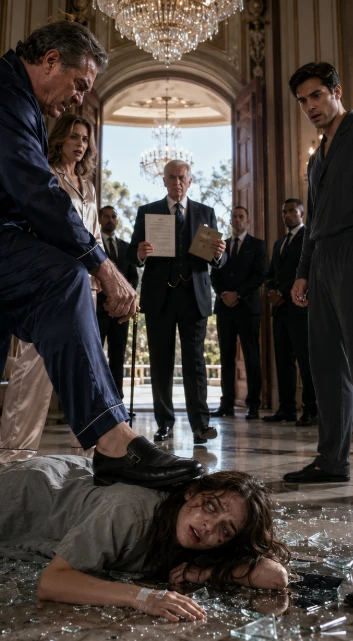
By the time they dragged me down from the attic, the IV stand was the only thing keeping me alive.
My hands trembled too badly to lift water.
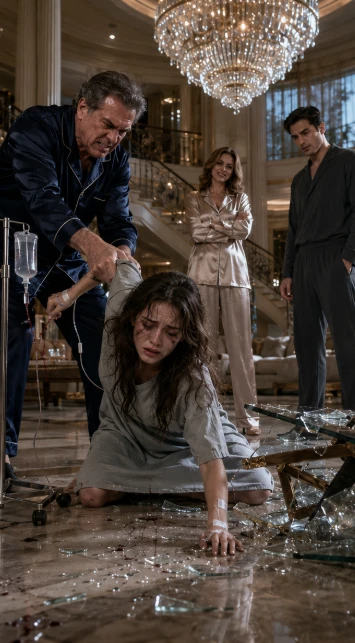
The wheels of the stand shrieked against the marble steps as Victor Harlan dragged me by one arm, his fingers digging so deeply into my skin that I could feel each bruise being born.
“Move,” he snapped.
I tried.
God help me, I tried.
My bare feet slid on the polished staircase. My knees buckled twice. Each time, the IV stand lurched beside me like a thin metal ghost, its clear bag swaying above my head, the tube tugging at the needle taped into the back of my hand.
The attic door stood open behind us.
A month ago, I had not known that room existed.
Now I knew every nail in its floorboards.
I knew the sound of rain through its cracked window.
I knew the taste of dust.
I knew how hunger changed shape after the third day.
At first, hunger was pain.
Then it became anger.
Then it became silence.
Victor dragged me down the last three steps so hard that my shoulder nearly came loose.
The foyer below glittered like nothing cruel had ever happened there. Gold mirrors. White marble.
A chandelier so large it looked like frozen lightning. Fresh roses cut short and arranged in crystal bowls. The Harlan family believed beauty could forgive anything.
It could not.
Marissa Harlan stood near the coffee table in champagne silk pajamas, holding a porcelain cup between both hands.
She smiled over the rim.
“My God,” she said softly. “Look at her. She smells like the attic.”
Her voice was not disgusted.
It was pleased.
My husband, Adrian, leaned against the archway between the living room and the foyer, wearing charcoal loungewear that probably cost more than the hospital bed Victor had canceled three weeks ago.
He glanced at me, then at his phone.
“Can we hurry this up?” he asked. “I have a call in twenty minutes.”
That was the voice I had once fallen asleep beside.
That was the mouth that had kissed my forehead in the hospital and whispered, Trust me, Elena.
Victor shoved me forward.
I stumbled, catching myself on the IV pole. The metal rattled beneath my weight.
My bones felt hollow, my lungs burned, and the room tilted in slow circles.
But I knew exactly which camera in the chandelier was recording.
Victor Harlan did not.
He looked at me like I was already a corpse inconveniently breathing on his floor.
“You think you’re clever,” he said.
I did not answer.
My throat was too dry.
My body was too weak.
And the truth was, he was right.
I was clever.
Not strong. Not anymore.
Not loud. Not protected.
But clever had kept me alive longer than they planned.
Victor seized my left wrist.
The IV tubing pulled tight.
I tried to fold my fingers around the tape.
“No,” I whispered.
It came out as air.
Marissa laughed.
Victor ripped the needle from my vein like he was pulling a weed from his garden.
Blood ran down my wrist, warm and thin, bright against the white marble.
Pain shot up my arm, sharp enough to make the room flash white.
I swayed.
The IV stand rolled away from me.
For one terrifying second, nothing held me upright.
Then Victor stepped close enough for me to smell his aftershave.
Cedar.
Smoke.
Money.
“Stop wasting my family’s money, you dying leech,” he snarled.
Then he slapped me.
The world broke sideways.
My cheek exploded with heat. My feet left the floor. I heard Marissa’s cup clink against its saucer. I heard Adrian sigh.
Then my body hit the glass coffee table.
It shattered beneath me like ice.
The pain did not come all at once.
It arrived in pieces.
Shoulder.
Hip.
Ribs.
Palm.
Face.
Tiny glass teeth bit into my skin. My breath vanished. My mouth opened, but no sound came out.
Above me, the chandelier glittered.
And behind its lowest crystal ring, hidden in a black pinhole smaller than a pearl, the camera watched.
Adrian pushed himself away from the wall.
“Dad,” he said, annoyed, “don’t kill her in the living room. It’ll be a cleaning nightmare.”
For a moment, that hurt more than the glass.
Not because I still loved him.
I think that part of me had died in the attic sometime between the fever and the third night without water.
It hurt because once, I had believed him when he looked at me as if I were the answer to a prayer.
Once, I had put my grief in his hands.
Once, I had signed my name because he asked softly.
One month earlier, Adrian had sat beside my hospital bed after my parents’ funeral, wearing a black suit and a face full of practiced sorrow.
My father and mother had died on a wet highway outside Hartford, their car folded beneath a delivery truck with no company markings.
The police called it weather.
My grandfather called it suspicious.
I called it impossible, because my father never drove fast in rain and my mother always made him pull over when the sky turned mean.
But grief makes facts feel far away.
Adrian held my hand, thumb brushing gently over my knuckles.
“Just sign the temporary transfer papers, Elena,” he said. “Your health is collapsing. My family will protect your inheritance until you recover.”
“My grandfather should review them,” I murmured.
His jaw tightened for less than a second.
Then he smiled.
“Malcolm is overwhelmed. He just lost his daughter. Don’t make him carry your burden too.”
My mother had been Malcolm Vale’s only child.
I was his only grandchild.
The Vale empire was not a single company. It was a continent of steel, shipping, medical technology, real estate, and old decisions buried beneath newer ones. My parents had raised me inside that world but outside its poison.
They taught me numbers before they taught me power.
Numbers were honest.
People rarely were.
I became a forensic accountant because lies always left fingerprints.
Contracts had bones.
Fraud had blood pressure.
Money never disappeared. It moved. It hid. It changed names. But it always left a trail.
I had found trails for my grandfather for six years.
I had exposed executives, shell companies, bribed auditors, false invoices, offshore laundries, and men who smiled while stealing pensions from janitors.
But when grief entered my own house, I forgot to examine it.
I signed.
The next morning, I woke in the attic.
No phone.
No doctor.
No clean clothes.
No explanation.
A mattress lay on the floor beside a bucket, three bottles of water, and a bowl of soup already turning cold.
The door locked from the outside.
At first, I screamed until my throat tore.
Then I begged.
Then I waited for Adrian.
He came that night.
He stood in the doorway, silhouetted by warm hallway light, holding a tray.
I crawled toward him.
“Adrian, what is happening?”
He looked down at me with an expression so empty that I did not recognize his face.
“You were supposed to be easier than this,” he said.
I stared at him.
“What?”
He crouched and set the tray just beyond my reach.
“You have no idea how expensive you are.”
That was the first time I understood my marriage had not ended.
It had been designed.
They told the staff I was contagious.
They told the doctors I had transferred abroad.
They told my grandfather I refused visitors, that grief had turned me cruel, that I wanted distance from the Vale name.
They did not know my grandfather.
Malcolm Vale had never believed silence.
But he was old.
Grieving.
And Victor Harlan was charming in the way rot is charming when covered in expensive perfume.
For days, maybe weeks, I drifted in and out of fever.
A private nurse came twice, never looking me in the eye. She changed the IV bag, checked my pulse, and left when Marissa snapped her fingers.
“What’s in it?” I asked once.
The nurse swallowed.
“Fluids.”
“Only fluids?”
She did not answer.
After that, my hands began to tremble.
My legs weakened.
My mouth tasted metallic.
I could not keep soup down.
Some nights I heard Victor and Marissa laughing beneath the attic floor.
Some nights I heard Adrian on the phone, calm and bright, telling investors that the Vale transfer would “unlock strategic liquidity.”
Liquidity.
That was what they called my life.
But they made one mistake.
They left me with paper.
Not much. A few discarded invoices in the trash outside the attic bathroom. Medical supply receipts.
A torn courier label. A corner of one contract Adrian had shoved into his pocket and dropped during an argument.
To anyone else, it was garbage.
To me, it was a map.
The invoices used a Harlan subsidiary I had seen before. The courier label had a Delaware address tied to a dormant trust.
The contract corner showed only three lines, but one of them contained a clause number.
Clause 14.3.
Cross-collateralization.
I had seen that clause six years earlier in a real estate acquisition so ugly my grandfather kept the file locked in his personal archive.
Victor Harlan did not own his mansion outright.
He had leveraged it.
Borrowed against it.
Hidden debt beneath debt beneath debt.
And somewhere, beneath all his arrogance, he had attached his family estate to a chain of obligations connected to Vale-controlled holdings.
His empire was not a fortress.
It was a glass table.
All it needed was pressure in the right place.
So I waited.
I memorized their schedules.
I counted footsteps.
I learned which floorboards screamed and which whispered.
And when the maid, Rosa, slipped me a fresh bottle of water with tears in her eyes, I pressed a folded scrap into her palm.
She looked terrified.
“Please,” I breathed. “Laundry chute. Basement wall. Old security panel.”
Rosa shook her head.
“Mrs. Harlan checks everything.”
“She doesn’t check things she thinks are broken.”
Rosa stared at me.
I held her gaze.
“Tell my grandfather to look at the chandelier.”
Three days later, Victor dragged me downstairs.
He thought it was punishment.
I knew it was timing.
Because at 8:00 that morning, the old security system would finish uploading thirty-one days of footage to the Vale archive.
At 8:07, Malcolm Vale’s chief counsel would receive an automatic alert titled: Unauthorized Confinement Detected.
At 8:12, my grandfather would stop being a grieving old man.
At 8:29, Victor ripped the needle from my vein.
At 8:31, he slapped me through the glass table.
At 8:33, his shoe pressed into my throat.
The sole was black leather.
Italian.
Polished.
Heavy.
I could not breathe.
My cheek lay against the marble, wet with blood and sweat. Glass glittered around me.
My fingers twitched, trying to curl, trying to push, trying to do anything.
Victor leaned over me.
“You were nothing before Adrian gave you our name,” he said.
That almost made me laugh.
I had been Elena Vale before I became Elena Harlan.
And I would be Elena Vale when every Harlan portrait had been pulled from the walls.
Victor pressed harder.
The room narrowed.
Marissa said something, but it came through water.
Adrian whispered, “Dad.”
Not worry.
Not guilt.
Fear.
I moved my eyes past Victor’s leg, past the shattered table, past Marissa’s silk slippers, toward the marble foyer.
The front doors opened.
Sunlight cut into the mansion.
My grandfather, Malcolm Vale, stepped inside with three lawyers, two security officers, and a silver-headed cane he only carried when he was furious.
He wore a black suit, white shirt, and a tie so dark it looked like a blade.
His silver hair was combed back. His face was pale, older than I remembered, but his eyes had not aged at all.
They found mine among the broken glass.
He did not flinch.
That was Malcolm Vale’s gift and curse.
He could look directly at devastation and become still.
In his left hand was a deed.
In his right hand was a foreclosure notice.
Victor froze.
Marissa’s smile died.
Adrian took one step backward.
“No,” he whispered.
Grandfather’s voice cut through the mansion.
“Take your foot off my granddaughter,” he said, “before I take more than your house.”
For one second, nobody moved.
Then one of the security officers stepped forward.
Victor lifted his shoe.
Air rushed into me so violently that I choked.
Rosa appeared from somewhere near the dining room and covered her mouth with both hands.
“Miss Elena,” she sobbed.
Marissa recovered first.
She always did.
“Malcolm,” she said, her voice thin and bright, “thank God you’re here. She’s had an episode. We were trying to restrain her before she hurt herself.”
I lay bleeding on glass beneath her chandelier.
And still, she lied beautifully.
Grandfather did not look at her.
He looked at the oldest lawyer, a woman named Grace Ellison who had taught me contract law over coffee when I was nineteen.
Grace opened a leather folder.
“Victor Harlan,” she said, “you are being served notice of default, acceleration, and foreclosure on the property located at 19 Briarstone Avenue, including all attached assets, fixtures, security infrastructure, and contents subject to lien.”
Victor’s face flushed.
“You can’t do that.”
Grace held out the papers.
“We already did.”
“This is my family home.”
“No,” Grandfather said. “It is collateral.”
Marissa’s hand went to her throat.
Adrian stared at the deed like it was a loaded gun.
Grandfather walked toward me.
His cane struck the marble once.
Twice.
Three times.
Each sound carried the weight of a verdict.
He crouched beside me with difficulty. For the first time, I saw the tremor in his hand.
“Elena,” he said.
I tried to say his name.
Only a broken sound came out.
His face changed then.
Not much.
But enough.
The old mask cracked, and beneath it was a grandfather who had once carried me through thunderstorms because I believed lightning could find children by name.
He touched my hair with two fingers.
“I’m here,” he whispered. “I am so sorry I was late.”
That was when I cried.
Not when Victor dragged me.
Not when the needle came out.
Not when the glass entered my skin.
I cried when someone finally spoke to me like I was still human.
The second security officer removed his jacket and laid it over me. Grace called for medical responders already waiting outside.
Another lawyer filmed the room. Rosa knelt by my head, trembling.
Victor began shouting about lawsuits.
Marissa began crying without tears.
Adrian walked toward my grandfather.
“Sir,” he said, voice shaking, “there has been a misunderstanding.”
Grandfather stood slowly.
The room seemed to shrink around him.
“A misunderstanding,” he repeated.
Adrian swallowed.
“Elena has been unstable since her parents died. She attacked my mother. She refused treatment. We’ve done everything we could.”
Grandfather studied him.
“Did she also throw herself through a glass table?”
Adrian looked at me.
For one second, I saw the man from my wedding photographs.
Handsome.
Soft-eyed.
Completely hollow.
“She fell,” he said.
Above us, the chandelier camera blinked red.
Grandfather looked up.
So did Adrian.
That tiny red light changed the room more completely than any scream could have.
Marissa whispered, “What is that?”
I smiled through blood.
Victor saw it.
And for the first time since I had known him, fear entered his eyes.
The ambulance came through the front doors that used to open only for billionaires and brides.
Paramedics lifted me from the glass. I screamed then because my body had waited until safety to admit how badly it hurt.
Grandfather stayed beside me.
At the threshold, I heard Victor shouting, “You have no right!”
Grace answered with the calm of a woman sharpening a knife.
“We have footage, forged transfer documents, medical neglect, unlawful imprisonment, and suspected poisoning. Mr. Harlan, rights are about to become the least of your problems.”
The last thing I saw before the oxygen mask covered my face was Adrian standing beneath the chandelier, staring at the camera as if it had betrayed him.
But cameras do not betray.
They remember.
The hospital smelled like antiseptic, rain, and flowers.
Too many flowers.
White lilies from board members.
Roses from investors.
Orchids from people who had ignored my calls for years but suddenly remembered my middle name.
I woke after surgery with my left arm bandaged, my ribs wrapped, and my grandfather asleep in a chair beside the bed.
His cane leaned against his knee.
He looked smaller in sleep.
That frightened me more than Victor ever had.
“Grandfather,” I whispered.
His eyes opened at once.
“Elena.”
His voice broke on my name.
I had never heard Malcolm Vale’s voice break.
He reached for my hand, then stopped himself, afraid of hurting me.
I turned my palm upward.
He took it.
His skin was cold.
“How long?” I asked.
His jaw tightened.
“Thirty-one days.”
I closed my eyes.
A month could be a life.
A month could be a grave.
“I thought you believed them,” I said.
“No.”
“Then why didn’t you come?”
His face folded with pain.
“Because every legal channel said you were refusing contact. Your signatures were on the medical privacy revocations. Your voice was on two recorded messages.”
My eyes opened.
“My voice?”
He nodded.
“Generated. Spliced from old interviews. Good enough to fool a hospital administrator. Not good enough to fool me.”
“Then—”
“I went to the police. They requested proof of immediate danger. I went to the courts. Harlan counsel buried us in injunctions. I tried to enter the property.
Victor had restraining documents signed in your name.”
My stomach twisted.
“How did you finally get in?”
Grandfather’s thumb moved slowly over my knuckles.
“You told Rosa to tell me to look at the chandelier.”
I breathed out.
“She did it?”
“She came to my gate at midnight with no shoes on.”
Tears burned my eyes.
“Is she safe?”
“She is under my protection.”
Good.
That word became a warm stone in my chest.
Good.
A doctor entered, then another. They spoke carefully, as people do when trying not to reveal horror too quickly.
Malnutrition.
Severe dehydration.
Soft tissue damage.
Glass lacerations.
Medication irregularities.
Possible toxic exposure.
Possible.
That was the word doctors used when they already knew but needed labs to make it official.
Grandfather listened without moving.
When they left, he stood and walked to the window.
Rain slid down the glass in long, silver threads.
“What did they give me?” I asked.
He did not turn.
“We’re waiting for confirmation.”
“Tell me.”
“Elena—”
“Tell me.”
His shoulders rose and fell once.
“A slow compound. Not enough to kill quickly. Enough to make you weak, confused, dependent.
Enough to support a claim of incapacity once they had your assets.”
The ceiling blurred.
I had thought my body betrayed me.
It had been poisoned into surrender.
Adrian had watched me tremble and called me unstable.
Marissa had withheld water and called me dramatic.
Victor had dragged me through his foyer and called me a leech.
I turned my face into the pillow.
For a while, I said nothing.
Then I whispered, “I want every account.”
Grandfather turned.
I looked at him.
My cheek was swollen. My voice was ruined. My hands still shook.
But somewhere beneath the bandages, Elena Vale sat up inside me.
“I want the transfer documents. The medical authorizations. The security footage.
The Harlan subsidiary ledgers. Every loan. Every trust. Every offshore entity.
Every charity Marissa used to clean money.
Every payment Adrian made to doctors, nurses, lawyers, and whoever generated my voice.”
Grandfather stared at me.
Then, for the first time in thirty-one days, he smiled.
It was not warm.
It was proud.
“There she is,” he said.
The investigation became a storm.
Not loud at first.
Storms that destroy dynasties rarely begin with thunder.
They begin with subpoenas.
Grace Ellison came every morning with files. She brought tablets, printed statements, bank records, and footage transcripts. She tried to limit my work to one hour a day.
I ignored her.
My body could barely sit upright, but my mind was starving.
The Harlans had stolen my name, my freedom, my health.
So I followed the money.
Victor’s company, Harlan Meridian Holdings, had been rotting for years.
Failed developments hidden through inflated asset valuations. Loans rolled into loans.
Employee pensions borrowed against and never restored.
Marissa’s charity, The Harlan Women’s Trust, spent more on “event styling” than survivors.
Adrian’s private investment fund had received three separate “consulting fees” from a medical services vendor that supplied my IV bags.
Every number opened a door.
Behind every door was another lie.
And beneath the lies was my parents’ accident.
At first, I refused to see it.
Grief protects itself.
It builds walls around certain rooms.
But numbers do not respect walls.
The delivery truck that struck my parents had been leased through a shell company funded by a Harlan subsidiary.
The driver disappeared two days later.
His sister received a wire transfer large enough to buy silence and small enough to hide from anyone who did not know where to look.
A week before the crash, my mother had requested a private meeting with my grandfather about “legacy exposure connected to H.M.H.”
Harlan Meridian Holdings.
Victor.
I read the email three times.
Then I vomited into a hospital basin until my ribs screamed.
Grandfather stood beside me, one hand hovering over my back.
“I didn’t want you to find that in bed,” he said.
“When did you know?”
His silence answered before his mouth did.
I looked up.
“When, Grandfather?”
His face aged ten years.
“I suspected within days.”
The room went very quiet.
“You suspected Victor killed my parents?”
“I suspected someone connected to him arranged the accident.”
“And you didn’t tell me?”
“I had no proof.”
I laughed once, a cracked and ugly sound.
“No proof. So you let me marry his son?”
Pain crossed his face.
“I did not know Adrian was part of it.”
“But you knew the family was poison.”
“I warned you.”
“You said they were aggressive investors. You said Victor was dangerous in business.
You did not say, ‘Elena, I think your fiancé’s father may have murdered your mother.’”
Grandfather closed his eyes.
That hurt more than if he had defended himself.
“I thought,” he said slowly, “that if I accused them without proof, you would run toward Adrian and away from me.”
I looked at the rain.
Would I have?
A month ago, I would have said no.
Now I did not know.
Love makes fools of smart women because it does not ask intelligence for permission.
“I needed evidence,” Grandfather said. “Your mother needed evidence too. That is why she died.”
Something inside me went still.
“My mother was investigating him.”
“Yes.”
“What did she find?”
Grandfather reached into his coat and removed a small velvet pouch.
Inside was a key.
Old.
Brass.
Worn smooth at the edges.
“Your mother mailed this to me the morning of the crash,” he said. “No note. Just the key.”
“To what?”
“I didn’t know. Until yesterday.”
Grace entered with a sealed evidence bag.
Inside was a music box.
My music box.
The one my mother had kept on her vanity when I was little. White enamel. A painted bluebird on top. It played a soft, uneven lullaby that always made my father pretend to waltz badly through the kitchen.
I reached for it with shaking hands.
Grace set it carefully in my lap.
“The key opens the false bottom,” she said.
My fingers almost failed me.
Grandfather helped guide the brass key into the tiny lock.
It turned.
The bottom panel clicked open.
Inside was a flash drive and a folded letter.
My mother’s handwriting waited on the page.
For a moment, I could not breathe.
Then I unfolded it.
My dearest Elena,
If you are reading this, then I failed to come home.
I pressed my fist to my mouth.
Grandfather looked away.
I need you to understand something before grief rewrites me into someone braver than I was.
I was afraid.
Victor Harlan is not merely stealing from companies. He is buying people. Doctors. Auditors. Judges. Police consultants. Men with trucks and no names.
Your father wanted to go public. I wanted to build a case strong enough that no one could bury it.
We argued about it the night before we died. He said truth does not become safer because we wait. I said daughters become orphans when parents are careless.
The letters blurred.
If Malcolm gives you this, forgive him for surviving us.
I looked at my grandfather.
He was crying.
Silently.
Like the tears had been waiting years for permission.
And forgive yourself for whatever you had to become to live.
The flash drive contained everything.
Emails.
Wire records.
Audio.
Photographs of Victor with men whose names had been kept out of newspapers by money and fear.
My mother had built half the case before she died.
I built the rest from a hospital bed.
The Harlans tried every defense wealth could purchase.
Victor claimed I was unstable.
Marissa claimed she had been afraid of me.
Adrian claimed he had been manipulated by his father.
That one almost worked on the public for three days.
He appeared outside the courthouse in a navy suit, eyes red, voice soft.
“I loved my wife,” he told cameras. “I was trapped between my family and a woman too ill to understand reality.”
I watched from the hospital television with an IV in my arm and stitches in my palm.
Rosa stood beside my bed.
She picked up the remote and threw it across the room.
The screen cracked.
For the first time in weeks, I laughed.
It hurt.
It was worth it.
The next morning, Grace released the chandelier footage.
Not all of it.
Just enough.
Victor ripping the needle from my hand.
Marissa smiling.
Adrian saying, Don’t kill her in the living room.
The world turned.
Sponsors vanished.
Banks froze credit lines.
Board members resigned.
The Harlan Women’s Trust removed Marissa’s portrait from its lobby before lunch.
By dinner, Adrian’s attorney called Grace to discuss cooperation.
I asked to hear the recording.
Grace hesitated.
Then she played it.
Adrian’s voice came through clean and small.
“I’ll testify against my father.”
Grace said, “In exchange for?”
“Reduced charges.”
“And your wife?”
A pause.
“My wife is emotional. She’ll understand later.”
I closed my eyes.
There it was.
Even ruined, even exposed, even crawling through the wreckage he had helped create, Adrian still believed my pain was a room he could enter when convenient.
Grace stopped the recording.
“Do you want me to negotiate?”
“No.”
“Elena, his testimony could help confirm Victor ordered the truck.”
“My mother already confirmed Victor ordered the truck.”
“Adrian can confirm Marissa arranged the medical poisoning.”
“Rosa can confirm it.”
“He can connect the forged voice messages.”
I turned toward her.
“Grace.”
She stopped.
“If Adrian wants mercy, tell him to ask God. I am busy.”
The trial did not come quickly.
Justice rarely moves at the speed of suffering.
First came hearings.
Then asset freezes.
Then indictments.
Then more names.
Doctors.
Accountants.
A private nurse who cried on the stand and said Marissa told her I was “terminal anyway.”
A digital consultant who built fake audio messages using clips from a podcast interview I had recorded about financial ethics.
A Harlan security manager who disabled half the mansion cameras but did not know about the legacy chandelier feed.
And Rosa.
Brave Rosa.
She walked into court wearing a navy dress my grandfather’s staff had bought for her and told the truth with both hands folded in her lap.
“She asked me for water,” Rosa said.
The prosecutor asked, “Who?”
“Mrs. Elena.”
“And what did Mrs. Harlan say?”
Rosa swallowed.
“She said, ‘Water makes weeds grow.’”
Marissa stared straight ahead.
Her pearls glowed at her throat.
Rosa continued.
“She told me if I helped Mrs. Elena, my son would lose his scholarship.”
I looked at Rosa.
She did not look back.
She was afraid that if she did, she would break.
The prosecutor softened his voice.
“Why did you help anyway?”
Rosa’s mouth trembled.
“Because my son asked me once what courage looks like. I wanted to have an answer.”
The courtroom fell silent.
That day, Marissa stopped smiling.
Victor lasted longest.
Men like him do.
He sat through testimony about forged documents, poisoned fluids, offshore accounts, my parents’ crash, my attic confinement, and his own voice on a recording saying, “The Vale girl will sign or rot.”
He never looked ashamed.
Only offended.
As if consequences were a breach of etiquette.
Then the prosecutor played the final audio from my mother’s flash drive.
Her voice filled the courtroom.
Clear.
Steady.
Alive in the way recordings make the dead briefly cruel.
“Victor, I have the transfers,” my mother said. “I have the truck leases. I have the judge payments. If anything happens to me or my husband, Malcolm gets everything.”
Victor’s recorded laugh answered.
“You think Malcolm can protect you from grief?”
My father’s voice appeared then.
Low and furious.
“Stay away from my daughter.”
Victor, younger and colder, said, “Your daughter is the only reason I haven’t buried you already.”
The courtroom disappeared beneath the roar of blood in my ears.
Adrian turned white.
I looked at him.
For the first time, he looked truly afraid of me.
Because he knew what I had just understood.
He had not met me by accident.
He had not loved me badly.
He had been sent.
The prosecutor did not need to say it.
The timeline did.
Two months after my parents died, Adrian Harlan appeared at a charity auction where I was speaking about financial transparency.
He spilled wine on his cuff.
I laughed.
He apologized.
He asked about my work as if he admired my mind.
He sent white tulips the next morning because I had once mentioned roses felt performative.
He remembered my coffee order.
He learned the names of my dead parents.
He held my grief like something sacred.
Every tender moment had been reconnaissance.
I stood up.
The judge said my name.
Grace reached for my arm.
I did not sit.
Across the courtroom, Adrian stared at me with wet eyes.
He mouthed, Elena.
I walked out before my heart could mistake pain for love.
Outside, the air tasted like winter.
Grandfather followed me slowly, cane tapping behind him.
“Elena.”
I stopped on the courthouse steps.
Cameras shouted below us.
“Did you know?” I asked.
He looked at me.
“When Adrian approached me?”
“Yes.”
“No.”
“Did you suspect?”
His silence came again.
This time it was softer.
Deadlier.
“I suspected Victor might try to reach you.”
I nodded.
The cameras flashed.
A woman somewhere shouted my name.
“You let him get close.”
“Elena—”
“You thought I could handle it.”
His mouth opened.
No sound came out.
That was the truth, then.
Not that he wanted me hurt.
Not that he traded me.
But something almost as painful.
Malcolm Vale had looked at the little girl he carried through thunderstorms and seen not a granddaughter, but a soldier.
He had trusted my intelligence more than he protected my heart.
I turned away.
“Go home, Grandfather.”
His face crumpled.
But he nodded.
For three weeks, I did not see him.
The Harlan mansion became mine during that silence.
Not because I wanted it.
I hated that house.
I hated the stairs, the chandelier, the roses, the polished floors, the smell of cedar and glass cleaner.
But assets tell stories, and this one had been stolen before I was born.
My mother’s flash drive revealed that Victor had forged documents decades earlier to push a Vale-backed development family out of ownership.
That family had been my grandmother’s sister.
The mansion had passed through shell companies, legal threats, and bankruptcies until Victor stood in its foyer calling it his birthright.
It had never been his.
Grace said I could sell it.
Burning it would have been simpler.
Instead, I ordered the attic door removed.
I ordered every lock replaced.
I ordered the glass coffee table hauled out in pieces.
Then I stood beneath the chandelier and stared up at the hidden camera.
It had watched me almost die.
It had saved me because Rosa was brave.
It had also recorded thirty-one days of my voice calling for people who did not come.
A contractor asked if I wanted it taken down.
“No,” I said.
“Ma’am?”
“Leave it.”
Some witnesses deserve to remain.
The verdict came in late spring.
Victor Harlan was convicted on financial crimes, conspiracy, unlawful imprisonment, attempted manslaughter, and charges connected to my parents’ deaths.
Marissa was convicted too.
She did not cry until the judge said the word years.
Adrian took a plea only after realizing no one wanted his confession unless it buried him with the rest.
At sentencing, he asked to address me.
Grace leaned close.
“You don’t have to listen.”
“I know.”
But I did.
Adrian stood in a gray suit that made him look younger, smaller, almost like the man I had invented.
“Elena,” he said, “I did terrible things.”
I waited.
“My father raised me inside fear. He controlled everything. He told me you were dangerous.
He told me your family destroyed ours. Then I met you, and I—”
“No,” I said.
The judge looked at me.
Adrian flinched.
I stood.
My legs were stronger by then, though pain still lived in my ribs when it rained.
“You do not get to turn my love into your tragedy,” I said. “You studied me. You targeted me.
You held me when I cried for parents your family killed. You kissed my forehead while poisoning me. You locked me in an attic and called it strategy.”
His eyes filled.
“I loved you.”
I almost smiled.
“No, Adrian. You loved how close you could stand to the fire without burning.”
The courtroom held its breath.
I looked at the judge.
“I’m done.”
That night, I went to my grandfather.
Not because forgiveness had arrived.
It had not.
Forgiveness is not a doorbell.
It does not ring just because someone is sorry.
I went because Grace called and said, “You need to come now.”
Malcolm Vale was in his library, not a hospital.
Of course he was.
Books rose around him in dark wooden walls. A fire burned low.
Rain tapped the windows. His silver-headed cane rested across his lap.
He looked thinner.
Terribly thin.
“Elena,” he said.
I stopped in the doorway.
For a moment, I was seven again, standing barefoot outside that same room after a nightmare, waiting for him to pretend he had not noticed me crying.
He held out his hand.
I crossed the room.
“What is this?” I asked.
He smiled faintly.
“The part where an old man runs out of places to hide.”
My chest tightened.
“No.”
He nodded once.
“Pancreatic cancer. Stage four. I knew before your parents died.”
The room tilted.
“You never told me.”
“I had hoped to spare you one grief.”
I laughed through sudden tears.
“You are all terrible at sparing me.”
He accepted that.
“I used the cane because I was weak,” he said. “Not because I was dramatic.”
“That sounds fake.”
“It was partly dramatic.”
I sat beside him.
He placed a folder on my lap.
“What is this?”
“The final deed transfer. Briarstone Avenue is yours outright.
So is the controlling interest in the Vale Foundation, the medical division, and my private voting shares.”
“I don’t want your empire.”
“I know.”
“Then why give it to me?”
“Because you understand what money does when no one decent is watching.”
I shook my head.
“I am tired.”
“I know that too.”
His voice had become very soft.
“That is why I put limits in place. Independent boards. Worker protections. Automatic audits. Whistleblower shields.
You can walk away if you choose. You can burn my name off every building.
But no Victor Harlan will ever use my companies to buy silence again.”
I looked at him.
All my anger was still there.
So was my love.
They sat side by side in me like strangers forced to share a bench.
“You should have protected me,” I said.
His eyes filled.
“Yes.”
“You should have told me about Adrian.”
“Yes.”
“You should have come sooner.”
His hand trembled around mine.
“I know.”
That broke me more completely than any excuse would have.
I laid my forehead against his hand.
For a while, we listened to the rain.
Then he said, “There is one more thing.”
I lifted my head.
He nodded toward the folder.
Beneath the deed was a medical directive.
Signed three weeks before he walked into the Harlan mansion.
I read the first line.
Then the second.
Then I stopped breathing.
He had been scheduled for an experimental treatment abroad.
A last chance.
Small odds, Grace later told me, but real enough that his doctors had begged him to try.
He canceled it the night Rosa came to his gate.
He redirected his private medical aircraft, his specialists, his security detail, his legal team, and the critical treatment slot to me.
The directive was clear.
If resources must be allocated between Malcolm Vale and Elena Vale, Elena Vale is to be prioritized without delay, consultation, or appeal.
I looked at him.
“No.”
He smiled.
“Elena.”
“No.”
“I was old.”
“You were alive.”
“So were you.”
I could not speak.
He touched my cheek with the back of his fingers, as gently as he had when I was a child with fever.
“I failed to protect your mother,” he whispered. “I failed to protect you from Adrian. Do not ask me to regret saving you when I finally could.”
That was the twist life saved for the end.
Not that monsters existed.
I knew that.
Not that love could be faked.
I had survived that.
The thing that wrecked me was simpler.
The man who arrived holding the deed to seize their mansion had already signed away his last chance to live.
He died before dawn.
Quietly.
Annoyingly.
Like a man leaving a meeting early because the rest of us were wasting time.
At his funeral, the sky was painfully blue.
People called him visionary.
Ruthless.
Brilliant.
Complicated.
They were all correct and none of them enough.
Rosa stood beside me.
Grace stood on my other side.
When the priest finished, I placed my mother’s music box on Malcolm’s coffin.
Then I leaned close and whispered the only forgiveness I could honestly give.
“I’m still angry.”
The wind moved through the cemetery trees.
“But I love you too.”
Months later, I returned to Briarstone Avenue alone.
The mansion was empty.
No roses.
No portraits.
No silk laughter.
The attic had been transformed into a library for women rebuilding their lives after financial abuse, medical coercion, and family violence.
Rosa ran it.
Her son received a scholarship in my mother’s name.
The glass coffee table was gone.
In its place stood a long wooden table built from reclaimed oak, scarred but solid.
I kept the chandelier.
People asked why.
I told them it was evidence.
That was true.
But not all of it.
At night, when the house settled and the marble cooled, I would stand beneath it and remember the exact moment Victor’s shoe left my throat.
I would remember Adrian whispering, “No.”
I would remember Marissa’s smile dying.
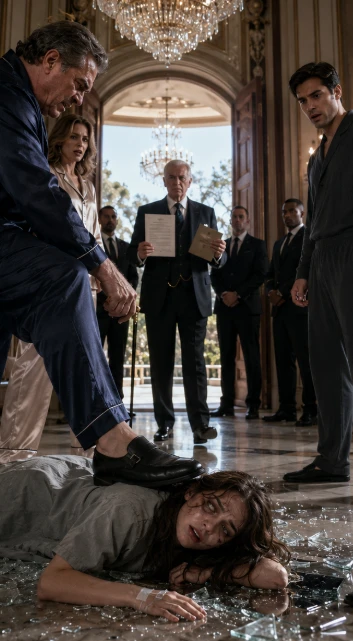
I would remember my grandfather in the doorway, holding paper like a weapon and love like an apology.
Some days, victory felt clean.
Other days, it tasted like ash.
Healing did not make me gentle.
It made me precise.
I rebuilt the Vale companies from the inside out. I sold divisions that fed on silence.
I exposed men my grandfather had tolerated because they were profitable.
I put cameras in places where powerful people preferred shadows. I funded investigators who did not stop at locked doors.
And every year, on the anniversary of the day I left the attic, I unlocked the old music box.
The lullaby still played badly.
Uneven.
Tender.
A little broken.
Like all honest things.
On the first anniversary, Grace handed me one final envelope from Malcolm’s estate.
I almost refused it.
I was tired of ghosts having paperwork.
But I opened it beneath the chandelier.
Inside was one photograph.
My mother, my father, Malcolm, and me at age six, standing in front of Briarstone Avenue long before Victor stole it.
I was missing one front tooth.
My mother was laughing.
My father had one hand over his eyes because the sun was too bright.
Malcolm stood behind us, pretending not to smile.
On the back, in my mother’s handwriting, were nine words.
One day, Elena will bring this house home.
I pressed the photograph to my chest.
For the first time, the mansion did not feel like a crime scene.
It felt like a body returned after a long kidnapping.
I walked to the front doors and opened them wide.
Morning entered slowly.
Gold across the floor.
Warmth across the walls.
Light climbing the stairs all the way to the attic.
Above me, the chandelier caught the sun and scattered it into a thousand bright fragments.
For a moment, every shard looked like glass.
Then every shard looked like a star.
And in the silence of the house they tried to bury me in, I finally heard my own breathing become the sound of something that had survived.