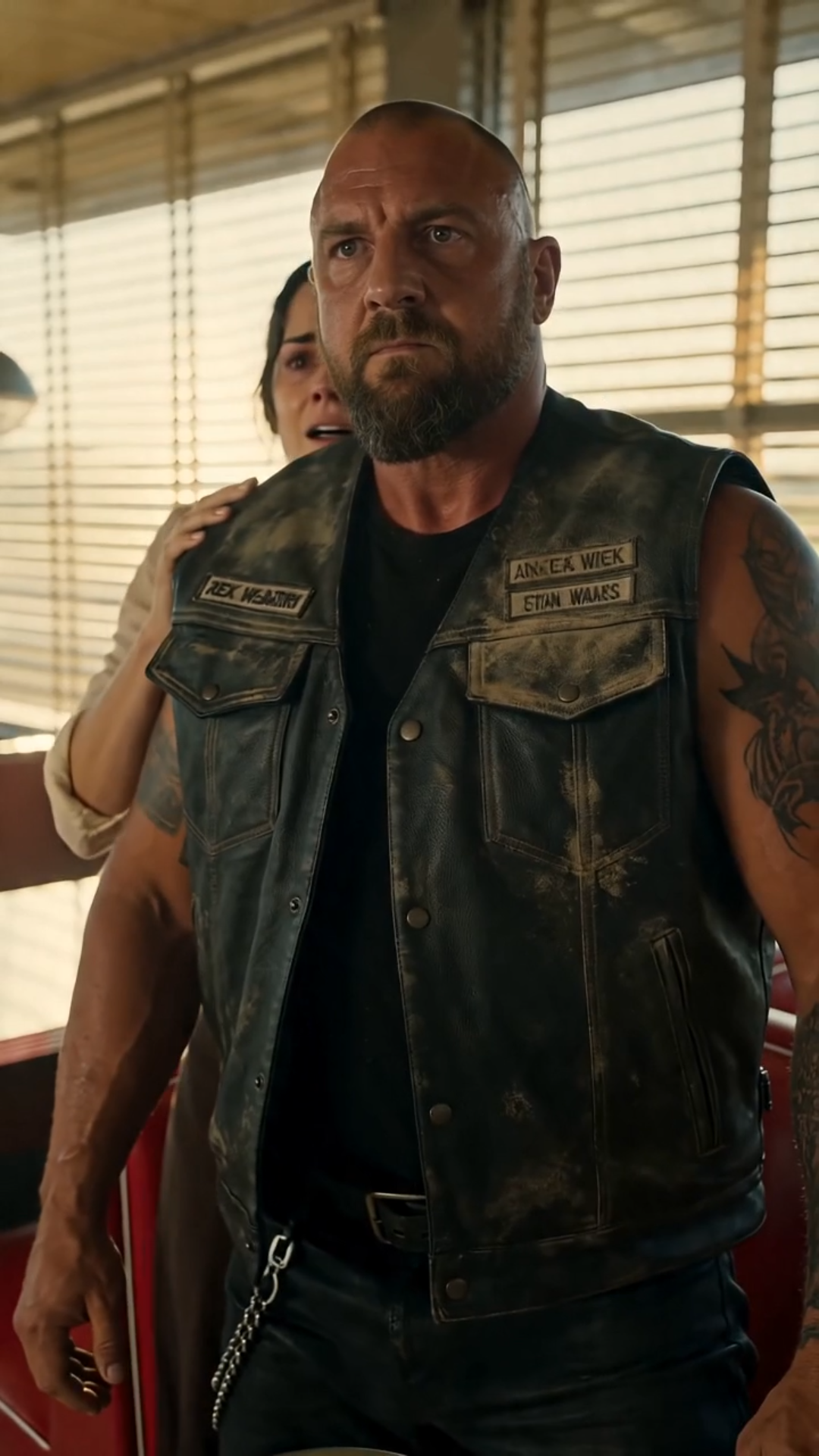
The coffee cup hit the table and spilled before she could apologize.
A middle-aged woman stood beside the bikers’ booth, breathing too fast, one hand pressed to the edge of the wood like her legs might give out.
Every man at the table turned.
Leather vests.
Tattooed hands.
Hard faces.
But she looked at them like they were the only safe thing left in the world.
“Please,” she whispered. “I need help.”
The lead biker slowly lowered his fork.
He didn’t laugh.
He didn’t look annoyed.
He only studied her shaking hands and the fear in her eyes.
“What kind?”
The woman looked toward the diner door.
Her lips trembled.
“Pretend to be my son.”
The bikers exchanged one silent look.
The lead biker leaned forward, confused but gentle.
“For who?”
Before she could answer, the diner door slammed open.
A man in a sharp black suit stormed inside, eyes locked on her.
“There you are.”
The woman flinched so hard the lead biker stood immediately.
His chair scraped across the floor.
He stepped between them.
The woman grabbed the back of his leather vest like it was the first solid thing she had touched in years.
The suited man stopped.
His confidence flickered.
Then the other bikers stood one by one behind the lead.
The whole diner went silent.
The lead biker looked at the man and said calmly,
“You looking for our mother?”
The suited man stared at the bikers like he had walked into the wrong diner.
“She is not your mother.”
The lead biker didn’t move.
The woman behind him shook so badly her fingers twisted into his vest.
“She was mine when nobody else wanted me,” he said quietly.
The man’s jaw tightened.
“What?”
The biker turned his head slightly, eyes softening just enough for her to see.
“She ran a shelter on 8th Street.”
One of the other bikers stepped forward.
“She fed me when my own father threw me out.”
Another biker raised his hand.
“She hid me from the man who broke my ribs.”
The third looked at the suited man with cold eyes.
“She called us sons before we knew what family meant.”
The woman covered her mouth.
Tears broke through her fear.
The suited man’s face darkened.
“This is family business.”
The lead biker stepped closer.
“No.”
His voice dropped.
“This is the part where family shows up.”
The woman whispered, “He’s my nephew. He wants me to sign the house over.”
The suited man snapped, “That house belongs to me.”
She flinched again.
And every biker saw it.
The lead biker’s face changed.
Not louder.
Colder.
“She gave that house to kids like us.”
The woman wiped her tears with trembling fingers.
“He locked me in my room this morning,” she whispered. “He said no one would believe a crazy old woman.”
The diner went still.
The suited man backed toward the door.
Too late.
The waitress had already called the police.
The lead biker reached behind him and gently took the woman’s shaking hand.
Then he placed it on his arm like he was escorting royalty.
“You asked us to pretend,” he said softly.
His eyes filled for the first time.
“But you never had to.”
The woman looked up at him, broken and overwhelmed.
He squeezed her hand.
“You saved every one of us.”
Then all four bikers stood around her like a wall while the suited man realized the woman he thought was alone had raised an army.
The police arrived three minutes later.
But by then, the diner already felt different.
Quieter.
Heavier.
The suited man sat rigidly in the booth near the door while two officers questioned him. Sweat gathered beneath his collar now. The confidence he walked in with was gone.
Because the story had changed.
An hour ago, he thought he was dealing with an old woman nobody would defend.
Now four large bikers stood behind her like bodyguards at a state funeral.
And the waitress had already told police about the locked bedroom upstairs.
The lead biker — everyone called him Mason — stayed beside the woman the entire time.
He never rushed her.
Never touched her unless she reached for his arm first.
And every time the nephew raised his voice, Mason’s eyes darkened in a way that made the officers nervous too.
Finally, one officer approached her carefully.
“Ma’am… do you want to press charges?”
The woman looked down at her trembling hands.
For a second, she looked eighty years old again.
Small.
Tired.
Then she glanced at the bikers surrounding her.
And slowly…
something steadied inside her.
“Yes,” she whispered.
Her nephew snapped instantly.
“You crazy old—”
Mason moved before the sentence finished.
His chair slammed backward.
The diner froze.
He leaned down slowly until he was inches from the nephew’s face.
“Careful,” Mason said quietly.
And somehow that quiet voice felt more dangerous than shouting.
The nephew said nothing after that.
Two days later, the truth started coming out.
The nephew had forged partial transfer papers for the house.
He had been draining her bank account for months.
He even told neighbors she was “developing dementia” to isolate her before forcing her into assisted living.
But the part that made the entire town explode came later.
The shelter on 8th Street.
The old woman had owned it for twenty-three years.
Hundreds of abandoned kids had passed through those doors.
Runaways.
Foster kids.
Children sleeping in cars.
Kids escaping violence.
Most people never knew her name.
Because she never wanted credit.
But the bikers did.
And one by one… they started showing up.
First came three motorcycles outside the courthouse.
Then ten.
Then thirty.
By Friday morning, the entire street thundered with engines.
Reporters gathered on sidewalks.
People stared from office windows.
Leather jackets filled the courthouse steps like an army of ghosts the city had forgotten.
Some were construction workers.
Some veterans.
Some mechanics.
One arrived wearing a sheriff’s badge.
Another stepped out of a black SUV in an expensive suit.
Former shelter kids.
All grown up.
All there for her.
The nephew walked into court pale as paper.
Because suddenly the “crazy old woman” had become the center of something much larger.
The courtroom stayed packed all day.
The prosecutor presented photos of the locked bedroom.
Bank records.
Witness statements.
Then finally the judge asked the old woman if she wished to speak.
She stood slowly.
The entire room quieted.
Even the reporters stopped typing.
“I never wanted revenge,” she said softly.
Her voice shook at first.
Then steadied.
“I only wanted to grow old in peace.”
The nephew stared down at the table.
The woman looked toward the crowded courtroom behind her.
Toward the bikers.
Toward the men society once called worthless.
“I gave children a place to sleep when nobody wanted them.”
Tears filled her eyes.
“And somehow… they became the ones protecting me.”
Several bikers lowered their heads immediately.
One wiped his eyes roughly with tattooed fingers.
Even the judge looked emotional.
Then the old woman reached into her purse.
“I have one more thing.”
The courtroom watched silently as she unfolded an old photograph.
Worn edges.
Faded colors.
A picture of dozens of children standing outside the shelter decades earlier.
Thin faces.
Secondhand clothes.
Hope hiding behind fear.
The woman smiled through tears.
“My family,” she whispered.
And then—
Mason slowly stood from the back row.
The massive biker removed his leather gloves carefully.
For the first time since entering court, he looked nervous.
“Ma’am…” he said softly.
The old woman turned.
Mason swallowed hard.
Then he held up a small folded piece of paper.
The room frowned in confusion.
“I carried this for twenty-seven years.”
He opened it with shaking hands.
It was a child’s drawing.
Stick figures.
A tiny shelter.
And a woman with bright yellow hair drawn beside a little boy.
The courtroom went silent.
“You gave me this the night social services came for me,” Mason said.
His voice cracked.
“You told me…” He struggled to continue. “‘Family isn’t always the people who abandon you. Sometimes it’s the people who stay.’”
The old woman covered her mouth.
Mason’s eyes turned red.
“I stayed alive because of that sentence.”
Nobody moved.
Nobody breathed.
Then slowly…
the old woman walked toward him.
The giant biker who looked terrifying to everyone else suddenly looked like a lost child again.
And in the middle of the courtroom—
she wrapped her arms around him.
Mason broke completely.
Years of pain collapsed out of him in one sound.
The bikers looked away quietly.
The judge removed his glasses.
Even the bailiff wiped his eyes.
Because everyone in that courtroom understood the same thing at once:
The old woman never built a shelter.
She built sons.
Three months later, the court officially returned the house and remaining assets to her.
But that wasn’t the real ending.
The real ending came on a cold December night.
The old shelter on 8th Street reopened.
Fresh paint.
Warm lights glowing through the windows.
A sign above the entrance read:
HOME FOR SECOND CHANCES
And beneath it, in smaller letters:
Founded by Eleanor Grant and Her Boys.
The old woman stood outside staring at the sign with tears in her eyes.
Motorcycles lined the street for blocks.
Former shelter kids laughed inside while serving food to runaway teens at long wooden tables.
For the first time in decades—
the building felt alive again.
Mason walked outside and placed a gentle hand on her shoulder.
“You once told us no child should feel abandoned at Christmas.”
The old woman looked at him.
“But I was never able to save everyone.”
Mason smiled softly.
“No,” he said.
“You just saved enough of us to come back for the rest.”