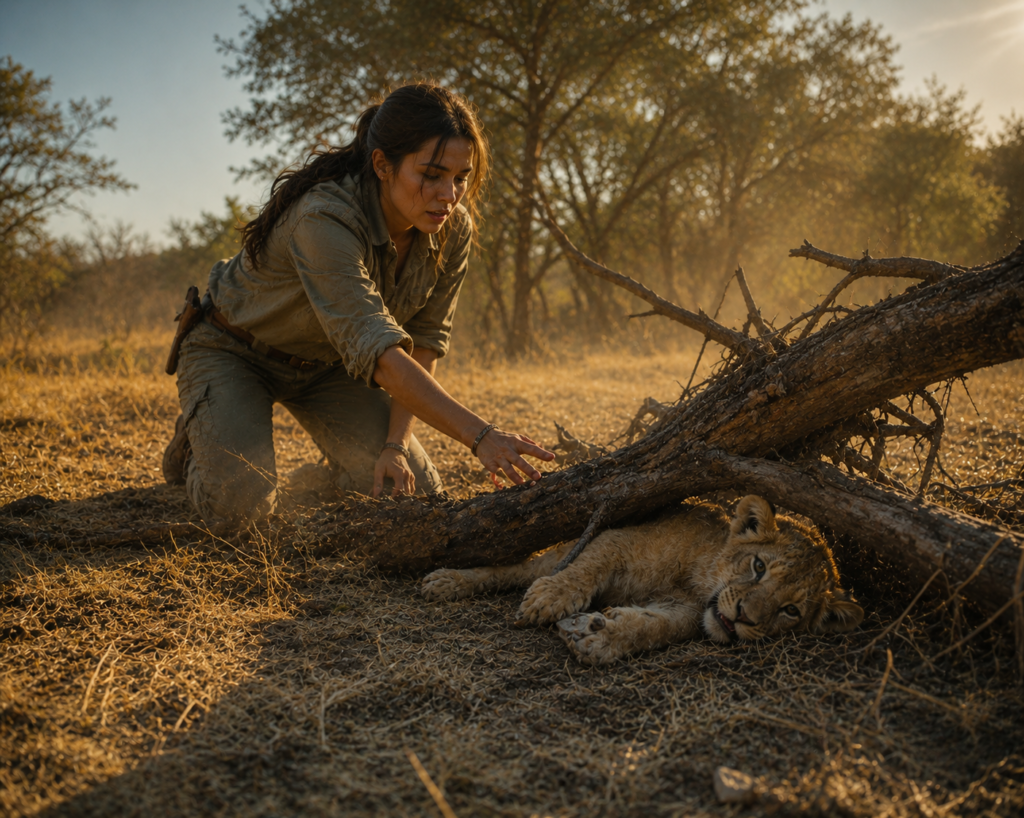
Valentina Cruz had not slept in thirty-six hours when she found the cub.
This matters because exhaustion does strange things to perception — it flattens time, blurs the edges between what is real and what the body simply invents in order to survive. Later, when she tried to tell someone about it, she would find that the most unbelievable parts were the ones she remembered most clearly, and the ordinary parts — the flight, the jeep, the base camp, the three days of work before everything went wrong — had become blurred and shapeless, like something seen through dirty water.
What she remembered with perfect clarity:
The dry grass crunching beneath her knees.
The sound the cub made.
The weight of the branch.
And after that, the footsteps.
Valentina was a field veterinarian, specializing in large cats, contracted by a conservation organization to assess a declining lion population in the corridor between two reserves. Real field work — not the romantic kind from documentaries, but the exhausting kind of inventories, transceivers, spreadsheets and jeeps with broken air conditioning and water that tasted of plastic and days that started before dawn and ended after dark.
She loved it.
That also matters. She didn’t do it for money — the money was nonexistent — nor for recognition, which was equally scarce. She did it because since the age of nine she had known with a quiet and absolute certainty that wild animals mattered, that their disappearance mattered, that someone had to go to the difficult places and count the ones that remained and defend the ones she could, and that someone could be her.
It was, she admitted in her most honest moments, the only thing she was truly good at.
On the third day, the jeep broke down twelve kilometers from base camp.
This was not catastrophic in itself — she had water for two days, emergency equipment, a communication radio. But the radio had taken on water during the previous night’s storm and was emitting only static, and the sun was already low and orange on the horizon, and the decision to walk or stay had to be made now.
She walked.
It was not a heroic decision. It was a practical decision based on knowledge of the terrain — the camp was in a known direction, the path was open, she had enough light to cover perhaps eight kilometers before complete darkness.
What she had not calculated was the ravine.
She rolled more than she fell — the slope was steep but not vertical, and she grabbed grass and branches and finally stopped against a large rock with the backpack absorbing the impact. Quick inventory: nothing broken, bruised ribs, right palm open where she had grabbed something with an edge, pride completely destroyed.
She sat on the floor of the ravine in the fading light and breathed for a minute.
It was then that she heard the sound.
It was not a sound she had heard before in real life, although she had studied it in recordings, in spectrograms, in the frequency analyses that form part of the technical work of understanding how animals that you can’t simply ask communicate. It was a small, rasping sound, with a particular quality that ethologists call distress vocalizations and that human beings, regardless of their training, recognize in the body before they recognize it in the mind.
Something was suffering.
Something young.
Valentina got to her feet.
Two
The cub was trapped beneath a fallen branch at the edge of the clearing, where the savanna opened from the edge of the riparian forest. The branch was not enormous — a medium-sized tree that had fallen at some recent point, perhaps during the storm, perhaps before — but it had fallen at an angle and trapped the cub’s right hind leg against the ground in such a way that the animal could move but could not free itself.
It was perhaps ten weeks old. Spotted coat, paws too large for its body, eyes still with that grayish-blue of infancy that in a few weeks would turn amber. Exhausted from struggling, lying on its side now, breathing fast, but its eyes found Valentina’s when she approached and in them there was nothing that resembled fear — only something she could only describe as waiting.
As if it had been waiting for someone to arrive.
— Tranquilo — she said softly, kneeling down. Her knees found the dusty ground, the dry grass. — Tranquilo, little one. I see you now.
The cub made the sound again — that small, rasping sound — and did not move while she extended her hands toward the branch.
It weighed more than it appeared. The wood had absorbed water from the storm and was dense and cold, and the angle meant that she couldn’t simply lift it but had to lever it, redistribute the weight, work against gravity from a kneeling position with muscles already exhausted from the fall and from the three previous days.
She pulled.
Dust fell. Something inside her shoulder protested in a way she noted mentally to deal with later. The branch creaked but did not yield.
She pulled harder.
— Come on — she said through her teeth. Not to the cub. Not to herself. To the branch, to the universe, to the sum total of all the obstacles that had placed themselves between her and anything she had ever tried in her life. — Come on.
The branch yielded.
Not all at once — gradually, with a resistance that kept diminishing until suddenly it was no longer there, and Valentina fell backward onto her heels and the cub scrambled forward, hind leg free, stumbling on its three sound legs as it found its balance.
She caught it before it fell.
It was heavier than she had expected. Warm and solid and real, its small heart beating at a speed that seemed impossible for such a small body. She checked the leg quickly — no apparent fracture, no serious laceration, only the kind of bruising that sustained weight leaves — and held it against her chest while it settled, first tense, then gradually less so, its breathing slowing to couple with hers.
— You’re all right — she said. — You’re all right now.
She was saying it for him. She was saying it for herself. In that moment there was no difference.
She exhaled.
She closed her eyes for a second, only a second, letting the relief be the only thing that existed — the weight of the cub, the warmth of the setting sun, the sound of the wind in the dry grass, the specific feeling of a problem solved that had seemed unsolvable thirty seconds ago.
Then her body knew.
Before her mind, before her eyes — her body knew, the way bodies know the things that the conscious brain is slow to process. A tension that began at the base of the spine and rose, vertebra by vertebra, until every muscle she had was saying the same thing very loudly and very clearly.
You are not alone.
She went completely still.
And then, very slowly, she turned her head.
Three
He was about forty meters away, at the edge where the tall grass met the open clearing.
Large. Dark-maned. Moving with that particular quality that adult lions have — not speed, but inevitability, as if the space between him and her were not a distance to be covered but simply a formality that the universe was processing with its customary indifference.
Head low. Shoulders rolling with each step. Tail moving once, slowly, from one side to the other.
Eyes directly on her.
Valentina had studied lions for eight years. She knew, with the part of her brain that still functioned clinically, exactly what these behaviors meant. She knew that a lowered head was aggression or evaluation or both. She knew that tail movement could indicate agitation. She knew that sustained eye contact in a large predator was a signal to be taken seriously.
She knew all of this.
She knew it the way one knows that falling hurts — in the abstract, perfectly, with all the correct information — until you fall, and then the knowledge becomes something completely different.
Something physical.
Something that lives in the body and has no words.
The cub moved in her arms.
It made the small rasping sound again — directed not at her but toward the approaching animal, the recognition vocalization that cubs use with adults of their group, the sound that says simply I am here, I am here, I am here.
And the lion stopped.
At perhaps twenty meters. No closer.
He went completely still, with the kind of stillness that large cats have and that seems unnatural precisely because it is so complete — not the stillness of something frozen but the stillness of something that is perfectly clear about what it is doing and does not need to move to do it.
His eyes moved to the cub.
Then to Valentina.
Then back to the cub.
And Valentina, holding the cub in her arms with her knees in the dust and her shoulder hurting and her heart beating in a place in her throat where it had not been before, understood something without words.
He knew.
Not the mechanics — not the branch, not the effort, not the technical details of what had occurred in the last five minutes. But something more essential than the mechanics. The result. The state of the world now versus the state of the world before.
His cub was free.
This woman had it.
And he was watching.
The cub stirred in her arms, more insistent now, pushing with its front paws toward the ground. She lowered it slowly, keeping it stabilized while it found its legs, and then released it, and it crossed the space between her and the lion with that particular clumsiness of very young cubs — too large for their coordination, running in a way that seemed as though it might fall at any moment but somehow never did.
The lion lowered his head.
The cub pushed against him — flank to flank, head against neck — and the large male covered it with one paw in a gesture that was unmistakably protective, unmistakably gentle, unmistakably private in a way that Valentina felt she was watching something that was not meant to be seen by human eyes.
Then the lion raised his eyes.
To her.
Afterward she would not be able to describe the look. She would try — with words, without words, in conversations and in the margins of her field notebooks — and would always fail, because the vocabulary available to the human experience of encountering something wild on its own terms is inadequate in ways that you only realize when you need it.
It was not threat.
It was not gratitude — that was too human, too transactional, too loaded with everything that humans have built around the concept of debt and repayment.
It was something closer to what one feels when someone tells you the truth without embellishing it. Without softening it. Without considering whether you want it or not.
I see you.
I know what you did.
We exist in the same world.
Three seconds. Perhaps four.
And then the male turned, and the cub turned with him, and they dissolved into the tall grass with the silent efficiency that lions have, as if the world simply closed behind them and rearranged itself so that they had never been there.
Four
Valentina stayed kneeling in the dust for a long time.
The sun had gone almost entirely now, the orange light turned into that dark blue that precedes complete darkness, and the stars were beginning to appear on the horizon and the wind in the grass had that sound it has at night on the savanna — deeper somehow, fuller, as if the world were exhaling what it had been holding throughout the day.
She thought about her mother.
Her mother, who had died when Valentina was sixteen, who had been the first person to tell her that wanting to spend her life counting lions in Africa was a perfectly reasonable thing to want. Most of the adults in Valentina’s life had smiled the way adults smile at children’s ambitions — with affection and a slight condescension that said you’ll learn to want more practical things. Her mother had simply said: then learn everything you can.
She had not been able to tell her that she had.
She had not been able to tell her any of this — the work, the field, the years of training, the moments like this one where the world opened in ways that had no words.
She wondered whether it mattered. Whether there was a way for the things one learns and the things one experiences to somehow reach the people who wanted one to experience them, even when those people are no longer there.
She decided that yes.
She had no proof. But she decided that yes.
She reached camp four hours later, at one in the morning, with her shoulder hurting seriously and her palm covered in dust and dried blood and her pride still destroyed but now coexisting with something else, something that had no clean name but was large and silent and occupied the same space as exhaustion without replacing it.
Her colleagues were awake, waiting, with the portable radio and the vehicles ready and that particular mixture of relief and anger that comes from finding someone you feared was lost.
— Where were you? — asked Emeka, who was the field coordinator and had spent thirty years in conservation and had the kind of face that makes only one expression at a time with complete honesty.
— In the field — said Valentina.
— What happened?
She thought about the cub. About the branch. About the eyes of the male at twenty meters, holding her with a gaze that had no category in any language she knew.
— I stumbled — she said.
Emeka looked at her for a moment.
— Are you all right?
— Yes.
— Sure?
Valentina thought about that.
— More than this morning — she said finally.
Emeka nodded. He was the kind of man who knew when an answer was all he was going to get and when that was enough.
— Eat something — he said. — Sleep. There’s work tomorrow.
There was work. There was always work.
But that night, in her tent, with the sound of the wind on the savanna and the pain in her shoulder and the tiredness weighing on every muscle she had, Valentina Cruz thought about her mother, and about the cub, and about the eyes of the male that had truly seen her — not as a threat, not as an intruder, but as what she was: one more creature in the world, doing what she could with what she had, in the time she had been given.
It was not nothing.
On the good days, it was not nothing at all.
She closed her eyes.
And slept.