There are moments that don’t announce themselves as life-changing.
They arrive sideways — ordinary on the outside, catastrophic on the inside — and you only understand what they were long after you’ve survived them.
For Maya Chen, that moment arrived on a Tuesday, wearing the shape of a lion cub.
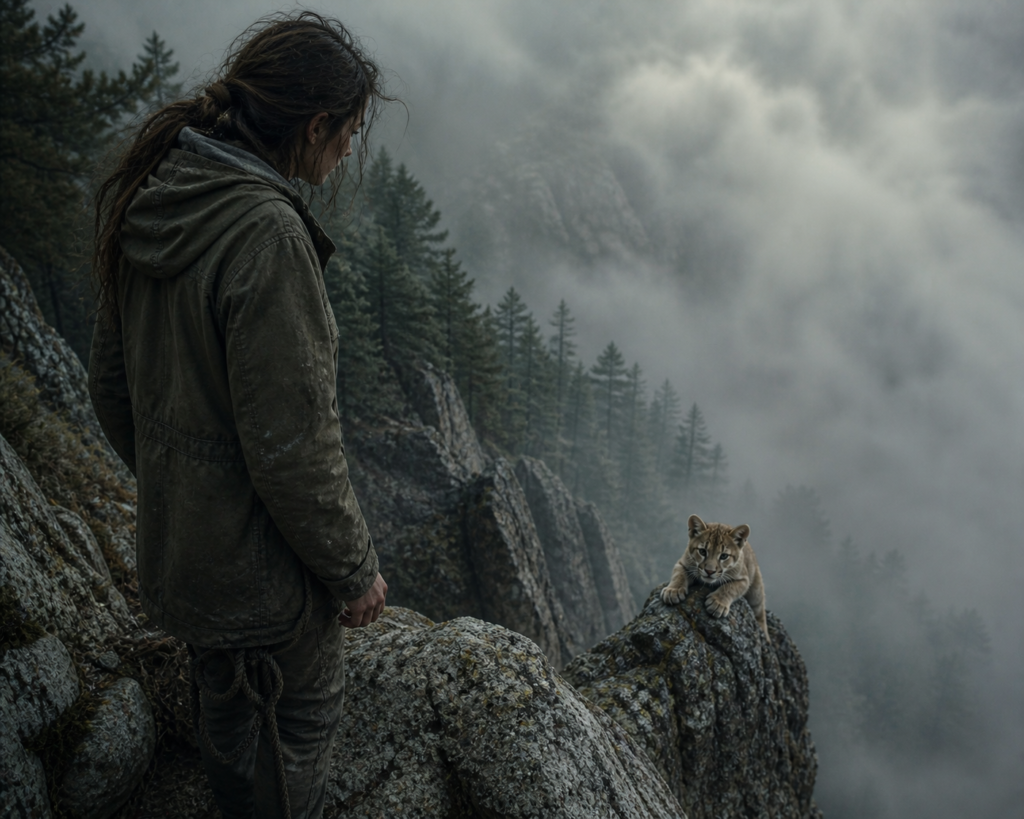
She’d been hiking Stormridge alone for three hours when the fog came in.
Not gradually. Not politely. It rolled down from the summit like something with intention, swallowing the tree line first, then the trail markers, then the middle distance, until the world contracted to a grey circle maybe twenty feet wide and Maya was at the center of it, alone, and completely fine with that.
This was the thing people didn’t understand about her. The solitude wasn’t something she endured. It was something she collected — kept carefully, the way others kept photographs. She’d been doing it since her brother died, though she wouldn’t have said it that way. She would have said: I just prefer my own company.
She was very good at saying things that were almost true.
She heard it before she saw it.
A sound between a whimper and a snarl — helpless and proud at once, if that’s possible, and apparently it is — coming from below the ridge’s edge. She stopped walking. Looked down.
The cub was maybe fifteen feet below, wedged on a narrow outcrop of rock that jutted from the cliff face like a crooked shelf. Sandy fur. Too-large paws. Eyes that caught what little light the fog allowed and threw it back at her like a challenge.
He was maybe four months old. Maybe less.
He was also completely, utterly stuck.
Maya stood at the edge and did the rational calculation: no rope, no equipment, no other hikers within earshot, no cell signal since the trailhead. The rock face below the outcrop disappeared into white nothing — she couldn’t see the bottom, which meant the bottom was far.
Walk away, said the voice that had kept her alive through thirty-one years of poor decisions. This is not your problem. This is nature. This is how it works. Walk away.
She looked at the cub.
The cub looked at her.
She took off her backpack.
She would not recommend the descent.
Later, reconstructing it in the emergency room while a nurse cleaned her palms with something that stung viciously, she would struggle to explain the sequence of moves — the way she’d lowered herself over the edge using a root as a handhold, found a foothold that felt solid until it didn’t, dropped two feet before catching a crack in the rock with her right hand, swung, stabilized. The nurse kept making a face. Maya kept having to skip parts because she couldn’t explain them without sounding like someone who wanted to die, which she didn’t, not anymore.
Not for a long time.
She just, occasionally, forgot to be afraid of things she should be afraid of.
The cub let her approach. That was the first miracle.
Not easily — he backed against the rock wall, hissing, showing her milk-white teeth and the pink of a tongue that had never tasted blood. But he was exhausted, and exhaustion, in the end, is more honest than pride. He let her come close. Let her speak.
Come on, she heard herself say, in the voice she’d once used for her brother when he was small and scared and convinced their father’s anger was somehow his fault. Come on… hold on… you’re okay…
She took his forepaws. He tensed. She tensed. The rock under her boots was slick with condensation and something green and ancient.
She pulled.
The strain hit her all at once — shoulders, spine, the specific agony of muscles asked to do more than they’d agreed to — and for a terrible half-second nothing moved and she thought: this is it, this is where it ends, both of us, together, at the bottom of something I can’t see.
Then she leaned back.
Everything she had, backward, trusting a foothold she couldn’t verify, trusting the rock, trusting something she didn’t have a name for.
The cub came up.
He scrambled, hind legs finding the cliff face, pushing while she pulled, the two of them working in sudden wordless unison — this woman and this wild thing — and then he was over the edge, rolling onto the flat ledge, tumbling onto the moss, and she was hauling herself up after him, and they were both lying on their backs in the fog, breathing.
Just breathing.
The mountain held them.
She lay there for a long time before she sat up.
The cub had moved a few feet away and was washing his face with one uncertain paw, which she found unreasonably funny. She laughed — a real laugh, surprised out of her, the kind she hadn’t had since before the funeral. It echoed off the rocks and went somewhere she couldn’t follow.
You’re welcome, she told him.
He looked at her with the withering contempt that cats of all sizes have mastered across every continent.
She laughed again.
She was reaching for her water bottle when the silence changed.
Not became quiet — it had been quiet. It became empty. The birds she hadn’t consciously noticed stopped. The wind stopped. Even the fog seemed to pause.
Maya looked up.
He was thirty meters away, at the edge of the trees. Black-maned, mountain-massive, moving with a heaviness that wasn’t slowness — it was certainty, the gait of a creature that had never doubted a single step it had ever taken. His head was low. His eyes were on her.
Only her.
The cub made a small sound and pressed against her leg. She felt it — that warm, trembling weight — and her body went entirely still.
Don’t run, said a voice that wasn’t thought so much as instinct, the oldest part of her standing up and speaking clearly for once. Don’t run. Don’t look away. Don’t apologize.
She didn’t.
She sat on the rock ledge, with the cub against her knee and the mountain falling away on all sides, and she looked at the lion and the lion looked at her, and between them moved something she had no vocabulary for. Some current. Some recognition.
I know what you did.
I see you.
I am deciding.
The roar came from everywhere at once.
It wasn’t sound so much as weather — a force that started in her sternum and moved outward, rattling the loose rock, reshaping the fog, rolling out across the peaks and valleys in waves that would take minutes to finish traveling. The cub bolted, a streak of sandy fur disappearing toward its father without a backward glance. She didn’t blame him.
She sat completely still and let it move through her.
And when it was done — when the last echo dissolved into the grey distance and the silence returned, different now, rearranged — she found, to her own bewilderment, that she was crying.
Not from fear, though fear had been there.
From something else entirely. Something she would spend years trying to name and never quite manage.
She sat on that ledge for a long time after the lion disappeared.
Long enough for the fog to thin slightly, to show her the valley below — green and enormous and indifferent in the beautiful way wild things are indifferent: not cruel, just complete, needing nothing from her.
She thought about her brother. She thought about the eighteen months since she’d lost him, all those careful acts of self-erasure — the solo hikes, the unanswered calls, the quiet project of making herself smaller so that her grief had less to fill. She thought about the cub. About the weight of him in her arms. About how it had not felt like saving something.
It had felt like being something.
She pulled out her phone — still no signal — and opened the notes app. Typed three words. Not for anyone else. Just to mark the moment, the way explorers once planted flags not to claim a place but to say: I was here. This was real. This happened to me.
Three words.
Still worth it.
Then she stood up, shouldered her pack, and walked back down the mountain toward the life she hadn’t yet decided to stop living.
The ranger who found her at the trailhead said she looked like she’d been through something.
«Rough hike?» he asked.
Maya thought about the cliff face, the bleeding palms, the cub’s warm weight, the roar that had rearranged something fundamental inside her chest.
«No,» she said. «Good one.»
And meant it, completely, for the first time in longer than she could remember.