Part One — Before
Lena Vasquez had always been the kind of person who said yes.
Yes to the extra shift. Yes to the favour nobody else wanted to do. Yes to her roommate’s cousin who needed a ride to the airport at four in the morning. Yes to her professor who needed someone to collect soil samples from the nature reserve before the thaw. Yes, of course, no problem, I’ll figure it out.
She had figured things out her entire life.
She was fairly certain she was not going to figure this one out.
It had started as a perfectly ordinary Tuesday.
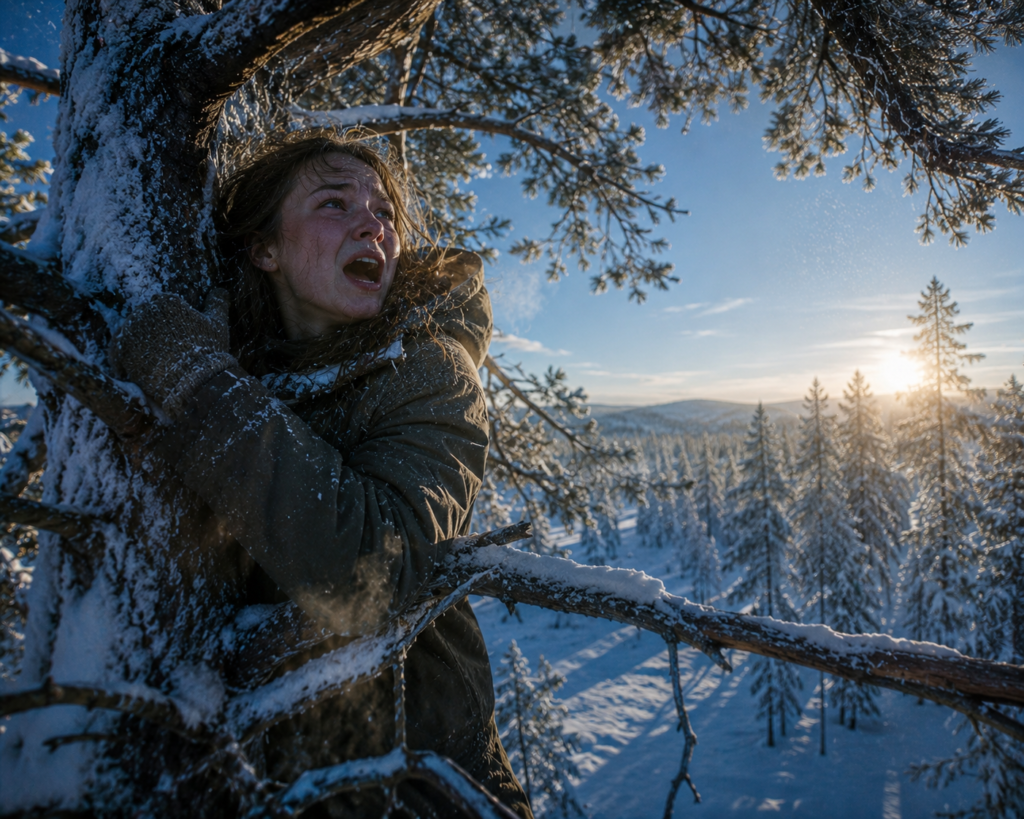
That was the thing that kept snagging at her, even now, even twenty feet up in a pine tree with her hands bleeding and a wolf circling below her like a slow dark thought — it had started as an ordinary Tuesday. She’d had oatmeal for breakfast. She’d listened to a podcast about the history of salt. She’d driven the two-lane road into the Vassberg Reserve with her sample kit on the passenger seat and her coffee going cold in the cupholder and absolutely no premonition, no chill, no whisper from the universe that today was going to be the day everything broke open.
The car had gotten stuck in the snow at the trailhead. That was the first thing.
She’d left it there and walked in, because the sample sites were only forty minutes away and she had good boots and a good coat and she was twenty-two years old and had never once been seriously afraid of a forest.
She understood, now, that this had been a form of arrogance. Not the reckless kind — the quiet kind. The kind that comes from a life in which the worst things that happen are inconveniences rather than catastrophes. A missed bus. A failed exam. A relationship that ends badly but ends, and you survive it, and eventually you’re fine.
She had confused surviving small things with being invulnerable to large ones.
The wolf had corrected that misunderstanding in approximately four seconds.
She hadn’t even heard it coming.
One moment she was walking between the trees, breath clouding in the cold air, boots squeaking on packed snow, thinking about nothing in particular — the assignment, the drive home, whether she had anything worth eating in the apartment. The next moment something moved at the edge of her vision and she turned and it was there, twelve feet away, standing absolutely still in the blue shadow of a spruce.
Large. Dark. Patient.
Looking at her the way things look at other things when the question of what happens next has already been decided.
She ran. She knew, distantly, that you weren’t supposed to run, that running triggered something ancient and instinctive and terrible — but her body made the decision before her mind could intervene, and she ran, and it came after her, and she reached the pine tree at the clearing’s edge with perhaps a second to spare and climbed with a desperation she had never accessed before in her life.
She climbed until the branches thinned and the tree swayed slightly under her weight and below her the wolf stood in the snow and looked up, and she held on, and she called for help into the bright empty winter air, and nobody answered.
Part Two — During
The sun was extraordinary.
That was the absurd thing. She was twenty feet up a pine tree with a wolf below her and possibly dying and the sun was the most beautiful she had ever seen it — low and brilliant, throwing long blue shadows across the white ground, turning the snow into something that sparkled like it was trying to say something. Like it was trying to be comforting. Like the world was making an effort.
She almost laughed. She didn’t. Her hands were too cold for laughing.
The wolf had stopped circling.
That was new. For the past — how long? She’d lost track of time in a way that frightened her — it had been moving, slow deliberate circles in the snow below her, its breath rising in small clouds, its dark eyes moving between her and the treeline and back to her. Patient. Methodical. Like something that understood that waiting was a form of winning.
But now it had stopped.
It stood directly below her and looked up.
And the silence was different.
Not the silence of a winter forest, which is full of small sounds — wind in the high branches, the creak of frozen wood, the distant percussion of a woodpecker — but a silence beneath that, inside that, a silence that pressed against her eardrums and made her aware of her own heartbeat in a way that felt almost medical.
She looked down.
The wolf looked up.
And in the three seconds that they held each other’s gaze, Lena understood something she had no framework for — that this animal was not angry, was not cruel, was not the monster of any story she’d been told. It was simply itself. Fully, completely, terribly itself. Operating according to laws older than language, older than cities, older than the entire project of human civilization that had taught her to walk into forests with sample kits and podcasts about salt as if the wild world was a backdrop rather than a force.
She had walked into its world.
It was simply responding accordingly.
The understanding didn’t make her less afraid.
But it made the fear feel different — less like panic, more like grief. A mourning for her own smallness. A sudden, vertiginous awareness of how thin the membrane was between her ordinary Tuesday and this tree and this animal and the cold and the dropping light.
How thin it had always been.
How little she had ever noticed.
Then she turned her head.
She didn’t know why. Instinct, maybe — the same animal instinct that had made her run when she shouldn’t have run, the deep old part of her that was wiser than the rest of her. She turned her head and looked sideways into the forest, into the long blue shadows between the trees.
And she saw them.
Four. Five. She counted, and then stopped counting because counting made it more real and she wasn’t sure she could afford more real right now.
They moved the way smoke moves — without urgency, without noise, slipping between the trees like they were part of the forest itself, like the forest was breathing them into existence. Their paws found the snow without disturbing it. Their eyes caught the low winter sun and threw it back, amber and cold.
They had been there for a while.
She understood that immediately. They had been there — watching, waiting, arranged with a patience and an intelligence that was not human but was not nothing — while she called for help into the empty air and focused all her terror on the single wolf below her.
A misdirection.
Not planned, not conscious — but a misdirection nonetheless. She had been looking at the thing she could see while the larger danger assembled itself in the periphery.
She had, she realized, been doing this her whole life.
Part Three — After
The howl started low.
Not from the wolf below her — from somewhere in the trees. A long, layered sound that started in one animal’s throat and was taken up by another, and another, until it filled the forest the way water fills a space, finding every corner, leaving no silence untouched.
Lena pressed her back against the trunk of the pine tree.
The bark was rough through her coat. The branch under her was solid. The sun was still doing its extraordinary thing with the snow, still throwing that clean cold light that had nothing apologetic about it, nothing soft. Just light. Just the world continuing to be the world, indifferent to the question of what happened to her next.
She thought about her mother.
She thought about her mother’s voice specifically — the particular timbre of it in the mornings, before coffee, slightly rough, always warm. She hadn’t called her mother in three weeks because she’d been busy, because she’d had the assignment and the extra shift and the roommate’s cousin and all the ordinary machinery of a life that had seemed, until forty minutes ago, entirely sufficient.
She should have called.
She pressed her forehead against the trunk of the tree and closed her eyes.
Think, she told herself. You have always been able to think.
Okay.
She was in the Vassberg Reserve. She had left her car at the trailhead on Route 7, which meant someone would see it eventually — hikers, another researcher, a ranger doing rounds. The question was when. The question was whether eventually was soon enough.
Her phone had no signal. She’d checked three times already, holding it up into the cold air like an offering.
She had a sample kit, a thermos of cold coffee, a granola bar, and a multi-tool she’d thrown in the bag at the last minute because her father had always told her to carry one and she’d always thought he was being dramatic.
She did not think he was being dramatic anymore.
She opened her eyes.
Below her, the wolf had not moved.
Around her, in the trees, the pack had gone quiet again.
The sun was lower now. She could feel the temperature dropping — that particular shift in cold air when the light begins to fail, when the warmth that has been pretending all day disappears and shows you what was underneath it all along.
She had perhaps an hour of proper light left.
Lena Vasquez, who had always said yes, who had always figured things out, who had walked into a forest on an ordinary Tuesday without once considering that the forest had its own ideas about how the day should go — she tightened her grip on the branch, and she breathed, and she thought.
And then she did what she had always done.
She started figuring it out.
Epilogue — Spring
The ranger found her just before dark.
She had made noise — systematic, rhythmic noise, banging the multi-tool against the trunk of the tree until her arms ached, until the sound carried far enough. It had taken forty minutes. The wolves had watched the whole time, and then, at some point she couldn’t precisely identify, they had simply stopped watching. Had slipped back into the forest the way they’d come — like smoke, like breath, like something the trees had briefly decided to show her and then thought better of.
She spent two nights in the hospital. Mild hypothermia. Three broken nails. A humility so thorough and so complete that it felt less like an emotion than a restructuring.
She called her mother from the hospital bed.
Her mother cried. Lena didn’t — not then. She lay there with the phone against her ear and listened to her mother’s voice, that particular timbre she’d been thinking about in the tree, and felt something move through her chest like a slow warm current.
She cried later. In the shower, two weeks after she was home. Unexpectedly, without warning, sitting down on the floor of the tub while the hot water ran and simply letting it happen — all of it, the tree and the cold and the wolf’s eyes and the howl that had filled the forest and the forty minutes of banging metal against wood with arms that didn’t want to keep going.
She let it move through her.
And when it was done, she got up.
That spring, she went back.
Not to the same spot — she wasn’t ready for that, might never be ready for that, and she had made peace with that limitation. But to the reserve. To the treeline. She stood at the edge where the groomed path ended and the wild things began, and she looked into the forest for a long time.
She was not the same person who had walked in there in October.
She wasn’t sure yet what person she was instead. She was still finding out, still turning over the new shape of herself in her hands, examining what had changed and what had been revealed and what had always been there, waiting underneath the ordinary Tuesdays to be seen.
She knew this much:
The world was larger than she had understood it to be.
Not more dangerous, necessarily — though it was that too, and she no longer forgot it. But larger. Fuller. More serious in its beauty, more honest in its indifference, more extraordinary in the way it kept going — wolves and snow and low winter sun and the rough bark of a pine tree and the sound of a mother crying into a phone — all of it continuous, all of it connected, all of it mattering in ways she was only beginning to have language for.
She stood at the edge of the forest.
The wind moved through the pines.
Somewhere in the distance — far, soft, layered — a wolf called to another wolf, and the sound traveled through the cold spring air and found her, and she stood very still and listened to it all the way to its end.
Then she turned around.
And walked back into her life.