Part One — What He Was Before
His name, in the records of the facility, was Subject 7.
Elena had started calling him Bruno on her third visit, quietly, under her breath, not in any official capacity. Just because she could not keep looking at him and thinking Subject 7. Because Subject 7 was a designation and Bruno was a living thing and the difference mattered to her even if it mattered to no one else in the building.
Bruno was a European brown bear, seven years old, four hundred and sixty pounds at his last weigh-in — though he had lost weight since then, you could see it in the way his coat hung differently, in the slight hollowing around his haunches. He had been confiscated from a traveling circus eighteen months ago following an investigation into animal cruelty. The investigation had been thorough and the findings had been damning and the circus had been shut down and its owner had been fined and that should have been the end of it.
Except nobody had known what to do with Bruno.
The sanctuary that had agreed to take him had lost its funding six weeks before the transfer date. The second facility on the list had a disease outbreak and was closed to new animals. The third had a fire. These things happened. Nobody’s fault. Just the ordinary cruelty of circumstance.
Bruno stayed in the concrete room.
He stayed and stayed and stayed.
And the metal muzzle stayed on him because the facility’s insurance policy required it and the facility’s director, a man named Garrett who Elena had stopped being able to look directly in the eye, said there was nothing he could do about the insurance policy and nothing he could do about the concrete room and nothing he could do about the timeline and his hands were tied.
His hands were tied.
Bruno’s mouth was muzzled.
Elena thought about the difference between those two things often.
She had first come to the facility as a wildlife rehabilitator hired to assess Bruno’s psychological condition and make recommendations for his eventual transfer. That was fourteen months ago. The report she had written was thorough and careful and devastating in the particular way that factual documents can be devastating — it said, in the precise language of her profession, that Bruno was exhibiting severe symptoms of learned helplessness, chronic stress, and psychological withdrawal, and that every additional month in the current conditions would make his eventual rehabilitation significantly more difficult.
She had submitted the report.
Nothing had changed.
She had submitted a second report.
Nothing had changed.
She had started visiting on her own time, outside of her contracted hours, because she could not stop thinking about him and because the thinking was worse when she was not there and at least when she was there she could do something, even if the something was only sitting on the cold concrete floor outside his enclosure and talking to him quietly about nothing in particular.
Bruno had not responded to her for the first two months.
He sat in the far corner of the enclosure and faced the wall and did not turn around. She could see his breathing — the slow rise and fall of his enormous back — and that was the only indication that he was alive and not simply a large dark object placed in a corner to be forgotten.
She kept coming.
She kept talking.
On the sixty-third day, he turned around.
Part Two — The Muzzle
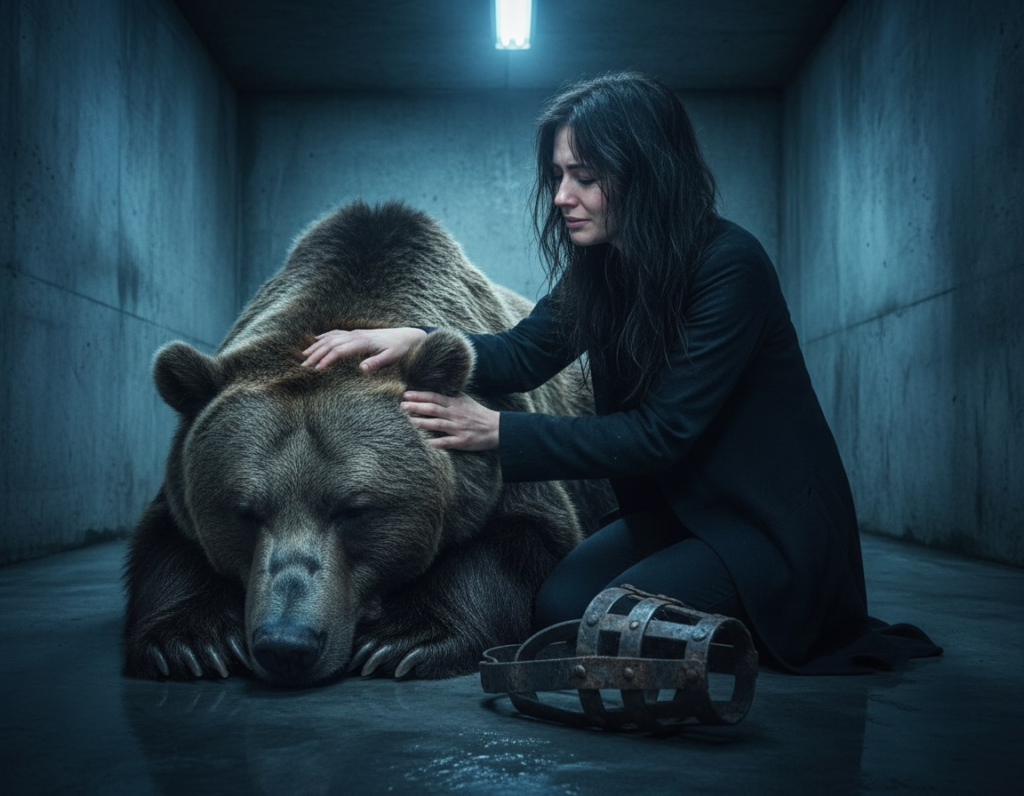
The muzzle was heavy steel, custom fitted, secured with three buckles at the back of his head.
Elena had looked at the specifications. She had looked at the weight of it and the pressure points and the veterinary literature on prolonged muzzling in large ursids and she had written a third report and a fourth report and she had sent emails that were answered with the phrase «insurance requirements» and phone calls that ended with the phrase «our hands are tied» and she had gone home and sat at her kitchen table and pressed her hands flat against the surface and breathed.
Bruno had been wearing the muzzle for four hundred and twelve days.
He had learned not to fight it. That was the thing that broke Elena most consistently — not the muzzle itself but what the absence of fighting meant. In the early records, before she had come, there were notes about attempts to remove it, about agitation, about the natural resistance of a living thing to having its mouth sealed shut. But somewhere in the first months those notes had stopped. Bruno had stopped fighting.
He had simply accepted.
And the acceptance was worse than the fighting would have been.
The morning it changed was a Tuesday in November.
Elena had arrived at six-thirty, two hours before the facility officially opened, using the key she had been given for her rehabilitation work. The corridor was empty. The fluorescent lights hummed. Her footsteps echoed on the concrete.
She had made a decision the night before.
She had not slept.
She had sat at her kitchen table with the four reports she had written and the email chain that had gone nowhere and the insurance policy document she had finally obtained a copy of and read three times, and she had found — in the policy, in the specific language of section 4, paragraph 2, subsection C — that the muzzle requirement applied to bears in public-facing areas of the facility.
Bruno’s enclosure was not a public-facing area.
It never had been.
Nobody had read the policy carefully enough. Or someone had read it and decided it was easier not to raise the question. Or someone had read it and not cared. Elena did not know which. She had stopped trying to assign reasons to things that had no good reasons.
She walked to Bruno’s enclosure.
She knelt on the cold concrete floor.
Bruno was in the far corner, facing the wall, in his customary stillness.
— Bruno,— she said.— I’m going to take it off today.
He didn’t move.
— I know I’ve said things before and nothing happened. I know that. I know you have no reason to believe me.
His breathing continued its slow rise and fall.
— But I’ve read the policy. And I’m going to take it off. And if Garrett wants to argue about it he can argue about it with the policy document that I am going to tape to his office door.
She stood up.
She reached for the enclosure door.
She heard Garrett before she saw him.
His footsteps in the corridor — heavy, fast, the particular rhythm of someone who has been called by the overnight security monitor and has come in from home still wearing his coat.
He appeared in the doorway at the end of the corridor.
— Elena.— His voice was controlled but she could hear the edge in it.— Step away from the enclosure.
She had the door open.
— I’ve read section 4, paragraph 2, subsection C,— she said, without turning around.
— Elena, the insurance—
— Subsection C, Garrett. This is not a public-facing area. The muzzle requirement does not apply here. It never applied here.
Silence.
— Step away from the enclosure.
— No.
She heard him take a step forward. Then another. She could hear his breathing now, the particular quality of it — not angry, she realized. Frightened. He was genuinely frightened and she thought about that for a moment, about what it meant that a grown man was frightened of a bear in a muzzle in a concrete room, and she felt something that was not quite pity and not quite contempt but something in between.
She stepped into the enclosure.
Bruno did not turn around.
She walked to him slowly. She knelt behind him. She could hear Garrett shouting now, loudly, something about liability and something about protocol and something about her career, and she let the words wash past her and focused on Bruno’s breathing and on the three buckles.
First buckle.
Second buckle.
Third buckle.
The muzzle came loose.
She lifted it away from his head slowly, carefully. It was heavier than she had expected. Four hundred and twelve days of weight.
She let it drop.
It hit the wet concrete floor with a sound that rang through the entire corridor.
Garrett went silent.
Bruno did not move immediately.
He sat in the corner with his enormous head free for the first time in four hundred and twelve days and he did not move. She could see his jaw working slightly — the muscles that had been compressed for so long beginning to recalibrate, to remember their own range of motion. His head moved fractionally from side to side, not a gesture but an adjustment, a recalibration, the body relearning what it felt like to be unbound.
Elena sat down on the concrete beside him.
She did not touch him.
She sat and she waited.
From the doorway she could hear Garrett’s breathing, rapid and shallow. She could hear him on his phone, speaking in a low tense voice. She did not look at him.
Then Bruno turned around.
He turned slowly, with the measured deliberateness of a very large animal in a very small space, and when he had completed the turn he was facing her. She looked up at him. He looked down at her.
His eyes were dark brown, deep-set, heavy-lidded with the chronic exhaustion of an animal that had been stressed for too long. But in them — underneath the exhaustion, past the learned stillness, behind everything that four hundred and twelve days had put there — Elena saw something that she had been waiting fourteen months to see.
He recognized her.
Not as a threat. Not as a keeper. As the person who had come. Over and over. Who had sat on the cold floor and talked about nothing. Who had come back when there was no reason to come back except that she could not stop.
He lowered his great head.
And rested it against her leg.
She put her hand on the side of his face.
She felt his jaw move — testing, exploring, the motion of a mouth that had been sealed for more than a year rediscovering its own freedom. She felt the warmth of him, the enormous solid warmth, and beneath her hand the slight trembling that she recognized as not fear but something like the opposite of fear — the trembling of something held very tight for very long beginning, finally, to let go.
Elena looked down at him.
Her face was wet. She hadn’t noticed when that had started.
She looked at the muzzle on the floor. Heavy steel, three buckles, four hundred and twelve days. She looked at it and thought about all the reports she had written and all the emails that had gone nowhere and all the mornings she had driven to this concrete building and sat on this concrete floor, and she thought: it was enough. It was enough to keep coming. It was enough to read the policy one more time. It was enough to not stop.
Bruno’s breathing slowed under her hand.
She felt it steady.
She felt the trembling ease.
And they stayed like that — the woman and the bear, in the cold blue light of a concrete room, while Garrett spoke on his phone in the doorway and the muzzle lay on the wet floor between them — until Bruno’s eyes closed.
Not in distress.
Just in rest.
For the first time in four hundred and twelve days.
Just rest.
Part Three — After
Garrett filed a formal complaint.
Elena filed the policy document, section 4, paragraph 2, subsection C, along with a timeline of every report she had submitted and every response she had received and a calculation — careful, precise, in the language of her profession — of the psychological damage caused by four hundred and twelve days of improper confinement.
The facility’s legal team reviewed the policy.
They found that Elena was correct.
The muzzle requirement had never applied to Bruno’s enclosure. It had been applied anyway, through inattention or convenience or the simple human tendency to continue doing things because they have always been done, and nobody had read carefully enough to stop it.
The formal complaint against Elena was withdrawn.
Garrett resigned six weeks later. Elena never knew if it was connected. She decided it didn’t matter.
Bruno was transferred to a sanctuary in Montana four months after the muzzle came off.
Elena drove him there herself — fourteen hours in a specially equipped transport vehicle, stopping twice so she could check on him, talking to him through the partition the entire way about nothing in particular. The weather. The landscape. A podcast she had been listening to about migratory birds. Things that didn’t matter and mattered completely.
The sanctuary was three hundred acres of forest and meadow in the foothills of the Rockies. It had a staff of twelve and a waiting list for animals and a reputation Elena had researched carefully over fourteen months of waiting.
When they opened the transport door at the sanctuary, Bruno sat for a long moment without moving.
The air was different here. She could see him processing it — the smell of pine and cold water and open space, things his body remembered from before the circus, from before the concrete room, from whatever the beginning of his life had been.
He stepped out slowly.
He stood in the Montana sunlight, enormous and unhurried, and he looked at the tree line and the mountains beyond it.
Then he walked forward.
Not running. Not fleeing. Just walking, with the measured deliberateness of an animal that has somewhere to be and all the time in the world to get there.
Elena watched him go.
She stood at the transport door with her hand still resting on the frame and she watched him until he reached the tree line, until his dark shape was almost indistinguishable from the shadows of the pines, until she could barely see him anymore.
Then he stopped.
And turned.
And looked back at her for a long moment — across the distance, across the meadow, across everything that had happened in the concrete room and everything that had happened before it.
Then he turned back to the trees.
And walked in.
Epilogue
Elena drove home through the night.
Fourteen hours back the way she had come, the transport vehicle empty behind her, the Montana sky enormous and dark above the highway.
She thought about the muzzle on the floor.
She thought about section 4, paragraph 2, subsection C.
She thought about the sixty-third day, when Bruno had turned around for the first time.
She thought about Arthur — no, that was the other story. She smiled slightly at herself. She was tired.
She thought about Bruno in the trees.
She thought about how long it would take him to remember what it felt like to be a bear in a forest. How long the concrete room would live in his body, in his movements, in the way he startled at sounds that weren’t threats. How long healing takes when something has been held shut for long enough.
She thought: longer than four hundred and twelve days.
She thought: but it starts somewhere.
It starts with one person reading one document one more time.
It starts with a key in a door at six-thirty in the morning.
It starts with a muzzle hitting a concrete floor.
It starts.
The End.