What the Grass Saw
No one knew how long the wolf had been there.
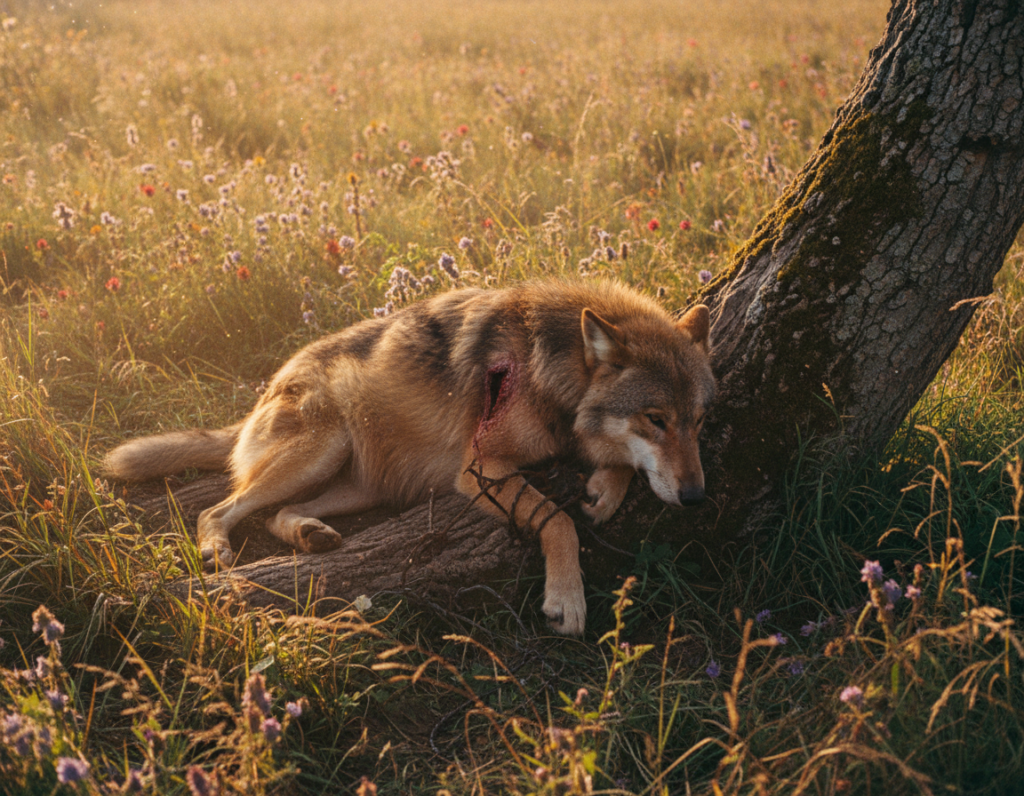
The farmer who owned the land found the broken fence post at dawn — the barbed wire coiled and snapped at one section, stretched at another, the kind of damage that happens when something large and desperate gets caught and pulls and pulls and cannot stop pulling until the pulling becomes stillness.
He followed the trail of blood through the wildflowers.
Found the wolf against the fallen oak at the far edge of the meadow. On its side. Leg wrapped in three loops of rusted barbed wire. Breathing in the shallow, rapid way that means the body is still fighting but the mind has begun to consider stopping.
He called animal control.
He called his neighbor.
He did not call his daughter.
But his daughter — seven years old, bare feet already stained green from the grass, hair loose and wild from a morning of running — had followed him without being seen, the way children follow when they understand instinctively that something important is happening and no one will let them near it if they ask.
She saw the wolf.
She did not run.
Part II — Three Feet Away
Her name was Clara.
Clara Voss. Seven years old. The kind of child who brought injured birds home in her shirt pocket and cried when earthworms dried on the pavement after rain and once sat beside a dying cat for four hours because, as she explained to her mother afterward, someone needed to be there.
She walked toward the wolf the way she walked toward everything that frightened other people.
Slowly. Openly. With her hands where they could be seen.
She stopped three feet away and knelt on the warm grass.
The wolf’s eyes found her immediately — amber, ancient, burning with the particular terror of a wild thing that has learned the hard way what human shapes mean.
Clara did not move.
She simply extended one small open hand, palm up, and waited.
The meadow held its breath.
Part III — Her Father’s Voice
«¡Aléjate de ese animal! ¡Está herido! ¡Te va a destrozar!»
Her father’s voice tore across the meadow like something breaking.
He had turned to find her gone from behind him and his heart had stopped and then restarted in the wrong rhythm — the rhythm of a parent who has located their child in the worst possible place.
He grabbed the fence post at the meadow’s edge.
His arm pointed at her violently, uselessly, the way arms point when the body wants to do something and the distance makes everything impossible.
Clara heard him.
She did not turn around.
Because the wolf had just done something.
It had moved its eyes from her father’s screaming shape — from the threat, from the noise, from the human fury it had every reason to fear — and returned them, slowly and completely, to her face.
And in that return, Clara understood something she would not have the words for until she was much older:
It chose to look at me instead.
Part IV — The Wire
She found the first loop by feel.
Her fingers moved through the warm air and down to the wolf’s leg — slowly, so slowly, with the particular deliberateness of someone who understands that speed is the enemy of trust — and found the wire where it bit deepest, just above the joint.
Rusted. Tight. Coiled in three places.
The wolf’s leg flinched once at her touch.
Then went still.
She worked the first loop open with both hands, the metal biting into her small fingers, a thin line of red appearing across her palm that she did not notice or did not care about.
The second loop was tighter.
She took longer.
The wolf watched her face the entire time.
Not with fear anymore.
With something that had no name in any language Clara knew but that felt, in her chest, like being trusted with something breakable and knowing you will not drop it.
The third loop released.
The wire fell into the wildflowers.
Curled into itself.
Went still.
Part V — The Weight of a Head
The wolf moved.
Not away.
Toward.
It lifted its massive head from the ground — slowly, with the enormous effort of something that has been holding itself rigid against pain for a very long time — and pressed its nose against Clara’s cheek.
Warm. Dry. Breathing.
Clara wrapped both arms around its neck.
Not carefully. Not tentatively.
With everything she had.
She pressed her face into its fur — that wild, sun-warmed smell of something that had never been indoors, never been tamed, never been asked to be smaller than it was — and held on the way you hold on when you have been looking for something without knowing what it was and you have finally, improbably, found it.
The wolf exhaled.
Long. Slow. Enormous.
Its body stopped trembling.
Part VI — The Man at the Fence
Her father had stopped shouting.
He stood at the fence post and watched his seven-year-old daughter hold a wolf in a field of wildflowers in the golden afternoon light and felt something happen inside his chest that he had no category for.
It was not relief.
It was not fear.
It was something older than both — something that lives in the part of a person that existed before language, before reason, before all the careful walls that adults build around the things that are too large to look at directly.
He pressed the back of his hand against his mouth.
His knees bent slightly.
He gripped the fence post.
And he watched.
Part VII — What She Said
Clara pulled back just far enough to look at the wolf’s face.
Its amber eyes were closed.
Its breathing was deep and even — the breathing of something that has decided, against all its instincts and all its history and all the very good reasons it had accumulated for never trusting anything human — to rest.
She looked at it for a long time.
Then she whispered:
«You don’t have to fight anymore. I’m here now.»
The wolf’s ear moved once toward her voice.
Then went still.
Epilogue
The wildlife team came at sunset.
They sedated the wolf carefully, treated the leg, loaded it into the transport with the practiced efficiency of people who do this work because they cannot imagine doing anything else.
Clara stood at the meadow’s edge and watched until the vehicle disappeared.
Her father stood beside her.
He had not spoken since the fence post.
He tried now.
«Clara—»
She looked up at him.
Her face was still wet. Her palm still had the thin red line across it. Her yellow sundress had grass stains at the knees that would never completely wash out.
«He looked at me,» she said simply. «Instead of you. He chose to look at me.»
Her father looked at his daughter for a moment.
Then he knelt down in the grass — right there, in the wildflowers, in the last of the golden light — and held her the way the wolf had let her hold it.
With everything he had.
The barbed wire lay in the grass behind them.
The meadow exhaled.
Some creatures carry wounds so long they forget there was ever a time before the pain.
It takes a certain kind of person to remind them.
Usually seven years old.
Usually barefoot.
Usually the one no one thought to call.