Mysterious Creature Found Washed Up on Beach Leaves Onlookers Stunned — The Truth Is More Disturbing Than It Looks
Its Swollen Body, Torn Skin, and Strange Shell-Like Remains Made It Almost Impossible to Identify, Until a Closer Look Revealed What Had Washed Ashore
At first glance, it looked like something that should never have existed.
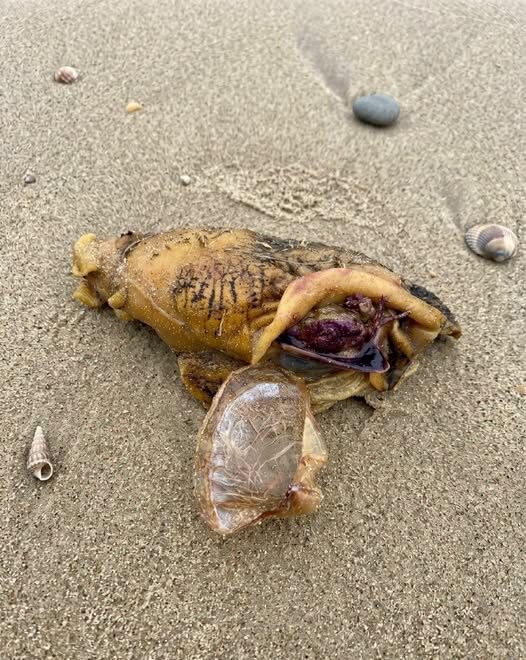
Half-buried in sand and coastal grass, the strange object had a swollen, distorted body, loose folds of damaged skin, and an unusual shape that made it difficult to recognize as any familiar
Nearby lay what appeared to be a hard, broken piece of shell. The surrounding remains were so badly deteriorated that it was difficult to tell where one part of the creature ended and another began
For someone encountering such a sight during an ordinary walk along the beach, the immediate reaction would likely be a mixture of curiosity, confusion, and unease.
Was it an unfamiliar deep-sea animal? A creature suffering from some strange disease? Or simply something that had been altered beyond recognition by the ocean?
The answer was far less mysterious than its appearance suggested, although no less unsettling.
The remains belonged to a dead sea turtle in an advanced stage of decomposition.
And the reason it looked so extraordinary reveals something fascinating about what happens to marine animals after death.
Why the Strange Discovery Was So Difficult to Recognize
Sea turtles are among the ocean’s most recognizable animals. Their streamlined bodies, powerful flippers, and distinctive shells make them relatively easy to identify when they are alive and healthy.
But decomposition can dramatically change the appearance of an animal, especially one that has spent time in the water before washing ashore.
In this case, the swollen body and damaged outer tissues had obscured the familiar features that would normally identify the creature as a turtle.
The remains no longer resembled the smooth, balanced shape people associate with a living sea turtle swimming through the ocean.
Instead, the body appeared irregular and distorted. Some tissues had loosened or collapsed, while parts of the shell appeared damaged or separated.
These changes can create an appearance that is surprisingly difficult to interpret without understanding the process of decomposition.
What initially seems like an unfamiliar species may actually be an ordinary animal whose recognizable features have been altered by natural biological processes.
How Decomposition Can Transform a Sea Turtle’s Body
After an animal dies, its body begins undergoing a series of biological changes. The process starts as cells lose their ability to maintain normal functions and microorganisms begin breaking down tissues.
As decomposition progresses, bacteria produce gases that can accumulate inside the body.
This buildup may cause significant swelling, sometimes making the remains appear much larger or more rounded than the animal would have looked while alive.
In marine environments, the process is influenced by several factors, including water temperature, oxygen availability, scavengers, and the length of time the body remains submerged.
Warm conditions generally accelerate many stages of decomposition, while colder temperatures can slow them down.
As tissues deteriorate, skin can loosen, internal structures may become exposed, and parts of the body can lose their original shape.
The result can be an appearance that bears little resemblance to the animal’s living
That is why severely decomposed marine animals are sometimes mistaken for unusual or unidentified creatures when they wash onto beaches.
The Swollen Shape Was One of the Most Important Clues
One of the most striking features of the discovery was the unusually swollen body.
Although such swelling can look alarming, it is a well-known part of decomposition in many animals.
As microorganisms break down organic material, gases can build up within body cavities and tissues. The pressure may stretch the skin and alter the body’s proportions.
In some cases, a decomposing marine animal may temporarily become buoyant because of accumulated gas, allowing its remains to drift with currents and wa
Eventually, gases escape, tissues deteriorate further, and the remains may sink again or be deposited along the shoreli
This movement can make it difficult to determine exactly where an animal died.
A carcass discovered on a beach may have traveled a considerable distance before reaching land, depending on local currents, wind, and tidal conditions.
For that reason, the location where remains are found does not necessarily reveal where the animal originally died.
Why the Turtle’s Shell Appeared Broken or Separated
The hard, shell-like material lying near the body added to the mystery.
Unlike the shells of some other animals, a sea turtle’s shell is an important part of its skeleton. It is connected to the backbone and ribs and provides protection for internal organ
The upper portion is called the carapace, while the lower portion is known as the plastron.
Many sea turtle species also have an outer covering of keratin plates called scutes.
As a turtle decomposes, the soft tissues connecting and surrounding these structures can deteriorate. Scutes may loosen, and damaged skeletal or shell components can become more visible.
Wave action, contact with rocks, scavenging animals, and earlier injuries can also contribute to the appearance of broken or displaced shell material.
However, the presence of a damaged shell does not by itself establish what caused the turtle’s death
Determining whether the animal suffered an injury before death would require a closer examination by qualified wildlife specialists.
Why Decomposed Marine Animals Sometimes Look Like Unknown Creatures
Unusual marine remains have fascinated people for generations.
When a badly decomposed animal washes ashore, its distorted appearance can lead observers to imagine that they have encountered an undiscovered species.
The explanation is often more familiar.
As soft tissues break down, an animal may lose the features that make it immediately recognizable. Skin can peel away, cartilage may become exposed, and the proportions of the body can appear completely different
Scavengers may remove parts of the remains, while currents and waves can further alter their shape.
Even common marine animals can become difficult to identify after prolonged decomposition.
Photographs may add to the confusion because they capture only one angle and provide little information about scale, texture, or surrounding conditions.
Without clear identifying features, viewers may interpret the remains as something far stranger than they really are.
This is one reason marine biologists and wildlife authorities rely on anatomical characteristics and, when necessary, laboratory examination rather than appearance alone.
What Could Have Caused the Sea Turtle’s Death?
Although the remains were identified as those of a decomposing sea turtle, the description alone does not establish why the animal died.
Sea turtles face numerous threats throughout their lives, including accidental capture in fishing gear, collisions with boats, ingestion of marine debris, habitat degradation, and certain diseases.
Some turtles also die from natural causes.
When a carcass is already badly decomposed, identifying a specific cause of death can become especially difficult.
Important evidence may have deteriorated or been lost before the animal reached shore.
Wildlife specialists sometimes conduct examinations known as necropsies to investigate possible causes of death and collect information useful for conservation research.
Such examinations may include observations of injuries, body condition, internal organs, and other available evidence.
Without that kind of assessment, it would be misleading to claim that this particular turtle died because of pollution, disease, or deliberate human activity.
The discovery tells us what the remains were, but not necessarily what happened before the animal died.
Why Finding a Dead Sea Turtle Matters to Wildlife Researchers
A dead sea turtle washing ashore can be more than an unsettling sight. For conservation scientists, stranded marine animals can provide valuable information about the health of ocean ecosystems.
Sea turtles are long-lived reptiles that travel through extensive marine habitats, often crossing large distances between feeding and nesting areas.
Because of their movements and interactions with different environments, information gathered from stranded turtles can help researchers understand some of the challenges affecting marine wildlife.
Stranding records may contribute to research on injuries, disease, environmental conditions, and human-related threats.
Even when an animal is too decomposed for a complete examination, photographs, location details, and observations of the remains may still be useful to authorized
These records can also help scientists identify patterns when multiple strandings occur in a particular area.
However, a single discovery should not be treated as proof of a wider environmental crisis without supporting evidence.
Each case must be evaluated in its proper context.
What Should You Do If You Discover a Dead Sea Turtle on the Beach?
Although curiosity is understandable, people should avoid touching or moving the remains of a dead marine animal.
Decomposing carcasses can contain microorganisms and other biological hazards, and severely bloated bodies may release fluids or gases if disturbed.
Sea turtles are also protected under wildlife laws in many regions, meaning that handling or removing their remains may be restricted.
The safest approach is to keep a reasonable distance and prevent children or pets from approaching the carcass.
If possible, record the location and take photographs from a safe distance without disturbing the animal.
In the United States, a stranded sea turtle can be reported to the appropriate state wildlife agency, local sea turtle stranding network, or other designated marine wildlife authority.
Reporting the discovery allows trained personnel to determine whether an examination or removal is necessary.
It also ensures that potentially useful information is not lost.
The Ocean Can Hide the Familiar Behind Something Frightening
There is something deeply unsettling about discovering an animal in a condition that makes it almost impossible to recogni
Beaches are usually associated with peaceful walks, warm sand, waves, and the occasional discovery of a beautiful shell.
But shorelines are also places where the natural processes of the ocean become visible.
Currents carry seaweed, driftwood, discarded objects, and sometimes the remains of marine animals onto land.
What seems mysterious or frightening may simply be a stage in the natural breakdown of organic material.
That does not make the sight any less disturbing, particularly when the animal was once a large, living creature moving through the ocean.
It does, however, offer a reminder that marine ecosystems are shaped by both life and death.
Decomposition is part of the biological cycle through which organic material is broken down and nutrients eventually return to the environment.
Even an unsettling discovery can reveal something important about the natural world.
The Truth Behind the Mysterious Beach Creature
What first appeared to be a bizarre, possibly unknown creature was ultimately identified as a dead sea turtle in an advanced state of decomposition.
Its swollen body, damaged tissues, and displaced shell material had transformed its appearance so dramatically that its familiar features were difficult to recognize
The discovery did not provide evidence of a mutated species or an extraordinary deep-sea animal.
Instead, it demonstrated how profoundly decomposition can alter the remains of an otherwise recognizable marine creature.
The exact cause of the turtle’s death remains unknown from the information provided, and any conclusion about what killed it would require additional evidence.
For anyone who encounters something similar, the most important response is to avoid disturbing the remains and notify the appropriate wildlife authorities.
The ocean is full of remarkable life, but it also carries the evidence of natural processes that are rarely seen so clearly.
And sometimes, what washes ashore reminds us that even the most familiar animals can become almost unrecognizable when nature begins the process of returning them to the environment.