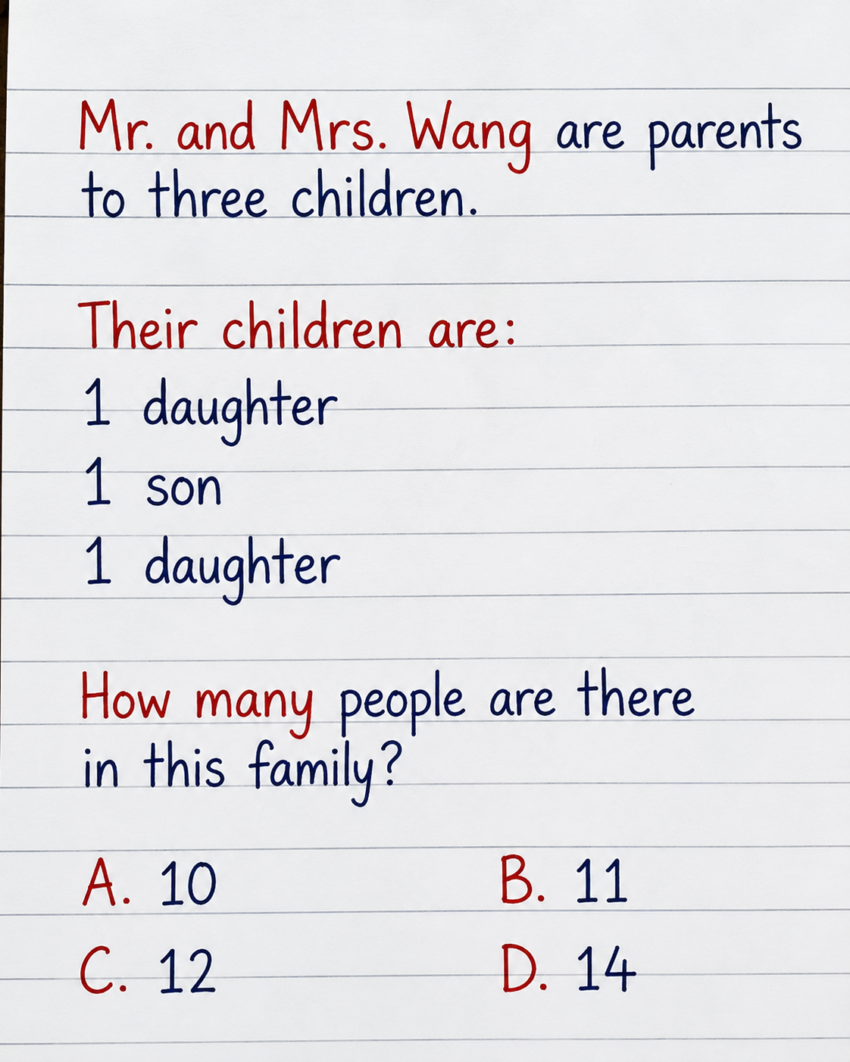
Can You Figure Out the Correct Answer to This Family Riddle?
This family brain teaser may seem like an easy math question, but there’s a clever little twist hidden in the wording.
Before selecting an answer, take your time and think carefully about how all the family members are connected.
Let’s break it down step by step.
Mr. Wang and Mrs. Wang are the parents of three sons.
First, we count the two parents. Then we include their three boys.
That gives us
2 parents + 3 sons = 5 people.
Now, the next clue tells us that each son has one wife.
Since there are three sons, we must include three wives in our calculation.
Our new total becomes:
5 + 3 = 8 people.
But we’re not finished yet!
The puzzle also mentions that every son has one son of his own.
Since all three brothers have one son each, we need to include three grandchildren.
Adding those three children gives us:
8 + 3 = 11 people.
You might think you’ve already solved the puzzle and that option B, 11, must be correct.
However, there’s still one final clue that needs our attention.
The question states that every son has one sister.
Here’s where the clever part comes in!
Does this mean that all three brothers
Not necessarily!
The puzzle doesn’t say that each brother has a different sister. It simply says that every son has one sister.
This means all three brothers can share the same sister.
For instance, Mr. and Mrs. Wang could have four children altogether: three boys and one girl.
Each boy would have exactly one sister, but that sister would be the same girl for all three brothers.
Therefore, we only need to count one sister instead of three.
Now let’s add her to our previous total:
11 + 1 = 12 people.
Let’s review the entire family to make sure nobody has been counted twice:
- Mr. Wang and Mrs. Wang: 2 people
- Their three sons: 3 people
- Three daughters-in-law: 3 people
- Three grandsons: 3 people
- One sister shared by all three brothers: 1 person
The final calculation is:
2 + 3 + 3 + 3 + 1 = 12
<escape>**</escape>Correct Answer: C. 12 People!
The real challenge here isn’t complicated mathematics. It’s understanding the relationships between family members.
Many people choose 11 because they forget to include the sister.
Others select 14 because they assume every brother must have a separate sister.
But neither assumption is necessary.
All three brothers can have the exact same sister, which satisfies the condition perfectly.
That’s the little trick that makes this puzzle interesting!
Remember, sometimes the hardest part of a simple math question is not the numbers themselves, but understanding exactly what the question is telling you.