Three months after my husband passed away, I received a phone call from my daughter’s school that made my heart stop.
It was an ordinary morning. I was at home, trying to get through another day without the man who had shared my life, raised our children with me, and made even the simplest moments feel meaningful.
Since his death, our home had felt different. His absence was present in little things: the empty chair at the dinner table, his belongings that I couldn’t bring myself to move, and the silence that sometimes settled over the house when the girls went to bed.
I had slowly learned how to manage the practical responsibilities of being a mother without him. But emotionally, I was still trying to understand how life could continue when someone so important was no longer there.
Then my phone rang.
It was the school principal.
At first, I thought something ordinary had happened. Perhaps Letty had forgotten something, or there was a problem with a classroom activity.
But the principal’s voice sounded unusually serious.
“Could you please come to the school as soon as possible? There are six men here asking to see your daughter.”
I immediately sat upright.
“Six men? Who are they? What do they want with my daughter?”
The principal explained that they had arrived together and had specifically asked for Letty. They had not caused any trouble, but the staff wanted me to come in before proceeding.
I barely remember ending the call.
My thoughts began racing. Who were these men? How did they know my daughter’s name? Why had they come to her school instead of contacting me?
I grabbed my keys and hurried outside.
During the drive, I imagined every possible explanation, and none of them made me feel better.
My husband had only been gone for three months. I was still learning how to protect our family without him beside me. The thought that something might have happened to Letty was almost unbearable.
I kept repeating one sentence to myself.
“Please let my daughter be okay.”
But when I finally arrived at the school, I discovered that the situation was nothing like the frightening picture I had created in my mind.
In fact, what I was about to see would bring back memories I had been trying so hard to hold together.
And it all began with a pair of scissors.
The Evening I Discovered What My Daughter Had Done
The previous evening had started like any other.
I was preparing things for the next day when I noticed that Letty had been unusually quiet. She had spent more time than usual in the bathroom, and I could hear small movements coming from inside.
At first, I didn’t think much about it.
Then she appeared in the doorway.
I stopped what I was doing.
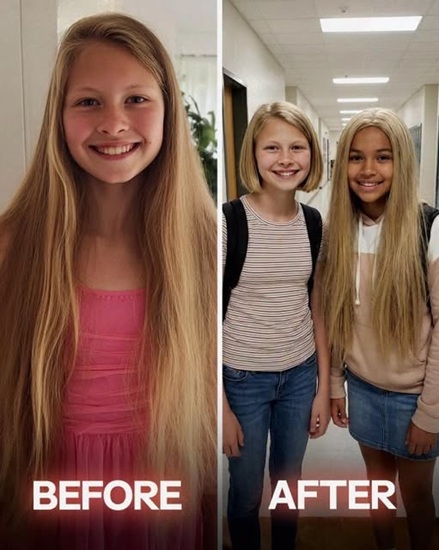
Her beautiful, long hair was gone.
Instead, it hung unevenly around her shoulders. Some sections were shorter than others, and it was immediately clear that she had cut it herself.
She was holding a pair of scissors in one hand and a bundle of hair in the other.
“Letty, what happened?” I asked.
She looked at me nervously.
For a moment, I didn’t know whether to feel surprised, upset, or simply confused. Her hair had taken years to grow, and I couldn’t understand why she would suddenly decide to cut it.
I wanted to ask a dozen questions.
But before I could say anything else, she began explaining.
“Mom, there’s a girl at school who has cancer.”
Her voice became quieter.
“Some of the boys have been laughing at her because she doesn’t have her hair anymore.”
I looked at the hair in her hands.
She continued explaining that the girl had been having a difficult time because of the changes caused by her illness. Letty had noticed how uncomfortable the girl seemed when other children commented on her appearance.
It had bothered her.
She told me that she had been thinking about the situation for a while. She had searched for information about donating hair and learned that suitable hair can sometimes be used to make wigs for people experiencing hair loss.
Then she looked at me and said something I will never forget.
“I thought maybe I could give her mine. I know it’s not enough, but perhaps it can help.”
Suddenly, the uneven haircut didn’t seem important anymore.
I looked at my daughter and tried to find the right words.
She hadn’t cut her hair because she wanted attention. She hadn’t done it because somebody had asked her to.
She had seen another child struggling and had decided that she wanted to do something.
It was a simple decision, but it revealed something important about the person she was becoming.
I thought about her father.
He had always believed that kindness was something people demonstrated through their actions, not something they simply talked about.
He was the kind of man who noticed when someone needed help. Sometimes he would assist without telling anyone afterward. He never seemed particularly interested in receiving recognition.
Watching Letty explain her decision, I recognized something familiar.

I could almost hear my husband saying that he was proud of her.
And although I felt emotional, I also realized that I needed to help her understand that donating hair required a little more than simply cutting it.
We would have to find out what was needed and make sure the hair could actually be used.
That evening, we talked about it together.
A Small Gesture That Meant More Than We Expected
The following morning, I helped Letty contact a local salon.
We explained what she wanted to do and asked whether her hair could be prepared appropriately for donation.
The people at the salon listened carefully.
They helped us understand that hair donation organizations can have different requirements regarding length, condition, and preparation. Not every haircut automatically qualifies, but there are ways to determine whether donated hair can be used.
Letty listened to everything.
She wasn’t concerned about how short her hair would become. Her attention remained on the girl she wanted to help.
After the salon visit, we had a much better understanding of the next steps.
For Letty, the important part wasn’t receiving praise or having people notice her new hairstyle.
She simply wanted the other girl to know that she wasn’t alone.
I remember watching her look at herself in the mirror afterward.
She touched the ends of her hair and smiled slightly.
“Do you think she’ll like it, Mom?”
“I think she’ll appreciate knowing that somebody thought about her,” I answered.
Letty nodded.
Then she asked whether we could make sure the girl received the gift without making a big announcement about it.
That question told me even more about her intentions.
She wasn’t thinking about how the gesture would make her look. She was thinking about how the other child might feel.
I hugged her.
For the first time in a long while, I felt something other than the sadness that had followed us since my husband’s death.
I felt proud.
I didn’t know that this small act would eventually connect us with people who had known her father in a completely different part of his life.
And I certainly didn’t expect what would happen a few hours later.
The Phone Call That Changed an Ordinary Morning
The next morning, I was going about my usual responsibilities when the school called.
Six men had arrived asking for Letty.
I had no idea who they were.
I didn’t immediately connect their visit to the previous day’s events. My mind was focused entirely on my daughter’s safety.
When I reached the school, I went straight to the principal’s office.
I opened the door quickly.
Letty was standing near the window.
Her expression was difficult to describe. She looked surprised, emotional, and slightly overwhelmed.
Beside her was the girl she had wanted to help.
The girl was wearing a wig.
Her mother was there too, and the two of them seemed deeply moved by what had happened.
But I was still trying to understand why six unfamiliar men were gathered in the room.
Then I noticed something resting on the principal’s desk.
A hard hat.
For a second, I couldn’t move.
I knew that hard hat.
It had belonged to my husband.
I recognized the shape, the familiar marks, and especially the small sticker on the side.
Years earlier, Letty had placed that sticker there herself. My husband had kept it on the helmet, even though it had started to look worn.
He used to say that it made the hard hat special.
I had not seen it since before his death.
Seeing it on that desk brought back a flood of memories.
I remembered him leaving for work in the morning, putting on his jacket, checking that he had everything he needed, and giving the girls a quick hug before walking out the door.
Back then, those moments seemed ordinary.
Now, I would have given anything to experience one of those mornings again.
I looked at the men.
One of them stepped forward.
“Are you Letty’s mother?”
I nodded.
He introduced himself and explained that the men had known my husband through his work.
They had heard about Letty’s gesture and wanted to meet her.
I was still confused.
Then one of them reached for an envelope.
And when I saw the handwriting on the front, my eyes filled with tears.
My name was written there.
It was my husband’s handwriting.
The Envelope My Husband Had Left Behind
For three months, I had been surrounded by things that reminded me of my husband.
His clothes were still in the closet. Some of his belongings remained exactly where he had left them. There were photographs throughout the house that I sometimes avoided looking at because they made the absence feel too real.
But an envelope with my name written in his handwriting was something entirely different.
I held it carefully.
I recognized the way he formed certain letters. I recognized the familiar shape of his writing.
For a moment, I couldn’t bring myself to open it.
The men gave me time.
They explained that my husband had started something important during his life, something that most people outside his circle of colleagues had never known about.
It was a small initiative called the “Keep Going Fund.”
According to the men, he had wanted to help families dealing with the financial and emotional difficulties that can accompany cancer.
They explained that the fund was intended to offer support to people facing difficult circumstances.
I listened quietly.
I knew my husband had a generous heart. I had seen him help friends, relatives, and people he barely knew.
But I had never heard about this particular project.
The men explained that he had worked on it quietly, without making a public announcement or expecting recognition.
They had learned about Letty’s decision to donate her hair, and something about it reminded them of him.
They recognized the same instinct to help someone who was going through a difficult experience.
That was why they had decided to come to the school.
They wanted Letty to know that her father’s kindness had not been forgotten.
They also wanted to share something he had left behind.
I finally opened the envelope.
Inside was a message written in his familiar handwriting.
I began reading, but after the first few lines, I had to stop.
My eyes were filling with tears.
I handed the paper to one of the men and asked him to continue.
What he read next made the entire room feel different.
The Words He Had Left for His Family
The man unfolded the letter and began reading slowly.
“If my girls ever forget what kind of man I tried to be, remind them by how you show up.
Letty will lead with her heart. Piper will carry too much on her own. Don’t let either of them stand alone.”
Nobody interrupted him.
I felt as though my husband had somehow found a way to speak directly to us through the people standing in that room.
He had mentioned our daughters.
He had understood their personalities in ways that only someone who loved them deeply could understand.
Letty had always been sensitive to the feelings of others. She noticed small things that many people overlooked.
If someone was sitting alone, she wanted to know why.
If a friend was upset, she tried to make things better.
And if she saw somebody being treated unfairly, she found it difficult to remain silent.
My husband had noticed that quality long before I understood how strongly it would shape her.
The letter also mentioned me.
He knew I often carried more responsibility than I needed to. I had always been someone who tried to solve problems quietly, sometimes without telling anyone how difficult things had become.
After his death, that habit had become even stronger.
I wanted the girls to feel secure.
I wanted our home to remain familiar.
I wanted to be strong enough for everyone.
Sometimes, I forgot that I was also allowed to need help.
His words reminded me of something I had not fully understood during those difficult months.
He had not wanted us to spend our lives trying to manage everything alone.
He had wanted us to remain connected to the people who cared about us.
The six men had not come to the school simply to tell us a story about the past.
They had come because they wanted to continue something he had started.
And by showing up, they had fulfilled the very message he had left behind.
I wiped my eyes and looked at them.
For the first time since the phone call, I no longer felt afraid.
I felt grateful.
Discovering Another Side of the Man I Loved
As the conversation continued, the men shared memories of my husband.
Some stories were familiar.
Others revealed parts of his life I had never known.
They spoke about his time at work, the way he treated his colleagues, and the small acts of generosity that had made an impression on them.
One man remembered how my husband had offered encouragement during a particularly difficult period.
Another spoke about his willingness to listen when someone needed to talk.
They described a person who didn’t always have the perfect answer but was willing to make time for others.
I listened carefully.
It was strange and comforting at the same time.
I had known my husband as the person who came home in the evening, asked about the girls, and sat with us at the dinner table.
I knew his habits, his sense of humor, and the little things that made our family life special.
But these men had known him in a different environment.
They had seen how he behaved when he was away from home.
They had witnessed the kind of colleague and friend he had been.
Their stories gave me another way to remember him.
For months, I had been afraid that the memories would gradually become harder to hold.
I worried that our daughters would eventually know their father mainly through photographs and stories.
But standing in that office, I realized that his life had touched people beyond our home.
There were people who remembered his words, his actions, and the things he had tried to accomplish.
His story had not ended in the same way his physical presence had.
His influence remained in the memories and choices of others.
And now, unexpectedly, Letty’s decision had brought some of those people back into our lives.
The Girl Beside My Daughter
While I was listening to the men, I noticed the girl sitting beside Letty.
She looked much more comfortable than she had during the difficult days Letty had described.
Her new wig had been arranged carefully, and her mother was sitting close to her.
I could see that the moment meant a great deal to both of them.
Letty stood nearby, looking slightly embarrassed by all the attention.
She had not expected her simple decision to become the center of such a gathering.
I walked over to her and placed my hand gently on her shoulder.
“Are you okay?” I asked.
She nodded.
Then she looked at the girl and smiled.
The girl’s mother thanked her.
She explained how much the gesture had meant to their family.
I didn’t want to assume that a wig or a donation could make everything easy. Cancer treatment can bring challenges that kindness alone cannot remove.
But I understood what this particular gesture represented.
It was a reminder that someone had noticed her daughter as a person, not simply as a child dealing with an illness.
It was an act of friendship.
And sometimes, knowing that someone cares can make a difficult day feel a little less lonely.
Letty looked at me.
“Mom, I’m glad she likes it.”
I smiled.
“So am I.”
Then I glanced back at the hard hat.
The sticker was still there.
And suddenly, I understood why the men had brought it.
It wasn’t simply an object that reminded them of my husband.
It was something that connected the girls’ childhood memories with the work he had done and the people he had cared about.
It represented a part of his life that we could now understand a little better.
What My Daughter Taught Me That Day
I thought about the previous evening.
I remembered how quickly I had reacted when I first saw the scissors.
I had been focused on the haircut.
I had noticed the uneven ends and worried about the decision she had made without asking me.
But I had almost missed the reason behind it.
My daughter had seen another child experiencing a painful situation.
She had not known how to solve everything.
She couldn’t change the illness, remove every difficult moment, or stop every unkind comment.
But she could offer something.
So she did.
That was the part I wanted to remember.
Children sometimes understand compassion in a way that adults make unnecessarily complicated.
They notice someone hurting and want to help.
They don’t always calculate whether their gesture will be noticed, whether it will be rewarded, or whether it will change the entire situation.
They simply respond.
Letty’s decision had reminded me that kindness doesn’t need to be dramatic to matter.
It can begin with noticing.
It can continue with listening.
And sometimes, it means giving something that is personally important because someone else might benefit from it.
I also realized that my daughter needed to know something else.
Helping others was beautiful, but she didn’t have to carry every problem herself.
She could offer kindness while still taking care of her own feelings.
She could be generous without believing that she had to solve everything.
That was a lesson I wanted both of my daughters to understand.
And perhaps it was something I needed to remember too.
An Unexpected Invitation
Before we left the school, I turned toward the six men.
I had been trying to find the right way to thank them.
Words seemed insufficient.
They had brought us something we could never have expected: a message from my husband, memories from his working life, and the reassurance that people who cared about him were still thinking about his family.
So I made an invitation.
“Would you like to come to our home for dinner sometime?”
They looked at one another.
One of them smiled.
“We would be happy to.”
I explained that I wanted the girls to hear more stories about their father.
I wanted them to know the people who had worked alongside him and understood another side of his character.
More importantly, I wanted them to see that asking for support was not something to be ashamed of.
My husband had written that neither of his girls should stand alone.
The men had shown us what those words could mean.
A dinner would give us an opportunity to continue the conversation.
It wouldn’t bring him back.
It wouldn’t remove the difficult days or answer every question we still had.
But it would create a chance for friendship, remembrance, and connection.
And that felt like a good beginning.
The Hard Hat on the Way Home
When everything was finished, we prepared to leave.
The men allowed Letty to hold her father’s hard hat.
She carefully picked it up and looked at the sticker she had placed there years earlier.
Her fingers moved over its familiar surface.
I watched her quietly.
She had been very young when she first decorated it. At the time, she probably hadn’t understood how much that small sticker would eventually mean to us.
Now she was carrying the same hard hat out of the school.
It seemed almost impossible that something so ordinary could hold so many memories.
During the drive home, Letty remained quiet for a while.
Then she finally spoke.
“Mom?”
“Yes, sweetheart?”
“Do you think Dad would have cried today?”
I glanced at her.
The question caught me off guard.
I thought about my husband standing in that office, listening to the men talk about Letty’s decision.
I imagined his expression when he saw the girl wearing the wig.
I imagined him trying to hide how emotional he felt.
Then I smiled.
“Absolutely,” I told her. “But he probably would have pretended he wasn’t crying.”
Letty laughed.
It was a small laugh, but I had missed hearing it.
For a moment, we were simply a mother and daughter sharing a memory.
The sadness was still there.
It hadn’t disappeared because of one beautiful afternoon.
But something else had appeared beside it.
Pride.
Gratitude.
And the comforting knowledge that love can continue to influence people even after someone is gone.
A Different Kind of Strength
That evening, after we returned home, I placed the hard hat somewhere safe.
I didn’t want it to become just another object that we kept without understanding its meaning.
It represented my husband’s working life, his friendships, and the quiet efforts he had made to help other people.
The envelope was placed beside it.
I read the message again.
This time, I managed to reach the end without putting it down.
His words stayed with me.
“Don’t let either of them stand alone.”
I thought about how often I had tried to protect the girls by hiding my own sadness.
I had believed that being strong meant keeping everything under control.
But perhaps strength could also mean allowing people to stand beside us.
Perhaps it meant accepting an invitation, listening to a memory, or admitting that some days were harder than others.
My daughters didn’t need a mother who never felt sad.
They needed someone who would continue loving them, listening to them, and learning how to move forward with them.
And I needed the same kind of support.
The six men had reminded me that we still had people around us who cared.
That was something I wanted to hold on to.
The Meaning Behind One Small Act of Kindness
Later, I thought again about everything that had happened.
It was remarkable how one decision had connected so many different people.
Letty had noticed a classmate struggling with the emotional effects of hair loss.
She had researched hair donation and decided to offer her own hair.
The salon had helped us understand how to prepare it.
The gesture had reached people who had known her father.
Those people had remembered his efforts to support families facing cancer.
They had brought his hard hat and a message he had left behind.
And in the middle of it all, our family had discovered another part of his life.
None of us could have predicted that sequence of events.
But it reminded me that kindness often travels farther than the person who first offers it can imagine.
Letty had wanted one girl to feel less alone.
She had not expected six men to arrive at her school.
She had not expected to receive a message from her father.
And she certainly hadn’t expected that her decision would help her mother discover a new reason to feel connected to the people who remembered him.
That day did not change what had happened three months earlier.
My husband was still gone.
There would still be birthdays, holidays, and ordinary evenings when his absence would be difficult.
There would still be questions the girls would want to ask him.
But I no longer felt that every reminder of him had to bring only sadness.
Some memories could also bring comfort.
Some stories could make us laugh.
And some people could help us remember the good things he had left behind.
The Promise I Made to My Daughters
Before going to sleep, I checked on Letty.
She was already in bed.
I sat beside her and gently moved a strand of her shorter hair away from her face.
“Are you happy with what happened today?” I asked.
She thought about it.
“Yes. I just wish Dad could have been there.”
I swallowed.
“So do I.”
She looked at me.
“Do you think he knows?”
I didn’t pretend to have an answer to a question that belongs to the deepest parts of grief and belief.
Instead, I told her what I knew.
“I know he would have been proud of the way you cared about someone else. I know he taught us many things about being kind, and I can see those lessons in you.”
She smiled softly.
Then she asked whether the men would really come to dinner.
I told her that they had accepted the invitation.
She seemed pleased.
I kissed her forehead and turned off the light.
As I walked toward the door, I looked back at her.
I realized that my husband had left us more than photographs, belongings, and memories.
He had left us relationships with people who had known him.
He had left examples of generosity that our daughters could learn from.
And through the words he had written, he had reminded me that our family did not have to face every difficult moment alone.
The next chapter of our lives would not look exactly like the one we had imagined.
But we could still make room for friendship, kindness, laughter, and new memories.
What I Will Remember Most
I had arrived at the school expecting the worst.
I thought six unfamiliar men had come for my daughter, and every minute of the drive had felt like an eternity.
Instead, I found a girl who had received a reminder that she mattered, a daughter whose compassion had made me incredibly proud, and a group of people who had kept their connection to my husband alive.
I had walked into that office frightened.
I walked out carrying his hard hat.
But the most important thing I carried home wasn’t the object itself.
It was the message inside the envelope.
It was the knowledge that my husband had cared about people beyond our family, and that those people had not forgotten the promises he had made.
It was also the realization that Letty was growing into someone who understood the importance of noticing when another person needed kindness.
That evening, I looked at the hard hat one more time.
The old sticker was still attached.
I smiled through my tears.
My daughter had once placed it there simply because she wanted to decorate something that belonged to her father.
Years later, that same sticker had helped us recognize an object that connected us to people who had brought a piece of his story back into our lives.
I had rushed to the school because I was afraid of losing something else.
Instead, I discovered that the people who had loved and respected my husband were still willing to show up for us.
And perhaps that was the most important lesson of all.
Love doesn’t erase grief.
It doesn’t make difficult circumstances disappear.
But it can leave behind examples, friendships, and memories that help people continue when life becomes harder than they ever expected.
Letty had wanted to help another girl feel less alone.
Without realizing it, she had reminded our family that we weren’t alone either.
And when I think about that day now, I don’t remember the fear of the phone call first.
I remember my daughter’s smile.
I remember the hard hat.
I remember the envelope with my husband’s handwriting.
And most of all, I remember the words he left for us:
“Don’t let either of them stand alone.”