
Part 1
The C-130’s rear ramp dropped with a hydraulic groan, and the heat rolled inside like a living thing.
Forward Operating Base Sentinel wasn’t just hot. It was weight. It pressed against lungs and eyelids and patience. It smelled like jet fuel, sun-baked limestone, and the stale exhaustion of a war that never truly ended, only rotated bodies through it.
Specialist Halley Thorne stood at the edge of the ramp with her duffel strap biting into her shoulder. The drop to the tarmac was nothing—three feet, maybe—but she felt every pair of eyes that would measure her before they learned anything else.
She hopped down.
Her boots landed with a solid thud. The sound was more confident than she felt. The duffel bag was nearly sixty pounds. The rifle case on her back—an M200 long-range system sealed in a drag bag—was almost as tall as she was. With armor, water, and kit, she carried a load that made her center of gravity feel like a bad joke.
At four feet nine and barely over a hundred pounds, Halley didn’t get to blend in. She didn’t get to be “just another soldier.” She got to be an argument.
“Hey,” a voice called from the shade of a hangar, low and amused. “Did someone order a mascot?”
Laughter followed—short, sharp bursts. The kind that didn’t come from real joy, only from a comfortable cruelty that required an audience.
Halley didn’t look over. She didn’t flinch. She kept walking across the shimmering tarmac, sunglasses reflecting a sky so bright it felt hostile.
Under the hangar’s shade sat seven men built like a recruiting poster’s revenge fantasy. Thick shoulders. Tan shirts. Beards that looked like they’d been carved into place. Tattoos and scars and that relaxed confidence you got when people kept telling you you were the best.
SEAL Team Viper.
Halley had read the file packet on the flight. She knew their names, their specialties, their call signs. She knew their reputation, which was just another kind of story people repeated until it became truth.
She stopped in front of the biggest one, a man who looked like he’d been designed to kick doors off hinges. Six-four, maybe. Slate-colored eyes. A faded scar cut from eyebrow to cheekbone.
Captain Garrett Blackwood.
She kept her voice neutral. “Captain Blackwood?”
He had to tilt his head to look at her. A smirk formed like a reflex. “You lost, sweetheart? Humanitarian tent’s on the other side. I think they’re handing out stuffed animals today.”
Halley reached into her chest rig, pulled out a manila folder sealed with red tape, and extended it without comment.
The smirk hesitated. Blackwood took the folder, flipped it open, and read with slow disdain, like he expected it to be a prank.
The laughter behind him died. The men stopped cleaning weapons, stopped sipping water, stopped pretending they hadn’t been watching.
Blackwood’s eyes ran down the page, then back up to Halley’s face. “You’re the sniper.”
“Yes, sir.”
He made a soft sound like the word didn’t fit. “JSOC said they were sending support. Not a…” His gaze flicked to her boots, then the rifle case, then back to her again. He found the word anyway. “A doll.”
The word hung in the air.
A younger SEAL—pretty in the way men got away with being pretty—snorted into his bottle. Another muttered, “No way.”
Halley’s expression didn’t change. She’d been called worse by men with less reason to survive.
“My qualifications are in the file,” she said. “Scout sniper graduate. Top bracket scores. Operational experience.”
Blackwood snapped the folder shut and handed it back, letting it dip so she had to catch it mid-air. A small power move, lazy and practiced.
“I don’t care about paper scores,” he said. “We hump heavy kit, we move fast, and we don’t babysit. If you lag behind, we don’t carry you. We leave you.”
“I can carry my own weight, sir.”
Blackwood stepped closer, his shadow swallowing her. The temperature dropped in the shade of his frame.
“Your weight isn’t the problem,” he said quietly. “It’s the weight of the mission. People die when we slow down. People die when we get pinned because someone can’t keep pace. I don’t know what political genius put you on my manifest, but I’m not watching my men bleed out because someone wanted a morale poster.”
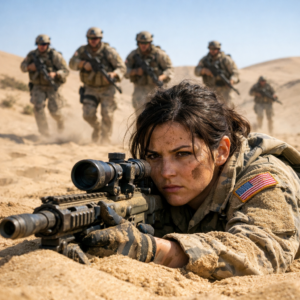
Halley looked up at him through mirrored lenses that reflected his face back at him, distorted and oversized.
“I don’t slow down,” she said.
Blackwood stared for a beat, then straightened. “We’ll see. Overflow tent. Briefing at nineteen hundred. Try not to get lost.”
He turned his back. Conversation over. Dismissal complete.
Halley stood there a moment, heat radiating through her boots, the familiar burn of humiliation trying to rise in her chest. She pushed it down where she kept everything that could make her hesitate.
She adjusted her straps, turned, and walked away.
Behind her, Viper’s laughter resumed, softer this time, like they weren’t fully sure they should be laughing anymore. But they did anyway. Habit was strong.
The tactical operations center was a refrigerated bubble of canvas and fluorescent light, the hum of a diesel generator vibrating through the floor. A three-dimensional terrain map glowed on the board: jagged limestone canyons and knife-edge ridges known locally as the Devil’s Throat.
Halley stood near the entrance in the shadows, watching the contours like they were a language she could read better than English.
Blackwood dominated the room. Marker in hand. Lines drawn. A simple plan delivered with the confidence of a man who’d survived enough times to confuse luck with invincibility.
“We insert here,” he said, tapping a plateau. “Move three clicks south under dark. Enter canyon floor at zero-two-hundred. Target compound’s against the eastern wall. Hit fast. Grab HVT. Extract before sunrise.”
The SEALs nodded as one.
Halley watched the canyon contours tighten into a bowl. She watched the ridgelines form an amphitheater of death around the route.
She raised her hand.
Blackwood’s eyes slid to her like a door closing. “Questions, Thorne?”
“The canyon floor is a killbox,” Halley said. “Walls give overlapping fields of fire. If you get pinned down there, you have no cover and no visibility.”
Blackwood waved the marker. “We operate under darkness. Thermal, NVGs. Reaper drone on station if it gets loud.”
“Meteorological report shows a high probability of a haboob within twelve hours,” Halley said. “If that storm hits, air support grounds. Visibility goes to zero. Your tech advantage disappears. You’ll be blind in a canyon while the enemy owns the high ground.”
A heavy hand slid over the laser pointer on the table before Halley could reach it.
Krueger, Viper’s heavy weapons specialist. A mountain of muscle with a beard like a warning sign. He didn’t even look at her. He just blocked her access like she was furniture.
“You worry too much, doll,” Krueger grunted.
Halley withdrew her hand slowly. She felt the truth settle hard: this wasn’t about tactics. It was about hierarchy. About who got to speak and who got to be ignored.
Halley pointed with her finger. “There’s an overwatch position on Hill 350. If I insert early and climb, I can cover your advance even in low visibility.”
Blackwood sighed like she’d asked him to recite a menu. He walked over until she had to crane her neck to see his eyes.
“This is a direct action raid,” he said, low and sharp. “Speed and violence of action. I don’t need a support sniper wandering off alone on some hiking trip.”
“I’m offering to clear your path,” Halley said.
Blackwood’s finger hovered near her chest rig, not touching but close enough to feel like pressure. “Your job is to trail the formation, watch our six, and stay out of the way. If we need a long gun, we’ll ask. Until then, you are luggage.”
The tent went quiet.
Halley felt a cold calm settle over her face like armor.
“Copy that, sir,” she said. “Trail and observe.”
Blackwood nodded, satisfied. “Wheels up at zero-four-hundred. Get squared away.”
Halley walked out into the suffocating night. The wind had picked up, hot and dry, carrying the first gritty taste of sand.
Somewhere out west, the sky had a bruise on it that didn’t belong.
And Halley knew—knew in the same instinctive way she knew wind and distance—that they were walking into a trap.
Part 2
Halley cleaned her rifle the way some people prayed.
In the equipment bay, under a single harsh work light, the M200 lay disassembled on a rubber mat. Barrel. Bolt. Optics. Bipod. Each piece inspected with quiet precision. She didn’t do it because the weapon was dirty; she did it because ritual was control, and control was the only thing that kept fear from taking up too much space in her head.
Outside the bay, the base settled into its pre-mission hush. Generators hummed. A dog barked once and stopped. Somewhere, a soldier laughed too loudly to convince himself he wasn’t nervous.
Halley ran a cleaning cable through the barrel, checked the crown, torqued the mounting points by feel. She loaded magazines with slow care, each round seated as if it mattered individually—which it did. Long-range wasn’t about spraying hope. It was about spending certainty.
Her weather meter flashed numbers she didn’t like.
Pressure falling. Wind rising. The storm wasn’t a rumor. It was timing.
Halley flipped open a small waterproof notebook and sketched the Devil’s Throat from memory: the canyon floor, the ridgelines, the choke points. She marked likely fighting positions and dead zones. She wrote a single line in the margin:
High ground decides.
A shadow appeared in the doorway.
Brennan, Viper’s medic. Lean, restless, hands always busy. He stood with a roll of tape in his fingers like it was a comfort object.
“Can’t sleep either?” Brennan asked.
“Sleep is for people who trust the plan,” Halley said without looking up.
Brennan stepped inside, careful, as if he wasn’t sure he was allowed in her orbit. He watched her hands for a moment, the practiced economy of motion.
“You really think the captain’s wrong?” he asked quietly.
Halley snapped the bolt back into place with a metallic click. “I think the captain is operating on confirmation bias,” she said. “He’s done a hundred raids. The hundred-and-first feels safe because the last hundred didn’t kill him.”
Brennan exhaled. “Terrain doesn’t care how many raids you’ve done.”
“No,” Halley agreed. “It doesn’t.”
Brennan hesitated, then sat on a crate at a respectful distance. “You ever… get tired of it?” he asked. “The jokes. The doll thing.”
Halley didn’t answer right away. She checked the scope seal, wiped dust off the glass, then set the rifle down gently.
“The jokes are predictable,” she said. “The bullets aren’t.”
Brennan’s mouth tightened. “For what it’s worth, I think you’re probably right about the canyon. But you’ve met Blackwood. He doesn’t like being second-guessed.”
Halley’s eyes stayed on the rifle. “He doesn’t like being second-guessed by someone he doesn’t respect,” she corrected.
Brennan didn’t argue.
Halley added, quieter, “If I’m wrong, everyone walks out and I wasted a climb. If he’s wrong, everyone dies in a canyon, and I get to live with knowing I didn’t try hard enough.”
Brennan stared at her for a moment, then nodded like he understood something he hadn’t understood before. “Stay alive out there,” he said.
“Same,” Halley replied.
Brennan left.
Halley sat alone again, listening to the wind test the edges of the canvas walls. She finished the final function check. The trigger broke clean. The bolt ran smooth. The weapon was ready.
She wasn’t sure anyone else was.
At 0400, the MH-60’s rotors started turning, the sound a physical thump that vibrated through teeth. Viper Team assembled on the tarmac in pre-dawn darkness, breath barely visible in the early cool before the heat returned.
Halley stood slightly apart, kit strapped tight, rifle in its drag bag across her back like a second spine.
Blackwood walked down the line, inspecting his men like tools. When he reached Halley, he paused.
“Last chance to stay behind,” he said. “No shame in admitting this is beyond your physical capacity.”
“I’m good to go, sir,” Halley replied.
Blackwood studied her a beat longer than necessary. “Stay with Krueger. He sets pace. If you fall more than fifty meters behind, we leave you with a radio and a pickup grid. Clear?”
“Crystal, sir.”
The helicopter lifted and the base lights shrank into a cluster of dull stars behind them. Halley looked out the open door at the desert. In the far west, she saw it: a darkness that wasn’t night. A wall.
The storm.
They landed on hardpan thirty minutes later. The Blackhawk lifted off immediately, rotor wash kicking up dust that stung eyes and filled mouths. Then it was gone, leaving only wind and the vast, indifferent silence of the desert.
Blackwood signaled movement. Ranger file. Ten-meter spacing.
Krueger set the pace.
It wasn’t patrol speed. It was punishment.
Krueger moved with long, efficient strides that ate terrain. The others matched easily. For Halley, every step was work. Rocks that came to their shins hit her knees. Angles that felt mild to them forced her into short climbs.
Her straps cut into her shoulders. Sweat stung her eyes. Her lungs burned as if she were inhaling sand.
Blackwood’s voice crackled in her earpiece. “Keep your spacing, Thorne. You’re drifting.”
Halley didn’t answer. She surged forward, refusing to let the gap widen.
They wanted her to quit. They wanted her to ask for help so they could call it proof.
She decided she would pass out before she gave them that satisfaction.
An hour in, the terrain steepened into broken limestone and loose shale. Krueger paused at the top of a scree slope, ostensibly checking bearings. Halley saw the real reason: he was watching her struggle, watching her boots slide and her rifle snag.
Krueger held out a hand toward her drag bag. “Want me to take the cannon? Heavy load for a little lady. You look like you’re about to snap.”
Halley slapped his hand away hard enough the sound cracked sharp in the thin air.
“Touch my weapon,” she said, voice low and venomous, “and you’ll lose a finger.”
Krueger blinked, surprised. The smirk died.
Halley climbed past him without another word.
By sunrise, they crested a ridge overlooking the Devil’s Throat. The canyon below was a dark scar. The air felt charged, hair lifting slightly under helmets. Halley looked west.
The wall of beige had grown taller. Closer. It rolled toward them like a tide.
“How long until it hits?” Blackwood asked, eyes narrowing.
Halley checked her meter. “Four hours,” she said. “Maybe less.”
Blackwood studied the canyon, then the storm, then his men. Calculation flickered across his face.
“We move fast,” he decided. “Storm noise covers insertion. We hit the compound, hunker down before the worst hits. Could work in our favor.”
Halley knelt near a limestone outcrop where something felt wrong. She shone a light into a depression.
Tire tracks. Deep. Recent. Military tread.
“Sir,” she called. “You need to see this.”
Blackwood walked over, irritation already loaded in his posture. Krueger and Brennan followed.
“Tire tracks,” Halley said. “Heavy vehicles. Multiple sets. Sharp edges. Less than two hours old.”
Blackwood frowned. “Smuggling corridor. Locals run trucks through here all the time.”
“These aren’t old Soviet junkers,” Halley said. “And they’re heading toward the ridge line overlooking the valley.”
Blackwood’s expression hardened. “Negative. We don’t have time to play it safe. Storm is our cover. We go low. We go now.”
He turned and signaled the team forward. Viper descended toward the canyon floor like men walking into a mouth.
Halley stood still, wind starting to sting her cheeks.
If she followed, she’d be another gun in a kill zone—blind when the storm hit.
If she climbed, she’d be disobeying a direct order.
Court-martial. End of career.
Halley watched Blackwood’s back disappear down the slope.
He wasn’t listening.
She made her choice.
Halley turned toward the eastern cliffs, tightened her straps, and began to climb as the sky fell down.
Part 3
The first minutes of the climb were pure friction and faith.
Halley went vertical on limestone that looked like it had been sharpened by time. She jammed her fingers into cracks barely wide enough for knuckles, tested holds by feel, and committed her weight only when the rock answered with stability.
Behind her, the canyon swallowed Viper Team.
Above her, the storm accelerated.
Blackwood’s voice hissed in her earpiece, furious and distorted by distance. “Thorne, return to formation immediately. That is a direct order. Do you copy?”
Halley turned her headset volume down until his voice became a ghost, then nothing.
She didn’t do it out of spite. She did it because she needed silence. She needed the rock’s language—grit, angle, give—to be the loudest thing in her world.
The wind hit like an unseen body check, trying to peel her off the cliff. Dust found its way under her collar, into her mouth, past the seal of her glasses. It tasted like crushed stone.
Her rifle dragged at her back, heavy and wrong for climbing. Every time she shifted, the weight tried to pull her center of gravity away from the wall.
Pain arrived early. Her fingertips burned. Her forearms screamed. Her shoulders throbbed.
Halley didn’t negotiate with pain. She filed it away like data.
Reach. Test. Commit. Breathe.
She moved with efficiency born from years of being underestimated. Her smaller hands fit into holds a bigger operator couldn’t use. Her smaller boots found ledges that didn’t exist for men with larger feet.
But her reach was shorter. Moves that would be a simple stretch for them required dynamic lunges for her—controlled moments of falling where her whole body left the rock and then reconnected on faith.
Halfway up, the world went brown.
The haboob arrived like an animal slamming into the mountain.
Light disappeared. Visibility collapsed. The temperature dropped hard enough to sting through sweat-soaked fabric. Wind screamed across the cliff face in sustained force that made her cling like a barnacle.
Halley pressed herself flat against the rock and waited out the worst gusts, not for them to stop—because they wouldn’t—but for a rhythm.
The storm had cadence if you listened: heavy push, lighter breath, heavy push again.
She climbed inside those breaths.
Time became meaningless. There was only the next hold.
Her gloves tore at the fingertips. Blood made her grip slick. She adjusted, using more palm, more wrist, anything to keep traction.
At last, her right hand found the edge of something flat.
A ledge. Not a lip. A surface wide enough to stand.
Halley hauled herself up and rolled onto the summit plateau, gasping air that was more dust than oxygen.
For ten seconds she lay there, chest heaving, body shaking, letting herself exist without fighting gravity.
Then she crawled to the northern edge and got to work.
Hill 350 wasn’t a peak so much as a broken table of limestone ringed by boulders. It offered shelter in fragments. Halley dragged her rifle free, deployed the bipod, built a rest with her pack weighted by loose stone. She sealed her optics and clipped on thermal.
The world transformed.
The brown chaos vanished in the scope, replaced by clean contrast. Heat against cool rock.
Halley swept the canyon floor.
Seven heat signatures glowed bright near a cluster of boulders, packed too tight, pinned and blind.
Viper Team.
Alive.
Her chest loosened a fraction.
She panned outward.
On the opposite ridge, nine heat signatures moved with disciplined spacing. Not civilians. Not wandering locals. Fighters with purpose. Several carried long tubes. Another signature read heavy weapon.
They weren’t reacting to the storm.
They were using it.
Halley watched them set a mortar base plate. Watched a man kneel and lift a round. Watched the tube angle toward Viper’s position.
She keyed her radio. “Viper 1, this is Overwatch. Break. You have nine contacts on your east ridge. Heavy weapons. Mortar setup. Ambush imminent.”
Static answered. Thick, dead noise. The storm chewed up signals and spat them out useless.
Halley tried again. “Blackwood, move now. Mortar in seconds.”
Nothing.
Chain of command didn’t matter if the chain was broken.
Halley looked at her rifle, then at the man holding the mortar round.
The range read 3,050 meters.
A distance that made most people’s math turn into prayer.
She didn’t have time for fear. She didn’t have time for doubt. If she hesitated, the mortar would drop, and Viper Team would become a crater.
Halley pulled her dope card from her sleeve, a small laminated sheet smeared with dust. She fed wind and pressure into her ballistic computer, watched it spit out a solution that was half science, half gamble.
She dialed, not with numbers anyone else would understand, but with a familiarity that lived in her fingertips.
She waited for a fractional lull in the gusts—less chaos, not none.
“Be the radio,” she whispered to herself. “Be the warning.”
Then she squeezed.
The rifle hit her shoulder like a hard punch, recoil brutal and honest. The muzzle brake kicked dust sideways, briefly obscuring her view.
She held steady through it, returned her eye to the thermal.
Four heartbeats later, the mortar loader’s heat signature snapped backward and collapsed. The round rolled away harmlessly down the ridge.
Halley didn’t celebrate. She cycled the bolt and found the next threat: a fighter fumbling with a radio, trying to call reinforcements.
She squeezed again.
Heat flared, then dimmed.
Below, Viper Team reacted in confusion, unable to see the shooters, only able to feel the sudden shift. Enemy fire began to stutter as the ambushers tried to locate the source of their dead.
Halley spoke into a radio that barely worked. “Viper 1, if you can hear me, move east to the ridge at your three o’clock. I will clear your path.”
Static.
Then, faintly, like a voice pushing through a wall:
“Overwatch… this is Viper 1… copy… moving…”
Halley exhaled once. The mission had changed.
Now she had to buy them a corridor through a storm.
She found the machine gunner laying down suppressive fire and took him out of the equation. She broke their leader’s heat signature mid-gesture. She hit a man sprinting for cover and watched him tumble into stillness.
Each shot was a decision. Priority. Threat. Time.
Below, Viper Team began to move, low and fast, trusting a voice they’d tried to silence hours earlier.
Halley kept firing until the ridge belonged to silence.
When the last immediate threat went down, she scanned wider and saw the final danger: a vehicle warming up behind cover, heavy weapon mounted.
If it rolled into the open, it would pin the SEALs and undo everything.
Halley loaded her last specialized round—her one hard answer to steel and engine block—and tracked the vehicle’s path, not where it was, but where it would be.
She fired.
In thermal, the engine bloomed into a bright, violent flare. The truck flipped and died, ammunition cooking off in angry bursts.
Halley keyed her mic. “Viper 1. All threats neutralized. Nine confirmed. Path to extraction is clear.”
Silence.
Then Blackwood’s voice, rough with pain and something that sounded like disbelief.
“Outstanding work, Overwatch. Moving to LZ.”
Halley let herself take one deep breath.
Then she heard something that didn’t belong.
A boot scrape on stone behind her.
Ragged breathing, close.
Halley spun, rifle too heavy and too long for close quarters. Her hand dropped to her pistol—
And three enemy fighters hauled themselves over the ledge, eyes wild, weapons slung, fury in their posture.
They’d traced her position.
And she was alone on a ridge inside a storm.
Part 4
For half a second, the lead fighter froze.
It wasn’t fear that held him. It was confusion.
He’d expected a team. A nest. Something that matched the legend that had just erased his friends from a ridge three kilometers away.
Instead, he saw a small woman in an oversized ghillie suit, blood on her gloves, rifle bigger than her body, eyes calm behind dust-streaked lenses.
That hesitation was all Halley needed.
She didn’t reach for her pistol.
She reached for the clacker already in her hand.
Because Halley Thorne didn’t climb a mountain without planning for the last move.
The claymore mine sat angled near the ledge—directional, focused, a brutal line drawn across space. Halley squeezed the clacker.
The explosion didn’t roar so much as crack the air into pieces. A flat, violent burst that threw metal outward in a wide fan. The lead fighter disappeared behind a spray of dust and sudden heat.
The blast wave slammed into the ledge itself. Limestone, already fractured by time and weather, shuddered.
Then it gave way.
A chunk of the cliff edge collapsed, taking the other two fighters with it. They dropped into the brown void below with no time for a scream.
Halley was thrown backward by the force, head cracking against stone. Her vision went white, then black, then returned as a ringing gray. Rock fragments rained down like hail. Something sliced her cheek. Something heavy struck her thigh and turned her left leg into dead fire.
She lay on her back, gasping air that tasted like cordite and blood.
When she tried to move, her leg refused.
Halley rolled onto her side and crawled, dragging herself toward the ridge edge to check what she’d done.
The path she’d climbed was gone.
The blast and rockslide had erased it, leaving only a vertical spill of loose scree and broken shale.
There was no way down. Not by climbing.
And she could hear it now, faint through the storm: helicopter rotors. Extraction.
Halley looked down through thermal. Far below, Viper Team formed a defensive perimeter near the LZ. They weren’t boarding yet.
They were looking up.
Waiting.
Stubborn, arrogant bastards.
Halley coughed, tasted blood, and muttered, “Unbelievable.”
If she stayed on the ridge, she would bleed, freeze, and become a footnote.
If she tried to climb down, she would fall.
So she chose the third option—the one nobody would put in a manual.
Halley tightened every strap of her kit with shaking fingers, securing the rifle to her back with paracord. She found a flat limestone slab near the edge, dragged it toward the scree slope like she was preparing a sled.
Wind tore at her ghillie suit. Dust tried to blind her.
She keyed her radio, voice thin. “Coming out.”
No answer came. Not because they weren’t listening—because there was too much noise to hear anything clearly.
Halley didn’t wait.
She pulled herself over the edge and jumped.
The world became motion.
She hit loose shale and started sliding immediately, accelerating fast. She shoved the limestone slab under her and rode it, using her boots as brakes, her body as a rudder, steering between boulders as rocks tumbled beside her like angry dice.
It wasn’t controlled so much as negotiated. Every second was a choice: slow and risk stopping in a dead slide, or speed and risk smashing into something big enough to end her.
Her injured leg screamed. Her shoulder bruises from recoil flared. She tasted dust and copper.
Five hundred feet of falling felt like forever.
Then the slope shifted, the angle softened, and Halley tumbled hard, rolling, stone battering ribs and elbows. She wrapped her arms over her head and waited for the world to stop.
When it did, she lay in a cloud of dust.
Fifty meters from the hovering Blackhawk.
She couldn’t stand. Her leg was a locked, burning weight. Her fingers were raw. Her body felt like it had been fed through machinery.
“Movement on the slope!” someone shouted.
Footsteps pounded toward her.
Through the dust, Krueger’s massive silhouette appeared first. He ran like a charging wall, then dropped to a knee beside her.
Halley tried to push up. Failed.
Krueger scooped her up as if she weighed nothing, cradling her with surprising care.
“I got you,” he yelled over rotor wash. “I got you.”
He didn’t say doll this time. Not as a joke. Not as a knife.
Brennan was right behind him, already opening his kit, eyes wide with the frantic relief of a medic who didn’t want another body.
Blackwood appeared too, arm limp in a sling made from torn fabric, face pale but eyes locked on Halley like she was the only thing in the storm worth seeing.
They sprinted for the helicopter.
A medic reached for Halley’s rifle as they climbed aboard. Halley’s hand tightened instinctively, fingers clamping like a trap.
“My weapon,” she rasped.
The medic froze.
Blackwood lifted his good hand in a quick, sharp gesture: don’t touch it.
Krueger held the rifle carefully instead, treating it like it might bite him if he disrespected it.
The cabin swallowed them in vibration and noise. The helicopter pitched forward and clawed into the air, leaving the Devil’s Throat shrinking behind them like a scar.
Inside, Brennan crawled toward Halley, trying to check her injuries. Blackwood shifted, refusing treatment when Brennan reached for him.
“Her first,” Blackwood ordered.
Brennan hesitated—rank instinct fighting medical instinct—then nodded and obeyed.
He cut fabric away from Halley’s leg and swore under his breath at the bruising and swelling. Halley hissed once when antiseptic hit torn skin, then locked her jaw and refused to make another sound.
Across the cabin, the SEALs watched her hands.
The gloves were shredded at the fingertips. Blood soaked the fabric. She’d torn herself apart to climb that mountain.
The realization moved through the team in silence.
They were alive because a woman they’d dismissed had turned herself into an overwatch position.
Blackwood leaned forward, voice rough. “Thorne… you saved us.”
Halley’s eyelids fluttered. “You’re welcome,” she muttered, the closest she came to sarcasm.
Krueger stared at her, then looked down at his own hands, still stained with her blood.
“That wasn’t shooting,” Krueger said finally, loud enough to be heard over the engines. “That was surgery.”
Halley forced her eyes open. She studied his face for a long moment, deciding if she believed him.
Then she said, flat, “Just doing my job.”
Blackwood shook his head, pain and humility mixing into something sharp. “You did my job too. You did the part I failed—listening to reality.”
Halley’s gaze stayed steady. “Do better next time,” she said. “Because next time I might not be there to fix it.”
The helicopter shuddered through turbulence.
And in the vibrating metal womb of the cabin, something fundamental changed.
Not because of gratitude.
Because of truth.
Part 5
The base medical tents smelled like antiseptic and sand.
Halley lay on a cot with her leg wrapped and elevated, IV fluids dripping into her arm. A medic offered morphine. Halley refused it, voice hoarse.
“Dulls me,” she said. “I need my head.”
The medic rolled his eyes but didn’t argue. People tended to stop arguing after you saved a SEAL team from a mortar.
Halley stared at the canvas ceiling, replaying the shots and the timing, searching for mistakes like her brain couldn’t let success exist without audit. Her body hurt in layers—bruise under bruise, scrape under scrape—but pain was familiar. It was the other thing—the sudden attention, the sudden respect—that felt like a threat.
Bootsteps approached.
Blackwood appeared at the foot of the cot, left arm in a proper sling now, skin pale under grime that hadn’t washed off entirely.
“Specialist Thorne,” he said formally, then hesitated as if he’d forgotten how to speak to someone he couldn’t belittle.
“How are you feeling?”
“Like I fell down a mountain,” Halley replied.
Blackwood’s mouth twitched. “You did.”
He pulled up a folding chair and sat, a small act that mattered more than any apology because it put them at the same level.
“I just came from Colonel Sterling,” Blackwood said. “I amended the afteraction report.”
Halley’s expression didn’t change. “Not necessary.”
“It was necessary,” Blackwood said firmly. “It has to be accurate. Not for publicity. For doctrine. For the next time someone with better eyes tries to warn a leader with too much ego.”
Halley watched him carefully. “By regulation,” she said, “I disobeyed a direct order.”
“Yes,” Blackwood said. “By regulation.”
He leaned forward, eyes hard. “By battlefield necessity, you made the correct call. Radios were compromised. Weather killed comms. You acted on your best assessment. That’s what we claim we train for. I’m not letting anyone hang you for saving lives.”
Halley breathed out slowly. “You’re bending it.”
“I’m interpreting it,” Blackwood corrected. “And I’m owning the part that matters. I ignored your analysis because I was biased. I nearly got my men killed. That will be in the record too.”
The honesty sat heavy.
Halley didn’t soften. “I don’t need an apology,” she said. “I need you to listen next time. Not just to me. To anyone who’s right.”
Blackwood nodded once. “Understood.”
He stood, then paused. “Colonel Sterling wants to shake your hand when medical clears you,” he added.
Halley snorted softly. “Tell him I’ll settle for clean coffee.”
Blackwood almost smiled, then left, boots echoing down the walkway.
Six hours later, Viper Team filed into the operations center for debrief. Blackwood, still pale, stood in front of Colonel Sterling’s desk and spoke with the same blunt honesty he’d shown Halley.
Sterling’s eyebrows climbed higher with every sentence.
“Nine kills,” Sterling repeated, staring at the report. “From over three kilometers. In a sandstorm.”
“Yes, sir,” Blackwood said. “Nine for nine.”
Sterling’s gaze sharpened. “That borders on impossible.”
“Then we provide evidence,” Blackwood replied. “Brass recovery. Thermal logs. Weapon inspection. Witness statements.”
Sterling studied him for a long moment, then signed the amended report. “Fine,” he said. “I’m forwarding this. Recognition will follow.”
Blackwood’s jaw tightened. “It belongs to her.”
Sterling nodded slowly. “It does.”
That evening, Halley limped into the dining facility.
She didn’t want attention. She wanted calories and quiet. She chose a corner table near the exit, back to the wall, old habits refusing to die. She ate three bites of chicken that tasted like cardboard and dust.
Then the main doors opened and Viper Team walked in.
Normally they took the center table like they owned it.
Halley watched them move—Krueger in front, Brennan beside him, the others in tight orbit.
They didn’t stop at the center.
Krueger’s eyes swept the room and locked onto Halley’s corner.
He changed direction.
The whole team followed.
Chairs scraped loudly as they dragged seats from nearby tables. The dining facility’s volume dipped as people watched. Three hundred soldiers suddenly pretending not to stare.
Krueger sat across from Halley without asking, his large frame filling the small space. Brennan took the seat to her left. Hicks and the others filled in around them.
Blackwood sat last, directly across from Halley, and began eating as if nothing about this was unusual.
But it was.
This was a public declaration. A perimeter built from presence.
She is one of us.
Krueger cracked open a milk carton, took a sip, then slid the salt shaker toward Halley.
“Pass the salt, doll,” he said.
The word hung there, balanced on a knife edge.
Halley looked at him, reading tone, posture, eyes.
Krueger wasn’t smirking. He wasn’t performing.
He looked… respectful. Awkwardly so, like a man learning new language with an old mouth.
Halley picked up the salt shaker and slid it across the table. “Here.”
Krueger’s beard shifted in something close to a smile. “That was some shooting,” he said. “Best I’ve ever seen.”
“Just doing my job,” Halley replied automatically.
“No,” Brennan said, voice firm. “You did our job. You kept us breathing.”
Hicks leaned in, wide-eyed. “How fast did you climb that ridge?”
Halley shrugged. “Fast enough.”
Hicks shook his head. “That’s not an answer.”
Halley met his gaze. “You want an answer? Motivation changes physics. Watching your team die is motivating.”
The men fell quiet for a moment. Not offended—absorbing.
A young female soldier approached hesitantly. Her name tape read REEVES. She looked barely old enough to rent a car, eyes bright with something fierce.
“Specialist Thorne,” Reeves said, voice shaky but determined. “I just wanted to say thank you.”
Halley frowned. “For what? I don’t know you.”
“You don’t have to,” Reeves said. “What you did… it matters.”
Halley stared at her for a long beat, then spoke without softness. “I didn’t do it to make a statement. I did it because my team was in danger and I had the skills.”
Reeves nodded hard, as if that answer was exactly what she needed.
Halley’s voice softened just slightly. “Do your job,” she added. “Be good. Don’t apologize for being here.”
Reeves swallowed, then smiled and walked away.
Blackwood leaned back, studying Halley like he was still trying to recalibrate his worldview.
“Question,” he said finally. “When you were up there… did you ever consider letting us learn the hard way?”
Halley didn’t hesitate. “No.”
Even Krueger looked surprised.
“You treated me like crap,” Krueger said bluntly. “Still no?”
“Still no,” Halley replied. “Professional isn’t conditional.”
Blackwood nodded slowly, as if the simplicity of that answer hit harder than any lecture.
As the meal ended, Blackwood stood and looked down at her.
“We have a follow-on op in seventy-two hours,” he said. “I want you in the briefing. And this time, you present terrain.”
It wasn’t an apology.
It was trust.
Halley nodded. “Yes, sir.”
When Viper Team left, Halley stayed at the table a moment longer, watching the room return to normal noise. She was still the smallest person in the dining facility.
But for the first time in a long time, she didn’t feel small.
Part 6
Recognition didn’t come fast. It came the way it always came: through forms, signatures, delays, and arguments from people who weren’t there.
Sterling called Halley into the operations center two weeks later. Her leg still ached. The cut on her cheek had scarred into a thin pale line. Her hands were healing, raw skin toughening back into something usable.
In Sterling’s office, Blackwood stood beside a small presentation box. Krueger and Brennan waited behind him, unusually quiet.
Sterling cleared his throat like he didn’t love ceremony. “Specialist Thorne,” he said, “what you did in the Devil’s Throat prevented a catastrophic loss. We have verification from multiple sources. SOCOM reviewed the evidence. The recommendation has been approved.”
He opened the box.
Inside was a medal, the ribbon crisp, the metal catching the fluorescent light.
A Silver Star.
Halley’s face didn’t change, but her throat tightened. She didn’t trust praise. Praise had a way of turning into expectation, then into resentment.
Sterling pinned it to her uniform with careful hands. “You earned it,” he said simply.
Halley nodded once. “Thank you, sir.”
Sterling leaned closer, voice lowered. “This doesn’t make you a legend,” he said. “It makes you accountable. People will study you. They’ll want to turn you into a story. Don’t let them.”
Halley met his eyes. “I don’t like stories,” she said.
Sterling almost smiled. “Good.”
Outside, in the hallway, Blackwood stopped her.
He looked different than he had on the tarmac. Not smaller—less armored.
“I’m assigning you as our mission overwatch lead going forward,” he said. “Not because you have a medal. Because you have eyes.”
Halley didn’t respond with gratitude. She responded with professionalism. “Then you’ll get blunt feedback,” she said.
Blackwood’s mouth twitched. “Good.”
Viper’s next operation went clean.
Not because Halley made impossible shots.
Because nobody made her.
In the briefing, she stood at the map and spoke in calm, precise language: high ground, funnels, dead space, alternate routes. She pointed out where the enemy would want them. She also pointed out where the enemy wouldn’t bother looking.
Blackwood listened. So did Krueger. So did the younger guys who’d laughed at her on day one.
They adjusted the plan.
They cleared the ridges first.
They moved through the canyon like professionals instead of gamblers.
No one died.
Afterward, back at base, the rumor mill did what rumor mills did. Some soldiers exaggerated. Some SEALs told the story with dramatic flourishes. Someone started calling Halley “Thorn” like it was a call sign and not just her name.
Halley didn’t correct them.
Thorn was better than doll.
Three months into her extended deployment, a new SEAL team rotated in to replace Viper: Team Sidewinder. Fresh faces. Clean confidence. The kind of swagger that came before it got scraped off by reality.
Lieutenant Marcus Hendricks arrived with a square jaw and a grin that assumed the world would cooperate.
His team sergeant, Weaver, walked beside him with quieter eyes. Weaver had the posture of someone who’d buried friends and didn’t romanticize anything.
As they crossed the tarmac, Hendricks spotted Halley at a cleaning station, field-stripping her rifle.
He slowed, smirk forming. “Well, look at that,” he said loud enough for his team to hear. “They gave the armorer a doll to play with. That rifle’s bigger than she is.”
His team chuckled, dutifully.
Weaver’s head snapped toward Hendricks. “Sir,” he said sharply, “stop talking right now.”
Hendricks blinked, confused. “What? I’m just—”
“You’re making a mistake,” Weaver cut in.
Weaver stepped closer, voice low but intense. “Sir, that’s Specialist Halley Thorne.”
Hendricks’s smirk faltered. Weaver continued, eyes hard.
“Three months ago, Viper Team walked into an ambush during a Class 5 haboob in the Devil’s Throat. They were pinned down, blind, taking casualties. Thorne climbed Hill 350 solo in full kit and established overwatch above the storm. She eliminated nine hostiles at extreme range. Nine for nine. She saved the entire team.”
Hendricks stared at Halley like the ground had shifted.
Weaver wasn’t finished. “Captain Blackwood put her in for a Silver Star. She’s now the long-range precision consultant for the theater. The afteraction is being taught. You are standing in front of a case study.”
Hendricks swallowed hard. His ego scrambled for an exit.
He approached Halley again, slower, voice controlled. “Specialist Thorne,” he said. “I apologize for my comment. Unprofessional.”
Halley looked up from her rifle, face unreadable. She didn’t smile. She didn’t grant him comfort.
“Apology noted,” she said. “Unnecessary.”
The bluntness landed like a slap.
Hendricks tried to salvage. “I understand you’re overwatch for our op next week. I’d like your assessment before we step off.”
Halley rose. Even standing, she barely reached his chest.
“That depends,” she said. A flicker of something like humor crossed her face. “You planning to listen this time?”
Hendricks held her gaze, chastened. “Yes,” he said. “Every word.”
Halley nodded once. “Good. Briefing is at nineteen hundred. Don’t be late. This terrain doesn’t forgive arrogance.”
Then she sat back down and returned to her rifle like he’d already used up all the attention she was willing to spend.
Hendricks walked away in silence.
Weaver fell into step beside him. “You’re young,” Weaver murmured. “But you learn fast. Keep it that way.”
Halley watched them go, then finished reassembling the M200. Function check. Smooth bolt. Clean break.
She loaded magazines for the next mission.
Because the work never stopped.
And she’d finally reached the point where the work spoke louder than any label.
Part 7
Sidewinder’s briefing at nineteen hundred started differently than Viper’s had.
Hendricks didn’t stand at the front like a king. He stood to the side. He let Halley take the map.
It wasn’t charity. It was survival.
Halley pointed at the route they’d been assigned—another canyon system, smaller than the Devil’s Throat but built on the same principles of ambush geometry. She didn’t waste words.
“Canyon floor is a funnel,” she said. “If you go low, you commit to someone else’s choice. We go high first. We own sight. Then we move.”
Hendricks nodded. “Overwatch first,” he repeated, like he was imprinting it into his bones.
One of Hendricks’s men—a big operator with impatient eyes—shifted and started to speak, probably about speed, probably about how they’d done it the other way back home.
Weaver cut him off with a look before the words left his mouth.
Halley continued. “Weather turns tomorrow afternoon,” she said. “Not a full haboob, but enough to degrade visibility. If comms get dirty, your plan has to survive without perfect radios.”
Hendricks lifted his hand. “Then we build redundancy,” he said. “Signals. Timing windows. Rally points.”
Halley nodded once. “Good.”
They stepped off before dawn.
The desert was calm in the early hours, cool enough to feel almost gentle, as if it wanted to trick them into forgetting what it could do. Halley moved ahead with a small overwatch element, climbing to a ridge line that gave them commanding views of the canyon mouth.
This time, she wasn’t alone.
Hendricks didn’t send a babysitter. He sent support because he trusted the logic: overwatch protected everyone, including the sniper.
From the ridge, Halley spotted signs of recent movement—disturbed rock, small piles of displaced gravel, the kind of subtle clues that told you someone had tried to hide their presence but didn’t understand terrain as well as they understood guns.
She keyed her mic. “Possible OP on west shoulder,” she said. “Hold the main element.”
Hendricks’s answer was immediate. “Copy. Holding.”
They waited. Halley watched. Then she saw it: a faint shift of fabric against rock, a heat bloom when a body adjusted.
Halley didn’t take the shot.
Not because she couldn’t. Because she didn’t have to.
She called it. “Contact confirmed. Two. West shoulder. Likely early warning.”
Hendricks coordinated with Weaver, sent a small flanking team under cover, and took the position quietly. No firefight. No drama. Just removal of a threat before it became a trap.
When the flank team secured the OP, Weaver’s voice came over comms, satisfied. “Good call,” he said.
Hendricks exhaled. “Proceed,” he ordered.
They moved through the canyon with the kind of patience that looked boring to outsiders and looked beautiful to anyone who’d survived violence.
The mission objective was met—intel secured, no casualties, no unnecessary contact. The team extracted before weather shifted, boots crunching over rock like a metronome.
Back at base, Hendricks found Halley near the range where she was logging her rifle maintenance.
He approached with a different posture than the day he’d arrived.
“Thorne,” he said, voice quieter.
Halley didn’t look up immediately. “Lieutenant.”
Hendricks swallowed once. “You were right,” he said. “About how it starts. It starts before the first shot. It starts in planning.”
Halley finally looked at him. “That’s why I climbed,” she said simply. “Not to prove something. To prevent something.”
Hendricks nodded. “I get that now.”
Halley studied him for a beat, then returned to her rifle. “Keep getting it,” she said. “The desert’s patient. It waits for people who think they’re special.”
Hendricks gave a short, humorless laugh. “Copy that.”
Word spread fast. Not just about Halley’s shots—those were already legend—but about the fact that Sidewinder’s new lieutenant listened. That a team known for ego had made space for competence without needing it to be wrapped in the right size body.
A month later, Reeves—the young engineer who’d thanked Halley in the dining facility—showed up outside the range with a paper in her hand and nervous excitement in her eyes.
“I got accepted,” Reeves blurted.
Halley blinked. “Accepted where?”
“Sniper screening,” Reeves said. “They’re letting me try.”
Halley stared at her for a long moment. She didn’t smile. She didn’t perform joy.
She simply nodded once. “Then be good,” she said. “Don’t chase approval. Chase consistency.”
Reeves nodded hard, like she was being handed doctrine.
As Reeves walked away, Halley looked out at the range targets shimmering in heat haze.
She’d never wanted to be a symbol.
But symbols happened when people needed permission to believe in themselves.
Halley didn’t owe anyone inspiration. She owed the mission her best work.
And if her best work gave someone else room to breathe, she could live with that.
Part 8
The last mission of Halley’s deployment wasn’t dramatic.
That was the point.
The target was a weapons transfer route that ran through a wide valley with multiple exits and no single choke point. The enemy had learned, too. They weren’t stacking all their hope in one perfect ambush. They were adapting.
So were they.
Halley took overwatch early with a small element, this time on a ridge that didn’t require a suicidal climb. She set her rifle and scanned in patient sweeps. Below, Sidewinder and the attached Army element moved with disciplined spacing, not the tight cluster that panic created, but the controlled spread that professionalism maintained.
Wind was steady. Visibility clear. No storm.
And still, Halley felt that old instinct: the world doesn’t have to be loud to be dangerous.
She spotted the transfer convoy two hours after sunrise—three vehicles, heat signatures clear, moving faster than normal traffic. They stopped near a dry creek bed. Men dismounted, weapons carried low but ready.
Halley didn’t take shots.
She reported. “Convoy confirmed. Ten-plus dismounts. Weapons visible. Recommend interdict at creek bed while they’re static.”
Hendricks acknowledged. “Copy. On your call.”
Halley watched the angles. She watched the spacing. She waited until the convoy’s security element separated slightly—an opening you could exploit without turning the valley into chaos.
“Now,” she said.
Sidewinder moved.
Fast, quiet, controlled. The first shots weren’t wild. They were precise. The convoy scattered, tried to return fire, but the valley didn’t belong to them anymore. Overwatch held the high ground. The assault element held the distance. The enemy broke in minutes and fled, leaving weapons behind.
Minimal contact.
No casualties.
No heroics.
After extraction, Hendricks gathered the team and did something Halley hadn’t expected: he made the afteraction debrief about listening.
“Overwatch called it,” Hendricks said, nodding toward Halley. “But more important—we built a plan where overwatch could be heard. That’s the win.”
Back at Sentinel, the air felt different when Halley walked across the tarmac.
Not because people stared—some still did—but because the staring had changed. It wasn’t mockery. It was recognition. Even when someone didn’t know her name, they knew the kind of operator she was.
Thorn.
Precision. Patience. The person you wanted watching your flank when the world turned ugly.
On her final evening, Halley returned to the ridge above the base where antennas bristled like metal weeds. The sun sank slow, painting the desert in bruised reds and soft gold.
She sat on a rock, rifle beside her, and let the quiet exist without trying to fill it.
Footsteps approached.
Blackwood—still in theater, still carrying the scar of his injury, still quieter than he used to be—stopped a respectful distance away.
“You leaving tomorrow,” he said.
Halley nodded. “Rotation.”
Blackwood hesitated, then held out something small.
A coin.
One side had Viper’s insignia. The other side had a single phrase engraved.
A DOLL CAN’T FIGHT.
Halley’s eyes narrowed slightly.
Blackwood’s mouth tightened. “Flip it.”
Halley took the coin between two fingers and turned it over.
The back read: SHE CAN. AND SHE DID.
Halley stared at it for a beat, then closed her fist around the metal.
Blackwood’s voice went low. “We were wrong,” he said. “Not just about you. About what strength looks like.”
Halley didn’t soften into comfort. “Strength looks like competence,” she said. “And humility. The rest is decoration.”
Blackwood nodded once. “You changed my team,” he said.
“I didn’t,” Halley replied. “Reality did. I just refused to let it kill you first.”
A gust of wind lifted dust in a lazy swirl, nothing like the storm that had tried to erase them months ago.
Blackwood glanced toward the western horizon, then back to Halley. “If you ever need anything,” he said, “you call.”
Halley’s expression stayed neutral, but her voice held something quieter. “Same,” she said.
Blackwood turned and walked away.
Halley sat alone again, coin warm in her hand from body heat, rifle cold beside her, sun lowering into the desert like a slow exhale.
Tomorrow she’d go somewhere else. A new base. New faces. New jokes. New people who would see four feet nine before they saw skill.
But Halley knew something now that she hadn’t known before.
She didn’t need to win every room.
She only needed to win the moments that mattered.
She stood, slung her rifle, and walked back toward the lights of Sentinel with the steady pace of someone who had nothing left to prove.
And in the quiet behind her, the desert waited—patient, indifferent, eternal.
But it would never again be able to pretend a doll couldn’t fight.
Part 9
The paperwork tried to kill her.
Not with bullets or sand or mortar rounds, but with email chains, signatures, skeptical colonels, and the kind of polite doubt that wore a clean uniform and hid behind phrases like verification and corroboration.
Three days after the mission, Halley sat in a climate-controlled conference room on Sentinel with her leg still wrapped and her fingertips still raw beneath fresh bandages. A projector hummed. A slide showed satellite imagery of Hill 350 and the opposing ridge. Another slide showed a grainy thermal capture with nine bright shapes in a line.
Across the table sat people who hadn’t been there: a JSOC liaison with an expression like a locked door, an Air Force intel major tapping a pen, a civilian contractor who looked like he’d never been sandblasted by weather, and Colonel Sterling at the head, face tired from fighting his own chain of command.
Captain Blackwood sat on Halley’s right, arm still healing, jaw set like he’d decided he was done being embarrassed by truth. Weaver sat on her left, quiet, watching the room like he expected someone to try to rewrite reality.
The JSOC liaison cleared his throat. “Specialist Thorne, the engagement distances in this report exceed standard validated ballistic models under these environmental conditions.”
Halley stared back, expression flat. “The storm didn’t care about your models.”
The liaison’s eyebrow twitched. “We’re not questioning your competence. We’re establishing fact.”
Halley nodded once, like she’d heard that line before. “Then establish it.”
Sterling slid a folder across the table. “We recovered the brass,” he said. “Nine casings from her firing position. Impact patterns consistent with thermal log timestamps. The rifle shows carbon scoring consistent with the number of rounds fired. We have seven operators on record and two drone frames before the storm thickened.”
The intel major leaned forward. “What about wind variables? At three kilometers—”
Halley cut in, voice calm and clear. “Wind doesn’t become magic at distance. It becomes accounting. You stop thinking in inches. You start thinking in feet. You stop aiming at targets. You aim at space.”
The contractor blinked. “That’s… not a standard way to describe—”
“It’s the only honest way,” Halley said.
Silence settled. The liaison glanced down, then back up. “Your actions included disobeying a direct order.”
Blackwood’s chair creaked as he leaned forward, voice clipped. “Comms were compromised. I had no positive control. Under mission necessity, she acted on best judgment and prevented total team loss. If you want to punish someone, punish my arrogance for not listening earlier.”
Sterling’s eyes stayed on the liaison. “If we’re done pretending the desert is polite, we can move on.”
The liaison exhaled, the resistance in him softening into something like reluctant respect. “SOCOM will accept the report as written,” he said. “But you understand this will get attention.”
Halley’s mouth tightened. “I don’t want attention.”
Sterling’s voice was dry. “The military doesn’t ask what you want. It asks what it can use.”
The meeting ended with signatures, and Halley walked out with a cane she refused to call a cane, leaning on it only when no one was looking. Blackwood caught up with her in the hallway.
He didn’t speak immediately. He walked beside her in silence for a few steps, the way men walked when they didn’t know if words were enough.
Finally, he said, “They wanted you to be a story.”
Halley looked straight ahead. “Stories get people killed. They make arrogance feel earned.”
Blackwood nodded. “Then we make it doctrine instead.”
Halley glanced at him. “You mean you do.”
Blackwood stopped walking. “No,” he said, firm. “We. You changed how my team thinks. You don’t get to pretend you didn’t.”
Halley didn’t argue. She just kept moving.
That evening, she found Reeves outside the range, a small notebook clutched in both hands. Reeves’s engineer patch was dusty, and her eyes were bright in the way eyes got when someone was standing on the edge of a decision.
“They confirmed my screening date,” Reeves blurted.
Halley paused. “Good.”
Reeves swallowed. “I’m scared.”
Halley’s gaze stayed steady. “Good,” she said again.
Reeves blinked, confused.
Halley continued, “Fear means you’re taking it seriously. The mistake is letting fear make you quiet.”
Reeves nodded, breathing faster. “What if they laugh?”
“They will,” Halley said. “Laughing is easy. You don’t fight easy. You fight competent.”
Reeves clutched her notebook tighter. “Will you… will you watch?”
Halley hesitated for a fraction of a second. Not because she didn’t want to, but because wanting meant attachment, and attachment meant risk.
Then she said, “Yes.”
Reeves’s shoulders dropped in relief so visible it made Halley’s chest tighten.
On rotation day, the base felt like it always did: movement without ceremony. Trucks. Pallets. People pretending leaving was nothing because admitting it mattered would make it harder.
Halley stood near the flight line with her duffel and rifle case, waiting for the C-130 ramp to open. She wore her uniform clean, Silver Star ribbon sitting quiet on her chest like it didn’t change anything about who she was.
Blackwood showed up with Viper Team behind him.
Krueger carried a small cardboard box. Brennan had tape on his fingers like he’d been trying to keep his hands busy. Hicks looked uncomfortable, like he wanted to say something meaningful and didn’t have the vocabulary.
Blackwood stopped in front of Halley. “You sure you’re not staying?” he asked, half-joking, half-serious.
Halley lifted an eyebrow. “You want me to run your life forever?”
Krueger snorted. “Wouldn’t hate it.”
Brennan stepped forward and handed Halley a laminated card. Halley looked down.
It was a small printed dope sheet, not for extreme-range theatrics, but for real-world things: quick wind calls, mirage reading cues, a simple checklist titled: BEFORE YOU MOVE LOW, ASK WHO OWNS HIGH.
Halley stared at it, then looked up at Brennan.
Brennan shrugged awkwardly. “We made it for the team,” he said. “But… figured you should have the first one.”
Halley slid it into her notebook without comment. But her fingers touched it once, like a quiet acknowledgment.
Krueger opened the box. Inside was a small patch: a thorn silhouette stitched in black over sand-colored fabric. Under it, one word.
THORN.
Krueger held it out. “No more doll,” he said gruffly. “Not after that day.”
Halley took the patch. Her voice stayed neutral, but something in it softened. “About time,” she said.
Hicks cleared his throat. “For what it’s worth,” he blurted, “I told my little sister about you. She thinks she can do anything now.”
Halley looked at him. “Good,” she said simply.
Blackwood held out his hand.
Halley shook it once. Firm. Clean.
Blackwood’s eyes held hers. “Next time someone tries to shut you down,” he said, “you call me.”
Halley released his hand. “Next time,” she replied, “you listen before the first round flies.”
Blackwood nodded, accepting the hit. “Deal.”
The ramp lowered. Hot air rolled out. Halley stepped toward it, duffel strap biting her shoulder, rifle case tall on her back.
She paused halfway up and turned.
Viper Team stood below, watching her go like they couldn’t quite believe the desert had allowed them to keep breathing.
Halley lifted two fingers in a small, casual salute, then continued up the ramp.
Inside the aircraft, she sat in a canvas seat and watched Sentinel shrink through the open rear as the engines roared and the world fell away beneath them.
She didn’t feel triumphant.
She felt tired. And clear.
The desert hadn’t made her bigger. It had just removed every excuse anyone had to pretend size mattered more than skill.
Somewhere below, the Devil’s Throat still existed. The ridges still waited. The wind still hunted.
But Halley Thorne wasn’t leaving behind a story.
She was leaving behind a lesson.
High ground decides.
And this time, people would listen before they learned it the hard way.
THE END!