That was what everyone kept saying about the father-daughter dance at Willow Creek Elementary. It was supposed to be a night of corsages and camera flashes, of little girls spinning under twinkle lights while proud fathers laughed too loudly and stepped on tiny satin shoes. It was supposed to be one of those memories children carried forever—warm, bright, untouched by sorrow.
But from the moment I saw my daughter standing in the doorway, I knew there was nothing simple about this night.
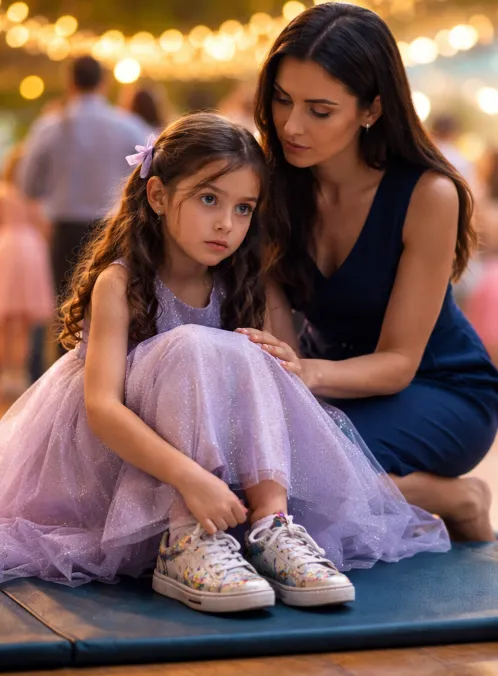
Aria stood with both hands smoothing the front of her lavender dress, her small shoulders squared with a bravery no eight-year-old should have needed. The dress shimmered faintly in the hallway light, soft and beautiful and heartbreakingly delicate. Yet it was her feet that stole my breath.
She was wearing the old canvas sneakers.
They were scuffed, frayed at the laces, and covered in wild splashes of neon paint and flecks of silver glitter. One shoe had a crooked yellow star painted near the toe. The other had a thumbprint-smudged streak of turquoise so bright it looked almost alive.
I stared at them, already knowing.
“Aria,” I whispered, “those are your play shoes.”
She looked up at me, and the quiet determination in her face nearly undid me.
“No,” she said softly. “They’re our magic shoes.”
Our.
Not mine. Not hers.
Our.
Her father’s ghost lived in that single word.
Three months earlier, Staff Sergeant Miguel Alvarez had died overseas during what everyone kept calling “his final deployment,” as though the word final made it neater, smaller, easier to survive. As though grief could be folded into an official phrase and tucked into a flag.
He had kissed Aria’s forehead before he left. He had told her, as he always did, that he’d be back before she had time to miss him too much. He had winked at me over her head. He had grabbed his duffel bag. He had walked out our front door.
And then he never walked back through it.
Aria had not stopped waiting for him.
At first she sat by the window every afternoon after school, drawing shapes in the condensation and asking me what time the planes from “far away” landed. Then she started leaving her backpack by the door so she could run to him faster when he came home. Then she began falling asleep in the living room, one hand curled around his old dog tags, as if somewhere in the dark her body still believed she might hear his boots.
Grief in a child is unbearable because it does not know how to hide.
Adults dress it up. We call it coping. We call it processing. We call it moving forward.
Children just wait.
So when she stood in that hallway, wearing that lavender dress and those ridiculous, paint-stained shoes, I knew why.
“Mom,” she said, looking down at them, “if I wear these, Dad will know I didn’t forget.”
That was all it took.
I had spent days debating whether to take her at all. A father-daughter dance without a father felt like cruelty disguised as tradition. But when she said those words, I understood something important: this night was never about pretending Miguel wasn’t gone. It was about showing up with the love he had left behind.
So I curled her hair. I tied the lavender ribbon just the way she liked. I pressed my shaking lips to the crown of her head.
And we went.
The gym was already glowing when we arrived.
Strings of warm lights hung from the rafters. Balloons drifted lazily overhead, their ribbons turning in the air currents. Paper stars dangled above the polished wood floor. A photographer had set up near the entrance with a painted backdrop of a moonlit garden. The speakers hummed with soft pop songs and old dance classics, and the room was full of movement—fathers crouching to adjust tiaras, daughters pulling grown men toward the dance floor, laughter spilling in every direction.
For one blinding second, it looked beautiful.
Then I saw Aria’s face.
She had frozen beside me.
Not dramatically. Not noisily. She simply went still, as though the sight of all those fathers and daughters moving together had reached inside her and switched something off. Her fingers slipped into mine, cold and tense.
“Do you want to stay near the wall for a little while?” I asked.
She nodded.
So we found a space near the edge of the gym where the thick blue mats had been folded against the wall. She perched on one of them, smoothing her dress over her knees, trying very hard to look smaller than she was. Around us, the night swirled on without pause.
I kept waiting for someone to come over. A teacher. A parent. Another mother who understood what it meant to survive a room full of happy people while carrying a private ruin.
No one did.
Aria kept glancing at the dance floor. Every time she saw a father bend toward his daughter, her eyes dropped to her lap.
Finally, she tugged the hem of her dress lower, hiding the sneakers.
That gesture hurt more than anything.
Because those shoes were the last loud, joyful thing she had left of him.
Miguel had painted them with her the summer before second grade. It had been one of those afternoons that turned into legend in our house: newspapers spread all over the kitchen floor, paint smeared across hands and cheeks and elbows, Aria shrieking with laughter when Miguel “accidentally” flicked green paint onto his own nose. By the end, both of them were speckled like fireworks, and the shoes looked gloriously absurd.
“They’re magic,” Miguel had told her solemnly, holding them up for inspection. “Because anything made with this much mess has to be.”
Now here she was, hiding them.
“Mom,” she whispered, so quietly I almost missed it, “can we go home?”
I looked at her face—the effort she was making not to cry, the humiliation she didn’t yet have words for—and my heart broke open all over again.
“Yes,” I said instantly. “We can leave right now.”
I had just bent toward her when I heard heels clicking across the floor behind us.
A cluster of PTA mothers passed nearby in fitted dresses and careful smiles, each carrying herself with the brittle efficiency of someone who believed competence and kindness were interchangeable. I recognized two of them from bake sales and fundraisers. Their names floated at the edges of my memory, but one stood slightly ahead of the others—a tall blonde woman with pearl earrings and a voice permanently pitched for being overheard.
She slowed when she saw Aria.
Her eyes traveled from the lavender dress to the hidden sneakers peeking from underneath.
Then she sighed.
“Oh,” she said. “That poor child.”
The other women glanced over.
I straightened.
The blonde woman tilted her head, the picture of polished sympathy. “Events like this are always difficult for children from… incomplete families.”
For a second I honestly thought I’d misheard her.
My body went cold.
Aria looked up, confused, which somehow made the insult even uglier.
The woman’s gaze dropped to the shoes. “And those sneakers,” she added, giving a small, disapproving smile. “It’s obvious she’s missing a father’s guidance.”
Something inside me stopped breathing.
“I’m sorry,” I said, turning fully toward her. “What did you just say?”
The room around us seemed to blur.
She lifted one shoulder. “I’m just being realistic. This is a father-daughter dance. Not every event is meant for everyone. If there’s no father, perhaps—”
“She has a father.”
The words cracked out of me with such force that several nearby conversations faltered.
The woman blinked.
My voice shook, but I didn’t care. “Her father died serving this country. Those shoes? He painted them with her. So don’t you dare stand there and reduce my daughter to your idea of what makes a family acceptable.”
The blonde woman’s face changed—not to shame, not exactly, but to that startled stiffness people wear when confronted with the fact that their casual cruelty has consequences.
One of the other mothers murmured, “Maybe we should—”
But before anyone could move—
BANG.
The gym doors slammed open so violently the sound ricocheted through the room.
The music screeched into static and cut out.
Every head turned.
For one impossible heartbeat, no one moved.
Then twelve United States Marines stepped through the doorway in full Dress Blues, their formation flawless, their presence swallowing the room whole.
Gasps rose around us.
The line of blue and red and gold entered with measured precision, polished shoes striking the floor in perfect rhythm. Light streamed in behind them from the hallway, casting long shadows across the gym. Parents fell silent. Children stared open-mouthed. Even the balloon ribbons seemed suddenly motionless.
At their head walked a man I had never seen before.
He was tall and broad-shouldered, with a scar curving along his jaw and a face carved into discipline. Yet there was something in his eyes—something worn, something human—that kept him from seeming cold. He didn’t scan the room. He didn’t acknowledge the whispers erupting around him.
His gaze fixed on one person.
Aria.
She had gone so still she looked carved from glass.
He walked toward her with slow, deliberate steps. Behind him, the Marines stopped and held position. The room watched as though under a spell.
When he reached her, he didn’t speak immediately.
He looked down first—at the glittered sneakers.
Then, with a care so profound it stole the breath from my lungs, he lowered himself onto one knee.
Eye level.
Gentle.
Respectful.
“Miss Aria,” he said, his voice low and steady. “I’ve been looking everywhere for you.”
The gym went deathly quiet.
I could hear my own pulse.
Aria stared at him with wide hazel eyes. “You know my name?”
The man’s expression softened. “I do.”
Then he reached into the inside pocket of his uniform.
My knees nearly buckled.
Because for one wild second, one impossible second, I thought—no, not thought, hoped—that he was about to hand me a letter. A final message. Something from Miguel. Some lost piece of him preserved across oceans and years.
Instead, the Marine drew out a small, battered tin star.
My breath caught.
I knew that star.
Miguel had kept it in the top drawer of his dresser, wrapped in an old handkerchief. It was cheap, silver-colored, the kind that came from a child’s costume set, dented at one point and missing a clasp. Aria used to play with it when she was four. Miguel had called it his “good luck badge” and would sometimes pin it to her shirt before school, pretending to deputize her against bad dreams and boring math.
We had searched for it after his death.
We never found it.
Captain Marcus Hale—though I didn’t yet know his name—held it out on his palm.
Aria made a tiny sound, not quite a gasp, not quite a sob.
“That was my daddy’s,” she whispered.
“Yes,” he said. “It was.”
“How do you have it?”
The Marine glanced at me first, asking silent permission for something I didn’t yet understand.
I could only stare.
He turned back to Aria. “Because your father gave it to me.”
I felt the entire room lean closer.
The blonde PTA mother had gone pale, though I barely registered her now. My whole world had narrowed to the scar-jawed Marine kneeling before my daughter and the tiny metal star trembling in his hand.
“He told me,” the man continued, “that if anything ever happened to him, I was to bring this back to the bravest girl he knew. He said she would probably be wearing sparkles. He said she’d try to be strong even when her heart was hurting. And he said if I saw shoes covered in paint, I’d know I had found the right person.”
Aria’s mouth fell open.
My vision blurred.
“You knew my daddy?” she asked.
The man smiled then—not broadly, but with the kind of grief-lit tenderness that can only come from having loved the same person in a different way.
“I did. My name is Captain Marcus Hale. Your father saved my life.”
A collective murmur rippled through the gym.
Captain Hale rose slowly to his feet, but he didn’t take his eyes off Aria.
“We served together,” he said, now speaking loud enough for the room to hear. “During our last mission, our convoy was hit. I was trapped. Your father came back for me when he should have been running for cover. He pulled me out. And before medevac arrived…” His jaw tightened. “Before the end, he made me promise two things.”
The gym had become a cathedral of silence.
Aria clutched the front of her dress so tightly her knuckles turned white.
Captain Hale’s voice roughened. “First, he made me promise that his daughter would always know he didn’t leave her by choice. He said if she ever felt forgotten, I was to look her in the eyes and tell her that every single day he was away, he talked about her. He carried her school picture in his vest. He made us all memorize the story of the day you painted these shoes.” He nodded toward her feet. “We heard it so many times we could all recite it.”
A few of the Marines behind him smiled through wet eyes.
Aria let out a shaky breath.
“And second?” I whispered before I could stop myself.
Captain Hale looked at me.
For the first time, something unreadable flickered across his face.
“The second promise,” he said slowly, “was that when the time was right, I was to bring her something else.”
He reached again into his uniform.
My whole body tensed.
This time he removed an envelope—aged, sealed, and marked in Miguel’s handwriting.
To Elena and Aria.
I made a sound that didn’t feel human.
No. No, no, no.
I had seen casualty reports. I had received official condolences. I had stood in a cemetery with a folded flag pressed into my hands while Aria asked if Daddy could hear the guns.
And now a letter.
A real letter.
Written by the man I had buried.
Captain Hale held it out, but before I could take it, he said, “There’s more you need to know.”
The words chilled me.
He looked around the room once, as if weighing whether the truth belonged here.
Then he made his decision.
“Staff Sergeant Miguel Alvarez was listed as killed in action,” he said. “That was the official report. But the report was wrong.”
I stopped breathing.
He continued, every word precise. “He survived the blast.”
The room seemed to tilt.
Aria stared up at him without understanding. I think I did too. My mind rejected the sentence on instinct, the way the body rejects poison.
Captain Hale went on, his own voice shaking now. “He was critically injured and taken across the border during the chaos of extraction. For months, intelligence failed to confirm whether he was alive. Our unit was ordered to stay silent until the recovery operation was complete.” His eyes locked on mine. “Three days ago, Elena… we got him back.”
For a second, no one in the gym moved because no one in the gym understood language anymore.
Everything had become sound without meaning.
Aria blinked once.
Twice.
Then she said, very softly, “My daddy is alive?”
I couldn’t answer. I couldn’t think. The gym, the lights, the people, the musicless air—all of it receded behind the thunder in my skull.
Captain Hale stepped aside.
And that was when I saw him.
At first I thought I was hallucinating—some grief-born cruelty conjuring exactly what I most wanted to see. A man stood in the doorway behind the Marines, thinner than memory, one arm in a sling, the left side of his face marked by healing scars. He leaned slightly, as though pain still lived in his ribs. But he was real. Terribly, breathtakingly real.
Miguel.
He took one step into the light.
Then another.
Aria made a sound I had never heard before—a raw, animal cry ripped straight from the center of her soul.
“DADDY!”
She ran.
The sneakers flashed white and neon and glitter across the polished floor. The entire room seemed to shatter around that movement, people gasping, sobbing, stepping back. Miguel dropped to his knees just as she reached him, and she collided with him so hard it nearly sent them both over.
He caught her with his good arm.
And then the gym erupted.
Not with music.
Not with applause.
With crying.
Grown men crying openly. Children clinging to their mothers. Marines wiping tears with brutal, embarrassed hands. Even the woman who had sneered at my daughter was covering her mouth, horror and shame flooding her face.
But I saw none of them.
I saw only my husband.
His face buried in Aria’s hair. His shoulders shaking. His eyes squeezed shut as though he could not bear the miracle of holding her and had to feel it before he believed it.
“I’m here,” he kept saying into her ribbon, into her curls, into the little shoulder he had missed for months that must have felt like years. “I’m here, baby girl. I’m here. I’m here.”
I don’t remember crossing the floor.
One moment I was by the wall. The next I was falling to my knees beside them, and Miguel was reaching for me with his trembling hand, touching my face as if I too were something he had dreamed into existence.
“Elena,” he whispered.
I grabbed his wrist and pressed it to my cheek because I needed the proof of bone and skin and warmth. “They told me you were dead.”
His eyes filled. “I know.”
“I buried you.”
“I know.”
I hit his chest once with the flat of my palm, a useless, broken gesture. Then I kissed him because there was nothing else left to do with the kind of grief that turns, in an instant, into impossible joy.
Around us, people stood frozen in witness.
Captain Hale quietly turned away, giving us the privacy of public space, which is sometimes the greatest mercy anyone can offer. The Marines behind him straightened in silence.
And then Miguel laughed.
Actually laughed.
The sound was hoarse and wet and astonished, but it was his.
He looked down at Aria, whose arms were still locked around his neck as if the whole world might steal him back if she loosened them even a fraction.
Then he saw her shoes.
The old canvas sneakers.
The star. The turquoise smear. The silver glitter.
Miguel closed his eyes for one second, overwhelmed. When he opened them again, he was smiling through tears.
“You wore the magic shoes,” he said.
Aria nodded so hard the ribbon bounced. “I wanted you to know I didn’t forget.”
His face crumpled.
“Oh, baby,” he whispered. “I never thought you did.”
That would have been enough. More than enough. The impossible had already happened. The dead had returned. The wound in the center of our family had split open and poured out light.
But the night still had one final turn left.
Captain Hale stepped forward again, clearing his throat. When Miguel looked up, their eyes met with a depth of history I could only partially imagine.
“There’s one more thing,” Hale said.
Miguel’s expression changed. “Marcus…”
Hale shook his head, just slightly. “She deserves to know.”
A hush fell again.
I felt Miguel tense beside me.
Aria looked from one man to the other.
Captain Hale drew in a slow breath. “The reason your father came back for me that day,” he said, speaking now to Aria though his eyes flicked once to Miguel, “was because I’m not just his commanding officer.”
He looked at me then.
At both of us.
“I’m his brother.”
The words landed like another blast.
I stared.
Miguel shut his eyes briefly.
“What?” I said, certain I had misheard.
Hale—Marcus—gave a crooked, pained smile. “Half-brother, technically. Same father. Different lives. We found out two years ago through military records and a DNA database tied to next-of-kin verification. We were still trying to figure out what it meant.” He glanced at Miguel. “He wanted to tell you both after he got home from deployment. Properly. In person.”
The floor might as well have disappeared beneath me.
Aria’s eyes widened with delighted confusion. “So… he’s my uncle?”
Miguel actually laughed again, a ragged, disbelieving sound. “Yeah, sweetheart.” He looked at Marcus and shook his head, tears glinting. “Yeah. He is.”
Aria turned to Marcus with the grave seriousness only children can summon in absurd moments. “Then why didn’t you say so first?”
The room burst into startled laughter through tears.
Marcus pressed a hand to his chest in surrender. “Fair point.”
Aria studied him, then held up the tiny tin star. “If you’re my uncle, can you dance too?”
For one beat, he seemed unable to answer.
Then every Marine in the room started grinning.
Miguel looked at me, and I saw in his face the full impossible shape of the night: death undone, family expanded, grief humiliated by hope. I thought of the blonde mother with her poisonous words about incomplete families, and I nearly laughed from the sheer wildness of the answer life had given her.
Incomplete?
No.
We had been broken. Lost. Buried under silence.
But in the span of one night, in a school gym under cheap paper stars, our family had become larger than we had ever imagined.
Aria reached one hand to her father and the other to her newly discovered uncle.
“Come on,” she said, with all the authority of a queen restoring order to her kingdom. “This is a dance.”
Someone in the back—God bless whatever teacher had the sense—turned the music on again.
Softly at first.
Then louder.
And as the first notes floated across the gym, Miguel rose with effort, Marcus moved to help steady him, and my daughter—my bright, stubborn, glitter-shoed daughter—stood between them, radiant and unashamed.
Every eye in the room followed as the three of them stepped onto the dance floor.
And when they did, the entire gym stood up.
Not out of obligation.
Not out of pity.
Out of reverence.
For love that had survived war.
For a child who had carried memory like a lantern.
For a man who came back from the dead.
For a brother no one knew existed.
For the impossible, unfolding right there beneath the lights.
Aria looked over her shoulder at me then, her face transformed—tearstained, shining, utterly alive.
And I understood, all at once, the true magic of those ridiculous painted shoes.
They had not led her father home.
They had done something far greater.
They had carried her straight into the night that changed everything.