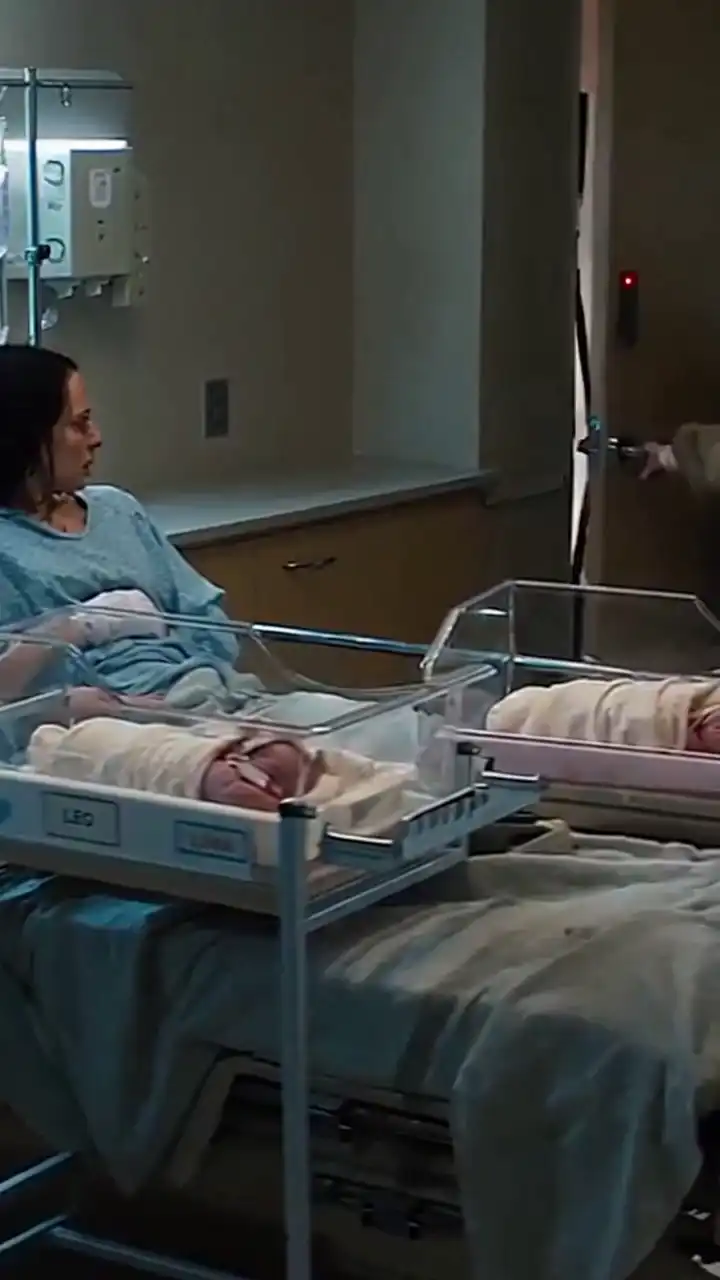
SHE STOLE MY NEWBORN FROM MY ARMS—THEN THE ENTIRE HOSPITAL LEARNED WHO I REALLY WAS
Chapter 1
“Judge Vance?”
Chief Mike’s voice came out thin, stunned, almost swallowed by the shriek of the alarm still flashing through the recovery wing.
Everything in the room froze for one impossible beat.
Mrs. Sterling stood with Leo in her arms, one hand pressed dramatically to her chest, her fur collar half slipping off one shoulder. Her expression flickered—confusion, annoyance, then calculation so fast it was almost elegant. She had heard the title. She just didn’t understand it yet.
My lip was bleeding.
My abdomen felt like someone had split me open all over again.
Luna had started wailing in the bassinet beside my bed, her tiny face red, fists clenched against the white hospital blanket. The sound cut through me sharper than the pain.
I pressed one shaking hand over my incision and pointed at Mrs. Sterling with the other.
“She hit me,” I said. My voice sounded raw, scraped hollow. “She assaulted me and took my son.”
Chief Mike didn’t move right away. He was staring at me, trying to reconcile the woman in the hospital bed—hair matted, gown wrinkled, blood on her mouth—with whatever image he had of me before this moment.
Mrs. Sterling recovered first.
“Oh, for God’s sake,” she snapped, dropping the sobbing act. “Don’t be ridiculous. This is a family matter.”
Then, with astonishing nerve, she tightened her grip on Leo and looked at the guards as though they were bellmen delaying room service.
“Escort her out of whatever delusion she’s having,” she said. “She’s unstable after surgery.”
I felt something cold settle inside me.
Not panic.
Not anymore.
Clarity.
“Chief,” I said, locking my gaze on Mike, “remove that woman from my child immediately. Then seal this floor.”
He blinked.
The old instincts were back in my voice now. Courtroom steel. The tone that made attorneys stop talking mid-sentence.
Mrs. Sterling noticed too. Her eyes narrowed.
Mike straightened at once. “Ma’am,” he said to her, “hand me the baby.”
Her face twisted. “Absolutely not.”
Two of the guards stepped forward.
Leo stirred, making that soft newborn protest that only sharpened the terror roaring through my chest. If she jerked, if she stumbled, if she clutched him too hard—
“I said,” Mike repeated, harder now, “hand me the baby.”
Mrs. Sterling let out a breath of offended disbelief. “Do you know who my son is?”
“No,” Mike said. “And right now I do not care.”
That answer landed like a slap she hadn’t prepared for.
One guard moved to her left, another to her right. She tried to step back, but her heel caught on the leg of the guest chair. Leo gave a startled cry.
Every muscle in my body seized.
“Careful!” I shouted.
Mike took advantage of the moment. Smoothly, expertly, he stepped in and lifted Leo from her arms. He cradled my son against his chest with surprising gentleness, then immediately passed him to a nurse who had rushed in behind security.
“Check both infants,” he ordered.
The nurse nodded and scooped Leo close, carrying him to the warmer beside Luna’s bassinet.
Mrs. Sterling exploded.
“You idiots! That is my grandson!”
She lunged after the nurse, but a guard caught her arm.
“Ma’am, stop resisting.”
She whirled on him, voice rising into a shriek. “Unhand me! I will have all of you fired!”
By then two more nurses had entered, followed by a doctor whose face went pale the second he saw me trying to sit upright against the bed rails.
“Judge—” he started.
My mother-in-law heard that too.
This time, the room changed.
I watched understanding begin to creep across her face, slow and ugly.
“Judge?” she repeated.
No one answered her.
The doctor crossed to me quickly. “Lay back. Please. You should not be upright.”
“She kicked the bed,” I said through clenched teeth. “Then struck me in the face.”
His jaw hardened. “Get me vitals now.”
A nurse wrapped a cuff around my arm while another checked my incision. I flinched when her fingers brushed the dressing.
“She’s bleeding more than she should be,” the nurse said.
“Of course she is,” I whispered. “I was just assaulted.”
Mrs. Sterling’s voice cut through the room. “This is absurd. She’s exaggerating because she’s embarrassed.”
Mike turned toward her fully now, and whatever he saw in his own memory of me settled the matter.
“Mrs. Sterling,” he said, reading the name from the visitor log one of the guards had already pulled from the clipboard at the door, “you are being detained pending police response.”
She laughed.
Actually laughed.
“You can’t detain me over some postpartum theatrics.”
I looked at her and tasted blood.
For three years, I had lowered my eyes at family dinners.
I had swallowed comments about my “lazy schedule,” my “empty little volunteering,” my “cute hobby of reading case files”—the irony of that one almost made me smile now.
I had let her believe I was soft because my husband, Daniel, had begged me for peace.
Just ignore her, Ivy, he’d say. She’ll calm down once she gets to know you.
She never got to know me. She only got comfortable.
And comfort turns cruel people reckless.
“Postpartum theatrics?” I repeated.
She looked at me with open disgust. “Yes. You milk every little thing. Private suite, flowers everywhere, staff fawning over you like you’re royalty while my son pays the bills.”
One of the nurses actually stared.
On the cabinet near the wall sat a card attached to one of the orchid arrangements: Congratulations, Judge Vance. The Supreme Court of Franklin is honored to celebrate your growing family.
The card had been turned sideways, half obscured by ribbon. She’d never bothered to read it.
Because in her mind, she already knew what I was.
“Those flowers,” I said softly, “were not purchased by your son.”
Her nostrils flared.
I could see her doing the math now. Replaying every lunch, every holiday, every insult. Looking for clues she had missed because arrogance had blinded her to them.
“No,” she said after a moment. “No. Daniel would have told me.”
“Daniel knows,” I said.
And that was the truth that hit her hardest.
Her face drained.
“No,” she said again, but this time it was quieter.
The doctor looked up from my chart. “Someone call OB trauma and local PD. And I want photographs taken of her injuries immediately.”
Mrs. Sterling jerked against the guard’s hold. “Photographs? Over a family disagreement?”
“You struck a post-op patient,” the doctor said flatly. “Who had major abdominal surgery less than twelve hours ago.”
“It was a tap.”
My cheek burned as if to answer her.
My head throbbed where it had hit the rail.
Luna’s cries quieted as a nurse lifted her and checked her tiny limbs. Leo was fussing too, his face crumpled, searching for warmth.
I reached out weakly. “My babies.”
The nurse brought Luna first, laying her carefully beside me. Another nurse settled Leo in my other arm once the doctor allowed it. The moment their weight touched me, I broke.
Not loudly.
Just tears, hot and unstoppable, sliding into my hairline as I pressed my face to theirs and breathed in that impossibly new scent—milk, warmth, skin, life.
Mine.
Both of them.
Mrs. Sterling made an irritated sound, as if my relief inconvenienced her.
“You always were dramatic.”
Something in Mike snapped.
“Enough,” he barked.
Silence fell.
Even Mrs. Sterling looked startled.
He pointed at the orchids. “Ma’am, I know exactly who Judge Vance is. I’ve testified in her courtroom. Half this hospital knows exactly who she is because your son checked her in under a privacy restriction this morning and administration briefed us all to keep media away. You barged into a restricted recovery room, assaulted a patient, attempted to remove a newborn, then lied to security. If you say one more word, it better be to request a lawyer.”
Her mouth opened.
Closed.
Opened again.
The first real flicker of fear crossed her face.
And still, even then, she searched for an escape hatch.
“She’s my daughter-in-law,” she said, softer now, trying a new angle. “This is all just a misunderstanding.”
I looked at her over Leo’s tiny head.
“A misunderstanding,” I said, “does not involve relinquishment papers.”
Every head in the room turned toward the bedside table.
The wrinkled packet still lay there where she had thrown it, the words black and official-looking beneath hospital light.
Mike walked over, picked up the papers, and flipped through them. His expression darkened further.
“This isn’t even a state form,” he said.
“Of course it is,” Mrs. Sterling snapped automatically.
He held up the first page. “It was downloaded from a generic legal website and partially filled out in different handwriting.”
The room went very still.
I stared at her.
She had actually come prepared.
She hadn’t stormed in on emotion alone. She had planned this. She had expected me to be weak, isolated, and frightened enough to sign away one of my children while still numb from surgery.
A tremor went through me so hard the nurse touched my shoulder in concern.
Not now, I told myself.
Do not fall apart now.
“Where is Karen?” I asked.
Mrs. Sterling’s eyes flashed.
That told me enough.
Mike caught it too. “Check the floor,” he ordered one of the guards. “Find Karen Sterling if she’s here. Lock down all exits until patrol arrives.”
The guard left at once.
Mrs. Sterling raised her chin. “My daughter did nothing wrong.”
“I didn’t ask if she did,” Mike said. “I asked if she’s here.”
No answer.
I closed my eyes for one second, just one, and the memories came in jagged fragments.
Karen at Christmas, touching my stomach with eerie intensity and saying, If one is a boy and one is a girl, that solves everything, doesn’t it?
Mrs. Sterling laughing beside her.
Daniel not hearing, or pretending not to.
The way they kept saying Karen had “been through enough” after years of infertility, as though suffering entitled her to someone else’s child.
I should have seen it.
I should have understood what lived beneath those comments.
But sane people do not naturally assume insanity in others. That had been my mistake.
The door opened again, and Daniel walked in smiling.
He had a paper cup carrier in one hand and a bakery box in the other.
“I got those lemon muffins you wanted, and they only had one decent coff—”
He stopped.
His eyes moved from the guards to my swollen lip, from the doctor to his mother restrained near the door, and all the color vanished from his face.
“What happened?”
No one answered quickly enough.
He dropped the coffees. Lids popped. Brown liquid spread across the tile.
“Mom?”
Mrs. Sterling burst into tears on cue. “Daniel, thank God. They’ve lost their minds.”
He ignored her and came straight to me.
The second he saw the mark on my face up close, his whole body tensed. “Ivy.”
“She tried to take Leo,” I said.
There are moments when truth lands so hard you can almost hear it.
This was one of them.
Daniel went still.
Not confused. Not disbelieving.
Still.
Then slowly, he looked at the bedside table, at the papers in Mike’s hand, and finally at his mother.
“Tell me she didn’t,” he said.
Mrs. Sterling drew herself up. “I was helping.”
“You hit her?”
“She was hysterical.”
“Did you hit her?”
“She screamed at me not to touch the baby like I was some criminal!”
Daniel’s face changed.
I had seen him angry before—in traffic, during an argument with a contractor, once when his college friend insulted me after too much whiskey. But this was different. This was colder. More dangerous because it was controlled.
“Did you hit my wife?” he asked.
His mother faltered.
That tiny hesitation was answer enough.
He turned to Mike. “Call the police.”
“They’re already on the way,” Mike said.
Mrs. Sterling stared at her son as if he had struck her. “Daniel.”
“No,” he said. “Don’t say my name like I’m supposed to save you from this.”
The room seemed to contract around us.
She switched tactics again, desperation showing through the cracks.
“I did this for family.”
Daniel laughed once, without humor. “You tried to steal my son.”
“For Karen!”
“That does not make it better.”
Karen.
At the sound of her name, the guard who had gone to search the floor returned. His expression said everything before he spoke.
“We found her in the stairwell with a car seat.”
A silence so complete it felt sacred dropped over the room.
Mrs. Sterling closed her eyes.
Daniel looked like he might be sick.
The guard continued, “She said she was waiting for her mother to bring the baby down.”
The doctor muttered, “Jesus Christ.”
I held my children tighter and felt my incision scream in protest. I didn’t care.
There it was.
No more misunderstanding. No more family drama. No more awkward holiday tension dressed up as concern.
This had been a kidnapping plan.
Badly executed, but real.
Premeditated.
And all because they thought I was too weak to stop them.
Daniel stepped back from his mother as though her skin might burn him.
“Get her out of here,” he said hoarsely.
She reached for him. “Daniel, listen to me. Karen is broken. You know what she’s been through. That girl”—she jerked her chin toward Luna—“she still gets to keep one—”
A guard actually recoiled.
Daniel’s expression went blank.
I had presided over enough criminal sentencing hearings to recognize that look. It was the face a person made when some deep interior bond snapped beyond repair.
“You will never,” he said very quietly, “come near my children again.”
Then he turned to Mike. “If there’s any paperwork needed for trespass, protective orders, charges—whatever my wife wants, we do it.”
My wife.
Simple words.
But this time he said them like a vow.
Mrs. Sterling began to protest, but the police had arrived.
Two uniformed officers entered first, then a detective in a navy suit carrying a notebook. They took one look at the room, at Mike, at me, and their posture sharpened.
The detective knew me too.
Of course he did.
“Judge Vance,” he said carefully.
“Detective,” I replied.
Mrs. Sterling made a furious, helpless sound. “Oh, this is unbelievable.”
The detective didn’t spare her a glance. “I’m going to need statements from everyone.”
“No,” the doctor said. “You’re going to need to wait until she’s medically stabilized. She’s postpartum, post-op, and in pain.”
“I can give a statement,” I said.
Daniel touched my shoulder. “You don’t have to do this right now.”
“Yes,” I said. “I do.”
Because I knew how stories shifted when time passed.
Bruises darkened, then healed.
Memories blurred.
Manipulators rehearsed.
And women—especially women called emotional, exhausted, dramatic—were expected to calm down before they were believed.
Not this time.
I looked at the detective.
“She entered my room without permission,” I said. “She verbally abused me, threw falsified relinquishment papers on my table, demanded I surrender Leo to Karen Sterling, kicked my hospital bed while I was recovering from a C-section, struck me in the face when I protested, and physically removed my son from the bassinet. I activated security.”
The detective wrote quickly.
Mrs. Sterling made a choking sound. “You are twisting everything.”
I kept going.
“Karen Sterling was found waiting in the stairwell with a car seat. I want charges pursued to the fullest extent available.”
The detective nodded once. “Understood.”
He turned to Daniel. “Sir?”
Daniel swallowed hard. “I left for twenty minutes to get coffee and breakfast. My mother was not authorized to visit alone.”
“Did she know your wife had delivered?”
“Yes.”
“Did she know there were twins?”
“Yes.”
“Did she know one was a boy?”
A pause.
Daniel looked devastated. “Yes.”
The detective made another note.
He spoke with Mike next, then the guards, then the nurses. The paper trail built itself in real time around Mrs. Sterling, each witness adding another brick until there was nowhere left for her to squeeze through.
At some point, Karen was brought to the doorway by another officer.
She looked disheveled, mascara smudged, clutching her handbag with white knuckles. Her gaze went straight to Leo, then away.
She didn’t look at me.
That, somehow, made me angrier.
Not the delusion. Not even the audacity.
The cowardice.
“You waited in the stairwell?” I asked her.
She flinched as if I had shouted, though my voice was barely above a whisper.
Karen’s mouth trembled. “I—I wasn’t going to hurt him.”
“No,” I said. “You were just going to take him.”
Tears spilled down her face. “You have two.”
The room turned to stone.
Even the officers looked stricken.
I felt Daniel beside me go rigid in horror.
Karen said it like the most obvious thing in the world. Like arithmetic. Like fairness.
You have two.
As if abundance erased ownership.
As if my son was a spare.
I will remember those three words until the day I die.
“You have two,” she repeated, voice cracking now. “I have none.”
“And that,” I said, “is tragic. It is not my son’s burden to fix.”
She covered her face and sobbed.
Mrs. Sterling surged forward. “Don’t speak to her like that!”
The officers caught her immediately.
The detective looked profoundly tired. “Take them both downstairs.”
“Daniel!” his mother cried as they led her away. “Daniel, say something!”
He did.
“If Dad were alive,” he said, “he’d be ashamed of you.”
That silenced her more effectively than handcuffs.
She stared at him, wounded and furious and disbelieving all at once, then disappeared into the hall.
Karen wouldn’t stop crying.
I watched them go and felt no triumph.
Only shaking.
Only the aftershock.
Only the horror of what almost happened settling into my bones.
The detective closed his notebook. “We’ll follow up when you’re ready, Judge. We’ll also recommend emergency protective orders.”
“Do it,” I said.
He nodded and left.
The room gradually emptied after that. Nurses adjusted my monitors. The doctor ordered pain medication I’d been too adrenalized to accept earlier. Mike asked if I wanted an officer posted outside my room.
“Yes,” Daniel answered before I could.
I nodded. “Yes.”
Mike hesitated, then said quietly, “I’m sorry you went through that.”
Something in his face told me he meant more than just the security response. He meant the split second when the accusation might have gone the wrong way. When a bleeding woman in a hospital bed could have been treated like the threat if no one had looked closely enough.
“So am I,” I said.
He gave me a grim nod and left.
At last, it was only me and Daniel and the twins.
The machines hummed.
Rain had started tapping against the wide window over the city.
Daniel pulled a chair close to the bed, then sat without speaking. His hands were clasped so tightly his knuckles had gone white.
I watched him for a long moment.
“You knew they were too invested,” I said.
It wasn’t really a question.
His eyes lifted to mine, full of guilt. “I knew Mom was overbearing. I knew Karen was fragile.”
“Daniel.”
He looked down.
“I heard comments,” he admitted. “I told myself they were just comments.”
I held Leo a little closer.
“She asked me once if we’d considered letting Karen be in the delivery room,” I said. “Do you remember what you said?”
He shut his eyes.
He remembered.
You know how she gets, Ivy. She doesn’t mean anything by it.
“She said if the babies looked alike, no one would know the difference for a while,” I whispered.
His eyes opened in shock. “What?”
“I thought it was a tasteless joke.”
“You didn’t tell me.”
“No,” I said. “Because every time I tried to tell you your family scared me, I ended up comforting you for being caught in the middle.”
That hit him.
He bowed his head.
Outside, thunder rolled somewhere far off.
I was exhausted beyond language. My body felt emptied out, stitched together, then nearly torn apart again. But clarity wouldn’t let me rest.
“I need you to hear me now,” I said. “There is no middle anymore.”
He looked at me, eyes rimmed red.
“I know.”
“Do you?”
“Yes.”
My laugh came out weak and painful. “Your mother just assaulted me and tried to traffic our child to your sister through a hospital stairwell.”
His face crumpled.
I had never seen my husband look truly broken before. That was what unsettled me most. Not rage. Not denial. Grief.
“I failed you,” he said.
The words hung there.
Simple.
True.
And because they were true, they hurt more than excuses would have.
I looked at my babies, at Leo’s tiny ear folded against the blanket, at Luna’s restless mouth searching in her sleep.
“You did,” I said.
Daniel nodded once as if accepting a sentence.
Then he leaned forward, elbows on knees, and covered his face.
For a long time, neither of us spoke.
Chapter 2
By evening, the bruising on my cheek had darkened into a livid bloom under my left eye.
The hospital photographer came in with a neutral face and clinical efficiency. She documented the split lip, the swelling at my temple, the red pressure marks where I had strained against the bed, the blood spotting around the dressing on my abdomen after the kick.
Flash.
Flash.
Flash.
Each burst of light made it more real.
I had spent years on the bench reminding jurors that photographs were not emotion. They were evidence.
Now my own body was evidence.
A sheriff’s deputy from the courthouse detail arrived around six with emergency paperwork. I signed the protective order while Luna slept against my chest and Leo hiccupped in Daniel’s arms.
My hands shook only once—when I wrote Karen’s name.
The deputy, a broad-shouldered woman named Elena whom I vaguely recognized from the east entrance screening station, kept her voice low and respectful.
“The order bars contact by phone, in person, through third parties, online, all of it,” she said. “Temporary until the hearing, but with these facts, it’ll likely convert.”
Daniel asked, “Can they post bail?”
Elena glanced at me before answering. “Possibly. But bail doesn’t override the protective order. And given the newborns, the assault, the attempted removal, and the falsified forms, the prosecutor may push hard.”
I almost said, They should.
Instead I signed.
Judge Ivy Vance.
The name looked strange to me in that moment. Detached. Powerful on paper, powerless in a hospital bed three hours earlier.
Titles are armor until someone catches you before you can put yours on.
After Elena left, Daniel stood at the window for a while, staring out at the rain-slick skyline.
He still hadn’t touched his phone much, which was unlike him. Usually, after any family blowup, there was a flurry of messages, triage, appeasement. This time, silence.
“Who knows?” I asked.
He let out a breath. “Now? Probably everyone.”
His phone buzzed as if on cue. He looked at the screen, jaw tightening.
“Don’t answer if you don’t want to,” I said.
“It’s my aunt.”
Of course it was. Family systems close ranks with astonishing speed. Not around the truth—around discomfort.
He answered anyway.
“Aunt Mel.”
I could hear the woman’s voice tinny through the speaker, shrill with outrage. “Daniel, what on earth is going on? Your mother says she’s been arrested in a hospital because your wife made a scene.”
Daniel’s face hardened.
“My wife didn’t make a scene. My mother assaulted her.”
A pause.
“Oh, sweetheart, I’m sure it wasn’t like that.”
“It was exactly like that.”
Another pause, longer this time.
Then: “Well, your mother is beside herself about Karen. You know how unstable she’s been since the last treatment failed. Maybe Ivy could find it in her heart to—”
“Stop,” Daniel said.
His tone was so flat even I felt it.
“No,” he continued. “No one is going to ask my wife to ‘find it in her heart’ after my mother hit her and tried to take our child.”
The voice on the phone softened into that deadly, patronizing register some people use when they’re trying to sound reasonable while excusing the indefensible.
“Daniel, families do desperate things when they’re hurting.”
He looked over at me, at the babies, at the bruise on my face.
“Then they deal with the consequences,” he said, and hung up.
A second later, his phone buzzed again.
Then again.
Then again.
He silenced it and put it face down.
The room fell quiet except for the soft whir of air vents and the tiny newborn sounds that now ruled my whole nervous system.
“Do you want me to contact court administration?” he asked after a while.
“I already texted Mara.”
His eyebrows rose slightly. “From the bed while being examined?”
I managed a faint smile. “Before the pain meds.”
Mara Bennett was my clerk, my gatekeeper, my closest professional ally, and one of the few people who knew exactly how carefully I had concealed my position from Daniel’s family. Not because I was ashamed—because I was tired.
Tired of being treated like a symbol.
Tired of every introduction turning into performance.
Tired of wondering whether people liked me or liked access to a judge.
With Daniel, I had wanted ordinary. I had wanted dinners where nobody asked me for legal favors. I had wanted to be a wife before a title.
So I let his mother think I was “between consulting contracts” and “doing occasional legal review work from home.” Daniel knew the truth from our third date, but he’d agreed that his family didn’t need details.
It turned out secrets don’t create peace. They just delay the moment when ugly people reveal themselves.
My phone buzzed on the tray table.
Mara: CALL ME NOW. I AM READY TO BURY BODIES LEGALLY.
Despite everything, I laughed—and instantly regretted it when pain tore across my abdomen.
Daniel was beside me in a second. “Easy.”
“I’m fine.”
“You are absolutely not fine.”
No, I thought. I’m not.
But the babies were breathing. The room was guarded. The women who tried to take my son were in custody.
For the first time since the alarm went off, “not fine” felt survivable.
I called Mara.
She answered on the first ring. “Ivy.”
That was all she said, but in that one word was alarm, loyalty, fury, and the faint metallic edge of someone already clearing her calendar for war.
“I’m okay,” I said.
“Your definition of okay is famously unreliable.”
I looked at Daniel. “Fair.”
Mara exhaled sharply. “I’ve already contacted the Chief Justice’s office and told them you had a medical emergency. No details beyond that. Your docket for next week is being reassigned pending your leave.”
“Thank you.”
“I also told anyone who asks that if they bother you in recovery, I’ll set them on fire.”
“That also helps.”
Her voice softened. “What do you need?”
The question nearly undid me. Need, when asked sincerely, is dangerous.
“An attorney,” I said. “Not criminal prosecution—I know the state will handle that. Family and civil. The best.”
“I’ve already called Naomi Pierce.”
Of course she had.
Naomi was terrifying in heels and had once reduced a billionaire to tears in pretrial deposition. Exactly the energy I wanted near my children.
Mara continued, “She’ll come by tomorrow if you’re up for it.”
“Yes.”
“And Ivy?”
I swallowed.
“You do not have to protect anybody from the fallout of this. Not his mother. Not his sister. Not your husband. Nobody.”
My eyes drifted to Daniel. He’d heard every word and didn’t flinch.
“I know,” I said.
After the call ended, the nurse helped me feed the twins. Those first awkward, painful attempts at breastfeeding felt strangely grounding. Their needs were immediate and honest. No manipulation. No performance. Just hunger, warmth, contact.
Daniel watched, then quietly assembled tiny supplies on the rolling cart as if order itself might be an apology.
When night settled fully over the city, he asked, “Do you want me to stay?”
I looked up sharply.
He gave a sad, tired half smile. “I mean in the room. I’m not leaving the hospital.”
A nurse had already offered him the fold-out couch.
Part of me wanted him there. Part of me wanted space wide enough to think in.
“You can stay,” I said at last. “But not to hover.”
He nodded. “Understood.”
The lights dimmed.
For a while I drifted in and out, waking every few minutes to check that Leo and Luna were still there, still within sight, still safe. Each time, the same cold surge flooded me before reason caught up.
Trauma makes your body repeat emergency long after the danger passes.
Around midnight I woke to voices in the hallway.
Daniel was outside the partially cracked door, speaking in a low, furious tone.
“I don’t care if she’s my mother.”
A woman answered—older, polished, brittle. His aunt, maybe.
“You’re overreacting because you’re emotional.”
“My wife was attacked hours after major surgery.”
“She’s pressing charges against family.”
“She’s protecting our children.”
“You know Karen didn’t mean—”
“I said stop.”
The hallway went silent.
Then Daniel again, quieter but somehow harsher. “If any of you contact Ivy directly, if anyone comes near this floor, if anyone shares her room number, photos, or medical information, I will personally provide every message to the prosecutor. Are we clear?”
No answer reached me.
A second later, the door closed and he came back in.
He noticed I was awake. “Sorry.”
“Who was it?”
“Aunt Mel and my cousin Rachel. They somehow got past the desk.”
“Want to know something awful?” I murmured.
“What?”
“I can’t tell anymore whether I’m more shocked by what your mother did or by how many people are trying to excuse it.”
He stood still for a moment. “Me too.”
He sat back down in the chair, not the couch, and scrubbed a hand over his face.
“In my family,” he said, “everything gets minimized. My dad used to call it ‘keeping the boat steady.’ Mom throws a fit, Karen melts down, everyone rearranges themselves around them so dinner can continue.”
I shifted carefully, wincing.
“And you learned that peace meant appeasement,” I said.
He nodded once.
“I didn’t realize,” he said slowly, “that what I was really doing was feeding them the belief that there would never be consequences.”
That was the thing, wasn’t it?
Cruelty grows in spaces where no one names it.
I studied his face in the low light. There was something stripped down about him now, some last illusion burned away.
“I need more than anger from you,” I said.
He looked up.
“I know.”
“Do you?” My voice was quiet, but it held. “Because if this becomes one of those moments where everyone says all the right things while the world is on fire, and then six months later your mother sends an apology card and you tell me she’s old and lonely and maybe we can meet in a public place—”
“That won’t happen.”
I held his gaze.
“It won’t,” he repeated. “I will not ask you to forgive this.”
The chair creaked as he leaned forward.
“I can’t undo what happened,” he said. “I can’t undo every time I dismissed your discomfort because it was easier than confronting them. But I can be very clear about what happens now.”
I waited.
“No contact. Full stop. Protective order, criminal complaint, civil action if you want it. Security at the house. New locks even though they don’t have keys. Cameras. I’ll tell the pediatrician’s office, daycare in the future, schools in the future—anyone who ever comes near our children—that my mother and sister are not permitted access.”
The practical specificity steadied me more than any grand emotional speech could have.
“And therapy,” he added, almost grimacing at himself. “For me, at least. Probably for us when you’re ready. Because if I ever let this pattern near our kids again, you should leave me.”
It was an ugly sentence.
An honest one.
I looked down at Luna sleeping against my side. Her lashes were so small they looked painted on. Leo made a snuffling sound in the bassinet.
“I’m not making decisions about our marriage tonight,” I said.
“I know.”
“But I am making decisions about safety.”
“Yes.”
“So hear mine.” I drew a breath. “Your mother and Karen will never be alone with Leo or Luna. Not in one year, not in ten. If either of them appears anywhere near our children, I call the police immediately. No family meeting. No benefit of the doubt. No giving them one last chance.”
Daniel nodded. “Agreed.”
“And if any relative pressures me to keep quiet for the family’s sake, they lose access too.”
Another nod. “Agreed.”
I closed my eyes.
For the first time all day, my body loosened by one degree.
Not trust. Not yet.
But maybe the outline of accountability.
Chapter 3
News leaks in layers.
First the family.
Then the hospital gossip.
Then the courthouse whispers.
Then, if you’re unlucky, the press.
By the next morning, three local reporters had already called the court’s media office asking whether “a sitting judge was involved in a domestic disturbance at St. Jude’s.” That was Mara’s wording when she entered my room with coffee, legal pads, and the expression of a woman prepared to cross-examine the devil.
She wore a camel coat over a black sheath dress and set her bag down with military precision.
“You look terrible,” she said.
“I love you too.”
“I mean lovingly. Also, if you weren’t attached to your husband before this, I’d have rolled him down a flight of stairs for letting those women breathe near you.”
Daniel, standing by the bassinet with Leo, surprised me by almost smiling.
“Mara,” he said.
“Daniel.” Her tone wasn’t warm, but it wasn’t icy either. Merely assessing. “You currently exist on a month-to-month basis in my heart.”
“Understood.”
She accepted that answer with a brief nod.
Then she crossed to the bed and very gently touched my shoulder. The contrast nearly broke me.
“How bad?” she asked.
I didn’t pretend not to understand.
“Bad enough that every time the door opens, I check the babies first.”
Her jaw tightened.
Naomi Pierce arrived twenty minutes later with two phones, a leather folio, and an air of efficient destruction. She was tall, silver-blonde, and impeccably tailored, with the kind of calm that made people confess things they shouldn’t.
She introduced herself to Daniel like he was an irrelevant but necessary witness, then turned to me.
“I’m very sorry we’re meeting under these circumstances.”
“So am I.”
She sat. “I’ve reviewed the preliminary incident reports. Criminally, the state has several options. Civilly, we also have several. More importantly, family court protective orders can be extended, strengthened, and customized.”
Mara took a position by the window, legal pad ready.
Naomi opened her folio.
“I want every prior interaction that now looks different in hindsight,” she said. “Comments, threats, pressure, fixation on the children, anything about gender, anything about Karen parenting one child, any attempts to isolate you.”
So I told her.
Not elegantly.
Not in perfect chronology.
But thoroughly.
Christmas.
The baby shower where Mrs. Sterling sniffed and said, “Two is wasteful on first-time parents.”
Karen offering to decorate “the boy’s nursery at her place” and laughing when I stared.
The repeated insistence that Daniel’s side of the family had “stronger claim” to carry on the Sterling name.
The little barbs about Luna being easier to “let you keep” because “girls belong with mothers.”
Each memory sounded more grotesque out loud than it had in the moment. That’s another trick of abuse—it often arrives one deniable comment at a time.
Naomi wrote fast.
“Any witnesses to these statements?”
“Might depend on the event,” I said. “Some were private. Some happened at family gatherings.”
Mara interjected, “I was at the shower. Karen absolutely made the nursery comment. I assumed she was doing that weird grief humor thing infertile women sometimes get allowed to do without consequence.”
Naomi looked up. “You can testify to that?”
“Yes.”
Daniel stared at the floor. “I heard pieces. I ignored too much.”
Naomi’s gaze flicked to him. “Your self-reproach may be emotionally appropriate, Mr. Sterling, but in legal terms I need precision, not guilt.”
He nodded. “Understood.”
“Were you aware your mother had obtained relinquishment forms?”
“No.”
“Did she ever discuss giving one twin to your sister?”
His silence was answer enough before he forced out, “In euphemisms. Never directly enough that I admitted to myself what she meant.”
Naomi’s pen paused.
“Euphemisms are often how conspiracies test for resistance,” she said.
That landed hard.
She continued, “The state will likely pursue assault, attempted custodial interference, possible attempted kidnapping-related charges depending on local statutes and prosecutorial appetite, conspiracy if they can tie Karen clearly to the plan, and potentially fraud-related counts because of the falsified documents. Civilly, we can pursue intentional infliction of emotional distress, assault, battery, and seek a permanent injunction.”
Mara’s eyes gleamed with professional approval. “I like her.”
Naomi ignored that. “I also recommend a complete digital lockdown. Password-protect pediatric records. Alert your home security company. Notify building management if you live in a secured residence.”
“We have a house,” Daniel said. “Suburban, no gate.”
“Then cameras by tonight,” Naomi replied. “And if either woman ever had keys, garage codes, alarm access, or pet-sitting privileges, assume every point is compromised.”
I said, “My mother-in-law had a code from when we were renovating.”
Daniel went pale. “I forgot about that.”
Naomi didn’t sigh, but it was close. “Change it immediately.”
He pulled out his phone and stepped aside to make the call.
Mara waited until he was out of earshot before muttering, “I’m trying very hard not to hate your husband.”
“I know,” I said.
“Is he worth the effort?”
It was too honest a question for that early in the morning.
“I don’t know yet.”
Naomi closed the folio. “That’s a personal matter. Legally, however, unity between parents is useful. If there’s any chance his family may claim he invited contact later, I want his position documented now.”
Mara nodded. “Affidavit?”
“Yes.”
When Daniel returned, Naomi had him sign a written statement affirming that neither his mother nor Karen had permission to remove, possess, transport, or make decisions for either child, and that any prior family access was revoked immediately.
Watching him sign felt strangely significant.
A line in the sand.
Maybe too late for the first battle.
Not too late for the next.
By noon, I was discharged under tighter security than some defendants got entering arraignment.
The hospital arranged a private exit through a staff corridor. Chief Mike himself walked with us. One nurse pushed my wheelchair while another carried discharge bags full of mesh underwear, pain meds, and the absurd little domestic debris of catastrophic life moments.
Leo and Luna rode in their car seats, so tiny they seemed to vanish into padding.
When we reached the elevator, Mike cleared his throat.
“There’s one more thing.”
Daniel tensed immediately. “What?”
“Your mother’s attorney is already making noise that she was confused, emotional, and believed the baby was in danger.”
I laughed once, sharp and humorless. “Of course.”
Mike looked embarrassed to even repeat it. “They may push for this to be framed as a welfare misunderstanding.”
“Was she confused when she brought forged relinquishment forms?” Mara asked coldly.
“Or when Karen waited in the stairwell with a car seat?” Naomi added.
Mike lifted both hands. “I know. I’m just warning you.”
“Thank you,” I said.
He hesitated, then leaned closer. “There’s security footage from the hallway. No camera in the room, obviously, but we have video of Mrs. Sterling entering without staff, Karen pacing near the stairwell with the seat, and the timeline matching your statement.”
Good.
Predators love ambiguity. Video starves it.
When we reached the car, rain-washed sunlight had broken through the clouds. Everything outside looked offensively normal.
A man walked a dog.
A teenager crossed the street holding iced coffee.
Somewhere, no doubt, mothers were taking healthy babies home without protective orders and detectives and emergency legal counsel.
I was absurdly jealous of them.
Home smelled like lemon cleaner and cedar.
Someone—probably Daniel after the renovation call—had arranged fresh flowers in the foyer and turned on every soft lamp in the living room. The sight almost annoyed me. Safety theater.
Then I saw the security technician van parked outside and revised my judgment slightly.
By evening we had four temporary cameras, new locks, changed codes, and a note in the pediatrician file: NO ACCESS OR INFORMATION TO BE RELEASED TO ELAINE STERLING OR KAREN STERLING.
Elaine.
It struck me suddenly that I had spent years calling her Mrs. Sterling in my head, as if the formal title kept some useful distance between us. But women like her thrive on title when it flatters them and discard it when it doesn’t.
Her first name tasted bitter.
My own mother arrived at sunset.
She had flown in from Chicago the moment I texted, and she swept into the house wearing travel wrinkles, sensible loafers, and the expression of a retired public defender who had spent forty years developing no patience for nonsense.
She took one look at my face and said, “Where is she?”
“Jail, hopefully,” Mara answered from the kitchen.
My mother nodded. “Good.”
Then she hugged me so carefully I nearly sobbed into her shoulder.
She held me back and inspected the bruise again. “Did she really think she could do this?”
“Yes,” I said.
Mom’s mouth hardened. “Then she’s been getting away with too much for too long.”
Daniel approached, looking like a man awaiting sentence.
My mother turned to him.
To his credit, he didn’t start explaining.
“I failed to protect her,” he said.
Mom looked at him for a long moment. “Yes.”
He accepted it.
Then she surprised me.
“But what matters next,” she said, “is whether you fail her again.”
He swallowed. “I won’t.”
She gave a small nod. “See that you don’t.”
That was all.
No drama.
No grand absolution.
Just terms.
It was one of the reasons I trusted her more than almost anyone alive.
That first night home was harder than the hospital.
At the hospital, danger had been dramatic and obvious. Alarms, guards, bright lights, evidence bags.
At home, fear got quieter.
I woke at every creak.
Every passing car made my pulse spike.
When Leo fussed at 2:14 a.m., I was already halfway out of bed before the second sound.
Daniel found me standing over both bassinets, one hand clutching the edge of the dresser, breathing too fast.
“They’re okay,” he said softly from the doorway.
I nodded, but my body didn’t believe it.
He came closer, slow enough not to startle me.
“Ivy.”
“I know they’re okay.”
“Then what is it?”
I stared at the twins. “I keep seeing her hands.”
His face changed.
“I know,” he said.
“No, you don’t.” The words came out harsher than I intended, but I couldn’t stop. “You didn’t see her reaching for him while I couldn’t even stand up. You didn’t hear Karen say I had two like one was extra. Every time I close my eyes I think about how close they got.”
He was silent.
And then, because he was finally learning, he did not defend himself. Did not say of course I know. Did not make my pain his wound to manage.
He just said, “Tell me what you need right now.”
I gripped the dresser harder.
“Sit with me.”
So he did.
We sat on the nursery rug at two in the morning, backs against the glider, watching our children sleep while the camera indicator light blinked red over the door.
It wasn’t healing.
But it was something.
Chapter 4
The arraignment happened three days later.
I didn’t attend in person.
Naomi strongly advised against it, and physically I still moved like every step was being negotiated with stitches and gravity. Instead, I watched a secure feed from my study at home while Mara sat on the couch with a legal pad and my mother held Luna against her shoulder like a small, furious guardian angel.
Leo slept in a bassinet by my feet.
Daniel stood by the fireplace, arms crossed, as though standing was a form of penance.
Elaine Sterling appeared on the screen in county beige instead of fur and diamonds. The transformation was almost jarring. Without her costume of superiority, she looked smaller. Meaner. Less mythic.
Karen looked shattered beside her, hair limp, eyes downcast.
The prosecutor requested substantial bail conditions, no contact with me or the children, surrender of passports, mental health evaluation for Karen, and explicit prohibition from approaching my residence, workplace, pediatric providers, or any childcare facility associated with the twins now or in future.
Good prosecutor, I thought.
Elaine’s attorney rose with exactly the performance I expected.
“My client is a distraught grandmother from a close-knit family who made a deeply unfortunate mistake in an emotionally charged medical setting.”
Mara muttered, “I hope he steps on a rake.”
The attorney continued, “There was no intent to harm the child. Mrs. Sterling believed the mother was medically unstable and sought only temporary family care.”
Daniel made a disgusted sound.
I felt cold all over.
This was why language matters. Not kidnapping—temporary family care. Not assault—emotionally charged setting. Not forged relinquishment papers—unfortunate mistake.
A whole world can be laundered through diction.
Then the prosecutor displayed stills from the hallway footage.
Elaine arriving with a large handbag stuffed thick enough to hold the papers.
Karen in the stairwell with the car seat, checking her phone repeatedly.
Elaine exiting my room only after the alarm triggered and security converged.
A timeline of text messages recovered from Karen’s phone under exigent review was referenced next. The judge did not read them all aloud, but enough was summarized to make the room go tight.
Did you get him?
Bring blanket over his face if crying.
Hurry.
My mother whispered, “Animals.”
Daniel looked physically ill.
Elaine’s attorney tried to object to characterization, but the damage was done. Premeditation had entered the room and would not leave.
Bail was set high.
The no-contact order remained.
Karen was ordered to undergo psychiatric assessment as part of release consideration.
Elaine looked furious. Karen looked hollow.
Neither looked sorry.
When the feed ended, silence filled the study.
Finally Daniel spoke.
“‘Bring blanket over his face if crying.’”
He said it as if the words themselves were poisonous.
I closed my eyes.
There it was. The line even he had not imagined they would cross.
“They weren’t thinking,” he said, then immediately corrected himself, voice bitter. “No. They were. That’s worse.”
My mother stood and handed Luna to me. “Now do not waste one shred of pity on what comes next.”
“I won’t,” I said.
But pity wasn’t the temptation.
Grief was.
Not for Elaine.
For the fantasy that family, if endured long enough, eventually becomes safe.
That week, more details surfaced.
Karen had painted a nursery in her townhouse six weeks earlier.
Yellow walls.
A crib.
A framed print over the changing table that read YOU ARE SO LOVED.
There was only one crib.
When I heard that, I had to hand Leo to Daniel because my hands had started shaking too hard.
Naomi obtained the photos through discovery channels after the search warrant return.
“Do you want to see them?” she asked carefully over speakerphone.
“No.”
A beat.
Then: “Good choice.”
Elaine’s social circle began its own campaign almost immediately. I heard about it through whispers at first, then screenshots. Posts about “a family tragedy being exploited.” Private group comments about how “career women become possessive and irrational after difficult births.” Thinly veiled sympathy for Karen’s infertility. Outrage that “a grandmother is being criminalized for loving too much.”
Mara, who had apparently appointed herself minister of digital vengeance, forwarded them all to Naomi.
Defamation may be live, she texted. I’m stretching before I fight.
I ignored the internet as much as possible, but one message made it through because it came from an unknown number directly to my phone.
You should be ashamed. Karen would have been a wonderful mother. You can’t even handle two by yourself.
I stared at the screen until the letters blurred.
Then I handed the phone to Daniel.
He read it, jaw set, and looked up. “I’ll send this to Naomi.”
“Do that.”
He hesitated. “Are you okay?”
“No,” I said. “But I’m consistent.”
The humorless corner of his mouth twitched. “Fair.”
If there was one thing I had not expected in the aftermath, it was this strange rebuilding process through logistics. New routines. Shared vigilance. Hard conversations in tiny intervals between feedings and diaper changes.
Daniel stopped trying to leap to emotional conclusions and started doing practical things without being asked. He screened every call. He installed additional outdoor lights. He joined me for the virtual consult with a trauma therapist who specialized in postpartum crisis.
The therapist, Dr. Hsu, had kind eyes and did not flinch when I told her I kept replaying the scene in sensory fragments—the slam of the door, the smell of perfume, the jolt in my incision, Leo’s weight leaving the bassinet.
“That’s common,” she said. “Your brain is trying to file an event it still believes may repeat.”
“Will it stop?”
“It can soften,” she said. “Especially if your environment remains predictably safe and your anger isn’t redirected inward.”
That last part lingered.
Because anger redirected inward had been my specialty for years.
Maybe I overreacted.
Maybe I should have spoken sooner.
Maybe if I’d told Daniel every creepy comment, he’d have intervened.
Maybe if I hadn’t hidden my status—
No.
Dr. Hsu cut through that quickly.
“The responsibility belongs to the people who planned and enacted harm,” she said. “Not to the person who didn’t imagine they were capable of it.”
I wrote that down.
Not because I fully believed it yet.
Because I wanted to.
Chapter 5
Two weeks after the hospital incident, the courthouse came to me.
Not formally.
Not with robed ceremony.
Just a stream of cards, casseroles, flowers, and awkwardly fierce messages from people who had seen me command a room for years and were rattled by the idea that violence had found me in a postpartum bed.
The Chief Justice sent white roses and a note in his cramped handwriting:
Take all the time you need. The law can wait. Your children cannot.
A public defender I’d once held in contempt for being chronically late sent a grocery delivery and a note that read:
No jokes. Just rage and soup.
One of the bailiffs mailed a tiny stuffed lion for Leo and moon-shaped rattle for Luna.
Their support touched me.
It also embarrassed me, though I knew that was old conditioning. Women are taught to minimize injury and apologize for the inconvenience of being harmed.
I was done with that, at least intellectually.
Emotion takes longer.
The first major hearing on the protective order extension took place one month after the incident.
This time I attended.
Walking back into a courthouse after maternity leave was not how I had pictured it. I had imagined tailored suits, congratulations, perhaps a little fatigue hidden under concealer.
Instead I entered through a private side door with Naomi, my bruise faded but not forgotten, my body still healing, my chest aching because I had pumped in the car, and a deputy assigned to me not because I was a judge but because I was the complainant in a case involving family violence and attempted child abduction.
The irony was bitter enough to taste.
Naomi wore charcoal and looked predatory in the best way.
“You do not have to make eye contact with them,” she said as we waited outside the hearing room.
“I know.”
“Do you want to?”
I thought about that.
“No,” I said. “But if they force it, I won’t look away.”
She gave a brief approving nod.
Inside, Elaine sat at the respondent’s table in tasteful navy as if auditioning for respectability. Karen looked thinner, medicated maybe, hands folded too neatly. Their attorneys shuffled papers.
Daniel was already seated behind Naomi’s table. When I came in, he rose.
Not performatively.
Instinctively.
For a second, seeing him there on my side of the room with no ambiguity between us struck me harder than I expected.
Elaine noticed too.
Her face tightened.
Good.
When proceedings began, her attorney tried the softened version again: grief, misunderstanding, psychiatric fragility, no actual removal from hospital premises, no malicious intent.
Naomi stood and dismantled him brick by brick.
She introduced the hallway footage, the forged forms, the text messages, the witness statements, my medical records, photographs of injuries, and excerpts from prior messages in which Karen asked Daniel whether “a boy deserves the Sterling house more than a girl anyway.”
The courtroom murmured at that one.
Then Naomi called me.
There is nothing quite like taking the witness stand in a courthouse where people are accustomed to rising when you enter from a different door.
The oath felt surreal.
But once I sat, the old instinct returned.
Breathe.
Answer only the question asked.
Tell the truth precisely.
Naomi’s voice was gentle. “Mrs. Sterling, can you describe what happened in your hospital room on the day in question?”
I did.
Not dramatically.
That was never my style.
I described the pain of the kick, the papers, the demand, the slap, the moment Leo left the bassinet, the terror of being unable to stand.
When I got to Karen’s words—you have two—my voice caught anyway.
Naomi let the silence stand for a second.
“How did that affect you?” she asked.
I looked at the judge presiding over the matter. A capable woman named Hernandez, fair and unsentimental.
“It taught me,” I said, “that these respondents do not see my children as human beings with inherent safety rights. They see them as assets to redistribute according to family desire.”
Elaine’s attorney objected to characterization.
Judge Hernandez overruled.
Good.
Naomi continued, “Do you fear future contact?”
“Yes.”
“Why?”
“Because planning was involved. Not impulse alone. They brought documents. They coordinated by text. One waited with a car seat. They have already shown that ordinary boundaries—marital, medical, legal, physical—mean nothing to them when desire is involved.”
The courtroom stayed very still.
Then came cross-examination.
Elaine’s attorney was a polished man with a careful voice and the moral flexibility of expensive leather.
“Mrs. Sterling,” he began, “isn’t it true that you intentionally concealed aspects of your professional identity from your husband’s family?”
Naomi objected. Relevance.
He argued bias, family dynamics, misunderstanding of status.
Judge Hernandez allowed limited inquiry.
I almost smiled.
Bad move, counselor.
“Yes,” I said. “I kept my judicial position private from my in-laws.”
“Why?”
“Because it was my information to share or not share.”
“Could that secrecy have contributed to confusion about your circumstances?”
“No.”
“Your mother-in-law believed you did not work outside the home, correct?”
“She believed many inaccurate things.”
A flicker of laughter moved through the gallery.
He tried again. “Would you agree she may have misunderstood your ability to care for twins?”
“No.”
“Because of your private suite, special treatment, and visible exhaustion after surgery—”
“That is called childbirth.”
Even Judge Hernandez’s mouth twitched.
The attorney regrouped. “Did you ever explicitly tell Karen she could not act in a maternal role toward one of the children?”
For one stunned second I simply looked at him.
Then I answered, “I was under the impression that not giving someone your baby covered that.”
This time the laughter was louder. The attorney flushed.
Naomi sat utterly expressionless, which was the only professional response available when your witness had just landed the line of the day.
Cross-examination got no better from there.
By the time Daniel testified that he had repeatedly downplayed his family’s behavior and now recognized a longstanding pattern of coercive entitlement, Elaine looked less offended than cornered.
Karen cried quietly through most of it.
I did not feel sorry for her.
Pain does not excuse predation.
At the end of the hearing, Judge Hernandez granted a long-term protective order with extensive conditions. No contact of any kind. Stay-away radius from home, workplaces, pediatric providers, and future schools. No third-party outreach. No social media mention of the children. Firearms surrender for Elaine due to the violence finding. Supervised psychological compliance conditions attached to Karen’s release.
When the order was read into the record, I finally exhaled.
Not relief exactly.
Law does not guarantee safety.
But it creates consequences. And consequences are one of the few languages dangerous people understand.
As we exited, Elaine called my name.
Not Ivy.
“Judge Vance.”
The title from her mouth was poison-sweet.
I turned before Naomi could stop me.
Elaine stood between her attorney and a deputy, posture rigid.
“So that’s what this is,” she said. “You wanted to humiliate us.”
The old version of me might have kept walking.
The newer one—the one born in blood and pain and alarm sirens—did not.
“No,” I said. “You did that yourselves.”
Her eyes flashed.
“You could have ended this privately.”
“You entered my recovery room with fake legal forms and left in handcuffs. There was never anything private about your choices.”
Karen made a soft strangled sound beside her.
Elaine’s mouth hardened. “You’re destroying this family.”
I looked at her for a long moment.
Then I said the truest thing available.
“No. I stopped letting you.”
And this time I did walk away.
Chapter 6
The criminal case took months.
That is how justice usually works when it is real—not as a lightning strike, but as paperwork, scheduling, motions, continuances, evidence review, and patient endurance.
In the meantime, life with newborn twins expanded to fill every space between legal updates.
Leo developed a dramatic sneeze.
Luna hated swaddles with the fury of a tiny revolutionary.
We learned to sleep in fractions.
My body healed in increments.
The scar from the C-section settled into a pink seam below my waist, while the one left by Elaine’s hand took longer to fade because I could still feel it in memory even after the skin had cleared.
Daniel started therapy and, to my astonishment, actually did the work.
Not the kind where people attend three sessions and come home fluent in self-forgiveness. Real work.
He came back from appointments quieter, more exact with his language.
He stopped saying things like “I was just trying to keep the peace.”
He started saying, “I was avoiding conflict at your expense.”
A painful improvement.
Still an improvement.
One night, after the twins finally fell asleep in their cribs and the house had reached that sacred hush only parents understand, he found me in the kitchen pumping and reviewing a filing Naomi had emailed.
He leaned against the counter.
“Can I ask you something?”
“That depends.”
“Fair.” He rubbed the back of his neck. “Before this—before the hospital—how close were you to leaving me?”
The machine whirred between us.
I considered lying.
Didn’t.
“Not close,” I said. “But not because things were good. Because I kept shrinking the problem to fit the marriage.”
He absorbed that without defending himself.
“I thought if I was patient enough,” I continued, “your family would eventually stop testing boundaries.”
He nodded once.
“And if they didn’t?”
“I thought you would notice before it became dangerous.”
That one hurt him.
Good, maybe.
Truth should.
“I’m sorry,” he said.
“I know.”
“No, I mean—” He stopped, recalibrated. “I know apologies aren’t enough. I just need you to know I understand now that what I called patience was really asking you to tolerate disrespect so I wouldn’t have to face what my family is.”
The machine clicked to a pause.
I set the bottle aside.
“That’s the first time you’ve said it exactly right.”
He gave a small, sad smile. “Therapy is expensive. I’m trying to get my money’s worth.”
Against my will, I laughed.
There were moments like that now. Unexpected little bridges.
Not forgiveness.
Not reset.
But movement.
The first crack in the criminal case came from Elaine’s arrogance.
Her attorney filed a motion arguing that the relinquishment papers were non-binding drafts and therefore irrelevant to intent. In doing so, he attached them in full as an exhibit. Naomi nearly purred when she called.
“His own filing confirms multiple sections were prefilled with your children’s names, Karen’s address, and a notary appointment placeholder for the next day.”
I sat up straighter on the nursery glider. “The next day?”
“Yes.”
I went cold.
They had scheduled a notary.
Not maybe.
Not hypothetically.
Scheduled.
The level of planning made my skin crawl all over again.
“Can the prosecutor use that?” I asked.
“They absolutely will.”
And they did.
A plea offer followed shortly after—reduced charges in exchange for guilty pleas, mental health treatment requirements for Karen, no jail recommendation beyond time served for her, and a more significant custodial sentence suspended for Elaine pending strict probation, public apology, permanent no-contact, and admission of factual basis.
I wanted trial.
Every injured part of me wanted a jury to hear every detail.
But Naomi was practical.
“A plea with admissions gives certainty,” she said. “A trial gives spectacle, delay, and risk. Especially with family members. Juries can be unpredictable around older women who cry.”
Mara, on speakerphone, added, “Old women have been weaponizing cardigans since the dawn of time.”
I almost smiled.
Daniel sat beside me during the call.
“What do you want?” Naomi asked him.
He answered without hesitation. “Whatever Ivy wants.”
Months earlier, that answer would have irritated me. Too easy. Too deferential after failing earlier.
Now, I heard the effort in it. The refusal to reclaim centrality in a wound he had helped permit.
I thought about the twins asleep upstairs.
About my own exhausted nervous system.
About years of appeals if things went sideways.
“I want admissions,” I said finally. “I want them on record saying what they did.”
Naomi nodded. “Then I’ll communicate acceptance contingent on exact language.”
The plea hearing took place when Leo and Luna were nearly five months old.
They had discovered their hands by then, and everything in my life existed in relation to impossible small joys: a half smile in sleep, a fist wrapped around my finger, the first laugh that made me cry harder than childbirth had.
It struck me then that Elaine and Karen had nearly stolen not only a child, but an entire unfolding universe of ordinary love.
At the plea hearing, Karen spoke first.
Her voice shook.
“Yes, Your Honor,” she said to the factual basis. “I agreed to take the baby if my mother brought him to me.”
The baby.
Not Leo.
She still couldn’t say his name.
Then Elaine.
She stood stiff-backed, chin high, as though dignity alone might rewrite reality.
When asked if she had assaulted me and attempted to remove my son without permission as part of a prearranged plan, she said, after a long silence, “Yes.”
No tears.
No remorse audible in it.
Just yes, dragged out of her by inevitability.
I looked at her and felt… nothing dramatic.
No thunderclap victory.
No cinematic closure.
Just a dull settling.
Truth on record.
That mattered.
Afterward, in the corridor outside, reporters waited despite the sealed identities of the babies. Microphones angled. Questions flew.
“Judge Vance, do you have a statement?”
Naomi started to steer me past, but I stopped.
For months, others had tried to tell this story for me. To make it about family strain, infertility tragedy, female hysteria, social embarrassment, or my professional status.
I wanted one clean statement in the world under my own name.
I stepped to the microphone.
“What happened in that hospital room was not a misunderstanding,” I said. “It was an act of entitlement and violence against a mother and her children at their most vulnerable. Too often, people are told to keep peace at the expense of their safety. I won’t do that. I hope other women don’t either.”
The flashbulbs popped.
Questions followed.
I did not answer them.
I had said enough.
Chapter 7
The public response was bigger than I expected.
Maybe because of my job.
Maybe because the facts were so grotesque.
Maybe because beneath the sensational surface was something painfully familiar to many women: the pressure to stay quiet when family crosses lines.
Messages poured in.
From mothers.
From nurses.
From women whose in-laws had tried to name, control, shame, or possess their children.
From one woman in Ohio whose mother-in-law had attempted to breastfeed her baby in secret “to bond.”
From another whose sister had forged school pickup authorization.
Reading them was like opening a trapdoor into a collective basement of normalized violation.
I started replying less as a judge and more as a person.
Keep records.
Trust your instincts.
Boundaries are not cruelty.
No is a complete sentence.
A legal nonprofit for women experiencing family coercion reached out and asked whether I would speak at a fundraiser once I was ready. Six months earlier I would have declined to protect privacy. Now privacy felt overrated compared to usefulness.
“I’ll do it,” I told Mara.
She looked delighted. “You’re about to become every controlling mother-in-law’s sleep paralysis demon.”
“Good.”
Daniel heard about the event and offered to stay home with the twins that evening.
I looked up from fastening Luna’s sleeper. “You don’t want to come?”
He leaned against the nursery door. “Do you want me there?”
That was the right question.
“Yes,” I said after a moment. “Not to stand in front. Just to stand with.”
He nodded. “Then I’ll be there.”
The fundraiser took place in a downtown hotel ballroom filled with lawyers, activists, counselors, and donors balancing wineglasses and righteous concern.
I wore navy.
A scar-hidden dress.
Low heels sensible enough for a woman still occasionally stepping on rattles in the dark.
When I took the podium, the room settled.
I told the story plainly.
Not every legal detail.
Not every wound.
Just enough.
The hush in that ballroom when I described the papers on the hospital tray felt like weather.
Then I said what had become my clearest understanding:
“Dangerous entitlement rarely appears out of nowhere. It grows where smaller violations are excused, where discomfort is minimized, where women are asked to absorb disrespect in the name of harmony. By the time the behavior becomes undeniable, the system around it has often spent years training everyone else to doubt themselves first.”
People wrote that down.
Good.
Afterward, dozens came to speak with me.
One donor cried.
A social worker pressed both my hands and said, “Thank you for saying it out loud.”
Daniel stayed near but not intrusive, exactly as asked. At one point I caught him across the room watching me with an expression I couldn’t fully read.
Later in the car, as city lights moved across the windshield, he said, “I’ve spent a lot of our marriage being proud of you in private because you asked for ordinary.”
I looked over.
“But tonight,” he continued, “I got to be proud of you in public. And I realized ordinary was never the point. You just wanted to be loved without being used.”
That hit so close to the center of things I had no immediate answer.
Finally I said, “Yes.”
He nodded, hands on the wheel. “I’m learning.”
“You are.”
It was not a declaration.
Just true.
Chapter 8
A year later, Leo and Luna smashed cake with both hands on their first birthday while my mother laughed, Mara took too many photos, and Daniel wore a paper crown Luna kept trying to rip off his head.
The party was in our backyard under strings of soft lights.
Intimate.
Protected.
Joyful in a way that felt earned.
We had invited only people who had proven they understood the difference between love and possession.
There were fewer of them than before.
Better quality.
The legal aftermath had settled into long-term structure. Permanent no-contact orders remained. Elaine violated once through a third-party message and spent a humiliating weekend in custody for contempt. She did not try again.
Karen moved out of state for treatment and, according to the prosecutor’s office, had complied with all psychiatric requirements. I wished her recovery from afar and wanted nothing else from her.
Daniel’s family tree had pruned itself brutally. Some relatives vanished when denied access on their terms. Others reappeared months later, chastened, respectful, willing to say, We were wrong.
A few relationships survived.
Not many.
Enough.
As for Daniel and me, we did not magically become better because tragedy clarified us. That would be too easy, too dishonest.
We fought.
We attended therapy.
We learned each other again with less illusion.
I learned that remorse backed by changed behavior can rebuild some things, slowly.
He learned that being “caught in the middle” is often just another name for standing too far from the person being harmed.
Trust returned in layers, not speeches.
One night around the twins’ birthday, after the house was finally quiet and frosting had been scraped from impossible places, we sat on the back steps with two mugs of decaf and the baby monitor between us.
Summer air hummed with cicadas.
Daniel looked out over the yard. “Do you ever think about how close we came to losing everything?”
“Yes,” I said.
“Everything?”
I knew what he meant.
The children, obviously.
But also us.
I was honest. “Yes.”
He was quiet for a long moment. “If you had left after the hospital, I would have understood.”
“I know.”
“Why didn’t you?”
That answer took more care.
“Because leaving and staying were both hard,” I said. “And I needed to see whether the man I married existed underneath the man who’d been trained by his family to appease dysfunction.”
He turned to me slowly. “And?”
I took a sip, considering.
“He did,” I said. “But he needed to wake up before I could live with him.”
His eyes went bright in the porch light.
“I’m still waking up,” he admitted.
“So am I.”
Inside, through the monitor, Leo made a sleepy chirp. Luna babbled once and settled.
Our children.
Still here.
Still ours.
That shouldn’t feel miraculous. But it did.
Daniel reached for my hand.
This time, I let him take it.
Epilogue
Sometimes people still ask me about the title first.
Not the judicial one.
The other one.
Mother.
As if after everything, that is the identity that swallowed the rest.
They’re wrong.
It didn’t swallow me.
It revealed me.
Before the hospital, I believed strength meant restraint. Endurance. Choosing the higher road while people lesser than you threw stones from below.
There is dignity in restraint.
There is also danger in mistaking silence for virtue.
The day Elaine Sterling put adoption papers beside my hospital bed and reached for my son, she thought she knew exactly who I was.
A wife who wouldn’t make a fuss.
A tired new mother too weak to fight.
A quiet woman trained to preserve family comfort.
She was wrong.
Not because I was a judge.
Not because security knew my name.
Not because the law eventually moved in my favor.
She was wrong because the moment her hand closed around my child, every false peace I had been maintaining died.
What replaced it was not rage alone.
It was clarity.
Love without boundaries is not love. It is appetite.
Family without accountability is not family. It is permission.
And a woman protecting her children is never the one who should be ashamed.
Leo likes to run now.
Luna climbs everything.
They are loud and stubborn and endlessly alive.
Sometimes, when I watch them race through the living room in sock feet, I still see for a split second the white hospital blankets, the alarm light flashing, Elaine’s hand where it did not belong.
Then the vision passes.
I look at my children.
I look at the life we kept.
And I remember the truest verdict I have ever delivered was not from the bench.
It was in a hospital bed, bleeding, terrified, and absolutely done being small.
Don’t touch my son.