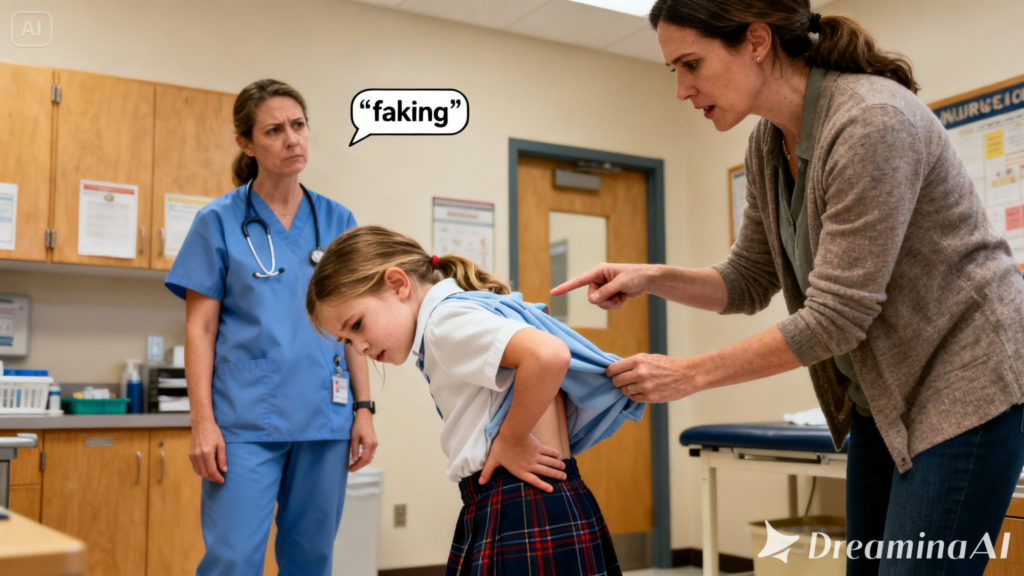
I’ve trusted the public education system with my children for my entire adult life, but sitting in that sterile school clinic smelling of rubbing alcohol, I realized the woman tasked with protecting my little girl had been watching her physically deteriorate for months.
My daughter, Mia, was six years old.
She was the kind of kid who lived for recess.
If there was a jungle gym, she was at the top of it. If there was a race across the blacktop, her scuffed sneakers were leading the pack.
She was pure, unadulterated energy wrapped in pigtails and missing front teeth.
That’s why the sudden change in her behavior in late October hit me so hard.
It started subtly.
I’d pick her up from the carpool lane, and instead of practically vibrating with stories about who tagged who in freeze tag, she would just slump into the backseat.
Her backpack suddenly seemed too heavy for her.
“How was school, sweetie?” I’d ask, looking at her in the rearview mirror.
“Fine,” she would mumble, staring out the window.
At first, I chalked it up to the transition into first grade. It was a longer day, more reading, less playtime.
But then the complaints started.
“Mommy, my leg hurts,” she told me one evening while I was making dinner. She was rubbing her right hip, her little brow furrowed in genuine distress.
I knelt down and felt her leg. No bruises. No swelling.
“Did you fall at recess?” I asked.
She shook her head. “No. It just hurts deep inside.”
I gave her some children’s Tylenol, tucked her into bed, and assumed it was growing pains. We all go through them.
But the pain didn’t stop. It evolved.
By November, the phone calls from the school started.
The first time the caller ID flashed “OAK CREEK ELEMENTARY,” my heart did the mandatory parent drop.
I answered in the middle of a spreadsheet review at work.
“Hello, is this Mia’s mother?” The voice on the other end was dry, professional, and entirely devoid of warmth. “This is Mrs. Gable, the school nurse.”
“Yes, is everything okay?”
“Mia is in my office complaining of hip pain again,” Mrs. Gable said. The word ‘again’ hung heavily in the air. “I’ve checked her over. There’s no bruising, no swelling, no sign of trauma.”
“She’s been complaining about that at home, too,” I explained, feeling a wave of relief that at least the school was noticing. “I think it might be growing pains.”
“Well,” Mrs. Gable sighed, a sound that conveyed a lifetime of dealing with overly dramatic children. “She was just running around perfectly fine during PE according to Mr. Davis. I think she just doesn’t want to participate in the kickball tournament today. I’m sending her back to class.”
I hesitated. “Are you sure? She doesn’t usually fake things.”
“I’ve been a pediatric nurse for twenty years, ma’am,” Mrs. Gable replied, her tone turning icy. “I know a school avoidance tactic when I see one. Have a good day.”
Click.
I stared at my phone, feeling a strange mix of embarrassment and defensiveness.
Maybe Mrs. Gable was right. Maybe the pressure of first grade was getting to Mia, and a phantom hip pain was her ticket out of things she didn’t want to do.
But when Mia came home that afternoon, she was limping.
It wasn’t a dramatic, exaggerated limp. It was a subtle, subconscious drag of her right foot, as if bearing weight on that side sent a jolt of discomfort up her side.
I made an appointment with her pediatrician the next morning.
Dr. Evans was a kind, older man who had seen Mia since she was a newborn. He did a thorough check.
He bent her legs, tapped her knees, and checked her reflexes.
“She seems perfectly healthy,” Dr. Evans concluded, handing her a sticker. “Kids this age grow rapidly. The muscles and tendons stretch, and it can cause localized joint pain. Keep giving her ibuprofen if it flares up, and make sure she’s stretching.”
I felt a massive weight lift off my shoulders. It was just growing pains.
Advertisement
I sent a polite note to Mrs. Gable the next day, explaining the pediatrician’s diagnosis, hoping it would smooth over our previous tense phone call.
I thought that would be the end of it.
I was horribly, tragically wrong.
December arrived, bringing freezing temperatures and a drastic decline in Mia’s health.
The limp became permanent.
She stopped wanting to go to the park entirely. She would sit on the living room rug, playing quietly with her blocks, often shifting her weight awkwardly.
And the calls from Mrs. Gable became a weekly, sometimes daily, occurrence.
Every time, the narrative was the same.
“Mia is in my office. She says her hip hurts.”
“Mia is asking to lay down instead of going to recess.”
“Mia is crying, but I cannot find a single physical reason for it.”
The frustration in Mrs. Gable’s voice grew more palpable with every call. She stopped framing it as an observation and started framing it as an accusation.
“She is taking up valuable resources in the clinic,” Mrs. Gable told me three weeks before Christmas. “I have children with actual fevers and asthma attacks who need these beds. Mia needs to understand that the clinic is not a lounge.”
“She is in pain,” I argued, my grip tightening on the phone. “She’s not sleeping well at night. She cries when she has to walk up the stairs.”
“I strongly suggest you look into behavioral therapy,” Mrs. Gable snapped back. “Because medically, there is absolutely nothing wrong with this child. She is seeking attention.”
I started to doubt myself.
Was I enabling her? Was I failing to set boundaries?
I tried tough love. When Mia complained of pain over the weekend, I encouraged her to push through it.
“The doctor said you’re okay, sweetie. You just need to stretch.”
Mia just looked at me, her big blue eyes swimming with tears. “Mommy, my body feels wrong. It feels broken.”
Advertisement
That phrase—”It feels broken”—haunted me for days.
Children don’t use words like that unless they are trying to communicate something profound.
The breaking point happened on a Tuesday in mid-January.
It was a miserable, sleeting morning. I had a massive quarterly presentation at work and was already operating on three hours of sleep because Mia had been up crying, holding her side.
At 10:15 AM, my phone buzzed on the conference room table.
OAK CREEK ELEMENTARY.
I excused myself, stepping into the hallway, my blood pressure already spiking.
“Hello?”
“She needs to be picked up,” Mrs. Gable said flatly. No greeting. No context.
“What happened? Is she okay?”
“She threw an absolute tantrum in the middle of PE,” Mrs. Gable replied, her voice dripping with disdain. “Screaming that her hip was on fire. She refused to stand up. I had to have the janitor carry her to the clinic. I’ve had enough of this performance. Come get her.”
I didn’t even go back into the meeting. I grabbed my coat, texted my boss a frantic apology, and drove to the school like a madwoman.
My heart was pounding against my ribs. I was angry. I was angry at the school, I was angry at the nurse, and God forgive me, a tiny part of me was frustrated with Mia.
I burst through the front doors of the school, signed the early dismissal log with a violently shaking hand, and marched down the hallway to the clinic.
I pushed the door open.
Mia was curled into a tiny ball on one of the vinyl cots, sobbing into a paper towel. She looked so small, so pale, and so utterly defeated.
Mrs. Gable was sitting at her desk, typing on her computer, not even looking at my child.
“Finally,” Mrs. Gable muttered, turning in her chair. “I’ve written up a disciplinary report for the disruption in PE. This behavior is completely unacceptable.”
I ignored her. I walked over to the cot and gently placed my hand on Mia’s head. She was radiating heat, not from a fever, but from sheer exhaustion and distress.
“Mommy,” she whimpered. “It hurts so bad.”
Advertisement
I turned to Mrs. Gable. “Did you even look at her?”
“I checked her vitals,” the nurse replied defensively, crossing her arms. “Her temperature is normal. Her blood pressure is normal. There is no swelling. As I’ve told you a dozen times, she is faking it to get out of class.”
Something inside me snapped.
It wasn’t a loud, explosive anger. It was a cold, terrifying clarity.
“Stand up, Mia,” I said softly.
Mia sniffled, slowly uncurling her legs. She slid off the cot, wincing in agony as her feet touched the linoleum floor.
“What are you doing?” Mrs. Gable asked, rolling her eyes. “Are you going to reward this behavior by taking her for ice cream?”
“I am going to figure out what is wrong with my daughter,” I said, my voice eerily calm.
I knelt down behind Mia.
“Sweetheart,” I whispered. “I need you to take off your sweater.”
Mia carefully pulled her heavy winter sweater over her head, leaving her in just a thin, white, long-sleeved undershirt.
“Now,” I said, looking directly into Mrs. Gable’s annoyed eyes. “I want you to come over here.”
“I have charting to do,” the nurse sighed.
“COME. OVER. HERE.” My voice echoed off the sterile walls.
Mrs. Gable blinked, startled by my tone. She slowly stood up and walked over, her arms still crossed tightly against her chest.
“Look at her,” I ordered.
“I am looking at her. She looks fine.”
“Look closer.”
I placed my hands on Mia’s hips.
“Mia, baby, I need you to stand as straight as you possibly can. Put your feet together.”
Advertisement
Mia did as she was told. She sniffled, trying to stand tall.
I kept my hands on her hips. My right hand was resting significantly higher than my left hand.
My heart stopped beating for a second.
“Do you see my hands?” I asked the nurse, my voice beginning to tremble.
Mrs. Gable frowned, her eyes dropping to my hands. Her crossed arms slowly began to loosen. “Well, yes, one side is slightly…”
“Now,” I interrupted, a wave of pure nausea washing over me. “Mia, I want you to bend forward and touch your toes. Keep your legs straight.”
Mia took a shaky breath and slowly bent forward, letting her arms dangle toward the floor.
The thin white fabric of her undershirt pulled tight across her back.
The silence in the clinic became deafening.
I heard Mrs. Gable suck in a sharp, ragged breath.
I looked down at my daughter’s back, and the entire world tilted on its axis.
CHAPTER 2
The right side of Mia’s back was pushed upward, forming a hard, unnatural hump just below her shoulder blade.
Her spine didn’t run in a straight, neat line down the center of her back like it was supposed to. Instead, it veered sharply to the right, twisting her ribcage along with it, before curving aggressively back to the left near her lower back.
Her left shoulder blade was sunken, practically swallowed by the curve, while the right one jutted out sharply against the thin cotton of her undershirt. It looked like a broken wing trying to push its way out of her skin.
It wasn’t just uneven. It was deformed. It was a severe, violent distortion of my little girl’s skeleton, hidden right beneath her oversized winter sweaters and fleece pajamas.
The silence in the clinic was absolute, broken only by the sound of Mia’s quiet, labored breathing.
Then came the clatter.
Mrs. Gable dropped her plastic clipboard. It hit the linoleum floor with a sharp crack, scattering printed hall passes and referral slips across the ground.
The school nurse wasn’t looking at me anymore. She wasn’t rolling her eyes. The annoyed, condescending flush had completely drained from her face, leaving her looking sickly and gray beneath the fluorescent lights.
Advertisement
She took a shaky step backward, her hands hovering in the air as if she didn’t know what to do with them.
“Oh my god,” Mrs. Gable breathed out, the words barely a whisper. “Oh my god, her back.”
She stepped forward, reaching a hand out toward Mia.
“Don’t touch her,” I snarled.
My voice was low, but it held a level of venom I didn’t even know I possessed.
Mrs. Gable froze, her hand suspended in mid-air. She looked up at me, her eyes wide with a sudden, horrifying realization of what she had done.
For three months, she had been sending my daughter back to class. She had accused a six-year-old of lying. She had forced a child with a severely twisted, deformed spine to run in gym class, to sit on hard plastic chairs, and to walk through crowded hallways while her body was literally collapsing in on itself.
“I… I didn’t know,” Mrs. Gable stammered, tears suddenly springing to her eyes. The tough, twenty-year veteran nurse facade crumbled into pieces. “She always wore those heavy sweaters. I only checked her hips and legs. I never asked her to bend over. I never checked her alignment.”
“You told me she was faking it,” I said, my voice trembling with a terrifying mixture of rage and overwhelming guilt. “You told me she needed a therapist.”
“I am so sorry,” she whispered, her voice breaking. “You need to take her to a doctor. Right now.”
“I am taking her to the hospital,” I corrected her, turning away.
I knelt down in front of Mia. My hands were shaking so violently I could barely grab the hem of her sweater.
“Okay, baby,” I kept my voice as soft and steady as humanly possible, forcing a smile onto my face that I absolutely did not feel. “You can stand up straight now. We are going to put your sweater back on, and we are going to go for a ride, okay?”
Mia sniffled, wiping her nose with the back of her hand. “Are we going back to class?”
“No, sweetie. No more class today. We’re going to go see a special doctor who is going to fix your hip.”
I carefully pulled the heavy wool sweater back over her head, guiding her arms through the sleeves. I was hyper-aware of every movement now. Every time she shifted her weight, I could see the hidden asymmetry in how her clothes draped over her small frame.
How had I missed this?
The question began to scream in my head on an endless, agonizing loop.
How did I, her mother, the person who bathed her, dressed her, and tucked her in every single night, miss the fact that her spine was curving into the shape of an ‘S’?
The guilt was like a physical weight pressing down on my chest, making it hard to pull air into my lungs.
Advertisement
But I knew the answer. Six-year-olds are fiercely independent. Since school started, Mia had insisted on dressing herself. She wanted her privacy in the bathroom. She lived in baggy hoodies, loose t-shirts, and thick winter coats.
And when she complained of pain, she always pointed to her right hip and her leg. She never pointed to her back.
I scooped Mia up into my arms. She felt so light, yet the burden of what was happening made her feel like she weighed a thousand pounds. She buried her face into my neck, her small hands gripping the collar of my shirt.
I didn’t say another word to Mrs. Gable. I didn’t look at her. I turned my back on the school nurse and walked out of the clinic.
The walk down the elementary school hallway felt like a surreal dream. The walls were covered in bright, cheerful construction paper turkeys and spelling tests with gold stars. I could hear the muffled sounds of a first-grade class singing a song about the alphabet.
It was a world of innocent, normal childhood things, and we had just been violently shoved out of it.
I pushed through the heavy double doors of the school and out into the freezing January sleet. The cold air hit my face, shocking my system and forcing me to focus.
I got to my SUV, opened the back door, and gently set Mia into her booster seat.
“Ouch,” she whimpered as I buckled the straps across her chest.
“I know, baby, I know. I’m sorry. We’re going to hurry.”
I slammed the door shut, ran around to the driver’s side, and climbed in. My hands gripped the steering wheel so hard my knuckles turned white.
I pulled out of the school parking lot and hit the gas.
We lived in a suburb about forty minutes outside of the city, but the best pediatric hospital in the state—Children’s Memorial—was right downtown. I wasn’t going to waste time at a local urgent care or try to get a last-minute appointment with our regular pediatrician.
This wasn’t growing pains. This was an emergency.
I grabbed my phone from the cup holder and hit the speed dial for my husband, Mark.
He was at work, sitting in a glass office at his architectural firm, completely unaware that our entire world had just shattered.
The phone rang three times before he answered.
“Hey, babe,” Mark’s voice came through the car speakers. He sounded distracted, likely looking at a blueprint. “What’s up? I thought you had a big quarterly presentation today.”
“Mark,” I said. My voice cracked. The dam holding back my panic completely broke.
“Whoa, hey, what’s wrong? Are you crying?” His tone instantly shifted from casual to high alert. I heard the sound of a chair scraping against the floor as he stood up.
Advertisement
“It’s Mia,” I sobbed, struggling to keep my eyes on the wet, slick road. “Something is horribly wrong with Mia.”
“Did she get hurt at school? Were you in an accident? Where are you?”
“We’re in the car. We’re driving to Children’s Memorial downtown. You need to meet us there right now, Mark. Just drop everything and go.”
“I’m leaving right now,” he said, and I could hear him grabbing his keys and his coat. “What happened? Tell me what’s wrong with her.”
“It’s her back,” I choked out, glancing at Mia in the rearview mirror. She had her eyes closed and was leaning heavily against the side of her car seat. “Her spine, Mark. It’s twisted. It’s completely deformed. The nurse made her take her shirt off and… oh god, Mark, it looks so bad. One side of her ribs is huge and the other side is collapsed.”
There was a long, terrifying silence on the other end of the line.
“Her spine?” Mark finally said, his voice dropping to a confused whisper. “But she’s been complaining about her hip. The doctor said it was growing pains.”
“The doctor was wrong! We were all wrong!” I yelled, the tears hot and angry on my cheeks. “Just please get to the hospital. I can’t do this alone.”
“I’m ten minutes away. I’ll beat you there. Drive safe, please. I love you.”
He hung up.
The rest of the drive was a blur of gray skies, swishing windshield wipers, and the agonizing sound of Mia occasionally whimpering in the backseat.
I ran three red lights. I didn’t care. If a cop pulled me over, I was going to force him to give us a police escort.
When we finally pulled up to the emergency room entrance of Children’s Memorial, Mark was already standing on the sidewalk, pacing back and forth in the freezing rain without an umbrella.
He ran over to the car before I even put it in park. He wrenched the back door open and unbuckled Mia, lifting her out into the rain and wrapping his large coat around her tiny body.
“Daddy’s got you, peanut,” he whispered into her hair. “I’ve got you.”
We rushed through the sliding glass doors into the ER waiting room.
It was packed. It was flu season, and the room was filled with coughing toddlers, crying babies, and exhausted parents holding plastic buckets. The air smelled of harsh bleach and stale coffee.
I ran straight to the triage window, pushing past a man filling out a clipboard.
“Excuse me,” I said to the nurse behind the thick glass. “My daughter needs a doctor immediately.”
The triage nurse looked up, her expression tired and guarded. She dealt with panicked parents every single hour of her shift.
Advertisement
“Ma’am, you need to sign in and take a seat. We triage based on the severity of the symptoms.”
“Her spine is deformed,” I blurted out, my voice loud enough to make several people in the waiting room turn and look at us. “She has been in severe pain for months, and her spine is completely twisted. She can barely walk.”
The nurse’s expression changed slightly. “Deformed? Like scoliosis?”
“I don’t know what it is!” I cried.
Mark stepped forward, holding Mia tightly against his chest. “Please. Just look at her back.”
The nurse sighed, standing up and opening the security door to the triage area. “Bring her in here. Let’s take a look.”
We followed her into a small, brightly lit room containing a blood pressure cuff, a scale, and an examination table.
“Put her on the table,” the nurse instructed.
Mark gently set Mia down. She immediately curled into a fetal position, holding her right side.
“Okay, sweetheart,” the triage nurse said, her voice dropping into a gentle, soothing tone. “I’m Nurse Kelly. I just need to take a quick peek at your back, okay? I’m not going to hurt you.”
I helped Mia sit up and, for the second time that day, pulled her heavy sweater over her head.
Nurse Kelly stepped behind her.
I watched the nurse’s face. I needed to see a medical professional’s reaction. I needed to know if I was overreacting, if this was somehow normal and fixable.
Nurse Kelly’s eyes widened. She didn’t drop a clipboard like the school nurse had, but her professional composure visibly slipped. Her mouth opened slightly, and she let out a quiet breath.
She reached out and gently traced two fingers down the center of Mia’s back, following the violent, unnatural S-curve of her spine.
“Does this hurt when I press here?” Kelly asked, touching the raised hump on the right side.
Mia shook her head. “No. It hurts down here.” She pointed to her right hip, the same place she had been pointing for three months.
Nurse Kelly didn’t say another word to us. She walked over to the computer mounted on the wall, her fingers flying across the keyboard with a sudden, frantic urgency.
She picked up a black phone on the wall and pressed a single button.
“Hey, it’s triage,” she said into the receiver. “I need an open room in the blue zone immediately. I also need you to page pediatric orthopedics on call. Get them down here right now.”
Advertisement
She hung up the phone and turned back to us. The guarded, tired look was entirely gone, replaced by a sharp, focused intensity.
“We are bypassing the waiting room,” Nurse Kelly said, grabbing a bundle of hospital blankets. “I’m taking you straight back to a room. They are going to get an x-ray machine in there within the next five minutes.”
“What is it?” Mark asked, his voice shaking. He reached out and grabbed my hand. His fingers were ice cold. “Is it scoliosis?”
“It is a severe spinal curvature,” Nurse Kelly said carefully, choosing her words like a diplomat navigating a minefield. “But we need imaging to see exactly what the structure looks like on the inside.”
She led us down a long, white hallway, through heavy double doors, and into the main emergency department. The noise level spiked—monitors beeping, nurses calling out orders, the hum of medical equipment.
They put us in Trauma Room 3. It was a massive room, designed for worst-case scenarios, filled with terrifying-looking machines and bright surgical lights mounted to the ceiling.
A team of nurses descended on us immediately. They moved with practiced efficiency, stripping Mia out of her clothes and putting her into a faded hospital gown covered in cartoon bears. They checked her vitals, attached a pulse oximeter to her finger, and asked us a rapid-fire series of questions about her medical history.
When did the pain start? (October.) Did she fall? (No.) Has she had any fevers? (No.) Any numbness in her legs? (No.)
Then, the portable x-ray machine arrived. It looked like a giant, mechanical praying mantis.
The technician, a kind woman named Sarah, asked Mark and me to step out into the hallway while they took the images.
We stood in the busy corridor, backed against the wall as doctors and nurses hurried past us.
Mark pulled me into his chest, burying his face in my hair. He was shaking. My big, strong husband, the man who never panicked about anything, was trembling like a leaf in the wind.
“It’s going to be okay,” he whispered, but it sounded like he was trying to convince himself, not me. “Kids get scoliosis all the time. They wear a brace. They do physical therapy. Sometimes they do surgery, and then it’s fine. It’s going to be fine.”
“She’s been in so much pain, Mark,” I cried against his shirt. “I made her go to school. I made her walk on it. The nurse told me she was crazy, and I started to believe her.”
“Don’t do that,” he said, pulling back to look me in the eyes. “We trusted the doctors. We trusted the school. You couldn’t have known.”
“I’m her mother. I should have known.”
The heavy door to Trauma Room 3 opened, and Sarah the x-ray tech wheeled the machine out.
“All done,” she said softly. “The doctor will be in to review the images with you momentarily.”
We rushed back into the room. Mia was sitting on the edge of the large hospital bed, her legs dangling over the side. The cartoon bears on her gown seemed to mock the gravity of the situation. She looked exhausted, her eyes heavy and dark.
Advertisement
We waited for what felt like an eternity. The clock on the wall ticked loudly, each second stretching out into an agonizing hour.
Fifteen minutes later, the door finally swung open.
A tall man in blue scrubs and a white coat walked in. He had graying hair, kind eyes, and a very serious expression. The badge clipped to his pocket read: Dr. Aris, Pediatric Orthopedic Surgery.
“Mr. and Mrs. Miller?” he asked, extending a hand.
We shook it, murmuring our greetings.
“I’m Dr. Aris,” he said, walking over to the computer station mounted on the wall. “I’ve just reviewed Mia’s x-rays.”
He typed his password in, and the large monitor on the wall flickered to life.
He clicked a button, and a black-and-white image appeared on the screen.
It was an x-ray of a human torso, from the neck down to the pelvis.
Mark let out a sharp gasp. I covered my mouth with both hands, feeling the bile rise in my throat.
Seeing the deformity from the outside was terrible. But seeing it on the inside, seeing the actual bones, was a nightmare made real.
The spine on the screen didn’t look like a support column. It looked like a snake writhing in agony. It curved drastically to the right in the thoracic region, the ribs splayed out and distorted, before violently whipping back to the left in the lumbar region.
It was a massive, terrifying “S”.
“This is Mia’s spine,” Dr. Aris said quietly, using his mouse to point to the screen. “What we are looking at is a severe case of scoliosis. We measure the severity of the curve using something called a Cobb angle. A normal spine is zero degrees. Mild scoliosis is anything over ten degrees. Surgery is typically considered when the curve reaches forty-five to fifty degrees.”
He paused, turning to look at us.
“Mia’s primary curve is currently measuring at sixty-two degrees.”
The room started to spin. Sixty-two degrees. Her spine was bent nearly in half.
“How does this happen?” Mark asked, his voice thick with emotion. “She was perfectly straight a year ago at her five-year checkup. How does a bone bend that much in a few months?”
“That is exactly the question we need to answer,” Dr. Aris said, and his tone shifted. It became lower, more cautious. “Idiopathic scoliosis—which means scoliosis with no known cause—is very common in children and teenagers. It happens as they grow.”
He turned back to the screen, his finger tracing the white outline of the bones.
Advertisement
“However, idiopathic scoliosis is almost never painful.”
The words hung in the air, cold and heavy.
“What do you mean?” I asked, my heart hammering against my ribs. “Mia has been in agonizing pain since October.”
“I know,” Dr. Aris said softly. “When a child this young presents with a rapidly progressing spinal curve and severe, localized pain… it tells us that the spine isn’t just curving naturally.”
He zoomed in on the lower part of the x-ray, right near the lumbar region, pointing to the exact spot where Mia had been complaining of hip pain.
“The spine is curving defensively,” the doctor explained. “It is twisting to get away from something.”
“Get away from what?” Mark demanded, stepping closer to the screen.
Dr. Aris pointed to a faint, cloudy shadow on the x-ray, nestled deep against the vertebrae in Mia’s lower back.
“There is something right here,” he said, his voice deadly serious. “It’s pressing against her nerves and forcing the spine to bend out of its way to avoid the pressure. X-rays only show us bone clearly. They don’t give us a good look at soft tissue.”
I felt the blood drain completely from my face. My knees grew weak, and I had to grab the metal railing of Mia’s hospital bed to keep from collapsing onto the floor.
“What is the shadow?” I whispered, terrified of the answer.
“I don’t know yet,” Dr. Aris replied, closing the image on the screen. “It could be a cyst. It could be a tethered spinal cord. Or, it could be a tumor.”
The word hit the room like a physical shockwave.
Tumor.
“I’ve already ordered an emergency MRI with contrast,” Dr. Aris continued, his professional mask fully in place as he prepared to move fast. “They are clearing the machine for her right now. We need to get a clear picture of exactly what is growing inside her back, and we need to do it tonight.”
CHAPTER 3
The word “tumor” hung in the sterile air of Trauma Room 3, heavy and suffocating, like a thick cloud of toxic smoke.
For a terrifying, endless moment, all the noise in the massive emergency department seemed to vanish. The beeping monitors, the frantic shouting in the hallway, the chaotic hum of the hospital—it all faded into a dull, underwater ringing in my ears.
Tumor.
It is a word no parent should ever have to hear. It is a word that belongs in movies, in tragic news articles about other people’s families. It does not belong in the same sentence as your vibrant, energetic, six-year-old daughter.
Advertisement
I looked at Mark.
The color had completely drained from his face, leaving his skin a pale, sickly gray beneath the harsh fluorescent lights. His jaw was clenched so tightly I could see a muscle jumping erratically in his cheek. He was staring at the blank computer monitor where the x-ray had been just seconds ago, as if hoping he could burn a hole through the plastic screen with his eyes and make the image disappear.
“A tumor,” Mark finally repeated, his voice barely a hollow whisper. It sounded like the word tasted like ash in his mouth. “Are you telling me my little girl has cancer?”
Dr. Aris held up a hand, his expression instantly shifting into a calm, steadying mask of professional reassurance.
“I am not saying that,” Dr. Aris said firmly, his voice cutting through the rising panic in the room. “Please, listen to me carefully. Not all tumors are cancerous. In fact, many pediatric bone tumors are benign. But benign does not mean harmless.”
He took a step closer to us, lowering his voice so it wouldn’t carry over to where Mia was sitting on the examination table.
“Whatever this mass is,” Dr. Aris continued, pointing toward Mia’s back, “it is taking up space inside her spinal canal. It is pressing directly against her nerves. That pressure is what is causing her agonizing hip pain, and it is what is forcing her spine to twist so violently out of alignment to protect itself. We need to know exactly what it is, how big it is, and what it is attached to.”
“So, what happens now?” I asked. My voice sounded foreign to me. It was shaky, thin, and terrified.
“We need a magnetic resonance imaging scan. An MRI,” Dr. Aris explained, his tone brisk and commanding. “An x-ray only shows us hard bone. An MRI will give us a high-definition, three-dimensional view of all the soft tissues, the nerves, the spinal cord, and the mass itself. I have already ordered it stat. The technicians are clearing the schedule for her as we speak.”
I looked over at Mia.
She was sitting on the edge of the large, terrifying hospital bed, her tiny legs dangling over the side. The cartoon bears on her faded hospital gown seemed to mock the absolute gravity of the situation. She looked utterly exhausted. Her normally bright blue eyes were heavy, ringed with dark circles that spoke of months of interrupted sleep and hidden agony.
She was clutching her right hip, her little fingers digging into the fabric of the gown.
“Is the machine going to hurt?” she asked, her bottom lip trembling.
She had been so brave all day. She had endured the rough handling at school, the frantic car ride, the poking and prodding in triage, and the cold metal plates of the x-ray machine. But she was reaching her breaking point.
I walked over and wrapped my arms around her, burying my face in her soft, messy hair.
“No, sweetie,” I whispered, fighting back the hot tears that were threatening to spill over my eyelashes. “The machine doesn’t hurt at all. It’s just a big camera that takes pictures of your insides. Like a superhero x-ray vision machine.”
Advertisement
“But she can’t hold still,” Mark pointed out, walking over to join us. He gently placed his large, warm hand over Mia’s small one. “She’s in too much pain. She’s been squirming and shifting her weight for weeks. How is she going to lay perfectly still in an MRI tube for an hour?”
“She won’t have to,” Dr. Aris said softly. “Because of her age, and because of her severe pain levels, we are not going to force her to stay awake. We are going to put her to sleep under general anesthesia.”
My heart hammered a frantic rhythm against my ribs.
Anesthesia.
There is something deeply, primal, and inherently terrifying about handing your child over to a doctor, knowing they are going to artificially stop their consciousness. It feels like a violation of the natural order of things.
“Is it safe?” I asked, my grip tightening on Mia. “She’s so small.”
“We have an excellent pediatric anesthesiology team,” Dr. Aris reassured me. “They do this every single day. But first, we need to get an IV line started. The nurses are going to come in and do that now. Then, a transport team will take you all down to the basement where the imaging center is located.”
He gave us a single, empathetic nod and quickly walked out of the room, leaving us alone in the terrifying silence.
The silence didn’t last long.
A team of two pediatric nurses entered Trauma Room 3 less than a minute later. They were aggressively cheerful, wheeling a metal cart loaded with plastic tubing, alcohol wipes, and syringes.
“Alright, Miss Mia!” the taller nurse said, flashing a bright smile that didn’t quite reach her eyes. “My name is Sarah, and this is my buddy Jessica. We need to give you a special straw in your arm so you can get some sleepy medicine for your pictures.”
Mia’s eyes went wide with pure panic. She knew what a needle was.
“No,” she whimpered, shrinking back against my chest. “No, Mommy, please. I don’t want a shot. I want to go home.”
“I know, baby, I know,” I murmured, my heart breaking into a million tiny, irreparable pieces. “But this is the only way we can fix your hip. You have to be brave for just one more minute.”
Mark moved to the other side of the bed. He leaned down, his face inches from hers.
“Hey, look at me, peanut,” Mark said, his voice surprisingly steady. “Squeeze my hand. Squeeze it as hard as you can. You can break my fingers if you want to. Just look right at me.”
Mia grabbed Mark’s large hand with both of hers, squeezing with a surprising amount of desperate strength.
Nurse Sarah tied a blue rubber tourniquet tightly around Mia’s thin forearm. She tapped the skin, searching for a viable vein.
“You’re going to feel a little pinch, sweetie,” Sarah warned. “One, two, three.”
Mia let out a sharp, piercing scream that echoed off the tile walls of the trauma room. It was a sound that will haunt my nightmares for the rest of my life. It wasn’t just a cry of physical pain; it was a cry of pure, helpless terror.
Advertisement
I squeezed my eyes shut, burying my face in her shoulder so she wouldn’t see the tears streaming down my own face. I felt like a failure. I felt like a monster for holding her down.
“All done, all done!” Nurse Sarah cheered, expertly taping the clear plastic hub to Mia’s arm. “You did so good! You are the bravest girl in the whole hospital.”
Mia was sobbing hysterically, her small body trembling uncontrollably. Mark kept his forehead pressed against hers, whispering quiet words of comfort, promising her ice cream, promising her a puppy, promising her anything in the world if she would just hold on.
Ten minutes later, a transport orderly arrived with a massive metal crib on wheels.
We laid Mia inside it, pulling the warm hospital blankets up to her chin. Mark and I walked on either side of the crib as the orderly pushed us out of the chaotic emergency department, down a long corridor, and into a large freight elevator.
We rode down into the basement of Children’s Memorial.
The basement was entirely different from the bright, frantic energy of the ER. It was quiet, dimly lit, and freezing cold. The walls were painted a calming, muted blue, but it didn’t feel calm. It felt isolated. It felt like we were descending into a dungeon.
We were guided into a small holding bay outside the massive metal doors of the MRI suite.
A woman in green surgical scrubs walked over to us. She had a kind, tired face and an incredibly gentle demeanor.
“Hello, I’m Dr. Patel,” she said softly, shaking both of our hands. “I am the pediatric anesthesiologist. I am going to be taking care of Mia while she sleeps.”
She asked us a series of rapid-fire questions about Mia’s medical history, making sure she hadn’t eaten anything in the last eight hours, checking for allergies, reviewing her weight.
“Okay,” Dr. Patel finally said, looking down at Mia, who was staring up at the ceiling, her eyes heavy and unfocused from the exhaustion of crying. “I am going to give her a medication through her IV called Versed. It is going to make her feel very silly, very relaxed, and she won’t remember anything that happens after this point.”
Dr. Patel attached a small plastic syringe to the port on Mia’s IV line and slowly pushed a clear liquid into her vein.
The effect was almost immediate.
Within thirty seconds, the rigid tension in Mia’s body completely melted away. Her heavy eyelids drooped. The tight, agonizing grip she had on Mark’s hand slowly loosened.
“Mommy?” Mia slurred, her words thick and heavy.
“I’m right here, baby,” I said, leaning over the metal railing of the crib.
“The room is spinning,” she whispered, a small, dopey smile spreading across her lips. “It’s a merry-go-round.”
“Enjoy the ride, sweetie,” Mark choked out, wiping a stray tear from his cheek.
“Alright,” Dr. Patel said, her voice entirely professional. “We are going to take her into the scanning room now. We will put her fully to sleep once she is on the table. The scan will take approximately ninety minutes. There is a family waiting room just down the hall. We will come get you the second she is awake in recovery.”
Advertisement
I leaned down and kissed Mia’s forehead. Her skin felt cool and clammy.
“I love you so much,” I whispered into her ear.
The orderly began to push the crib away.
Mark and I stood in the freezing hallway, watching our tiny, helpless six-year-old daughter being wheeled through the heavy metal doors of the MRI suite.
When the doors clicked shut behind her, the finality of the sound hit me like a physical blow to the stomach.
She was gone. We were completely powerless.
Mark wrapped his arms around me, pulling me tight against his chest. I finally let go. I buried my face in his coat and sobbed. I cried for the pain my daughter was in. I cried for the horrifying shadow on the x-ray.
And most of all, I cried because of the crushing, suffocating guilt of the last three months.
We slowly walked down the long, empty hallway toward the family waiting room.
It was a small, depressing square room lined with uncomfortable vinyl chairs, outdated magazines, and a vending machine humming loudly in the corner. There was a large clock mounted on the wall.
The red second hand ticked forward with agonizing slowness.
Tick. Tick. Tick.
Every single sound in that room felt magnified.
Mark began to pace. He walked from the window to the door, back and forth, over and over again. His heavy boots squeaked against the cheap linoleum floor.
“I’m going to ruin her life,” Mark said suddenly, his voice low and vibrating with a terrifying, absolute anger.
I looked up from my hands. “What?”
“That nurse,” Mark snarled, stopping his pacing to look at me. His eyes were dark and furious. “Mrs. Gable. I am going to march into that elementary school on Monday morning, and I am going to have her fired. I am going to sue the school district. I am going to make sure she never works with a child ever again.”
He ran a hand roughly through his hair.
“She called my daughter a liar. She forced her to run in gym class while a tumor was crushing her spine. She told you we needed a therapist.”
His voice cracked on the last word, the anger dissolving rapidly back into overwhelming despair. He sank into a plastic chair next to me, dropping his head into his hands.
Advertisement
“We trusted them,” Mark whispered into his palms. “We trusted the pediatrician. We trusted the school. We just told her to take an ibuprofen and go to sleep.”
“Don’t do this, Mark,” I pleaded, reaching out to rub his back. The muscles beneath his shirt were pulled tight as steel cables. “You couldn’t have known. I couldn’t have known.”
“You knew something was wrong today,” he pointed out, looking up at me with red, bloodshot eyes. “You went down there. You forced the issue. If you hadn’t made her take her shirt off, she would still be sitting in that clinic right now, being called a faker.”
His words hit me like a bucket of ice water.
He was right.
If Mrs. Gable hadn’t pushed me to my absolute breaking point today, I never would have snapped. I never would have demanded she look closer. I would have just taken Mia home, given her Tylenol, and put her to bed again.
The school nurse’s absolute cruelty had inadvertently saved my daughter’s life. It was a sickening, twisted irony that made my stomach churn with nausea.
The next ninety minutes were the longest, darkest hours of my entire life.
We didn’t talk much. We just sat there, listening to the hum of the vending machine and the relentless ticking of the clock. Every time footsteps echoed in the hallway outside the waiting room, our heads snapped toward the door, our hearts leaping into our throats, terrified that it was a doctor coming to deliver catastrophic news.
Outside the hospital windows, the gray January afternoon slowly faded into pitch-black night. The sleet turned to heavy snow, burying the city streets under a thick blanket of white.
At exactly 6:45 PM, the heavy wooden door of the waiting room finally swung open.
It was Dr. Patel, the anesthesiologist.
She looked exhausted, but she offered us a small, reassuring smile.
“The scan is completely finished,” she announced. “Mia did incredibly well. She is waking up in the recovery room right now. You can come sit with her.”
Mark and I practically sprinted out of the waiting room.
We followed Dr. Patel down the hallway and into the Post-Anesthesia Care Unit. It was a large, quiet room filled with beds separated by privacy curtains.
Mia was lying in a bed near the back corner.
She looked so fragile. She was hooked up to a heart monitor that was beeping a slow, steady rhythm. She had an oxygen mask resting gently over her nose and mouth, pumping moist air into her lungs.
Her eyes fluttered open as we walked up to the bed.
“Mommy?” she croaked, her voice dry and raspy from the breathing tube they had used during the scan.
Advertisement
“I’m here, sweetie,” I said, leaning over the rail and pressing my cheek against hers. “I’m right here. It’s all done. You did so good.”
“Can we go home now?” she asked, closing her eyes again.
“Soon, baby. We just have to talk to the doctor first.”
We sat by her bed for another agonizing hour as she drifted in and out of a deep, drug-induced sleep. The post-anesthesia nurses checked her vitals, removed the oxygen mask, and eventually allowed her to take tiny sips of apple juice from a plastic cup.
She was safe. She was breathing. But the heavy, terrifying question still hung over our heads like an executioner’s axe.
What did the MRI show?
At 8:15 PM, the privacy curtain surrounding Mia’s bed was pulled sharply back.
Dr. Aris stood there.
He had changed out of his surgical scrubs and was now wearing a tailored suit and a long white coat. He looked immaculate, professional, and deadly serious. He held a thick manila folder in his hands.
He didn’t offer us a comforting smile. He didn’t ask how Mia was doing.
He looked directly at Mark, and then at me.
“Mr. and Mrs. Miller,” Dr. Aris said, his voice dropping into a low, somber register that immediately sent a jolt of pure terror straight down my spine. “I have the results of the MRI.”
“Okay,” Mark said, standing up from his plastic chair. He unconsciously positioned his body between the doctor and Mia’s bed, as if he could physically protect her from the words that were about to come out of the surgeon’s mouth. “Tell us.”
“I would prefer to do this in a private setting,” Dr. Aris replied, gesturing toward the hallway. “Mia is resting comfortably. The nurses will monitor her. Please, follow me to the consultation room.”
You never want to be invited to the consultation room.
In a hospital, the consultation room is the place where bad news is delivered. It is the room with the soft couches, the dim lighting, and the strategically placed boxes of tissues on every table. It is the room where worlds end.
My legs felt like they were made of lead as I followed Mark and Dr. Aris out of the recovery unit.
We walked into a small, carpeted room down the hall. Dr. Aris closed the heavy wooden door behind us, sealing us in. The click of the latch sounded like a gunshot.
He walked over to a large computer monitor mounted on the wall, tapped the keyboard, and the screen roared to life.
It wasn’t a blurry, black-and-white x-ray this time.
Advertisement
It was a terrifyingly clear, high-definition, cross-sectional view of the inside of my daughter’s body. I could see the exact shape of her vertebrae. I could see the dark, vital rope of her spinal cord running down the center of the bones.
And I could see the monster.
There was a massive, glowing white mass sitting right in the center of her lower back. It was shockingly huge. It didn’t look like a neat, round cyst. It looked chaotic. It looked angry.
“What you are looking at,” Dr. Aris began, pointing a pen at the glowing white mass on the screen, “is a tumor.”
The word felt just as horrifying the second time.
“Is it cancer?” Mark demanded, his voice shaking violently.
“Based on the imaging characteristics, I am highly confident that this is a benign bone tumor,” Dr. Aris said.
A wave of dizzying relief washed over me. Benign. Not cancer. It wasn’t cancer.
“Thank god,” I breathed out, reaching for Mark’s hand.
But Dr. Aris didn’t smile. He didn’t relax. His face remained carved in stone.
“Do not mistake benign for safe,” Dr. Aris warned, his tone sharp enough to instantly kill my relief. “Cancer kills by spreading. This tumor kills by destroying what is right next to it.”
He used his pen to trace the jagged edges of the glowing white mass.
“This is called an Osteoblastoma,” the surgeon explained. “It is a rare, aggressive type of bone tumor that grows extremely fast. It has likely been growing inside her for the last four months, slowly expanding.”
He clicked the mouse, and the image on the screen rotated, showing us the spine from a different angle.
The image was so horrific I literally stopped breathing.
The tumor wasn’t just sitting next to the bone. It was consuming it. The glowing mass had eaten through the hard outer shell of her vertebra and was violently pushing its way into the center of the spinal column.
“The tumor has grown so large,” Dr. Aris said, his voice devoid of any emotion, “that it has completely filled the spinal canal.”
He pointed to the dark rope of her spinal cord.
The massive white tumor was pressing directly into it, crushing the vital nerves against the bone.
“This is why her spine twisted,” Dr. Aris continued. “Her body physically warped her skeleton by sixty-two degrees trying to create more space in the canal, trying to get her spinal cord away from the tumor. But there is no more room left.”
Advertisement
He turned away from the screen and looked directly into my eyes.
“Mrs. Miller,” he said, his voice dropping to a horrifying whisper. “The tumor is currently strangling your daughter’s spinal cord. If we do not intervene immediately, the pressure will sever the nerves.”
The room started to spin violently.
“What does that mean?” Mark asked, stepping backward until his back hit the wall.
Dr. Aris didn’t flinch. He didn’t sugarcoat it.
“It means that if we do not remove this mass, Mia will be permanently paralyzed from the waist down.”
CHAPTER 4
“Paralyzed.”
The word didn’t just hang in the air. It hit me like a physical blow, a baseball bat swung directly into my stomach. It knocked the wind entirely out of my lungs, leaving me gasping in the sterile, air-conditioned chill of the consultation room.
I looked at Mark.
My husband, the man who built custom homes for a living, the man who understood structural integrity and weight-bearing walls, looked like his entire foundation had just been kicked out from under him. He was leaning heavily against the wall, his chest heaving as he stared at the glowing white mass on the computer screen.
“From the waist down,” Mark repeated, his voice completely hollow. He wasn’t asking a question. He was testing the reality of the words, trying to see if they made any sense in the universe we lived in. They didn’t.
“If the cord is severed or crushed beyond repair, yes,” Dr. Aris confirmed. His tone was brutally honest. There was no sugarcoating, no false hope, no gentle bedside manner left. We were out of time for pleasantries.
“But you can take it out,” I pleaded, stepping forward, gripping the edge of the doctor’s desk so hard my fingernails dug into the cheap wood veneer. “You said it’s a tumor. You’re a surgeon. You can just cut it out, right?”
Dr. Aris sighed, a long, heavy sound that made him look ten years older. He turned off the monitor, plunging the room into dim lighting.
“I can cut it out,” he said carefully. “But you need to understand the extreme complexity of what we are dealing with. This is not a surface-level mass. This Osteoblastoma is actively eating into the pedicle and lamina of her vertebra.”
He held up his hands, using his fingers to create a makeshift model of a spinal column.
“The tumor is wrapped around the dura—the protective sac holding the spinal cord—like vines wrapped around a fragile tree branch. To get it out, I cannot simply pull it. If I pull it, I tear the spinal cord. She wakes up paralyzed.”
A fresh wave of nausea washed over me. I clamped a hand over my mouth, terrified I was going to be sick right there on the carpet.
“So, what do you do?” Mark demanded, stepping away from the wall. His protective instincts were kicking in, replacing the shock with a frantic, desperate need for a plan.
Advertisement
“We do a very long, very dangerous surgery. Tonight,” Dr. Aris said, his eyes locking onto Mark’s. “I have already booked Operating Room 7. We are going to open her back. We have to perform a laminectomy—which means physically cutting away the back portion of her spine—just to access the tumor. Then, using microscopic instruments, my team and I will slowly, millimeter by millimeter, scrape the tumor off the nerve roots and the spinal cord.”
He paused, letting the terrifying reality of the procedure sink in.
“Because we are removing bone, her spine will be completely unstable once the tumor is gone. It will collapse. So, we will have to perform a spinal fusion. We will insert titanium screws into the healthy vertebrae above and below the surgical site, and attach two solid titanium rods to hold her spine in place. We will physically force her spine back into a straight line and lock it there.”
Titanium rods. Screws. Laminectomy. Scraping a tumor off a nerve.
This was my six-year-old daughter. A girl who was crying over a scraped knee two days ago. A girl who still slept with a stuffed rabbit missing one ear.
“What are the risks?” Mark asked. His voice was steady, but his hands were shaking violently.
Dr. Aris walked over to the desk and picked up the thick manila folder. He pulled out a stack of paper covered in dense, terrifying legal text.
“The risks are catastrophic bleeding,” Dr. Aris said, handing the papers to Mark. “The tumor is highly vascular; it bleeds heavily when cut. We have blood on standby. The other risk is infection, as with any major open surgery. And the primary risk…”
He didn’t want to say it again. He didn’t have to.
“Paralysis,” I whispered.
“Yes,” Dr. Aris nodded slowly. “If a nerve is nicked during the scraping process, or if the cord loses blood supply during the fusion, the damage could be permanent. But I must be absolutely clear with you both: doing nothing is no longer an option. If we do not operate tonight, the tumor will crush the cord completely within days. The paralysis is inevitable without intervention.”
Mark didn’t hesitate. He didn’t read the papers. He grabbed a pen from the desk and signed his name on the bottom of the consent forms with sharp, violent strokes. He handed the pen to me.
I stared at the black ink. I was signing away my daughter’s body. I was giving this man permission to cut her open, to break her bones, and to put metal into her spine.
I signed my name. The ink blurred as tears fell freely onto the paper.
“We will prep her immediately,” Dr. Aris said, taking the forms. “You have ten minutes to say goodbye in the pre-op holding area. Then, she is mine for the next eight to twelve hours.”
He left the room, leaving the door wide open.
Mark and I stood in the silence for a long moment. Then, he wrapped his arms around me. He didn’t say it was going to be okay. He didn’t offer empty promises. He just held me together, acting as the structural support for my collapsing world.
Advertisement
We walked back down the hallway to the holding area.
Mia was awake, but heavily sedated. They had moved her to a surgical gurney. She was wearing a tiny surgical cap over her messy blonde hair, and they had hooked her up to a new set of monitors.
A nurse was gently taping a second IV line into her other hand.
“Mommy,” Mia slurred, blinking heavily at the bright lights overhead. “Are we going home now?”
My heart shattered all over again. I plastered on the bravest, most convincing smile I have ever faked in my entire life.
“Not yet, sweetie,” I said, leaning over the metal railing of the gurney, brushing my lips against her warm forehead. “Dr. Aris found out what is making your hip hurt so much. He’s going to fix it tonight while you take a really long, deep sleep.”
“Will it hurt?” she whispered.
“No, baby,” Mark said, leaning in beside me. He took her tiny hand in his. “You won’t feel a single thing. It’s just going to feel like a nap. And when you wake up, Mommy and Daddy are going to be sitting right next to you.”
“Can I have ice cream when I wake up?” she asked, her eyes fluttering shut.
“You can have all the ice cream in the world,” I choked out, a tear escaping and dropping onto the white hospital blanket. “Chocolate, vanilla, strawberry. Whatever you want.”
Two surgical nurses dressed in blue scrubs and surgical masks walked over.
“It’s time, mom and dad,” the taller nurse said gently. “We need to take her back to OR 7 now.”
I kissed her cheek. I kissed her nose. I kissed her forehead. I didn’t want to let go of the metal railing. Every instinct in my biological makeup was screaming at me to grab her, run out the automatic doors, and hide her from the knives and the monitors.
But I stepped back.
Mark wrapped his arm around my waist, anchoring me to the floor as the nurses unlocked the wheels of the gurney.
We walked alongside the bed down the long, freezing corridor until we reached a set of massive, heavy double doors that read: AUTHORIZED SURGICAL PERSONNEL ONLY.
The nurses pushed the gurney through the doors.
Mia was asleep, her chest rising and falling with the rhythm of the monitors.
The heavy doors swung shut with a dull, final thud.
The physical separation was agonizing. It felt like someone had reached into my chest and pulled out my heart, taking it behind those doors while leaving me standing in the hallway to bleed out.
Advertisement
The next ten hours were an exercise in psychological torture.
The surgical waiting room on the third floor was completely empty. It was past midnight. The rest of the hospital was quiet, but our world was completely consumed by the chaotic ticking of the wall clock.
We drank terrible, bitter coffee from styrofoam cups. We paced the length of the room until our feet ached. We stared out the large windows at the dark city skyline, watching the snow fall silently onto the empty streets below.
At 2:00 AM, Mark broke the silence.
He was sitting in an uncomfortable vinyl chair, staring blankly at the dark television screen in the corner.
“I am going to destroy that school,” he said. His voice wasn’t loud. It was deadly calm, which was somehow much more terrifying.
I looked at him, pulling a thin hospital blanket tighter around my shoulders.
“Mark, don’t focus on that right now.”
“I have to focus on it,” he snapped, his eyes flashing with raw, unprocessed anger. “Because if I don’t focus on it, I’m going to picture them cutting my little girl’s spine open, and I will lose my mind.”
He stood up, pacing again.
“Mrs. Gable. That was her name, right? The nurse.” He practically spit the name out. “She let this tumor grow for four months. She watched our daughter limp. She watched her cry. And she called her a liar. She told you we were bad parents enabling a behavioral issue.”
“She didn’t know,” I said, playing devil’s advocate purely to keep Mark grounded. “She’s not a doctor.”
“She’s a nurse!” Mark yelled, his voice echoing in the empty room. “Her one job is to protect those kids! She didn’t even look at her back! She just assumed she knew better. That arrogant, dismissive woman could have paralyzed our daughter permanently because she couldn’t be bothered to ask a six-year-old to bend over.”
He stopped pacing and looked at me, his face crumbling. The anger vanished, replaced instantly by the crushing weight of grief.
“And I believed her,” he whispered, dropping into the chair next to me. He buried his face in his hands. “When you told me what she said, I actually thought… maybe Mia is just looking for attention. I doubted my own kid.”
“I did too,” I admitted, the guilt threatening to drown me. I reached out and pulled his head onto my shoulder. “We both did. We listened to the authority figures. We thought the school and the pediatrician knew best. We will never make that mistake again.”
We sat like that for hours, leaning on each other as the darkest part of the night slowly gave way to the gray, pale light of dawn.
At 6:30 AM, the waiting room phone rang.
The sound was so loud and abrupt I physically jumped out of my chair.
Mark grabbed the receiver. His knuckles were white.
Advertisement
“Hello?” he said, his voice trembling.
He listened for a few seconds. “Okay. Yes, we are here. We will wait.”
He hung up the phone and looked at me, his eyes wide.
“It was the OR circulating nurse,” Mark said, his breathing shallow and rapid. “They are closing her up. The surgery is over. Dr. Aris is coming out to talk to us.”
My legs gave out. I sank back into the chair, clutching my stomach.
This was the moment. This was the moment our entire lives would be defined by. She was either whole, or she was paralyzed. There was no middle ground.
Ten minutes later, the heavy wooden door of the waiting room pushed open.
Dr. Aris walked in.
He looked like he had just survived a war. His surgical scrubs were rumpled and stained with sweat. The surgical mask was pulled down around his neck, revealing deep, dark circles under his eyes. There were tiny, microscopic flecks of dried blood on his shoes.
He walked slowly, his shoulders slumped with exhaustion.
He stopped in front of us. He didn’t sit down.
“Mr. and Mrs. Miller,” Dr. Aris said, his voice raspy and thick.
I couldn’t breathe. I couldn’t blink. I was frozen in time.
Dr. Aris looked directly at me, and a slow, exhausted, genuinely beautiful smile broke across his tired face.
“We got it,” he said quietly.
The oxygen rushed back into the room.
“We got the entire tumor,” Dr. Aris continued, leaning against the back of a chair for support. “It was heavily entangled with the nerve roots, just as we suspected. It took us six hours just to peel the mass away from the dura without tearing it. But we managed to remove the mass completely with clean margins.”
“The spinal cord?” Mark asked, tears already spilling down his cheeks. “Is it intact?”
“The cord is perfectly intact,” Dr. Aris nodded. “We removed the damaged bone, realigned her spine, and completed the fusion with the titanium hardware. Her spine is straight. And most importantly, the pressure is completely gone.”
I grabbed Mark, burying my face in his chest, sobbing uncontrollably. The relief was so intense it physically hurt. It felt like a thousand-pound boulder had been lifted off my ribcage.
Advertisement
“She is in the Pediatric Intensive Care Unit now,” Dr. Aris said, giving us a moment to process the news. “She is still intubated and heavily sedated. We will slowly wake her up over the next few hours to perform a neurological check. I want to be there when she wakes up. You can come see her now.”
We followed him out of the waiting room. My legs felt like jelly, but I practically floated down the hallway.
The PICU was a completely different world. It was quiet, highly monitored, and filled with a terrifying array of life-support equipment.
They led us to Room 4.
Mia was lying perfectly flat in a massive, specialized bed. She looked incredibly small. There was a breathing tube taped to her mouth, thick IV lines going into her neck, and a drain tube coming out of her lower back, collecting dark fluid into a plastic bulb.
She looked broken, battered, and bruised. But to me, she had never looked more beautiful.
We sat by her bed, holding her hands, watching the monitors beep with a steady, reassuring rhythm.
It took three hours for the anesthesia to completely wear off.
At 10:00 AM, the PICU nurses removed the breathing tube. Mia coughed violently, her eyes fluttering open, confused and terrified by the bright lights and the tubes attached to her body.
“Mommy,” she tried to say, but no sound came out of her raw throat.
“I’m right here, my brave girl,” I said, stroking her hair. “Daddy is here too. You did it. The surgery is over. The doctor fixed your back.”
Dr. Aris walked into the room. He had showered and changed into fresh clothes, looking much more like the confident surgeon we had met the day before.
He walked over to the bottom of Mia’s bed and pulled the heavy hospital blanket back, exposing her bare feet.
The entire room held its collective breath.
This was the final test. This was the moment of truth.
“Hi, Mia,” Dr. Aris said gently, leaning over the end of the bed. “I know you’re very sleepy, and I know your back hurts a lot right now. But I need you to do a big job for me, okay?”
Mia blinked slowly, staring at the doctor.
Dr. Aris took his pen and lightly dragged the blunt end of it across the sole of Mia’s right foot.
“Mia,” Dr. Aris said, his voice commanding but incredibly gentle. “Can you wiggle your toes for me?”
The silence in the ICU room was absolute. I stopped breathing. Mark squeezed my hand so hard I thought my bones were going to snap.
Advertisement
I stared at her tiny, pale foot.
Nothing happened.
One second. Two seconds.
Panic, cold and sharp, began to crawl up my throat.
“Come on, peanut,” Mark whispered, a desperate plea to the universe. “Wiggle your toes.”
Then, a miracle happened.
Her big toe twitched.
Then, slowly, deliberately, all five toes on her right foot curled downward, and then fanned back out.
Dr. Aris moved to her left foot and ran the pen across the sole.
Instantly, her left toes wiggled, pushing against the air.
“That’s my girl,” Dr. Aris breathed out, a massive smile lighting up his face. He looked up at us, his eyes shining. “Neurological function is completely intact. She is going to walk.”
Mark collapsed into the chair beside the bed, burying his face in the blankets, weeping openly. I fell to my knees, holding onto the metal railing, thanking God, thanking the universe, and thanking the brilliant, exhausted surgeon standing at the foot of the bed.
The nightmare was over.
Recovery was not easy.
It was a brutal, grueling marathon. We spent three weeks living in that hospital room. Mia had to re-learn how to sit up, how to stand, and how to walk with the massive titanium hardware locked into her spine. There were days filled with agonizing physical therapy, tears of frustration, and heavy doses of pain medication.
But every single day, she got stronger.
Four weeks after the surgery, Mia walked out of Children’s Memorial Hospital using a small pediatric walker. She walked straight, her spine perfectly aligned, the terrible, unnatural hump entirely gone.
Two months after that, the walker was retired to the garage.
And Mark kept his promise.
He didn’t march into the school and shout at the nurse. He did something much more effective. He took Mia’s MRI images, the surgical report detailing the absolute severity of the tumor, and a timeline of the nurse’s documented refusals to provide care, straight to the district superintendent and the school board.
Mrs. Gable resigned before she could be formally terminated. We never saw her again. The school district implemented new, mandatory training for all clinic staff regarding the proper physical assessment of children reporting chronic pain.
It was a small victory, but it meant no other child in that district would ever be dismissed the way Mia was.
Today, it has been over a year since that terrifying January afternoon.
Mia is seven years old now. She is back in school, running on the blacktop, and climbing the jungle gym with the reckless abandon of a normal second grader.
The only physical reminder of the nightmare is a long, thin, silver scar running straight down the center of her lower back. It is a beautiful, terrible badge of honor. It is the zipper that saved her life.
Every night, when I help her put on her pajamas, my hand inevitably brushes against that scar.
It serves as a constant, permanent reminder of a truth that I will carry with me for the rest of my life.
Authority figures are not infallible. Medical degrees and decades of experience do not automatically guarantee perfect judgment. Sometimes, the systems designed to protect our children fail them spectacularly.
When your child tells you they are broken, you listen to them. You don’t let a tired nurse tell you they are lying. You don’t let a busy doctor brush you off. You demand answers. You demand tests. You force them to look closer.
Because nobody knows your child the way you do. And sometimes, the only thing standing between your child and an unimaginable tragedy is a mother who absolutely refuses to back down.