It was a cold and desolate morning when a rescue volunteer received a frantic call that would forever change the course of a tiny puppy’s life. The air was thick with a chilling sense of hopelessness as the volunteer made their way through the abandoned streets, each step heavy with the knowledge of what they might find.
In an alleyway, amidst the remnants of broken dreams and neglected lives, four small bodies lay still. Three puppies, lifeless and cold, were curled together in a tragic embrace. The little bodies, once full of energy and life, were now victims of a brutal attack that had stolen their futures away. But there, in the center of the tragedy, was one tiny survivor—a puppy, barely older than a few weeks, lying weakly next to his siblings, his tiny body trembling with fear and confusion.
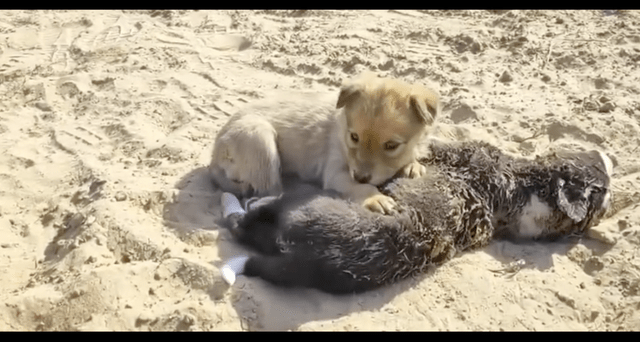
The puppy’s large eyes were wide with disbelief as he nudged at his siblings’ unmoving forms, desperately trying to wake them. His cries, small and broken, echoed through the empty street, as though he knew something had gone terribly wrong but couldn’t grasp the reason why. To him, this was just another day in the world he had been born into, a world that had already shown him cruelty and loss. He didn’t understand the coldness of his siblings, only that he was now alone.
As his tiny form curled next to his siblings, stray dogs circled nearby, sensing the weakness of the vulnerable puppy. If no one stepped in, he would surely be the next victim, just another nameless casualty in the forgotten corners of the city. But fate had not abandoned him yet.
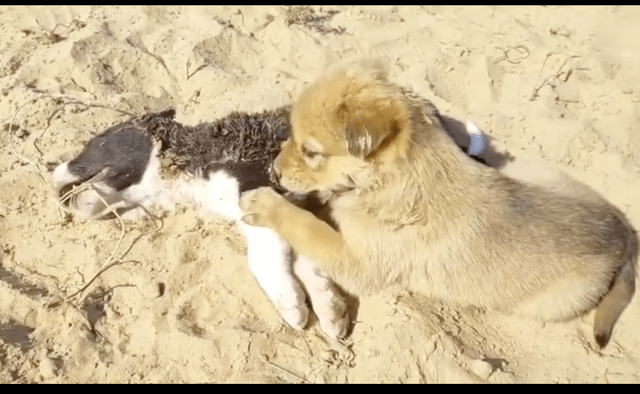
A rescue volunteer, arriving just in time, spotted the fragile puppy and rushed to his side. The sight of the puppy, trembling and confused, struck a deep chord of empathy in the volunteer’s heart. With a gentle hand, the volunteer scooped him up, holding him close to their chest for warmth and comfort. The puppy, weak and terrified, seemed to understand the safety of the arms that held him, even though he had known nothing but hardship up until that moment.
The journey to safety was a blur for the little one. His world had been filled with pain, hunger, and the cold weight of abandonment, but now, for the first time, he was cradled in a place of safety. The volunteer whispered calming words to him, assuring him that he was no longer alone, that help had come at last.
At the veterinary clinic, the tiny puppy was given the warmth and care he had desperately needed. His frail body was examined, and the vet noted the injuries he had sustained from the attack. But more importantly, they recognized the emotional trauma the puppy had endured. His tiny body was shaking not just from the cold, but from fear—a fear that had been instilled in him from the moment he was born into a world so harsh and unforgiving.
The puppy was carefully treated for his wounds and given time to recover. As the days passed, he began to respond to the gentle care of the clinic staff. Slowly, his eyes began to lose their fearful haze, and the soft, playful nature that is often found in puppies began to shine through. The trauma of his past would not disappear overnight, but with each new day, the little survivor began to trust again.
May you like
A Homeless Stranger, a Shared Burger, and My Dad’s Legacy.226
Lady Bug: The Toy That Brought My Grandma Back to Life.487
The Officer Who Gave a Boy More Than Gifts—He Gave Hope.744
His recovery wasn’t immediate, nor was it without its challenges. At first, he was withdrawn, still unsure of his surroundings and the people who now cared for him. But, with patience and love, the puppy’s true nature began to emerge. He learned that not all humans were cruel, and he started to respond to the kind voices and the gentle hands that offered him comfort. Slowly, he began to play again, first tentatively, then with more joy. His tail wagged once more, and the spark of life that had been dimmed by his tragic past began to burn brightly again.
As time passed, the tiny survivor grew stronger—physically, emotionally, and socially. His once-weak body filled out, and his playful spirit returned in full force. He loved to chase after toys, his tiny paws moving with the exuberance of youth. He formed bonds with other dogs at the clinic, learning the joys of companionship and socialization. The puppy who had once been so terrified of the world now greeted it with curiosity and joy. He had learned to trust again, and with that trust came the ability to experience the simple joys of life—things he had never known before.
Eventually, the day came when the little puppy was ready for his forever home. His story, a testament to resilience and survival, had caught the attention of a family who had been searching for the perfect dog to bring into their home. They had heard about his journey—how he had survived the impossible—and they knew that he was the dog they had been waiting for.
When the family first met him, he was hesitant, but there was something in his eyes that spoke of his past—a past full of pain, but also of survival. His new family greeted him with love and warmth, and though it took time, the puppy began to understand that this was his new home. It wasn’t just a roof over his head—it was a place filled with love, care, and safety. Slowly, he began to trust again, this time with a family who would never hurt him.
The puppy, now named Max, became a beloved member of his new family. He played with the children, ran through the yard with boundless energy, and curled up at night beside his owners, secure in the knowledge that he was safe. His transformation from a scared, lonely pup to a confident, happy dog was nothing short of miraculous. Max’s story was not just one of survival, but of the power of compassion and second chances.
For Max, the journey had been long and filled with pain, but it was also a story of triumph over adversity. He had been given a chance to heal, to trust, and to live a life filled with love. And though the scars of his past remained, they were no longer the defining feature of his life. Instead, it was the love, joy, and resilience that defined who he had become.
Max’s story is a powerful reminder that every life, no matter how broken or small, is worth saving. No creature, no matter the circumstances, should be left to suffer. His journey from pain to joy, from fear to trust, is a testament to the healing power of love and compassion, and it is a story that will inspire all who hear it.
HB 87: A Misguided Bill Targeting Florida’s Black Bears.3034

A recent bill passed by the Florida Legislature has sparked a wave of debate. Dubbed HB 87, it would allow anyone to kill a black bear at any time, for any reason, even if the bear is not a threat. The bill was presented under the pretense that black bears are ingesting illegal drugs and causing property damage, yet there is no credible evidence to support such claims. In fact, these so-called “crack bears” do not exist.
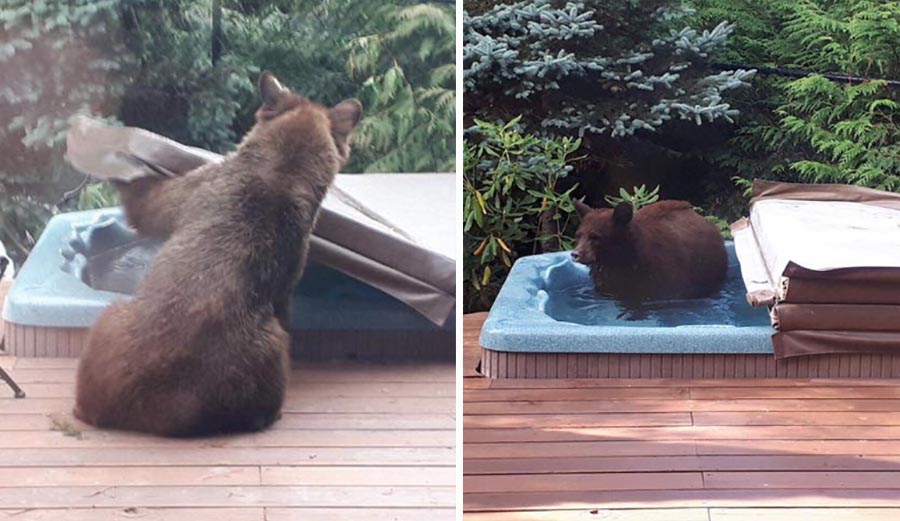
Black bears are naturally curious animals, known to explore areas close to human settlements in search of food. It’s not uncommon for bears to wander into suburban neighborhoods, sometimes even lounging in hot tubs or rummaging through garbage. However, these bears are not dangerous. Black bears are typically non-aggressive and prefer to avoid human contact. Most bear
encounters are harmless, with the bear either running away or simply going about its business.

Yet, some legislators have introduced HB 87, arguing that the bill is necessary to protect Florida residents from these supposedly drug-affected animals. The claim that bears are consuming illegal drugs and causing destruction is highly dubious. In fact, there are no verified reports of black bears using or ingesting drugs. Bears may scavenge human food or garbage, but their behavior is driven by hunger, not by any external substances. The real issue lies in human encroachment on bear habitats, which forces these animals into areas where they might inadvertently cause damage in search of food.
The Florida Fish and Wildlife Conservation Commission (FWC) already has measures in place to manage bear populations and prevent conflicts with humans. These include education programs to teach people how to coexist with bears and reduce attractants, such as securing trash and using bear-resistant containers. In fact, bear-related incidents are rare, and attacks on humans are even rarer.
So, why is HB 87 gaining traction? The bill seems to be based on fear-mongering rather than fact. It’s important to question the motives behind the bill. Could it be a response to a few isolated incidents where bears have caused property damage? Or is it simply a political move, capitalizing on fear to pass legislation that will make it easier for individuals to harm wildlife? What’s clear is that the bill’s premise—killing bears in response to alleged drug use—is unfounded and extreme.
If passed, HB 87 would effectively open the door for anyone to kill a bear on sight, regardless of whether the animal poses a real threat. This would not only undermine the safety of bears, but also disrupt the delicate balance of Florida’s ecosystem. Black bears play a vital role in maintaining the health of the forest by dispersing seeds and controlling populations of smaller animals. Removing them from the environment would have long-term consequences that could ripple throughout the food chain.
The real solution to bear-related issues is not to kill these animals, but to address the root cause: human behavior. The growing population of Florida is pushing further into bear habitats, and with urban sprawl, there’s an increasing likelihood of bear-human interactions. It is essential to invest in education and proper wildlife management strategies to help people and bears coexist peacefully.
Advocates for wildlife are strongly opposing HB 87, warning that it will set a dangerous precedent for wildlife management across the state. Many believe that the bill is part of a broader effort to weaken protections for wildlife, making it easier for individuals to kill animals that are perceived as nuisances. If this bill passes, it could lead to a troubling trend where other species, not just black bears, are targeted as scapegoats for human issues.
Instead of passing laws that allow the killing of bears without cause, Florida lawmakers should focus on better solutions to ensure the safety of both humans and wildlife. This includes supporting wildlife education programs, improving bear-proofing methods in neighborhoods, and enhancing conservation efforts to protect bear habitats. By doing so, Florida can maintain its natural beauty and biodiversity, ensuring that future generations can enjoy the sight of black bears in their natural environment.
The bottom line is that black bears are not a threat to humans, and HB 87 is a misguided bill based on fear and misinformation. It is essential that Floridians speak out against this legislation and demand that lawmakers prioritize the well-being of both wildlife and people. It’s time to reject fear-driven policies and adopt solutions that promote peaceful coexistence with the animals who share our world.