The Falcon’s Justice
PART I — THE KNEELING FIGURE IN THE RAIN
The windshield wipers of my sedan were fighting a losing battle, slapping frantically against the glass in a futile attempt to clear the deluge pounding Beverly Hills. It was 8:00 PM, and the world outside was a blurred watercolor of gray rain and streetlights. Inside the car, the air was warm, smelling faintly of the chicken casserole I had wrapped in a thick towel on the passenger seat.
I was driving to see Isabelle, my daughter. She was three months pregnant, battling a nausea so relentless it had hollowed out her cheeks and stolen the light from her eyes. I hoped a taste of home—her favorite comfort food—might coax her appetite back.
I pulled up to the imposing wrought-iron gates of the Thompson estate. Even through the roar of the rain, the sounds of a party drifted out—bass-heavy music, the sharp clink of crystal, and laughter that sounded careless and expensive.
I rang the video doorbell. The little blue light blinked, but no one answered.
I waited a minute, anxiety beginning to coil in my stomach like a cold snake. I pressed it again, holding my thumb down longer. Still nothing.
I pulled out my phone and dialed Isabelle. It rang once, then cut straight to voicemail.
“Hi, this is Isabelle. Leave a message.”
My heart sank. A mother’s instinct is a primal thing; it doesn’t whisper, it screams. And right now, it was screaming that something was wrong.
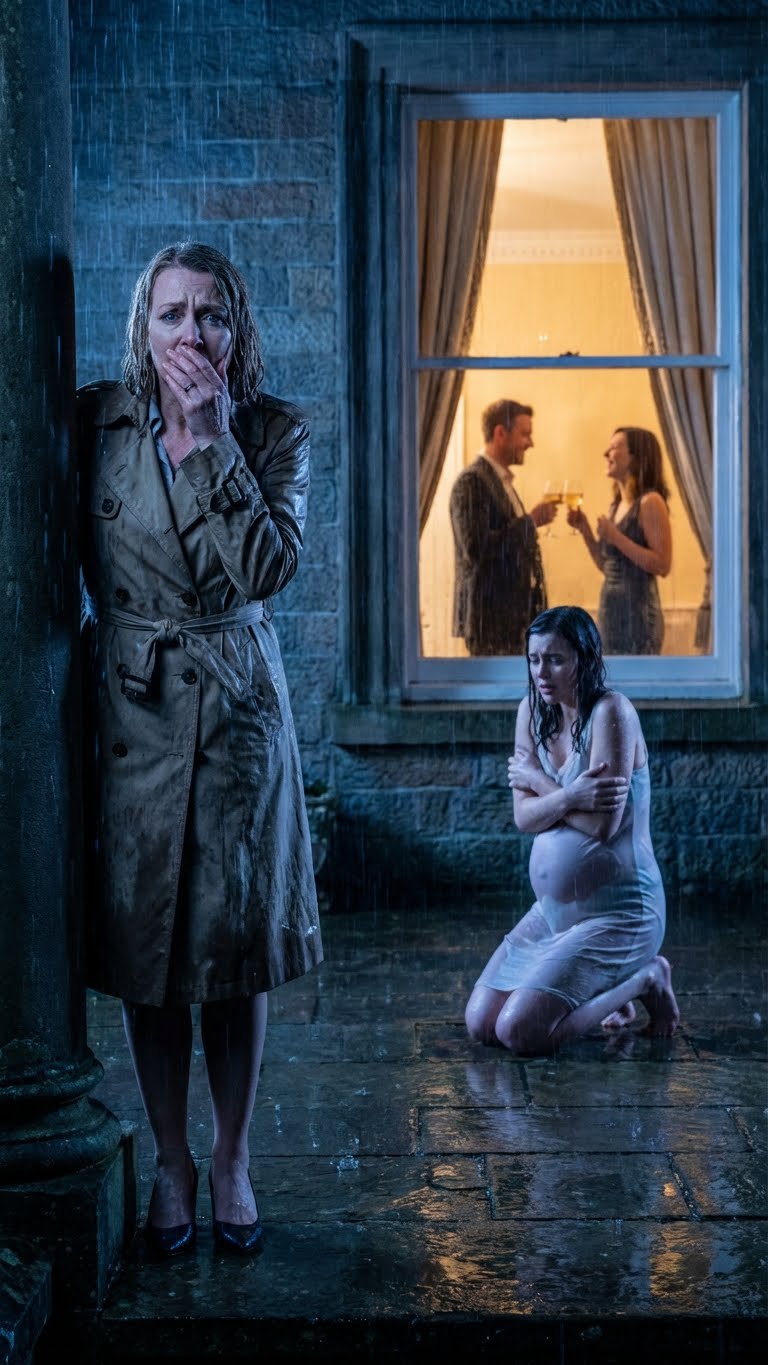
I got out of the car, shielding my head with my coat, and ran to the living room window. The curtains were open, revealing a scene bathed in warm, golden light. Jackson, my son-in-law, was sprawled on a leather sofa that cost more than my car, a video game controller in his hands. His mother, Mrs. Thompson, stood nearby, swirling a glass of red wine and laughing with a group of strangers.
It looked perfect. It looked normal. But Isabelle wasn’t there.
I walked around the side of the house, my shoes squelching in the mud, toward the small garden gate I knew was usually unlocked. I pushed it open.
And then I saw her.
Under the dim, yellow spill of the porch light, my daughter was kneeling on the freezing flagstone patio.
The rain hammered down on her. She was wearing a thin floral dress—the one she had bought just last week, twirling in the mirror with a rare smile. Now, it clung to her shivering frame, outlining the small swell of her baby bump. Her head was bowed, water streaming down her face, indistinguishable from the tears I knew were there. Her lips were blue. Her hands were clasped tightly over her thighs, knuckles white.
She looked like a penitent sinner. She looked broken.
A choked cry escaped my throat. I ran to her, dropping to my knees on the hard stone, pulling her freezing body against mine.
“Issa! My baby! Oh my God, what happened?”
She lifted her head slowly. Her eyes were open but vacant, staring through me to some terrifying place I couldn’t see. Her teeth chattered violently.
“Mom,” she whispered, her voice a broken reed. “I… I only bought a maternity dress. That’s all.”
The sentence was so simple, so innocent, that it took a moment to register. And when it did, the shock vanished, replaced by a volcanic, white-hot fury I hadn’t felt in decades.
I stripped off my coat and wrapped it around her. I stood up, lifting her into my arms. She was light, terrifyingly light.
My name is Elena Miller, but thirty years ago, the world knew me as “The Falcon.” I was a National Taekwondo Gold Medalist. I had retired my belt, buried that part of myself under layers of motherhood and gentleness. But tonight, The Falcon woke up.
I turned toward the back door—a solid oak barrier between my suffering child and the monsters inside. I didn’t knock. I didn’t shout. I focused every ounce of my rage, every year of training, into my right leg.
KIAA!
The kick was perfect. The door exploded inward, the wood shattering around the lock.
The music stopped. The laughter died.
I stepped into the luxurious warmth of the living room, water dripping from my hair, holding my barely conscious daughter like a pieta.
Jackson jumped up, dropping his controller. Mrs. Thompson froze, her wine glass tilting dangerously.
“God will not forgive this cruelty,” I said. My voice wasn’t loud, but it filled the room, echoing off the high ceilings.
No one moved. Jackson looked at me with annoyance, not shame. Mrs. Thompson stared at Isabelle with eyes as cold as a winter frost.
I didn’t wait for an explanation. There are moments when words are useless, when the only language left is action. I turned and walked back out into the rain.
I had to get her to the hospital.
CLIFFHANGER:
As I sped toward the ER, Isabelle began to whimper in the backseat. “It hurts, Mom… it hurts.” I glanced in the rearview mirror and saw her clutching her stomach, her face twisted in agony. I pressed the accelerator to the floor, praying to a God I hadn’t spoken to in years. But as the hospital lights came into view, Isabelle let out a sharp, guttural scream that stopped my heart cold.
PART II — THE SHATTERED DREAM
The emergency room doors burst open, and the white, antiseptic light blinded me. Nurses swarmed the car, their voices a blur of urgency as they lifted Isabelle onto a gurney.
“Family waits here!” a nurse shouted, pushing me back as they wheeled my daughter through the double doors.
I collapsed onto a plastic chair in the waiting room, my wet clothes clinging to my skin. I wasn’t shivering from the cold anymore. I was shaking from a rage so profound it felt like poison in my blood.
A young nurse brought me a cup of tea. “Drink,” she said gently. “It will help.”
I held the cup, feeling the heat seep into my numb fingers, and suddenly I was transported back. Not to a happy memory, but to the night my life broke the first time.
I remembered the stadium lights, the gold medal around my neck, the pride in my husband Richard’s eyes. We were the golden couple. But when a knee injury ended my career, Richard didn’t offer comfort. He offered scorn. He called me useless. He started drinking. And one rainy night, just like this one, he raised his hand to me.
Ten-year-old Isabelle had run between us. “Daddy, don’t!” she had screamed.
He pushed her. She fell. Her head hit the table.
That was the night The Falcon returned. I took him down, packed our bags, and never looked back. I promised myself then: No man will ever hurt my daughter again.
I had failed.
“Mrs. Miller?”
I looked up. A doctor with graying hair stood over me, his face grim. He pulled down his mask.
“We did everything we could,” he said softly. “Your daughter suffered severe hypothermia. It triggered violent uterine contractions. I’m so sorry… we lost the baby.”
The tea cup slipped from my fingers and shattered on the floor.
Lost.
The word hung in the air, heavy and final.
They let me see her. She looked small in the hospital bed, her skin translucent. I sat beside her and took her hand. It was ice cold.
When she woke up, her hand went instinctively to her stomach. She looked at me, her eyes wide with a question she didn’t want to ask.
I didn’t have to speak. My tears told her everything.
She broke. It wasn’t a scream; it was a low, keening wail that tore through the room.
“Mom,” she gasped, grabbing my arm. “Please… don’t make a scene. Jackson didn’t mean it. His mother just… she has rules. I love him. Please.”
I stared at her. Love? This wasn’t love. This was Stockholm Syndrome wrapped in a wedding band. But looking at her broken face, I couldn’t scream. I nodded, lying to her for the first time in my life.
“Rest, baby. We’ll talk later.”
Three days passed. Jackson didn’t call. Mrs. Thompson didn’t visit. Their silence was a verdict.
On the third day, my patience evaporated. I left Isabelle sleeping and drove back to the Thompson estate.
This time, I pounded on the front door with my fists.
Jackson answered, looking disheveled in silk pajamas. “What the hell are you doing here?” he sneered.
“Why?” I demanded, my voice trembling. “Why haven’t you come? Do you know she lost the baby?”
Jackson smirked. It was a cruel, twisted expression. “Go for what? To see her face? Your daughter is useless, Elena. She couldn’t even keep the kid. She spends my money on trashy dresses and cries for attention. Let her suffer the consequences.”
The air left my lungs.
I looked at him—really looked at him—and realized there was nothing human behind his eyes. He was a hollow shell painted with money.
I didn’t hit him. I didn’t scream. I turned and walked away. Because I realized in that moment that physical pain would be too easy for him. He deserved to be destroyed completely.
As I walked to my car, I noticed something across the street. A small red light blinking on the neighbor’s porch.
Mr. Peterson, a retired professor who lived opposite the Thompsons, had recently installed a high-end security system.
I crossed the street. Mr. Peterson opened the door before I could knock. He saw my face and ushered me inside.
“I saw you the other night,” he said quietly, leading me to his study. “And I saw what they did.”
He sat at his computer and pulled up the footage.
There it was. High-definition cruelty.
The wide-angle lens captured everything: Isabelle kneeling in the rain, shaking. Mrs. Thompson walking past the window with her wine, looking out, and turning away laughing. Jackson playing his video game, oblivious to his wife freezing a few yards away.
“They’re animals,” Mr. Peterson muttered. He handed me a USB drive. “Take it. Get justice.”
I took the drive to Amy Miller, the toughest lawyer in San Francisco. She watched the video in silence, her face hardening into stone.
“This is powerful,” she said. “But the Thompsons will fight dirty. Are you ready for a war?”
“I don’t care about the war,” I said. “I care about the victory.”
Amy sent a legal notice that afternoon. We were suing for abuse and damages.
But that night, the Thompsons struck back.
I woke up at 3:00 AM to a sound in my living room. I grabbed a baseball bat and ran out, but the front door was wide open. My purse was dumped on the floor.
The USB drive was gone.
And so was the box containing all of Isabelle’s medical records.
I called Amy, panic rising in my throat. “They broke in! They took the evidence!”
“Lock your doors,” Amy said, her voice tight. “This just got dangerous.”
The next morning, the rumors started.
Mrs. Rodriguez, my neighbor, stopped me in the hall. “Elena… people are saying Isabelle faked the pregnancy. They’re saying she’s mentally unstable and doing this for money.”
I felt the ground shift under my feet. They weren’t just defending themselves; they were rewriting reality. They were destroying my daughter’s reputation before we even stepped into a courtroom.
I was cornered. I had no evidence, no credibility, and a daughter who was being painted as a liar.
Then, my phone buzzed.
Unknown number.
“I have a copy of the video. If you want justice, meet me at the Black Cat Café at 4:00 PM. Come alone.”
CLIFFHANGER:
I walked into the café with my heart in my throat. A figure sat in the back booth, wearing a hooded jacket. As I approached, the person looked up and lowered the hood. I gasped. It was Caroline Thompson—Jackson’s younger sister. She slid a black USB drive across the table. “My mother thinks she destroyed the evidence,” Caroline whispered, her eyes burning with a fierce, quiet anger. “She was wrong.”
PART III — THE TURN OF THE TIDE
I stared at the young woman across from me. Caroline Thompson had always been a ghost at family gatherings—a quiet, hunched figure in the shadow of her mother’s dominance and her brother’s arrogance. But the woman sitting in the Black Cat Café looked different. Her jaw was set, her eyes clear and defiant.
“Why?” I asked, my voice barely a whisper. “Why are you helping us?”
Caroline took a deep breath. “Because I was next,” she said.
She told me her story. How her mother had forced her out of college, crushing her dream of becoming a journalist. How she had cut up her credit cards, locked her in the house, and tried to arrange a marriage with a business partner’s son.
“Isabelle was the only one who was kind to me,” Caroline said, tears welling in her eyes. “When she got pregnant, she was so happy. And that night… I heard her crying outside. I tried to go to her, but Mom had locked the doors. I watched through the window, helpless.”
She tapped the USB drive. “I heard them planning the break-in at your house. They laughed about it. Jackson said, ‘Let the crazy old woman try to fight us now.’ That was the last straw. I snuck into Jackson’s office while they were asleep and copied the file.”
She pushed the drive into my hand. Her fingers were cold, but her grip was strong.
“Destroy them, Mrs. Miller,” she said. “For Isabelle. And for me.”
I left the café feeling like I was carrying a grenade.
I drove straight to Amy’s office. When she saw the drive, a rare, sharp smile crossed her face.
“They made a fatal mistake,” Amy said, plugging it in. “By breaking into your house, they turned a civil suit into a criminal conspiracy. But we aren’t going to court yet. We’re going to the court of public opinion.”
The next morning, Amy contacted Michael, an investigative journalist known for taking down bullies. We gave him everything: the video, the medical records (which the hospital luckily had digital backups of), and Caroline’s account of the family dynamics.
The article dropped at noon.
“THE PRICE OF A DRESS: How a Beverly Hills Dynasty Tormented a Pregnant Woman.”
The video—with Isabelle’s face blurred—went viral in hours. The hashtag #JusticeForIsabelle trended worldwide. The image of a pregnant woman kneeling in the rain while her family partied inside struck a nerve that transcended class and geography.
The Thompsons’ response was immediate and catastrophic.
Jackson called a press conference outside their gates. He stood there in a thousand-dollar suit, looking into the cameras with a practiced, sorrowful expression.
“This is a tragedy,” he said, his voice trembling theatrically. “My mother-in-law is extorting us. Isabelle… she has mental health struggles. There was no baby. She imagined the pregnancy. We were trying to help her during a psychotic break.”
I watched from Isabelle’s hospital room. Beside me, Isabelle stared at the TV, her face pale.
“He’s lying,” she whispered. “He’s telling the world I’m crazy.”
“Watch,” I said.
As soon as Jackson finished speaking, Michael published the second part of his investigation: a high-resolution photo of the hospital report, stamped and signed.
DIAGNOSIS: Intrauterine Pregnancy, 12 Weeks. CAUSE OF MISCARRIAGE: Severe Hypothermia and Physical Trauma.
The internet exploded. Jackson wasn’t just a villain anymore; he was a liar caught in 4K.
Crowds gathered outside the Thompson estate. They threw eggs, garbage, and red paint at the pristine white walls. They chanted “Baby Killer.”
That night, Caroline called me. “My mother had a heart attack,” she said, her voice shaking. “The stress… she collapsed.”
We didn’t gloat. We issued a statement asking for calm. “Justice belongs in the courtroom,” Amy wrote.
But the real victory happened in the hospital room. Isabelle turned off the TV. She looked at me, her eyes dry and clear for the first time in months.
“Mom,” she said. “I want a divorce.”
The trial was a spectacle. Jackson arrived looking haggard, stripped of his arrogance. His lawyer tried to paint Isabelle as unstable, but when Amy played the video in the courtroom, the silence was deafening. You could hear the rain. You could hear the indifference.
Then Caroline took the stand.
She walked in with her head high. She looked at her brother, who stared at her with pure hatred, and didn’t flinch.
“I am here,” she told the judge, “because the truth matters more than the family name.”
Her testimony sealed his fate.
The judge sentenced Jackson to two years of probation, mandatory anger management, and a massive settlement for damages. The divorce was granted immediately.
But the story wasn’t over.
Two weeks later, Mrs. Thompson died in the hospital. Caroline called to tell us. She didn’t sound sad, just tired.
“She left a letter,” Caroline said. “For you.”
Caroline brought it over before she left for New York to restart her journalism degree. We sat in my living room, and I opened the envelope.
The handwriting was shaky, stripped of its usual pretension.
To Elena and Isabelle,
I cannot ask for forgiveness. I know I don’t deserve it. I treated my children like chess pieces and my daughter-in-law like an enemy. I paid for my pride with my life and my family’s honor.
I cannot bring the baby back. But I can try to balance the scales.
Included was a copy of her will. She had bypassed Jackson entirely. She left the bulk of her estate to a foundation for victims of domestic abuse.
It wasn’t redemption. But it was an ending.
CLIFFHANGER:
A year later, Isabelle and I were closing up her new design studio, Rebirth, in Greenwich Village. She was happy, successful, healing. As we locked the door, a sudden spring shower began to fall. Isabelle stopped. She didn’t run for cover. She stood in the rain, tilting her face up to the sky, letting the water wash over her. She smiled at me. “It’s just water, Mom,” she said. “It can’t hurt us anymore.” But as we turned to leave, a black car pulled up to the curb. The window rolled down. It was Jackson. He looked older, broken. “Isabelle,” he called out. “Please. I have nowhere else to go.”
PART IV — THE RAINBOW AFTER THE STORM
I stepped in front of Isabelle instinctively, my body remembering the stance of The Falcon.
Jackson looked pathetic. His suit was frayed at the cuffs. His eyes were bloodshot. The arrogance that had defined him was gone, replaced by a desperate, hungry look.
“Isabelle,” he pleaded, ignoring me. “The settlement… the lawyers took everything. My friends won’t talk to me. I’m living in a motel. You have to help me. We were family.”
Isabelle stepped out from behind me. She didn’t look scared. She looked at him with a detachment that was more powerful than anger.
“We were never family, Jackson,” she said calmly. “Family protects you. You destroyed me.”
“I made a mistake!” he shouted, desperation cracking his voice. “I was listening to my mother! She controlled everything!”
“And now you’re free,” Isabelle said. “Just like me. What you do with that freedom is up to you. But you will not do it here.”
She turned to me. “Let’s go, Mom.”
We walked away. Jackson screamed insults at our backs, reverting to his true nature when pity didn’t work. We didn’t turn around.
That evening, we walked along the Hudson River. The rain had stopped, leaving the city scrubbed clean and glistening. A massive double rainbow arched over the Manhattan skyline.
“Do you think he’ll come back?” Isabelle asked.
“No,” I said. “He’s a coward. Cowards only attack when they think you’re weak. He knows you’re strong now.”
Isabelle nodded. She touched the faint scar on her forehead—the reminder of her father’s rage so many years ago.
“I used to hate this scar,” she said. “Now… I think it’s a map. It shows where I’ve been.”
“And where you’re going,” I added.
We watched the river flow, carrying the debris of the storm out to sea.
Isabelle’s studio, Rebirth, became a haven. Her maternity line wasn’t just about fashion; it was about dignity. Women came to her not just for clothes, but for the feeling of being seen. I managed the books, watching my daughter turn her trauma into armor for others.
Caroline writes to us from New York. She’s winning awards for her journalism. She exposed a corrupt landlord last month. She calls us her “real family.”
I realized something profound in the quiet moments of my life now.
Pain is inevitable. But suffering? Suffering is what happens when you stay silent.
I lost a grandchild. I almost lost a daughter. But in the fire of that loss, we forged something unbreakable.
If you are reading this, and you are kneeling in your own rain—whether it’s a bad marriage, a toxic family, or a situation that makes you feel small—listen to me.
Stand up.
Kick down the door.
Find your voice.
Because the only thing waiting for you on your knees is more rain. But on your feet?
On your feet, you can see the rainbow.
THE END
Like and share this post if you find it interesting.