Dust rode the late-day wind through Frontier Market, drawing thin, restless streams across the planks and hardpacked earth, as if the town itself wanted to move on.
Sunlight slanted low and tired, glazing wagons half-loaded with crates nobody bothered to touch, while vendors lingered with forced smiles that fooled no one watching.
Parents pretended to browse, children kicked stones near the trough, and every voice seemed carefully measured, because tension lived here like a second shadow.
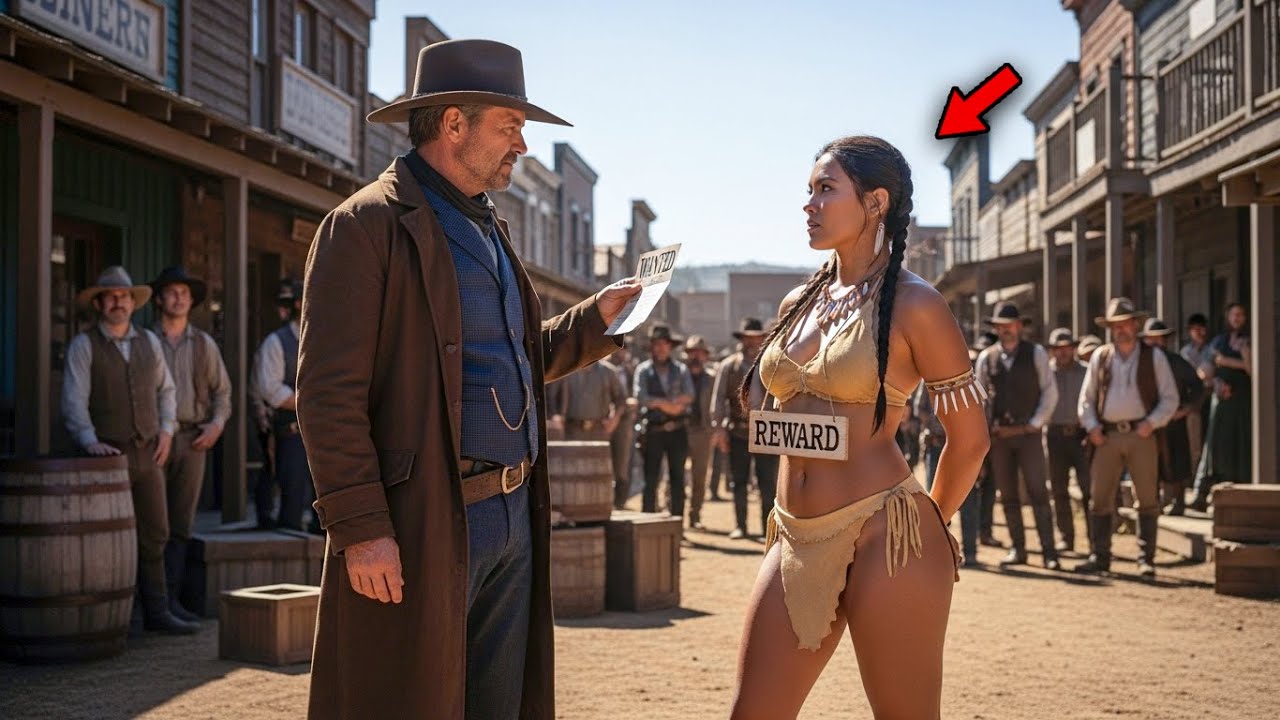
Near the edge of the square, she stood alone, planted on uneven boards, legs trembling from hours of stillness she refused to admit to anyone nearby.
Woman adopted the most hated dog at the shelter. Weeks later, she screamed OH MY GOD when this happened.Tip Parents
Gold Hits Record Levels – Trade and Capture the OpportunityIC Markets

A thin blanket covered her front, slipped loose at one side, and the cold crept under it anyway, biting skin that had already learned to endure.
The man who brought her had vanished without a word, leaving her like unwanted cargo, and the crowd reacted with the same practiced indifference.
When she dared glance up, people looked away too quickly, or stared with mild amusement, as if humiliation were just another market spectacle.
Fear sat beneath her ribs like a stone, steady and heavy, and shame pressed deeper than the cold because she could not control anything except her grip.
She held that blanket as if it were a boundary, the last line between her and whatever claim the world might try to place on her next.
Across the square, a man stepped down from his mare, boots hitting ground with the weight of long days and longer silences.
His name was Adam, and he moved with quiet purpose, eyes scanning stalls and faces with the caution of someone used to surviving without help.
He came to town only when he needed tools or grain, and he always planned to leave before sunset, returning to a life kept simple by distance.

A past he didn’t discuss followed him like a scar beneath his shirt, family lost to circumstances he refused to reopen, because grief could swallow a man whole.
As he crossed the market’s center, he noticed a sudden stiffening in people’s shoulders, a hush that rolled outward like ripples from a thrown stone.
Their attention slid toward the far end, and Adam’s followed, landing on the lone figure with bare feet and bruised arms.
She kept her gaze fixed on the boards in front of her, posture upright despite exhaustion, refusing to collapse in public where cruelty loved to feed.
Adam didn’t approach immediately; he paused, studying the scene as he would a broken fence or a storm line in the hills.
He saw the hollow around her eyes, the hunger masked by discipline, and the way others avoided responsibility as if it were contagious.
A vendor stacking crates muttered without looking up, “Seller dropped her off. Tried to get rid of her. Folks said no. Then he left.”
Adam drew a slow breath, feeling an old instinct stir, the one grief had buried under solitude, the one that once made him choose duty over comfort.
He stepped closer, and her eyes flicked up just long enough to register another stranger, shoulders tightening as her body prepared for the worst.
His face remained calm, unreadable, but not threatening, and still her heart raced, because kindness had often been the first mask of danger.
“Cold?” he asked, voice low and plain, not theatrical, and she didn’t trust her voice enough to answer, only nodded once.
Adam removed his coat, heavy and wool-lined, collar worn smooth by years, and held it out with one steady hand, waiting.
She hesitated, then reached, fingertips brushing his, and the shock of how cold her skin was made his jaw tighten with quiet resolve.
She pulled the coat around her shoulders, shaky breath slipping out, and for a moment the world felt less sharp, less eager to cut.
That was when the vendor returned at a run, eyes bright with calculation, voice bored as if selling a life were routine.
“Taking her? Pay and she’s yours. If not, move on,” he said, and the words made her stomach knot into something small and helpless.
She stared at the coat instead of Adam’s face, bracing for rejection, for bargaining, for anything that would turn her back into an object.

Adam reached into his pocket, counted coins without hesitation, and placed them on a nearby crate, neither negotiating nor asking questions.
He didn’t look at the vendor again, as if the man had become no more than a stain on the air, then turned back to her.
“Can you walk?” he asked quietly, and her throat tightened, but she nodded again, clinging to the one signal of will she could offer.
He guided her toward the mare with minimal contact, not dragging, not gripping, letting her body keep its dignity even while it shook.
She climbed onto the saddle slowly, stiff from standing so long, and Adam adjusted the coat to cover her better, small care without ownership.
He took the reins and started toward the road, walking beside the horse instead of riding, as if he meant to match her pace.
On the way out, she watched the horizon, trying to understand why he asked nothing, demanded nothing, and how silence could feel like mercy.
Adam’s mind turned over what he’d seen: guarded eyes, tense shoulders, the alertness of someone abandoned by those who once held power over her.
By the time they reached his land, evening deepened, and the cabin sat alone on a rise, chimney still faintly warm from morning fire.
She looked at the place with curiosity and fear braided together, unsure whether shelter meant safety or simply a quieter kind of trap.
Adam opened the door and stepped aside, offering entry without pressure, and she hesitated only a heartbeat before stepping inside.
The cabin was simple: bed, stove, table, two chairs, shelves of tins and tools, everything clean and plainly used, a life built for function.
He pointed to the wash basin, then the bed, then the chair near the stove, gestures careful, as if words might bruise what was fragile.
“I’ll bring water,” he said, and stepped outside, leaving her alone in a silence that felt strange because it wasn’t guarded by threats.
She sat on the bed’s edge, mattress dipping beneath her, and tried to comprehend a man who brought a stranger home without demanding repayment.
When Adam returned, he lit a fire, kindling catching fast, glow spreading across the room, and he didn’t hover, didn’t crowd her breathing.
He set a bowl of leftover stew on the table and stepped back, allowing her choice, and hunger finally pushed her toward the chair.
She ate in controlled movements, half-expecting conditions to appear with every spoonful, but Adam watched the fire instead, offering privacy in shared space.
When she paused, unsure if she was allowed more, he nodded once. “If you want the rest, take it,” steady as a fencepost.
Afterward, he placed a folded blanket beside the bed and pulled a chair near the stove. “You sleep there,” he said. “I’ll sit here.”
Relief hit her so sharply it hurt, because she had learned to expect claims, and his refusal to claim anything unsettled her in a new way.
He left the lamp dim, not dark, as if he understood sudden night could wake old terrors, and he settled into stillness like a guard.
She fought sleep, listening to every creak, then exhaustion won, and when she drifted off, she didn’t feel hands reaching, only warmth holding.
At dawn, she woke first, panic rising until she saw Adam asleep in the chair, posture bent from the night he spent keeping watch.
He opened his eyes without startling, offered a small nod, and said, “You can use the basin,” like normalcy were a gift.
Outside, he fed the mare and checked the fence line, routine anchoring him, while inside she breathed out, realizing nobody ordered her to move.
Later he set bread and dried fruit on the table, slid half toward her, and said, “Eat,” simple instruction without dominance.
When he mentioned fixing a barn hinge, she asked, uncertain, “Do you want me to stay inside?” and he answered, “Do whatever feels right.”
Choice felt foreign, but she followed him out, gathered scattered kindling, stacked it neatly, and he glanced once, then returned to his work.
Days passed in small tasks—water from the well, nails for the fence, steady hammer strikes—until her body remembered capability instead of only fear.
“You’re stronger than you look,” Adam observed one afternoon, not flattery, just fact, and she swallowed, unsure how to hold sincere respect.
She tested boundaries by walking the ridge behind the cabin, seeing wide open land without men waiting to trade her, and relief ached in her chest.
One morning, she finally confessed, “I had a name… they changed it so many times I don’t know which one is mine anymore.”
Adam listened, jaw tight with restrained anger at the world, then said, “You don’t have to rush. Choose when you’re ready. Or don’t.”
That night, near the fire, she murmured, “I want it to be mine,” and Adam answered, “When you pick it, I’ll use it.”

The cabin began to feel balanced, lived in, shaped by two rhythms instead of one, and the silence between them softened into something shared.
Then one morning Adam said, “I’m riding to town,” and her stomach clenched, not from distrust, but from the new fear of being left again.
He returned hours later with a wrapped bundle: a simple dress the color of warm earth, sturdy shoes, and a small wooden box.
Inside the box lay a polished tin ring, modest and sincere, and her breath caught because no one had ever offered her choice, only demands.
“I shouldn’t keep holding back what needs saying,” Adam told her, voice steadier than his eyes. “I want you here—if you want.”
He didn’t promise ownership, only partnership. “If you leave, I’ll ride you wherever you choose. But I’m hoping you’ll stay with me.”
She stared at the ring, then up at him, and for the first time her tears came not from pain, but from permission to decide her own life.
“I don’t want to leave,” she whispered. “Not now. Not ever,” and Adam’s shoulders eased as if a decade of weight finally shifted.
He slid the ring onto her finger with careful precision, and in that small circle lived something louder than speeches: two lives joining by choice.
As they walked back toward the cabin, step by steady step, she held the dress against her arms and imagined mornings without dread, meals without fear.
Adam reminded her, “Choose your name whenever you’re ready,” and she squeezed his hand, feeling hope settle warm and frightening inside her chest.
They stepped through the doorway together, not as strangers, not as rescuer and rescued, but as two people choosing to build something honest.
That evening the fire glowed, the ring caught lamplight, and for the first time in years she rested her hand in another’s without flinching.