CHAPTER 1: THE FRICTION OF SILENCE
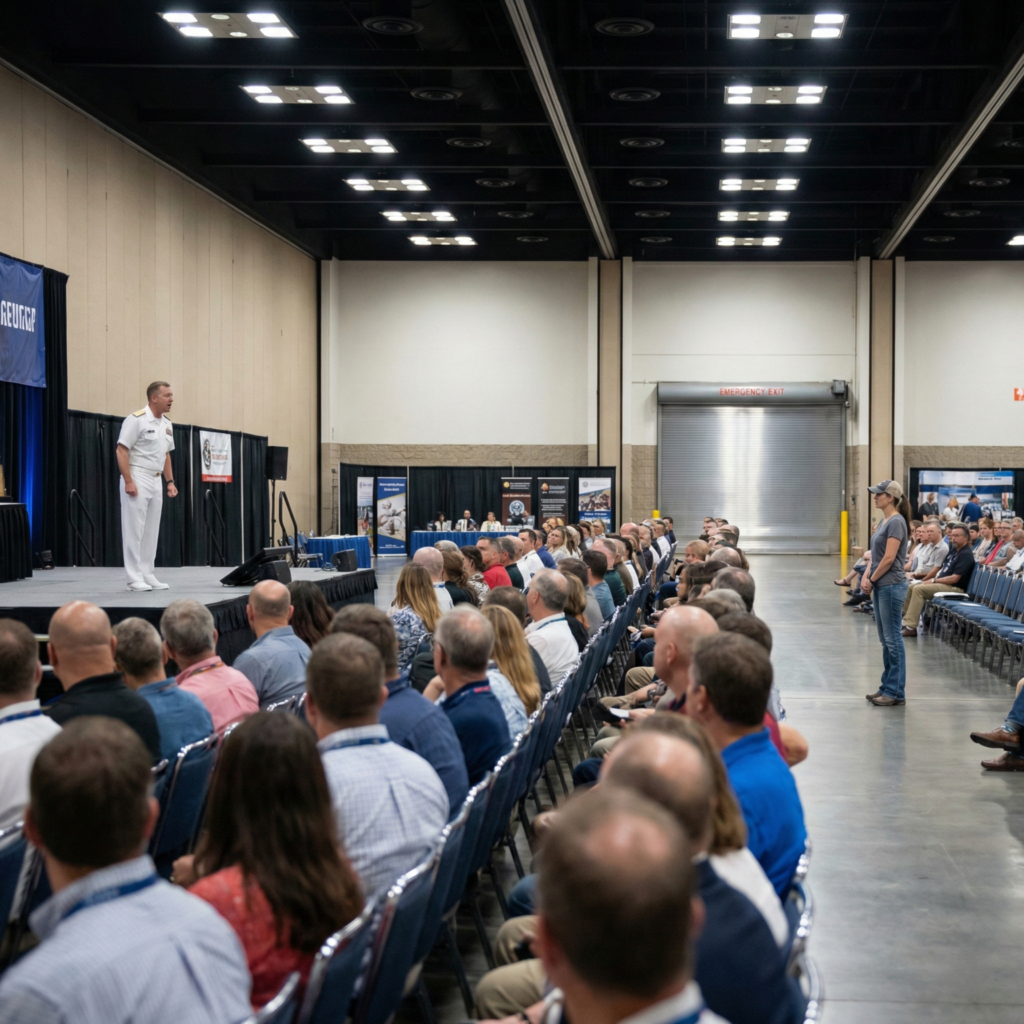
The air in the San Diego Convention Center tasted of stale coffee and industrial-grade floor wax—the scent of a garrison waiting for a deployment that never comes. Maya Rodriguez adjusted her baseball cap, the brim low enough to shadow her eyes. To the crowd of contractors and active-duty SEALs, she was a non-entity, a soft-edged civilian in faded denim. She liked it that way. In the cockpit of an F-16, everything was sharp edges and high-tensile steel; here, she was just dust in the light.
“He’s the real deal, May,” Danny whispered, his voice vibrating with the kind of hero-worship that made Maya’s stomach churn. “Captain Morrison. Third Team. He’s seen more dirt than a shovel.”
Maya didn’t look at her brother. She was too busy scanning the exits. Old habits didn’t die; they just rusted. She chose a seat near the back, right next to the heavy steel of the emergency door. It felt solid. Grounded.
On stage, Captain Jake “Reaper” Morrison moved with the heavy, deliberate grace of a man who had spent too much time wearing body armor. He didn’t walk; he occupied space. His Navy whites were crisp, but Maya saw the way he favored his left leg—a micro-flinch that suggested a legacy of metal in the bone. He was a mirror of her own fatigue, a survivor of the “Dusty Gray” where rules were suggestions and survival was the only currency.
“Combat,” Morrison’s voice grated through the PA system, cutting through the low hum of the air conditioning like a combat knife through silk. “It’s not about the medals. It’s about the person next to you. It’s about the friction.”
Maya looked down at her hands. They were steady, but her skin felt tight, the phantom pressure of 6G’s beginning to pull at her chest.
“I need to know who I’m talking to,” Morrison said, his steel-gray eyes suddenly sharp, methodically slicing through the 800 people in the room. “Any combat pilots in the wire tonight? Not the guys who flew circles over the Gulf. I mean the ones who dropped lead while the radio was screaming for blood.”
The room went silent. The heavy rumbles of San Diego traffic outside seemed to fade, leaving only the sound of 800 people holding their breath. A few hands went up—men with the arrogant tilt of the head that came with the flight suit. Maya felt the weight of the “Sovereign Protector” role she had played for fifteen years. She had protected the men on the ground, and in doing so, she had protected the secret of her own existence.
15 September 2019. Helmand Province. The memory hit her with the smell of cordite and JP-8 fuel. She could almost hear the scream of “Chaos 6” in her headset, the desperate, ragged breathing of a man who knew he was about to die in the dirt. Viper, danger close. Drop it on my head if you have to.
Beside her, Danny’s elbow nudged her. It wasn’t a push; it was an invitation. He knew the cost of her silence. He knew that the “Rusted Truth” of that night was the only reason Morrison was standing on that stage instead of being a name on a black granite wall.
Maya felt the internal gears grind. If she stayed down, the secret remained intact. If she stood, the “Invisible Ghost” died.
She stood.
The movement was fluid, mechanical, and loud. The chair gave a sharp, metallic creak. In an instant, the friction in the room changed. Eight hundred heads snapped toward the back. The air felt heavy, pressurized, as if the ceiling had suddenly dropped a thousand feet. Morrison’s eyes locked onto hers, his expression shifting from a predator’s scan to a sudden, jarring realization.
“Viper?” he breathed, the word carrying more weight than the silence that preceded it.
CHAPTER 2: THE PREDATOR’S ACQUISITION
The silence in the auditorium didn’t just fall; it pressurized. It was the heavy, suffocating weight of a cockpit losing oxygen at thirty thousand feet. Maya stood at the back of the hall, her boots anchored to the carpeted floor, but her mind was calculating the friction of the eight hundred stares pinning her against the emergency exit. She was no longer a ghost in a baseball cap. She was a target acquired.
On stage, Captain Morrison didn’t move. He looked like a statue cast in oxidized bronze, his hands gripping the edges of the wooden podium until his knuckles turned the color of bone. The “Reaper” wasn’t looking at a civilian woman in a Stanford hoodie anymore. He was looking through her, back to a night where the sky was a bruised purple and the earth was screaming.
“Viper,” Morrison repeated. This time, the word wasn’t a question. It was a debrief. His voice had lost its performative theater grit; it was now the dry, transactional rasp of a man reporting casualty counts. “Helmand. The compound at Grid 41. You were the one who stayed when the fuel light went red.”
READ MORE The Ghost in the Supply Chain: A Tactical Deconstruction of the Wolf’s Silent Return
Maya didn’t answer immediately. She felt the “Sovereign Protector” instinct flare—a cold, pragmatic need to control the variables. She scanned the room. Danny was staring up at her, his mouth slightly open, the adoration in his eyes replaced by a sudden, jarring fear. He had seen her medals, but he had never seen the weight of them.
“I was lead,” Maya said. Her voice was thin but carried the structural integrity of a reinforced airframe. “15 September. We had eyes on the target. We heard the bleed-over on the net.”
“You didn’t just have eyes,” Morrison countered. He stepped away from the podium, ignoring the general in the front row who was shifting uncomfortably. Morrison’s limp was more pronounced now, a rhythmic hitch that sounded like a mechanical failure on the stage’s hollow floorboards. “You dropped a GBU-12 sixty meters from my position. I felt the heat of your engine wash on the back of my neck. I thought the sky was falling.”
The crowd stirred—a low, collective murmur of disbelief. To them, it was a war story. To Maya, it was the sound of a “Rusted Truth” being forced into the light. She remembered the grit of the sand on her HUD, the way the F-16’s stick had vibrated with the strain of the pull-out. She remembered the specific, metallic taste of adrenaline that came when you realized you were seconds away from killing your own people.
“Rules of engagement were clear, Captain,” Maya said, her tone sharpening into weaponized silence. “It was danger close. You signed for it.”
“I signed for a miracle,” Morrison barked, a harsh, jagged laugh escaping him. “I didn’t think I’d find it sitting in a San Diego convention center wearing sneakers.”
He gestured toward the stage, a command disguised as an invitation. The movement was a tactical acquisition. He wanted her in the light, where the shadows of the “Dusty Gray” couldn’t hide the scars.
Maya looked at the stage. The wood was scuffed, the American flag behind it slightly frayed at the edges—everything was worn, used, and stubbornly persistent. Just like them. She felt the friction of her choice. To stay in the back was to remain a ghost; to walk forward was to acknowledge that the war hadn’t ended when she turned in her flight suit. It had just moved indoors.
She stepped into the aisle. The sound of her sneakers on the floor was a rhythmic, dull thud. Every person she passed felt like a milestone. The air smelled of wood polish and old sweat.
As she reached the midpoint of the room, a micro-mystery manifested in the corner of her vision. In the third row, a man in a dark suit—no uniform, no medals—wasn’t looking at her or Morrison. He was looking at a ruggedized tablet, his thumb hovering over a red icon. He wasn’t cheering. He was measuring.
Maya didn’t slow down. She had spent a career ignoring the “red icons” until it was time to kill them. She reached the stairs to the stage. Morrison held out a hand, his palm calloused and mapped with thin, white scars of old rope burns and shrapnel.
“Come up, Viper,” he whispered, his eyes searching hers for the same rust he carried. “Tell them what it’s like when the iron sky starts to rust.”
CHAPTER 3: THE TARGET LOCK
The moment Maya’s hand met Morrison’s, the friction was literal. His palm was a map of dry, abrasive history, the skin roughened by salt air and the heavy grit of Afghan soil. He didn’t just shake her hand; he anchored her. The “Sovereign Protector” in her bristled at the contact, her internal sensors spiking as she stepped onto the stage—the high ground.
The auditorium lights were a blinding, clinical white, reflecting off the polished floorboards like sun off a desert salt flat. Below, the sea of faces had transformed. They weren’t just spectators anymore; they were a collective intelligence, scanning her for weaknesses, for the “Rusted Truth” behind the civilian disguise.
“Viper,” Morrison said, his voice dropping below the register of the microphones. “You look like you’re still waiting for the SAM-site warning to go off.”
“It never stopped,” Maya replied, her voice a low, transactional rasp. She looked past him, her eyes instinctively finding the man in the dark suit in the third row. He hadn’t moved. The red icon on his tablet was still active, a digital blood-spot in the periphery of the room. He was the variable she couldn’t account for—the malfunction in the system.
Morrison turned back to the crowd, his hand lingering on the frayed sleeve of her hoodie. “You see this woman? She wasn’t supposed to be there. The mission protocol called for an F-18 strike package from the carrier. But the weather turned the sky into a soup of iron and dust. The Navy birds stayed on the deck.”
He paused, letting the silence grate against the audience. “Maya Rodriguez didn’t stay on the deck. She pushed an F-16 through a localized sandstorm that should have shredded her turbines. She came in at five hundred feet, blind, guided only by the sound of my men dying on the radio.”
Maya felt the phantom pressure of the G-suit squeezing her legs. The air in the room felt thin, oxygen-depleted. She remembered the vibration of the airframe, the way the HUD had flickered as the sand eroded the sensor glass. It hadn’t been an act of heroism; it had been a pragmatic calculation. If she didn’t drop, the mission failed. If the mission failed, her legacy was a pile of rusted scrap and body bags.
“Why?” Morrison asked, suddenly turning the spotlight back on her. It was an interrogation. “The override came from Level 4. You were ordered to RTB—Return to Base. You switched off the long-range comms. Why?”
The question was a kinetic breach. The room leaned in. This was the friction Morrison had been building toward—the moment the legend met the reality of the insubordination.
Maya looked at the man with the tablet. His thumb twitched. He wasn’t a contractor; he was an auditor. The realization clicked with the cold precision of a weapon being readied. The “Core Truth” of Helmand wasn’t just about the lives saved; it was about the protocol she had broken to save them. The system didn’t like miracles that came at the cost of its rules.
“The radio was making too much noise, Captain,” Maya said, her voice cutting through the clinical light. “I preferred the silence.”
Morrison’s eyes narrowed, a flash of equal intellect sparking behind the gray. He knew. He had always known. The “miracle” he had carried for years was a crime in the eyes of the JAG office. By standing here, she wasn’t just being honored; she was being identified for a secondary debrief.
“Silence,” Morrison repeated, a grim smile touching his lips. “It’s a heavy thing to carry.”
He turned to the general in the front row, whose face was the color of a bruised plum. The general was looking at the man with the tablet, a silent communication passing between them. The trap was sprung. The symposium wasn’t a celebration; it was a subpoena.
Maya’s hand drifted toward the pocket of her hoodie, feeling the weight of the burner phone Danny had handed her earlier. It vibrated once. A short, sharp pulse.
Target Lock.
CHAPTER 4: THE KINETIC BREACH
The vibration of the burner phone against Maya’s thigh was a rhythmic, mechanical warning—a secondary alarm in a cockpit already screaming with red lights. On the tablet in the third row, the red icon didn’t just sit there anymore; it pulsed.
Maya looked at Morrison. The Captain’s hand was still on her arm, his grip tightening as he caught the shift in her gaze. He was a predator, but he was also a veteran of the “Dusty Gray.” He knew when the wind changed. He followed her eyes to the auditor in the dark suit.
“Viper,” Morrison whispered, the name barely a breath over the roar of the standing ovation that refused to die. “You have an exit strategy?”
“I’m working on the navigation,” Maya said, her voice a sharp, transactional rasp.
She didn’t wait for him to respond. She stepped toward the edge of the stage, the wooden boards groaning under her sneakers like a hull under pressure. The General in the front row was standing now, his face a mask of disciplined fury. He wasn’t clapping. He was signaling. Two men in charcoal polos—security, or perhaps something more clinical—started moving toward the stairs from the left flank.
The “Sovereign Protector” in Maya’s mind mapped the room in micro-seconds. Exit A: The emergency door she had sat next to. Blocked by the surge of the crowd. Exit B: The service corridor behind the stage curtain. exit C: The vertical breach.
She turned to Morrison. “Captain, I need a distraction. High-intensity.”
Morrison didn’t ask for details. He didn’t ask about the auditor or the General. He simply nodded, his eyes reflecting the “Equal Intellect” of a man who had spent his life breaking the rules to save the mission. He stepped back to the podium, leaning into the microphone. The feedback squealed, a sharp, metallic spike that made the crowd flinch.
“There’s one more thing about that night!” Morrison roared, his voice booming over the PA system, drawing every eye in the room back to the center of the stage. “Something the official reports missed. Something about the cost of the iron!”
While Morrison grabbed the room’s attention like a flare in a dark sky, Maya moved. She didn’t run; running invited pursuit. She slipped behind the heavy velvet of the stage curtain, the fabric smelling of dust and neglected history. The darkness back here was thick, the “Rusted Surfaces” of the stage machinery cold against her hands.
She pulled the burner phone from her pocket. The screen showed a single message from Danny: Black SUV. Basement Level 2. They aren’t Navy.
The friction of the situation was grinding. The “Core Truth” was starting to leak—the mission in Helmand hadn’t just been “Danger Close.” It had been unauthorized. The General wasn’t there to honor her; he was there to contain the evidence of a Level 4 breach that had been buried for years.
A shadow fell across the service corridor.
“Colonel Rodriguez,” a voice said. It was smooth, devoid of the grit that characterized the men in the room. It was the voice of the auditor.
Maya froze, her back against a rusted gear housing. She didn’t reach for a weapon she didn’t have. She simply adjusted her stance, her weight balanced, her internal monologue calculating the strike points.
“You’re out of your assigned airspace,” the auditor said, stepping into the dim light. He wasn’t holding a gun. He was holding the tablet. The red icon was steady now. “The General has questions about the encrypted logs from 15 September. The ones you thought you deleted before you punched out of the Air Force.”
“The logs were corrupted by the sand,” Maya said, her voice a flat, weaponized silence.
“The logs were scrubbed,” the auditor countered, his thumb hovering over the tablet screen. “But the telemetry from Morrison’s team survived. It shows you weren’t just low. It shows you were operating on a private frequency. Who were you talking to, Viper?”
Maya felt the air in the corridor grow cold. This was the Layer 1 reveal—the realization that her “miracle” hadn’t been a solo act of defiance. She had been guided by a ghost.
A sudden crash echoed from the stage—the sound of a heavy chair being overturned and Morrison’s voice rising in a calculated shout. The distraction.
“I don’t talk to auditors,” Maya said.
She lunged.
It wasn’t a cinematic fight. It was a pragmatic application of force. She drove her shoulder into the auditor’s chest, the friction of his suit jacket rough against her skin, and sent him stumbling back into a rack of lighting cables. The tablet hit the floor with a plastic crack.
Maya didn’t look back. She sprinted for the service elevator, the smell of grease and electricity filling her lungs. The “Escalation” had reached its peak. The horizon was moving.
CHAPTER 5: THE DEBRIEF
The service elevator descended with a rhythmic, industrial groan, the steel cables snapping like whips against the shaft walls. Maya stood pressed against the rusted interior panels, the cold vibration traveling through her spine. She checked the tablet she’d snatched from the floor; the screen was spider-webbed, but the red icon still blinked with a stubborn, dying light. It was a beacon.
The doors slid open to the basement level, a cavern of concrete and low-hanging pipes dripping with condensation. The air smelled of wet earth and exhaust. Twenty yards away, a black SUV sat idling, its headlights cutting through the gloom like twin searchlights.
Maya moved low, keeping her shadow merged with the grime-streaked pillars. The “Sovereign Protector” mindset was in full gear—her eyes tracking the sweep of the headlights, her ears filtering the hum of the building’s ventilation against the distant, muffled roar of the crowd above.
“Danny?” she called out, her voice a sharp, transactional rasp.
The driver’s side door opened. It wasn’t Danny. It was a man in the same charcoal polo as the stage security, his hand resting on the holster at his hip with practiced, equal intellect. He didn’t draw. He just watched her.
“The General wants his property back, Colonel,” the man said.
“The General has a lot of property,” Maya replied, her eyes locked on the passenger side window. “Which piece is he missing tonight?”
“The piece that proves Helmand was a ghost operation.” The man took a step forward, his boots crunching on the grit of the concrete floor. “Morrison didn’t call for a miracle. He called a private number. One that isn’t on the official Air Force manifest. One that belongs to a pilot who was supposed to be grounded for medical reasons on September 15th.”
The friction of the truth finally fully emerged. Maya’s hand tightened on the tablet. She hadn’t just broken protocol; she had bypassed the entire chain of command using a back-channel system designed for operations the public—and the JAG—were never meant to see.
A second set of headlights flared from the entrance ramp. A silver sedan screeched to a halt, blocking the black SUV’s exit. Danny jumped out, his face pale under the flickering fluorescent lights.
“May! Get in!” he yelled, his voice echoing through the hollow space.
The man in the charcoal polo didn’t flinch. He looked at the sedan, then back at Maya. “You think you can fly your way out of this one, Viper? There are no clouds to hide in down here.”
“I don’t need clouds,” Maya said, her voice dropping to a dangerous, weaponized silence. “I just need the silence.”
She threw the tablet toward the black SUV. As the man instinctively turned to track the device, Maya lunged for Danny’s car. The air was suddenly filled with the sound of tires screaming against concrete.
As they sped up the ramp, the “Core Truth” sat heavy in the backseat between them. The mission hadn’t saved Team Bravo just through skill; it had been the first field test of a decentralized command protocol—one that the General was now scrubbing from history. Maya looked back at the receding lights of the convention center. The rust was gone. The truth was bare, and it was jagged enough to draw blood.
“Where to?” Danny asked, his hands white-knuckled on the wheel.
Maya looked at the sky, the vast, dark expanse where the rules of the earth didn’t apply. “Higher,” she said.