The Norfolk sun hung low and merciless over the parade ground, baking the concrete into a shimmering haze. Heat waves distorted the rows of camouflaged sailors, marines, and airmen standing at rigid attention, their eyes riveted on the spectacle unfolding.
Evelyn Cross, wrists bound behind her in cold steel, was marched through the parting crowd like a condemned heretic. Phones popped up like periscopes, capturing every humiliating step, every forced shuffle. Laughter rippled through the ranks—sharp, cruel, relentless.
“Look at the wannabe,” a burly petty officer sneered. “Stealing a dead SEAL’s valor. Pathetic.”
Staff Sergeant Colt Ramsay led the procession, boots polished to a mirror sheen, clicking against concrete with surgical precision. He was the base’s golden boy—decorated, unflappable, a man whose instincts had saved lives more times than anyone could count.
Today, he believed, he had caught a major threat: a woman claiming to be a fallen hero. Stolen valor. Espionage. The charges stacked like storm clouds.
Evelyn didn’t flinch. Didn’t cry. Didn’t beg. Her spine stayed ramrod straight, chin tilted in defiance bordering on arrogance. Corporal Reed Tucker gripped her arm—firm, professional, no theatrics like Ramsay.
His touch hesitated, just a fraction. Why wasn’t she breaking?
She matched Tucker’s stride, scanning the faces, exits, and layout. This wasn’t a walk of shame—it was reconnaissance. Whispers washed over her: “Soft.” “Never held a real gun.” “Lock her up.” Underestimation was her shield, and she wore it like armor.
Two figures lingered at the periphery, apart from the jeering crowd. Lieutenant Jackson Pierce, young but battle-hardened, narrowed his eyes as he clocked her fluid movement—no shuffle, no flinch, no resistance.
Master Chief Cain, a weathered veteran whose face seemed carved from old oak, observed her cuffed hands. Even restrained, her fingers danced in subtle drills, fighting numbness, preserving dexterity. Predator in prey’s clothing. Both sensed it immediately.
The administrative building swallowed her in cold relief. Air conditioning hit like a slap, fluorescent lights buzzing overhead, painting linoleum scarred by countless boots in jaundiced hues. Ramsay’s reflection gleamed off glass cases of medals and portraits of admirals—he belonged here. Evelyn was the intruder.
Interrogation Room 3 awaited. A beige coffin of a room, ten by ten, bolted table in the center, two chairs, and a narrow sliver of sky through a tiny window. A digital recorder blinked red on the table.
“Sit, sweetheart,” Ramsay drawled, lacing his fingers behind his head, his smirk smug. Tucker removed the cuffs, the click-clack echoing like distant gunfire. Her wrists throbbed, raw and red, but she didn’t rub them. Palms flat on the cold metal, she flexed her fingers methodically, assessing nerve damage—a clinical operator’s habit.
Behind the one-way glass, Pierce and Cain watched. Commander Blackwood would join soon.
Ramsay fanned a stack of documents like a poker hand: aerial photos, schematics, security protocols. “Real name, this time.”
“Evelyn Cross.”
“Age?”
“Twenty-eight.”

“Occupation?”
“Unemployed.”
He smirked. “Logistics before that, huh? Explains the classified intel in your bag.” He tapped the planted evidence. “Guard rotations to the minute. Defensive positions. Handler? Russia? China?”
Evelyn’s pulse remained steady, sixty beats per minute. She traced the edge of a photograph, scanning in trained grids—threat vectors, ingress points. Cain shifted behind the glass; he recognized the pattern immediately.
“Never seen these,” she said flatly.
Ramsay laughed, a short, sharp bark. “Fairy godmother?”
“I said unfamiliar with the documents. Not the info,” she replied evenly. “This is Google Earth resolution. Substation refitted post-hurricane—diagram’s outdated. Noise, not classified.”
Pierce murmured from behind the glass, “She’s right.”
Ramsay shoved personnel files forward. “SEAL Team 6 rosters. Current. Life-threatening.”
Her breath deepened. Real leak. “Ongoing access. Inside job.”
Ramsay’s composure began to fray. “Not your concern.”
“Isn’t it? You parade public-domain junk while flashing active intel I couldn’t touch. Contradiction,” she said, calm as a sniper’s breath.
Cain whistled softly. She’s lapping him, he thought.
Ramsay exploded, pacing the room, slamming a fist on the table. “You’re no civilian! CIA? DIA?”
She waited out the echo. “Trust your instincts fully, Staff Sergeant.”
The door burst open. Private Luna Hayes, trembling, holding a coffee mug. “S-sir…”
“Out!” Ramsay barked.
Coffee sloshed, burning her hand. Evelyn tore a foil antiseptic wipe with one hand, offered it. “Neutralize acid. Field basics.”
Hayes accepted, wide-eyed. Ramsay’s gaze sharpened—med kit issue. Evelyn lied smoothly: “OSHA requirement.”
Blackwood ordered deep checks. Ramsay’s phone buzzed. His face turned pale. “Fingerprints… Pentagon warning.”
Cain dragged him out. “Deep cover hallmarks. You compromised an asset.”
Ramsay returned, hollow-eyed. “Compartmented systems? How?”
“I read,” she said simply.
Another buzz, ghostly white on a screen: Level One alert. D.C. team incoming.
Convoys roared in. Blackwood suspended the interrogation. To Evelyn: “Official cover?”
“Clearance-dependent.”
“Top Secret SCI not enough?”
“Operation Nightfall. Ghost 7 extraction.”
Blackwood recoiled. “Ghost 7 died eighteen months ago.”
“Exaggerated,” she said.
Agent Sarah Carson, FBI handler, entered. “Debrief. Suspect: Ramsay. Narcissist, financial stress, access. Sloppy today confirms.”
“Mission concluded,” Evelyn said. Relief washed over her. Eighteen months, seventeen ops compromised, three SEALs dead. Traitor caught.
But the sedan ride revealed new alarms. Carson’s phone buzzed. “Reroute. Ramsay escaped custody. Sedated guards.”
Evelyn’s heart skipped. “Extraction. Conspiracy bigger.”
Base went into lockdown. A message reached Ghost 7: Amphitheater. Alone.
Carson warned over earpiece: “Trap. Snipers.”
“No. I know him. Wired support.”
Geared in tactical black, Evelyn entered the floodlit bowl. Shadows stretched long across the concrete. “Here, Ramsay!”
His voice echoed from the far side: “Why parade me if guilty?”
“Pressure mistakes,” she called.
“Or scapegoat. By your handler,” he replied, calm.
Proof: planted drive. “Carson sells to China. You cleaned for her.”
Carson’s voice came in sharp: “Hostiles! Engage!”
No teams visible.
Ramsay emerged, hands up. Bullets chewed concrete around them. They bolted for the maintenance building. Crash inside—her shirt tore, revealing a tattoo: compass rose, arrow, script. OPERATION NIGHTFALL. GHOST 7. PENTAGON COORDS. MORTUUS SED NON OBLITUS.
“You’re the survivor,” Ramsay breathed.
“Five died. Reminder,” she said, eyes cold.
Beacon activated. Marines secured perimeters. Carson captured.
Colonel Mitchell arrived. “Espionage ring. Three Ghosts missing. New task force—you two.”
Evelyn touched Ramsay’s tattoo. “Overseas?”
“Relaxing,” he grinned grimly.
“War in light now,” she said.
They Laughed at Her Worn Jacket—Until the General Saw the Patch and the Entire Store Went Silent-hongtran
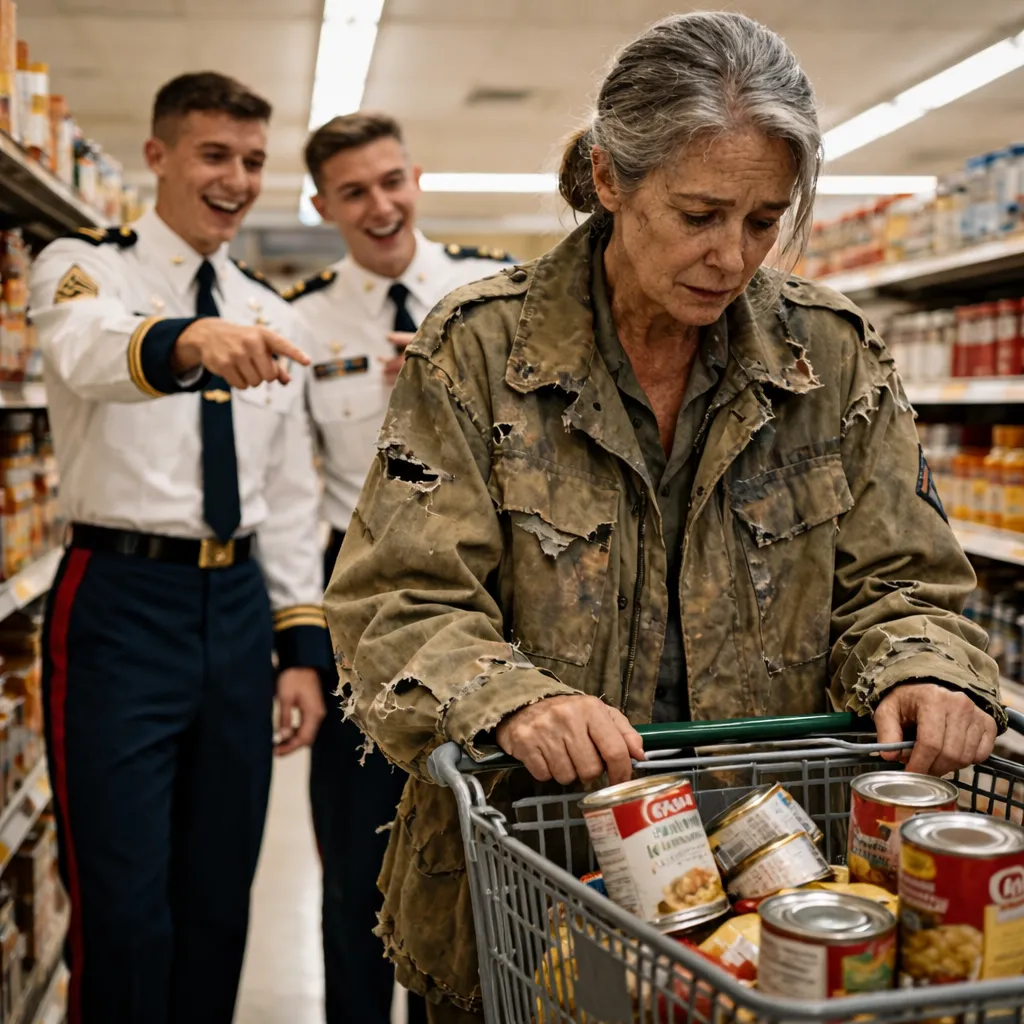
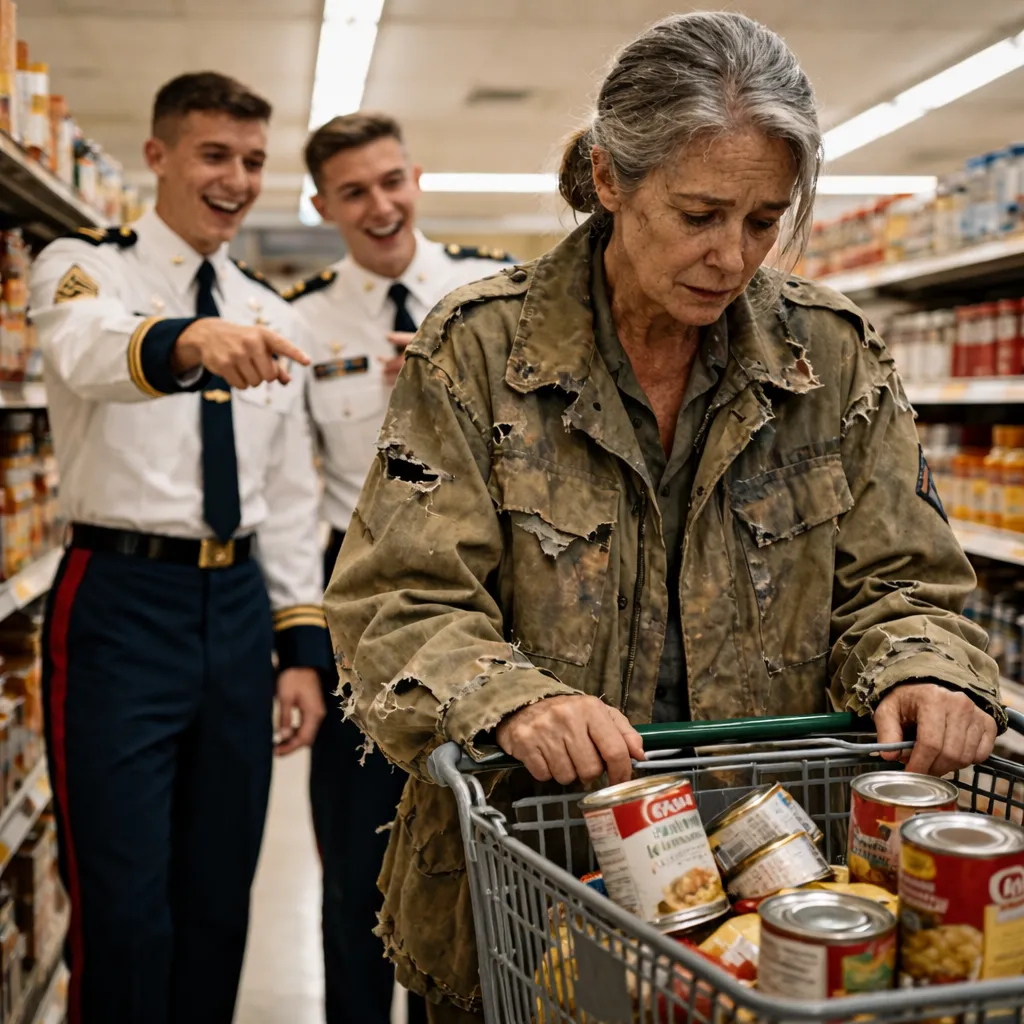
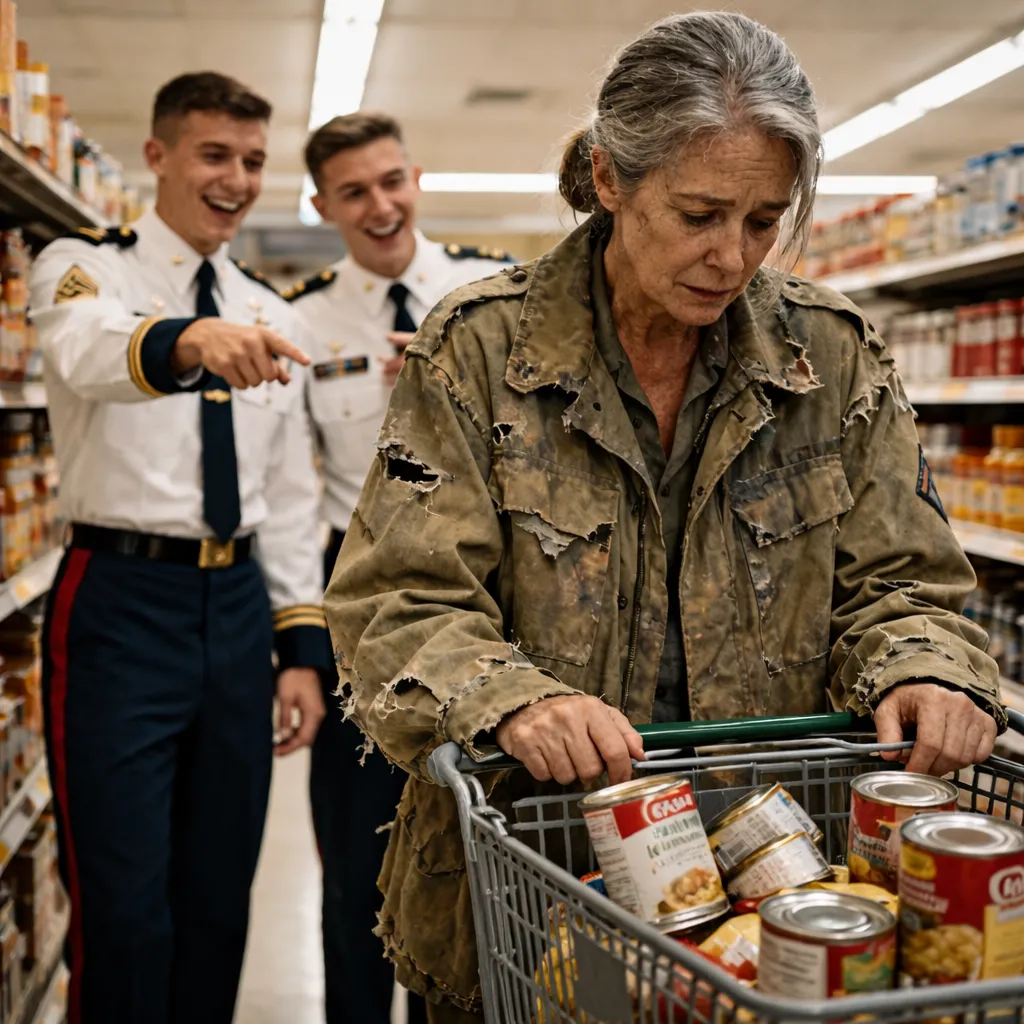
The first laugh hit me before I even reached the soup aisle, soft and cruel, like a secret shared between people who assumed I couldn’t possibly matter.
I kept my eyes on the shelf labels, counting coins in my pocket, pretending the fluorescent hum was louder than the whisper behind my back.
“Must’ve raided her grandfather’s closet,” a young voice murmured, amused and polished, the kind of confidence you earn when consequences have never touched you.
“That thing looks like it survived World War Two.”
My hand hovered over a can of chicken noodle soup, and I did the quiet math that rules your world when your life has been reduced to change and necessity.
Soup, yes.
Eggs, maybe.
Milk, no.
I adjusted the collar of my olive-green field jacket, frayed at the cuffs and worn thin at the elbows, because the jacket was old but it still knew how to hold my shoulders upright.
To them, it was cloth.
To me, it was a memory I could still touch, a weight that reminded me I used to be more than a woman negotiating groceries like a battlefield.
My name is Miranda Reeves, and I’m fifty-five, though most mornings my body wakes up older than my face.
A jagged scar wraps my right wrist like a bracelet I never chose, and my right leg drags a little when the weather changes, like it remembers the sand better than I do.
The commissary smelled like floor cleaner and bread, and people moved around me with the casual ease of lives that had never been filed away under “classified.”
That was the part that made me bitter sometimes, not the pain, but the normalcy other people got to carry openly.
The laughter followed me down the aisle, growing bolder, as if my silence gave them permission to sharpen their words.
“Speaking of shortages,” another voice said, snickering as he eyed my basket, “looks like she picked that up on discount day at the thrift store.”
I stared at the soup can until the label blurred, because rage is a dangerous thing when you’ve spent decades learning how to keep it leashed.
I wanted to turn around and tell them exactly where this jacket came from, and exactly what it cost to wear it.
I wanted to say it belonged to Major Callahan, and he died so I could limp away from a night that officially never happened.
But my records are sealed, my injuries are “non-service connected,” and the operation that broke me is a ghost the government insists doesn’t exist.
So I swallowed my truth the way I’d swallowed sand in 2003, when the wind turned the air into knives and our radios turned to static.
“Classic stolen valor,” the taller voice said, louder now, greedy for an audience, “bet she’s heading to the admin building to beg for handouts.”
My fingers tightened around the soup can, and the scar on my wrist throbbed like it recognized the tone of mockery as a cousin to threat.
In another life, I could have ended this conversation with a look, a word, a posture that reminded men like that to stay in their lane.
In this life, I was just a civilian woman in a worn jacket, standing under harsh lights, trying not to shake.
I set the soup back on the shelf, because the humiliation suddenly tasted worse than hunger, and I turned my cart toward the exit.
I didn’t want soup anymore.
I just wanted air.
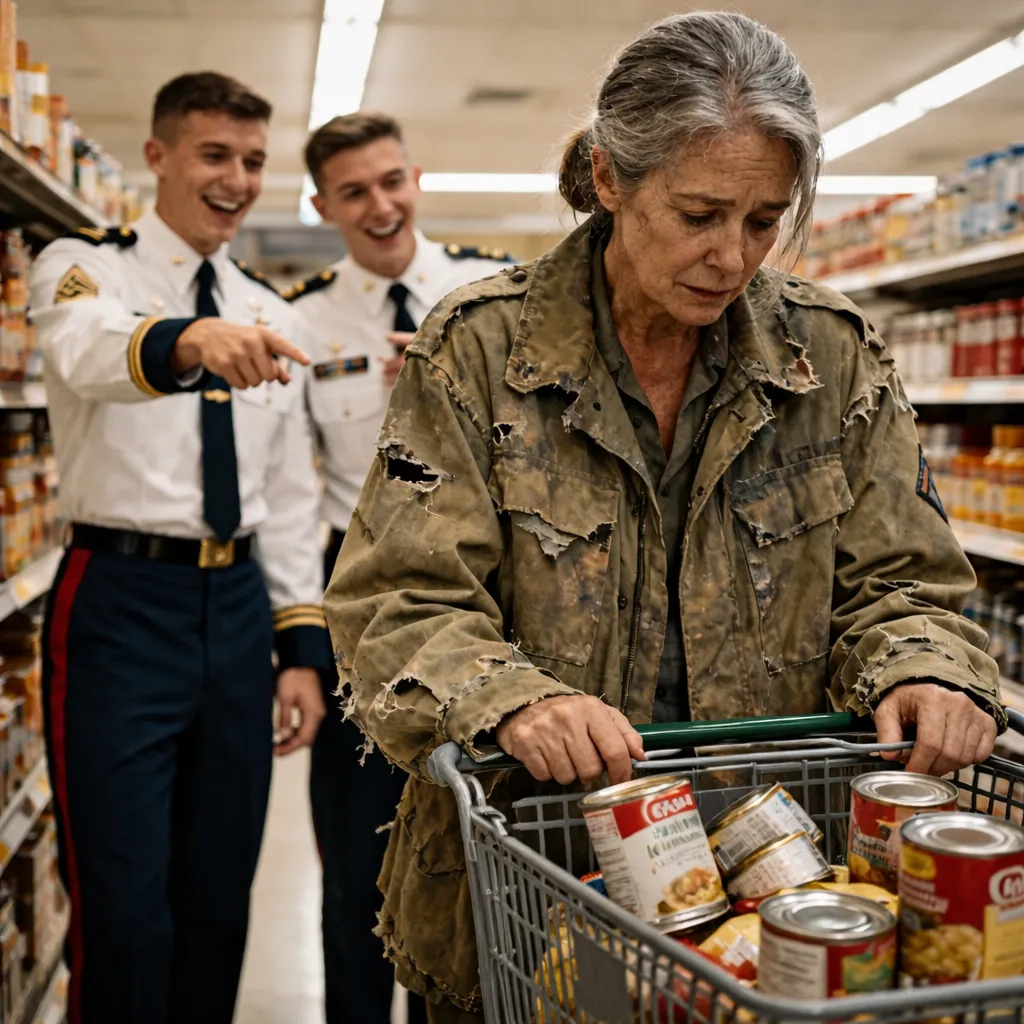
My right leg dragged slightly against the linoleum, each step a small confession that my body had paid in full for a mission that would never be entered into anyone’s history book.
“Hey,” the taller lieutenant called out, stepping into my path like he owned the aisle, “we’re talking to you.”
I stopped, because sometimes your survival instincts misfire, and you forget that in grocery stores people don’t usually hit you.
I lifted my eyes, and there they were: two lieutenants in crisp uniforms, clean boots, bright rank, and the smugness of men who had never been ignored by the system.
They looked at my jacket the way people look at trash they don’t want to touch.
The taller one leaned forward, grin widening, and I caught the scent of cheap cologne trying to mask youth.
“You know it’s illegal to wear military gear you didn’t earn,” he said, loud enough for nearby shoppers to glance over.
A small circle of attention formed, not because people love truth, but because they love drama when it isn’t theirs.
I felt my cheeks heat, not from shame, but from the old fury that used to keep me alive.
“Ma’am,” the other lieutenant added, playing the helpful one, “we can escort you to security if you want to avoid embarrassment.”
The irony nearly made me laugh, because embarrassment had been my companion for years, and it had never once been invited.
I opened my mouth, then closed it, because the words I wanted to say would only sound like madness to anyone who hadn’t bled in silence.
Instead, I tried to step around them.
The taller one shifted again, blocking me like a bouncer guarding a door I wasn’t allowed to enter.
“What’s your name?” he demanded, as if he needed it for the story he’d tell later.
My throat tightened, and for a moment I saw a different room, a different light, a different kind of authority asking questions that decided whether you lived.
Then the automatic doors at the front of the commissary slid open with a mechanical hiss, and the entire air of the building changed.
It wasn’t dramatic like movies.
It was subtle, like when a room senses something powerful has entered and adjusts before anyone even speaks.
The chatter dimmed.
Footsteps slowed.
A man walked in with the calm precision of someone who had been obeyed for most of his life.
Tall, silver hair, posture straight as a mast, four silver stars gleaming on his collar like cold moons.
General Marcus Harris.
Even civilians knew that name, because his face appeared on televised hearings and recruitment posters and ceremonial events where the nation pretended it understood sacrifice.
The lieutenants snapped to attention so fast they nearly collided with each other, their smugness evaporating into rehearsed respect.
I didn’t move, because I didn’t have the energy for fear anymore.
The General took three steps into the commissary, then stopped mid-stride, as if the floor had turned to ice beneath his boots.
He wasn’t looking at the lieutenants.
He wasn’t looking at the shelves.
He was staring at my chest.
Not at the worn jacket, not at the frayed collar, but at the faded, ghost-like outline of a patch above my heart, half unstitching, barely visible to anyone else.
His face went pale, and for the first time, the entire commissary became quiet enough to hear the buzzing lights.
The taller lieutenant smiled nervously, eager to impress.
“Sir,” he said, “we were just addressing a potential stolen valor situation.”
General Harris didn’t blink.
His eyes remained locked on the patch like it had reached out and grabbed him by the throat.
“Where did you get that jacket?” the General asked, and his voice didn’t sound angry.
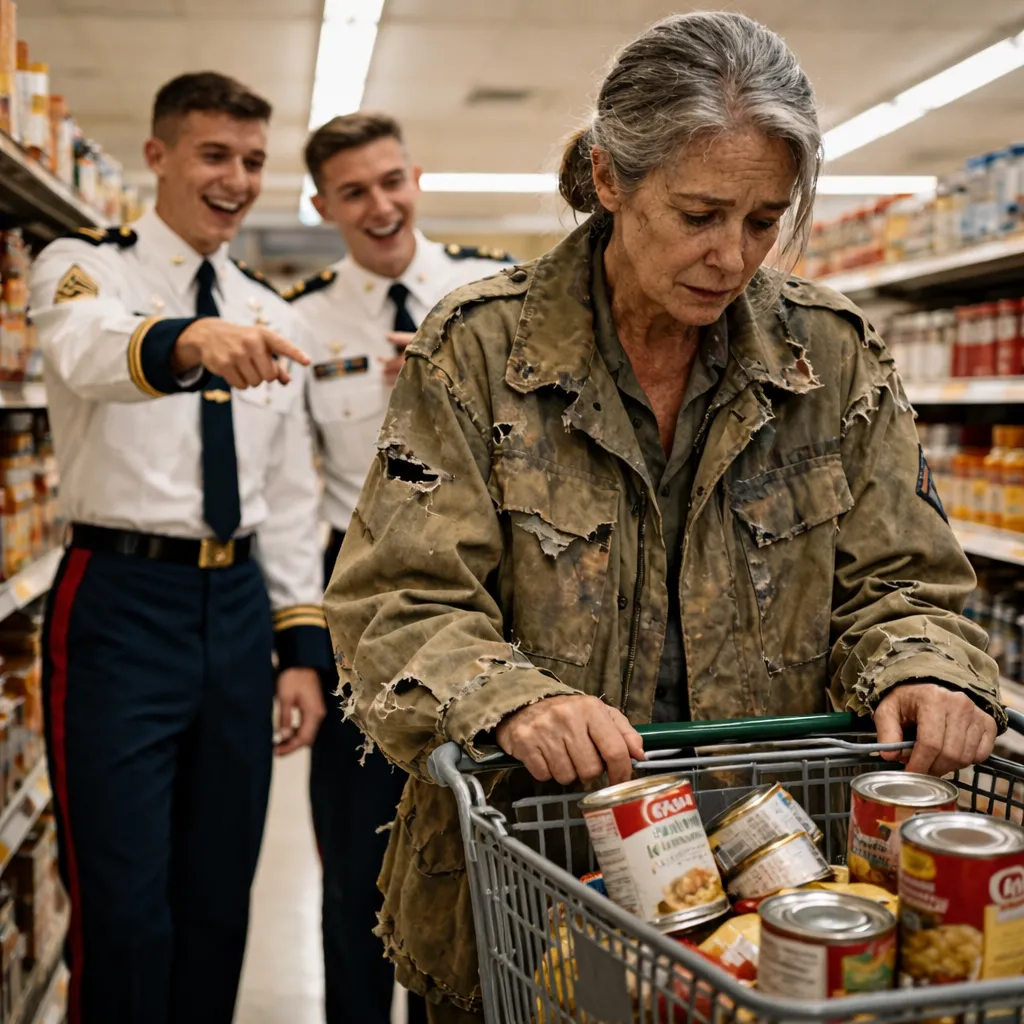
It sounded haunted.
The lieutenants glanced at each other, confused, because this wasn’t the script they expected.
I swallowed hard and finally spoke, because something in his tone demanded honesty.
“It belonged to Major Callahan,” I said quietly, “and it’s all I have left.”
The words fell into the silence like stones into deep water.
General Harris took another step, slower now, as if approaching an animal that might bolt.
“Major Callahan is… deceased,” he said, and it wasn’t a statement.
It was a question disguised as fact.
“Two decades,” I answered, because time doesn’t dull the truth when you’ve carried it like a wound.
“He died on an op that never happened.”
The General’s jaw tightened, and his gaze flicked briefly to the lieutenants, who were now sweating under the weight of a room that suddenly felt like a courtroom.
“What is your name?” he asked, and I could tell he already knew something, even if he couldn’t yet prove it.
“Miranda Reeves,” I said, and my voice almost broke on my own name, because I hadn’t heard it spoken with respect in a long time.
His eyes widened by a fraction, the smallest crack in a man trained to show nothing.
“No,” he whispered, so soft only the people closest could hear, “that can’t be right.”
A murmur rippled through nearby shoppers, because humans can smell revelation the way animals smell rain.
General Harris stepped closer, his gaze scanning my face with a careful intensity, like he was comparing me to a memory he’d tried to lock away.
Then his eyes dropped again to the faded outline of the patch and the tiny stitched mark where the unit number used to sit.
“Nightglass,” he said, almost to himself, and the word hit me like a punch.
No one said that name out loud.
Not anymore.
Not if they wanted to keep breathing comfortably.
The taller lieutenant blinked.
“Sir?” he asked, uncertain, “Nightglass is… what is that?”
General Harris finally looked directly at him, and the air around the lieutenant seemed to shrink.
“Something you don’t mock,” the General said, voice sharp as a snapped rope.
The lieutenant tried to recover, puffing his chest with nervous bravado.
“Sir, she’s wearing a military patch,” he insisted, “and she’s claiming—”
“Enough,” the General said, and it wasn’t loud, but it carried the kind of authority that makes grown men feel like children.
He turned back to me, eyes searching.
“Do you know what this patch means?” he asked, and his voice softened again, like he was speaking to someone he owed.
I nodded once, because my throat had become too tight for anything else.
“It means we weren’t supposed to be remembered,” I said, “even when we were the reason others made it home.”
The General’s face changed then, the way a man’s face changes when he sees the past standing in front of him, alive, impossible, undeniable.
He exhaled slowly, and it sounded like a burden leaving his lungs.
“I remember that patch,” he said, and every ear in the commissary leaned closer without moving.
The lieutenants stood frozen, suddenly realizing they had kicked open a door they didn’t understand.
General Harris glanced down at my right leg, the way it dragged slightly, then at my wrist scar, then back to my face.
“You were there,” he said, and it wasn’t a question anymore.
“You were on the crash site.”
My stomach turned, because that night lived behind my eyes, always ready to replay.
“There was smoke,” I said, voice steady despite the tremor in my hands, “and the rotor wash was throwing sand like shrapnel.”
A gasp escaped someone behind us, because suddenly this wasn’t about a jacket.
It was about a story the country never got to hear.
General Harris’s eyes glassed over, and for a second he looked older than his silver hair suggested.
“I was trapped,” he said quietly, “inside twisted metal.”
I nodded once, remembering the heat, the alarms, the smell of burning insulation, the way time had become a narrow hallway.
“You were bleeding,” I said, “and you were trying not to panic, because you knew panic would kill you faster than fire.”
The General’s throat bobbed as he swallowed, and the commissary felt like it had stopped existing, replaced by a desert night and a broken aircraft.
“You told me to leave you,” I added, because the truth deserved to breathe.
The General closed his eyes briefly, and when he opened them, something fierce lived there.
“I told you to save your team,” he corrected, voice raw, “because you were the only one still moving.”
The lieutenants stared, faces blank with shock, because this was no longer a joke, and they were standing inside someone else’s legend.
General Harris turned to them slowly, and his stare could have stripped paint from steel.
“You accused her of stolen valor,” he said, “while she stood quietly buying soup, after a lifetime of carrying the kind of service you benefit from.”
The taller lieutenant opened his mouth, but no sound came out, because humiliation is hard when you’re not used to it.
General Harris took one step closer to the lieutenants, and his voice lowered.
“You will apologize,” he said, “and you will do it like you mean it.”
The lieutenants snapped into movement, faces flushing, and the taller one stammered, “Ma’am, I—”
I held up a hand, not to stop him, but to stop myself from shaking.
“I don’t need your apology,” I said, and I surprised myself with how calm it sounded.
“I need my life back.”
That sentence landed harder than any shout could have, because it carried decades in six words.
General Harris turned back to me, and for the first time he looked ashamed, not personally, but institutionally.
“They buried you,” he said, voice tight, “and they buried Callahan.”
I nodded, because anger is easier than grief, and I had run out of space for grief a long time ago.
General Harris looked around at the watching shoppers, then back at me, and made a decision you could feel in the air.
“Miranda Reeves,” he said, loud enough for the commissary to hear, “you are not a ghost.”
The building went silent again, the kind of silence that feels like someone turned the world to face you.
General Harris removed his cover, held it under his arm, and stood straighter than before.
Then, in the middle of a grocery store aisle, beside canned soup and discounted cereal, a four-star General raised his hand and saluted me.
A crisp, formal salute, perfect and unmistakable.
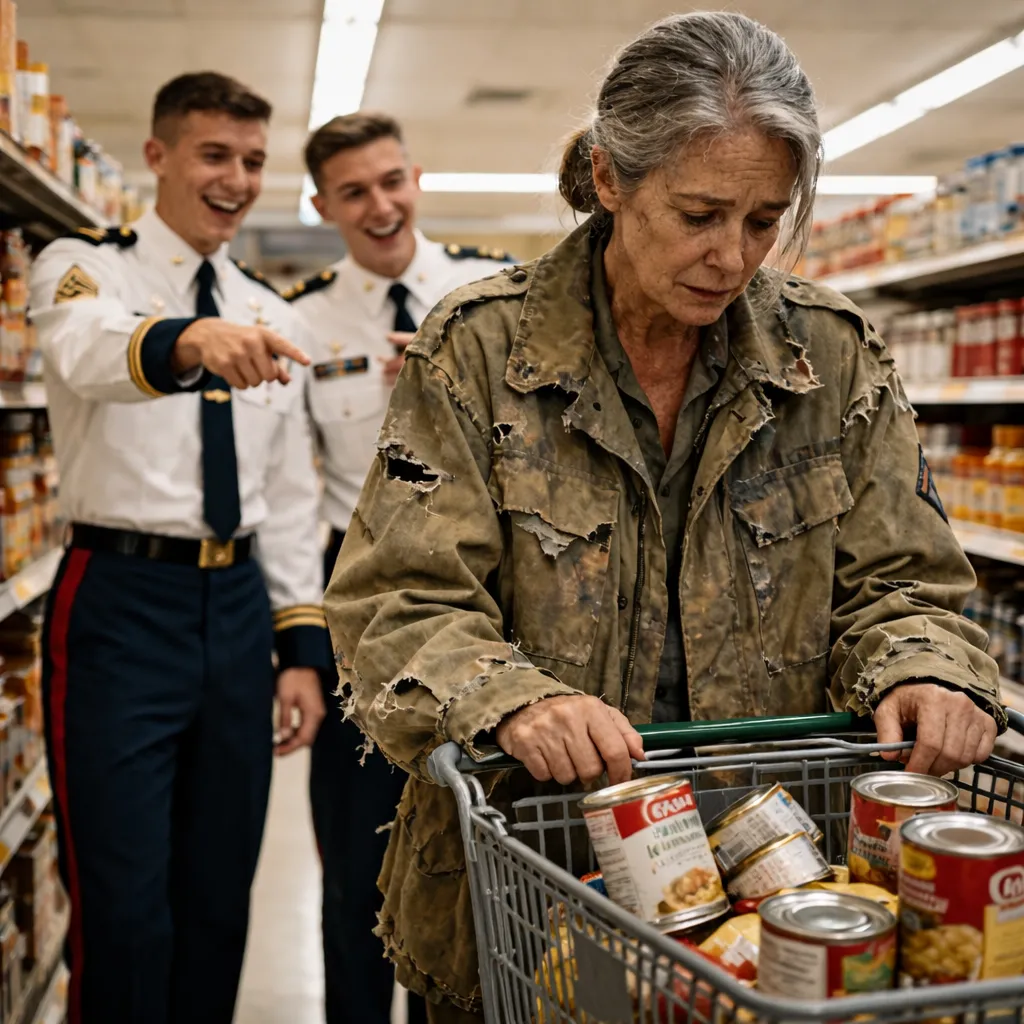
My breath caught, because my body remembered that gesture like a language it had been forbidden to speak.
And without thinking, without hesitating, I returned it, my hand rising with shaky precision, as if my bones recognized the truth before my mind could.
People around us stared, some with mouths open, some with tears, because a salute in public is a kind of confession.
General Harris lowered his hand and looked at me like he was seeing the cost finally written in ink.
“Come with me,” he said.
“Right now.”
The lieutenants stepped back quickly, suddenly eager to become invisible.
I hesitated, because years of being dismissed trains you to expect the world to yank hope away.
General Harris seemed to read that hesitation, and his voice softened.
“I owe you,” he said simply, “and the Army owes you more than silence.”
He escorted me out of the commissary as if I mattered, and that alone felt surreal, like walking in someone else’s dream.
Outside, the wind was sharp, and my knee complained with each step, but the General matched my pace without impatience.
We moved through the base like a current cutting through crowds, and people turned to watch, because rank draws attention and mystery draws more.
Inside a nearby administrative building, he led me into an office and shut the door, sealing the noise outside.
He pulled out a secure phone and dialed a number from memory, the kind of number you don’t call unless you’re ready to break things open.
When someone answered, he didn’t waste time with pleasantries.
“This is General Harris,” he said, voice clipped and lethal, “and I am looking at a woman who should not be surviving on coins and denial letters.”
He listened, eyes fixed on me, jaw clenched.
“No,” he said sharply, “I don’t care what the records say, because I am the record for what happened that night.”
He paused, then added, “Yes, I’m aware the operation is sealed, and that is exactly why we’re fixing it.”
I sat in the chair across from him, hands folded tightly in my lap, afraid that if I relaxed I would fall apart.
General Harris kept speaking, each sentence like a key turning in a lock that had been rusted shut for years.
“Miranda Reeves served under Nightglass,” he said, “and Major Callahan’s jacket is still on her back, which means your paperwork failed long before she did.”
His voice dropped, colder now.
“If I have to drag every denial letter into the sunlight, I will,” he said, “and I will do it with names attached.”
He ended the call and looked at me like a man trying to choose the right words for something overdue.
“Tell me what they did to you,” he said quietly.
So I did.
Not everything, because some parts still live behind my teeth like glass, but enough.
I told him about the sealed file, the missing medical codes, the VA letters that said “insufficient evidence,” as if my limp was imagination.
I told him about nights when pain was so loud it felt like a radio stuck on static, and mornings when I couldn’t afford both food and prescriptions.
I told him about how it feels to be thanked in speeches while being erased in practice.
General Harris listened without interrupting, and that was its own kind of mercy.
When I finished, he exhaled slowly, eyes hard with resolve.
“This ends,” he said, and the simplicity of it made my throat burn.
He stood, opened a safe behind a framed photo on the wall, and pulled out a small case.
Inside was a patch, crisp and new, the Nightglass emblem stitched with the kind of care reserved for things that are treated as sacred.
He placed it on the desk between us like an offering.
“They tried to bury your unit,” he said, “but they can’t bury what saved me.”
My hands shook as I reached out, fingertips hovering over the patch without touching it, like I was afraid it might vanish.
“Major Callahan,” I whispered, and the General nodded.
“He was the best officer I ever met,” the General said, voice thick, “and he trusted you with my life.”
That sentence snapped something inside me, and for a moment I pressed my palm to my eyes, fighting tears I hadn’t allowed myself in years.
General Harris leaned forward, voice steady.
“Miranda,” he said, using my first name like it deserved respect, “you are going to be recognized.”
“Publicly,” he added, “so no one can ever call you a liar again.”
My stomach flipped, because publicity is a weapon too, and I’d spent years avoiding it.
“They’ll come for you,” I warned, because fear is a habit when you’ve lived under secrecy.
The General’s eyes narrowed.
“Let them,” he said, “and they’ll come for me too.”
Two days later, the base auditorium filled like a storm cloud gathering, because rumors travel faster than official notices.
They said a four-star General was giving an unscheduled address.
They said it was about “integrity.”
They said it was about “a mistake.”
I stood backstage in my worn jacket, heart pounding, feeling like a teenager again, terrified of being seen.
A young sergeant offered me water with trembling hands, looking at me like I was both fragile and legendary.
“You’re her,” the sergeant whispered, and I didn’t know whether to laugh or cry at the idea that “her” could be me.
General Harris walked onto the stage, and the room snapped to attention like a single body.
He didn’t start with jokes.
He didn’t start with slogans.
He started with truth.
“Years ago,” he said, voice carrying, “I was pulled from wreckage by a team the public was never allowed to thank.”
A murmur spread, and I could feel the audience leaning forward, hungry for a story.
General Harris lifted a hand.
“This woman,” he said, “was told her service didn’t exist, and she was treated like a liar in a grocery store.”
Gasps.
I stepped out from backstage, and the lights hit me like a wave, making my knees feel weak.
I walked slowly, my leg dragging slightly, and the room watched like they were witnessing a page torn from history being restored.
General Harris turned toward me and spoke into the microphone with fierce clarity.
“Miranda Reeves,” he said, “you served with honor, you saved lives, and you carried silence so others could carry pride.”
He opened the patch case, lifted the Nightglass emblem, and held it up for the room to see.
The symbol gleamed under stage lights like a secret refusing to stay secret.
Then he pinned it onto my jacket above my heart, right where the faded outline had been.
A perfect match, like time folding back into place.
The audience rose, not slowly, but all at once, a standing ovation that felt like thunder.
I stood frozen, hands trembling, because I didn’t know how to receive something I’d been denied for so long.
General Harris leaned close and spoke so only I could hear.
“Welcome back,” he said, and the words hit harder than any medal ever could.
In the front row, I saw the two lieutenants from the commissary, faces pale, eyes fixed on the patch like it was a warning carved from steel.
They stood too, clapping, but their applause looked like penance.
After the ceremony, they approached me hesitantly, their bravado stripped away.
The taller one swallowed hard.
“Ma’am,” he said, voice shaking, “I was wrong.”
I looked at him, and for the first time I felt the strange freedom of not needing revenge.
“Learn from it,” I said quietly, “because the next ghost you mock might be the reason you’re alive.”
His eyes widened, and he nodded quickly, like the lesson finally landed.
Outside the auditorium, cameras appeared, phones raised, clips uploaded, captions typed with shaking excitement.
People posted about the General saluting an older woman in a worn jacket, and the internet did what it always does.
It turned truth into wildfire.
But this time, the wildfire didn’t burn me.
It warmed me.
Because in thousands of comments, strangers wrote the words my paperwork never did.
“Thank you.”
“We see you.”
“You were never invisible.”
And that night, for the first time in years, I hung Major Callahan’s jacket on a chair instead of sleeping in it.
I traced the new patch with my fingertips and let the silence feel peaceful instead of punishing.
The system didn’t fix itself overnight, but it moved, finally, because a General had seen a faded outline and refused to look away.
And in the end, the most satisfying part wasn’t the applause or the cameras.
It was the fact that I could walk into a commissary again, wearing that jacket, and know the truth no longer had to whisper.