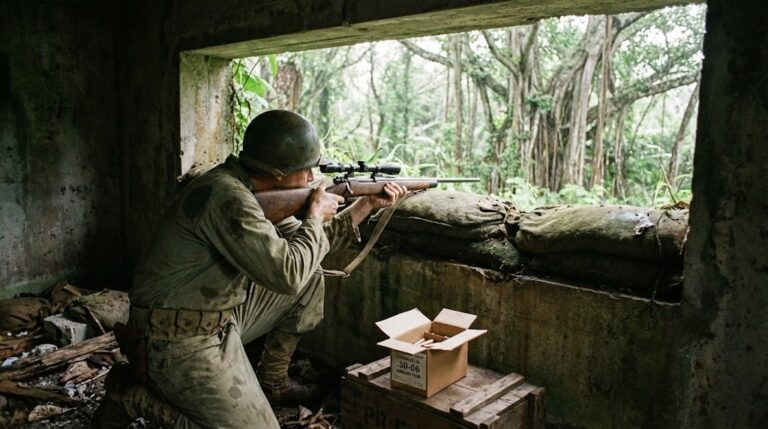
CHAPTER 1: THE TOY FROM ILLINOIS
“It’s a bolt-action sporting rifle, Captain. It doesn’t belong in a jungle, and it damn sure doesn’t belong in my regiment.”
Captain Morris didn’t look up from the map table, his thumb tracing the jagged line of the Matanakau River. The air in the command tent was a humid soup of sweat and stale tobacco. Outside, the tropical rain drummed against the canvas with the rhythm of a slow execution.
Second Lieutenant John George kept his hand on the wooden crate. The label FRAGILE was half-peeled, blistered by the salt air of the Pacific voyage. “The Garand is a fine weapon for a line-man, sir. But it won’t hit a helmet at three hundred yards through a banyan canopy. This will.”
“It’s a toy, George. A mail-order sweetheart for shooting deer in the backwoods,” Morris spat, finally meeting George’s eyes. “The Japanese are killing my men at the watering holes. They’re killing them in their sleep. I don’t need a marksman; I need volume of fire.”
“Volume is just a way to miss faster, sir.”
The silence that followed was heavy, textured by the distant, rhythmic thud of Japanese mortars. George didn’t wait for a dismissal. He took the crate back to his tent.
The Winchester Model 70 felt wrong in the heat. The walnut stock was dry, craving the cool air of an Illinois autumn, not this rot. He spent the night with a rag and a tin of cosmoline, working the action until the bolt slid with a sound like oiled silk. He checked the Lyman Alaskan scope, twisting the dials—two clicks right for the ghost of a breeze he felt through the tent flap.
At 05:00, the rain stopped, leaving the jungle in a state of dripping, predatory suspense.
George moved toward the ruins of the Japanese bunker west of Point Cruz. He didn’t carry a radio. He didn’t want a spotter’s heavy breathing in his ear. He carried the Winchester, a canteen, and sixty rounds of .30-06 hunting ammunition—not the military ball stuff, but the rounds he’d hand-packed in Tennessee.
He crawled into the jagged concrete mouth of the bunker. The smell of old charcoal and rot filled his lungs. He didn’t look at the horizon; he looked through the glass.
The world narrowed to a two-and-a-half-power circle. It was a desaturated world of gray bark and deep, obsidian shadows. He glassed the banyans, 240 yards out. These trees were monsters—ninety feet tall, their roots like the twisted limbs of a drowned giant.
9:15 AM. A bird shrieked and took flight.
George froze. His finger found the trigger—a 3.5-pound pull he’d adjusted himself until it broke like a glass rod.
9:17 AM. A branch shifted eighty feet up in a banyan. There was no wind.
Through the scope, the textures shifted. The rough bark resolved into the weave of a dark uniform. A man. A Japanese sniper, positioned in the fork of three branches, his Arisaka aimed toward the American supply trail. George could see the man’s thumb move as he adjusted his own bolt.
George didn’t think about the fourteen men dead in the last three days. He thought about the drop, the humidity, and the three-inch group he’d shot at Camp Perry.
He squeezed.
The Winchester kicked into his shoulder, a sharp, authoritative snap that tore through the jungle’s humidity. Through the scope, the dark shape jerked. The sniper didn’t scream. He simply let go. He tumbled through the canopy, hitting branches with a sickening, hollow thud-thud-thud before disappearing into the ferns at the base of the tree.
George didn’t celebrate. He worked the bolt, the brass casing hitting the concrete floor with a metallic chime. He chambered the next round, his eyes never leaving the scope.
The jungle went silent, but it wasn’t empty. Japanese snipers worked in pairs.
He waited for the partner to move. He waited for the rustle of a leaf or the glint of a lens. Instead, he felt a cold prickle on the back of his neck. A different sound—a soft, rhythmic thump from the south. Not a rifle.
A mortar tube being dropped into its baseplate. They hadn’t just watched their friend die; they had been waiting for the flash.
CHAPTER 2: THE FIRST CLICK
The thump was distant, but the physics were immediate.
George didn’t wait for the whistle. He knew the math of a mortar trajectory from the ruins of a bunker—it was a static target, a pre-registered coordinate. He rolled hard to his left, the Winchester pulled tight against his chest to keep the Lyman Alaskan from slamming into the jagged concrete.
The first shell hit the outer lip of the bunker’s aperture.
The world turned into a roar of gray dust and pulverized coral. Heat lashed George’s neck, and the taste of cordite and ancient limestone filled his throat, thick enough to gag on. He didn’t stay to check the damage. He scrambled out the rear egress, staying low, his boots sliding in the slick, iron-rich mud of the grove.
He reached the roots of a massive banyan fifty yards back just as the second and third rounds collapsed the bunker’s roof. The sound was a dull, heavy crunch—the sound of a tomb closing. George pressed his cheek against the rough, flaking bark of the banyan. His lungs burned, but he forced his breathing into a rhythmic, shallow cadence.
Calculate. Don’t react. Calculate.
The mortar had come from the southwest. It wasn’t a random barrage; it was a response. By killing the first sniper, George had tripped a wire he hadn’t seen. The partner hadn’t fired back with a rifle because the partner was a spotter for the heavy stuff.
He wiped a smear of grit from the objective lens with a silk cloth. The glass was clear. The world was still desaturated, a monochrome of greens and browns, but now it felt smaller. The Japanese weren’t just waiting in the trees anymore; they were triangulating.
George shifted his weight. The mud under his boots had the consistency of wet grease. He glassed the tree line again, moving the scope in a slow, mechanical sweep. Left to right. Top to bottom. Ignore the swaying vines; look for the straight lines of a rifle barrel or the unnatural curve of a helmet.
At 9:43, he found the friction in the scenery.
It wasn’t a man. It was a glint—a momentary fracture in the shadows of a banyan sixty yards north of his first kill. The light wasn’t hitting a lens; it was hitting a brass button or a buckle. The shape was lower this time, maybe fifty feet up, hunkered against the trunk.
The second sniper was moving. He was retreating, sliding down the trunk with the practiced, fluid motion of a man who knew his position was a dead end. He’d heard the Winchester’s report and the subsequent mortar strike. He assumed the American was either buried under concrete or running for his life.
George braced the Winchester against a thick, ropey vine. The crosshairs settled on the retreating shape. He didn’t lead by much—the distance was short, the bullet’s velocity high.
“One for the sweetheart,” he whispered, a ghost of a reminder of the armorer’s taunt.
He squeezed.
The rifle barked, the recoil a sharp, familiar punch against the bruise already forming on his shoulder. Through the 2.5x magnification, the Japanese soldier snapped backward. It was a clean hit, center mass. The man didn’t fall immediately; he snagged on a cluster of vines, his body jerking like a marionette with cut strings before gravity claimed the rest. His Arisaka clattered through the branches, hitting the forest floor seconds before he did.
George worked the bolt. The spent casing flicked into the mud, steaming in the humid air. Two shots. Two kills.
He didn’t move. He stayed in the shadow of the roots, his eyes scanning the periphery. The silence that followed was different now. It wasn’t the silence of an empty forest; it was the silence of a predator holding its breath.
A bird landed on a branch ten feet above him, its claws scratching the bark. George didn’t look up. He watched the southwest. The mortar team was still there. They were waiting for a third shot to pin him down again.
He reached into his pocket and pulled out a stripper clip, the brass rounds dull and stained with thumb-grease. He topped off the internal magazine, the springs clicking with a metallic finality.
Something caught his eye on the ground near the base of his tree. A scrap of fabric, half-buried in the muck. It wasn’t Japanese olive-drab. It was American herringbone twill, stained a dark, oxidized crimson.
He leaned forward, just an inch, to see it better. It was a sleeve. And inside the sleeve, there was still a wrist, wearing a watch with a cracked crystal. The hands had stopped at 11:21.
George looked at his own watch. It was 11:18.
The air suddenly felt colder, despite the heat. He went back to the scope, his heart rate spiking for the first time. He glassed the southwest cluster, the five banyans that looked like a wall of wood.
At 11:21, a bullet struck the bark six inches from George’s temple.
CHAPTER 3: THE MORTAR TRAP
The bark of the banyan tree disintegrated into a spray of coarse pulp and dry splinters.
George didn’t hear the shot; he felt the vacuum of the passing lead and the sharp sting of debris peppering his cheek. He rolled left, his body instinctively seeking the deep, rotting hollow between two massive aerial roots. Dirt sprayed into his face as a second round chewed into the mud where his hip had been a heartbeat before.
Southwest. Three hundred yards. Low angle.
He pressed his spine against the wood, the grit of the banyan’s hide snagging his salt-crusted uniform. His heart hammered a frantic rhythm against his ribs, but his hands remained mechanical. He checked the Winchester’s bolt—locked. He checked the scope—clear.
He didn’t look at the dead man’s watch again. He didn’t need to. The “11:21” wasn’t a coincidence; it was a psychological marker. The Japanese were hunting him with a clock. They weren’t just shooting; they were following a protocol of timed attrition.
“You’re late,” George whispered, his voice a dry rasp.
He risked a glance around the root. The jungle was a wall of rusted greens and sickly yellows. Nothing moved. The silence was absolute, save for the distant, rhythmic thud of the mortar tubes he’d heard earlier. He knew the pattern. The snipers pin the target; the mortars erase the grid square.
He had roughly ninety seconds before the first high-explosive shells corrected their range.
George didn’t run. Running was for prey. He crawled, dragging the nine-pound Winchester through the sucking muck, moving deeper into the shadows of the grove. He needed an angle. He needed to find the friction in the southwest cluster.
At 11:24, the first mortar round screamed.
It detonated forty yards short, a fountain of black earth and shredded ferns geysering into the canopy. The shockwave rattled George’s teeth. He ignored it, propping the Winchester over a fallen, moss-slicked log. He dialed the Weaver scope, focusing on the five banyans.
There.
Seventy-three feet up, in the third tree from the left. A branch didn’t sway; it vibrated. It was the subtle, high-frequency tremor of a man tensing his muscles for a reload.
George aligned the crosshairs. The Lyman’s 2.5x magnification brought the dark shape into focus—a sniper, perched in a shroud of vines, his silhouette a fractured stain against the sky. The man was confident. He believed the mortars had George pinned.
George breathed in, a deep, steady lungful of humid rot. He let half of it out.
The Winchester’s trigger broke.
The recoil was a sharp, familiar jolt. Through the glass, the dark shape in the tree didn’t just fall; it vanished. There was no tumble, no struggle. Just the sudden absence of a threat.
But George didn’t stay to watch the result. He knew the mortar team would be watching for his muzzle flash. He grabbed the rifle and sprinted north, his boots pounding the iron-rich earth.
He dove into a shell crater, the stagnant rainwater soaking into his trousers, just as the next salvo hit.
The bunker he had occupied moments ago, and the banyan roots where he’d hidden, disappeared in a synchronized eruption of fire and splintered coral. The sound was a physical weight, pressing him into the mud.
George lay in the water, the Winchester held high above the surface. He was shivering, not from cold, but from the adrenaline dump. He reached into his pocket and pulled out a fresh stripper clip, his fingers fumbling slightly against the rusted brass.
He looked back toward the supply trail. The dead American’s arm was gone now, buried under the debris of the mortar strike. But the mystery remained. How had they known the time?
He checked the clip. The fourth round was different. The lead tip was filed into a crude cross—a “dum-dum” round, improvised and lethal. It wasn’t his work.
George realized then that he wasn’t the first man to use this Winchester in these woods.
CHAPTER 4: THE DECOY DUEL
The water in the crater was the color of rusted iron and tasted of sulfur.
George kept his chin just above the surface, the weight of the Winchester resting on a shelf of packed mud. He didn’t look at the sky, which was a bruised, humid gray. He looked at the palms. Specifically, a single palm tree 190 yards out, squat and deceptively inviting.
There was a man in those fronds. A shape, low and heavy, barely forty feet up. It was an amateur’s position—low elevation, limited sightlines. An easy kill for a state champion.
George didn’t take the shot.
His thumb traced the serrated edge of the “crossed” round he had found in his magazine. It was a jagged, ugly piece of work. He thought about the warehouse in Illinois, the “fragile” crate, and the six weeks his rifle had spent in transit through the military mail. He thought about the supply sergeant who had handed it to him with a smirk.
They weren’t just forwarding my mail, George realized. The realization was a cold stone in his gut. Someone used this sweetheart before it reached me. Someone who knew how to file lead and wait for a clock to strike 11:21.
He ignored the ghost in his rifle and shifted his focus. If the man in the palm was the bait, where was the hook?
He glassed the perimeter, ignoring the obvious. He searched for the friction. He found it 80 yards northwest of the palm. A banyan tree, 91 feet tall, draped in a curtain of strangler vines so thick they looked like a solid wall.
Through the 2.5x magnification, George saw the eye.
Not a human eye, but the objective lens of an Arisaka Type 98. It was perfectly positioned to cover anyone who took a shot at the decoy in the palm. It was a mirror image of his own logic. A professional’s hide.
The man in the banyan wasn’t looking at George. He was looking at the fallen tree 120 yards north—George’s previous position. The Japanese were following the “Rusted Truth” of the jungle: a soldier always returns to the familiar.
“Equal intellect,” George muttered, the grit in his mouth grinding between his teeth.
The clock in his head was ticking. If he didn’t fire, the sniper in the banyan would eventually sweep his glass toward the crater. If he fired at the banyan, the recoil and muzzle flash would give him away to the mortar teams or a third shooter.
He decided to break the protocol.
He aimed at the decoy in the palm. He didn’t breathe. He didn’t think about the blood on the watch or the crosses on the lead. He squeezed.
The Winchester barked. The decoy in the palm jerked, a dark weight plummeting forty feet into the undergrowth.
George didn’t wait for the body to hit the ground. In the same micro-second that the bolt cycled—clack-shirr—he swung the barrel eighty yards northwest.
The sniper in the banyan tree reacted exactly as trained. He turned his head toward the sound of the Winchester. That turn created a momentary flash of skin against the dark vines.
George fired his second round before the first casing had even settled in the water.
The dark shape in the banyan didn’t fall. It slumped, caught in the web of vines, the Arisaka slipping from nerveless fingers and spinning down through the branches like a falling leaf.
Two men. Two shots.
But the victory felt hollow. George looked down at the Winchester’s action. Under the grime and the oil, near the safety catch, he saw a small, deliberate scratch he hadn’t noticed before. A set of initials: J.G.
His own initials. But the scratch was old, oxidized, and worn down by someone else’s palm.
He wasn’t reclaiming his rifle. He was stepping into a cycle that had been spinning long before he arrived on Guadalcanal. The “mail-order sweetheart” wasn’t a gift; it was a hand-off.
The sound of Japanese voices rose from the tree line—not the sharp commands of officers, but the urgent, guttural calls of a recovery team. And they weren’t moving toward the snipers.
They were moving toward his crater. They weren’t hunting a marksman anymore. They were closing a circuit.
CHAPTER 5: THE WATER-FILLED CRATER
The first boot hit the mud at the crater’s rim with a wet, heavy slap.
George didn’t rise. He sank. He let the sulfurous water swallow his chest, his shoulders, and finally his chin, until only his eyes and the bridge of his nose remained above the surface. He held the Winchester vertically, the barrel a blackened finger pointing toward the weeping sky, keeping the action and the glass from the muck.
Through the surface tension of the water, the world was a blurred, trembling mess of grays. A Japanese soldier stood above him, silhouetted against the light. The man wasn’t looking for a marksman; he was looking for a ghost. He stared directly at the spot where George’s head should have been, his Arisaka leveled, his breath visible in the humid air.
Their eyes met through the water’s skin.
George didn’t wait for the shout. He surged upward, the water cascading off his shoulders like a breaking wave. He didn’t shoulder the rifle—there was no time for the scope. He fired from the hip, the .30-06 round punching a hole through the soldier’s chest at a distance of four feet.
The impact threw the man backward. George worked the bolt while still half-submerged, the brass casing hissing as it hit the water.
“Contact!” a voice screamed from the tree line.
Two more soldiers appeared at the rim, their faces twisted in a mixture of shock and predatory focus. George fired again, the recoil jarring his submerged hips. One soldier folded; the other dived for cover, his return fire raking the water and sending geysers of mud into George’s eyes.
George scrambled out of the north side of the crater, his uniform a heavy, sodden weight. He ran, not toward the trail, but toward a fallen, rusted log twenty yards away. Bullets snapped past his ears, one shearing a button from his tunic.
He dropped behind the log, his lungs burning with the taste of stagnant water and cordite. He glassed the crater. Three men were advancing, leap-frogging through the tall ferns. They were infantry, moving with a disciplined, aggressive sweep.
He aimed at the lead man, the Lyman’s crosshairs settling on the bridge of the soldier’s nose. Squeeze. The man dropped. George worked the bolt—clack-shirr—and felt the internal magazine bottom out. Two rounds left.
The voices were flanking him now. South and East. A pincer. They weren’t just recovery teams; they were the “Equal Intellect” response to his four-day spree. They had stopped playing the sniper’s game and started playing the soldier’s game.
He checked his pocket. No clips. The leather pouch on his belt was empty, the spare rounds lost in the crater’s mud.
“Two rounds,” George whispered, his fingers touching the rusted metal of the receiver. “Make ’em work, sweetheart.”
He saw a flash of movement to his left. A soldier was crawling through the roots of a banyan, less than thirty yards away, reaching for a grenade. George didn’t use the scope. He used the “Rusted Truth” of his own instinct. He fired. The soldier slumped over the roots, the grenade rolling harmlessly into a puddle.
One round left.
The jungle suddenly went quiet. No shouting. No shooting. Just the drip of water from the leaves and the distant, mocking rumble of artillery. They were waiting for him to move. They knew he was dry.
George looked at the Winchester. The initials J.G. seemed to catch the dim light. He thought about the man who had died at 11:21. He thought about the man who had filed the crosses into the lead.
He wasn’t the hunter anymore. He was the legacy.
He didn’t run north. He stood up, the last round chambered, and walked back toward the water-filled crater. If he was going to die on this island, he wasn’t going to do it running. He was going to do it over the bodies of the men who thought they could out-calculate him.
He reached the rim. The water was still settling. And there, sitting on the opposite side of the crater, was the eleventh sniper. No rifle. Just a watch in his hand, identical to the one on the dead man’s wrist.
The man looked up at George and smiled.
CHAPTER 6: THE LEGACY OF THE BOLT
The eleventh man didn’t reach for a weapon. He didn’t even stand.
He sat on the lip of the crater, his uniform a mess of shredded hemp and mud, his fingers tracing the cracked glass of the watch. It was 10:40 AM. George stood thirty feet away, the Winchester at his shoulder, the front sight post steady on the man’s throat.
“The watch,” George said, his voice a dry rasp that barely carried over the drip of the leaves. “Where did you get it?”
The Japanese soldier didn’t look up. He spoke in a low, rhythmic English, his accent thick with the ghost of a missionary school. “It belonged to the man who gave you this rifle. A man who sat in this mud long before you were sent to finish his map.”
George’s finger tightened on the trigger. The “Rusted Truth” was finally visible. The initials J.G. weren’t his. They belonged to the man from the 132nd who had carried this “toy” into the jungle weeks ago, the one the supply sergeant had whispered about. A ghost who had been hunting these groves alone until the jungle claimed him.
“He was a good shot,” the soldier said, finally looking up. His eyes were bloodshot, weary with the same exhaustion George felt in his marrow. “But he forgot that the jungle does not care about championships. It only cares about maintenance.”
He tossed the watch into the water. It sank with a small, final plip.
“You have one round left, Lieutenant. I have six men behind me. The math is simple.”
George felt the weight of the rifle—the nine pounds of wood and steel that had defined his world for four days. He looked at the soldier, then at the tree line where the infantry patrol was closing in. He realized then that the “toy” wasn’t a weapon anymore. It was a burden. He had cleared the groves, but the groves were already regrowing.
He didn’t fire.
George stepped back, keeping the muzzle level as he retreated toward the thickest part of the banyan roots. He didn’t run. He moved with the mechanical precision of a man who had already solved the problem. He knew the patrol would find their comrade, and they would find the watch, and they would find the empty casings.
By the time the first Japanese rifleman reached the crater, George was gone.
He reached the American perimeter at 11:13. His uniform was a rag; his shoulder was a map of bruises. He walked past the sentries without a word, heading straight for the command tent. Captain Morris was there, hunched over his maps.
George placed the Winchester on the table. It was covered in mud, the Lyman Alaskan scope scratched and fogged.
“Eleven,” George said. “The groves are clear.”
Morris looked at the rifle, then at George. The mockery was gone. “The men say you did it with a mail-order sweetheart.”
“I did it with a tool that works, sir. But the tool is tired. And so am I.”
George spent the next two hours field-stripping the rifle. He cleaned the cosmoline from the action, ran patches through the barrel until they came out white, and oiled the bolt until it clicked with the sound of a closing vault. He didn’t think about Burma yet. He didn’t think about the Marauders or the mountains or the next war.
He thought about the “J.G.” on the receiver.
He realized that the rifle didn’t belong to him, or the man before him. It belonged to the task. It was a rusted truth: in the jungle, you are only as good as the friction you can endure.
He loaded five fresh rounds into the magazine, clicked the safety to on, and laid the rifle in its case. The war was moving west. The groves were silent. John George closed the lid, the latch snapping shut with a final, metallic resonance.
CHAPTER 7: THE GHOST OF BURMA
The air in Central India didn’t rot; it parched.
John George sat on a crate of ammunition in the staging area outside Deogarh, watching the dust of five hundred marching men settle onto the action of his Winchester. The tropical humidity of the Solomons had been replaced by a fine, abrasive grit that seemed to find its way into every screw-head and spring.
He wasn’t a celebrity here. To the three thousand men of the 5307th Composite Unit—the men the papers were already starting to call Merrill’s Marauders—George was just another replacement officer with a strange case and a quiet disposition.
“That the one?”
A man leaned against the tent pole. He was thin, his face a map of sun-blasted skin and deep-set eyes that had already seen too much of the world. Corporal Hayes, a veteran of the Chindit raids, nodded toward the leather case.
“It’s a rifle, Corporal,” George replied, not looking up. He was running an oily rag over the bolt, the scent of Hoppe’s No. 9 a sharp, clean contrast to the smell of mules and dry dung.
“Men say it’s the one that cleared the groves. Say it’s got a ghost in the trigger.” Hayes stepped closer, his eyes tracing the line of the Weaver 330 scope George had just mounted. The heavier Lyman had been sacrificed to the “Rusted Truth” of long-range penetration: every ounce saved was a foot gained on the march.
George stopped his hand. “There are no ghosts. Just ballistics and maintenance. The jungle is the same everywhere—it wants to break your gear. India just does it with dust instead of mold.”
“The Japanese in Burma aren’t the ones you fought at Point Cruz, Lieutenant. These are the 18th Division. The ‘Chrysanthemum.’ They’ve been fighting since China. They don’t sit in trees and wait to be shot. They move like water.”
George finally looked up. He saw the friction in Hayes’s expression. It wasn’t skepticism; it was a warning. The Marauders were being built for a mission that didn’t exist in the Army’s field manuals. Seven hundred miles through the Hukawng Valley. No supply lines. No retreat. Just a bolt-action rifle and the weight of what you could carry.
“I’m not looking for a trophy, Hayes. I’m looking for a tool that can reach out and touch an officer at four hundred yards before he knows he’s in a fight.”
“Then you’d best get to work on the stock,” Hayes said, gesturing to the walnut. “That wood will swell the second we hit the monsoon. It’ll put pressure on the barrel. Your zero will shift three inches by noon.”
George looked at the beautiful, dark wood of the Winchester. He thought about the initials J.G. scratched into the metal beneath it. He took a deep breath, the dry air stinging his lungs, and reached for his pocket knife.
He began to shave the wood away from the barrel channel, the curls of walnut falling into the Indian dust. It was a desecration of a state-champion rifle, a surgical stripping of its civilian soul to make it a sovereign protector of the men who were about to march into the green hell of the North.
The “Rusted Truth” had followed him across the ocean: a rifle was only as good as its ability to survive the man carrying it.
“We move at dawn,” Hayes muttered, turning away.
George didn’t answer. He just kept carving, the steel of his knife clicking against the wood—shirr, shirr, shirr—as he prepared the Winchester for a war that wouldn’t care about the beauty of its grain.
CHAPTER 8: THE HUKAWNG VALLEY
The Hukawng Valley was a green lung that refused to breathe.
The heat was no longer a sensation; it was a physical weight, a rusted iron blanket that pressed against the lungs until every gasp felt like swallowing hot silt. John George moved with the rhythmic, mechanical gait of the exhausted. His boots, once sturdy leather, were now salt-crusted husks held together by grime and stubbornness.
The Winchester was no longer a “sweetheart.” It was a cross.
The synthetic stock he’d swapped in India felt slick with a mixture of condensation and the palm-grease of a hundred miles. Every mile of the 217 they had covered felt etched into the metal of the receiver. George didn’t look at the beauty of the jungle; he looked for the friction in the greenery.
“River crossing ahead,” Hayes whispered. The Corporal didn’t turn around; he just signaled with a flat hand. The Marauders behind them melted into the ferns with the practiced silence of men who had learned that noise was a death sentence.
George dropped to one knee, the joint popping with a dry, metallic sound. He didn’t feel the pain. He only felt the shift in the air. The Tanai River lay two hundred yards ahead, a brown, turgid snake cutting through the emerald hell. On the far bank, a Japanese patrol was moving with the casual arrogance of those who believed the mountains behind them were impassable.
READ MORE The Raven’s Penance: A Symphony of Lead and Mercy in the Dust of the Kunar
He propped the Winchester over a fallen, moss-choked log. The wood was so soft with rot that his rifle sank an inch into the pulp. George didn’t mind. It was a natural sandbag.
He dialed the Weaver 330. Through the glass, the world resolved into a circle of sharp, vibrating detail. He saw the Japanese officer—a man in a sweat-stained tunic, waving a map toward the eastern ridgeline. 412 yards.
The wind was a negligible phantom, moving left to right through the bamboo. George accounted for the drop. He thought about the walnut shavings in the Indian dust. He thought about the “J.G.” on the receiver. He wasn’t a state champion today. He was a sovereign protector of the exhausted men at his back.
Calculate. Squeeze.
The Winchester barked, a sharp, singular crack that the heavy Burmese air seemed to swallow instantly.
Through the scope, the officer didn’t jerk or scream. He simply folded, his map fluttering into the brown water of the Tanai like a broken wing. The Japanese patrol scrambled, their Arisakas barking at shadows, but George was already moving.
He didn’t cycle the bolt until he was ten yards back from the log. He didn’t want the glint of the ejecting brass to betray his hide. Clack-shirr. The hot casing fell into the mud, its gold finish already tarnished by the acidic soil.
“One shot, Lieutenant,” Hayes muttered as they slithered through the undergrowth. “They’re starting to call you the ‘Ghost of the Winchester.’ The Japanese think we’ve got a whole company of snipers in these hills.”
“Let them think it,” George said, his voice a dry rasp. “Fear is just another form of maintenance. It keeps them from pushing too hard.”
But as he checked his magazine, he noticed the discrepancy. He had loaded five rounds before the crossing. He had fired once. There were three left.
George stopped in the shadow of a giant fern. He didn’t look at Hayes. He looked at the bolt. The “J.G.” mark was there, but beneath it, a new scratch had appeared—a small, jagged “M” that hadn’t been there at dawn.
He touched the metal. It wasn’t cold. It felt unnaturally warm, as if the rifle itself was holding onto the heat of a previous owner George had never met. The mystery of the warehouse wasn’t a closed circuit; it was an evolving protocol.
“Lieutenant?” Hayes prompted, his hand on his Garand.
“Nothing,” George said, snapping the bolt shut. “Just a bit of grit in the action.”
He knew it was a lie. The Winchester was changing. Or perhaps, the Winchester was finally revealing what it had always been: a vessel for a war that never truly ended, just changed its terrain.
CHAPTER 9: THE SIEGE OF MYITKYINA
The rain didn’t fall in Myitkyina; it drowned.
The airfield was a desolation of cratered runways and rusted hangars, hemmed in by a jungle that seemed to be actively reclaiming the tarmac. John George lay in a trench that was more of a shallow grave, the water rising to his chest. The grit of Burma had been replaced by a slick, gelatinous mud that coated everything—the sandbags, his skin, and the once-pristine action of the Winchester.
The siege had lasted weeks. The “Ghost of the Winchester” was no longer a myth of distance; he was a rat in a hole. The long-range precision that had defined his war was a memory. Here, in the ruins of the hangars, the Japanese were ten yards away, hidden by the relentless gray curtain of the monsoon.
“They’re coming again,” Hayes rasped. The Corporal was shivering, his skin a sallow yellow from the malaria that was eating the battalion from the inside out. He held his Garand like a crutch.
George didn’t use the Weaver scope. It was fogged internally, a casualty of the humidity that no amount of maintenance could outrun. He had stripped the glass off two days ago, relying now on the iron sights—the “Rusted Truth” of a soldier who knew that at fifteen feet, optics were just a liability.
A shadow moved in the mist. Not a man, but the suggestion of one.
George squeezed. The Winchester barked, the recoil driving his shoulder back into the wet earth. He worked the bolt, but the handle didn’t slide. It stuck. The mud had found the tolerances he’d shaved in India, turning the silk-smooth action into a grinding, stubborn mess of friction.
“Dammit,” he hissed, slamming the palm of his hand against the bolt handle.
A Japanese soldier lunged over the lip of the trench, bayonet leveled. Hayes fired his Garand—ping-ping-ping—the semi-automatic volume of fire doing what the bolt-action couldn’t. The soldier fell, but three more were behind him.
George finally hammered the bolt open, the spent casing flipping into the mud. He chambered the next round just as a grenade hissed into the water at his feet.
“Out!” Hayes screamed.
They scrambled over the rear of the trench as the explosion geysered a pillar of black muck into the air. George landed hard on his left side, his shoulder screaming. The Winchester clattered against a rusted oil drum.
He reached for it, his fingers slipping on the synthetic stock. His hand brushed the receiver, near the initials. The “M” he had seen in the valley was gone, replaced by a deep, fresh gouge that looked like a jagged “V.”
He didn’t have time to calculate the mystery. A Japanese officer was standing over him, Nambu pistol raised. The man’s eyes weren’t full of hate; they were full of the same hollow, exhausted pragmatism George saw in his own reflection.
George didn’t shoulder the rifle. He swung the heavy walnut buttstock in a desperate arc, the wood connecting with the officer’s jaw with a sickening, heavy thud. As the man fell, George felt the stock crack—a sharp, final splintering of the wood he had carved with such care in Deogarh.
The airfield was a chorus of screams and the staccato rhythm of M1 Garands. The Marauders were breaking the siege, but they were doing it with volume, not precision.
George slumped against the oil drum, the broken Winchester across his lap. He looked at the cracked stock, the fogged scope, and the mud-caked bolt. The “mail-order sweetheart” was a wreck. It had carried him through the Pacific, through the mountains, and into this hole, but the toll had been paid in full.
“Lieutenant,” Hayes said, crawling over to him. He looked at the rifle. “She’s done, John. You can’t fight a war with a trophy anymore.”
George didn’t answer. He looked at the “V” on the receiver. He knew now what the letters meant. They weren’t initials. They were marks of the campaigns—Guadalcanal, Marauders, Victory. The rifle wasn’t haunted. It was being written on.
And he was just the current pen.
CHAPTER 10: THE FINAL HAND-OFF
The field hospital near Henderson Field smelled of ether, unwashed skin, and the metallic tang of blood. It was a familiar scent to John George—the olfactory map of the Pacific war.
He sat on the edge of a canvas cot, his left shoulder wrapped in a thick, white cocoon of bandages. The bullet had been a clean “through-and-through,” a parting gift from a Japanese rifleman near the Tanam Boa River. It was a pragmatic wound for a pragmatic war.
Hayes stood at the foot of the cot, holding the Winchester. The rifle looked like it had been pulled from a shipwreck. The stock was cracked, the synthetic finish scarred by the jagged “V” he’d noticed at the airfield, and the metal was dull with the ghost of a hundred monsoons.
“The cormans say you’re headed back to the States, Lieutenant,” Hayes said. He didn’t offer a salute. The Marauders didn’t have much use for them anymore. “They wanted me to turn this in to the armory. Said it’s ‘non-standard equipment.’”
George looked at the rifle. He reached out with his good hand and ran his thumb over the receiver. The “J.G.” was still there, but it looked smaller now, overshadowed by the deep, rough “V.”
“They’re right, Hayes. It’s not standard. It never was.”
“What do you want me to do with it?”
George looked at the window, where the sun was setting over the Solomon Sea, turning the water into a sheet of hammered gold. “Pack it. In cosmoline. Use the heavy stuff. I want it preserved exactly as it is—mud, cracks, and all.”
The “Rusted Truth” was that the war wasn’t over because the shooting stopped. The war lived in the tools that survived it. The Winchester had been his sweetheart, his toy, and his burden. It had cleared the groves and survived the mountains. It was a witness.
“You’re not taking it with you?” Hayes asked, surprised.
“I’m taking the lessons, Corporal. The rifle… the rifle belongs to the story now. If I take it back to Illinois, it’ll just be a hunting rifle again. It deserves better than that. It deserves to stay a soldier.”
Three years later, back in the quiet, academic halls of Princeton, George would open a footlocker and find the rifle. The cosmoline would be thick and yellowed, like ancient honey. He would sit for hours, his fingers tracing the “V” and the “J.G.,” and he would realize that the rifle wasn’t haunted by men—it was haunted by the weight of the decisions they made through its scope.
He didn’t clean it. He didn’t fix the stock.
In 1947, as he finished the final page of Shots Fired in Anger, he looked at the Winchester one last time. It was a heavy piece of steel, a relic of a time when one man with nine pounds of walnut and a mail-order scope could hold back the dark.
He handed it to the museum curator in a quiet room in Virginia.
“Is this the one from Guadalcanal?” the curator asked, his eyes wide.
“No,” George said softly, his eyes reflecting the desaturated gray of the metal. “It’s the one that survived it.”
He walked out into the sunlight of a world that was moving on to semi-automatics, atomic bombs, and faster ways to miss. But behind him, in the glass case, the Winchester sat silent—a rusted, jagged truth that would never let the silence be absolute.